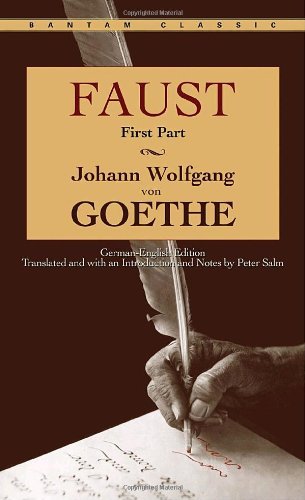
Goethe’s masterpiece and perhaps the greatest work in German literature, Faust has made the legendary German alchemist one of the central myths of the Western world. Here indeed is a monumental Faust, an audacious man boldly wagering with the devil, Mephistopheles, that no magic, sensuality, experience, or knowledge can lead him to a moment he would wish to last forever. Here, in Faust, Part I, the tremendous versatility of Goethe’s genius creates some of the most beautiful passages in literature. Here too we experience Goethe’s characteristic humor, the excitement and eroticism of the witches’ Walpurgis Night, and the moving emotion of Gretchen’s tragic fate.
This authoritative edition, which offers Peter Salm’s wonderfully readable translation as well as the original German on facing pages, brings us Faust in a vital, rhythmic American idiom that carefully preserves the grandeur, integrity, and poetic immediacy of Goethe’s words.
A master of poetry, drama, and the novel, German writer and scientist Johann Wolfgang von Goethe spent 50 years on his two-part dramatic poem Faust, published in 1808 and 1832, also conducted scientific research in various fields, notably botany, and held several governmental positions.
George Eliot called him "Germany's greatest man of letters... and the last true polymath to walk the earth." Works span the fields of literature, theology, and humanism. People laud this magnum opus as one of the peaks of world literature. Other well-known literary works include his numerous poems, the Bildungsroman Wilhelm Meister's Apprenticeship and the epistolary novel The Sorrows of Young Werther.
With this key figure of German literature, the movement of Weimar classicism in the late 18th and early 19th centuries coincided with Enlightenment, sentimentality (Empfindsamkeit), Sturm und Drang, and Romanticism. The author of the scientific text Theory of Colours, he influenced Darwin with his focus on plant morphology. He also long served as the privy councilor ("Geheimrat") of the duchy of Weimar.
Goethe took great interest in the literatures of England, France, Italy, classical Greece, Persia, and Arabia and originated the concept of Weltliteratur ("world literature"). Despite his major, virtually immeasurable influence on German philosophy especially on the generation of Georg Wilhelm Friedrich Hegel and Friedrich Wilhelm Joseph von Schelling, he expressly and decidedly refrained from practicing philosophy in the rarefied sense.
Influence spread across Europe, and for the next century, his works inspired much music, drama, poetry and philosophy. Many persons consider Goethe the most important writer in the German language and one of the most important thinkers in western culture as well. Early in his career, however, he wondered about painting, perhaps his true vocation; late in his life, he expressed the expectation that people ultimately would remember his work in optics.
Goethen klassikkonäytelmässä Faust myy sielunsa paholaiselle saadakseen rajattoman tiedon. Teemoiltaan teos käsittelee yhtäältä kriittisesti valistuksen ideologiaa ja toisaalta myös kirjallisuutta: kuinka ihmisen pyrkimys kuvata todellisuutta on aina tuomittu epäonnistumaan ja viemään vain turmioon. Pidin teoksen okkultistisesta kauhukuvastosta ja tiedon ja kielen rajojen pohdinnasta, mutta lyyrinen, vanhahtava dialogi on usein vaikeaselkoista ja välillä lukeminen tuntuu melkoiselta tarpomiselta.
Luin e-kirjana vanhan Forsmanin suomennoksen. Suomennos oli helppolukuinen ja mielestäni tarinaa oli yllättävänkin helppo seurata. Tarina jäi pahasti kesken, pitäisi lukea Faust 2 mitä en kuitenkaan aio tehdä.
Johan Wolfgang von Goethen runomuotoisessa klassikossa on legendaarinen hyvän ja pahan välinen taistelu keskeisenä teemana, kun taivaassa Paholainen ja Jumala lyövät vetoa tiedemies Faustin uskon väkevyydestä.
Siitä tarina lähteekin liikkeelle, ja vanha, arvostettu tiedemies ja lääkäri tuntee vetoa okkultismiin tiedon- ja elämänjanoansa tyydyttäessään. Hän manailee henkiä tutkimuskammiossaan ja haluaa nuorentaa raihnaista olemustaan, ja siihen löytyykin ratkaisu, ennen kuin hän tajuaakaan.
Apulaisensa Wagnerin seurassa Faust kävelylenkillä ottaa mukaansa mustan villakoiran, josta pelmahtaakin itse hornanhenki Mefistofeles vanhuksen kammiossa. He tekevät salaisen sopimuksen, jonka mukaan Mefistofeles lupaa täyttää Faustin kaikki toiveet tässä elämässä, kunhan vastaavasti tämä palvelisi Mefistofelesta ikuisesti kuolemansa jälkeen. Siitä lähtien piru alkoi täyttää Faustin kaikki toiveet kuin pullonhenki.
Kun kerran on kysymys paholaisesta ja sellaisen kanssa verellä allekirjoitusta sopimuksesta, kaikki ei mennytkään ihan suunnitelmien mukaan. Maisemat vaihtuvat, ja Mefistofeles tekee temppujaan ja siinä ohessa järjestää kaikenlaista pilaa tavallisten kuolevaisten keskuudessa.
Myös noidat ovat vahvasti edustettuina ikään kuin paholaisen palvelijoina, ja teoksessa myös Faust saa nuorukaisen ulkomuodon nautittuaan väkäleuan nuorentavaa eliksiiriä. Kirjan loppuhuipennuksessa saapuu Valpurin yö, jossa noitamaiset menot jatkuvat, ja tulenlieskat leimuavat, kun noita-akat oksentelevat eläviä hiiriä suustaan.
Sitä ennen kuitenkin Faust iskee silmänsä nuoreen impeen Margaretaan, jonka makuukamariin hän haluaa väkisin ängetä himoissaan. Avuksi tulee jälleen orjamainen Mefistofeles, joka puolestaan odottaa vesi kielellä, milloin heidän osansa vaihtuvat. Tarvitaan aarteita ja unitippoja, mutta kaikki ei tietenkään suju suunnitelmien mukaan, kun Mefistofeleella on ihan omat intressinsä…