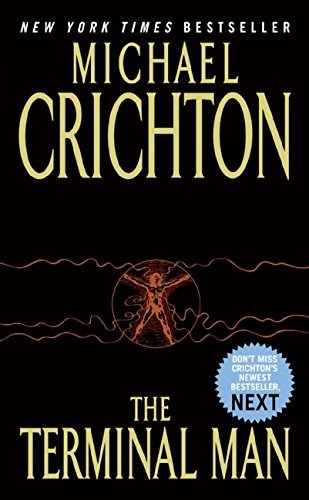
Harry Benson is prone to violent, uncontrollable seizures and is under police guard after attacking two people.
Dr. Roger McPherson, head of the prestigious Neuropsychiatric Research Unit at University Hospital in Los Angeles, is convinced he can cure Benson through a procedure called Stage Three. During this highly specialized experimental surgery, electrodes will be place in the patient's brain, sending monitored, soothing pulses to its pleasure canyons.
Though the operation is a success, there is an unforseen development. Benson learns how to control the pulses and is increasing their frequency. He escapes -- a homicidal maniac loose in the city -- and nothing will stop his murderous rampages or impede his deadly agenda. . .
John Michael Crichton was an American author, screenwriter, and filmmaker whose prolific career left an indelible mark on popular culture and speculative fiction. Raised on Long Island, he displayed a precocious talent for writing, publishing an article in The New York Times at sixteen. Initially enrolling at Harvard as an English major, he switched to biological anthropology after discovering a preference for scientific study over literature. He graduated summa cum laude and received a fellowship to lecture in anthropology at Cambridge. Later attending Harvard Medical School, he earned his MD but chose not to practice, dedicating himself to writing instead. His medical background profoundly influenced his novels, providing authentic scientific and technical underpinnings that became a hallmark of his work. Crichton began writing under pseudonyms, producing suspenseful thrillers as John Lange, including Odds On, Scratch One, and Easy Go, and as Jeffrey Hudson with A Case of Need, earning him an Edgar Award. His first major success under his own name, The Andromeda Strain, established his signature blend of scientific authenticity, tension, and exploration of technological hazards, leading to its film adaptation. Over his career, he wrote 25 novels, including The Terminal Man, The Great Train Robbery, Congo, Sphere, Jurassic Park, Rising Sun, Disclosure, The Lost World, Airframe, Timeline, Prey, State of Fear, and Next, several adapted into major films, with four additional works published posthumously. Crichton also made significant contributions to film and television. He wrote and directed Westworld, pioneering the use of 2D computer-generated imagery, and later directed Coma, The First Great Train Robbery, Looker, and Runaway. He created the influential medical drama ER, which he executive produced and developed with Steven Spielberg, achieving critical and commercial success. Many of his novels, most famously Jurassic Park and its sequel The Lost World, became cultural phenomena, combining imaginative adventure with grounded scientific speculation, often exploring humanity’s overreach in genetics, biotechnology, and complex systems. His literary style was notable for integrating meticulous scientific detail, suspense, and moral cautionary themes. His works frequently addressed the failure of complex systems—biological, technological, or organizational—demonstrating the unpredictable consequences of human hubris. Employing techniques such as first-person narratives, false documents, fictionalized scientific reports, and assembling expert teams to tackle crises, Crichton created immersive stories appealing to both popular and scholarly audiences. His exploration of genetics, paleontology, nanotechnology, and artificial intelligence revealed both fascination and caution about humanity’s technological ambitions, while his early non-fiction, such as Five Patients and Electronic Life, reflected his scientific insight and forward-thinking approach to computers and programming. Standing 6 feet 9 inches tall, Crichton experienced social isolation in adolescence and later pursued meditation and consultations with psychics, cultivating a lifelong interest in human consciousness and alternative experiences. A workaholic, he approached writing with disciplined ritualistic methodology, often retreating entirely to complete a novel in six or seven weeks. He was married five times, fathered two children, and maintained a wide-ranging collection of 20th-century American art. Crichton engaged in political and scientific discourse, particularly regarding global warming, where he was an outspoken skeptic and testified before the U.S. Senate. He contributed significantly to the discussion of intellectual property, technology, and environmental policy, coining concepts such as the Gell-Mann amnesia effect. Throughout his life, he received numerous awards, including Edgar Awards, a Peabody Award for ER, an Aca
به راستی یه کتاب علمی تخیلی در زمینه پزشکی بود. گر چه من از علمی تخیلی های فضایی بیشتر خوشم می آد. وقتی در مورد روند عمل جراحی صحبت می شد واقعاً حس می کردم منم توی اتاق جراحی هستم و الحاق یه کامپیوتر به مغز خودم رو تصور می کردم. در چیره دستی نویسنده در مورد اطلاع و اگاهی کافی برای تشریح داستان نمیشه گذشت و به حق کار علمی بود. سوالی که با تموم شدن کتاب از خودم رسیدم این بود که امروز چطوریه؟ تاریخ اتفاقات کتاب 1971 (تاریخ چاپ کتاب 1972 )بود و مراجع علمی هم مربوط به همان دوران بود چیزی هحدود چهل پیش ... آیا اتفاق خاصی در این رابطه افتاده؟