

What do you think?

Балада за Георг Хених
Новелата разказва за последните години от живота на Георг Хених, реална историческа личност (майстор на цигулки от Чехия, преселил се в България в началото на миналия век за да положи основите на този занаят тук), през погледа на дете, върху чийто живот по стечение на обстоятелствата има решаващо влияние.
176 pages, Paperback
First published September 15, 1987
About the author
Viktor Paskov
15 books129 followersViktor Marinov Paskov (Bulgarian: Виктор Маринов Пасков; 10 September 1949 – 16 April 2009) was a Bulgarian writer, musician, musicologist and screenwriter.
Paskov was born in the capital Sofia and finished high school in the city. He graduated from what is today the Felix Mendelssohn College of Music and Theatre in Leipzig, East Germany in 1976 and was part of several jazz bands. Viktor Paskov was in Germany as a composer, opera singer and critician until 1980, when he became literature and music editor with the Sofia Press publishing house, a position he held until 1987. In 1987, Paskov joined the Boyana Film Studio as an editor and screenwriter.
The years from 1990 to 1992 Paskov spent in Paris, France. He also worked as director of the Bulgarian Cultural Centre in Berlin from 2002 to 2004. Paskov died from lung cancer in Berne, Switzerland, aged 59. He was buried in the Central Sofia Cemetery.
Paskov's early poems were published in the Rodna rech magazine in 1964. His first book Nevrastni ubiystva (Juvenile Murders) was released in 1986. Viktor Paskov has also written five other books and four screenplays.
His second and probably best known book, Balada za Georg Henih (A Ballad for Georg Henych), published in 1987, won the foreign literature award at the Bordeaux book exhibition. In the novella set in 1950s Sofia, the quasi-autobiographical character Viktor tells the story of an elderly Czech emigre, master luthier Georg Henych. Destitute and lonely, rejected by his Bulgarian former apprentices but embraced by Viktor's family, the skilled violin maker passes on to young Viktor the values of art, faith and love, virtues severely lacking in the financially and culturally impoverished Sofia neighbourhood in the early years of communism.
Paskov was born in the capital Sofia and finished high school in the city. He graduated from what is today the Felix Mendelssohn College of Music and Theatre in Leipzig, East Germany in 1976 and was part of several jazz bands. Viktor Paskov was in Germany as a composer, opera singer and critician until 1980, when he became literature and music editor with the Sofia Press publishing house, a position he held until 1987. In 1987, Paskov joined the Boyana Film Studio as an editor and screenwriter.
The years from 1990 to 1992 Paskov spent in Paris, France. He also worked as director of the Bulgarian Cultural Centre in Berlin from 2002 to 2004. Paskov died from lung cancer in Berne, Switzerland, aged 59. He was buried in the Central Sofia Cemetery.
Paskov's early poems were published in the Rodna rech magazine in 1964. His first book Nevrastni ubiystva (Juvenile Murders) was released in 1986. Viktor Paskov has also written five other books and four screenplays.
His second and probably best known book, Balada za Georg Henih (A Ballad for Georg Henych), published in 1987, won the foreign literature award at the Bordeaux book exhibition. In the novella set in 1950s Sofia, the quasi-autobiographical character Viktor tells the story of an elderly Czech emigre, master luthier Georg Henych. Destitute and lonely, rejected by his Bulgarian former apprentices but embraced by Viktor's family, the skilled violin maker passes on to young Viktor the values of art, faith and love, virtues severely lacking in the financially and culturally impoverished Sofia neighbourhood in the early years of communism.
Ratings & Reviews
Friends & Following
Create a free account to discover what your friends think of this book!
Community Reviews
Displaying 1 - 2 of 2 reviews

February 27, 2023
Der kleine Viktor freundet sich mit dem alten, verarmten Geigenbaumeister Georg Henig an und erlebt, wie dieser in seiner schimmligen Kellerwohnung sein letztes Instrument baut, eine Viola d'Amore. Er zeigt dem Jungen, dass das jahrelang liebevoll gelagerte Holz spricht, und dass man zuerst hinhören muss, bevor man das erste Brett sägt. Der alte Mann leidet an Parkinson und Morbus Bechterow, seine Nachbarn machen ihm das Leben schwer. Trotz aller Widerstände vollendet er sein Meisterstück. Er hat die Geige für Gott gebaut und nach seinem Tod soll sie neben ihm im Sarg liegen.
Es ist eine berührende Geschichte, die Paskow mit unprätentiösen Worten erzählt. In einer Umgebung aus Armut, Entbehrung, aber voller Neid, Häme und Missgunst erfährt Viktor von dem alten Mann den Wert von Selbstvertrauen und Freundschaft und dass Glück nur in Resonanz mit sich selbst zu finden ist.
Viele Jahre habe ich den Gebrauchtmarkt nach diesem vergessenen Buch abgegrast. Wenn es mal eines gab, dann zu Preisen weit jenseits meiner Schmerzgrenze. Bis ich endlich Glück hatte. Dass dieses 1982 erschienene Juwel auf Deutsch nicht mehr aufgelegt wird, ist eine Schande!
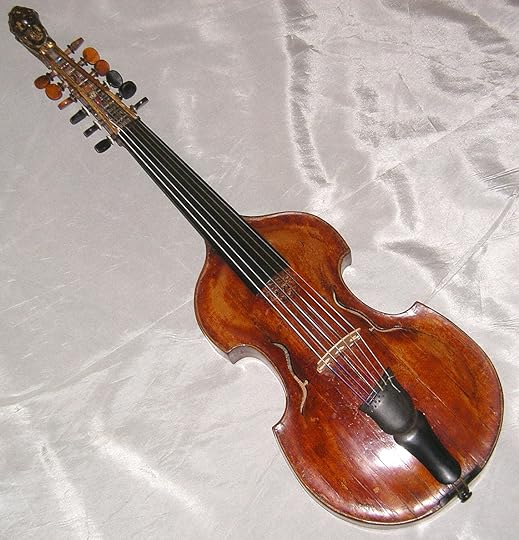
[Viola d'Amore, ca 1700-1715, CC BY-SA 3.0 by Aviad2001]
Es ist eine berührende Geschichte, die Paskow mit unprätentiösen Worten erzählt. In einer Umgebung aus Armut, Entbehrung, aber voller Neid, Häme und Missgunst erfährt Viktor von dem alten Mann den Wert von Selbstvertrauen und Freundschaft und dass Glück nur in Resonanz mit sich selbst zu finden ist.
Viele Jahre habe ich den Gebrauchtmarkt nach diesem vergessenen Buch abgegrast. Wenn es mal eines gab, dann zu Preisen weit jenseits meiner Schmerzgrenze. Bis ich endlich Glück hatte. Dass dieses 1982 erschienene Juwel auf Deutsch nicht mehr aufgelegt wird, ist eine Schande!
[Viola d'Amore, ca 1700-1715, CC BY-SA 3.0 by Aviad2001]

January 6, 2017
Ein wirklich ungewöhnlich gutes Buch von einem Schriftsteller, den ich nur durch Zufall entdeckt habe. Sehr empfehlenswerte, wunderschöne, auch traurige Geschichte von einem alten Geigenbaumeister in Sofia, der sein letztes Instrument baut und damit deutlich macht, worum es seiner Meinung nach im Leben geht!
Displaying 1 - 2 of 2 reviews