Jump to ratings and reviews
Rate this book

The Book on the Bookshelf

Rate this book
"A fascinating history of two related common objects, impeccably documented and beautifully illustrated." —Civilization

Henry Petroski, "the poet laureate of technology" and author of the highly acclaimed The Pencil and The Evolution of Useful Things now sets his sights on perhaps the greatest technological advances of the last two thousand years: the making and storing of books—from papyrus scrolls to precious medieval codices to the book as we know it, from the great library at Alexandria to monastic cells to the Library of Congress.

As writing advanced, and with it broader literacy, the development of the book was seemingly inevitable. And as books became more common, the question of where and how to store them became more pertinent. But how did we come from continuous sheets rolled on spools to the ubiquitous portable item you are holding in your hand? And how did books come to be restored and displayed vertically and spine out on shelves? Henry Petroski answers these and virtually every other question we might have about books as he contemplates the history of the book on bookshelf with his inimitable subtle analysis and intriguing detail.

"After reading this book, you will not look at a book or a bookshelf in the same way." —The Seattle Times

307 pages, Paperback

First published September 14, 1999

75 people are currently reading
5530 people want to read

About the author

Henry Petroski

35 books261 followers
Henry Petroski was an American engineer specializing in failure analysis. A professor both of civil engineering and history at Duke University, he was also a prolific author.

Ratings & Reviews

What do you think?
Rate this book

Friends & Following

Create a free account to discover what your friends think of this book!

Community Reviews

5 stars
404 (27%)
4 stars
492 (33%)
3 stars
438 (29%)
2 stars
112 (7%)
1 star
40 (2%)
Displaying 1 - 30 of 164 reviews
Profile Image for Aerin.
165 reviews571 followers
January 3, 2019
Henry Petroski is fascinated by the design of everyday objects, and how the seemingly-simple technology of items like pencils, forks, and paperclips have evolved and improved over time.

In this volume, he examines the history of - not books per se - but books on bookshelves, which is a very different topic. If you are seeking a deeper understanding of printing and binding methods, or the impact of literature and literacy on human culture, you won't find much here. But if you've ever wondered why we store books the way we do - vertically, spine-out, following some purposeful order, in neat rows along shelves custom-made for the purpose - and how this storage system influenced the design of books (and vice versa), this treatise is absolutely thrilling.

So yes, I am a dork who is thrilled by dorky things. But still, this topic caught me off guard. Like many of Petroski's subjects, bookshelves were something I'd taken utterly for granted and - had I thought about them at all - figured must exist in their current form because how else could you possibly store books?

But Petroski is an engineer, and he never takes anything designed by humans for granted. In particular, he is fascinated by infrastructure, noting that it tends to go unnoticed when designed well. "Once in place and with books upon it, the bookshelf has no moving parts and no obvious function except to stay where it is and support a line of books. It is like a common bridge on a small country road, there but not there to all who use it every day. Yet let the bridge be washed out in a flood, and suddenly it becomes the most important topic of discussion in the county. So it is with technology generally: it is most present in its absence."

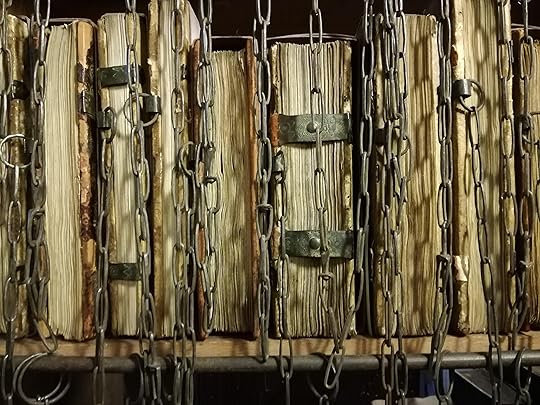
Despite how obvious they may seem, bookshelves are a relatively recent and innovative type of infrastructure, developed as the need to house more and more books in an accessible way increased over the past few centuries. Before books, when most written material was stored in volumes (i.e., scrolls), a shelving system would be useless. The Library at Alexandria probably used pigeonholes or boxes. Even when codices (i.e., books) became standard, libraries typically held a maximum of a few hundred, which were usually kept locked in trunks or cabinets to deter thieves. Only later in the Middle Ages, when monastery libraries started to outgrow their storage systems, did books start to be arrayed upright on shelves - but with the spines facing backward, since a chain would be attached to the front edge of the book linking it securely to the shelf. (Again, to deter thieves - prior to the printing press, books were expensive.)


And this is all only the tip of the iceberg. I never knew, for instance, how critical natural light was to the design of all libraries and bookstacks until electricity became commonplace. Using any fire-based method of illumination would be utterly irresponsible in a room full of priceless and highly-flammable books, so libraries were always designed around their windows, and only used during daylight hours.

I also never knew that in the early days of printed books, most of them were sold unbound, looking like oversized magazines. The collector would then take this sheaf to his favorite bookbinder. This is why so many personal libraries of a few centuries ago consist of uniform-looking leatherbound books. These books weren't bought as sets, they were just bound by the same binder.

And there is so, so much more to this story. If you love books as objects, if a room full of bookshelves never fails to enthrall you, if you are curious about the history of the technology you use every day (in other words, if you are my kind of nerd), you will find much to fascinate you in this book.
Profile Image for Emily.
172 reviews268 followers
January 20, 2009
If there's one thing I'm taking away from Henry Petroski's The Book on the Bookshelf, it's the fact that no technology is so basic as to be self-evident. I always thought of the humble bookshelf as a foregone conclusion: faced with a bunch of narrow rectangular solids, it only makes sense to place them vertically, front-to-back along a horizontal surface, with some kind of identifying label along their edges, yes? Petroski's book, a history of the development of book storage technology in the West, entertainingly disproves this assumption.

Petroski points out that, given the high value of early books, which were each hand-lettered and often bound between jewel-encrusted covers, a very secure storage technique was needed. In pre- and early medieval monasteries and universities, the few books available were kept in steamer-type trunks with multiple (often three) locks, each with a different key. The librarian would keep one key, and two other responsible persons would have the other two, so that all three key-keepers would need to congregate at the book trunk anytime someone wanted to withdraw a book. In this way, accountability would also be maintained: at least three people would witness each book withdrawal, which would minimize lost volumes. Not only that, but the ritual of book return is enough to chill the blood of a person like me, who nearly always returns her library books shockingly late, often without having read them:

The librarian shall read a statement as to the manner in which brethren have had books during the past year. As each brother hears his name pronounced he is to give back the book which had been entrusted to him for reading; and he whose conscience accuses him of not having read the book through which he had received, is to fall on his face, confess his fault, and entreat forgiveness.


Of course, I might be more motivated to finish my library books if I knew I would have to fall on my face and beg to be pardoned.

As more books accumulated, and architecture changed, the locked chest evolved into a system of tilted lecterns, with or without seats, to which individual books were attached with iron chains. The tradition of chained libraries was apparently preserved for a shockingly long time in some places; the last college in Oxford to remove the chains from their books did so in 1799. At first the books were left open or closed on their designated lecterns, but as library collections grew, each lectern began to have multiple books. This necessitated shelves added above the lecterns themselves, where chained books could be lain when not being consulted. These shelves are the ancestors of the modern bookshelf.

But lots of things still had yet to evolve about book shelving before it would be recognizably "modern." Books were usually shelved horizontally in piles, for example, and even when space considerations forced people to start shelving them vertically, the chains attached to their covers dictated that they be placed with their fore-edges, rather than their spines, facing outward. Based on an informal sampling of my friends and acquaintances, this is the single most disturbing part of Petroski's book. People react strongly to the idea of shelving books spine-inward; comments like "that's just wrong" and "I don't like to think about it" kept cropping up when I mentioned the practice. But in addition to the chains, which would have scraped the covers of the neighboring books if the spines had been faced out, there are other reasons that a fore-edge first shelving technique makes sense. There was no identifying information on the spines of books, for example, until well into the seventeenth century. For a long time, they were completely unadorned, in stark contrast to the elaborate front and back covers. In addition, Petroski brings up the fascinating point that, even when they began to be decorated,

The exoskeletal spine, which holds up the innards of the book structurally...was still the machinery of a book...and so it continued to be the part that was hidden as much as possible, pushed into the dark recesses of bookshelves, out of sight. Shelving books with their spines inward must have seemed as natural and appropriate a thing to do as to put the winding machinery of a clock toward the wall or behind a door, or both.


This is so interesting to me. I would, of course, never think of positioning a computer or desk lamp so that its electrical cords were on conspicuous display, and medieval and Renaissance folks apparently felt the same way about book spines. I wonder what this reaction, so seemingly universal, is about. Why do we find unattractive the parts of our technology that make it work? Do we only stop feeling put off by the functional/structural elements of a thing when we no longer perceive it as "technology"? The idea that book spines, so infinitely appealing to me now, once seemed distasteful bits of mechanics, makes me wonder how future generations will perceive our messes of wires and cords. Maybe my great-great-grandchildren will, like J.K. Rowling's Arthur Weasley, take to collecting plugs.

I found the last third or so of Petroski's book less interesting than the first two-thirds. Once the bookshelf assumed more or less its modern form, it was just a matter of optimizing space and usability in libraries, and I don't have the engineer's soul to enjoy such conversations as much as some people. Nevertheless, the book as a whole was highly enjoyable - the kind of thing from which I tend to read out tidbits as I find them to whomever is around to listen (usually David, who is a good sport). It was a great way to kick off the Dewey Decimal Challenge (000 century), and I'm looking forward to picking out an equally thought-provoking choice for next month.
Profile Image for Melody Schwarting.
2,134 reviews82 followers
January 28, 2023
Henry Petroski, renowned author of an entire book on the history of The Pencil, has turned to books and their storage in this volume. It's an aspect of book history that I hadn't thought much about before now. He considers ecclesiastical/school libraries, personal libraries, and bookstores. Numerous woodcuts and illustrations show the evolution of the book, the library, and the habit of reading in history. He also gives brief histories of a few libraries, like the Library of Congress and the Bodleian, which was quite interesting given the different times in book history during which they entered the world.

Petroski ends the book with a tour de force of an appendix, in which he considers twenty-five different ways to arrange one's books. If you thought arrangement by color was blasphemous, alas, Petroski sinks to lower depths than that. (Evidently there is a bookstore that arranges by publisher, and publication date, and not in Dewey's row-oriented format but in long lines going around the whole store. No, thank you.) This appendix made me think hard about why I arrange my books the way I do. It makes so much sense to me, but to someone like Petroski, it must seem as strange as his system seems to me.

I was pleased to see that, despite its 1999 publication date, this book does not moan overmuch about the future of the book. Petroski does get a bit dramatic about ebooks and e-readers (which did exist back then) but it's clear that the purpose of this book is not to save the physical book itself. Fifteen years into the Kindle era, we can confirm that physical books are still alive and well and occupying miles of shelving in The Strand in Manhattan. I have a Kindle and read on it frequently, but it only supplements my physical books. The only time it replaces physical copies on my shelves is for long series like Poldark or Miss Read.

I wouldn't call this a must-read for all bibliophiles, but for anyone interested in book history (and a loving perspective on books that comes from an engineer who rarely mentions fiction, creative non-fiction, or poetry) The Book on the Bookshelf presents a fascinating story of the bones that make up our libraries.
Profile Image for Jaci.
864 reviews7 followers
April 25, 2011
I actually learned a lot about shelving, esp. about the desk area, filling up to the top, and THEN filling the shelves under the desk. Interesting. Which makes me think I've found my calling.
p.4: "Indeed, the presence of bookshelves greatly influences our behavior."
p.22: "Is an empty bookshelf an oxymoron?"
p.24: "It is extraordinary that so simple a device as the separation of words should never have become general until after the invention of printing."
p.69: "Windows and natural light were also important because of the fear of fire, and many old libraries were open only as long as the sun was up..."
p. 120: "The decorated fore edges of...books were also lettered over with literary identifiers, further suggesting the the purpose in part was to identify individual books in this large library..."
167: "In the nineteenth century the idea arose of keeping a library's collection of books in a space separate from the reading room, and this led to the development of the bookstack as we know it today."
p.217: "Bern Dibner, the electrical engineer, inventor, and premier twentieth-century collector of books in the history of science and technology, kept his treasures in wooden bookcases with glass doors in the offices of his Burndy Engineering Company. Since the Burndy factory, which manufactured electrical connectors, was fitted with a water-sprinkler system, the rare books were in danger of being soaked if the system was ever triggered. To protect his collection in this event, Dibner had the bookcases fitted with metal canopies to shed the water as a pitched roof does."
If you've read this far, I'd like you to know that I worked on the short-title catalog for the Dibner Collection at the Smithsonian in 1977-78.
Profile Image for Pamela.
1,119 reviews39 followers
October 4, 2025
Earlier this year I read an Object Lessons series book Bookshelf, but it was a bit short for me, left me unsatisfied and curious to know more. Well it happens on my bookshelf for many, many years was sitting this book by Petroski, a book often quoted in the Object Lessons book. I’m glad I finally read it.

Petroski’s book is primarily about the history of the bookshelf, the furniture that holds books. Some history of the book itself is discussed, but that wasn’t the focus and likely there are more detailed books out there.

The furniture for books was varied in centuries past. Early forms were a type of box like a hat boxes when books were scrolls. When the book became closer to today's format there were stored in what we may call a truck but are properly called armaria. They could lock, which was important when books were few.

As books changed, the furniture did too to better hold them. As books became easier to copy, from hands to machines, then more people started to collect books. Libraries started to collect many more, and so the bookshelf came about. Still they were stored differently than today.

While books were still valuable there were chained libraries. The types of furniture and how these books were chained was a chapter or two. Some of the early shelving after the chained libraries had books facing up and at an angle. Often books were stored with the foredge showing, as this was before spines held any information on the book. It took centuries before the standard format of the bookshelf and spine out that we see today.

For most of the history of the book, and shelving, placement of shelving had to account for light. When libraries grew they had to be mindful of how the windows and shelves line up to prove the best lighting for reading. This was particularly important when the books were chained.

I had started to read this via audiobook but quickly realized that was not the best way to read this book. Since I had a print copy, I turned to reading it. Besides with audio I would have missed all of the illustrations that are throughout the book, and they definitely enhance the reading.

This is a quite detailed book, which I did appreciate. Although it is a couple of decades old, the eBook was being developed and is mentioned a few times. What dates the book is more the descriptions of the internet. But these portions are minimal.

The appendix is to be noted as here were listed 25 different ways to shelve a book. Petroski took some fun here, as it was more light hearted, and certainly not exhaustive. I noticed the bibliography at the end contained a long list of books that I could really go down the rabbit hole with this topic, but maybe I will leave it here. This one did satisfy a lot of my curiosity about the history of bookshelves. But it did make me kinda want some ancient book furniture.

Profile Image for S..
Author 5 books82 followers
August 8, 2013
competent rather than stunning, inclusive rather than unified, -- and written, most probably, under the simple rubric, 'a book about books has to get some readers, engineer Henry Petroski can write, but doesn't stun or immediately derive a rabid following. much of the book is concerned with bookshelf designs, and while three or four pictures of medieval bookshelf concepts (a rotary concept, an angled lectern) are fine, by the thirteenth or fourteenth, you're wondering of the writer needed to produce filler.

Petroski missed the opportunity to track a book from production to finish (he could have covered papermaking, ink production, tree farming) and he could have researched unusual or extreme short production books (Evelyn Waugh did a leather edition of 200 for his close friends of Brideshead Revisited; there was a medieval book with iron covers called Malleus Witchitorium or something like that, 'hammer of witches' which was designed both for reading and to be physically used to beat witches to death--I'm not making this up). if I know these two random facts about books, then Petroski's lack of deep research is clear since he probably could have come up with 100 totally unique books or publications with a little more willingness to talk to librarians or allied professionals.

a competent, not-horrible 3.
Profile Image for Paul.
103 reviews35 followers
February 14, 2012
I'd like to give this half a star less, but that is unfortunately not possible, so in the spirit of being generous, I'll give it three stars.

This book could easily have been shortened by 15-20% had the editor been a bit more liberal with his red pen in eliminating some of the more boring personal anecdotes along with the many paragraphs of repetitious overkill. For example, I am genuinely amazed by the sheer number of references and stories the author uses (ad nauseum) to demonstrate the tendency to shelve books spine-in in the earlier centuries. (There, I just more or less summed up half the book in one sentence!)

Unfortunately, it seems as though much of that heavy earlier history came at the expense of the more recent years, which was delivered towards the end in a couple of efficient and streamlined chapters. If only the earlier history could have been as efficient and succinct, it would make a nicer, quicker, and more interesting read.

That said, though, it was still an interesting book as it stands, and I don't regret reading it.
Profile Image for Sol.
700 reviews35 followers
November 9, 2025
The basic idea here is that there's nothing so simple that it has no history, nothing so obvious that it's universal. The bookshelf is the perfect case study for this thesis: surely bookshelves are horizontal planks arranged vertically, and books are shelved on them vertically with spine out, right? Right?

Apparently not so. Petroski has assembled a history of book storage showing that not only does the bookshelf have a history of its technological development, the very idea of shelving books with spines out is a (relatively) recent idea, to the extent that as late as the early 20th century, Spain's El Escorial library shelved books with the spines facing inward toward the wall. He traces the history of book shelving from late antiquity, as the scroll was replaced by the codex (the common form of book we're familiar with), through the medieval, the early modern, all the way up to the present (of 1999). While he maintains his focus on shelving-as-such, he touches on developments in book manufacture, artificial lighting and library design that have affected how shelving is designed and used. His position is that design develops from dissatisfaction with how things are done and the search for a better way. For shelving, the driving forces are their constant accumulation, their safe care and keeping, and the problem how to get enough light to read them.

The basic story is that scrolls were (and are) stored stacked on top of each other, or upright in small hat-type boxes, with tags on the rolled up end to identify them. Codices rapidly replaced them due to how much more compact, easy to read, and durable they are. Early in their history, when all codices were handwritten or copied manuscripts, they were stored horizontally, cover-up, in either chests, or in an armarium, which is like a dresser with some shelves. In either case, books were locked inside to prevent theft or unsanctioned borrowing. As libraries expanded, books were chained to lecterns, so they could largely only be read where they were stored, with some shelf-like storage above them. Because book spines couldn't withstand having the chain attached them, the chain was usually attached to the leading edge of one of the covers, and books were shelved with the spines inward. The practices of both chaining, and especially spine-inward shelving last for centuries, and were the "natural" way. With continued acquisition, plank-based storage above lecterns expanded, and though there is no actual proof, it seems the modern bookshelf grew out of the lectern-stall, and not the somewhat more physically similar armarium. As printing replaced manuscripts, the cost of books dropped precipitously, and chaining became less and less of a concern, though it lasted until the late 18th century, and spine-inward shelving survived in some places even beyond that.

Early bookshops sold not finished and bound books, but loose quires of pages, which would be kept in drawers according to size of the ultimate page, and would be taken by the purchaser to be bound by a bookbinder at varying levels of cost and luxury. Some books were simply read unbound, and perhaps discarded like people did for magazines. Unbound books were identified by the half-title or bastard title page, which went before and protected the title page, and was in some cases removed during binding, in some cases kept in. The half-title survives as a skeuomorph in some books even today. As book publishers increasingly bound their own books, and printed title and author information on them, shelving with the now-informative spine outward became more and more normal, in both library and private collections. From there, Petroski traces the development of the architecture of modern libraries, which I found less interesting. Basically, as artificial lighting became safe and common, sunlight was no longer the only safe way to illuminate books, leading to the possibility of such things as high-density bookstacks, rolling shelves, and offsite depository libraries.

Along the way he brings up all kinds of little tidbits, like how parchment books had clasps to hold them closed, as without pressure, parchment will permanently swell wider than the spine, or odd practices like dos-a-dos binding, where two bound books share a single back cover, with a spine and fore-edge on each side of the book. Several quotations from Melvil Dewey (creator of the Dewey Decimal System) preserve his idiosyncratic reformed spelling, e.g. ar for are, thru for through, pusht for pushed.

One thing Petroski doesn't cover are the virtual shelves I've already placed this book on. Virtual shelves have the advantage that any number of books can be placed on them, and a single book can be placed on any number of shelves. By tagging every single book I own, I can easily keep track of which I've read and when, how many of each type I have, and group them together by any criteria I wish. Some of my shelves are simple genre tags that would be recognizable to anyone, other are specific motifs I'm interested in, others have meaning only to me. They've saved me from buying duplicates dozens of times, and have helped me improve the condition of my collection by marking which I own in bad condition and want to buy again. He does mention ebooks, but writing at the turn of the millennium, they were a very recent development, and his remarks on them are mostly speculative. So far, the codex has proved astoundingly durable, with ebooks failing to kill off the paper book industry. Book publishing isn't in any golden age, but it's treading water. Bookshelves live on.

There are a lot of black and white pictures, ranging from diagrams and photos to paintings and woodcuts. The textual sources for a lot of these things are rather thin on the ground, so he sometimes has to marshal evidence from contemporary images of how things like bookshops and personal studies might have looked like.

If all that sounds fascinating, this is the book for you, because he gets into an almost autistic amount of detail at times. Personally I think this book could've been shaved down by a good 10-15% without losing anything vital. Especially the personal anecdotes. These things are the bane of my nonfiction reading. I don't mean to diss Petroski specifically, but if you were interesting enough to read about, I would be reading a book about you and not bookshelves. I do thank him for the intriguing suggestion to use car paint on shelves to decrease friction when pulling out books, and the flair with which he ends the book on the word bookend.

He doesn't mention China even once, which I assume has to have its own parallel history of scroll-and-codex shelving. Given how poorly sourced the history of the bookshelf already is in English, I can't really fault him for it, but I would really love to know if it underwent some kind of parallel evolution, or had its own development track that was completely different. There's a whole other literate civilizational lineage out there, and even after reading this book I know nothing about the history of its shelves.

The book closes with a somewhat tongue-in-cheek section on ordering schemes, from the prosaic alphabetical and by-subject, to the more whimsical by size or colour, to the straight up silly by price or by ISBN. I personally reordered my mass market paperback scifi books in a boustrophedon order, so that the alphabetically arranged books snake down a shelf, continue to the adjacent, and begin snaking back up. It looks a little weird at first, but it has the advantage that related books are always physically near each other. He doesn't mention boustrophedon ordering here at all, so it looks I managed to one-up him.

The notes section is surprisingly joyful. The main text has no citations, but the notes provides chapter-by-chapter and page-by-page sources for quotations and statements of fact, which is extremely easy to quickly reference, since the exact words from the main text are reproduced in their order in the text. The few times I wanted to find a source for some statements, I located it in seconds. While this scheme might become cumbersome for a more citation-heavy academic book, it's absolutely perfect for this use case.
Profile Image for Gregsamsa.
73 reviews412 followers
July 31, 2013
While parts of this book were very slow going, it is worth it for the way it illustrates one of the most wonderful things about learning about history: what you think is the "right" way something is done is just as historical as the "weird" way people in past eras did things. It is just good for your head to have the banal things around you that you take for granted suddenly come alive as part of an historical process. It's so strange to think that the way we shelve DVDs has its roots in the days when books were chained to lecturns. Who knew?
Profile Image for Mark Fallon.
919 reviews30 followers
July 3, 2018
The book for one who loves books, engineering and the history that brings them together.
Profile Image for Storey.
140 reviews10 followers
February 16, 2012
A bit dry in parts, but other parts were pretty fascinating...so it evens out into a 3 out of 5 stars. Some of my favorite quotes below:

"The accumulation of books on shelves appears to be inevitable, and the search for ever more places to store books appears to be without limit. The house or apartment with too many books seems always to acquire even more." ~pg. 223

"When I travel, I find myself drawn into bookstores and to books I wonder if I will ever see again. Many of these volumes must be bought, of course, lest the opportunity to possess them be lost." ~pg. 230

"The booksehlf seems to abhor a vacuum, and so the void that is created when one book is removed is seldom adequate to receive the book again. Like a used air mattress or a roadmap, which can never seem to be folded back into the shape in which it came..." ~pg. 11

"And just as we may wonder if a tree makes a sound when it falls out of earshot, so we may ask, Is an empty bookshelf an oxymoron?" ~pg. 22

"According to its developers, the "ebook" could ultimately hold the entire Library of Congress, which is of the order of 20 million volumes...In time, the developers of this 21st century technology claim such books could also incorporate video clips to give us illuminated books that are also animated." ~pg. 166 (this book was written in 1999)

Profile Image for Susan.
1,524 reviews56 followers
May 31, 2016
This short volume provides a detailed look at an object the lover of books usually takes for granted: the bookshelf. Since the history of the bookshelf is intertwined with the development of the book, that subject is also covered, starting with scrolls and codices and how they were stored and moving onto “chests, cloisters and carrels” and onto printing and the modern age. The architectural problems of storing books safely and accessibly in monasteries and libraries are also discussed. A delightful appendix discusses the pros and cons of different ways “to arrange books on our bookshelves” from last name to title, size, color, sentimental value, order of publication, read or unread, and enjoyment (among others). The material is largely limited to Western Europe and the U.S. Well-written with great illustrations, and much, much (almost too much) information.

“The bookcase without a full complement of books is like a day-dreaming student’s notebook, its lines half filled with substance and half with space”.
Profile Image for Elizabeth.
1,020 reviews
December 16, 2010
It was clear throughout this attempted "history of the bookshelf" that Petroski was probably more interested in the history of book display than he was in shelves themselves. However, in focusing specifically on shelves, he limited the extent to which he could discuss other relevant sorts of display (books on coffee tables, books in stores, etc.) that may have provided interesting contrasts to some of the information he gave. Likewise, I wanted more information about the symbolic connotations of housing books on bookshelves, and less of the engineering behind it. Granted, this is a personal preference. In any case, what was here was a straightforward history, which was easy to read and did provide some fun anecdotes (though it was less rich in archival information than I presumed it would be). I would recommend Alberto Manguel's book on libraries before this one, though they do accomplish different tasks (and treat slightly different subjects).
Profile Image for Angel .
1,536 reviews46 followers
October 8, 2012
This is a history of bookshelves, and how people have been organizing books since the time we had books as scrolls. His main argument is that the book shelf evolved as people needed better ways to store and arrange books; it came forth out of necessity. The idea is an intriguing one, and there is a lot that people who love reading about books will probably enjoy. I found the segments on medieval libraries and monasteries to be very interesting. However, the book lost steam for me about halfway down the road. By the time I got to the chapter on moveable and compact shelving, I just wanted for the book to be done already. This last part was a bit on the tedious side. Librarians will likely find something to like in this book as well.

I can say that at least this book was better than his other book on the pencil. That other book I dropped because it was pretty much unreadable. Overall, for people who enjoy reading books about books and reading, I would consider this an optional book.
Profile Image for Traci.
1,107 reviews44 followers
May 6, 2019
Interesting, but it does get a bit dry and repetitive. Plus I had to remember that it was written 20 years ago...strange to come across someone wondering if "the e-book will succeed". It feels like Kindle and other formats have been around for a long time, then I realize that they weren't really being used when I first started in libraries, some 17 years ago. WOW! And that I've heard all the arguments about how e-books will replace print, that print will go the way of vinyl, etc. Well, print is very much alive and well, and vinyl is actually making a comeback. Just shows that folks want MORE, not one format or the other.

This has made me think about my own shelving in my house. I'm pretty much a "by author" person, but not strictly alphabetical. Just all Stephen King books together, all Clive Barker books together, etc. And paperbacks are pretty much with other paperbacks. I guess I don't have much of a system after all!
Profile Image for Jean Kojali.
160 reviews5 followers
June 17, 2025
This is one of the more unique books I've read recently. I was initially skeptical because book history is a discipline I feel decently well-versed in, and Henry Petroski was an engineer by trade, so it felt a bit out of place at first for him to be writing on this subject. I was very quickly proven wrong, as the first chapter of this book is extremely sharp and highlighted a lot of nuance when it comes to studying books as a technological innovation. The analytical/applied skills that Petroski developed throughout his decades-long career in STEM must have been very useful when researching this book.

My criticisms of this book are more of a result of my own expectations of the book rather than any glaring, objective issues. I would have liked to see more historical context included throughout. Petroski was clearly a detail-oriented writer, and there is a LOT of specific information about bookshelves (dimensions, etc) included in this book that gets a little repetetive and redundant. It is obvious that this was written by an engineer rather than a historian. However, that makes Petroski's consistent use of primary sources even more impressive. Although he largely relied on the same sources, he was very adept at identifying which quotes to employ for each section. On a lesser note, I wish the included images were a bit more original. It seems that Petroski used a lot of books found in secondary sources. Though the images were relevant and interesting, that felt a little bit lazy.

Overall, this was a really niche book that was a lot of fun. For the foreseeable future, my opening line at parties will be "I just read a 300+ page book all about bookshelves, and it was awesome!"
Profile Image for Sarah.
196 reviews21 followers
December 4, 2022
This book is packed to the brim with facts. One should be intensely committed to learning everything possible about bookshelves if they wish to complete this book.
Personally, I was fascinated by the vast amount of information that the author had gathered.
But I can definitely understand why some readers may quickly lose interest. If you truly love books and anything about them, as well as their history, you will enjoy this scholarly tome!
Profile Image for Nick.
557 reviews
September 7, 2024
Some chapters on the history of shelving and organizing of interest (particularly chapter 9) but ultimately worth perusing for the appendix where Petrovski lists more than a dozen organization methods: these range from the aesthetically sensible (Alphabetical by author’s last name, subject) to the ludicrously pedantic (UPC, color).
Profile Image for Lora.
1,057 reviews13 followers
January 25, 2017
Enjoyable book by an engineer about the history, nature, and design of both books and bookshelves. Many great lines, some painful passages about load bearing formulae of different kinds of shelves, and more. Cool illustrations throughout. The appendix was at least as enjoyable as the main text. The author combines poetic thoughts with engineering sciences! Well rounded!
Parts were fun to read out loud.
A good bibliophile book.
Profile Image for Michael.
132 reviews
October 13, 2018
A thorough look at the history of the bookshelf, books, the structure of libraries, and the book in our lives. I found this to be generally interesting, while not being as engaging as I would hope. I felt this was an interesting subject, but that the text here was a bit dry.

I would still say to read the book if you are interested in the subject, as there are fascinating nuggets of information in the text.
Profile Image for Lisa Lindsay.
59 reviews6 followers
February 26, 2019
This book traces the histories and technological developments through the centuries of both books and bookshelves. Books used to be so rare and valuable that they were kept chained to shelves in libraries and monasteries. I look around my apartment, with its seven bookshelves and hundreds of books, and I realize how very fortunate (and spoiled) I am. As a bonus, the appendix has many helpful suggestions for arranging a home library.
Profile Image for Daahoud Asante.
22 reviews7 followers
June 25, 2015
Did you know that books used to be chained to shelves? and "worth its weight in gold" derives from the pay a scribe would earn for copying a book?....yeah, if your a bibliophile your gonna like this book about books, super interesting read that i would highly recommend, a little academic but not dry.
429 reviews1 follower
February 14, 2019
I love books. I love bookshelves. I love the subject of this book. It is well written. It is just a little too much detail for me as I am not an engineer. But, isn’t it fascinating that most of us have never thought about whether books were always put vertically on bookshelves....or even spine outward?
Profile Image for Michael Ritchie.
Author 4 books27 followers
November 19, 2016
Mostly interesting, but sags a little in the middle like an overstuffed bookshelf. Some really cool, nerdy tidbits to be had here, though.
Profile Image for Lucas Miller.
584 reviews12 followers
October 22, 2025
Bought this as a curiosity years ago, and decided to finally sit down to read it. I was quite pleased at first, the author was a prolific author of books that took a rather lighthearted take on engineering and design, specializing in the history of everyday, mundane objects. His book on the pencil gets referenced here several times. There are some highlights. The reflections on how technology develops and the way that good design disappears made me feel like I was gearing up for an episode of 99PI. The book did get boring. The sections on the development of the codex from scrolls and the beginnings of library in Medieval monasteries through the chained libraries of the Renaissance was fascinating. I was excited about the section on Samuel Pepys book presses and his fraught relationship with his book binder, but by the end, most of the charm had worn off, and the increasingly technical discussion of modern stacks and movable shelving started to wear on my patience. Even in the depth of these later sections Petroski can manage the offhand observation or exhibit the dry humor that reminded me of Nicholson Baker's early novels so focused on detail. My favorite part of the book was the number appendix on different methods of shelving books. I wish the entire book had maintained this more aphoristic, mini-essay style. I'm glad I finally read this. I'm not sure how much information I'll retain, but I'll appreciate my own book cases more.
Profile Image for Sarah Coller.
Author 2 books46 followers
December 11, 2022
I wanted to enjoy this book more than I did, but it seemed that for every one interesting bit, there were ten extreme yawners. I think it's possible for an author to give us tooo much information on a subject, and this author is guilty of just that. He gave so much detail on several subjects that they quickly went from intriguing to very dull.

Still, there was quite a lot to think about! I still struggle with the idea that books were stored with the spine in for so many centuries. All the reasons for storing books any way but spine out are just so nonsensical to me. It's hard to believe the space-saving way took so long to catch on!

I thought the Ramelli wheel was genius and it would not be impractical to set a desk beside for scholarly use.

I also did not realize that books weren’t purchased bound in the 17th c. No wonder books were so valued and difficult for the average laborer to afford very many.

Some of the stories about the different ways elite people treated books were pretty disgusting (Humphrey Davy ripping out pages as he read, using books as placemats, etc.). Such a waste to treat books badly---I was always taught to be careful with my books and was grounded from them if I didn't.
Profile Image for Nathan Albright.
4,488 reviews161 followers
September 26, 2016
This is a book written by an engineer that asks a question that few people would think to ask: what is the history of the storage and presentation of books? How is it that we came to have the sort of bookshelves that we do in our homes and libraries? What is the history of a technology that we take for granted? Petroski is an author on the history of technology and is well-equipped to provide a thoughtful history about bookshelves and how books were stored beforehand. The audience to this book is pretty straightforward, and if you can answer the following questions affirmatively, you are likely to enjoy this book: Do you like reading books about books [1]? Are you interested in forgotten technologies [2]? Do you like focusing on the infrastructure that others take for granted [3]? If the answer to all of these questions is yes, this is definitely a worthwhile book for you to read, and at around 250 pages including an entertaining appendix, this is a book that should not prove too taxing even if it is is somewhat old-fashioned in many ways.

The book itself looks at the history of the bookshelf in tandem with a variety of other concerns that were related to books themselves as well as the larger concerns of architecture and engineering. From time immemorial book-lovers have found that the number of books in their collections multiplied far faster than their space. This is not a problem of myself alone, or a new problem by any rates, but goes back to ancient history. The author, by investigating old woodcuts and all of the books he could find that described and discussed the storage of books throughout history, has done excellent work in presenting a picture of the past when books were chained to the shelves or to the desks that they were on, when most books were stored in chests or boxes, when books were stored with their pages out. Of particular interest is the fact that increasing the number of shelves on top of each other made for difficult solutions in managing the safety of bookshelves from sag and deflection as well as damage during earthquakes. Also of interest is the difficulty of light, including the widespread divorce of bookshelves from sensible patterns of organization in order to take advantage of natural light. All in all, this is a book that encourages book-lovers to think about the nature of how their books are to be stored, displayed, and appreciated, and to no longer take the humble bookshelf for granted.

Why do we take technology for granted? Few people within my circle of friends and acquaintances have more reason to celebrate the bookshelf than I do, given my massive collection of books in my library and given my appreciation of the engineering problems in managing the heavy dead and live loads of the bookshelves and books from a structural engineering perspective. The problem of storing books involves several problems of considerable personal interest--how do we maximize the storage space of books, allow those books to be easily accessible, preserve the enjoyment of reading those books using natural light where possible in a way that preserves books from unnecessary harm (aside from the harm that comes from reading them), and that is structurally safe and if possible aesthetically pleasing as well. These are a lot of simultaneous concerns to deal with, and the technologies we have used over time have all sought to address these various concerns based on the technology of the day. Even the ebook and book on tape or cd cannot hope to rid ourselves of our dependence on physical copies of books given the vulnerability of media to decay and the problem of storage. As Solomon said wisely so long ago, of books there is no end, and we can be glad for that as long as they are like this book, worth reading and reflecting on.

[1] See, for example:

https://edgeinducedcohesion.wordpress...

https://edgeinducedcohesion.wordpress...

https://edgeinducedcohesion.wordpress...

https://edgeinducedcohesion.wordpress...

https://edgeinducedcohesion.wordpress...

https://edgeinducedcohesion.wordpress...

https://edgeinducedcohesion.wordpress...

https://edgeinducedcohesion.wordpress...

[2] See, for example:

https://edgeinducedcohesion.wordpress...

https://edgeinducedcohesion.wordpress...

https://edgeinducedcohesion.wordpress...

[3] See, for example:

https://edgeinducedcohesion.wordpress...

https://edgeinducedcohesion.wordpress...

https://edgeinducedcohesion.wordpress...

https://edgeinducedcohesion.wordpress...

https://edgeinducedcohesion.wordpress...

https://edgeinducedcohesion.wordpress...

https://edgeinducedcohesion.wordpress...

https://edgeinducedcohesion.wordpress...

https://edgeinducedcohesion.wordpress...

https://edgeinducedcohesion.wordpress...
22 reviews
February 15, 2024
I enjoyed the book, I'm glad to have read it. It had enough relevant content for a book (his book on pencils felt stretched), which was nice. The fact books used to be shelved with the spine in was fascinating, but made sense after reading this book. That said, he more than once started rambling on an opinion presented as a given. (To be clear, I didn't mind where he told a personal story--those overall were smoothly interwoven and often good transitions.). The illustrations were complimentary and useful--he needed a few more; there are places where a picture could have saved a lot of awkward description. It wandered between book history and bookshelf (or book press--I do like having that term now, as bookshelf is unclear between the multi-shelf thing and a single shelf on it), but that's because they evolved together! An easy read with lots of fascinating historical tidbits throughout. A bit rambling, but not too bad. He found interesting quotes from various times and sources. In an unfortunate twist, reading one book has added two more to my to-be-read list!
Displaying 1 - 30 of 164 reviews

Can't find what you're looking for?

Get help and learn more about the design.