Contents i • The New Atlantis • (1975) • novelette by Ursula K. Le Guin 1 • The Blind Geometer • (1986) • novella by Kim Stanley Robinson 89 • The Return from Rainbow Bridge • juvenile • (1987) • novelette by Kim Stanley Robinson
Kim Stanley Robinson is an American science fiction writer. He has published 22 novels and numerous short stories and is best known for his Mars trilogy. His work has been translated into 24 languages. Many of his novels and stories have ecological, cultural, and political themes and feature scientists as heroes. Robinson has won numerous awards, including the Hugo Award for Best Novel, the Nebula Award for Best Novel and the World Fantasy Award. The Atlantic has called Robinson's work "the gold standard of realistic, and highly literary, science-fiction writing." According to an article in The New Yorker, Robinson is "generally acknowledged as one of the greatest living science-fiction writers."
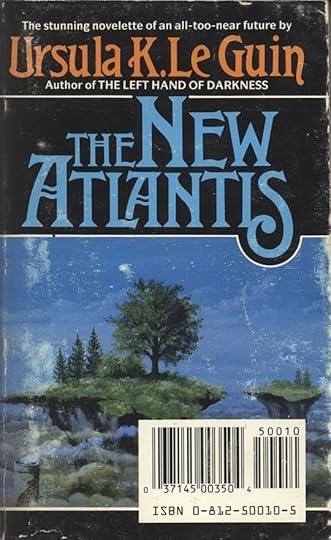
This is the thirteenth volume in the Tor Double series, which featured two novellas printed back-to-back and in opposition to each other, each with its own cover, in the tradition of the old Ace Double books. This one actually has two stories of novelette length and one novella; the Le Guin story was short, so they added an additional novelette by Robinson to fill out the book. The Blind Geometer, which won the Nebula Award for best novella in 1988 after it appeared in Asimov's magazine, is a very thoughtful action story with a blind protagonist who finds he's being manipulated; it's a very good modern example of science fiction, as we see a scientist using science to solve a problem, and it had an interesting plot and good characterization as well. Also included is an often-over-looked novelette from The Magazine of Fantasy and Science Fiction by Robinson, a sort of YA Native American parable that's quite thought-provoking and was my favorite of the three in this book. Le Guin's The New Atlantis was nominated for several awards in the novelette category after it was printed in a Robert Silverberg edited anthology in 1975, along with stories by Gene Wolfe and James Tiptree, Jr., as the title track. It's a kind of confusing New Wave tale, never one of my favorites. Very well written, but unclear. The cover by Michael Bohme is neat; it reminded me of the old Yes album covers by Dean. Altogether a fine, enjoyable book... it's a shame the line didn't last longer than it did.
This is Tor Double #13, of a series of 36 double books published from 1988 to 1991 by Tor Books. It contains two novellas, bound together tête-bêche in mass market paperback – back-to-back, inverted, with two front covers and both titles on the spine. The novellas are listed here alphabetically by author; neither should be considered “primary.”
second read – 3 June 2020 - *****. When I recently handled this physical book from my collection, I decided to re-read it. The stories are linked by potential discoveries of new energy sources, and by Kim Stanley Robinson’s writer’s relationship with Ursula K. Le Guin. Refer to the talk by him at https://theinterval.org/salon-talks/0...
The New Atlantis, by Ursula K. LeGuin (1975) ***** This was originally published in The New Atlantis and Other Novellas of Science Fiction, edited by Robert Silverberg. It won the 1976 Hugo Award as well being nominated for the 1976 Nebula Award in their novelette categories. The Hainish universe of Le Guin's science fiction was well established by the time this was published, but it's a stand-alone story. It is set in a future of extreme oppression and centralized control in the US, patterned somewhat after the old Soviet Union. Interspersed with the narrative are passages describing a sea-changed Atlantis. In the main thread, the perspective character’s husband is a physicist just out of prison, who has discovered the key to cheap and low-tech energy. That would be a threat to control by the corporate state, because it promises self-reliance and therefore freedom. Unfortunately, I feel that in this daydream of a story, Le Guin has not really considered that some individuals could use such unlimited power for evil purposes as well.
The Blind Geometer, by Kim Stanley Robinson (1985) ***** This was first published in the August 1987 issue of Isaac Asimov's Science Fiction Magazine. It won the 1988 Nebula Award as well being nominated for the 1988 Hugo Award in their novella categories. This was one of Kim Stanley Robinson's earlier stories and a stand-alone. The narrator is a blind mathematician, who is investigated by a mysterious and violent group for his work that relates to physics of a new energy source. They bring a distraught scientist to him, supposedly a victim of a lunar disaster, because she has become incapable of communicating in any form other than diagrams that illustrate Desargues’ Theorem. Robinson wonderfully explores the concepts of mathematical geometry and human perception on many levels. In the end, the symbolism of the included figures is made plain, as are the point and/or line references that begin paragraphs. A fabulously crafted story, and I highly recommend it.
The Return from Rainbow Bridge, by Kim Stanley Robinson (1985) ** This was first published in the August 1987 issue of The Magazine of Fantasy & Science Fiction. A teen-aged white kid from suburban LA visits his aunt on or near the Navaho Reservation in Arizona. He gets introduced to a contemporary Navaho lifestyle through his cousin’s friend Paul, and they go on a desert hike to a remote arch named Rainbow Bridge. On the return hike, he learns a life lesson. Robinson is a backpacker (as am I), and I appreciate the treks and outdoor lives that often appear in his novels. But it’s just a filler here.
first read - 6 November 1990 - *****. When Tor Doubles were first released, I reliably purchased and read most of them. This particular one, I bought about a year after it was released, after I realized I was going to read ALL of them. My thoughts about them at the time have been incorporated into the reviews I wrote for my second read, above.
Ursula K. Le Guin's The New Atlantis and Kim Stanley Robinson's The Blind Geometer felt very Dickian (KSR wrote a thesis on Philip K. Dick's fiction and UKLG went to school with him). Both stories are early works by the authors and are far surpassed by many of their other stories. 2.5★ to 3★
The Return from Rainbow Bridge, a coming-of-age story about a suburban Californian teenager in the 1960s who almost gets lost in a canyon, is by far the best of the three, capturing the magic of the wilderness. 3.75★
As always, I'm not as likely to warm to short fiction. The LeGuin story reminded me somehow of The Blind Assassin (even though I didn't much care for this story and LOVED the Atwood), The Return from Rainbow Bridge story reminded me of Ray Bradbury, and The Blind Geometer reminded me of Roald Dahl's storytelling style. None of them will stick with me, though there were interesting enough to read as I read them. The Blind Geometer held my attention best, and could easily have been a full-length novel. All three of these stories were told in the first person, and only Carlos Nevsky, the blind geometer drew me in to the character and spoke with a unique voice. Robinson had good ideas and a clear hold on the humanity at the center of what could otherwise have been a pretentious but simplistic story.
What is technically billed as a double novel by rights is a triple as Kim Stanley Robinson gets 2 stories in this book & Ursula K. Le Guin gets the 3rd story. The longer story in this book is Kim Stanley Robinson's "The Blind Geometer" which is a fast-paced story of math, intrigue & danger as well. Robinson does his usual fine job with storytelling in a piece that will keep you guessing from beginning to end.
The more fascinating story of the 2 by Robinson is the second one entitled "The Return from Rainbow Bridge" which tells the story of a pair of youths on a return trip in a canyon back to civilization as part of a trip. It also focuses on the beliefs of Native Americans and the "magic" they can employ through their spirituality. This tale will have you run the gamut of emotions and is a place I've not known Robinson to spend a lot of time in writing and wish he would.
The 3rd story in this book is Ursula K. Le Guin's "The New Atlantis". This strange and at times curious tale deals with a future where the oceans have inundated our cities as well as imprisoned people for various reasons. Set in Portland, Oregon, we the reader are lead down a path that explains some of the events around this timeframe as well as some interlopers that aren't exactly explained although who by rights could be considered aliens. Le Guin's story isn't bad I though as a reader just wish there was more too it since 42 pages doesn't exactly do it justice.
Overall though these 3 science-fiction works are worth reading as this book works well for the format of this book which is the 13th in this series published in 1989.
I wish more books were published this way. It's a lovely way to package novelettes. Two slim stories from Robinson and one from LeGuin make for a perfectly sized pocketbook. The only complaint, really, is that they don't feel like the stories complement each other as well as they might, though some of the themes ring along.
LeGuin's The New Atlantis keeps that balance of blatant and soft, heartbreaking and hopeful, that she was always so good at walking. Parts are lyrical and strange, working to convey a feeling more than words. Robinson's first story, The Blind Geometer plays with written word and sense as well, though it's a far more straightforward, beginning-and-end piece. The sense of loss that rings through The New Atlantis seems to hang awkwardly next to it. Even Return from Rainbow Bridge, which handles some un-grasped loss, doesn't feel quite right with it.
It's not anything against any of the stories, they're all quite good on their own and I'm sure one's experience is different depending on which side you read first and how much space you give between pieces. The brain wants to find connections, it's just these three pieces don't fit quite perfectly together. However, still wish this sort of book was still regularly made. I'd rather be a bit disappointed that three short stories from different authors didn't quite fit together than never get to read them.
Every now and then I randomly pick a book I'm sure I haven't read from my husband's truly extensive sf and fantasy collection. This 'novella' (actually a short story) is in a 'double book' --remember those? You have to turn it over to get to the second story? The other story is called The Blind Geometer (Kim Stanley Robinson) and I read half and decided it was out of my league. But, in a way, so was this LeGuin story. Impenetrable. Written in 1975 it has that flavor, frankly, of an idea had while kind of stoned, so it is too cryptic and vague and personal to mean anything. It had some LeGuin playfulness though, with things turned on their heads -- marriage is illegal, as it is exclusive, the state has to look after you if you are more than a few days ill. With friends, her husband has invented a solar gadget, made from simple materials, that could power an apartment building for months after a ten minute exposure. Naturally, the state won't let this happen. Now at the same time, this other thing seems to be happening of land rising out of the oceans, while the continents are being inundated . . . but the connection is a big hunh? for me. LeGuin not up to her usual level. Let's call it an experiment? ***
3.5 stars. I enjoyed The New Atlantis (Le Guin) and The Blind Geometer but Return from Rainbow Bridge (Kim Stanley Robinson) was weird. The former left me wishing that they were longer novels, rather than novellas. The New Atlantis is packed with riffs on climate change and science denial. Humans are no longer allowed to stay married. Women are required to attend diet camps while scientists are persecuted. The narrator's tale is interspersed with fragments of voices from Atlantis. I was intrigued by the connection between power and energy. That made me wonder - Why is it so short though?!?! Why? Why? The Blind Geometer's narrator, Carlos Negsky, is a blind mathematician. The central metaphor is the use of Desargues' theorem to explain perspective. (Yours truly had to look it up because, Math.. hee hee hee.) The story pitches the reader back and forth into Carlos' life. There's a femme fatale and some spy-stuff too. Nevertheless, the most interesting part is Carlos as a narrator. Return from Rainbow Bridge - I did not like this novella as much as the other two in the compilation. The book is based on the Navajo (spelled Navaho). The narrator encounters a mysterious Navajo called Paul while visiting his great-aunt. A mysterious set of events follow a trek that Paul leads to the Rainbow Bridge. There is some Orientalising at work in the book, which put me off.
A Tor Double Novel (#13) but really this is a collection of three stories - 'The Blind Geometer' and 'The Return from Rainbow Bridge' by Kim Stanley Robinson and 'The New Atlantis' by Ursula K. Le Guin. Enjoyed the KSR stories the most even though Rainbow Bridge I wouldn't classify as science fiction. The Blind Geometer was the best of the three and I enjoyed the unique perspective. The Le Guin story was interesting and well-written but ultimately unsatisfying. The book overall was an easy quick read and it did make me want to search out more of these Tor 'double novel' books...
在飞机上读完了New Atlantis。老阿姨很少见的短篇,设定在波特兰,另一个没有结局的故事。关于生态和末世,但又非常温柔。小说里这段话特别打动人:So our sense of space sharpened and localized to a sense of place. For sound is local, as sight is not. Sound is delimited by silence; and it does not rise out of the silence unless it is fairly close, both in space and in time. 未来在哪里?不知道,读者和Belle一起背上了行囊、朋友们的期待,以及科技的种子,走下去。
This is one of those books where if you open it one way, it's one book, but if you turn it over and open it the other way, it's another book, and they meet upside-down in the middle.
The Blind Geometer by Kim Stanley Robinson: A blind mathematician in nearish-future Washington, DC, is approached by a colleague to aid in a strange puzzle in the shape of a woman who draws esoteric geometric diagrams and talks in jumbled phrases. The intrigue is less interesting than the experiences of the blind narrator. It's a novel way of telling a story, since you can never mention what anything looks like. This story was my introduction to Robinson, and I think I might pick up more of his stuff.
Return from Rainbow Bridge by Kim Stanley Robinson: This bonus novella tells the tale of a teenage boy in the 1960s and his strange experiences with Paul, a mysterious Navajo Indian friend (though in this story it's spelled Navaho). It's not strictly science fiction, but it's a fun and slightly spooky story that rekindled my desire to visit Arizona again.
The New Atlantis by Ursula K. Le Guin: I love Le Guin, but I had a terrible time following this one. I got that they were living in a strange fascist state, and there was talk about new continents rising in the oceans, but all the italicized parts completely lost me, and I have no idea what was going on at the end. It felt almost like it was building up to something and then just sort of stopped.




 SF ***


