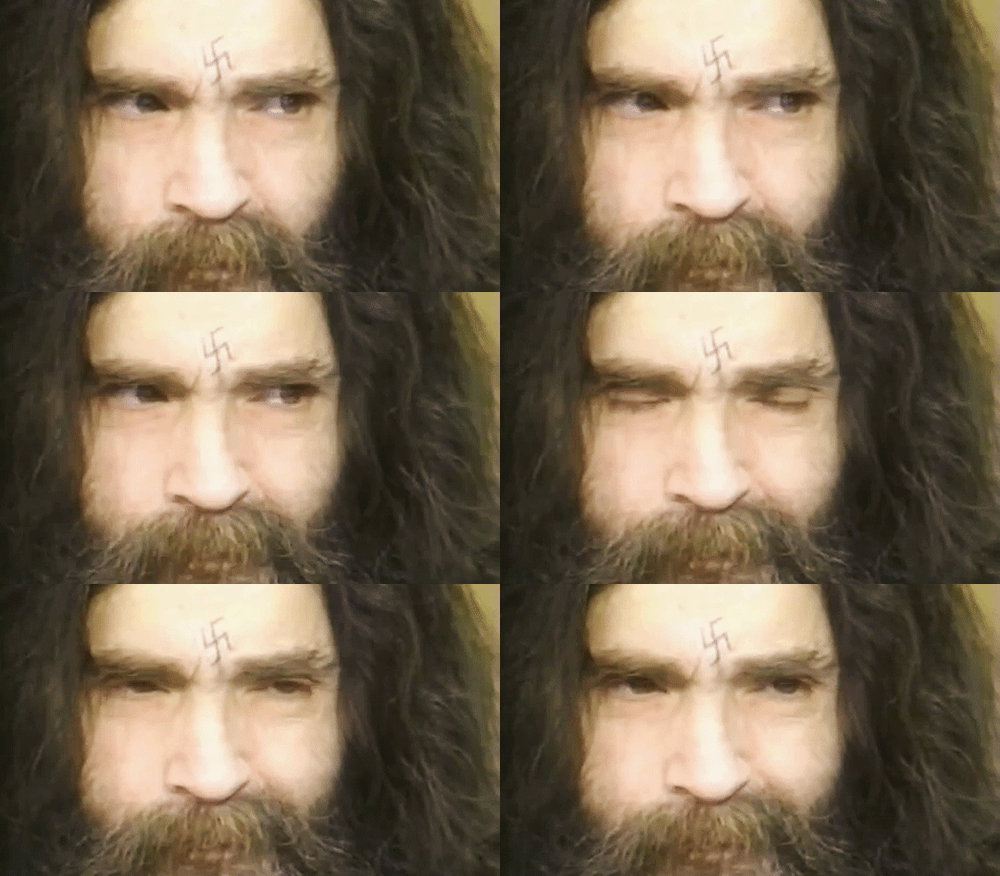
“My father is the jailhouse. My father is your system…I am only what you made me. I am only a reflection of you.”
- Testimony of Charles Manson, November 20, 1970 (given outside the presence of the jury)
When I started Helter Skelter, it did not have an ending; by the time I finished, by an odd quirk of timing, it did. On November 19, 2017, with about a hundred pages left in my paperback chronicle of his infamous deeds, Charles Manson – cult leader, convicted murderer, synonym of charismatic depravity – died of “natural causes” at the age of 83. A mundane end to a homicidally tumultuous life.
To be sure, other members of the “Manson Family” remain behind bars, serving out multiple life sentences (though with the possibility of parole). But the end of Manson feels like the closing of a final chapter. The end of something. Though he never took part in the brutal slayings that killed seven people at two different crime scenes, he is the one that will be remembered for it.
Part of the reason is Helter Skelter, written by Manson prosecutor Vincent Bugliosi, with help from Curt Gentry. Originally published in 1974, Helter Skelter is said to be the number one selling true crime book in history. Certainly it stands alongside Capote’s In Cold Blood as the most famous true crime writing. It casts a long shadow, which is why – spurred on by Netflix’s serial-killer exploration Mindhunter – I finally got around to reading it.
It almost goes without saying, but Helter Skelter tells the well-known story of the so-called Tate-LaBianca murders committed by members of Manson’s Spahn Ranch cult in August 1969. Among the victims was actress Sharon Tate (who was pregnant) and coffee heiress Abigail Folger. Manson acolytes Tex Watson, Susan Atkins, Patricia Krenwinkel, and Leslie Houten were eventually convicted for committing the murders. Manson was convicted for orchestrating them. All were sentenced to die, but had their sentences commuted to life when the California Supreme Court ruled the death penalty unconstitutional.
Bugliosi & Gentry begin their tale with the discovery of the murders at two separate crime scenes. This, to me, is probably the strongest part of Helter Skelter. The opening line – “It was so quiet, one of the killers would later say, you could almost hear the sound of ice rattling in cocktail shakers in the homes way down the canyon” – is a classic hook. This section is detailed, objective, and presented in the third-person.
After setting the gruesome scene, Bugliosi & Gentry take us into the investigative phase. This includes the troubled biography of Charles Manson, who spent most of his pre-Tate-LaBianca life in jail (of course, he spent all of his post-Tate-LaBianca life there as well). At this point, Bugliosi begins to appear more often, and the style turns to the first-person, as he shares his knowledge, insights, and opinions. And he has plenty of opinions. He does not blunt his judgment that LAPD nearly made a botch of the investigation. It’s unusual to see a prosecutor say anything negative towards law enforcement, at least in public, so Bugliosi’s take was rather refreshing. Of course, based on a history of racism, corruption, and incompetence, maybe he’s just going after the low-hanging fruit.
Unsurprisingly, based on Bugliosi’s central involvement, the trial itself is dealt with extensively. All the ins-and-outs are covered, from pretrial motions and jury selection to witness examinations and the sentencing phase. Bugliosi & Gentry often quote the trial transcript, so that you get to see the exact interactions recorded by the court reporter. This is a thorough book. My 20th anniversary paperback weighs in at over 600 pages of text. You really feel the length during certain trial sections. The level of detail is exacting, at times witness by witness, meaning there is a lot of repetition. At times, tedium set in, as I imagine it must have set in for the actual jurors on the seven-month trial. (Bugliosi claims in Helter Skelter that this was the longest criminal trial in U.S. history. It might have been the true then; it certainly isn’t now. In any event, it was lengthy).
My general rule, though, is that too much information is better than too little. I appreciated Bugliosi’s unwillingness to skimp or summarize, even when that came at the expense of the pacing. What did irritate me, however, is Bugliosi & Gentry’s portrayal of the central character: Bugliosi himself.
I don’t like reading first-person accounts for the reason that they inherently lack objectivity. That’s the case here. The underlying theme of Helter Skelter – frankly, “underlying” is putting it mildly – is that Bugliosi was always right, and everyone else was either wrong, or getting in the way. He criticizes the LAPD, the LASO, his own DA’s office, the judge (at times, even though he got just about every ruling he requested), and – most of all – the defense attorneys. Bugliosi may be right in some of his judgments, but he’s certainly wrong in others; of course, since he is the one telling the story, you won’t see that mentioned. For instance, Bugliosi (who is generally extremely negative towards the defense attorneys) directs a lot of ire at Patricia Krenwinkel’s attorney Paul Fitzgerald. Fitzgerald, who was called “legendary” by the Los Angeles Times, left his job at the Public Defender’s Office in order to keep Krenwinkel as a client. Bugliosi continually criticizes Fitzgerald as ineffective, and even intimates that Krenwinkel would’ve walked on the LaBianca slayings had Fitzgerald done a better job. This opinion is not shared by others who watched the trial, including a member of the DA’s office. You don’t read any dissenting views in Helter Skelter; instead, Bugliosi & Gentry tell the story from Bugliosi’s point-of-view, discounting even the possibility that there might be any other worth noting.
(In the 20th anniversary afterword, Bugliosi pulls back from his criticism of Fitzgerald, perhaps mellowed by time and reflection).
Another example of the singularity of viewpoint comes from the fact that Stephen Kay, who assisted Bugliosi, rates only six mentions, even though Kay eventually had to retry Krenwinkel, whose Bugliosi-conviction was overturned.
I read more than my share of true crime, while acknowledging that it can be a sordid genre. When done right, true crime provides a fascinating insight into the darkness and fragility of the human condition. At its worse it is simply gratuitous. There is nothing gratuitous or exploitative about Helter Skelter. It is written in a matter-of-fact style. It never rises to the level of artistry, but makes its points in the manner of a prosecutor’s brief. There are times when Bugliosi, who has already proven his case to the jury, seems intent on proving his case to the reader as well. This does him credit. He does not shy away from explaining what he thought the holes in his own case were. Of course, he never lets even a smidgen of human doubt creep onto these pages, or ever acknowledges that he might have made a mistake. (In my own career doing criminal defense, the certainty of prosecutors has never ceased to amaze me).
When Manson finally died, it was front page news. It begs the question why. Why do we remember Charles Manson and his deeds? It’s a tough question to answer. This wasn’t an epoch-turning crime, where America “lost her innocence” (as though we ever had it). To the contrary, this took place at the height of the Vietnam war; My Lai had already occurred. No, there was no innocence to be lost. Further, despite Bugliosi’s claim to the contrary, these slayings were not sui generis in their horrors. Rather, the annals of American crime are filled with equally brutal slaughters, such as the ax murders of eight people (including 6 kids) in Villisca, Iowa, in 1912.
Today, the Tate-LaBianca murders seem – in a terrible way – almost quaint. How do they compare, after all, to what has happened since? Two high schoolers go into a library and begin methodically executing their fellow students. A young man takes a high-powered rifle into an elementary school and riddles 20 children and six adults with bullets. Fifty-eight people die at a concert in Vegas; twenty-six more are murdered at a Texas church. As Tommy Lee Jones says at the start of No Country For Old Men: “The crime you see now, it’s hard to even take its measure.”
It’s a questions Bugliosi tries to answer, a bit defensively, in the 20th anniversary afterward. His explanations, though, are not satisfactory.
The reason, I think, is that Bugliosi is the one at fault. Bugliosi created Manson the celebrity, the magnetic “Maharaja” who need only part his lips to will murder be done. This happened in two stages: at trial, and with this book.
Bugliosi the prosecutor never needed to prove “motive” in his case. Motive is not an element of murder. Nevertheless, he made it a central feature. He highlighted for the jury Manson’s charm, his powers of control, and his loony ideas about a coming race war, all to prove that Manson’s followers were under his sway. In doing so, he gave credence to Manson’s delusions. People v. Manson became a perverse kind of show trial, in which the defendant, rather than the State, was given an extraordinary platform.
Helter Skelter continued this trend. A good story needs conflict between a protagonist and an antagonist. Bugliosi, of course, cast himself as the dragon-slaying hero. He needed a foil worthy of being conquered. Enter Manson. Bugliosi takes great delight in the narrative in showing himself verbally sparring with Manson, even daring him to take the stand. One of the results is that Manson grew in outsize proportion to his worth.
The world is full of terrible people, and Charles Manson used to be one of them. He was a bad man, and nothing more than that. Bugliosi turned him into an enduring monster. Helter Skelter is a classic, in its fashion. But it also demands of us that we look at Manson and see something more, to learn a lesson that does not exist.
Instead, we should probably think of looking away.