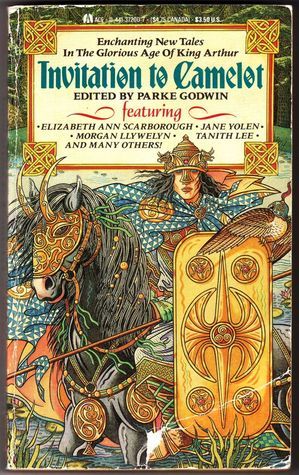
The cover of the paperback edition hearkens back to those 80’s fantasy pulp prints—a bright cover with a Celtic warrior decked in all his regalia and an enchanting world behind him that extends to the back cover and a short blurb that welcomes us to Camelot.
The volume starts with a nice short intro by Parke Godwin, an Arthurian writer I do respect for his Firelord. He is succinct and does not overstay his welcome.
A rather forgettable even pretentious stab at verse by Jane Yolen opens the collection of stories. Thus, Morgan Llywelyn’s capable prose came almost as relief in the first story, “Their Son”—an interesting version on the “Morte.” I don’t know why I was left feeling bit flat at the final reveal and cannot really say much else without spoiling it. Nevertheless, I cannot picture anyone really saying at the end of the story, “Gosh! I didn’t see that coming!” —even though that seems to be the intended effect.
Tanith Lee’s “The Minstrel’s Tale” is a huge step up in the collection at this time, although I do not really see an Arthurian connection, except that it is a medieval ghost story of sorts, extremely well told, with chilling and quaint descriptions that will delight any M.R. James lover.
“Two Bits of Embroidery” by Phyllis Ann Karr is overtly Arthurian and firmly fixed in Malory’s version. The story offers a surprisingly endearing contrast of Kay against the popular Lancelot. Each are offered tokens from two young admirers and with one comes an end, and with the other a beginning. I enjoyed this story and look forward to Karr’s “Idylls of the Queen.”
Scarborough’s “Camelot Connection” is a ramshackle of sci-fi, psychoanalysis with dragons, and humor. Parts of it are humorous and brilliant, but for the most part, the story falls short as something from a pulp magazine.
Parke Godwin’s contribution “Uallannach” (a Prydn word for love) is a retread of his first Arthurian novel, “Firelord,” only this time we approach the story from Modred’s point of view in which he tries to give this pivotal character some more flesh. As a short story it does not really succeed, although Godwin’s prose is supple, well-crafted and light-years ahead of his peers who are included in this volume. Godwin’s most powerful bits of writing are always towards the end, and once again he concludes with a punch.
Oddly enough, one of the more amateurish efforts in the anthology comes from a Harvard Ph.D in Susan Schwartz’s “Seven from Caer Sidi,” (which goes to show that an English degree at a distinguished school does not guarantee a good writer). Did Godwin sequence this pulp prose intentionally after his work to make his own supple efforts shine? Yet, there are moments of brilliance, such as when Arthur looks into the cauldron and sees those who will remember and even write about him. I think I would have enjoyed this one better had I read it in my younger years.
Frost’s “The Vow that Binds” doesn’t seem particularly Arthurian except that at the very beginning there is the mention of King Mark of Cornwall, and this feels almost like an afterthought as an added qualifier to bring the story into the collection. The story starts off promisingly, but in the end goes nowhere.
“Nimuë’s Tale” by Madeline Robins stands head and shoulders above most of the stories here. It is told from Nimuë’s point of view and breathes in the enchanted forest of Brocéliande and the complexities of betrayal and love. Had she written more (and I’m not sure that she has), she would have left Marion Zimmer Bradley trailing, for Robins is the better writer.
Yarbro’s “Night Mare” overextends its welcome without really going anywhere. This is a Mordred story, and after having read Godwin’s take on Mordred, I was predisposed to not really wanting another. I found myself skimming on this read, and at the end felt as if I had just read not so much a short story as the first chapter of a much longer book.
The younger me delighted in Sharan Newman’s “Guinevere”; the older me is bit more critical, but find myself ever with a weak spot just to see her name in print. She is, after all, like a first love, one whose writing I really enjoyed as a Quixotic youth in my day. Here, in her “Palace by Moonlight” Newman does not disappoint. The story takes place thirty years after the fall of Arthur. Miniffer, a poet waxes wistfully about the return of Arthur and meets various characters, who all tend to take the stories he loves into outright bawdiness until he meets Domin, someone who actually served at Camelot, and then moves on to meet the legends he sings about. This is the type of story (the most pleasurable by far) I expect in an anthology with the promising title “Invitation to Camelot” and I would have been satisfied had the collection ended here.
Yolen’s “Meditation in a Whitethorn Tree” is refreshingly amusing and even lighthearted as a trapped Merlin ponders on the women of the Arthurian legends. His musings have a twist and Guinevere, depicted as being far from beautiful, presents the most surprising twist of all. I was not looking forward to Yolen’s contribution as I had read some something else that had failed to impress me in some forgotten anthology. Here, she has surprised me.
Another surprise follows in Ford’s contemporary lines that scatter and coalesce the Arthurian legend in a modern train station. There is descriptive power here, the type of thing I have not seen done to the legend since Mark Twain and T.H. White. One by one the characters step unto the station: Gareth , Gaheris, and Agravaine in Orkney sweaters; Gawain in Shetland tweed; Palomides in damascene armor; Galahad “Just the sort of man you’d want finding your chalice./ He signs an autograph, he strikes pose”; Mordred who prefers to fly but shows up, matching his car “upholstered in blue velvet and black leather.” Wow! I’ll have to read this again.
The anthology ends with a cursory afterword by Thompson, an English professor who sums up the recurring themes within the collection with some allusions to medieval sources. In short, I think this is the best Arthurian anthology of modern short stories I have read. Despite some of the low points, the high points more than compensate.