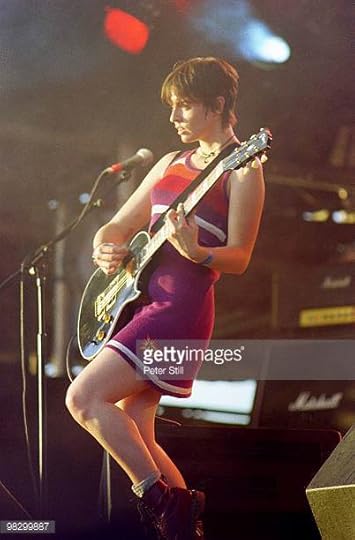
[3.5] Louise from Sleeper: plenty to like and also plenty to dislike, she wasn't easy or straightforward and that was part of her awkward-squad appeal. In the first, pre-fame, half of the book I was reminded mostly of the dislike; I was annoyed and frustrated as I had been nearly twenty years ago when reading her interviews, full of disappointment that someone I thought was cool had said that. And wished, then and now, that I was reading Justine Frischmann instead because she wasn't like this.
That first half was mostly in that semi-humorous nostalgic journalese that thousands of people, including several of my friends, can write creditably probably even on a bad hangover and no sleep. Tapes made from Top of the Pops, people you liked and disliked at school (surnames always given as part of the style, though it rarely seems a fair thing to do) - you know the sort of thing. It gets old unless you really really like the person, the music they're talking about and/or they've got a transcendent writing style. I actually wouldn't swap her childhood for mine, though it, whilst far from perfect, was happier and more normal on balance. Whilst she, like me, felt a bit out of sync due to having older parents, she was just a bit brighter than average, not brilliant as I'd assumed when I was a teenager, and she seemed too content with the mediocrity around her, not weird enough - an asset in her suffocating, bully-riddled Essex school... There are shining moments but mostly it's all very stereotype-Essex, right down to the way she and her friend dress to see a Bowie gig. I used to assume that having spent teenage years closer to London would mean that interesting, less obvious music and culture and people who liked them were easier to find, but this was no better than hundreds of miles further north - and much worse than my school which was at least quite peaceful (even if it couldn't compare, in terms of academic options or interesting people, with the schools many of my university friends had been to).
Much of the meh-ness fell into place later, with this: “Our debut interview was with the NME or Melody Maker, I'm not sure which – both are interchangeable to me. Jon, Diid and Andy have grown up on these papers but they've never been part of my musical landscape.” So that's partly why her tastes stayed so mainstream-pop, why she never even referred to the idea of corporate-sellout plastic Bowie in order to dismiss it, why in her teens she hardly seems to get any more serious about music than she was as a kid. That she didn't have any idea about what you actually needed to do to be in a band until she went to university and didn't even know the difference between rhythm guitar and bass. (The fucking cheek! As far as I was concerned you were a write-off band-wise if you hadn't learned to play guitar etc reasonably well by university time . Not that I, being frequently ill and also very moody back then, would have been any sort of asset to a student band even if I could play. I had several opportunities to talk myself into bands, but wouldn't have dared because you already had to have the skillz. I was in absolute agreement with that, never liked people to see I couldn't do stuff, and simply being an okay singer was not good enough for me if I couldn't play and write. If it hadn't been for illness I certainly would have made a better stab at it, or perhaps I would have been confident enough not to think the keyboard too embarrassing to be worth working at; as it was my hands were too weak for guitar and I tired too easily in the crucial year or two when it may still have been worth seriously learning and practising guitar - pretty often even walking to lectures was too much.Yes I am bitter.)
Oh god, and then there was this bit: “He's a boy. He is very particular about amps and guitars. He's surprisingly reluctant to base his selection criteria on a) which guitar looks the prettiest b) which guitars come in green, c) what guitar Courtney Love is currently using.” [I have one of my bouts of “I'm not actually a girl, I'm something that was randomly allocated the body of one (and usually tries to make the best of this). Though at least she reminded me of an old favourite, Hole's 'Celebrity Skin'... my name is might have been, my name is never was, my name's forgotten, and that power pop chorus angrily celebrating nothing - because you might as well when you've nothing else to celebrate but almost. Words and ideas which sound quite different when nearly twenty years older; I'm just smiling in recognition. ]
And this: “His interview technique is a test of their musical hobbyism, to see if they pass muster or fail...It goes on like this for another half an hour. Endlessly on about favourite rock guitarists and obscure German electronica and not a single question directed to the girly singer. No enquiry into songwriting or lyrics.” Now, there were not a lot of social things I was good at as a fresher, but I am 100% serious that even as a teenager I dealt with equivalent group conversations way better. You fucking well interrupt, you tell them your opinions about music that are as well-informed as theirs, you watch the momentary puzzlement gradually turn to respect, which is a bit of a buzz, and you keep on with the joining in and interrupting - after all they interrupt each other all the time, so once they've noticed you in the first place it becomes equal. In my day there was even a useful comedy reference if they were being twats in certain ways. (Mentioning the Fast Show woman whose ideas were always repeated by men – I used to know her character name – leveraged several apologies. Thank you Arabella Weir.) If I'd been more truly confident and more solid, I should have started referring to them as my Sleeperblokes...
It was a great disappointment to me, and I honestly thought it would not be this way as I got older, that I can count on the fingers of one hand the other women I've known who also like this sort of intensively detailed conversation about music – and a couple of them I don't even know very well, mostly just to talk to online in group discussions.
Oh yeah, and the “musical hobbyism” thing, and not talking about songwriting? That's because the journo doesn't want to show up his own shortage of musical talent, is trying to create a level playing field with people he envies, and is doing the same for many readers who are in the same boat. Not that I realised this until I was much older...
But then, but then … In that same bit about the interview, just as they're starting to get famous, there at last is the Louise Wener who I remembered, who was the reason to read this bloody book...
Not even realising the irony of this whilst making no effort to talk to the woman, the journalist “hasn't stopped banging on about political correctness since he got here.
You use the phrase 'right on' a lot, don't you?...it's a bit prescriptive, a bit Orwellian” (p.158)
She may have felt like a controversialist cartoon, but if you were a teenage girl with strong, awkward opinions, reading this stuff was seriously inspiring.
Then remembering about when I disagreed with her and agreed with Frischmann.
“How does it feel to know boys are masturbating over your photograph?...They are questions male music journalists ask me. All the time...”
[Find quote] Justine Frischmann was detached, amused and cool, not angry or especially flattered. Which was even more cool because she didn't look like Claudia Schiffer.
Though what I don't remember anyone saying at the time was “So what? If you're not very old or a complete moose (and possibly even then given the infinite variety of humanity and its secret tastes) someone who saw you on the bus this week probably thought about you later on whilst they were having a wank. It's good that they don't tell you...”
It's probably fitting that a post about Louise Wener consists mostly of off-topic, off-the-cuff rants. But yeah, on to the good stuff, because there is also plenty of it. In the pre-fame section 1, her writing really takes off, away from the journalese, with the more melancholy stuff: the chapter on the “groundhog years” of temp jobs, cold flats, rubbish rehearsal rooms and greasy spoons, and on her father's last illness and death. That inspired her to give the band one last push, a sad event but so lucky in the timing: a band like theirs needed to pop up in 1993-4 at the beginning of the Britpop cycle; arrive very late at the party in 96 or 97 and you might only have a few months before you were dropped. (Later, she says that one thing that contributed to the rise and fall of Britpop was cuts in singles prices that record companies couldn't really afford, and in 97 they were put up again. [p.296] Which instinctively makes sense. I didn't buy a lot of singles when I already had the album, but when they were only 99p I sometimes would if I liked a B-side that Lamacq and Whiley had played, or to support a band like a team. I still remember the scorching journey into town to buy the cassette single of 'Country House', in the summer of 1995 which for me as for her is “indelibly hot and sunny in my memory”. I loved to imagine I was somewhere else (Camden), doing more exciting things, but far away in my boring life there was still some magic.)
Films or songs about being famous are often derided, and not of much interest to people who haven't experienced it, but Louise Wener's writing about her few years of fame is often much better, more alive and wiser than the by-numbers schooldays stuff (not entirely free of cliches, but there's a vivid urgency that makes them easier to disregard). I couldn't quite believe it after the disappointment of the first half. She makes me realise stuff I should have worked out years ago: the extent to which bands aren't in control of their own budget, that labels can piss them off by spending stupid amounts of royalties on promo stuff . Or (one that was more between the lines) that the stress of being cooped up with other people and their noise and smells and unending presence on tour buses can make temperamental types who need their space tip from drug use into addiction as they try to cope. I know I would have to be out of it to live with some of that stuff 24 hours a day for weeks on end. Louise Wener feels lucky not to have an addictive personality: ”you can happily regress to a sort of dirty, corrupt state of extended childhood if you want to. Other people will make your decisions for you. Other people will endlessly spin your mistakes. You see it all the time, bands laying down in the chaos and getting comfortable, forgetting to get back up again.” (p.263) I was only ever dimly aware that whilst Louise was in the band she'd been the partner of one of them for seven years, split up with him, and shortly afterwards started going out with one of the others (who she's still with now). And they managed to keep the band functioning reasonably well for about three years, including being in each others' pockets on tour, after that which is pretty impressive. You have to be a pretty solid, non-temperamental personality to pull that off. And it must have been well-managed for it not to become the defining thing about the band to someone who read as much music press as I did. (It's a bit of a shame that she wants to discourage her children from getting involved in music, but I'm not sure quite how serious she was about that bit.)
After the annoyance about pretty guitars above, I was absolutely delighted to read this: “Six hours working out the exact guitar line that fits the newly-crafted chorus. I'm getting geeky about sonics. I'm getting particular about amps and snare drum sounds. I'm not so bothered if my guitar is green or not...Music is slippery and elusive and chasing it, taming it, making it fit together is where the good stuff is. What I love most about all of this, I'm beginning to realise, is the process”. (p.245)
Sleeper may not have been as good as Blur and Pulp, but they did have some decent songs.
There were yer classic Britpop character songs ….back in the early 80s one of the seeds was sown: “the [Jam] album I fall in love with is Setting Sons. It's less Vespa and Parka than All Mod Cons, more crafted, satirical and Kinks-ish. It's crammed full of narratives about wasted lives and class rivalries... council houses, rusting bicycles and holy Coca-Cola tins... 'Smithers-Jones': I don't think I've ever heard a pop song with lyrics about a ground-down, pinstripe-suit-wearing middle-aged man before.” (p.54) But it was the songs about love and sex which stuck in my memory most.
'What Do I Do Now?', even before I'd experienced a moribund relationship, was almost too real and painful to listen to, and there's something great about the way it's so simple, so poignant and catchy and jaunty. It wasn't for years, till I'd realised about my own Inbetweeners and my dismissiveness of them that I really heard what she'd been on about in that track. Or 'Delicious', “a frank, gorgeous, throwaway, punky pop gem about the pure lustful joy of having it off with someone [you] really really like”. And which enshrined that word for me; it's rare I use it without thinking of the song. Though I always had to block out the line that created the unattractive image of some hulk of a rugby player gone to seed (“you're a big man but you're out of shape” … her type isn't mine). I never bought the second album – it didn't seem cool and I'd probably disagreed with too many of Louise's interviews – though I've heard a few friends praise it since. Sleeper are maybe a band where you'd recommend a few tracks – likewise I'd like to recommend bits of Just For One Day rather than the whole thing, though books don't really work that way.