Spring is here and even with beaches closed, I knew I could "run for cover" with a series that has never left me dry. John D. MacDonald published twenty-one Travis McGee mysteries (between 1964 and 1984) narrated by his weary "salvage consultant" who often agrees to locate missing persons or items. MacDonald was one of the earliest authors to use themed titles for their series and his wonderful use of color not only offered a visual motif to help readers tell one book from another, but generated some of my favorite titles: The Deep Blue Good-By, Darker Than Amber, The Lonely Silver Rain, etc.
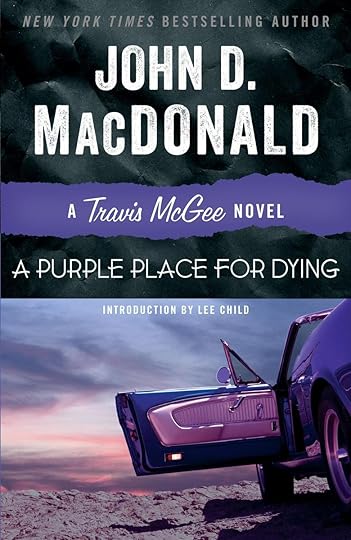
Up next is A Purple Place For Dying. Published in 1964 as the third entry in the series, MacDonald shakes things up by transporting McGee far from his 52-foot houseboat The Busted Flush in Fort Lauderdale. He's introduced near the town of Esmerelda in an unspecified state in the American West. McGee has accepted plane fare from a potential client, a "ripe-bodied blonde of about thirty" named Mona Yeoman, who likes to give orders and take curves fast. She drives them out to a cabin she keeps where McGee can stay should be take the job. She explains that her husband is Jasper Yeoman, business partner of her late father and executor of her father's estate.
Accepting Jass' marriage proposal while she was tore up and need of care, Mona assumed she could divorce him and inherit the money her father had left her. Jass informs her that the estate is gone. Mona wants McGee to find proof her lawyer could not that her husband plundered her inheritance. She needs that money to divorce him and run away with a community college professor named John Webb who she's fallen in love with. McGee calculates that Mona doesn't really want to recover her inheritance or run off with any penniless lover, but make a scene of it for her husband. He's about to turn the job down when someone else does it for him.
Suddenly she plunged forward, her shoulder brushing me and knocking me back. She went with her tilted back, and she landed facedown on the baked dirt and edges of stone, and slid at least six inches after she struck, without having lifted her hands to try to break her fall. The noise that started the fall was a curiously ugly noise. It was a dull sound of impact, like the sound of burying a hatchet into a soft and rotten stump. She lay without a twitch, without sound, totally soft and flattened. I heard then the distant ringing bark of a heavy rifle, a ka-rang, echoing in the still rock hills of the windless day.
McGee waits the sniper out and confirming that Mona Yeoman is dead, manages to make his way back to where they left the car. It's gone and the road ahead blocked by a rockslide which appears dynamited. McGee walks to a roadhouse, phones the sheriff to report the murder but accompanying them back to the crime scene, find no body or trace of Mrs. Jass Yeoman. The assumption among the more dim witted of Esmerelda is that Mona has run off with her boyfriend and McGee is trying to make it seem like she was killed, but McGee lucks out when the town sheriff proves to be a good cop who doesn't buy that.
Financing his investigation with cash he removed from Mona's purse before his flight to safety, McGee checks himself into a motel and once again, determines to poke his nose where no one has asked him to poke it. Jass Yeoman drops by to size McGee up and the amateur sleuth concludes that Mona's husband was neither aware nor wanted his wife killed. He visits the college where John Webb taught and meets his sister Isobel, an intellectual who has filled in the missing spaces of her own life by trying to manage her brother's. She's sure he's run off with Mona but when McGee discovers Webb's insulin left behind, they conclude someone wanted it to look like he'd run off.
Once the sheriff turns up lung tissue belonging to Mona Yeoman at the crime scene, Jass Yeoman hires McGee to find out who killed her. The old boy admits to everything else but wanting to kill his wife, plundering her father's estate, conducting shady business deals, facing an IRS audit and fathering illegitimate children over the years. McGee narrowly saves Jass from being stabbed by an assassin and the suspects could be limitless. He tries to comfort Isobel, who's going through the five stages of grief as she realizes someone had her brother murdered. McGee came to town with regrets of his own and as he looks around at modern life, doesn't like what he sees.
Education is something which should be apart from the necessities of earning a living, not a tool therefor. It needs contemplation, fallow periods, the measured and guided study of the history of man's reiteration of the most agonizing question of all: Why? Today the good ones, the ones who want to ask why, find no one around with any interest in answering the question, so they drop out, because theirs is the type of mind which becomes monstrously bored at the trade-school concept. A devoted technician is seldom an educated man. He can be a useful man, a contented man, a busy man. But he has no more sense of the mystery and wonder and paradox of existence than does one of those chickens fattening itself for the mechanical plucking, freezing and packaging.
If Travis McGee had decided that modern living was beyond redemption, he'd be asea and never offer to help those in trouble. If he was only doing it for money, he'd be dead. A Purple Place For Dying starts off with a bang and from there, under different guises and circumstances offers all the things I love about this series: brutal violence that demands justice, hidden money, a woman who helps McGee as much as he helps her. I marvel over how MacDonald shuns trends, tech or pop culture that could date this as a product of the early '60s. The result is a timeless detective mystery. His first-person prose rolls off the page and his dialogue is often magnanimous.
She frowned across the table at me, dark glasses laid aside. "There is something about trying to kill yourself, no matter what. Maybe the ability to feel deeply. I don't know. I feel like a stranger to myself. I have to find out who I am, who I am going to be. I feel--cut loose from everything. And I have this strange little feeling of--some kind of unholy joy. Every once in a while. An electric sparkle, like knowing you're soon to go on holiday. I shouldn't feel like that for no reason. I keep wondering if something is--wrong with my mind."
"I'll make an absurd guess. Maybe you're glad to be alive."
"Not particularly. But I won't try to kill myself again."
This novel did sag in the middle for me. Like a lot of prolific authors, MacDonald was able to crank out so many books by kicking his interior editor off the boat and hitting the throttle. Dialogue runs on in some spots and characters fall into the habit of telling each other things that a more compelling story might've found ways to introduce as clues. But something else MacDonald dials in supremely well is an exciting climax, throwing McGee into a life or death struggle with someone far more desperate than he is and who always seems one step ahead of him. A Purple Place For Dying satisfied in all the ways I hoped this book would, curing my reader's block in the process.
Word count: 75,715 words