

What do you think?

The White Wolf of the Hartz Mountains
"The Werewolf," a short story extracted from Frederick Marryat's novel The Phantom Ship (1839) . Reprinted many times since, often under alternative title of "The White Wolf of the Hartz Mountains," the tale chronicles the misfortunes of Krantz, A Hungarian nobleman's steward, who flees from Transylvania with his three children after murdering his unfaithful wife and lover.
48 pages, Paperback
First published January 1, 1839
About the author
Frederick Marryat
1,021 books92 followersCaptain Frederick Marryat was a British Royal Navy officer and novelist, an early pioneer of the sea story.
For more information, please see http://en.wikipedia.org/wiki/Frederic...
For more information, please see http://en.wikipedia.org/wiki/Frederic...
Ratings & Reviews
Friends & Following
Create a free account to discover what your friends think of this book!
Community Reviews
Displaying 1 - 29 of 29 reviews

March 18, 2020
A very compelling and uncanny classic story about a father first killing his wife and her seducer and later on marrying a mysterious young woman named Kristina in the Hartz mountains. At first his new wife is friendly but later on she turns into something else. Will the three children survive? What about her night-outs? Krantz tells his friend Philip this incredible and adventurous tale. A real classic page turner with some violent elements. What a tale. Highly recommended!

February 24, 2014
Read this. It's really dark and awesomely terrible. And for a most satisfactory experience, pretend you are reading it in the era in which it was written. If it never received critical success, and I'm not sure it did, it would have been because it was just too cruel. It has a description of an abusive household that draws the reader in with eerie sense of realism. It doesn't toy with the notion of weak circumstantial evil, like so much other horror out there. The villains and dark forces in these stories (there are two stories, the flashback and the wrap-around) are fiercely wicked and totally unprovoked. And the underlying notion that human lives are always subject to outside evil interference is a convincing one.

December 9, 2015
Amongst the pages of Frederick Marryat’s gothic novel, The Phantom Ship, lies a short tale titled The White Wolf of the Hartz Mountains. A supernatural yarn filled with strange events meant to haunt the reader, it narrates the tragedy of a family brought to despair and annihilation under odd circumstances.
In the vast expanse of Transylvania, Krantz, a serf, commits double murder by killing his wife and lord for having engaged in a sexual affair during his absence. Fearing the punishment he will surely receive, he decides to flee with his three young children to an isolated area where none will be able to trace him, thus ending up in the Hartz Mountains.
But the Hartz Mountains conceal within their harshness and cold beauty a horrifying secret. One night, a white she-wolf howls without intermission for hours. Krantz takes the bait and leaves his hut to give chase to her. As he comes a stone’s throw away from her, though, and is about to shoot, the beast suddenly vanishes. A few minutes later, a huntsman appears followed by his young daughter.
Krantz offers his hospitality to the pair of strangers and not much time has lapsed when he decides to marry Christina, the huntsman’s daughter, first having sworn by a peculiar oath imposed by his new father in law.
“I swear by all the spirits of the Hartz mountains, by all their power for good or for evil, that I take Christina for my wedded wife; that I will ever protect her, cherish her, and love her; that my hand shall never be raised against her to harm her. And if I fail in this my vow, may all the vengeance of the spirits fall upon me and upon my children; may they perish by the vulture, by the wolf, or other beasts of the forest; may their flesh be torn from their limbs, and their bones blanch in the wilderness: all this I swear.”
Thus, married life starts, but it is far from a blissful one as the menacing oath foreshadows. Christina turns out to be far from the loving and caring ideal of the woman as the Victorians conceived her. Instead, she abuses her stepchildren and abandons her marital bed at night in order to prowl in the forest in the form of a vicious she-wolf.
The Victorians held fast to strict rules regarding women. The female was supposed to exhibit traits of docility and sexual submission, recognizing the power and absolute dominance of the male. Women displaying traits that flouted such notions such as strong sexual urges and passionate appetites were deemed a disgrace and an abomination who had to either be excluded from polite society or to forcibly jump on the bandwagon of meekness.
In the tale, Krantz’s first wife is described as ”more beautiful than virtuous”, a phrase that denotes her vast carnality, something which makes her deserving of her tragic fate. Similarly, Christina conceals a carnal nature, for beneath her beauty a fierce longing for the flesh is concealed. However, Christina takes this carnality to a whole other level, her behaviour even more appalling than the first wife’s. She doesn’t seek for a lover, but devours the little bodies of her husband’s children, her hunger for the flesh acquiring a literal meaning.
Plato had talked of the wandering uterus claiming that ”when remaining unfruitful long beyond its proper time, it gets discontented and angry, and wandering in every direction through the body causes all varieties of disease.” The fact that Christina wanders at night by rejecting her conjugal state and that of motherhood can be interpreted by Plato’s theory as a symptom of hysteria caused by her empty womb. A common belief in the Victorian culture as women not bearing children frequently were thought to suffer from anxiety, nerves and agitation.
Christina’s abhorence to motherhood and her domestic responsibilities incite her to not only beat her stepchildren but to eventually devour them alive. Hearing the howl one night, the oldest son, Ceasar, rushes outside. Later, his mutilated body is found. Christina comments that he must have been hunting the white she-wolf and couldn’t fight off the powerful beast. The male legacy is threatened as the family’s oldest heir lies dead.
It is only after the youngest child, Marcella, is killed that Christina’s bestial nature is disclosed. Seeing his stepmother abandon her bed, Hermann, the only surviving offspring, stalks after her only to see her devouring the remains of Marcella at the little girl’s grave. He dashes inside the house to call his father who, with horror, sees “his wife in her nightdress, on her hands and knees, crouched by the body of Marcella, tearing off large pieces of the flesh, and devouring them with all the avidity of a wolf.”
Struck by the dreadful scene of cannibalism, Krantz drops his gun, the phallic symbol of male dominance. Hermann, as the surviving male heir picks it up and gives it back to his father, forcing the patriarch to come to his senses and assert his authority over his wife, by shooting at the beast.
In the end, a surprising reversal of the werewolf trope takes place. Dead, instead of returning to her human form as it usually happens in the werewolf lore, Christina remains in the semblance of the white she-wolf. Perhaps a reminder that beneath the glossy camouflage of gentleness and sweet domestication that women present, the voracious beast is always ready to leap to the surface.
Having read this tale multiple times, I found myself conflicted because one could, also, interpret it as going to the entirely opposite direction. Instead of being a story of expression of male Victorian fear and obsession regarding the untamed nature of women and the need for their suppression, it could be viewed as a cautionary tale that warns readers about the dangers of such a catastrophic suppression.
Nothing is known about the first wife. Nor about the second. Their background and character history is a blank canvas. However, a few things are known about Krantz that don’t help the reader picture him in a particularly flattering light. We read that he’s moody, brusque in his manner and violent towards his youngest child. Nothing is mentioned openly, but there lurks throughout the tale an unspoken implication that perhaps it’s Krantz’s male dominance that caused both his wives to disregard their domestic duties and abandon their passive respectability in order to answer their undeniable call to freedom. A freedom gone awry after so much brutal suffocation.
The reader is left wondering: if Krantz didn’t act as a swinish symbol of male power and brutish control, would his first wife seek a liaison outside marriage and would Christina abandon her marital bed at night and sadistically murder his children? Marryat perhaps might be suggesting here that a system of female subjugation to male authority leads to monstrosities and deeply unnatural consequences that can only end in tragedy for everybody involved.
Last, I believe there’s room for a third interpretation (if not for many more). Leaving aside for a moment both patriarchal and feminist perspectives, the story can be read as a narrative of justice. A justice that hovers between the human and the divine laws. Krantz, having caught wind of his wife’s unfaithfulness, ”surprised her in the company of her seducer! Carried away by the impetuosity of his feelings, he watched the opportunity of a meeting taking place between them, and murdered both his wife and her seducer.
”Conscious that, as a serf, not even the provocation which he had received would be allowed as a justification of his conduct, he hastily collected together what money he could lay his hands upon, and, as we were then in the depth of winter, he put his horses to the sleigh, and taking his children with him, he set off in the middle of the night, and was far away before the tragical circumstance had transpired. Aware that he would be pursued, and that he had no chance of escape if he remained in any portion of his native country (in which the authorities could lay hold of him), he continued his flight without intermission until he had buried himself in the intricacies and seclusion of the Hartz Mountains.”
Krantz flees the scene of the murder, dreading the consequences of his action. Secluded in the Hartz Mountains, he has escaped from the claws of the human law. However, punishment cannot be evaded, and Krantz has only managed to fool himself in thinking so. As it turns out, he cannot avoid the punishment meted out by some higher forces residing in this world.
After Krantz kills Christina in the semblance of a white she-wolf, the huntsman returns to the hut and demands to see his daughter. When Krantz lashes out and tells him all that has happened, the huntsman replies, ”Mortal! We have power over those only who have committed murder. You have been guilty of a double murder: you shall pay the penalty attached to your marriage vow. Two of your children are gone, the third is yet to follow and follow them he will, for your oath is registered. Go. It were kindness to kill thee. Your punishment is that you live!”
Here it is important to remember that as Hermann, an adult now, narrates this tale to his friend, Philip, the second makes some philosophical and ethical remarks. We read, ”The great principle of all evil fulfils his work of evil; why, then, not the other minor spirits of the same class? What matters it to us, whether we are tried by, and have to suffer from, the enmity of our fellow−mortals, or whether we are persecuted by beings more powerful and more malevolent than ourselves? We know that we have to work out our salvation, and that we shall be judged according to our strength; if then there be evil spirits who delight to oppress man, there surely must be, as Amine asserts, good spirits, whose delight is to do him service. Whether, then, we have to struggle against our passions only, or whether we have to struggle not only against our passions, but also the dire influence of unseen enemies, we ever struggle with the same odds in our favour, as the good are stronger than the evil which we combat. In either case we are on the ‘vantage ground, whether, as in the first, we fight the good cause single−handed, or as in the second, although opposed, we have the host of Heaven ranged on our side. Thus are the scales of Divine justice evenly balanced, and man is still a free agent, as his own virtuous or vicious propensities must ever decide whether he shall gain or lose the victory.”
Could the hunstman’s final confrontation with Kratz reveal to us the story’s deeper meaning? If the supernatural forces are in league to deliver justice upon the mortal world and leave the innocent untouched, then the roles are suddenly reversed. Krantz is the villain and the destruction Christina wreaks is merely in the service of just punishment. Where the human law has failed, the law of a superior force is ultimately enacted.
Philip comments about the existence of evil spirits that delight to oppress man and good spirits that work in his favour. Having read the tale on the Hartz Mountains, it becomes evident that what Philip expresses takes on another meaning in the end. Horrific as Christina’s actions might seem to the reader, Marryat might be implying that justice is poetic and the guilty only suffer according to the proportion of the offense they have committed.
A strong case of no rest for the wicked.
In the vast expanse of Transylvania, Krantz, a serf, commits double murder by killing his wife and lord for having engaged in a sexual affair during his absence. Fearing the punishment he will surely receive, he decides to flee with his three young children to an isolated area where none will be able to trace him, thus ending up in the Hartz Mountains.
But the Hartz Mountains conceal within their harshness and cold beauty a horrifying secret. One night, a white she-wolf howls without intermission for hours. Krantz takes the bait and leaves his hut to give chase to her. As he comes a stone’s throw away from her, though, and is about to shoot, the beast suddenly vanishes. A few minutes later, a huntsman appears followed by his young daughter.
Krantz offers his hospitality to the pair of strangers and not much time has lapsed when he decides to marry Christina, the huntsman’s daughter, first having sworn by a peculiar oath imposed by his new father in law.
“I swear by all the spirits of the Hartz mountains, by all their power for good or for evil, that I take Christina for my wedded wife; that I will ever protect her, cherish her, and love her; that my hand shall never be raised against her to harm her. And if I fail in this my vow, may all the vengeance of the spirits fall upon me and upon my children; may they perish by the vulture, by the wolf, or other beasts of the forest; may their flesh be torn from their limbs, and their bones blanch in the wilderness: all this I swear.”
Thus, married life starts, but it is far from a blissful one as the menacing oath foreshadows. Christina turns out to be far from the loving and caring ideal of the woman as the Victorians conceived her. Instead, she abuses her stepchildren and abandons her marital bed at night in order to prowl in the forest in the form of a vicious she-wolf.
The Victorians held fast to strict rules regarding women. The female was supposed to exhibit traits of docility and sexual submission, recognizing the power and absolute dominance of the male. Women displaying traits that flouted such notions such as strong sexual urges and passionate appetites were deemed a disgrace and an abomination who had to either be excluded from polite society or to forcibly jump on the bandwagon of meekness.
In the tale, Krantz’s first wife is described as ”more beautiful than virtuous”, a phrase that denotes her vast carnality, something which makes her deserving of her tragic fate. Similarly, Christina conceals a carnal nature, for beneath her beauty a fierce longing for the flesh is concealed. However, Christina takes this carnality to a whole other level, her behaviour even more appalling than the first wife’s. She doesn’t seek for a lover, but devours the little bodies of her husband’s children, her hunger for the flesh acquiring a literal meaning.
Plato had talked of the wandering uterus claiming that ”when remaining unfruitful long beyond its proper time, it gets discontented and angry, and wandering in every direction through the body causes all varieties of disease.” The fact that Christina wanders at night by rejecting her conjugal state and that of motherhood can be interpreted by Plato’s theory as a symptom of hysteria caused by her empty womb. A common belief in the Victorian culture as women not bearing children frequently were thought to suffer from anxiety, nerves and agitation.
Christina’s abhorence to motherhood and her domestic responsibilities incite her to not only beat her stepchildren but to eventually devour them alive. Hearing the howl one night, the oldest son, Ceasar, rushes outside. Later, his mutilated body is found. Christina comments that he must have been hunting the white she-wolf and couldn’t fight off the powerful beast. The male legacy is threatened as the family’s oldest heir lies dead.
It is only after the youngest child, Marcella, is killed that Christina’s bestial nature is disclosed. Seeing his stepmother abandon her bed, Hermann, the only surviving offspring, stalks after her only to see her devouring the remains of Marcella at the little girl’s grave. He dashes inside the house to call his father who, with horror, sees “his wife in her nightdress, on her hands and knees, crouched by the body of Marcella, tearing off large pieces of the flesh, and devouring them with all the avidity of a wolf.”
Struck by the dreadful scene of cannibalism, Krantz drops his gun, the phallic symbol of male dominance. Hermann, as the surviving male heir picks it up and gives it back to his father, forcing the patriarch to come to his senses and assert his authority over his wife, by shooting at the beast.
In the end, a surprising reversal of the werewolf trope takes place. Dead, instead of returning to her human form as it usually happens in the werewolf lore, Christina remains in the semblance of the white she-wolf. Perhaps a reminder that beneath the glossy camouflage of gentleness and sweet domestication that women present, the voracious beast is always ready to leap to the surface.
Having read this tale multiple times, I found myself conflicted because one could, also, interpret it as going to the entirely opposite direction. Instead of being a story of expression of male Victorian fear and obsession regarding the untamed nature of women and the need for their suppression, it could be viewed as a cautionary tale that warns readers about the dangers of such a catastrophic suppression.
Nothing is known about the first wife. Nor about the second. Their background and character history is a blank canvas. However, a few things are known about Krantz that don’t help the reader picture him in a particularly flattering light. We read that he’s moody, brusque in his manner and violent towards his youngest child. Nothing is mentioned openly, but there lurks throughout the tale an unspoken implication that perhaps it’s Krantz’s male dominance that caused both his wives to disregard their domestic duties and abandon their passive respectability in order to answer their undeniable call to freedom. A freedom gone awry after so much brutal suffocation.
The reader is left wondering: if Krantz didn’t act as a swinish symbol of male power and brutish control, would his first wife seek a liaison outside marriage and would Christina abandon her marital bed at night and sadistically murder his children? Marryat perhaps might be suggesting here that a system of female subjugation to male authority leads to monstrosities and deeply unnatural consequences that can only end in tragedy for everybody involved.
Last, I believe there’s room for a third interpretation (if not for many more). Leaving aside for a moment both patriarchal and feminist perspectives, the story can be read as a narrative of justice. A justice that hovers between the human and the divine laws. Krantz, having caught wind of his wife’s unfaithfulness, ”surprised her in the company of her seducer! Carried away by the impetuosity of his feelings, he watched the opportunity of a meeting taking place between them, and murdered both his wife and her seducer.
”Conscious that, as a serf, not even the provocation which he had received would be allowed as a justification of his conduct, he hastily collected together what money he could lay his hands upon, and, as we were then in the depth of winter, he put his horses to the sleigh, and taking his children with him, he set off in the middle of the night, and was far away before the tragical circumstance had transpired. Aware that he would be pursued, and that he had no chance of escape if he remained in any portion of his native country (in which the authorities could lay hold of him), he continued his flight without intermission until he had buried himself in the intricacies and seclusion of the Hartz Mountains.”
Krantz flees the scene of the murder, dreading the consequences of his action. Secluded in the Hartz Mountains, he has escaped from the claws of the human law. However, punishment cannot be evaded, and Krantz has only managed to fool himself in thinking so. As it turns out, he cannot avoid the punishment meted out by some higher forces residing in this world.
After Krantz kills Christina in the semblance of a white she-wolf, the huntsman returns to the hut and demands to see his daughter. When Krantz lashes out and tells him all that has happened, the huntsman replies, ”Mortal! We have power over those only who have committed murder. You have been guilty of a double murder: you shall pay the penalty attached to your marriage vow. Two of your children are gone, the third is yet to follow and follow them he will, for your oath is registered. Go. It were kindness to kill thee. Your punishment is that you live!”
Here it is important to remember that as Hermann, an adult now, narrates this tale to his friend, Philip, the second makes some philosophical and ethical remarks. We read, ”The great principle of all evil fulfils his work of evil; why, then, not the other minor spirits of the same class? What matters it to us, whether we are tried by, and have to suffer from, the enmity of our fellow−mortals, or whether we are persecuted by beings more powerful and more malevolent than ourselves? We know that we have to work out our salvation, and that we shall be judged according to our strength; if then there be evil spirits who delight to oppress man, there surely must be, as Amine asserts, good spirits, whose delight is to do him service. Whether, then, we have to struggle against our passions only, or whether we have to struggle not only against our passions, but also the dire influence of unseen enemies, we ever struggle with the same odds in our favour, as the good are stronger than the evil which we combat. In either case we are on the ‘vantage ground, whether, as in the first, we fight the good cause single−handed, or as in the second, although opposed, we have the host of Heaven ranged on our side. Thus are the scales of Divine justice evenly balanced, and man is still a free agent, as his own virtuous or vicious propensities must ever decide whether he shall gain or lose the victory.”
Could the hunstman’s final confrontation with Kratz reveal to us the story’s deeper meaning? If the supernatural forces are in league to deliver justice upon the mortal world and leave the innocent untouched, then the roles are suddenly reversed. Krantz is the villain and the destruction Christina wreaks is merely in the service of just punishment. Where the human law has failed, the law of a superior force is ultimately enacted.
Philip comments about the existence of evil spirits that delight to oppress man and good spirits that work in his favour. Having read the tale on the Hartz Mountains, it becomes evident that what Philip expresses takes on another meaning in the end. Horrific as Christina’s actions might seem to the reader, Marryat might be implying that justice is poetic and the guilty only suffer according to the proportion of the offense they have committed.
A strong case of no rest for the wicked.

January 10, 2016
Reminds a lot of "Der weiße Wolf von Kostopchin". But like the other audio play this is a great one too! Enjoyed it really much!

October 21, 2021
A good October read. A bit spooky. Not anywhere near Marryat's best work, darn it.
February 21, 2023
4.5⭐
This excerpt from Frederick Marryat's novel The Phantom Ship is a more fleshed out version of his 1837 short story The Were-Wolf where in this story we discover the eventual doomed fates of Hermann Krantz and his father.
This excerpt from Frederick Marryat's novel The Phantom Ship is a more fleshed out version of his 1837 short story The Were-Wolf where in this story we discover the eventual doomed fates of Hermann Krantz and his father.

September 2, 2019
The "a beautiful woman enters into the life of a man who ends up getting into trouble because of said woman" thing is reminiscent of Clemence Housman's
The Werewolf
, but the result is not as atmospheric as that or Erckmann-Chatrian's
The Man-Wolf
. It is, however, more brutal (think Lucas Cranach's woodcut).
The awkward structure stems from being an excerpt from Marryat's The Phantom Ship. With a bit of editing it would have been fine, but the frame story adds unnecessary padding (the ending especially takes you away from the mood of the mountain cabin).
Which reminds me: I added Harz Mountains to my list of places to visit. Strange rock formations, witches, Walpurgisnacht celebrations, fairy tale houses, magical forests... Yes. Thank you.
The awkward structure stems from being an excerpt from Marryat's The Phantom Ship. With a bit of editing it would have been fine, but the frame story adds unnecessary padding (the ending especially takes you away from the mood of the mountain cabin).
Which reminds me: I added Harz Mountains to my list of places to visit. Strange rock formations, witches, Walpurgisnacht celebrations, fairy tale houses, magical forests... Yes. Thank you.

January 9, 2019
This short story is an extract from Marryat’s gothic novel ‘The Phantom Ship’, but exists as a wonderfully evocative werewolf themed short story in its own right. It’s macabre and the setting is real enough that it is believable, whilst also having the feel of a dark fairytale. Beware stepmothers in white fur!

June 17, 2022
"The White Wolf of the Hartz Mountains" (1839) by Frederick Marryat, also titled “The Werewolf,” is a genuinely disturbing horror tale. The supernatural elements are made more effective by the all-too realistic elements of domestic abuse that pervade the story. The father character, with his love for his children paired with unpredictability and petty cruelty towards them, raises mixed feelings in the reader.
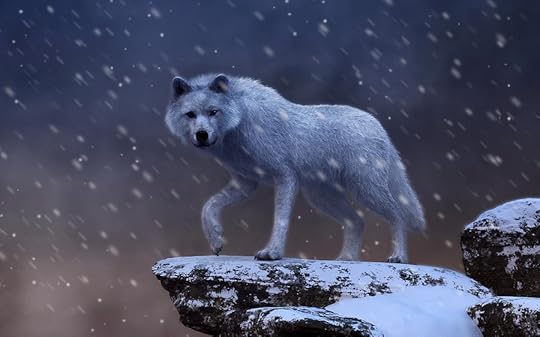
[Digital painting: White Wolf in a Blizzard (2018) by Daniel Eskridge]
American author H.P. Lovecraft mentions Marryat and this story specifically in the fifth chapter of his great literary essay Supernatural Horror in Literature (1927), titled The Aftermath of Gothic Fiction. He wrote: “Capt. Marryat, besides writing such short tales as “The Werewolf”, made a memorable contribution [to weird fiction] in The Phantom Ship (1839), founded on the legend of the Flying Dutchman, whose spectral and accursed vessel sails for ever near the Cape of Good Hope.” In fact, this novelette* is a part of The Phantom Ship and was later excerpted for horror anthologies. The frame story differs depending on what edition of the tale you read.
I listened to "The White Wolf of the Hartz Mountains" because Sean Branney and Andrew Leman chose to include it in their audiobook The Literature of Lovecraft (2021). I am also interested in the development of supernatural horror. Marryat (1792–1848) had an extensive literary career, often nautical tales reflecting the 25 years of his life he spent at Sea. Sailors have always been a superstitious people, so supernatural elements can be found in even Marryat’s most traditional ocean adventure stories. The Phantom Ship in particular contains many references to the strange and occult (Fifer & Lackey, 2014). I’ll need to read the whole novel one day.
Title:"The White Wolf of the Hartz Mountains"
Author: Frederick Marryat
Dates: 1839
Genre: Fiction - Novelette*, horror
Word count: 9,585 words*
Date(s) read: 6/16/22-6/17/22
Reading journal entry #189 in 2022
Link to the story: https://gutenberg.net.au/ebooks06/060...
Link to Lovecraft’s essay: https://www.hplovecraft.com/writings/...
Link to the image: [White Wolf in a Blizzard (2018) by Daniel Eskridge] https://fineartamerica.com/featured/w...
Sources:
Fifer, C., & Lackey, C. (2014, February 7). Episode 194 – The White Wolf of the Hartz Mountains – Part 1. H.P. Lovecraft Literary Podcast
https://www.hppodcraft.com/episodes/2...
Fifer, C., & Lackey, C. (2014, February 14). Episode 195 – The White Wolf of the Hartz Mountains – Part 2. H.P. Lovecraft Literary Podcast
https://www.hppodcraft.com/list/2014/...
Lovecraft, H. P., & Joshi, S. T. (2012). The annotated supernatural horror in literature (second edition). Hippocampus Press. https://www.hplovecraft.com/writings/... (Original work published 1927)
Marryat, F. (2021). The white wolf of the Hartz Mountains. In H.P. Lovecraft Historical Society (Ed.), The literature of H.P. Lovecraft (S. Branney, Narr.; A. Leman, Narr.) [Audiobook]. HPLHS. https://www.hplhs.org/lol.php (Original work published 1839)
*The contents of The Literature of H.P. Lovecraft are:
"The Adventure of the German Student" by Washington Irving
"The Avenger of Perdóndaris" by Lord Dunsany
"The Bad Lands" by John Metcalfe
"The Black Stone" by Robert E. Howard
The Boats of the "Glen Carrig" by William Hope Hodgson
"Count Magnus" by M.R. James
"The Dead Valley" by Ralph Adams Cram
"The Death Mask" by Henrietta Everett
"The Fall of the House of Usher" by Edgar Allan Poe
"The Ghost of Fear" by H.G. Wells (also called “The Red Room”)
"The Ghostly Kiss" by Lafcadio Hearn
"The Horla" by Guy de Maupassant
"The House and the Brain" by Edward Bulwer-Lytton
"The House of Sounds" by Matthew Phipps Shiel
"Idle Days on the Yann" by Lord Dunsany
"Lot #249" by Arthur Conan Doyle
"The Man-Wolf" by Erckmann-Chatrian
"The Middle Toe of the Right Foot" by Ambrose Bierce
"The Minister's Black Veil" by Nathaniel Hawthorne
"The Monkey's Paw" by W.W. Jacobs
"One of Cleopatra's Nights" by Théophile Gautier
"The Phantom Rickshaw" by Rudyard Kipling
The Place Called Dagon by Herbert Gorman
"Seaton's Aunt" by Walter de la Mare
"The Shadows on the Wall" by Mary E. Wilkins
"A Shop in Go-By Street" by Lord Dunsany
"The Signal-Man" by Charles Dickens
"Skule Skerry" by John Buchan
"The Spider" by Hanns Heinz Ewers
"The Story of a Panic" by E.M. Forster
"The Strange Case of Dr. Jekyll and Mr. Hyde" by Robert Louis Stevenson
"The Tale of Satampra Zeiros" by Clark Ashton Smith
"The Tapestried Chamber" by Sir Walter Scott
"The Upper Berth" by F. Marion Crawford
"The Vampyre" by John Polidori
"The Venus of Ille" by Prosper Mérimée
"The Were Wolf" by Clemence Housman
"What Was It?" by Fitz-James O'Brien
"The White People" by Arthur Machen
"The White Wolf of the Hartz Mountains" by Frederick Marryat (also called “The Werewolf”)
"The Willows" by Algernon Blackwood
"The Yellow Sign" by Robert W. Chambers
"The Yellow Wallpaper" by Charlotte Perkins Gilman
Review written on 6/17/22
My reviews for all of the stories, read in the order that they were written:
The Vampyre (1819) by John William Polidori
The Adventure of the German Student (1824) by Washington Irving
The Tapestried Chamber (1828) by Walter Scott
The Minister's Black Veil (1836) by Nathaniel Hawthorne
The Venus of Ille (1837) by Prosper Mérimée
The White Wolf of the Hartz Mountains (1839) by Frederick Marryat
The Fall of the House of Usher (1839) by Edgar Allan Poe
What Was It? (1859) by Fitz-James O'Brien
The House and the Brain (1859) by Edward Bulwer-Lytton
The Signal-Man (1866) by Charles Dickens
The Man-Wolf by Erckmann-Chatrian
The Ghostly Kiss (1880) by Lafcadio Hearn
One of Cleopatra's Nights (1882) by Théophile Gautier
The Upper Berth (1886) by F. Marion Crawford
The Strange Case of Dr. Jekyll and Mr. Hyde (1886) by Robert Louis Stevenson
The Horla (1887) by Guy de Maupassant
The Phantom Rickshaw (1888) by Rudyard Kipling
”The Middle Toe of the Right Foot” (1891) by Ambrose Bierce
Lot #249 (1892) by Arthur Conan Doyle
The Yellow Wallpaper (1892) by Charlotte Perkins Gilman
The Ghost of Fear (1894) by H.G. Wells- also called The Red Room
The Yellow Sign (1895) by Robert W. Chambers
The Dead Valley (1895) by Ralph Adams Cram
The Were-Wolf (1896) by Clemence Housman
The Monkey's Paw (1902) by W.W. Jacobs
The Shadows on the Wall (1903) by Mary E. Wilkins
Count Magnus (1904) by M.R. James
The White People (1904) by Arthur Machen
The Willows (1907) by Algernon Blackwood
The Boats of the "Glen Carrig" (1907) by William Hope Hodgson
Idle Days on the Yann (1910) by Lord Dunsany
The Story of a Panic (1911) by E.M. Forster
The House of Sounds (1911) by Matthew Phipps Shiel
A Shop in Go-By Street (1912) by Lord Dunsany
The Avenger of Perdóndaris (1912) by Lord Dunsany
The Spider (1915) by Hanns Heinz Ewer
The Death Mask (1920) by H.D. Everett
The Bad Lands (1920) by John Metcalfe
Seaton's Aunt (1922) by Walter de la Mare
The Place Called Dagon (1927) by Herbert S. Gorman
Skule Skerry (1928) by John Buchan
The Tale of Satampra Zeiros (1929) by Clark Ashton Smith
The Black Stone (1931) by Robert E. Howard
[Digital painting: White Wolf in a Blizzard (2018) by Daniel Eskridge]
American author H.P. Lovecraft mentions Marryat and this story specifically in the fifth chapter of his great literary essay Supernatural Horror in Literature (1927), titled The Aftermath of Gothic Fiction. He wrote: “Capt. Marryat, besides writing such short tales as “The Werewolf”, made a memorable contribution [to weird fiction] in The Phantom Ship (1839), founded on the legend of the Flying Dutchman, whose spectral and accursed vessel sails for ever near the Cape of Good Hope.” In fact, this novelette* is a part of The Phantom Ship and was later excerpted for horror anthologies. The frame story differs depending on what edition of the tale you read.
I listened to "The White Wolf of the Hartz Mountains" because Sean Branney and Andrew Leman chose to include it in their audiobook The Literature of Lovecraft (2021). I am also interested in the development of supernatural horror. Marryat (1792–1848) had an extensive literary career, often nautical tales reflecting the 25 years of his life he spent at Sea. Sailors have always been a superstitious people, so supernatural elements can be found in even Marryat’s most traditional ocean adventure stories. The Phantom Ship in particular contains many references to the strange and occult (Fifer & Lackey, 2014). I’ll need to read the whole novel one day.
Title:"The White Wolf of the Hartz Mountains"
Author: Frederick Marryat
Dates: 1839
Genre: Fiction - Novelette*, horror
Word count: 9,585 words*
Date(s) read: 6/16/22-6/17/22
Reading journal entry #189 in 2022
Link to the story: https://gutenberg.net.au/ebooks06/060...
Link to Lovecraft’s essay: https://www.hplovecraft.com/writings/...
Link to the image: [White Wolf in a Blizzard (2018) by Daniel Eskridge] https://fineartamerica.com/featured/w...
Sources:
Fifer, C., & Lackey, C. (2014, February 7). Episode 194 – The White Wolf of the Hartz Mountains – Part 1. H.P. Lovecraft Literary Podcast
https://www.hppodcraft.com/episodes/2...
Fifer, C., & Lackey, C. (2014, February 14). Episode 195 – The White Wolf of the Hartz Mountains – Part 2. H.P. Lovecraft Literary Podcast
https://www.hppodcraft.com/list/2014/...
Lovecraft, H. P., & Joshi, S. T. (2012). The annotated supernatural horror in literature (second edition). Hippocampus Press. https://www.hplovecraft.com/writings/... (Original work published 1927)
Marryat, F. (2021). The white wolf of the Hartz Mountains. In H.P. Lovecraft Historical Society (Ed.), The literature of H.P. Lovecraft (S. Branney, Narr.; A. Leman, Narr.) [Audiobook]. HPLHS. https://www.hplhs.org/lol.php (Original work published 1839)
*The contents of The Literature of H.P. Lovecraft are:
"The Avenger of Perdóndaris" by Lord Dunsany
"The Bad Lands" by John Metcalfe
"The Black Stone" by Robert E. Howard
The Boats of the "Glen Carrig" by William Hope Hodgson
"Count Magnus" by M.R. James
"The Dead Valley" by Ralph Adams Cram
"The Death Mask" by Henrietta Everett
"The Fall of the House of Usher" by Edgar Allan Poe
"The Ghost of Fear" by H.G. Wells (also called “The Red Room”)
"The Ghostly Kiss" by Lafcadio Hearn
"The Horla" by Guy de Maupassant
"The House and the Brain" by Edward Bulwer-Lytton
"The House of Sounds" by Matthew Phipps Shiel
"Idle Days on the Yann" by Lord Dunsany
"Lot #249" by Arthur Conan Doyle
"The Man-Wolf" by Erckmann-Chatrian
"The Middle Toe of the Right Foot" by Ambrose Bierce
"The Minister's Black Veil" by Nathaniel Hawthorne
"The Monkey's Paw" by W.W. Jacobs
"One of Cleopatra's Nights" by Théophile Gautier
"The Phantom Rickshaw" by Rudyard Kipling
The Place Called Dagon by Herbert Gorman
"Seaton's Aunt" by Walter de la Mare
"The Shadows on the Wall" by Mary E. Wilkins
"A Shop in Go-By Street" by Lord Dunsany
"The Signal-Man" by Charles Dickens
"Skule Skerry" by John Buchan
"The Spider" by Hanns Heinz Ewers
"The Story of a Panic" by E.M. Forster
"The Strange Case of Dr. Jekyll and Mr. Hyde" by Robert Louis Stevenson
"The Tale of Satampra Zeiros" by Clark Ashton Smith
"The Upper Berth" by F. Marion Crawford
"The Were Wolf" by Clemence Housman
"What Was It?" by Fitz-James O'Brien
"The White People" by Arthur Machen
"The Willows" by Algernon Blackwood
"The Yellow Sign" by Robert W. Chambers
"The Yellow Wallpaper" by Charlotte Perkins Gilman
*The difference between a short story, novelette, novella, and a novel: https://owlcation.com/humanities/Diff...
Vignette, prose poem, flash fiction: 53 - 1,000 words
Short Stories: 1,000 - 7,500
Novelettes: 7,500 - 17,000
Novellas: 17,000 - 40,000
Novels: 40,000 + words
Review written on 6/17/22
My reviews for all of the stories, read in the order that they were written:
The Vampyre (1819) by John William Polidori
The Adventure of the German Student (1824) by Washington Irving
The Tapestried Chamber (1828) by Walter Scott
The Minister's Black Veil (1836) by Nathaniel Hawthorne
The Venus of Ille (1837) by Prosper Mérimée
The White Wolf of the Hartz Mountains (1839) by Frederick Marryat
The Fall of the House of Usher (1839) by Edgar Allan Poe
What Was It? (1859) by Fitz-James O'Brien
The House and the Brain (1859) by Edward Bulwer-Lytton
The Signal-Man (1866) by Charles Dickens
The Man-Wolf by Erckmann-Chatrian
The Ghostly Kiss (1880) by Lafcadio Hearn
One of Cleopatra's Nights (1882) by Théophile Gautier
The Upper Berth (1886) by F. Marion Crawford
The Strange Case of Dr. Jekyll and Mr. Hyde (1886) by Robert Louis Stevenson
The Horla (1887) by Guy de Maupassant
The Phantom Rickshaw (1888) by Rudyard Kipling
”The Middle Toe of the Right Foot” (1891) by Ambrose Bierce
Lot #249 (1892) by Arthur Conan Doyle
The Yellow Wallpaper (1892) by Charlotte Perkins Gilman
The Ghost of Fear (1894) by H.G. Wells- also called The Red Room
The Yellow Sign (1895) by Robert W. Chambers
The Dead Valley (1895) by Ralph Adams Cram
The Were-Wolf (1896) by Clemence Housman
The Monkey's Paw (1902) by W.W. Jacobs
The Shadows on the Wall (1903) by Mary E. Wilkins
Count Magnus (1904) by M.R. James
The White People (1904) by Arthur Machen
The Willows (1907) by Algernon Blackwood
The Boats of the "Glen Carrig" (1907) by William Hope Hodgson
Idle Days on the Yann (1910) by Lord Dunsany
The Story of a Panic (1911) by E.M. Forster
The House of Sounds (1911) by Matthew Phipps Shiel
A Shop in Go-By Street (1912) by Lord Dunsany
The Avenger of Perdóndaris (1912) by Lord Dunsany
The Spider (1915) by Hanns Heinz Ewer
The Death Mask (1920) by H.D. Everett
The Bad Lands (1920) by John Metcalfe
Seaton's Aunt (1922) by Walter de la Mare
The Place Called Dagon (1927) by Herbert S. Gorman
Skule Skerry (1928) by John Buchan
The Tale of Satampra Zeiros (1929) by Clark Ashton Smith
The Black Stone (1931) by Robert E. Howard

December 7, 2018
A tale as cold and cruel as a spear of ice

March 5, 2021
https://archive.org/details/WeirdTale...
http://www.gutenberg.org/files/21573/...
Weird Tales reprint of an excerpt of a chapter from The Phantom Ship, published in 1839. The Phantom Ship is a Gothic novel exploring the legend of the Flying Dutchman. The narrator in the excerpt is retelling the story of his childhood, making it into a fairly standalone short story which has been republished in a lot of different places.
I'm torn between giving it a 4 for being a good short story, and 3 for losing a lot of context being stripped out of a longer novel. It's certainly unsettling and creepy while remaining realistic... for a dark werewolf fairy tale, anyway.
http://www.gutenberg.org/files/21573/...
Weird Tales reprint of an excerpt of a chapter from The Phantom Ship, published in 1839. The Phantom Ship is a Gothic novel exploring the legend of the Flying Dutchman. The narrator in the excerpt is retelling the story of his childhood, making it into a fairly standalone short story which has been republished in a lot of different places.
I'm torn between giving it a 4 for being a good short story, and 3 for losing a lot of context being stripped out of a longer novel. It's certainly unsettling and creepy while remaining realistic... for a dark werewolf fairy tale, anyway.

March 24, 2018
An immensely disturbing read that in no way tried to censor and mold itself to fit the literary standards of the Victorian era. Dark, gritty, and pretty damn violent, this was a short story that both surprised and frightened me to the core with its disturbing sense of realism. Highly recommend this one.

October 13, 2014
The White Wolf of the Hertz Mountains, written in 1839, is a wonderfully descriptive and fast-paced short story.

June 29, 2015
Un cuento de magia, maldiciones y hombres lobos, un relato que te mantiene en vilo hasta último momento, narrado de tal forma que te hace dudar si es un cuento o una historia real.

August 3, 2018
Great original classic. Very nice and interesting story, the plot is simple but well written.
It was the 1st story ever to write about she wolf or female werewolf back in 1839.
It was the 1st story ever to write about she wolf or female werewolf back in 1839.
January 9, 2021
Had mixed feelings about this story. It's pretty gruesome, and when you step back and examine it, it has a lot of fairy tale trappings (mischievous spirits, evil stepmother, supernatural retribution) that create a pleasing effect. But there's no ray of hope in it, and the main victims are children, who go through a lot of unnecessary grief even before their villain enters the picture, so it was too much for me.
It's also part of a longer story, and I could tell. It kind of suffers for the lack of context.
[MILD SPOILERS AHEAD]
I think my biggest turnoff was that it lacks the kind of moral irony that makes a lot of Gothic stories so grotesquely enjoyable -- which is weird, actually, since you see something similar in fairy tales. .-. I think the writer tried for it, but the effect doesn't come through because the kids are victimized by the original crime, and then re-victimized by the punishment for it. (Also, their dad is an idiot and needs to be kicked in a hole.)
It's also part of a longer story, and I could tell. It kind of suffers for the lack of context.
[MILD SPOILERS AHEAD]
I think my biggest turnoff was that it lacks the kind of moral irony that makes a lot of Gothic stories so grotesquely enjoyable -- which is weird, actually, since you see something similar in fairy tales. .-. I think the writer tried for it, but the effect doesn't come through because the kids are victimized by the original crime, and then re-victimized by the punishment for it. (Also, their dad is an idiot and needs to be kicked in a hole.)

October 13, 2022
Apparently there are a few versions of this story floating around. I read this one on Project Gutenberg, which I think is the original chapter from The Phantom Ship removed in its entirety. I can understand why one version cuts off at the werewolf story itself, because the framing device goes on a bit long and is obviously part of another story. (Also, wouldn't it have been better if a wolf ? I don't know if that's geographically accurate, but come on, it's a magical curse.)
Anyway, it's a nice, creepy little story, and I feel like it could easily be adapted into something longer. This seems to be one of the oldest literary werewolves, so it's interesting to see how different she is than the more familiar takes.
Anyway, it's a nice, creepy little story, and I feel like it could easily be adapted into something longer. This seems to be one of the oldest literary werewolves, so it's interesting to see how different she is than the more familiar takes.
August 6, 2022
I loved this short story because of the orginal werewolf mythology. And for the story itself that you don't see in today's werewolf novels all that much. And I will tell you why and go deeper in my next podcast episode review that will be coming out soon in the future . But Overall I think Marryat did a wonderful job.
April 6, 2020
gdfghjkl;

June 18, 2020
Man, werewolf stories today just don't measure up to all these old timey sexy baby-eating werewolves.
October 17, 2021
A very quick, fun and creepy old story.

June 13, 2023
Neat little fairy tale, with all the classic elements down to the wicked step-mother.

October 2, 2023
Erm definitely won’t be reading this one to my kids. Victorian ideas on what is suitable children’s fiction aren’t quite tallying with my modern ones!

July 13, 2025
*an "enormous tiger" spawns out of nowhere to finish the job*
August 25, 2025
Great horror story.

March 18, 2011
Gutsverwalter Krantz führt mit seiner schönen Frau und ihren drei Kindern ein zufriedenes Leben als Leibeigener des Fürsten Istvan. Doch das friedliche Lebend endet abrupt, als er seine Frau mit seinem Fürsten in Flagranti beim Beischlaf erwischt. Im Affekt tötet er seinen Herren und die untreue Gattin und flüchtet mit seinen Kindern in die Hartzer Berge.
Die kleine Familie beginnt ein abgeschiedenes, neues Leben, aber die Kinder haben schwer unter den Launen des Vaters zu leiden, besonders seine einzige Tochter, die den aufgestauten Frauenhass des Vaters regelmäßig zu spüren bekommt.
Das ändert sich, als die geheimnisvolle Kristina und ihr Onkel Wilfired in das Leben der Familie Krantz treten. Kristina exotische Schönheit und Freizügigkeit schlägt Vater und seine Söhne in ihren Bann und schon bald werden Hochzeitsschwüre getauscht zwischen Vater Krantz und der schönen Kristina. Jedoch ist Kristina mehr als sie scheint, und die Kinder beobachten des Nachts das seltsame Treiben ihrer schönen Stiefmutter mit Bangen. Schon bald wird das erste von Krantz Kindern Opfer eines weißen Wolfes und weitere Opfer werden Folgen.
Eine ungewöhnliche Geschichte, die wohl zu den ungewöhnlichsten und faszinierendsten des Werwolfgenres gehören dürfte. Zum einen ist da die Spannung zwischen Vater und Tochter, ausgelöst durch den Treubruch seiner ersten Gemahlin versinkt Vater Krantz in Frauenhass, unter dem die einzige Tochter zu leiden hat, als wenn sie für die taten ihrer Mutter büßen müsste. Zum anderen ist da die sexuelle Spannung zwischen Vater, Söhnen und Ludmilla, denn Ludmilla macht sich nicht nur an den Vater, sondern auch an dessen Söhne ran und auch nach der Eheschließung ist sie den jungen Männern zugetan.
Auch die Darstellung des Werwolfs ist ungewöhnlich. Zum einen handelt es sich hierbei um einen weiblichen Werwolf und dieser ist nicht angsteinflößend, sondern ganz im Gegenteil, anziehend und begehrenswert. Auch der Ursprung des Werwolfdaseins, der zugrundeliegende Werwolfmythos ist bisher recht unverbraucht und so alt, dass er schon wieder innovativ wirkt.
"The White Wolf of the Hartz Mountains" ist eigentlich ein Teil von Marryat's Novelle "The Phantom Ship" (1839) und wurde später noch einmal separate als "The White Wolf" veröffentlicht.
Frederick Marryat (1792 - 1848) war englischer Marineoffizier, Abenteurer, Erfinder (Marryat-Signalcode für die Handelsschifffahrt), Salonlöwe, Gutsbesitzer und Schriftsteller, ein Universalgelehrter seiner Zeit, wie sein Zeitgenosse Goethe. Er ist der Erfinder des marinehistorischen Romans. Ab 1830 erst widmete er sich ganz der Schriftstellerei und verkehrte unter anderem mit Charles Dickens
Die Hörspielumsetzung ist gelungen wie immer. Die Atmosphäre des Hörspiels ist voller sexueller Spannungen und Anspielungen, geheimnisvoll und düster. Die Sprecher sind topp und teils wunderbar unverbraucht. Die Geschichte an sich ist ein unbekannterer Klassiker ihres Genres, der jedoch in Deutschland, genau wie sein Autor, eher unbekannt sein dürfte.
Dieses Hörspiel ist ein eigenständiges Hörspiel und kann einzeln außerhalb der Reihe gehört werden.
Die kleine Familie beginnt ein abgeschiedenes, neues Leben, aber die Kinder haben schwer unter den Launen des Vaters zu leiden, besonders seine einzige Tochter, die den aufgestauten Frauenhass des Vaters regelmäßig zu spüren bekommt.
Das ändert sich, als die geheimnisvolle Kristina und ihr Onkel Wilfired in das Leben der Familie Krantz treten. Kristina exotische Schönheit und Freizügigkeit schlägt Vater und seine Söhne in ihren Bann und schon bald werden Hochzeitsschwüre getauscht zwischen Vater Krantz und der schönen Kristina. Jedoch ist Kristina mehr als sie scheint, und die Kinder beobachten des Nachts das seltsame Treiben ihrer schönen Stiefmutter mit Bangen. Schon bald wird das erste von Krantz Kindern Opfer eines weißen Wolfes und weitere Opfer werden Folgen.
Eine ungewöhnliche Geschichte, die wohl zu den ungewöhnlichsten und faszinierendsten des Werwolfgenres gehören dürfte. Zum einen ist da die Spannung zwischen Vater und Tochter, ausgelöst durch den Treubruch seiner ersten Gemahlin versinkt Vater Krantz in Frauenhass, unter dem die einzige Tochter zu leiden hat, als wenn sie für die taten ihrer Mutter büßen müsste. Zum anderen ist da die sexuelle Spannung zwischen Vater, Söhnen und Ludmilla, denn Ludmilla macht sich nicht nur an den Vater, sondern auch an dessen Söhne ran und auch nach der Eheschließung ist sie den jungen Männern zugetan.
Auch die Darstellung des Werwolfs ist ungewöhnlich. Zum einen handelt es sich hierbei um einen weiblichen Werwolf und dieser ist nicht angsteinflößend, sondern ganz im Gegenteil, anziehend und begehrenswert. Auch der Ursprung des Werwolfdaseins, der zugrundeliegende Werwolfmythos ist bisher recht unverbraucht und so alt, dass er schon wieder innovativ wirkt.
"The White Wolf of the Hartz Mountains" ist eigentlich ein Teil von Marryat's Novelle "The Phantom Ship" (1839) und wurde später noch einmal separate als "The White Wolf" veröffentlicht.
Frederick Marryat (1792 - 1848) war englischer Marineoffizier, Abenteurer, Erfinder (Marryat-Signalcode für die Handelsschifffahrt), Salonlöwe, Gutsbesitzer und Schriftsteller, ein Universalgelehrter seiner Zeit, wie sein Zeitgenosse Goethe. Er ist der Erfinder des marinehistorischen Romans. Ab 1830 erst widmete er sich ganz der Schriftstellerei und verkehrte unter anderem mit Charles Dickens
Die Hörspielumsetzung ist gelungen wie immer. Die Atmosphäre des Hörspiels ist voller sexueller Spannungen und Anspielungen, geheimnisvoll und düster. Die Sprecher sind topp und teils wunderbar unverbraucht. Die Geschichte an sich ist ein unbekannterer Klassiker ihres Genres, der jedoch in Deutschland, genau wie sein Autor, eher unbekannt sein dürfte.
Dieses Hörspiel ist ein eigenständiges Hörspiel und kann einzeln außerhalb der Reihe gehört werden.

September 10, 2015
Horror story of the female werewolf variety. Listened to on Classic Tales Podcast.

December 22, 2015
Audiobook narrated by B.J. Harrison on The Classic Tales Podcast


April 6, 2018
Heard this on a CSA audio short story collection. I really enjoyed Marryat’s Children of the New Forest back when I was in my early 20s. I enjoyed this story as well, so will have to read more of his work. Marryat was a Captain in the Royal Navy and a friend of Charles Dickens. What I’ve read of his work focused on children as protagonists, and have good pacing and a lot of adventure.
This is a bit of a horror story, recounted by a soldier who shares the terrible fate of his family when he was a child, and how they came to fall under the curse of a werewolf.
This is a bit of a horror story, recounted by a soldier who shares the terrible fate of his family when he was a child, and how they came to fall under the curse of a werewolf.
Displaying 1 - 29 of 29 reviews