Now a dozen years old, the award-winning collection continues to provide dozens of the best stories of the year, including work by remowned veterans and exciting newcomers...
Rounded out with a long list of honorable mentions and Gardner Dozois's entertaining summation of the year in science fiction, this remains the one book for every science fiction reader.
Contents xi • Summation: 1994 • (1995) • essay by Gardner Dozois 1 • Forgiveness Day • [Yeowe and Werel • 2] • (1994) • novella by Ursula K. Le Guin 40 • The Remoras • [The Great Ship Universe] • (1994) • novelette by Robert Reed 65 • Nekropolis • (1994) • novelette by Maureen F. McHugh 93 • Margin of Error • (1994) • shortstory by Nancy Kress 98 • Cilia-of-Gold • (1994) • novelette by Stephen Baxter 118 • Going After Old Man Alabama • (1994) • shortstory by William Sanders 131 • Melodies of the Heart • (1994) • novella by Michael F. Flynn 206 • The Hole in the Hole • [Wilson Wu and Irving • 1] • (1994) • novelette by Terry Bisson 230 • Paris in June • (1994) • shortstory by Pat Cadigan 243 • Flowering Mandrake • (1994) • novelette by George Turner 273 • None So Blind • (1994) • shortstory by Joe Haldeman 281 • Cocoon • (1994) • novelette by Greg Egan 305 • Seven Views of Olduvai Gorge • [Birthright Universe] • (1994) • novella by Mike Resnick 343 • Dead Space for the Unexpected • (1994) • shortstory by Geoff Ryman 355 • Cri de Coeur • (1994) • novella by Michael Bishop 402 • The Sawing Boys • (1994) • novelette by Howard Waldrop 417 • The Matter of Seggri • (1994) • novelette by Ursula K. Le Guin 446 • Ylem • (1994) • novelette by Eliot Fintushel 465 • Asylum • (1994) • novella by Katharine Kerr 492 • Red Elvis • (1994) • novelette by Walter Jon Williams 507 • California Dreamer • (1994) • shortstory by Mary Rosenblum 520 • Split Light • (1994) • shortstory by Lisa Goldstein 531 • Les Fleurs Du Mal • [Biotech Revolution] • (1994) • novella by Brian Stableford 585 • Honorable Mentions: 1994 • (1995) • essay by Gardner Dozois
Gardner Raymond Dozois was an American science fiction author and editor. He was editor of Asimov's Science Fiction magazine from 1984 to 2004. He won multiple Hugo and Nebula awards, both as an editor and a writer of short fiction. Wikipedia entry: Gardner Dozois
Note, Dec. 2, 2020: When I read short story collections intermittently over a long period of time, my reactions are similarly written piecemeal, while they're fresh in my mind. That gives the reviews a choppy, and often repetitive, quality. Recently, I had to condense and rearrange one of these into a unified whole because of Goodreads' length limit; and I was so pleased with the result that I decided to give every one of these a similar edit! Accordingly, I've now edited this one.
On the whole, I'm not a big reader of "year's best" collections in any genre; but I was able to get this one cheaply several years ago at a yard sale, so I snapped it up. Dozois has edited these annual SF anthologies for a number of years; it isn't the only annual series covering the genre, but it's one that commands considerable respect from both fans and critics. This volume, covering the year 1994, is the only one I'm familiar with, but I know and appreciate Dozois' excellent editorial skills from his Modern Classics of Fantasy collection (see my review here: https://www.goodreads.com/review/show... ). He begins with a detailed survey of developments and trends in the English-language science fiction world (his geographical scope, here and in the selections that follow, includes Great Britain, Canada and Australia along with the U.S.; George Turner and Greg Egan, for instance, are Australian.) For me, this covered too limited a chronological scope to be very interesting or illuminating, especially since I was reading it some years after 2000; but for a regular reader of the series, all of the volume introductions taken together would constitute a valuable running history of the contemporary SF genre. This is followed by 23 stories from 22 authors (Le Guin is represented twice), as listed in the book description above. These include both well-known writers like Le Guin, Bisson, Haldeman, Nancy Kress, etc. and writers whom I was encountering for the first time. Each story is preceded by a short but useful bio-bibliographic introduction to the author.
As an editor, Dozois is clearly drawn to well-written, effective stories that communicate clearly and exhibit strong stylistic skills, a description that applies to most of the material here. Sometimes he selects something I don't like; but usually in those cases my reaction is to the messages or premises of the story, not to poor writing per se. The few stories I genuinely disliked were the two examples of New Wave SF, which I don't personally care for, Eliot Fintushel's "Ylem" and Pat Cadigan's "Paris in June" (Cadigan's effort is at least coherent and accessible; "Ylem" is not), and the two exercises in contemporary hard-Left "political correctness," Katharine Kerr's "Asylum" and Egan's "Cocoon," in which cardboard characters parrot cliches as they move through a predictable plot. (Neither of these stories is designed to make a case for a position --the authors assume that all right-thinking people already share their position-- but rather to demonize anyone who holds "incorrect" positions.) But these four are the only clunkers in a collection of 23, and that's not a bad percentage. Stephen Baxter's "Cilia-of-Gold" and Mike Resnick's misanthropic "Seven Views of Olduvai Gorge" have premises and messages so bound up with Darwinist ideology and pseudo-science that it's very difficult for a reader who doesn't share that world-view to muster the "willing suspension of disbelief" to make them work; but they do have a narrative drive, and a "what's happening next?" quality to them, that can carry you along while you're reading. For that matter, George Turner's "Flowering Mandrake," with its conception of inborn hatreds for another species and its view of inter-stellar relations in terms of a fight to the death for survival of the fittest, certainly draws on Darwinist ideas (and unintentionally reminds us why Darwinism and racism have historically been cozy bedfellows); but there those elements are muted enough to make the story readable as a grim, gripping cautionary tale, and the idea of a star-faring race of motile, sentient plants is highly original and well worked out.
All of the other stories range from good to outstanding. Two selections here really have no speculative fiction element: Waldrop's "The Sawing Boys," a comic re-imagining of the folk tale of the "Bremen Town Musicians" transposed to 1920s backwoods Tennessee, and "Split Light," in which Lisa Goldstein draws on her Jewish heritage to re-tell the story of 17th-century Messianic claimant Shabbetai Zevi. And William Sanders' "Going After Old Man Alabama," premised as it is on Cherokee folk magic and shamanism (Sanders is himself Cherokee), is really supernatural fiction. But regardless of genre-label quibbles, all three of these are top-notch stories!
Among the strictly science fiction stories, my personal favorites include Bisson's humorous "The Hole in the Hole;" Michael F. Flynn's haunting "Melodies of the Heart;" Mary Rosenblum's poignant "California Dreamer;" and Maureen F. McHugh's "Necropolis". But special mention has to be made of Brian Stableford's "Les Fleurs du Mal," which (at least at one level) is a far-future murder mystery in which the weapon is genetically-engineered spores that, when introduced into a victim's body, germinate into a black-flowered carnivorous plant that consumes the flesh from within. (This genre-blender is also a cornucopia of allusions to delight fans of 19th-century literature: the title comes from a long poem by Baudelaire, police detective Charlotte Holmes works with a colleague named Watson, one suspect calls himself Rappaccini after the scientist in Hawthorne's "Rappaccini's Daughter," and another character is named Oscar Wilde and imitates aspects of his namesake's persona.) Another story that deserves mention is Walter Jon Williams' alternate-history yarn "Red Elvis," which is clearly based on very accurate knowledge of the life and times of the real Elvis, and makes use of a particularly effective surprise ending. Both Le Guin selections are set in her "Hainish universe;" her short fiction as a whole is uneven in quality, IMO, but these two tales are among her good ones and feature the kind of careful world building and cultural (and sometimes cross-cultural) analysis she's justly famous for. Her second story here, "The Matter of Seggri," like her novel The Left Hand of Darkness, uses an alien race's unusual gender characteristics that result from long-ago genetic engineering gone awry --in this case, a gender imbalance of about 16 adult females to one adult male-- to make points about gender roles in our own society. Aspects of Seggrian sex attitudes and practices will (or at least should) strike readers as thoroughly disgusting, but that's the point --they're intended to disgust; not to be a Utopian model, but rather to make us realize that this isn't the way for males and females to relate to each other.
One caveat --a number of these stories do have some bad language, sometimes including the f-word. The only two stories where this is particularly intrusive are Geoff Ryman's "Dead Space for the Unexpected" and LeGuin's "The Matter of Seggri." In the former, it is arguable that the crass language serves to highlight the crassness of the social situation the author is skewering (and the cutthroat world of corporate culture that he depicts differs from today's only in the degree of its intrusive monitoring, not in its basic ethos); but in the latter, it belies even the usual "realism" defense --how realistic is it that an alien culture that never heard of Earth would employ German- derived obscenities and vulgarisms to name its bodily functions?
The vast majority of these stories, though, that consideration aside, are solid, worthwhile, absorbing works that always entertain and often stimulate thought. And while they may employ futuristic technology or alien landscapes as premise or trappings, they really focus, as the best science fiction always does, on human beings: human feelings, relationships, and decisions --the heart of what all literature has always really been about, whatever genre it is. I'd highly recommend this volume; and it's whetted my interest in other annual numbers of the series as well, if ever I run across any!
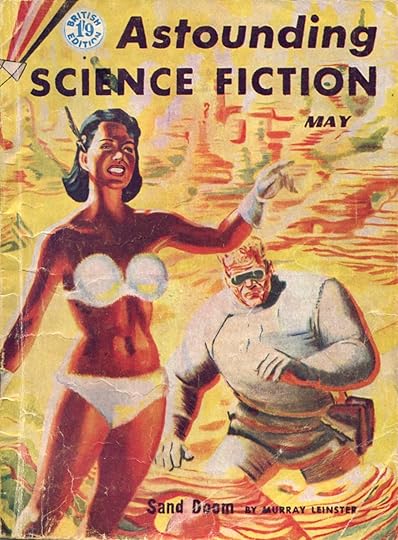
This one's actually got a nice cover (many of the others in this series are truly nasty). This was the first Dozois I got, having lapsed from SF years previously. Okay, what could possibly be new? I thought. Then I found one cracking story after another - Cilia-of-Gold by Stephen Baxter, Flowering Mandrake by George Turner, a trenchant view of the search for the gay gene in Cocoon by Greg Egan, the wonderful Seven Views of Olduvai Gorge by Mike Resnick, a funny and moving alternative-Elvis where Jesse survives in the womb, not Elvis, replicates his brother's career precisely except he sees the light, joins the workers' struggle, resists the draft and eventually takes the bullet for Martin Luther King. And more. Anyway, I now have all of Gardner Dozois' large annual collections except the first two which were small-press productions and therefore very rare and sell for stupid prices (hint - how about a reprint?). And science fiction seems to be very healthy - which is surprising. In the days of Wells and Verne and Conan Doyle it was new and engaging. Then in the 20s and 30s it became the pulpiest of all genres, the mags all had insanely lurid covers
It was truly despised. But gradually its potential began to emerge in the 40s and burst into flower in the 50s and 60s. Like the similarly teenage-focused musical genre of rock & roll, it grew and grew until it had taken over vast areas of popular culture. Rock became the default form of popular music after Elvis and SF became the default form of big fat adventure movies after Star Wars. Has there been a kids' movie in the last 20 years which hasn't been SF or fantasy? The big loud in-your-face science fiction is what gets noticed, but underneath all the Hollywood megabudget spinoff hysteria there is still a lot of great writing being done, in the form of short stories and novellas. What Hollywood thinks of as science fiction is what fans think of as space opera, a sub-genre, and you can see the attraction because it's loud and there are a lot of effects, but the SF of sparkling, challenging, convoluted, infuriating and (this was not always the case) beautifully written SF is still here like a river hidden behind a mountain.
I bought this science fiction book in a library sale and hurried home to read it. Unfortunately, it took me longer than anticipated; twenty three short stories and novellas demand time. The stories are a strange mix of types and subgenres, some of which I don't understanding why they were included in a collection of science fiction, others rely on sex to make them interesting. I rated each story, took the average, and ended up with a score of 2,9 – not very impressive. Only four stories received a top mark of 5, and I will certainly look into the authors' other works. These were: The Remoras-Robert Reed; Going After Old Man Alabama-William Sanders; Flowering Mandrake-George Turner; Seven Views of Olduvia Gorge-Mike Resnick. It is my opinion that these stories are true science fiction, well written and captivating. For those who have read and enjoyed 'Flowering Mandrake by George Turner', I would recommend a novella by Sean DeLauder titled 'The Speaker for the Trees.' Another intriguing novel exploring the possibility of intelligent plant life.
It is obvious that the editor is limited by the stories published over a given year, but this year really stands out above prior anthologies. Not only is the story selection better than ever, but so is the summation of the year and the introduction to each of the stories.
Forgiveness Day by Ursula K. Le Guin: 5 A woman is sent as an emissary to a sexist and slaver planet seeking to join an interplanetary organization and is kidnapped by some local insurgents
The Remoras by Robert Reed: 5 The remoras are people that live on the outside hull of the ship collecting radiation mutations as trophies. A woman living in an interplanetary ship goes out to meet a remora to pay off her husband's debts and is offered the chance to become one of them
Nekropolis by Maureen F. McHugh: 4.5 A servant girl falls in love with an android who is a fellow member of the servants of a rich family
Margin of Error by Nancy Kress: 5 A single mother finally gets revenge on her sister that had taken her scientific career from her after stealing her research
Cilia-of-gold by Stephen Baxter: 5 An exploration mission to Mercury stumbles upon life under the frozen ice caps
Going After Old Man Alabama by William Sanders: 5 Two native American men believe that Old Man Alabama is up to no good, so they set out to stop his most recent plan
Melodies of the Heart by Michael F. Flynn: 5 A man, in a strained marriage due to the unusual health condition affecting his daughter that makes her age prematurely, working in a nursing home is puzzled by a patient that seems to have a constant stream of songs playing in her head and memories that seem too old to be hers
The Hole in the Hole by Terry Bisson: 5 Two friend decide to use a portal that links a Volvo junkyard to the moon to recover the lunar rover
Paris In June by Pat Cadigan: 3.5 The encounters in Paris between two alien androids? sent to earth by an alien species to gather information
Flowering Mandrake by George Turner: 4 The story of how a plant lifeform that had been adrift in space for thousands of years is captured by a human spaceship and the ensuing encounter
None So Blind by Joe Haldeman: 5 The story of the life of the doctor that developed a new surgery that would allow unused neurons allocated in the visual cortex of blind people to be used. After his first patient, his own wife, undergoes the first surgery a human revolution ensues
Cocoon by Greg Egan: 5 3rd best story of the anthology: A mystery story where a gay detective from a privatized police force is hired to investigate the sabotage attacks against a bioengineering firm
Seven Views of Olduvai Gorge by Mike Resnick: 5 The story of a group of alien archaeologists that analyze the artifacts found at Olduvai Gorge, the cradle of the long extinct human civilization that enslaved the galaxy
Dead Space for the Unexpected by Geoff Ryman: 3 A look into an all too possible dystopian future where all workplace interactions are scored
Cri de Coeur by Michael Bishop: 4 The story of a father raising his son with down syndrome in a space ark taking humans to a new inhabitable planet
The Sawing Boys by Howard Waldrop: 1.5 1st worst story of the anthology: The story of how some lumberjacks? end up playing at a local music festival
The Matter of Seggri by Ursula K. Le Guin: 5 1st best story of the anthology: Five looks into the society in the planet of Seggri. A society that has become women dominated due to a lopsided birthrate where men are always kept locked up in castles and only used for reproduction
Ylem by Eliot Fintushel: 3 3rd worst story of the anthology: A man experiences a migraine that takes him on a journey to Ylem, the time before the origin of the universe
Asylum by Katharine Kerr: 5 The story of woman seeking asylum in Britain after the USA undergoes a christo-fascist coup as she is declared an enemy of the state because of her work
Red Elvis by Walter Jon Williams: 4.5 A story where Elvis is the twin brother that dies after birth focusing on the life and work of his brother, especially after becoming a communist
California Dreamer by Mary Rosenblum: 2.5 2nd worst story of the anthology: Three women try to survive in California after a massive earthquake
Split Light by Lisa Goldstein: 4 The story of a Jewish man that must decide between denouncing his faith or losing his life with far reaching implications on the future of humanity
Les Fleurs du Mal by Brian Stableford: 5 2nd best story of the anthology: A murder mystery, with several homages to literature, where 100+ year old rich men are murdered with the use of bioengineered carnivorous plants
A collection of twenty-three of 1994's best science fiction stories as selected by editor Gardner Dozois.
The book begins with Dozois' extensive summary of the year in science fiction and his concerns for the future of science fiction as a genre. Reading his 1994 observations in 2024, thirty years later, is both jarring and sad when you consider how many of the magazines mentioned no longer exist. I know most genre fiction (mystery, science fiction, fantasy in particular) go through moments where writers, critics, and anthologists are worried/predicting its destruction. I can remember hearing that worry in the late 1960s (science fiction), the 1970s (fantasy), and pretty much every decade for mystery. It never really happened, although there were always growing pains as the tropes changed. I've stopped worrying about it.
There's a fair mix of humor and angst, tragedy and farce within these pages, which I personally appreciate as it keeps the reading experience from becoming monotonous.
Contents
"Forgiveness Day" by Ursula K. Le Guin, 4 out of 5. "The Remoras" by Robert Reed, 4.5 out of 5. "Nekropolis" by Maureen F. McHugh, 3 out of 5. "Margin of Error" by Nancy Kress, 4.5 out of 5. "Cilia-of-Gold" by Stephen Baxter, 2.5 out of 5. "Going After Old Man Alabama" by William Sanders, 3.5 out of 5. "Melodies of the Heart" by Michael F. Flynn, 5 out of 5. "The Hole in the Hole" by Terry Bisson, 3.5 out of 5. "Paris in June" by Pat Cadigan, 2 out of 5. "Flowering Mandrake" by George Turner, 3 out of 5. "None So Blind" by Joe Haldeman, 3 out of 5. "Cocoon" by Greg Egan, 4 out of 5. "Seven Views of Olduvai Gorge" by Mike Resnick, 4.5 out of 5. "Dead Space for the Unexpected" by Geoff Ryman, 3 out of 5. "Cri de Coeur" by Michael Bishop, 3 out of 5. "The Sawing Boys" by Howard Waldrop, 2 out of 5. "The Matter of Seggri" by Ursula K. Le Guin, 4 out of 5. "Ylem" by Eliot Fintushel, 3 out of 5. "Asylum" by Katharine Kerr, 4.5 out of 5. "Red Elvis" by Walter Jon Williams, 3 out of 5. "California Dreamer" by Mary Rosenblum, 3 out of 5. "Split Light" by Lisa Goldenstein, 3 out of 5. "Les Fleurs du Mal" by Brian Stableford, 3 out of 5.
Some of my favorites include: "Margin of Error" which had a particularly satisfying revenge; "Melodies of the Heart" almost killed me emotionally; and "Asylum" which is frighteningly close to what we are facing in 2024.
A few of the stories disappointed me greatly, having such wonderful plots, terrific flow, and interesting characters, only to crash and burn the endings. No matter how great a story might be, if you can't stick the ending, it's all for nothing. Despite that, I'm still glad that I picked up this collection at the Friends of the Library store.
This annual edition of The Year’s Best Science Fiction reports on everything sci-fi from 1994 in a 42-page summary, followed by an anthology of 23 short stories published during the year. I found the following eight stories to be superb: “Forgiveness Day” by Ursula K. Le Guin; “The Remoras” by Robert Reed; “Nekropolis” by Maureen F. McHugh; “Melodies of the Heart” by Michael F. Flynn; “ Cri de Coeur” by Michael Bishop; “The Matter of Seggri” by Ursula K. Le Guin; “Asylum” by Katharine Kerr; and “Les Fleurs du Mal” by Brian Stableford.
This is the 12th massive Gardner Dozios tome I've read over the last couple of years and by far the best. Literally every story had me captivated til the end. If you've only got time for -one- of these volumes, or you're just curious what the series is like, I'd highly recommend picking this up. And now on to the next one (Volume 22)!
1994 was a very bad year for science fiction. How bad? Dozois even stuck in a NON science fiction Howard Waldrop story called "The Sawing Boys." THAT's how bad. The absolute worst story is the last, "Les Fluers du Mal" which is apparently some insider joke about nineteenth century literature. It's ridiculous and pretentious. Oscar Wilde in the 23rd century? Oh, please. Brian Stableford is usually good, but this was awful.
The best story (I thought) was Robert Reed's "The Remoras." Since that story can be found in other anthologies like The Big Book of Science Fiction you can skip this. Even the Hugo Award winners here are losers.
Most of the other stories are ponderous novellas, incomprehensible drivel (if you have not read any of the novels the story is only an accompaniment to) or both.
I do believe 1994 was the publication of the anthology Alien Sex. Skip any "best of" anthology for 1994 and just stick with Alien Sex. No matter what year it was published.
Selections:
* "Summation: 1994" by Our Editor. * "Forgiveness Day" by Ursula K. LeGuin. * "The Remoras" by Robert Reed. * "Nekropolis" by Maureen F. McHue. * "Margin of Error" by Nancy Kress. * "Cila-of-Gold" by Stephen Baxter. * "Going After Old Man of Alabama" by William Sanders. * "Melodies of the Heart" by Michael F. Flynn. * "The Hole in the Hole" by Terry Bisson. * "Paris in June" by Pat Cadigan. * "Flowering Mandrake" by George Turner. * "None So Blind" by Joe Haldeman. * "Cocoon" by Greg Egan. * "Seven Views of Olduvai Gorge" by Mike Resnik. * "Dead Space for the Unexpected" by Geoff Ryman. * "Cri de Coeur" by Michael Bishop. * "The Sawing Boys" by Howard Waldrop. * "The Matter of Seggri" by Ursula K. LeGuin. * "Ylem" by Eliot Fintushel. * "Asylum" by Katherine Kerr. * "Red Elvis" by Walter Jon Williams. * "California Dreamer" by Mary Rosenblum. * "Split Light" by Lisa Goldstein. * "Les Fleurs Du Mal" by Brian Stableford. * "Honorable Mentions: 1994" by Our Editor. If you get a kick out of reading lists, enjoy. Otherwise, skip this six page rundown of story titles and authors that Dozois kinda liked.
every single one of these collections is essential reading for true fans of science fiction short stories... each lengthy volume has a stellar array of all mini-genres and areas of powerfully influential science fiction: hard science, speculative, steampunk, alien invasions, apocalyptic/post-apocalyptic, space opera, fantasy, aliens, monsters, horror-ish, space travel, time travel, eco-science, evolutionary, pre-historic, parallel universes, extraterrestrials... in each successive volume in the series the tales have advanced and grown in imagination and detail with our ability to envision greater concepts and possibilities... Rod Serling said, "...fantasy is the impossible made probable. science fiction is the improbable made possible..." and in the pages of these books is the absolute best the vastness of science fiction writing has to offer... sit back, relax, and dream...
Lots of good material in this collection, including great stories by Le Guin (two of them!), Nancy Kress, Robert Reed, Mike Resnick. At this point, through these collections, I was pretty much sold on Nancy Kress and Mike Resnick. Robert Reed I've always had mixed opinions on, but Le Guin's gender/social politics were always interesting.
If you read one sci-fi book a year, this is the one. Always stories of high caliber with a few tossed in that will keep you thinking weeks later, not to mention the collection is a primer for what science and technology everyone will be talking about five to ten years from now.
"None So Blind" by Joe Haldeman - This story postulates a future in which many people choose to have their eyes removed due to resulting vast boost in brain power.
"Dead Space for the Unexpected" by Geoff Ryman - wc
This entire review has been hidden because of spoilers.