"The American version of the great English classics, such as the Pooh books or The Wind in the Willows."--The New York Times Book Review
When Freddy's friend Mr. Dimsey is ousted for publishing news of Bean Farm in the local newspaper, the animals decide to take action and publish the first animal newspaper The Bean Home News-with Freddy as editor-in-chief, of course! But everyone's favorite pig discovers that being a newspaperman isn't as easy as it look s!
Walter Rollin Brooks (January 9, 1886 – August 17, 1958) was an American writer best remembered for his short stories and children's books, particularly those about Freddy the Pig and other anthropomorphic animal inhabitants of the "Bean farm" in upstate New York.
Born in Rome, New York, Brooks attended college at the University of Rochester and subsequently studied homeopathic medicine in New York City. He dropped out after two years, however, and returned to Rochester, where he married his first wife, Anne Shepard, in 1909. Brooks found employment with an advertising agency in Utica, and then "retired" in 1911, evidently because he came into a considerable inheritance. His retirement was not permanent: in 1917, he went to work for the American Red Cross and later did editorial work for several magazines, including The New Yorker.
In 1940, Brooks turned to his own writing for his full-time occupation. Walter married his second wife, Dorothy Collins, following the death of Anne in 1952.
The first works Brooks published were poems and short stories. His short story "Ed Takes the Pledge" about a talking horse was the basis for the 1960s television comedy series Mister Ed (credit for creating the characters is given in each episode to "Walter Brooks"). His most enduring works, however, are the 26 books he wrote about Freddy the Pig and his friends. Source
Another excellent Freddy the Pig book! My kids and I loved it. In this book, Freddy starts a newspaper for the Bean Farm animals, but when the people of Centerboro start reading The Bean Home News more than they read the Centerboro Guardian, Freddy finds himself the target of the ruthless Guardian editor and his imperious sister. John McDonough is an excellent narrator, and the story is full of adventure as well as humor and spot-on observations on life. I highly recommend these!
So I was going through some of my old books, and I happened across some of my old Freddy The Pig books, which I remember liking quite a lot back when I was a wee lass. Curious as to whether the books would still hold up now that I am no longer wee, I picked one up and random and decided to read it. I have such mixed feelings as to how these books hold up. On one hand, the writing isn't painful, which is more than I can say for most books I read when I was little. The plot wasn't particularly fast-paced, but it was pleasant enough to read, and the characters are just interesting enough that you can keep them straight in your head. Honestly, it seems like this would be a perfect children's book. Except that the world these books takes place in is SCREWED UP. Animals are sentient. It appears that pretty much all animals are sentient, from cows to cats to ants. And yet they are not only typically owned by humans (which should be considered slavery of some kind, if the animals are sentient), but MEAT is commonly eaten. Mrs. Bean cooks BACON somewhere in the first third of the book. How could you do that, if you are friends with a talking pig? A talking pig who has relatives, who might not be able to talk, but are also sentient! This dichotomy has the makings of some kind of scifi novel, it really does. And the Beans would have to be the antagonists, for regularly eating creatures that they know to be sentient. I'm torn. If you can get over the fact that this book raises all kinds of ethical questions that it doesn't address, then it's a perfectly fine read. It's a kid's book, after all. You don't really expect it to get into questions like "When is murder murder?" and "Is it okay to eat/own other sentient beings if they're really tasty?" I just wish they could have left out the part about cooking bacon. And any other mentions to meat-eating. Then I could have imagined that the book took place in some sort of fantasy universe where everyone was a vegetarian, and people didn't go around killing other people in order to eat them.
How did it not bother me, when I was young and fell in love with this series, that the Beans eat ham and chicken?
Other than that, these are fun books. I love the personalities of the different animals, and the sheriff's jail (he never gets a name, interestingly enough), and the amusing drawings (the ant, Jerry Peters, lolling on his back is a hoot), the gentle satire of human customs & motivations.
I do wish that there was more about the newspaper business here. There is a bit about how the paper can be used as a tool by influential politicians if the publisher is weak or bribed, and a bit about whether the focus should be investigation and politics or gossip and poetry submissions. But nothing about freedom of the press, or other journalism concerns. Still, as an introduction for kids age 8-11 or so, it's ok. Or at least it was in the days before online news... might be fun to talk with your child about the similarities and differences of the news industry as practiced in the days of the book and now.
In fact, this is actually older than it might seem, because the scrap iron drive was done for patriotism, to get planes and bullets to our soldiers in WWII. Yes, this was originally published in 1943... not many of us actually read it new when we were children!
But honestly, except for the adventure of how the animals save the day, this is best read as nostalgia by the people who actually remember the days of family farms and print newspapers and bears in the woods. I thoroughly enjoyed it and will read more from the series, but I can't actually think of which of you to recommend it to.
The tenth Freddy the Pig book, Freddy and the Bean Home News (1943), begins mildly on the Bean farm, with Charles the Rooster feigning a cold to make his wife do the early morning wake-up crowing and Freddy giving a speech to the animals of the farm and environs to make them do “their patriotic duty” by joining a scrap metal drive to support the war effort. (This is a WWII novel: in addition to the drive, it features a well-timed blackout.) When Freddy visits Centerboro to give a story about the drive to the town newspaper, the Guardian, he finds a new regime there: the wealthy Mrs. Humphrey Underdunk has bought the paper because she was offended when the editor ran a story about her luncheon party next to a story about Freddy’s birthday party, and some people confused the photos of woman and pig, so she has replaced the editor Mr. Dimsey, a friend of Freddy’s, with her animal-hating brother Mr. Garble. Freddy thus decides to start his own paper, The Bean Home News.
Soon, the pig’s energy, writing ability, personality, and extensive pool of “reporters,” (including keen-eared town mice and a curious hen who lives with a curious woman who provide Freddy with more news than he can—or should—use) are helping his paper outsell the Guardian. Mr. Garble starts printing anti-Freddy, anti-animal fake news, and such is the power of print and Mrs. Underwood’s money, that she gets a law passed by which any animal appearing in town without its owner may be repossessed or shot, and Freddy becomes a menace to society, a wanted pig sought by state troopers and private detectives. Freddy’s friend the Sheriff counsels him to tell his side of the story in print, so he starts fighting back in his paper with the truth. Mr. Bean has warned Freddy that “Politics … ain’t news,” but when the Guardian targets the Sheriff (who’s so humane that he provides the jail inmates with ice cream, picnics, and games, to the point that they try to stay in jail after their sentences end), Freddy defends his friend to help his chances to win the next election.
Will Freddy’s disguise as a little boy called Longfellow Higgins clad in a sailor suit really work? Will he be able to continue publishing his paper while in hiding? Will he win the battle for public opinion? Will Old Whibley the owl successfully defend him in court? Will the Bean animals win the scrap metal drive? Will Freddy resist the tempting offer of a job on the staff of Senator Blunder? Will he ever write a poem that does not feature a pig? Will he ever purr like Jinx the black cat? The story answers such questions with aplomb.
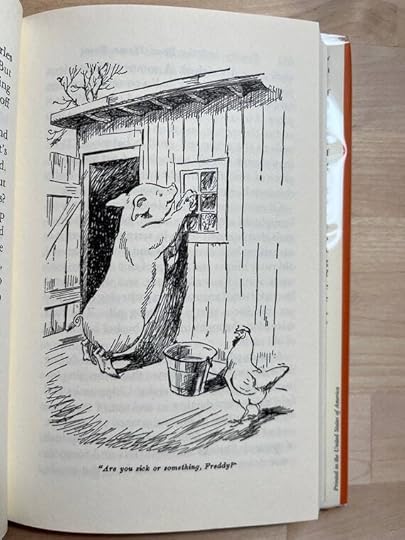
The illustrations by Kurt Weise are a big part of the charm of Freddy books like this one. The pictures are clean and realistic compared to “cute,” anthropomorphized Disney animals. Although Weise depicts the animals doing things animals would not really do (like writing poems), he usually draws them anatomically correct. And he usually chooses good scenes to illustrate.
In Brooks’ fictional world animals (including birds and insects) can speak with each other and with humans (though they try to remain silent around most people to avoid startling them). According to his moral system, anyone who feels superior to animals or mistreats or insults them is punished, while anyone who likes animals and tries to help them is rewarded. Pompous bullies like Mrs. Underwood and Mr. Garble had best beware…
*Brooks’ treatment of the situations that arise when Freddy and his animal friends are or aren’t invited to certain events or permitted to do certain social things signal that the books may be read as a pre-civil rights era racial allegory with animals representing people of color (though I bet kids wouldn’t notice it).*
This is a fun book written in clean, demotic English (the black cat Jinx is downright slangy) aimed at least as much for adults as for kids. It features plenty of humor (ranging from slapstick and bickering to quirky “facts” about animals and ironic wisdom about people), some porcine poetry, a media war, a courtroom drama, and a neat new character in Jerry Peters, a keen, argumentative, lazy loner ant with a miniscule pet beetle.
When Jerry, “no fool,” explains why he wants Freddy to teach him to read, he says, “Because I like things that aren’t any use to me,” which makes the pig defensive:
“Reading is the—h’m, the gateway to knowledge. It opens up the—ha, the portals of wisdom. It permits you to share the thoughts of all great thinkers of the past—” “Such as what?” said the ant. “Eh?” said Freddy. “What thoughts?” said Jerry. “What are some of these great thoughts? You read a lot. Give me just one great thought you’ve got out of your reading.” “Well, naturally,” said Freddy, “you can’t just offhand pick out one. There’s Shakespeare, for instance, whose Complete-Works-in-One-Volume I possess. Shakespeare is full of great thoughts—” “Such as?” said the ant. “If you want to know these things, learn to read and then read them for yourself.”
Brooks uses Freddy and Jerry to poke fun at pretentious people who collect and push “literature” without understanding it, while ultimately telling kids they should read.
Freddy’s conflict with Underwood and Garble over the newspaper and animal rights is amusing and pointed, and the novel has plenty of the usual virtues of Freddy books, being a fusion of whimsical talking animal fantasy, realistic animal behavior, exciting action, sophisticated irony, and social, literary, and human satire, but this one seems slighter than the better ones.
Anyway, it’s a pity that although the Freddy books were best sellers in the middle of the twentieth century, they are not so popular today. Perhaps they are too literate while looking too childish? On the bright side, they are mostly back in print as physical or kindle books. I’m really enjoying rereading the several Freddy books I first read fifty years ago and reading the others for the first time now.
In this book published in 1943, we find Freddy the talking pig of Oneida County, New York at his patriotic best. First to defend freedom of the press, Freddy founds a newspaper to oppose the villaness, Mrs. Humphrey Underdunk who has purchased the Centreboro "Guardian" for the purpose of suppressing the publication of views opposed to hers. Second, Freddy leads a scrap metal drive to support the American war effort. Again, he runs a foul of Mrs. Underdunk who objects to having her tacky iron statuary being collected, melted down and turned in weapons. A true fiend, Mrs. Underdunk users her political connections to obtain additional coupons to obtain rationed gasoline that she uses for frivolous shopping trips. This children's novel is witty and highly topical. Unfortunately, it is no longer relevent to readers in its targetted age bracket. Much as I enjoyed Freddy in my youth, I must admit that lacks the qualities needed to reach young readers in the 21st Century.
Our family continues to be delighted by the Freddy the pig books and Freddy and the Bean home news is no exception. Once again, I loved listening to John McDonough’s audible narration. I especially enjoyed Mr Bean’s role in this book as well as the sheriff’s comments about the way he runs his jail (not saying his views could work IRL, but I appreciated his compassionate and novel approach). I also very much liked Freddy’s friendship with the ant. Overall, a very amusing installment in the Freddy series.
I remember liking Freddy books when I was much younger, but I don't think I read too many of them. They are so delightful!! To this writing, I have listened to five or six in the past month and this one is still my favorite (though I have enjoyed ALL of them!). Is it the wry humor? Or the hilarious situations? Or the animals' personalities? Or the characters' perspectives on the people and things around them? I don't know, but I think we all would be better humans for having read a book or two about Freddy the Pig.
I love Freddy the Pig. This time he is an editor of the Bean Home News, in a free speech battle with the Guardian, a human run newspaper in Centerboro. Freddy goes to court and is defended by an owl.
This entire review has been hidden because of spoilers.
This is really a 4.5 stars -- it is so delightful! We listened to a wonderful audiorecording on Audible and just laughed through the whole thing. These characters are so funny and real-seeming, and the story was unexpected and charmingly told. We've already started another Freddy book.
A whimsical story that has some themes that adults would appreciate, for example, politics and the media, as well as the importance of community. Children will appreciate the talking animals and the adventures they encounter. The animal characters are fully realized and quite entertaining!
Another winner! All the characters are so deftly drawn. I am an adult who never found these books as a child and they are so good. I recommend them to all.
More fun, though this has more than the usual amount of the weird stuff with humans eating sentient animals. Well, that's just part of the series' charm, more or less.
One of the more focused Freddy stories from Walter R. Brooks due to it being published while the US was in the middle of WWII. Brooks engages the children of 1943, painting the need for patriotism and freedom of the press.
The animals on the Bean farm take part in a scrap drive, competing with other farms to collect the most metal to support the war effort. Meanwhile, the main newspaper in town has been taken over by Mr. Garble, who begins to print lies about Freddy in an attempt to get him thrown in jail for daring to start an alternative newspaper. (It would've been known at the time that Hitler's chief propagandist was named Goebbels, a name Brooks was no doubt hinting at in his series).
Freddy is eventually taken to jail and put on trial, where Freddy and his friends come up with a plan to claim his freedom. The story contains more tension than most of Brooks' offerings, yet he still finds space for his usual charm and humor.
It's clear that the story contains pointed messages for both adults and children who would've been aware of the war and potentially fearful of it's outcome. As usual, Brooks' satire, wit, and silly side commentaries are better coming from the beloved animals of the Bean farm.
This is yet another great classic! This time, Freddy the Pig discovers that his old friend, and editor for The Guardian Newspaper, is fired for having a debt to long. He opens a newspaper stand that raises enough money for the editor to live. But when people start liking Freddy's paper--The Bean Home News--more than the guardian, the new editor gets angry and a verbal battle between the newspapers evolves. As it gets uglier, Freddy realizes that this could become more than a verbal battle. Can Freddy prove that the he is not guilty of the sues he has gotten from the editor? Another must-read! Hilarious, its my favorite Freddy The Pig book!
I never saw this series as a child, but would have enjoyed it. I enjoy it now! This is the 10th in the series, but the first I have tried, and you don't lose much in knowing what is happening. The characters all have amusing names, funny situations develop that are clean and kid-appropriate, and the talking animals save the day at the end of the story. Probably age 9 or 10 and up on the language level, with a word every page or two that might bear looking up ("phaeton" for example). Proper grammar/language and full sentences, which i love older books for (though I don't always use them myself these days--getting sloppy). Glad to have found this series.
I liked it. He starts The Bean Home News cause his friend who usually prints his poems in his paper got fired, so he starts printing the Bean Home News and it's the most read paper in Centerboro. It's the first Freddy with Mr. Garble and Mrs. Underdunk.
Everything I learned about being a journalist, I learned here. Very handy when I found myself suddenly becoming managing editor of an investigative newsweekly in Mississippi.
The moral of the story is that if you don't like what someone is saying (e.g., if you think it's un-American) you can just kill them. I never knew Joseph McCarthy started in children's literature.