REVIEW OF THE 1970 GERMAN TRANSLATION BY VIVICA AND KURT BANDLER
This here (and unfortunately also extremely rare and generally rather massively expensive if indeed even available used online) Ravensburger Taschenbücher German language translation of Tove Jansson's Komet im Mumintal (which Swedish language original title on the Goodreads database is Kometer kommer, although Vivica and Kurt Bandler's 1970 translation actually claims the original title to have been Kometjakten) was one of my favourite childhood reads (a book that I received in a large stack of about twenty Ravensburger Taschenbücher as a birthday present in 1975, a book that I took with me when we immigrated to Canada in 1976 and that I even carried along in my trunk when I went to university in New Brunswick in 1985, where it unfortunately ended up somehow disappearing during one of those silly residence "panty raids" during frosh week, and oh boy, was I ever both sad and seriously, lastingly peeved because of that).
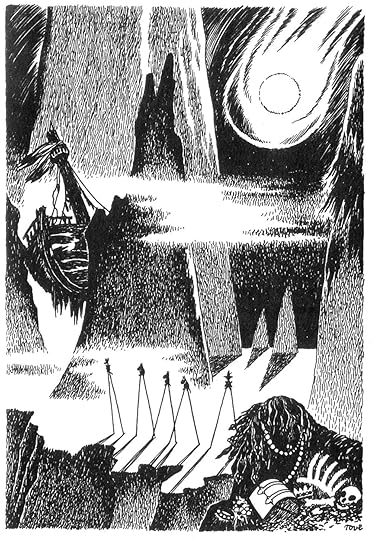
And honestly, to and for me personally, Vivica and Kurt Bandler's translation (and I finally did locate a reasonably intact and not too shabby copy online a couple of years ago), it still and absolutely feels as THE ONE German language version of Komet im Mumintal I do love the most, as the more recent translation by Birgitta Kicherer at least in my opinion leaves way way too much to be desired and in particular that it fails to present far too many important details, such as for example patently ignoring the little silk monkey, who though strangely and incomprehensibly is still featured in Tove Jannsson's accompanying illustrations but has textually seemingly been textually forgotten by Kicherer (albeit that according to readers who have read the original Swedish version, Kicherer supposedly does include parts that were left out by the Bandlers in 1970, but I for one simply cannot handle the removal of that delightful little silk monkey). And sorry, but with Elizabeth Portch's English language translation, with Comet in Moominland (which I did try and originally had quite high hopes for) her writing style, her narrational renderings expression and cadence wise, they both just do not at least for me in any way capture the delightful magic of the story, as they tend to make me feel aloof, above and beyond, and not really rooting for and exploring with Moomin, Sniff, Snuffkin and the rest of the group (but just dispassionately observing them and theirs).
However, while I do personally and always will prefer the Bandlers' 1970 German language translation, their 1970 rendition of Komet im Mumintal, I would still if recommending this second Moomin novel most definitely suggest Elizabeth Portch’s English language translation, I would absolutely recommend Comet in Moominland before I would in any way even consider recommending Birgitta Kicherer's more recent German language rendition, as the latter just really and frustratingly bothers me to on end with its additions and especially with its annoying subtractions and abridgements (and sorry, but even if it is indeed true that the recent German translation contains parts that appear in the Swedish original and do not appear in the 1970 translation, the little silk monkey has always been a personal favourite and I was quite seeing red so to speak when I could not find her textually in the Birgitta Kicherer translation). And indeed, if you speak and read German and are actually able to find Vivica and Kurt Bandler's 1970 Ravensburger Taschenbücher translation online, yes, do consider reading their Komet im Mumintal, with its reddish and orange hued book cover of Moomin, Sniff, Snuffkin et al crossing the evaporated ocean on their stilts, as it truly is a lovely, evocative and fun, as well as occasionally eye-opening romp, a fantastical experience for young and old.
And finally with regard to Tove Jansson’s featured themes and contents, what I love the most lastingly about Komet im Mumintal (and actually, this pertains to all of the Moomin books I have read so far) are the delightfully anecdotal episodes, which although generally complete in themselves also never feel as though they are hanging in space so to speak, as though there is not a thread of continuity from beginning to end, with the chapters seamlessly moving from the first inklings that a comet could perhaps be arriving to the fateful day it does (and how close the earth comes to disaster). But for me even more importantly (and probably the main reason why I have always so much adored the Moomin novels both as a child and now as an adult) I have so much appreciated how very much humanely and with personal understanding and supportiveness, Jansson describes and presents her diverse and often rather intriguing characters, and yes that even those individuals who show potentially problematic or negative behaviour patterns (such as Sniff, the Hemulens and even the silent, creepy Hattifatteners) are shown not only as negative but also with positiveness and much authorial understanding (and considering that the Hemulens, for example, with their OCD like obsessions and neuro-atypical ways and means could easily be considered as being on the autism spectrum, the Moomin books are in my humble opinion also interesting and important discussion vehicles, especially considering that these novels were for the most part penned at a time when autism and other such syndromes were not as yet really part of public awareness and the public conscience).