

What do you think?
Rifters #3 part 1
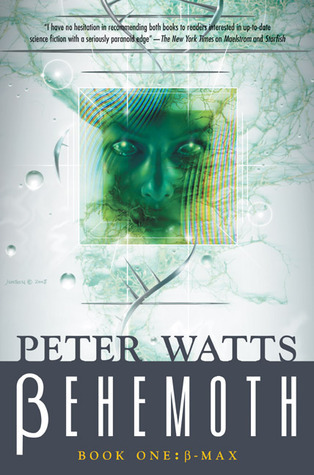
Behemoth: β-Max
Starfish lit the fuse. Maelstrom was the explosion. But five years into the aftermath, things aren't quite so simple as they once seemed...
Lenie Clarke-rifter, avenger, amphibious deep-sea cyborg-has destroyed the world. Once exploited for her psychological addiction to dangerous environments, she emerged in the wake of a nuclear blast to serve up vendetta from the ocean floor. The horror she unleashed-an ancient, apocalyptic microbe called ßehemoth- has been free in the world for half a decade now, devouring the biosphere from the bottom up. North America lies in ruins beneath the thumb of an omnipotent psychopath. Digital monsters have taken Clarke's name, wreaking havoc throughout the decimated remnants of something that was once called Internet. Governments have fallen across the globe; warlords and suicide cults rise from the ashes, pledging fealty to the Meltdown Madonna. All because five years ago, Lenie Clarke had a score to settle.
But she has learned something in the meantime: she destroyed the world for a fallacy.
Now, cowering at the bottom of the Atlantic Ocean, rifters and the technoindustrial "corpses" who created them hide from a world in its death throes. But they cannot hide forever: something is tracking them, down amongst the lightless cliffs and trenches of the Midatlantic Ridge. The consequences of past acts reach inexorably towards the very bottom of the world, and Lenie Clarke must finally confront the mess she made.
Redemption doesn't come easy with the blood of a world on your hands. But even after five years in purgatory, Lenie Clarke is still Lenie Clarke. There will be consequences for anyone who gets in her way-and worse ones, perhaps, if she succeeds. . . .
ßehemoth: ß-Max is the first of two volumes. The story will conclude in ßehemoth: Seppuku.
Lenie Clarke-rifter, avenger, amphibious deep-sea cyborg-has destroyed the world. Once exploited for her psychological addiction to dangerous environments, she emerged in the wake of a nuclear blast to serve up vendetta from the ocean floor. The horror she unleashed-an ancient, apocalyptic microbe called ßehemoth- has been free in the world for half a decade now, devouring the biosphere from the bottom up. North America lies in ruins beneath the thumb of an omnipotent psychopath. Digital monsters have taken Clarke's name, wreaking havoc throughout the decimated remnants of something that was once called Internet. Governments have fallen across the globe; warlords and suicide cults rise from the ashes, pledging fealty to the Meltdown Madonna. All because five years ago, Lenie Clarke had a score to settle.
But she has learned something in the meantime: she destroyed the world for a fallacy.
Now, cowering at the bottom of the Atlantic Ocean, rifters and the technoindustrial "corpses" who created them hide from a world in its death throes. But they cannot hide forever: something is tracking them, down amongst the lightless cliffs and trenches of the Midatlantic Ridge. The consequences of past acts reach inexorably towards the very bottom of the world, and Lenie Clarke must finally confront the mess she made.
Redemption doesn't come easy with the blood of a world on your hands. But even after five years in purgatory, Lenie Clarke is still Lenie Clarke. There will be consequences for anyone who gets in her way-and worse ones, perhaps, if she succeeds. . . .
ßehemoth: ß-Max is the first of two volumes. The story will conclude in ßehemoth: Seppuku.
304 pages, Hardcover
First published January 1, 2004
Ratings & Reviews
Friends & Following
Create a free account to discover what your friends think of this book!
Community Reviews
Displaying 1 - 30 of 92 reviews

August 11, 2021
коротко: Уоттс, как обычно, великий мыслитель — и посредственный писатель.
суть третьей части такова. совесть в сеттинге «Рифтеров» (ну и реальности, настаивает Уоттс) — это биохимия. и есть герои — сверхлюди, наделённые всякого рода экстраординарными способностями, которыми их владельцы и начальники управляют при помощи Guilt Trip — биохимической реакции, вызывающей у них ужасную боль и прочие страдания, если они будут вести себя неэтично.
в конце прошлой книги героическая повстанка против такого насилия над личностью освободила некоторых из них, заразив вирусом, который немного перепилил их нейронные связи.
в начале этой книги она умирает от руки одного из освобождённых.
***
основной конфликт задуман невероятно интересно. гениальный аналитик с доступом к данным, которого нет у простых людей; способный разглядеть в этих данных то, чего другой не увидит, и так управляющий миром. и бывший корпоративный ассасин, получающий физиологическое наслаждение только от убийства. раньше обоими управляла эта самая биохимическая совесть, а теперь она отключилась.
кто из них сможет остаться хорошим человеком? что вообще такое — «быть хорошим человеком»? зачем не становиться королём мира, если ты можешь и у тебя нет *потребности* им не становиться? и наоборот — почему бы не начать убивать людей, если это единственное, что приносит тебе удовольствие, и ничто тебя больше не сдерживает?
а если ты всё-таки сдерживаешь себя вопреки собственной изменившейся природе, то почему?
а делает ли это тебя *хорошим человеком*?
***
как жаль, что ни одну из этих историй Уоттс толком не прописывает. он будто прочитал в статьях, как это всё работает, но не в состоянии вролиться в собственных героев. мы видим со стороны и зверства Дежардена, и то, как срывается и снова берёт себя в руки Любин, но мы не *проживаем* эти состояния. и в конечном итоге так и не становится понятно, что отличало одного от другого. почему один выбрал сдерживать себя, а другой нет? на что это было похоже? ради чего?
самый финал (и заметки после текста) намекают нам, что отличала их способность к мести. люди, пишет Уоттс, по статистике мстительны — и, что удивительно, склонны мстить обидчику даже в ущерб себе. вирус, отключивший Дежардену совесть, судя по всему, отключил ему и мстительность, сделав сверхрациональным (зачем делать кому-то зло, если тебе это не принесёт удовлетворения или пользы?); а Любину, судя по всему, нет. и всё его вроде как положительное поведение (отказался убивать, хотя хотелось, взял на себя квест по спасению мира) — это в конечном итоге поведение животного, которое на всё готово, лишь бы откусить лицо врагу. даже на этичное поведение.
так он ли здесь «хороший человек»?
мысль занимательная чрезвычайно — но увы, и она звучит лишь вскользь в самом финале и даже заметках после него. мысль эту Уоттс, как обычно, подумал, но проиллюстрировать и отыграть в полной мере забыл.
и всё же содержание книги настолько интересно, что оцениваю я её достаточно высоко. больно уж интересные темы на стыке биологии и этики заявлены, не говоря уж о происходящем на фоне биологическом апокалипсисе.
***
а ещё там где-то есть Лени Кларк, типа главная героиня трилогии. но ничего интересного с ней тут не происходит, она снова меняет мотивации, снова особо это не отыгрывает и в конечном итоге выступает просто как зрительница более интересного конфликта поехавших мужиков.
суть третьей части такова. совесть в сеттинге «Рифтеров» (ну и реальности, настаивает Уоттс) — это биохимия. и есть герои — сверхлюди, наделённые всякого рода экстраординарными способностями, которыми их владельцы и начальники управляют при помощи Guilt Trip — биохимической реакции, вызывающей у них ужасную боль и прочие страдания, если они будут вести себя неэтично.
в конце прошлой книги героическая повстанка против такого насилия над личностью освободила некоторых из них, заразив вирусом, который немного перепилил их нейронные связи.
в начале этой книги она умирает от руки одного из освобождённых.
***
основной конфликт задуман невероятно интересно. гениальный аналитик с доступом к данным, которого нет у простых людей; способный разглядеть в этих данных то, чего другой не увидит, и так управляющий миром. и бывший корпоративный ассасин, получающий физиологическое наслаждение только от убийства. раньше обоими управляла эта самая биохимическая совесть, а теперь она отключилась.
кто из них сможет остаться хорошим человеком? что вообще такое — «быть хорошим человеком»? зачем не становиться королём мира, если ты можешь и у тебя нет *потребности* им не становиться? и наоборот — почему бы не начать убивать людей, если это единственное, что приносит тебе удовольствие, и ничто тебя больше не сдерживает?
а если ты всё-таки сдерживаешь себя вопреки собственной изменившейся природе, то почему?
а делает ли это тебя *хорошим человеком*?
***
как жаль, что ни одну из этих историй Уоттс толком не прописывает. он будто прочитал в статьях, как это всё работает, но не в состоянии вролиться в собственных героев. мы видим со стороны и зверства Дежардена, и то, как срывается и снова берёт себя в руки Любин, но мы не *проживаем* эти состояния. и в конечном итоге так и не становится понятно, что отличало одного от другого. почему один выбрал сдерживать себя, а другой нет? на что это было похоже? ради чего?
самый финал (и заметки после текста) намекают нам, что отличала их способность к мести. люди, пишет Уоттс, по статистике мстительны — и, что удивительно, склонны мстить обидчику даже в ущерб себе. вирус, отключивший Дежардену совесть, судя по всему, отключил ему и мстительность, сделав сверхрациональным (зачем делать кому-то зло, если тебе это не принесёт удовлетворения или пользы?); а Любину, судя по всему, нет. и всё его вроде как положительное поведение (отказался убивать, хотя хотелось, взял на себя квест по спасению мира) — это в конечном итоге поведение животного, которое на всё готово, лишь бы откусить лицо врагу. даже на этичное поведение.
так он ли здесь «хороший человек»?
мысль занимательная чрезвычайно — но увы, и она звучит лишь вскользь в самом финале и даже заметках после него. мысль эту Уоттс, как обычно, подумал, но проиллюстрировать и отыграть в полной мере забыл.
и всё же содержание книги настолько интересно, что оцениваю я её достаточно высоко. больно уж интересные темы на стыке биологии и этики заявлены, не говоря уж о происходящем на фоне биологическом апокалипсисе.
***
а ещё там где-то есть Лени Кларк, типа главная героиня трилогии. но ничего интересного с ней тут не происходит, она снова меняет мотивации, снова особо это не отыгрывает и в конечном итоге выступает просто как зрительница более интересного конфликта поехавших мужиков.

September 18, 2022
3.0 stars
I loved the first book but the later books in series aren't working for me. The story has just gotten unedited and these final books need to be edited down.
I loved the first book but the later books in series aren't working for me. The story has just gotten unedited and these final books need to be edited down.

February 2, 2018
I love the direction this series has taken and I love the flawed characters that inhabit these pages. Without giving anything away, we're back underwater with the claustrophobia and sense of urgency that was present in book one and more harsh truths have been revealed. This is great science fiction and an end of the world scenario that is savage but pragmatic.
July 15, 2008
This was a difficult book to read; it was dark, nasty, brutish, and long. First off, Peter Watts seems to specialize in these claustrophobic, psychological dramas involving broken people. In Blindsight, he had a small crew (with a vampire as its leader!) making an expedition to a neutron star, to make first contact with an alien. The whole book chronicles the descent into madness, under extreme psychological duress. Of course, there are some interesting ideas about alien intelligences, genetics, and the difference between sentience and intelligences.
Behemoth is the third book in the Rifters trilogy (actually, it's four books, but Watts says that Behemoth should have been one book and not split into two (B-max and Seppuku). Having read Watts oeuvre before writing a review is nice. Patterns become a bit obvious, whether Watts meant for them to be there or not. Watts really likes the idea of the "Chinese room", and is featured prominently in Starfish (and Blindsight, which is not related to Rifters.) It is more developed in Blindsight, but suffice to say, that device is partly responsible for bringing about apocalypse. Watts, as I had mentioned, really enjoys writing about twisted characters. Normal people crack under pressure and die.
The Rifters trilogy begins undersea, in a deep water power geothermal power plant. We find two deep sea divers, genetically and mechanically modified to be able to survive 3 km beneath sea surface. They are fitted with an artificial gill system to extract oxygen from seawater; they have suits that withstand pressure; their bodies have been completely retrofitted with genes encoding proteins that can function in this environment. Soon, we find out these divers are actually a part of a psychological test; the diver who cracks first can't handle the darkness and the space. Lenie Clark, the diver who can, we find had been abused sexually. One idea, then is that people who have been ... preconditioned by sufficient trauma ... has a skewed psychological pleasure response profile. These people may or may not enjoy extreme conditions, but their bodies are essentially geared to tolerate pain and stress. Thus Watts neatly captures why he sends the crazies into space and undersea.
This sums up why I thought the story was so dark, nasty, and long. It isn't easy to enjoy rooting for abuse victims, rapists and sociopaths - these are the other extremo-philes who wind up in Beebe, the underwater base. They go about their day-to-day business, maintaining the power plant function. They gradually become aware that they are down underwater for a purpose other than keeping machines working. At first, they don't mind because these divers were chosen because they not only work effectively on the ocean floor, but they like it down there. They become a family of sorts. However, they realize that they are being quarantined. Here, we have the second big idea: a bug living near sulfur vents on the sea floor, with faster metabolism and able to extract nutrients from a variety of sources - including lifeforms at sea level. In fact, the worry is that it is so efficient it can out compete the natives. Perhaps it is only a matter of time until ocean currents dredge up the bug and land it on some continent, thereby gaining a foothold. But what if all measures to contain it fail?
Thus, we come to the second book, Maelstrom. It is disturbing that apocalypse is handled so lightly by the heroine. Lenie Clark thirsts for revenge, against her abusive father, the people who left her to rot in the deep sea, against the whole world, actually. She brings the bug, named Behemoth with her. Where she goes, so goes the bug; once it is unleashed, it is only a matter of time before it wipes out all life on earth. But Lenie doesn't really care; I think she may have known that she is carrying some sort of parasite, but damn the consequences.
I found myself in the strange position of wanting the book to end; I wanted someone to kill her, of course, before the Behemoth spreads. But on some level, I want to see her quest for vengeance succeed. I suppose this speaks to the effectiveness of Peter Watts's writing; despite these characters whom one would want to lock up in a penitentiary, one comes to sympathize with them and their goals.
In Maelstrom, we are introduced to some supra-national agencies who run the world; one analyst plays a crucial role in this book and in Behemoth. Needless to say, he also harbors some darkness in his soul. Regardless, this is Lenie's story; if Maelstrom is her reaching nadir, then Behemoth is an attempt at closure and redemption. Lenie, at the end of Maelstrom, hides in the ocean, along with the bigwigs who had unwittingly unleashed the Behemoth bug onto the world. In Behemoth, she leaves the refuge, trying to find out if there are people living in a post-apocalyptic earth who craves revenge against the suits who brought about the end of the world.
It is disturbing to find myself caring about such a capricious woman. She is both a horseman of the apocalypse and its Messiah. Again, it is due to Watts's talent that makes me care to see the story through, but there are many disturbing vignettes along the way. Lenie, for instance, lets herself be raped in some misguided attempt to spread Behemoth, another hero engages in sick, snuff sex fulfillment, yet another hero is a killer with a strict code of conduct - who seeks ways to force his eventual victim to transgress this code.
Strangely enough, these acts are related to the third idea Watts develops is, what price is acceptable if we want to keep the peace? If you want to save the world, do you need a monster? Do you do everything you can to appease him for the greater good? More simply, if you have an option to kill 10 people to save a hundred, would you do it? Watts make up an interesting device to handle this, but yes, it is a painful decision and Watts clearly comes down on the side of the greater good.
The end result of this sprawling mess is an epic that asks and answers some basic questions about our intelligence and our morality. It was difficult to read because the book serves as a dark, twisted carnival mirror; the reader will not like what he sees, but I also found all 3 books hard to put down.
Behemoth is the third book in the Rifters trilogy (actually, it's four books, but Watts says that Behemoth should have been one book and not split into two (B-max and Seppuku). Having read Watts oeuvre before writing a review is nice. Patterns become a bit obvious, whether Watts meant for them to be there or not. Watts really likes the idea of the "Chinese room", and is featured prominently in Starfish (and Blindsight, which is not related to Rifters.) It is more developed in Blindsight, but suffice to say, that device is partly responsible for bringing about apocalypse. Watts, as I had mentioned, really enjoys writing about twisted characters. Normal people crack under pressure and die.
The Rifters trilogy begins undersea, in a deep water power geothermal power plant. We find two deep sea divers, genetically and mechanically modified to be able to survive 3 km beneath sea surface. They are fitted with an artificial gill system to extract oxygen from seawater; they have suits that withstand pressure; their bodies have been completely retrofitted with genes encoding proteins that can function in this environment. Soon, we find out these divers are actually a part of a psychological test; the diver who cracks first can't handle the darkness and the space. Lenie Clark, the diver who can, we find had been abused sexually. One idea, then is that people who have been ... preconditioned by sufficient trauma ... has a skewed psychological pleasure response profile. These people may or may not enjoy extreme conditions, but their bodies are essentially geared to tolerate pain and stress. Thus Watts neatly captures why he sends the crazies into space and undersea.
This sums up why I thought the story was so dark, nasty, and long. It isn't easy to enjoy rooting for abuse victims, rapists and sociopaths - these are the other extremo-philes who wind up in Beebe, the underwater base. They go about their day-to-day business, maintaining the power plant function. They gradually become aware that they are down underwater for a purpose other than keeping machines working. At first, they don't mind because these divers were chosen because they not only work effectively on the ocean floor, but they like it down there. They become a family of sorts. However, they realize that they are being quarantined. Here, we have the second big idea: a bug living near sulfur vents on the sea floor, with faster metabolism and able to extract nutrients from a variety of sources - including lifeforms at sea level. In fact, the worry is that it is so efficient it can out compete the natives. Perhaps it is only a matter of time until ocean currents dredge up the bug and land it on some continent, thereby gaining a foothold. But what if all measures to contain it fail?
Thus, we come to the second book, Maelstrom. It is disturbing that apocalypse is handled so lightly by the heroine. Lenie Clark thirsts for revenge, against her abusive father, the people who left her to rot in the deep sea, against the whole world, actually. She brings the bug, named Behemoth with her. Where she goes, so goes the bug; once it is unleashed, it is only a matter of time before it wipes out all life on earth. But Lenie doesn't really care; I think she may have known that she is carrying some sort of parasite, but damn the consequences.
I found myself in the strange position of wanting the book to end; I wanted someone to kill her, of course, before the Behemoth spreads. But on some level, I want to see her quest for vengeance succeed. I suppose this speaks to the effectiveness of Peter Watts's writing; despite these characters whom one would want to lock up in a penitentiary, one comes to sympathize with them and their goals.
In Maelstrom, we are introduced to some supra-national agencies who run the world; one analyst plays a crucial role in this book and in Behemoth. Needless to say, he also harbors some darkness in his soul. Regardless, this is Lenie's story; if Maelstrom is her reaching nadir, then Behemoth is an attempt at closure and redemption. Lenie, at the end of Maelstrom, hides in the ocean, along with the bigwigs who had unwittingly unleashed the Behemoth bug onto the world. In Behemoth, she leaves the refuge, trying to find out if there are people living in a post-apocalyptic earth who craves revenge against the suits who brought about the end of the world.
It is disturbing to find myself caring about such a capricious woman. She is both a horseman of the apocalypse and its Messiah. Again, it is due to Watts's talent that makes me care to see the story through, but there are many disturbing vignettes along the way. Lenie, for instance, lets herself be raped in some misguided attempt to spread Behemoth, another hero engages in sick, snuff sex fulfillment, yet another hero is a killer with a strict code of conduct - who seeks ways to force his eventual victim to transgress this code.
Strangely enough, these acts are related to the third idea Watts develops is, what price is acceptable if we want to keep the peace? If you want to save the world, do you need a monster? Do you do everything you can to appease him for the greater good? More simply, if you have an option to kill 10 people to save a hundred, would you do it? Watts make up an interesting device to handle this, but yes, it is a painful decision and Watts clearly comes down on the side of the greater good.
The end result of this sprawling mess is an epic that asks and answers some basic questions about our intelligence and our morality. It was difficult to read because the book serves as a dark, twisted carnival mirror; the reader will not like what he sees, but I also found all 3 books hard to put down.
This entire review has been hidden because of spoilers.

September 27, 2007
This is the first half of the third book in the Rifters trilogy. Peter Watts' style isn't for everyone ... it's sparse and really pretty dark ... but I really enjoy his books. He has a fairly bleak vision of the future, and his characters aren't what you would typically consider likeable, but I think that's what draws me to his novels. No candy coating here.

December 5, 2013
The world is not dying, it is being killed. And those that are killing it have names and addresses.
Utah Phillips
As an epigraph for this book, it's hard to fault Watts' choice of the above; depending on how you read it, it mixes black comedy and social responsibility, a very human lust for revenge (even if it probably won't do the world much good) and a despairing awareness that we have very much either created or at least largely contributed to our own problems. This is the instalment where, at least at the beginning, the world-ending threat is still present but at least contained to the point where it can be lived with (even if the methods for doing so are a little more extreme than in other works of its kind), which just means people have the breathing room to start turning on each other.
The caveats I set out for the first two books in this series continue to apply, although I do appreciate Watts' continued desire to complicate and twist things around, and I do repeat that my concerns are mostly concerns rather than things I am certain are harmful or barely done. There is an exception here, though; Watts is a good writer, but I fundamentally disagree with his metaphorical use of the word "rape" at places here. It only happens maybe 2-3 times in the whole book, but a last-chapter reference to some compromised satellites as being "date-raped" felt especially egregious. This book review isn't the place for a full account of why this sort of thing is unacceptable (shorthand: because actual rape is a thing that happens, a lot, and our culture is really fucked up about it, and I may not feel more than a twinge of distaste at that phrase, but at least some people who have been actually raped could potentially feel much worse), and to be clear, I'm not saying Watts isn't allowed to do that. I am saying that to me at least it feels hacky and transgressive for the sake of being transgressive, and in the work of a writer who I generally find to be much more interesting and empathetic than that it sticks out. This is a guy who dedicates this particular book to his dead cat and then notes "she wouldn't have cared"; that combination of blunt, pitiless clarity about the essential irrationality of human existence with the fact that, well, he's still going to dedicate it to the cat (because acknowledging that it is, in a sense, pointless isn't the same thing as trying to deny the way he feels) kind of sums up what I like about Watts as a writer. He can use whatever language he likes, including throwing around rape loosely, but that particular choice doesn't work for me as a reader.
The main part of why I can't quite go to four stars here is not really Watts' fault at all, though (and it is more of a 3.5 stars); as he explains in the introduction (in characteristically straightforward language) this last book of his trilogy is split into two books because of purely financial considerations. Namely, that he's a midlist author and at this point books as big as βehemoth is won't get wide distribution when they're by midlist authors. It's a recent change that happened when he was finishing up the book, so we get the first half here. If he hadn't mentioned it, I don't think β-Max would have felt incomplete, really; as he says, the book like his other novels was basically split down the middle anyway. And what's here is certainly gripping; it's just hard to scale back from the scope of Maelstrom and not, at least in my case, spend chunks of this book desperate to find out more about what's going on with the rest of the world. You get glimpses, but I'm really excited to finish off the series and bring a lot of this stuff home. I do think if the concerns I've been mentioning in these reviews don't bring up red flags for you that the Rifters series is very worth reading, and that Watts' work is good enough that he deserves a much wider audience. I just wish I could recommend them without reservation.
Utah Phillips
As an epigraph for this book, it's hard to fault Watts' choice of the above; depending on how you read it, it mixes black comedy and social responsibility, a very human lust for revenge (even if it probably won't do the world much good) and a despairing awareness that we have very much either created or at least largely contributed to our own problems. This is the instalment where, at least at the beginning, the world-ending threat is still present but at least contained to the point where it can be lived with (even if the methods for doing so are a little more extreme than in other works of its kind), which just means people have the breathing room to start turning on each other.
The caveats I set out for the first two books in this series continue to apply, although I do appreciate Watts' continued desire to complicate and twist things around, and I do repeat that my concerns are mostly concerns rather than things I am certain are harmful or barely done. There is an exception here, though; Watts is a good writer, but I fundamentally disagree with his metaphorical use of the word "rape" at places here. It only happens maybe 2-3 times in the whole book, but a last-chapter reference to some compromised satellites as being "date-raped" felt especially egregious. This book review isn't the place for a full account of why this sort of thing is unacceptable (shorthand: because actual rape is a thing that happens, a lot, and our culture is really fucked up about it, and I may not feel more than a twinge of distaste at that phrase, but at least some people who have been actually raped could potentially feel much worse), and to be clear, I'm not saying Watts isn't allowed to do that. I am saying that to me at least it feels hacky and transgressive for the sake of being transgressive, and in the work of a writer who I generally find to be much more interesting and empathetic than that it sticks out. This is a guy who dedicates this particular book to his dead cat and then notes "she wouldn't have cared"; that combination of blunt, pitiless clarity about the essential irrationality of human existence with the fact that, well, he's still going to dedicate it to the cat (because acknowledging that it is, in a sense, pointless isn't the same thing as trying to deny the way he feels) kind of sums up what I like about Watts as a writer. He can use whatever language he likes, including throwing around rape loosely, but that particular choice doesn't work for me as a reader.
The main part of why I can't quite go to four stars here is not really Watts' fault at all, though (and it is more of a 3.5 stars); as he explains in the introduction (in characteristically straightforward language) this last book of his trilogy is split into two books because of purely financial considerations. Namely, that he's a midlist author and at this point books as big as βehemoth is won't get wide distribution when they're by midlist authors. It's a recent change that happened when he was finishing up the book, so we get the first half here. If he hadn't mentioned it, I don't think β-Max would have felt incomplete, really; as he says, the book like his other novels was basically split down the middle anyway. And what's here is certainly gripping; it's just hard to scale back from the scope of Maelstrom and not, at least in my case, spend chunks of this book desperate to find out more about what's going on with the rest of the world. You get glimpses, but I'm really excited to finish off the series and bring a lot of this stuff home. I do think if the concerns I've been mentioning in these reviews don't bring up red flags for you that the Rifters series is very worth reading, and that Watts' work is good enough that he deserves a much wider audience. I just wish I could recommend them without reservation.
April 2, 2022
Ok, I should start this review by saying that if I had read Starfish & Maelstrom first, I would probably be writing a very different review...however, I didn't....and so, for me, the book was like a beautiful jigsaw, each piece, a detailed pixel of picture in its own right but without a front cover image to place that piece in the right place. So at times, I hated the book, at times I loved it.
The wild animal analogy of code, registers and electrons was worth a story of its own and an amazing piece of writing
IF you have just picked this book up, please read the other two, so you know what corpses and Rifters are and know what the hell has happened to the Earth. :)
The wild animal analogy of code, registers and electrons was worth a story of its own and an amazing piece of writing
IF you have just picked this book up, please read the other two, so you know what corpses and Rifters are and know what the hell has happened to the Earth. :)

August 2, 2023
It feels like every book has had a different main character, even though it's all been Lenie the whole time. I couldn't stand her in this book, but she was great in the last one. Also, the whole deep sea sci-fi horror vibe is reminding me of Sphere by Michael Crichton. I'm probably stopping the series here.

October 22, 2019
Long, dark, tedious. Yuck.
August 19, 2024
3.5 stars
Not a bad book, but maybe it's just not matching my current mood. The series is a little heavy, but I'm in a good mood so I was mostly just ready to move onto something lighter. One more to go and as it stands I'll be happy to wrap the series up.
Same excellent narration.
Not a bad book, but maybe it's just not matching my current mood. The series is a little heavy, but I'm in a good mood so I was mostly just ready to move onto something lighter. One more to go and as it stands I'll be happy to wrap the series up.
Same excellent narration.
December 15, 2021
low mark because of tortures
This entire review has been hidden because of spoilers.
December 18, 2020
In desperate need of an editor.
I really enjoyed Starfish overall a great dark sci-fi book. Maelstrom had some interesting concepts around Memes, AI, and chemical emotional control. However it seemed to get as lost in its purpose as Lenie Clark but I still had fun on the dark but weird ride.
Behemoth however is an ocean apart from those books. It’s incredibly rare that I don’t enjoy some part of a book or have something nice to say about a work of art. It rarer that I rate anything with one star. This book is simply that bad. This mess of a third installment just keeps going down hill.
Everything in this plot line feels forced or crowbarred in to setup reality TV level drama with shock jock writing about emotionally broken people. The author literally sets up a post bio-apocalyptic backdrop which could have 1000s of interesting threads. Instead we get a bad version of a corporate debate at the bottom of the ocean. In between it is a slog of nothing happening and recap of the last two books. The real fin kick in face is the author opens the book saying that he couldn’t have possibly cut anything while throwing shade on the publishing industry. This whole book could have been replaced with an epilogue in Maelstrom. We find out nothing relevant or new about the first skirmishes between the rifters and corpses, a five year advance in a time line, the characters, or candidly the plot. Avoid this broken mess.
I really enjoyed Starfish overall a great dark sci-fi book. Maelstrom had some interesting concepts around Memes, AI, and chemical emotional control. However it seemed to get as lost in its purpose as Lenie Clark but I still had fun on the dark but weird ride.
Behemoth however is an ocean apart from those books. It’s incredibly rare that I don’t enjoy some part of a book or have something nice to say about a work of art. It rarer that I rate anything with one star. This book is simply that bad. This mess of a third installment just keeps going down hill.
Everything in this plot line feels forced or crowbarred in to setup reality TV level drama with shock jock writing about emotionally broken people. The author literally sets up a post bio-apocalyptic backdrop which could have 1000s of interesting threads. Instead we get a bad version of a corporate debate at the bottom of the ocean. In between it is a slog of nothing happening and recap of the last two books. The real fin kick in face is the author opens the book saying that he couldn’t have possibly cut anything while throwing shade on the publishing industry. This whole book could have been replaced with an epilogue in Maelstrom. We find out nothing relevant or new about the first skirmishes between the rifters and corpses, a five year advance in a time line, the characters, or candidly the plot. Avoid this broken mess.

June 3, 2008
Decent twists and turns in the plot and a nice solid ending outweighed the
occassional gruesome torture scene, but I still could have done without them.
Basic plot: two sociopaths band together to save the world from a third
sociopath. Well, at least they save what is left of the world after five years of
horrible plague and anarchy.
I read the two Behemoth books as one, uninterrupted e-book, so the review is the same for both.
occassional gruesome torture scene, but I still could have done without them.
Basic plot: two sociopaths band together to save the world from a third
sociopath. Well, at least they save what is left of the world after five years of
horrible plague and anarchy.
I read the two Behemoth books as one, uninterrupted e-book, so the review is the same for both.

May 3, 2019
Much worse than the first two. Looks like author forgot first two books and tried to remember them in third one. Situations are not believable in general, so the script looks weird and fragmented. Major disappointment.

December 25, 2018
Uneventful until the end.
August 1, 2020
To preface my thoughts, I must admit that it was only when I was halfway through that I realised this book was part of a series, although it stands alone as its own narrative.
Behemoth is set in a stunningly rich and fleshed out world, with characters that contain a fair amount of depth.
Some moments in the book felt hard to decipher and I had to re-read several pages over again to figure out what was going on.
That said, for those familiar to the series, these moments may feel more like a refreshing return to the sea than the bends it caused me.
As a new reader, I found the way that previous events, characters, and world-building were handled in a smooth way that never felt jarring or alienating - hence why I didn’t even realise haha
Ultimately, I really enjoyed Behemoth and am looking forward to reading the rest of the series!
Behemoth is set in a stunningly rich and fleshed out world, with characters that contain a fair amount of depth.
Some moments in the book felt hard to decipher and I had to re-read several pages over again to figure out what was going on.
That said, for those familiar to the series, these moments may feel more like a refreshing return to the sea than the bends it caused me.
As a new reader, I found the way that previous events, characters, and world-building were handled in a smooth way that never felt jarring or alienating - hence why I didn’t even realise haha
Ultimately, I really enjoyed Behemoth and am looking forward to reading the rest of the series!

April 1, 2025
this one was a bit annoying.
nothing grand happens. there's a timeskip, but you don't really feel like anything's changed. the characters are still the same, only some have become sociopaths (before the timeskip they were kinda sociopaths?). at least we are back under the ocean now, although it's not the same atmosphere as the first book. also ew, why the hell is lenie hitting on an underage girl now? desjardin on the other hand has to be watts' self insert. the descriptions of his fucked up sexuality sounded too real to be invented lmao. and suddenly, in the very last chapter, there's a brand-new world-ending bug? out of nowhere? that twist felt completely random, like a last-minute "oh by the way, the world is still doomed". i am exhausted at this point
nothing grand happens. there's a timeskip, but you don't really feel like anything's changed. the characters are still the same, only some have become sociopaths (before the timeskip they were kinda sociopaths?). at least we are back under the ocean now, although it's not the same atmosphere as the first book. also ew, why the hell is lenie hitting on an underage girl now? desjardin on the other hand has to be watts' self insert. the descriptions of his fucked up sexuality sounded too real to be invented lmao. and suddenly, in the very last chapter, there's a brand-new world-ending bug? out of nowhere? that twist felt completely random, like a last-minute "oh by the way, the world is still doomed". i am exhausted at this point

March 24, 2021
Ok I guess?
Other Watts books have dealt more with evolutionary biology or the subject of consciousness. While sometimes nihilistic in their outlook they are at least interesting, provocative, and entertaining (if a bit dense at times). Starting with this final book(s) in the Rifters Trilogy, the main characters except for Desjardins have plateaued in their development, sometimes even been crippled in the way they interact.
This was fine, a quick read, and entertaining, but nothing groundbreaking like the first book.
Other Watts books have dealt more with evolutionary biology or the subject of consciousness. While sometimes nihilistic in their outlook they are at least interesting, provocative, and entertaining (if a bit dense at times). Starting with this final book(s) in the Rifters Trilogy, the main characters except for Desjardins have plateaued in their development, sometimes even been crippled in the way they interact.
This was fine, a quick read, and entertaining, but nothing groundbreaking like the first book.
June 1, 2025
Peter Watts likes to hide his science under a lot of poetic diction and uses a lot of metaphors. Because of this, his world-building remains very vague, only the present environment gets fleshed out enough over time - I think that's a loss, because he has a lot of awesome ideas.
More to the point of this book however, its almost as much a depressing ****show (in the good sense) as the predecessor, just not quite as good. Hopefully, because it builds to the finale...
Another point that irks me bit is he uses vulgarity unnecessarily often, even overuses it to the point it becomes cheap.
More to the point of this book however, its almost as much a depressing ****show (in the good sense) as the predecessor, just not quite as good. Hopefully, because it builds to the finale...
Another point that irks me bit is he uses vulgarity unnecessarily often, even overuses it to the point it becomes cheap.

September 30, 2026
You're well past the point of no return when simply communicating with the other side constitutes an act of treason.
Sex WAS violence, literally, right down to the neurons. The same synapses lit up whether you fucked or fought, the same drive to violate and subjugate. It didn't matter how gentle you were on the outside, it didn't matter how much you pretended: even the most consensual intercourse was nothing more than the rape of a victim who'd given up.
Sex WAS violence, literally, right down to the neurons. The same synapses lit up whether you fucked or fought, the same drive to violate and subjugate. It didn't matter how gentle you were on the outside, it didn't matter how much you pretended: even the most consensual intercourse was nothing more than the rape of a victim who'd given up.

May 19, 2020
Much better than Maelstrom. The return to the deep blue was something I enjoyed. The tribal attitudes, tensions between two groups and the eventual war evoked Fallout vibes from me, and the isolation underwater is beautifully played out. Plot-wise I'm glad it moved in a specific direction - that Clarke was slowly losing her authority and the eventual discovery of B-max.

December 2, 2022
Too much descriptive psyche in the beginning for my liking, but it gets more even with action after a while. Don't doubt the writer is a good one.
It is a shame that Kindle did divide the last book of the trilogy, I mourn for the writers of this world and us the readers.
It is a shame that Kindle did divide the last book of the trilogy, I mourn for the writers of this world and us the readers.
July 27, 2024
Another excellent book in the series - esp if you are a Bio type!
All the characters are so interesting and complex and the Bio is as believable as it gets! This is NOT Star Wars but something which is much more realistic and terrible . .
On to the next book!
All the characters are so interesting and complex and the Bio is as believable as it gets! This is NOT Star Wars but something which is much more realistic and terrible . .
On to the next book!

December 28, 2017
The penultimate entry of this exceptional series keeps raising the stakes as the plot builds inexorably towards a nailbiting finale.

February 8, 2018
Dark depths of the ocean are back with all their glory. What's not to love?
July 12, 2018
Happy to give this one a 3.5 but it wasn't quite as interesting as his earlier work.

August 20, 2018
First two books were GOAT candidates for me, but this went way off the rails. Hoping the last book brings it all together and makes sense of whatever I just read.
November 12, 2018
Skipped the torture without missing anything. Was a decent read, and the end wasn't as bad as I had feared. Glad I finished the series out.
April 22, 2019
I loves em. waiting for the concluding part to get delivered from the usa, cant get em here. lenie Clarke and her rampage across my consciousness.

May 31, 2019
Nice mix of vol. 1 & 2, 3.5 for me.
Displaying 1 - 30 of 92 reviews