Richard Wardour leaves England on a voyage to the African coast under the impression he is engaged to delicate orphan Clara Burnham. When he returns and is refused he immediately sets sail on an expedition to the Arctic unaware that in the same party is Clara's accepted lover Aldersley. The expedition fails, the ships are marooned and Wardour and Aldersley are sent across the treacherous ice to reach civilisation!
Wilkie Collins was an English novelist and playwright, best known for The Woman in White (1860), an early sensation novel, and The Moonstone (1868), a pioneering work of detective fiction. Born to landscape painter William Collins and Harriet Geddes, he spent part of his childhood in Italy and France, learning both languages. Initially working as a tea merchant, he later studied law, though he never practiced. His literary career began with Antonina (1850), and a meeting with Charles Dickens in 1851 proved pivotal. The two became close friends and collaborators, with Collins contributing to Dickens' journals and co-writing dramatic works. Collins' success peaked in the 1860s with novels that combined suspense with social critique, including No Name (1862), Armadale (1864), and The Moonstone, which established key elements of the modern detective story. His personal life was unconventional—he openly opposed marriage and lived with Caroline Graves and her daughter for much of his life, while also maintaining a separate relationship with Martha Rudd, with whom he had three children. Plagued by gout, Collins became addicted to laudanum, which affected both his health and later works. Despite declining quality in his writing, he remained a respected figure, mentoring younger authors and advocating for writers' rights. He died in 1889 and was buried in Kensal Green Cemetery. His legacy endures through his influential novels, which laid the groundwork for both sensation fiction and detective literature.
"The Frozen Deep" was first staged as a play in 1857, written by Wilkie Collins and modified by Charles Dickens. It was later rewritten into the form of a novella. "The Frozen Deep" was written in reaction to the ill-fated 1845 Franklin expedition where all the explorers perished. They were searching for the Northwest Passage in the Arctic.
The novella centers around a love triangle where two of the members of the Arctic expedition love the same woman, Clara. She has the gift (or curse) of the Second Sight, falling into a trance and seeing into the future. "The Frozen Deep" is a story of rivalry and self-sacrifice. It has Victorian Gothic elements and a touching, tragic ending. 3.5 stars.
3/26/24 Edit: I also read the play version with the revisions that Collins made after Dickens' death. We are discussing the novella and play in the Dickensian group.
"-¿Y bien?, ¿por qué se hizo a la mar? -No estoy seguro, señor Frank. A veces pienso que fue mi natural obstinación. Otras, creo que fue el falso orgullo de ser capaz de superar el mareo. Y otras, creo que fue leer Robinson Crusoe y otros libros que me advirtieron que no me hiciera a la mar."
Wilkie Collins, maestro del género policial y famoso por sus dos grandes novelas “La dama de blanco” y “La piedra lunar”, también fue un gran escritor de cuentos y logra plasmar en esta novela corta, “En mares helados”, una excelente historia con buenas dosis de suspenso, amor y aventura desarrolladas en poco más de doscientas páginas. Collins era un gran amigo de Charles Dickens. Se admiraban mutuamente y también trabajaban en conjunto. “En mares helados” fue concebido por ambos como una obra de teatro e incluso la pusieron en escena en 1856 actuando frente a la mismísima reina Victoria e interpretando ellos mismos los personajes principales de la obra. Posteriormente, en 1874, Collins la adaptó al formato de novela, es por esta razón que los diálogos en la misma son tan fluidos y posee tantos capítulos. El argumento es clásico y enlaza el famoso triángulo amoroso entre Clara Burnham, una hermosa doncella que tiene la particularidad de caer en trances en los que puede “ver” el futuro, y su relación con dos fogosos y temerarios hombres de mar, Richard Wardour y Frank Ardersley. Ambos se disputan el corazón de Clara, quien dentro de su ingenuidad le promete su corazón primero a Richard y luego a Frank sin saber que Richard volverá para reclamárselo. Wardour, humillado y ofendido prometerá vengarse de aquel hombre que le robó el amor de Clara y por causas fortuitas, ambos, sin conocerse se embarcarán en una arriesgada misión al Ártico a bordo de dos barcos, el Wanderer y el Sea-mew. Lo que se suponía era un viaje de un año como máximo se transforma en dos años de penurias luego del naufragio de ambas naves en los hielos del Ártico. A partir de allí, Collins se encargará de mantenernos atentos a la historia sin saber el lector en qué desembocará todo y si esos hombres volverán o no con vida para quedarse con el corazón de Clara. El lector tendrá que esperar el desenlace de la novela para saber qué pasó realmente y allí es donde reside lo genial de Wilkie Collins, uno de los más grandes generadores de misterio y suspenso que nos dio la literatura.
If you have never read The Frozen Deep, the catalogue entries may seem confusing. It is variously entered in libraries as a play, or a novella, by Wilkie Collins, or Charles Dickens, or both. Is this a mistake?
In fact all of these are largely correct. The Frozen Deep was initially written as a play: a collaboration between Charles Dickens and Wilkie Collins in 1856, with Charles Dickens taking the lead and making the major decisions. It has been said that the changes were so numerous that the drama could almost be ascribed to Dickens himself. The other end of this work’s genesis came with a final version, 4 years after Charles Dickens’s death. This had been considerably rewritten as a novella, by Wilkie Collins, although he kept the divisions into “Scenes” as if it were still a play. In between at different times there were also more edits made to the play, but not all the editions are extant. There was a revised version staged in 1866, but it was nowhere near as successful as it had been earlier, so Wilkie Collins was convinced that it should no longer be staged. The only play version we have in print is this one; it remained unpublished until a private printing appeared in 1866. This review is attached to the novella from 1874, although the details cover a little more.
A topic uppermost in the public’s mind in 1856 was the fate of the “Franklin expedition”, which had left England in May 1845 in search of the Northwest Passage. Last seen just two months after it had set out, it had apparently been lost without trace. Nine years later, when hope was dwindling, a report was published by the Admiralty Office. John Rae’s account was that he had met with some Inuit (“Eskimo”) people who had told him they had seen 40 “white men”, and later 35 mutilated corpses. The state of these was such that according to John Rae:
“our wretched countrymen had been driven to the last resource—cannibalism—as a means of prolonging survival”.
The public’s shocked reaction to this news can well be imagined, and the Arctic explorer’s wife, Lady Franklin, wrote emphatically that an Englishman was able to “survive anywhere … and triumph over any adversity through faith, scientific objectivity, and superior spirit.” Charles Dickens would not believe the report either, and attacked the veracity of it in print in a long drawn out battle with John Rae.
The Frozen Deep was his creative contribution to upholding the image of the courageous English sailors, thereby lifting the spirits of the public with an emotionally charged, thrilling and highly melodramatic tale. Such a tale must necessarily have a glorious, happy ending. We can imagine the passion with which both Charles Dickens and Wilkie Collins embarked on their own mission to keep hope alive, (although with hindsight we know that there would be no such relief.) Their play was an allegory, where the main characters were identifiable as the main members of the expedition and their families, but carefully given fictitious names. It was set in Devon, where four young women each had a relation or lover in the Polar Expedition.
The first performance of The Frozen Deep was at Dickens’s home at the time, Tavistock House, on 5th January 1857. He was already keen on giving “private theatricals”, and wanted to impress everyone with this one, saying: “I want to make it something that shall never be seen again.” His friend and biographer John Forster recorded how Dickens converted the rear of his house into a theatre, and had a 30-foot stage built that could hold 90 people. New gas lines were installed to facilitate footlights and superior lighting effects, there was elaborate scenery and curtains, Clarkson Stanfield, R.A. painted the backdrop—and this was all in order to pursue Dickens’s love of amateur drama. The first performance was a dress rehearsal for an informal audience of servants and tradespeople, with Charles Dickens, Wilkie Collins and friends and members of the family acting the main parts, and John Forster reading the Prologue.
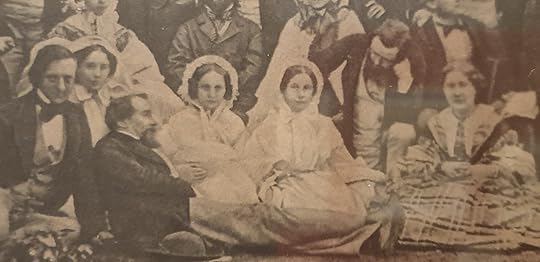
When I was at the Dickens Museum in Doughty Street (his first house when married) recently, I examined a photograph of the cast of the first professional production. Everyone was facing front as you would expect, except for Dickens, who was sprawling on the grass in front, with his side to the camera. Another bearded man sat a couple of rows back pensively looking down, also apparently oblivious to the camera. Suddenly it struck me. That full beard and spectacles were unmistakable; this was Wilkie Collins! It is as if we were sharing an intimate moment of creation with them; the cast being in a different dimension entirely.
focusing on Charles Dickens side view, and Wilkie Collins, lost in thought - my detail from the original photograph in 1857
The two authors had first met because of their joint interest in the theatre, 5 years earlier in March 1851, at Forster’s house. The painter Augustus Egg, a mutual friend, had suggested that Wilkie Collins might be a good actor to take over the role of valet to Dickens’s character (Lord Wilmot) in Bulwer-Lytton’s play “Not so Bad as We Seem”. Dickens was pleased with Collins’s performance and the three men went on a 3 month tour of Italy afterwards, sealing their friendship. They were to act in other plays together over the next few years.
For a good while Wilkie Collins was happy to be Dickens’s “ampersand” (they were known as “Dickens & Collins”) and for this, their first collaborative play, he was content to produce the first draft and for Dickens to extensively revise it. Dickens added a preface, altered lines, and—as we have seen—he organised most of the props and sets. The main edition of the play included the words: “Under the Management of Charles Dickens”. Dickens had tried to counteract any diverging goals, and as he saw it, guide Wilkie Collins in constructing the play, and make sure that Collins’s contributions were as he said “less offensive to the middle class”. At this stage Wilkie Collins was happy to comply. He had already acted in a couple of Dickens’s own farces, and was happy to collaborate in writing a play. This was at a time when plays were just beginning to be considered respectable. Alongside the “minor” working class illicit and suggestive farces, plays aimed at a middle class audience were being staged, with family and home uppermost. These were championed by Queen Victoria.
Writers were keen to become known in Victorian theatre, which could establish their reputation. Although we tend to think of novels and stories coming first before their adaptations for stage, The Frozen Deep shows that this was not always the case. Ironically, given Dickens’s role as mentor, he was not to make much of a success as a playwright, with only a handful to his name, whereas Wilkie Collins went on to write 18 substantial plays. Both men wrote novels, but Collins became a playwright, whereas Dickens remained an actor.
And what an actor he was! Dickens always found it impossible to delegate, and was stage-manager during The Frozen Deep’s original staging in Tavistock House. He also gave himself the most high profile and challenging part of Richard Wardour, the dastardly villain who everyone would love to boo and hiss. Wilkie Collins, in contrast played the popular young hero, Frank Aldersley. Thus the lead roles were taken by the authors, with Dickens’s elder daughter Mamie (then 19 years old) as Clara Burnham, and his sister-in-law Georgina Hogarth as the older female Lucy Crayford, kindly wife of the Lieutenant, who seeks to advise the distraught, highly sensitive young woman. Other roles such as the down-to-earth, disbelieving doctor (who is keen to dismiss Clara as an hysterical lonely young woman), and various naval officers were taken by Mark Lemon, (who had co-written a play with Dickens), Augustus Egg and Edward Hogarth.
Both Dickens and Collins made a lot of use of melodrama, which was enormously popular with the sentimental Victorians. They had similar tastes in other ways too, with mystery very much at the heart of their works. Both authors were concerned with the unmasking of hidden crimes and dark motivations in middle class households. When Wilkie Collins’s rewrote The Frozen Deep as a novella in 1874, aspects such as class conflict were more fully developed. He also toned down the racial stereotyping, completely cutting out the character of a barbarous Scotch nurse whom Dickens had described as a “savage”. She had been intended to symbolise the Inuit, and provide a contrast to the courageous English sailors, but time had moved on and the motives for producing this work were not the same. In her place, Clara, one of the young women became the female visionary: an intuitive aspect of fiction which we associate very much with Wilkie Collins.
Wilkie Collins became known for his novels of sensation from “The Woman in White” onwards, and The Frozen Deep develops surprisingly from what seems to be a drawing room drama, to quickly involving the supernatural. However, the young female character having inexplicable psychic abilities involving premonition is typical of Wilkie Collins’s style of creating suspense. Right from the start though, when the play was being rehearsed, one particular scene was omitted. When many weeks later Collins was allowed to view it along with everyone else, it was a scene in which Dickens as Richard Wardour had the stage all to himself. The composer Francesco Berger, a friend of one of Dickens’s sons who had also written the music for another of his plays,“The Lighthouse”, said that it was “a most wonderful piece of Acting. Anything more powerful, more pathetic, more enthralling, I have never seen.”
He was not alone in this reaction. It is on record that night after night, everyone—including according to John Forster the carpenters and the stage-hands—was moved to tears by the play. By now the production had moved from the first few performances staged in Dickens’s home Tavistock House. The playbills advertising it were increasingly noticed, and there were a series of outside performances, including one before Queen Victoria, Prince Albert, and their family at the Royal Gallery of Illustration. Other guests were King Leopold I of Belgium, Prince Frederick William of Prussia, and his fiancée Princess Victoria, along William Thackeray and Hans Christian Andersen. Queen Victoria wrote in her diary how much she had enjoyed the play, especially Dickens’s acting. After this John Forster tells us, Dickens was keen to hold an extra three performances at the Manchester Free Trade Hall for the benefit of the Douglas Jerrold Fund to benefit the widow of his old friend, Douglas Jerrold.
Thousands came to see these larger professional performances in Manchester, so professional actors were employed, although Dickens and Collins still stayed in their roles. Three of the cast members are still of interest to us today. The professional actors Mrs. Francis Ternan and her daughters Maria and Ellen were engaged for the August performances in Manchester. And as we know, Dickens soon became enamoured of the younger daughter “Nelly”. He was 45, and Nelly was just 18, only 6 months older than his youngest daughter Katey.
Their romance blossomed as the marriage of Charles and Catherine declined, despite their 10 children, but this is not the place to examine that. As well as his connection with the Dickens family, The Frozen Deep’s composer Francesco Berger was also a friend of the Ternan family. He recalled Charles Dickens providing extravagant rehearsal dinners for the cast, full of joints of meat, pies and jellies. Over the coming years Francesco Berger recalled spending Sunday evenings playing the piano, while Charles and Nelly sang duets. We do still have this music; I saw a copy on the piano at Doughty Street, and an excerpt can be heard here https://w3.ric.edu/faculty/rpotter/te...
It seems a shame that The Frozen Deep is never performed now. In recent years there has been just one performance in the UK, in 2005 at the Edinburgh Festival. Reviewers wrote that it was “dark and moody”, but it was not really a success. However, it did lead to Wilkie Collins’s novella being reprinted.
Would I go to see it now, if it were staged? You bet I would! It’s a wonderfully exciting tale, mysterious and thrilling by turn, with the odd bit of comic bombast thrown in to lighten the mood (this is Dickens after all). But the central issue, whether Clara was a true mystic with powers of premonition or merely deluded, is riveting. By all accounts the original production was mesmerising, with dramatically lit tableaux on the iceberg in the middle scene. We can no longer see Dickens’s terrifying portrayal of Richard Wardour, but the play lends itself to gripping performances by talented actors, and stage designers would have a field day with the potential here.
The novella too is well worth reading. Wilkie Collins has kept the melodrama, but developed it to include sensationalist elements whilst also highlighting their social significance. If you enjoy the novels by Wilkie Collins, then give this novella a try.
The Frozen Deep began as a drama in 3 acts, a play written by Wilkie Collins with Charles Dickens’ ideas at the helm. In 1856, Dickens was finishing Little Dorrit and could not devote time to writing this play. He was interested in writing a play based on the ill-fated 1845 Arctic Expedition which was to find the Northwest Passage. The British public was enamored with the Arctic, a place of the ultimate unknown. They were fascinated by news and stories of explorers who braved their journeys there and back. When Franklin’s expedition failed and all 129 members of the crew were lost forever, Charles Dickens wanted to write a play to honor the men.
Without getting into many details of the Franklin expedition, I will say that it is fascinating to research and to read about. There are many sources online and knowing that in 2014 and 2016 the two ships, HMS Terror and HMS Erebus were finally located some 160+ years later, the relics and information being found today is so interesting.
The Frozen Deep was written by Wilkie Collins. The story is a melodrama of a love triangle using tropes of second sight and revenge. Wilkie Collins eventually rewrote the play into a novella which we read in the Dickensians group this past month. If you enjoy Dickens and Collins, this would be an excellent addition to your reading. Knowing the background of the real Arctic expedition made reading the story even more fascinating.
If it is melodrama that you want, this is the book for you, it oozes it from every page; even the title 'The Frozen Deep' has a touch of melodrama about it. It is not 'The Frozen Deep' play that Wilkie Collins wrote in 1856 and Charles Dickens edited before it was published in 1857; the pair of them then going on to perform in it in that latter year. It is a novella that Collins wrote prior to his reading tour of America in 1874. And thinking of Dickens acting in it, I can imagine him giving it his all (as he always did) in one of the roles for he was nothing if not a manqué actor.
The story is set against the background of Franklin's lost Arctic expedition of 1845 and the two main male protagonists are Richard Wardour and Frank Aldersley while the females in the background, very much in the background I should add, are Clara Burnham, 'a young girl pale and delicate', and her companion Lucy Crayford, 'a dark beauty in the pride of womanhood'.
Lucy's husband, First Lieutenant Crayford of the 'Wanderer', is involved in organising a two-ship trip to the Arctic in search of Franklin and at a dance prior to departure he meets up with some of the sailors who are to accompany him to the Arctic regions. One of them, Wardour, also of the 'Wanderer', has a liking for Clara and expresses his feelings (melodramatically, of course) but Clara has eyes for someone else, Aldersley, and without giving away her paramour's name informs him that she is not his to pursue. He is utterly dejected and tells her so in no uncertain terms.
Meanwhile the sailor that she has eyes for enters the room and when discussions develop as to the Arctic voyage and it is discovered that one of the seamen has been taken ill and is unable to travel, he volunteers to go in his place and is accepted as a crew member of the other ship, the 'Sea-Mew'. Clara is distraught for she has had what she calls 'Second Sight' and sees trouble brewing between the two men who are involved in her life.
After many trials and tribulations on the way, the two ships eventually are wrecked and the two crews are thrown together in an attempt to survive and organise rescue parties. This brings Wardour and Aldersley into close contact and it soon becomes apparent that the two men are after the same girl; Wardour is particularly miffed because he knows that Clara is in love with Aldersley so he is determined to do him harm.
However, things do not quite work out and in most melodramatic fashion a rescue party sets off and eventually two bedraggled seamen arrive back in England at the home of the Crayfords in Kent. At first nobody recognises the one who makes the first entry because he is so battered and unshaven from his long journey back to England. But once it is realised who he is, the question is raised as to where the other of the two prospective lovers is ... and that is when the melodrama reaches new heights and the story ends - very melodramatically, of course!
It is not an action packed story but it is certainly one that keeps the interest right through, particularly if one imagines Dickens in one of the roles and Collins in the other ... oh, to have seen that production!
The best part was the buddy read! 😂 I learned by reading this that I hate arctic settings. It's too stressful for my comfort-loving self that eats 10 times a day. 😅 There were some enjoyable characters (the Crayfords) and a certain amount of pathos that I enjoyed but the rest was just not to my taste. Clara is just...too much??
Reading as a novella. Was originally written and produced as a play by Wilkie Collins. It was greatly revised by Charles Dickens as a novella in 1873 and performed as a play before Queen Victoria.
Magnífico triángulo amoroso victoriano. Una pelirroja magnética, dos expedicionarios competitivos, salones llenos de chaperonas. Todo articulado como novela policial. Es un placer la manera en que fluye la narración. Hay armonía, continuidad, fe pura en la palabra. Es posible que sea justamente esa ingenuidad maravillosa la que genera fascinación en esta novela. Se nota la participación de Dickens. De la calidez de los salones victorianos a los mares helados del Ártico, ida y vuelta. Todo parece tan simple que dan ganas de quedarse en ese mundo sostenido -sin que nadie se percate- por la fuerza ciega de la voluntad.
Τα αμέσως δυο προηγούμενα βιβλία του Γουίλκι Κόλινς που έπεσαν στα χέρια μου (το "Το στοιχειωμένο ξενοδοχείο" που διάβασα το 2018 και το "Η γυναίκα του ονείρου" που διάβασα φέτος τον Ιανουάριο) ουσιαστικά την τελευταία στιγμή τσίμπησαν τέταρτο αστεράκι, κυρίως λόγω ατμόσφαιρας και της γενικότερης αίσθησης που μου άφησαν. Όμως τούτη η νουβέλα δεν τα γλιτώνει τα τρία αστεράκια, μιας και μου φάνηκε υπερβολικά μελοδραματική για τα γούστα μου και στο τέλος κάπως αδιάφορη. Η κεντρική ιδέα της ιστορίας είναι σίγουρα ενδιαφέρουσα και υπάρχουν κάποιες ωραίες σκηνές και εικόνες εδώ και κει, όμως το συνολικό αποτέλεσμα δεν μου έκανε ούτε κρύο ούτε ζέστη. Η γραφή έχει πολλά θετικά στοιχεία, αλλά τείνει προς το μελόδραμα και στο τέλος δείχνει τα εκατόν εξήντα και πλέον χρόνια της. Πάντως του χρόνου που έχω σκοπό να διαβάσω κάμποσα πολυσέλιδα μυθιστορήματα, λέω να πιάσω επιτέλους το "Η φεγγαρόπετρα", ώστε να γνωρίσω ακόμα καλύτερα τον Γουίλκι Κόλινς, με ένα πολύ μεγάλο σε έκταση έργο του.
Wilkie Collins es uno de los autores que más he leído y que más suelo disfrutar, y desde hace bastante tiempo tengo la costumbre no escrita de leer al menos uno de sus libros al año. Pero este 2024 se me ha echado el tiempo encima y no he podido ponerme a disfrutar de una de sus obras. Justo el año en que se conmemoraba el bicentenario de su nacimiento. Así que siendo una fecha tan especial he decidido leer algo nuevo de este escritor, aunque sea justo al final de diciembre con una obra cortita suya que tenía desde hacía tiempo cogiendo polvo en mis estanterías. Mejor tarde que nunca, que se suele decir.
En un puerto Inglés se está celebrando una fiesta para despedir a los tripulantes de dos barcos que al día siguiente van a poner rumbo al ártico para una larga y tortuosa expedición. A esta fiesta ha acudido la joven Clara Burnham, la mejor amiga de la esposa de uno de los oficiales que van a partir a tierras heladas. Clara es muy supersticiosa y vive con el temor del regreso a Inglaterra de un pretendiente no deseado y su reacción cuando descubra que ha entregado su corazón a otro joven, Frank Alderseley, que también va a ir al ártico. Unos temores que esa misma noche se confirmarán, y que llevarán al rechazado Richard Wardour a obsesionarse con la venganza hacia la persona que le arrebató el amor que nunca tuvo de Clara. Su corazón destrozado le llevará a la expedición al ártico, donde los destinos de Richard y de Frank se encontrarán finalmente.
Nos encontramos ante la obra cortita, de poco más de 200 páginas (publicada por el sello Navona en una edición en pequeño formato) con una trama perfectamente comprimida y unos pocos personajes. Lo cual es herencia de los orígenes que tuvo esta historia y que se narran la sinopsis del tomo, donde se cuenta que fue escrita en 1856 a modo de obra de teatro por Collins junto a su amigo y mentor Charles Dickens, siendo estrenada de 1857. Posteriormente, en 1874, Collins redactaría en solitario la historia en forma de novela corta debido al éxito que en su momento tuvo la obra de teatro. Me parece una muestra muy interesante de la colaboración artística entre dos de los escritores más afamados de la época victoriana .Personalmente creo que nunca he tenido la oportunidad de leer algunos de sus trabajos a dos manos, y aunque la versión que he manejado venía de la pluma de Collins me ha parecido por este motivo una lectura muy interesante. además, saber eso me ha permitido entender alguna que otra cosa que me ha escamado mientras leía. Y es que la lectura bebe mucho de su estructura teatral anterior. Como se dicho, es una historia que argumentalmente está muy comprimida. No es que solo haya un elenco de personajes bastante acotado, también transcurre en muy pocos espacios que están explicados en el libro por medio de breves capítulos donde se desarrollan esos escenarios de una manera que da la impresión de ser acotaciones teatrales bastante desarrolladas. Además, al principio de varios capítulos y en ciertas escenas, se usa el presente debido a la forma en que esta obra estaba anteriormente redactada, y los diálogos ocupan mucho espacio dentro de esta lectura. Son frescos y dinámicos y hacen que la trama avance, teniendo en todo momento la marca del autor, aunque se note mucho el peso de lo dickesiano en ellos. Todo esto tiene cosas muy positivas de cara a animarte a leer este libro, como que Collins vaya siempre al grano, no tiene espacio para dedicárselo a los detalles o temas superfluos o secundarias. Pero también proporciona a la lectura una sensación de cierto acartonamiento y concreción en ciertos momentos que a veces hace que todo resulte un pelín artificial.
En esta ocasión Wilkie Collins lleva a sus personajes a las frías tierras del ártico, lo que da a la lectura, una fuerte carga de novela de aventuras que recuerda a las historias de descubrimientos y aventuras de julio Verne o a “ La Barración de Arthur Gordon Pym” de Edgar Allan Poe. La ambientación en los polos de “En Mares Helados” hace que esta obra resulte una curiosidad dentro de la producción literaria de nuestro autor, cuyas historias suelen ambientarse en la Inglaterra, rural o urbana, y esto puede dar la idea de que estamos ante una lectura diferente, más enfocada en la aventura. Pero lo cierto es que Collins maneja estas diferencias junto a algunos de sus temas y argumentos más habituales, creando una historia en la que hay bastantes escenas de misterio y tensión, junto a una trama romántica que involucra un triángulo amoroso y que es la que hace girar toda esta historia. Es cierto que, como es característico en las obras de este autor, hay momentos, dialogos y escenas que resultan de un melodramático muy pesado e incluso cursi. Pero una vez más, creo que aquí la brevedad de la lectura le hace un gran favor a esto, ya que estas escenas no resultan especialmente pesadas de leer. La historia romántica, dentro de su sencillez, está muy bien inscrita en los parámetros de la novela amorosa de esa época, y nos habla de temas que pueden percibirse como más actuales como el consentimiento o la necesidad de ser clara a la hora de expresar tus opiniones.
La novedad de todo el conjunto del libro radica en cómo esta trama amoroso se combina con lo que sucede en el ártico, como el autor nos muestra también las duras condiciones por las que la la expedición debe pasar y como el frío y las condiciones extremas de hambre y aislamiento van pasando factura a sus miembros después de que hayan quedado encallados en el hielo durante casi dos años. Y esto da margen a Collins para componer una historia que nos hable sobre el sacrificio personal, los limites de la moral y la cordura, la lealtad y, sobre todo, la eterna lucha de las personas contra nuestros sentimientos y pensamientos más oscuros y egoístas, y lo duro que puede resultar sobreponerse a ellos y aprender a sacar lo mejor de uno mismo. Y el resultado de toda esta mezcla son escenas potentes que nos hablan del bien y el mal interno y de la venganza, pero también del amor y la redención con toda su belleza, y de las victorias grandes y pequeñas sobre una mismo. Una de las cosas que más me gustan de Colín es el cuidado que pone en el desarrollo psicológico de sus personajes, y aquí no se pierde esta faceta suya. Los caracteres tienen personalidades finalmente perfiladas en pocos trazos, que hacen que la historia avance, se mueva y te lleve hacia un desenlace que quizás resulte previsible, pero no por ello menos conmovedor.
First appearing as a play written in collaboration with Charles Dickens, Wilkie Collins’ The Frozen Deep is a novella concerning a failed expedition to find the Northwest Passage. At the heart of this story is a love triangle, which, speaking of Mr. Dickens, made me think back to A Tale of Two Cities. I wonder if love has ever existed in the exact form that Victorian’s imagined. I fear it has not.
I very much enjoy Wilkie Collins’ writing style and found this an easy and fascinating read. One thing I cannot help admiring is the willingness of the men of this time to go out into the dangers of the little known world. The only men of that ilk we have had in my lifetime were the Apollo Astronauts. Ah, but, to quote Milton, they also serve who stand and wait.
I had never heard of this novella, which is apparently based on a play of the same name, written and originally performed by Wilkie Collins and Charles Dickens in the main two roles. It's based on the ill-fated Franklin expedition that set sail in 1845 in search of the Northwest Passage. To this day, no one *really* knows what happened to them (though The Terror by Dan Simmons makes a pretty compelling argument for scurvy and arctic monsters).
There are no monsters in The Frozen Deep. In fact, because this such a short book based on a stage play, there are very little scenes with ice in them at all. Half of the action takes place in London and concerns the wife of one of the expeditions lieutenants, along with her friend/ward Clara, a beautiful orphan who (not entirely willingly), has stolen the heart of two other men departing for the Arctic and whom she correctly predicts will become bitter rivals if they ever learn the truth (reader, they do).
Wilkie Collins and Charles Dickens are both renowned for their sprawling novels in which the reader gets to know the characters intimately, and get emotionally caught up as they grow and change. Unfortunately, this story suffers most from its conciseness, though it does cleverly raise tension by using jumps in time and perspective until the big reveal. However, the reveal when it comes felt more like an emotional bait-and-switch because I didn't get to know the characters well first and experience the physical/emotional journey first-hand. If anything, my reading experience of The Terror and subsequent reading up on the historical events leant this story more emotional grist than was earned on the page alone. I'm curious to read the play now, but I suspect seeing Dickens and Collins embody their roles would have brought this story to another level, and I'm just disappointed I wasn't around to see it!
Excelente lectura para este el mes del amor, y no exento de suspenso y un poco de misterio. Un triángulo amoroso entre la hermosa Clara y los dos hombres a los que promete su corazón.
Y ya le decían que no se le ocurriera comprometerse sin estar libre del otro hombre. La lectura es fluida y muy entretenida, no sabia por ejemplo que esta historia fue inspirada por el hecho real de los buques que desaparecieron y que se sospecha llegaron a cometer canibalismo.
Pero lo más sorprendente es el final y la redención de uno de sus protagonistas.
Y para ser una obra de teatro esta bastante entretenida. Muy recomendable.
A short work, interesting if not necessarily inspiring. A brute thug antihero, an insipid heroine, and a clueless hero. All three come across as several snowballs short of an iceberg. Still, again, not bad. Collins' prose benefits from the novella format, altho the shifts from present tense to past can get annoying. Available free from Gutenberg and worth the price.
Collins' tale is based on the tragic trips to find the Northwest Passage. At times, the story is a bit melodramratic, but in the middle the tension is just right. It is a tale of love and revenge.
Depending on where you search, you will find that The Frozen Deep is either in play or novella format. Charles Dickens and Wilkie Collins had quite a writing rivalry/friendship and this novella here is Collins’ work taken and adapted from the play. This is important knowing going in to read because the book “almost” reads like a play in how it is stylized and presented.
I became hooked on Wilkie Collins about ten years ago when reading The Moonstone for a book club. I went on to read the others of his “big four,” The Woman in White, No Name, and Armadale and really enjoyed all of them. When Collins is on his game, his plots are constructed so cleverly as to give an air of mystery and also put together so many interwoven subplots into a very climactic finish.
Some of Collins’ “lesser knowns” are a bit of a mixed bag and hit and miss, and I preface that because I felt like The Frozen Deep was just a bit too melodramatic and didn’t have quite enough “meat on its bones” or punch to be a fully enjoyable experience.
Set historically in the backdrop of the infamous and failed Franklin Expedition, The Frozen Deep’s primary conflict concerns a love triangle between three of its lead characters. One of the interesting wrinkles that Collins throws in at the outset is having the lead female character, Clara, have “second sight.” I think this sort of allows us, as readers, to follow her ominous thoughts of what could possibly happen as the plot unfolds.
We are thrust right into the basis of the pickle right away when we find out that Clara has her sights set on a man named Frank, but that there is another man, Richard, a friend from childhood, who also believes that he will win Clara’s love. Interestingly enough, Richard comes into the scene right as the exploration and its men are getting ready to sail, with Frank being one of the men going on the journey. Clara has premonitions of bad tidings between the two, especially when she learns that the two will both be taking part in the expedition. How will things pan out?
While I will never turn down a Collins read, I just felt like this was a lesser effort and less substantial than his other longer works. I felt like, while not entirely predictable, the plot is set up in a way that can go either one way or another and it becomes fairly obvious to the reader. Moreover, there is really a lack of depth in this book, as it just seems very light and fluffy. For this reason, the intrigue was sort of lacking, and I chugged along to the finish line even though the book was less than one hundred pages.
Serious Collins fans will probably enjoy this one, but it pales in comparison to his longer, more substantial, and tightly constructed longer novels.
'The Frozen Deep' was first published in 1874, originally written as a play by Collins in 1856. A novella of just over one hundred pages, this is a very quick read. No doubt inspired by the Victorian fascination with the lost expedition in search of the North West Passage led by Lord John Franklin in 1845. A rare foray into nineteenth century fiction for me, Wilkie Collins' tale of vengeance and self sacrifice is played out within an Arctic expedition, lost and ice-locked in the Polar wastes. To bring spice to the plot the author also includes the dilemma of a love triangle, a pinch of guilt, as well as a dichotomy of Christian belief with that other Victorian allure to the occult. Too short a novel to enthrall and not long enough to develop intriguing characterisation. All the same, has not put me off further reading of this writers work.
This was an intense read. Love triangle, the artic, and the good vs evil plot, of not just man v man, but also man v nature.
It begins with a ball when a young maiden has a premonition about the two men involved in her life. Her love is to set sail for the artic the next day, and the man she is supposed to marry is on his way back from Africa. But the one who gets denied swears vengeance on the other man.
Wilkie Collins' writing makes you care about all the characters, even the one who vows revenge; they are all so well developed, with all the action, and foreshadowing the coming conclusion of who will win the hand of the young maiden.
One of the best I've read so far this year. Highly recommend; 5*****
Definitely, this is not the English version of L'abîme by Charles Dickens, Wilkie Collins, in spite of some websites.
First sentence: The date is between twenty and thirty years ago. The place is an English sea-port. The time is night. And the business of the moment is—dancing.
I just found an interesting post concerning Dickens and Collins partnership, where The Frozen Deep is also mentioned: Wilkie Collins and Charles Dickens
The date is between twenty and thirty years ago. The place is an English sea-port. The time is night. And the business of the moment is - dancing.
Miss Clara Burnham believes she is capable of second sight and it's doing her no favours at all healthwise. For entirely personal reasons I love the explanation:
Clara's early years were spent [...:]Scotland. The ignorant people about her [...:]filled her mind with the superstitions which are still respected as truths in the wild north.
This entire review has been hidden because of spoilers.
This version of "The Frozen Deep" is based on play by the same name which was written by Wilkie Collins with help from Charles Dickens. That play was then performed at Charles Dickens' house, with Collins and Dickens playing leading roles of Frank Adersley and Richard Wardour, respectively. It was a thrill to read this with the excellent GR group "Dickensians!", and to imagine both authors acting in these roles. I highly recommend reading this, and looking up the Dickensians! group read for all the wonderful supplemental information provided.
So this story started life as a play starring Collins and Dickens and then Collins turned it into this novella. And honestly? I think it probably worked better in its original form because really, there's not quite enough in the story to get invested in the characters and actually care about what's happening to them. There's not enough set up for Clara and her mysterious "second sense". We get several pages several times over of the ship's cook complaining about making bone broth and then the actual crux of the story almost gets lost?
Basically? I would love to see it as a play. But as a novella? It was decidedly meh.
Wilkie Collins's The Frozen Deep is a novella based on a play. There is enough of a difference between the two media to judge the novella as something of a failure. The character of the heroine is surprisingly shallow for Collins: It is the basic situation of two sailors who love the same woman that is dominant, whereas the heroine is someone whose preoccupation with "second sight" is overstressed.
Highly enjoyable! This actually started as a play and Collins added to it to flesh it out a bit. In the start it had that play feel, but it smoothed out. I thought it was a nice novella that goes into themes of the human spirit when it's life and death situations. Some surprising moments made this very suspenseful.
If What Was I Made For was an anxiety-ridden Victorian play/short story, it would be The Frozen Deep. I've read the play as well as the short story that Collins wrote after his tour and it is honestly even better than the play. I am so entertained!
“The gain is his. He has won the greatest of all conquests—the conquest of himself. And he has died in the moment of victory. Not one of us here but may live to envy his glorious death.”




 The Frozen Deep: A Drama in Three Acts by Wilkie Collins