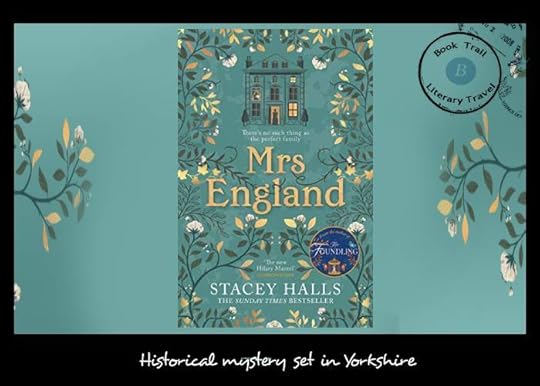
"Highly atmospheric and tense." —Richard Osman, internationally bestselling author of The Thursday Murder Club
Mrs. England is a portrait of an Edwardian marriage, an enthralling tale of men and women, power and control, courage, truth and the very darkest deception.
West Yorkshire, 1904. When recently graduated Ruby May takes a nanny position looking after the children of Charles and Lilian England, a wealthy couple from a powerful dynasty of mill owners, she hopes it will be the fresh start she needs. But as she adapts to life at the isolated Hardcastle House, it becomes clear something is not quite right about the beautiful, mysterious Mrs. England.
Distant and withdrawn, Lilian shows little interest in her children or charming husband and is far from the angel of the house Ruby was expecting.
As the warm, vivacious Charles welcomes Ruby into the family, a series of strange events forces her to question everything she thought she knew. Ostracized by the servants and increasingly uneasy, Ruby must face her own demons in order to prevent history from repeating itself. After all, there's no such thing as the perfect family—she should know.
This captivating new novel from Sunday Times bestselling author Stacey Halls proves her one of the most exciting and compelling new storytellers of our time.
Stacey Halls grew up in Rossendale, Lancashire, as the daughter of market traders. She has always been fascinated by the Pendle witches. She studied journalism at the University of Central Lancashire and moved to London aged 21. She was media editor at The Bookseller and books editor at Stylist.co.uk, and has also written for Psychologies, the Independent and Fabulous magazine, where she now works as Deputy Chief Sub Editor. The Familiars is her first novel.
1904: Ruby is a Norland nurse with an impeccable reputation. She is sent to a new placement at an isolated family estate in the English countryside. She has an immediate connection with the four children and finds herself drawn into the mysterious relationship between her employers, Mr. and Mrs. England. Ruby becomes wrapped up in the mysterious happenings and questionable circumstances within the dark and eerie mansion.
This was highly enjoyable from start to finish. I am always drawn to stories involving nannies and the children they care for. This novel included everything I love in a historical mystery. It carried a constant air of foreboding tension and suspense. The pace and flow kept me fully engaged and invested. The atmosphere was palpable and had me consumed and engrossed. I loved the family estate and forested lands that surrounded it - the author did a phenomenal job making the setting part of the intensity of the story. The characters were fantastic! I was curious and had my suspicions about each of them. I especially loved Ruby who I connected with immediately.
This is my second book by this author and I can confidently say I love her writing!
Thank you to the publisher for my physical review copy!
This is my third book by Stacey Halls and I have loved every one of them. In this one Ruby May is a child nurse for Mr. and Mrs. England's three children. They live in an isolated home called Hardcastle House. Inside the home, there are many secrets and Ruby has a few of her own.
I loved how the author used the book's setting to show foreboding. Halls writes atmospheric tales using location and particular historical times, this one being in the very early twentieth century. I also really appreciated the way Halls wrote the younger characters. The children's thoughts, feelings and behaviours were very true to life and realistic.
This was such a captivating read using setting, time and place to set up tension leaving this reader on the edge of her seat. But this book is really about the relationship between Mrs. England and Miss May, who have a lot more in common than they think.
I am really looking forward to The Household which comes out in April of 2024. By the way, this was another gift from The UK. I asked for it because I love the cover. Sometimes you can judge a book that way.
A novel set in Yorkshire in 1904 with some Gothic elements. There is more than one mystery which, together with understatements and dark atmosphere of Hardcastle House, make a captivating read. Ms Halls proves yet again that she knows how to build a tension and tell a captivating story.
Dazzling, dark, disturbing, and athmospheric are some of the words I have come across in review describing this book, but it fell short for me on many levels.
The story does get off to a great start, as its set in Yorkshire in 1904, when newly gradualted nurse Ruby May takes a position looking after the children of Charles and Lilian England, a wealthy couple from a powerful dynasty of mill owners, she hopes it will be the fresh start she needs. But as she adapts to life at the isolated Hardcastle House, it becomes clear there's something not quite right about the beautiful, mysterious Mrs England.
However the story plods along without ever really creating any atmospheric. I kept reading thinking... this its a slow burner but will dazzle at any moment and before I knew it, I was 3/4 way through before I felt any sense of intrigue or suspense. Its wasn't dark or disturbing like her other novels, the characters didn't really make any impact on me and by the end I was glad to have finished with the lot of them.
I ordered a hard copy of this one to place on my real life bookshelf alongside Stacey Hall's other novels, but sadly it will have to go to the pile for the used bookstore.
Very enjoyable read, but I do think Halls needs to work on her pacing because I felt like nothing happened in like 90% of this book and then it all went down in the last 10%.
Mrs. England by Stacey Halls is a 2022 Mira publication.
West Yorkshire -1904
Ruby May is unable to immigrate to the United States with her employers, so and in dire need of funds, she accepts a Nanny position, working for Charles and Lilian England. Charles is a wealthy mill owner, but only employs a small staff. But that is not the only odd thing Ruby notices about her new situation.
It would seem that Mrs. England is mentally unwell, and her husband is a bit overly familiar with Ruby on occasion, which puts her at odds with the staff. Slowly, Ruby begins to fall under Charles’ spell, relishing the extra attention he gives her- but Mrs. England may not be as aloof as she seems…
What a terrific story. Yes, this story has some Gothic tones, which by now, everyone knows is my favorite- but there’s something deeper here than the creepy atmosphere, mystery, and intrigue. At its core it is the story of two women from differing backgrounds who are stronger than they are given credit for, but forced to work within the confines of the strictures of the society they must conform to. But they also lean on and help one another, while still maintaining their individual independence- which is a message we should all pick up on and practice.
Overall, the author did an amazing job with this book. It’s hard to capture that special Gothic atmosphere- these days- but Stacey Halls has it down to a science. Yet, she also creates fabulous characters and provides rich historical details that kept me enthralled, on the edge of my seat, and turning pages well past my bedtime.
I am a huge fan of Stacey Halls. A great historical fiction writer and another page turner.
In this latest novel, the author manages to capture the period, the brooding Yorkshire landscape and the characterization of people in Edwardian times. Stacey Halls knows how to captivate people without going over the top in boundless pages of scene setting.
The book is called Mrs England but in reality, this is the story about 2 women. We follow their present whilst their disturbing stories becomes apparent as both women grow from under their subversive and controlling past (and present).
Ruby May is a wonderful character who recalls what her principal told her "..The child's mind is a material more precious than canvas, more exquisite than marble". The book reveals some beautiful examples of how Ruby goes about teaching these 4 children in her charge - their development as precious as a canvas. As a reader, you admire her courage, strength, devotion to care, teaching and love for humankind.
Mrs England, starts as an unwelcoming, distant and unloving character even to her own children. Not wanting to spoil for people who haven’t read the book. You will want to follow her story.
The only slight criticism I would have is the author could have created more menace with the Greatrex family, having introduced us to some intriguing yet unpleasant characters. The Greatex family could have but did not add much to the story.
Ruby May is a sympathetic character. She’s motivated and determined and her care of children is beyond reproach. Trained at the prestigious Norland school and recipient of her childcare certificate, Nurse May puts the child or children she is caring for at the center of her life. Norland College, which still exists today, provided Prince George and his siblings, Charlotte, and Louis, the children of Prince William and Kate with a Norland nanny.
This version of Norland exists in 1904 England. A young woman who goes there can rise above her social class and take part in a lifestyle to which she would otherwise never be exposed. Such was the case for Ruby May, who attends Norland with a scholarship. At the beginning of the story, she is set to lose her position with the Radletts because they are moving overseas. They wish for Nurse May to go with them, but she refuses, saying that she can’t leave her family in England. It’s a bit mysterious because Norland nannies travel and live abroad with their families all the time. Why can’t Nurse May do the same? Slowly over the course of the novel, Stacey Halls reveals the answer to this mystery.
Norland stipulates that if their graduates lose three positions, they will no longer be considered Norland nurses. This puts pressure on Nurse May to succeed at her next position which is with the Englands in Yorkshire. Mr. England is a mill owner and there are four children in the family, Rebecca, Saul, Millie, and one year old Charley. I love how Halls brings the children and the nursery to life. All the chores Nurse May has to accomplish, washing and dressing the children, cleaning the nursery, noting how all their clothing fits them badly and how all but Charley needs new shoes, and being entertainer in chief. She’s always mending, playing, supervising walks, teaching, and available. As the eldest of five, Nurse May’s experience with her own siblings puts her at an advantage. It isn’t long before she notices that Mrs. England doesn’t visit the children often, and when she takes the children to the drawing room for daily visits, Mrs. England always seems uneasy with them. . .
Stacey Hall is attentive to the details of history, giving the story credibility and adding layers of interest. How children worked in Mr. England’s mill, some barefoot, some coughing, but the children of the wealthy were for the most part well dressed and had access to healthcare. How many of even the well-to-do considered education for girls unnecessary. How even an educated nurse might know more about asthma than a country doctor in 1904 (Nurse May is decidedly more familiar with appropriate treatments for asthma when Saul has an attack)
It’s in the dynamics of Mr. and Mrs. England’s relationship that Stacey Hall excels. Of course, Nurse May becomes increasingly aware that their relationship is dysfunctional, that something is way off. More and more, she is pulled into their daily drama, leading to a tension filled crescendo.
This is one of the most magical and atmospheric novels I have had the pleasure of reading in some time.
The novel might be called Mrs England, and she is the enigmatic character of the house, but the story centres around Ruby May who works as Norland nanny. She decides not to move abroad with the family she works for and so finds employment with the MrsEngland of the title. Well, THAT turned out to be interesting....
The house is set on the desolate Yorkshire moors and it's a deliciously gothic one. Isolated yet compelling but as for friendly? Well, the father of the house might be but that Mrs England - you want to watch her I thought. The staff are very Mrs Danvers type people. Good for the reader, but not so good for the character who comes into the house as an outsider ...
Oh if walls could talk....well in this book secrets start to seep out pretty quickly and we get an insight into Mrs England, the family and most importantly the marriage. Don't take your eyes off the nanny though....she has secrets of her own!
I had shivers down my neck and heard whispers in my ear as I read this. Very cinematic too although whenever the film is made ( fingers crossed) the book will always win for the sharp, melodic writing and pictures it forms in your mind as you read.
I feel like there were two people within me who read this book: one who is only a reader, and one who is also a writer; and they had different thoughts about this book.
Reader me would say that this was an easy, quick and entertaining read. The mystery was intriguing enough to pull me along, and the prose flowed easily. Perhaps not the kind of book that will stay with me for years, but certainly something to enjoy on a lazy summer afternoon when you want to while away some hours with a book and not use too much of your brain, but still be entertained.
Writer me would like to add: people who write have probably heard, if not used of books like Save the Cat Writes a Novel, in which basic plot structures are analysed and you learn at which percentage of the book part X, Y and Z are supposed to happen. Similar guides can be found for free on the internet. I read this as an e-book, meaning I had the percentages displayed on the screen; and I could tick the boxes as I read. Aha, 10 %; we're done with the introduction. Next chapter will kick-start the plot. Aha, 20 %: this is where the story will take place, we've met everyone of importance, the mystery is set up; now we're just rolling along until the mid-point reveal. And so on. And it made the book utterly predictable and therefore, to me, boring. That's probably not a problem for many readers, but I still wanted to mention it - because this also means that if you read a lot, you've probably internalised these structures, be it consciously or subconsciously, and you will also likely find the book rather predictable. I kept waiting for something fresh, a twist I hadn't seen before, but it never came.
I did have some trouble caring for any of the characters in the book and found the heroine Ruby, simply too gullible and thick in places, even if her inexperience was meant to be part of her character. Her terrible secret that the book worked towards revealing in the end was, to me, neither shocking nor very terrible and the reveal fell rather flat.
Mrs England by Stacey Halls is one of my most highly anticipated releases for 2021 and I was thrilled when it delivered on all of my hopes and expectations. From the stunning cover design, the enticing premise, the Edwardian era setting and location at Hardcastle House in West Yorkshire, Mrs England is everything I love in historical fiction.
Ruby May is a qualified nurse from the Norland Institute in London and after her employers move to America, Nurse May finds herself frantically looking for work so she can continue to support her ailing sister. Accepting a position at the isolated Hardcastle House, Ruby eagerly agrees to look after three children from the family of wealthy mill owners Charles and Lilian England. The previous nurse had cared for Charles as a boy and died of natural causes and Nurse May finds her new surroundings lacking. She immediately embarks on a drastic 'makeover' of the nursery, cleans and dusts, mends the children's clothes and takes the children outdoors to play every day. This kind of 'manor makeover' is total bookish catnip to me. I love when a governess or nursemaid shakes things up for the better, and I was in heaven during these pages.
Mrs Lilian England keeps strange hours, doesn't interact much with the children and doesn't involve herself in the running of the household. Mr England is friendly, relaxed and approachable and it's soon clear who really runs the house. This is a slow moving gothic tale, with Ruby's past carefully revealed and the relationships between the characters slowly evolving.
Reading Mrs England felt like being immersed in the world of Downton Abbey. Not much happens but I just loved being there, the interactions and back stories of the characters being enough to keep me transfixed. It is for this reason that the denouement came as quite a surprise and everything I thought I knew was turned slightly on its head. Oh, and the last line of dialogue between the characters made me exclaim out loud and impatient to discuss it with another reader.
I've read all of Stacey Halls' books, beginning with The Familiars in 2019 and The Foundling in 2020, both of which were 5 star reads. You can understand why Mrs England was high on my watch list, and I'm thrilled to report it was also a 5 star reading experience. This makes Stacey Halls an automatic must-read author for me and I can't wait to find out what what she's working on next.
ESTE LIBRO TE CREARÁ unas incontenibles ganas de comentarlo cuando lo termines! Así que asegúrate de conocer a alguien que lo haya leído antes de ponerte con él!
¡Estás avisada🤭!
Pero vamos a lo que vamos!
Si te gusta Jane Eyre, ponte a chillar de la emoción, porque esta historia te recordará un montón a este gran clásico❤️🔥
Es más, si te fascinan las novelas que son tremendamente adictiva hasta el final, que tienen un aire sombrío, con secretos, intriga y suspense, lo vas a flipar. Y si encima, te van los personajes moralmente grises, esos que no sabes si son buenos o malos, te acaba de tocar la lotería😍!
Es más de los mases, si te apasionan las historias ambientadas en páramos oscuros, casas aisladas, bosques tenebrosos, ríos peligrosos, esta es tu siguiente lectura🤪!
Y es que esta historia te enganchará de tal manera que no podrás soltarla hasta terminar de leerla!
UNA FASCINANTE HISTORIA SOMBRÍA QUE TE ROBARÁ EL ALIENTO y, quizás, algo más...🤫
Another interesting, atmospheric historical work of fiction from Stacey Halls. Ruby May is a children’s nurse trained at the prestigious Norland Institute. She joins the England family from West Yorkshire to care for their four children. Their house sits isolated above the wool mill the family own. At the start Nurse May finds it hard fitting in within the servants hierarchy, feeling cut off and very much on her own. She also feels very uncomfortable with the master, Mr England, when he treats her on almost friendly equal terms. From the beginning she knows that something isn’t quite right within the house. Slowly we we learn more about Mrs England’s extremely rich family and her marriage, as well as an insight about Nurse May’s background. Great read and loved the eerie feel/atmosphere of the story.
Un roman slab. Personajele sunt neconturate, neverosimile, scriitura este plină de dialog, scriitoarea urmărind parcă să îi fie ecranizată cartea. Traducerea lasă și ea de dorit; toate la un loc fac din pacate ca această carte să fie un fiasco total.
I have already read Halls’ account of the Pendle witches and she writes historical fiction from a female perspective. This is an undemanding novel, set I would guess in the early 1900s. It is a bit gothic and is a bit of a slow burner. The main character Ruby May is a Norland Institute nurse/nanny. After her first family emigrated she is sent to Yorkshire to the family of Mr Charles England and his wife Lilian and their four children. Each of the main characters has secrets which gradually unravel over the course of the novel. Halls also provides a pretty good description of how coercive control works. The setting is in the Hardcastle crags area of Yorkshire and there is a bleakness to it which is quite pleasing. Of course there is no such thing as the perfect family and Ruby is alerted from the beginning that all is not well: ‘Something’s not right here.’ I was aware of Mr Booth’s eyes on me, and he seemed to hold his breath. ‘What do you mean?’ ‘In the house. With the family.’ One of the shocks at the end is based on a real event. Having said all of that there is a real twist in the last sentence which makes the reader re-evaluate the whole of the book. As I have said, it was undemanding and read easily. Halls is good at creating atmosphere. It didn’t quite, for me, match her first novel, but has been a good summer read. It was written during the first lockdown and is dedicated to the NHS.
O combinație între „Jane Eyre”, „Bucătăria sclavilor” și chiar „Menajera”. Dădaca Ruby May ajunge la familia England, o familie cu 4 copii, dar cu obiceiuri aparte. Cel mai ciudat este acela că mama copiilor pare dezinteresată de gospodărie și de copiii săi, iar rolul ei este îndeplinit de domnul England. De ce se întâmplă asta, ce ascunde doamna England și ce secrete are Ruby May?
I really enjoyed Stacey Halls last two novels. However, Mrs England left me underwhelmed. Not much happens and I didn't feel the level of suspense or surprise other reviews have mentioned. Not a bad book, just a bit underwhelming.
An eerie, dangerous landscape, a wealthy family, a children’s nurse, a controlling husband, and characters with secrets greet us in this delicious, Gothic novel.
Ruby May graduated from Norland Institute, a nursing school in London, to take her first position as a nursemaid to an infant.
Her first position did not last long because she couldn't leave England for America with this family. The school found her another position at the remote Hardcastle House taking care of the four children of Mr. and Mrs. England.
Ruby May was worried about taking care of four children, but the children should not have been her main concern.
The staff at Hardcastle House was not welcoming, and Ruby had to do many things she hadn't done in her first position.
Along with everything else, Mr. England was subtly controlling, and Mrs. England was quiet as a mouse. Mrs. England seemed to be afraid of her husband, and Ruby saw cigar burns on her hands.
Was this house safe for her and for the children?
Why was Mrs. England so quiet, and why did she seem so indifferent to her children?
Why did Mr. England not trust his wife to take care of their children?
MRS. ENGLAND is very descriptive, very well written, and it drew me in immediately.
I had read Ms. Halls' book THE LOST ORPHAN/THE FOUNDLING and thoroughly enjoyed her writing style and story line.
This book is just as amazing.
If you enjoy spending time with wealthy families in Edwardian England and feel an undertone of danger as you turn every page, be sure to add MRS. ENGLAND to your reading list.
Ms. Halls does not disappoint and will have you staying up late so you can find out what's going on in this household and with each character. 5/5
This book was given to me by the publisher via NetGalley for an honest review.
I have had my lovely signed coloured edged physical book sitting on my shelf since this was published.
I saw this come up on my library audio app and grabbed it.
I absolutely loved this book. Historical fiction at its best.
I own several books by this author and not read one! So I’m listening to The Foundling written by this author now.
This nanny is sent to a remote mansion to care for 3 children. It’s not going to be plain sailing is it? So I was wondering what turn this would have, would it be the Nanny (nurse) the family? A family member? Someone else in the household?
Secrets? Past?
My mind was buzzing with all sorts of things.
I adore a book that makes me think about it while I need to get on with life and I’m excited to get back to it, don’t you?
I did question halfway into the book about a certain person, so it didn’t come as no surprise when I was proved right, however……why. That was my eagerness to find out.
But wait! There’s much more!
One of the best historical fictions I’ve read this year. Yet….. It was loosely based around something or someone and you hear this in the authors notes so that made this read more impactful.
*if you like family fiction/saga *thrillers *mystery
“Doamna England” m-a atras de cum i-am văzut coperta și nu a dezamăgit! Aș fi vrut poate mai mult în anumite locuri, dar tot este un titlu pe care-l recomand cititorilor de ficțiune istorică și mystery!
Ce mi-a plăcut: - se parcurge foarte repede, eu am combinat audiobook-ul cu cartea fizică și a mers perfect. - subiectul. Anglia anilor 1900, o dramă de familie, un observator activ, o privire aruncată în culisele epocii edwardiene. - atmosfera. Aici cred că este cel mai mare plus al romanului. Setting-ul & vibe-ul sunt palpabile, introduc cititorul în lumea dinăuntrul copertelor. Descrierile sunt foarte vizuale. - acțiunea. Nu e ticsită de evenimente, dar nici nu se lungește aiurea. Evenimentele sunt ușor de urmărit și reținut, ba chiar produc o reacții: frustrare, bucurie, teamă, anticipare. - personajele. Aici văd un alt mare plus al romanului: portretizarea caracterelor. - ritmul. Faptul că nu am nimic de comentat aici și că nu am simțit când am ajuns la ultima pagină spune suficient.
Ce nu mi-a plăcut: - aș fi vrut ca dramele/intrigile din familie să fie mai profunde și mai complexe. Am simțit nevoia să spun un “mm” după anumite dezvăluiri.
Oops, I actually marked this finished when I meant to mark my update at 50% of the audiobook. -- November 1st, 2025 Finished the audiobook while I unpacked Night Worms books and I find that I have really fallen in love with this book
Thank you to the publisher, MIRA, and NetGalley for providing me with an ARC of Mrs. England in exchange for an honest review. All opinions are my own.
The Gist
Have you ever been so disappointed by a book that you didn’t even want to write the review, because you really did not want to think of it any longer?
Yup, that’s me right now. I can’t be bothered. On top of that, the majority of the reviews for Mrs. England are rather positive. So, what’s going on?
Do I just happen to be one of the few, who feel unimpressed by Mrs. England? Or did I miss something?
I don’t know. But I can tell you why I wasn’t the greatest fan of this story.
The Details
The protagonist, Ruby, is very inconsistent throughout Mrs. England. I wasn’t sure if she is just one of the moody sort, has some type of depression, or suffers from a split personality. She just keeps flopping back and forth, which makes for an unsatisfactory read.
The rest of the characters are pretty basic minor characters. Relatively one-dimensional, very predictable and for the most part not well developed or thought through.
The plot feels heavily inspired by Brontë’s Jane Eyre and I could feel a sort of The Yellow Wallpaper by Gilman vibe. Something about the premise and delivery of the story lack passion.
The entire story is built on the anticipation of something happening, which never occurs. With every page I read I had the impression that the next page would bring some sort of action, conflict, something that would make reading this book worth while. But that never happened.
There are a number of tangents, red herrings and twists that are supposed to keep the anticipation steady. None of them really lead any where and feel more like false promises.
It is deceiving.
The only other reason why I kept reading is because the writing was excellent. I could picture every scene, every room, and every character visually. Unfortunately, this does not make up for the lack in story.
While the writing is good, the amount of detail that is dumped on the reader for roughly 400 pages with very little to no action is very disappointing. Also, Mrs. England wraps up so quickly and on such a random note that I feel robbed of my time reading it.
The Verdict
Overall, I have to say the reason why I’m giving Mrs. England three stars is because of the author’s writing skill. If the quality of the writing had been a little worse, I would have stopped reading this story a long time ago.
Ultimately, I’m sitting here shrugging my shoulders, kind of happy that now I’m done with Mrs. England.
I enjoyed this book, much more than my previous read from Halls. It was very gothic and atmospheric, reminding me at times of Rebecca by Daphne du Maurier because of the haunting way in which Mrs England appears in the narrative.
Okay so this book just fell flat for me. It had so much potential, the building of characters and points in which it was suspenseful but I was kinda sad that it ended the way it did. 5 stars for the way this book was beautifully written. However, only 2 starts for the storyline and general seamless flow through the book with no real page turners or plot twists.
Spoilers: There would have been a great storyline had Nurse May actually fallen deeper for Mr Booth, who had just married and was expecting a child with another woman, which at one point I was sure that’s where it was heading, that unfortunately ended abruptly. The death of Mr England ended before it had even started which was a real shame and being one of the main characters I would have expected plot twists and unlikely turns in the road, but again, nothing. Just as it was picking up, it ended.
Overall, a beautifully written book set in the 1900 but lacked any real substance. What was told in 400+ pages could have easily been condensed to 200 and given the same storyline, scenes and outcomes. The story could have picked up after a hundred or so pages and could have included more hearty chapters filled with, just, more of anything than what was told.
5/5 for a simple and warming read. 1/5 for gripping, page turning or intensity.
The authors writing is fantastic, very cleverly written. However they just delved too deep into the unimportant ‘fillers’ of the book and didn’t spend enough time talking about any of the interesting moments throughout. Sadly, it just failed to impress and not a book I’ll think about in a few days from now.
No ha estado mal la lectura, es un libro entretenido. Quizás eché en falta algo más del suspense prometido pero en líneas generales lo disfruté.
Una casa solitaria, alejada del pueblo y una familia con 3 niños que contrata a una niñera de Londres. Desde el primer momento el ambiente en ese hogar no parece normal y Ruby, la niñera, se esforzará por atender a esos niños olvidados por su madre. En cambio el señor de la casa es un derroche de amabilidad. Muchos secretos se le ocultan a la niñera... aunque ella tiene su propio secreto.
Ambientada en la época eduardiana, esta novela nos muestra el poder del hombre sobre la mujer en esa época. Una historia de control y una aparente sumisión por parte de la mujer. Y una venganza al fin cumplida.
Like Ruby, the reader is immediately struck by Hardcastle House’s remote location, surrounded by thick forest. Certainly one of the book’s many strong points is the evocation of the brooding nature of the landscape. For example, the nearby cotton mill owned by the England family is described as ‘crouching like a secret at the bottom of the valley’. Or the moorland surrounding a small village described as ‘lapping against…cottages like a great flood of bleakness’.
Ruby is also struck by the surprising informality of the household. In particular, by Charles England who seems to take more of an interest in his four children than does their mother, Lilian. Indeed Lilian spends most of her days within the confines of her bedroom either, Ruby supposes, through physical or mental frailty. If anything, Lilian seems worn down by the influence of her powerful family, the Greatrexes, only really coming to life when away from Hardcastle House.
From early on in the book there are some spine-tingling moments, often evoked by a single sentence such as Mr England’s intruction to Ruby to lock the nursery door at night. There are also questions about the motivations and truthfulness of all the characters, including Ruby herself. Why is she so disturbed at being photographed? Why does she avoid opening the bundle of letters hidden away in her trunk? Only in her correspondence with her sister Elsie does Ruby seem to feel free to disclose a little of her life at Hardcastle House.
Gradually the truth about the many secrets lurking within the England household emerges, revealing a chilling picture of deception, manipulation and control. If you love the gothic elements of novels such as Rebecca or Jane Eyre, you are sure to enjoy Mrs England.
In her author’s note, Stacey Halls reveals the real life event that inspired a key moment in the book. I’ll say no more about it other than to advise readers to refrain from reading the author’s note until they’ve finished the story.
Doamna England este un roman atmosferic, întunecat prin decorul său, dar și luminat de oamenii care apar în acesta. Ruby reușește să deslușească misterele din casă, să se împrietenească cu cei din jur, să sufere o decepție în dragoste. Am admirat-o pe Ruby pentru că nu uită niciodată unde-i este locul și care sunt îndatoririle și pentru faptul că e capabilă de o dăruire de sine fără margini. Recenzia mea, aici.
I've read both of Stacey Hall's previous novels: The Familiars and The Foundling, so knew I would enjoy this one, and I did. Still though, of the three, The Familiars is my favorite. It's the elements of witchcraft in The Familiars, that and the atmospheric setting, that make it so. Having said that, Mrs England hooked me from the outset and kept me turning those pages. Well-drawn characters, and the Yorkshire mill-house setting was very well done. I loved the mystery surrounding the family, though the ultimate twists were a little predictable. I found the final two paragraphs to be ambiguous, and I'm sure that's what the author intended. I'm not the kind of reader who likes to be told everything. I definitely prefer to make my own assumptions and draw my own conclusions. However, I'm not sure the ending worked. I don't want to give any spoilers, but I felt as though we were told x + y = z only to have it snatched away at the final moment. Or were we?
Stacey Halls is quickly becoming one of my favorite authors. This is my second novel I've read by her and she had me encaptured from the first page to the last.
Plot:
West Yorkshire, year 1904.
A young Nanny named Ruby May takes a last minute assignment for a family living in a remote estate (Hardcastle House). She's excited about this new post to care for four children, yet on her arrival, she realizes something is not right. The mistress of the house (Mrs. England) seems confused and has no idea why Ruby has arrived on that particular day. The staff also treat her in a cold manner. The only friendly senior member of the household is Mr. England, who makes Ruby uncomfortable at times with his comments towards her. With a richly atmospheric setting, young Ruby has to solve the mystery of what's really going on in the England household or her life as well as the children's could be in jeopardy.
Cel mai mult mi-a plăcut finalul. Recunosc ca pana pe la final, nu prea mi s-a parut cartea cine stie ca mister. Si cumva mi se pare ca autoarea nu a stiut sa dozeze suficient de bine acest mister. Ca a lasat ce e mai bun la final. Iar in rest...nu prea se întâmplă nimic ca sa zici "wow, nu ma așteptam la asta". Dar este o lectura interesanta si merita sa faceti cunoștință cu familia England si cu personajul meu preferat, dadaca Ruby May. Chiar recomand!




 The Familiars by Stacey Halls I was eager to read Mrs England.