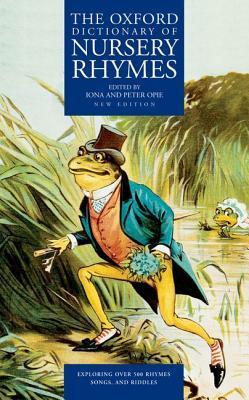
Here is a brand new edition of the classic anthology of nursery rhymes--over 500 rhymes, songs, nonsense jingles, and lullabies traditionally handed down to young children. Included are all of your favorites, ranging from "Yankee Doodle Came to Town" and "A Frog He Would A-Wooing Go" to "Baa, Baa, Black Sheep," Jack and Jill" and "Old Mother Hubbard." And complementing the rhymes are nearly a hundred illustrations, including reproductions of early art found in ballad sheets and music books, which highlight the development of children's illustrations over the last two centuries.
With each piece, Iona and Peter Opie introduced a wealth of information, noting the earliest known publications of the rhyme, describing how it originated, illustrating changes in wording over time, and indicating variations and parallels in other languages. Moreover, in the general introduction, the Opies discuss the different types of rhyme and the earliest published collections, and they address such questions as who was Mother Goose and whether or not individual rhymes originally portrayed real people. For this second edition, the notes have been updated and extended in light of recent scholarship, providing an unrivaled wealth of literary and bibliographic information.
The Oxford Dictionary of Nursery Rhymes is now more than ever an indispensable reference source for scholars and book collectors as well as a volume to be treasured by parents and children alike.
Iona Margaret Balfour Archibald was born in Colchester, Essex, England. She was a researcher and writer on folklore and children's street culture. She is considered an authority on children's rhymes, street and playground games and the Mother Goose tradition. She was elected a Fellow of the British Academy (FBA) in 1998 and was made a Commander of the Order of the British Empire (CBE) in 1999.
The couple met during World War II and married on 2 September 1943. The couple worked together closely, from their home near Farnham, Surrey, conducting primary fieldwork, library research, and interviews of thousands of children. In pursuing the folklore of contemporary childhood they directly recorded rhymes and games in real time as they were being sung, chanted, or played. Working from their home in Alton, Hampshire they collaborated on several celebrated books and produced over 30 works. The couple were jointly awarded the Coote Lake Medal in 1960. The medal is awarded by The Folklore Society "for outstanding research and scholarship".
Speaking in 2010, Iona speaks of working with her husband as being "like two of us in a very small boat and each had an oar and we were trying to row across the Atlantic." and that "[W]e would never discuss ideas verbally except very late at night."
When I was a little girl I had a book of nursery rhymes which I loved rereading. I think they are lovely.
As I went to Bonner, I met a pig Without a wig. Upon my word and honour. ------------------------------------------------------------------------------
I saw a fishpond all on fire I saw a house bow to a squire I saw a parson twelve feet high I saw a cottage near the sky I saw a balloon made of lead I saw a coffin drop down dead I saw two sparrows run a race I saw two horses making lace I saw a girl just like a cat I saw a kitten wear a hat I saw a man who saw these too And said though strange they all were true. -----------------------------------------------------------------------------
If you are a gentleman, As I suppose you be, You'll neither laugh nor smile At the tickling of your knee. ------------------------------------------------------------------------------
O the little rusty dusty miller, Dusty was his coat. Dusty was his colour. Dusty was the kiss I got from the miller; If I had my pockets Full of gold and siller, 1 would give it all To my dusty miller. ------------------------------------------------------------------------------
A wise old owl lived in an oak; The more he saw the less he spoke; The less he spoke the more he heard. Why can't we all be like that wise old bird ? ------------------------------------------------------------------------------
If wishes were horses Beggars would ride; If turnips were watches I would wear one by my side.
This book like so many other dictionaries are a bit of a challenge to me. Like any reference book you should really only dip in and out of them when looking for something - the problem is that one reference tends to lead to another and done yet another rabbit hole I go.
But why read this book in the first place - well I think the same can be said about many if not all literary based reference books. However in my case its to do with my enjoying of working through the Everyman Children's classics - an exquisitely presented series I found after being presented with a copy of the Secret Garden.
And I will stop there as that is a review for another book - but suffice to say that this book is one of those infuriating titles you start at one point and end somewhere utterly unexpected. After all I have had a copy of this book for many years and have been dipping in and out of it - however this time I decided to stay the course and read it through.
Or at least I thought I did as checking the ISBN I flicked through it again and found entries I had overlooked. I think I shall park it now otherwise this is a book I can see I would never finish - and they say the internet is a distraction!
This vintage book is one of the classics of the 20th century. The oral tradition and inherent sound lessons of nursery rhymes are being lost in this contemporary, over-connected society, and this volume reminds us all of what we are in the process of losing forever.
This is my master first-stop go-to reference resource for any inquiries about the history and meaning of nursery rhymes. Extremely well researched, with thorough citations, this is the master tool for any scholarly inquiry into traditional English language nursery rhymes.
I've had this on my desk for a year and a half, about once a week day reading a nursery rhyme and any know backstory. Here are five bits of trivia I learned:
- About a quarter of the English nursery rhymes remembered today existed in Shakespeare's day. Most were written in the 17th century. - Some riddles were written down without their answers, but their answers are made clear when comparing versions across different languages. - "Hot cross buns" was traditionally recited during the game where everyone takes turns putting their hand on top of the stack of hands. - Going back to the middle ages, the inhabitants of the English village Gotham are proverbially said to be foolish. The Gothamites say the tradition started after they tricked King John by pretending to be foolish. - Caxton's "The Game and Playe of the Chesse" (1475, one of the first books printed in English) named the pawns: Labourer, Smith, Clerk (Notary), Merchant, Physician, Taverner, Guard, Ribald. There may be a relation to the nursery rhyme: Tinker, Tailor, Soldier, Sailor, Rich man, Poor man, Beggarman, Thief.
And six nursery rhymes new to me that should not be forgotten:
Arthur O’Bower has broken his band And he comes roaring up the land; The King of Scots with all his power Cannot stop Arthur of the Bower.
Baby and I Were baked in a pie, The gravy was wonderful hot. We had nothing to pay To the baker that day And so we crept out of the pot.
Barber, barber, shave a pig, How many hairs will make a wig? Four and twenty, that’s enough. Give the barber a pinch of snuff.
Who comes here? A grenadier. What do you want? A pot of beer. Where’s your money? I forgot. Get you gone, You drunken lot.
Hinx, minx, the old witch winks, The fat begins to fry, Nobody at home but Jumping Joan, Father, mother, and I.
I have four sisters beyond the sea, Perrie, Merry, Dixie, Dominie; And they each sent a present to me, Petrum, Partrum, Paradisi, Temporie, Perrie, Merry, Dixie, Dominie.
(This last one has a bunch of verses and is fun to sing. It looks like everyone except The Wiggles has forgotten it.)
The dusty hard-drive of oral culture found in the back of a drawer, lets dig out an old emulator and see what's inside.
(Of course we rarely have access to actual oral culture as it is annihilated and transformed by contact with the structure of academic recording, more on this at the end. What we actually have is records of the point of transformation and/or translation from orality into text, almost always into print since it requires the cheapness and replicability of print to make 'common' culture worth recording to most societies.)
It’s a mixture of trash and gold, but even the trash isn't actually trash because, like Belloq's watch, it is ennobled by survival and time, and because, like an ink-stained stream used to trace a water table, watching its flow and mutation lets us trace the structure of human thought.
Some common elements;
COMMON SONGS
A huge amount of nursery rhymes are alterations or mutations of the historical version of pop-songs; broadside ballads, folk songs, music hall numbers etc. These provide the seed structure for a lot of rhymes. Like a mother singing a half-remembered chorus of a Taylor Swift song, altering the words, keeping the structure.
MISSING MUSIC
If there is one huge failure with this, and with the whole culture of transmitted orality studies, it is that there is no smooth or *commonly* readable way to encode musical notes, rhythm or any of that musical stuff in text form. Even Rubins Memory in Oral Tradition, didn't talk enough about the music.
In their natural environment, a vast range of these structures exist, are transmitted with, generated by and possess a deep interrelationship with music. They exist sung, the exist played, they are symbiotic with instrument, voice and song on a lot of levels, and that very rarely shows up in books like this.
For good reason; it would mean opening up an entire new, parallel track of scholarship and resourcing it like the first track.
And because you would then need to integrate the two, needing more time and more resources.
And you would need to find a way to present this to a mass, or at least a common/educated audience - though modern neo-orality like Youtube etc, could be good at this.
But still, the text-based nature of the transmission of orality studies is a major, and unacknowledged limitation, and more dangerous BECAUSE it is unacknowledged - as people will default to text-fetishism.
RIDDLES
Still a minor, but continual theme. 'Good' riddles (the kinds I like) where you could understand them even if they were translated. 'Dick' riddles, where the clue is that four kings each took an apple even though there was only one apple because the guys name was 'Fourkings' or some bullshit like that, Textual games as well, including some elegant verse forms made from the removal or alteration of punctuation and shifting of line-meanings.
THEEVES
The heavyweights of nonsense verse, Lear & Carrol, both based their early stuff on generative verses, subjects and forms from mass oral culture.
THOSE CRAZY KIDS
The moral universe of children, as seen through their rhymes, is arbitrary (yet rule bound), stark, intense, bordering on surreal (as in super-real), morally cruel or violent, funny, imaginative; loving both the excise and overturning of authority, highly animate (everything is alive, has intention and a self), with many changes in scale - living in shoes, floating to the moon etc.
Doubtless the moral view of children is shaped by the fact that they exist under the dominion of gigantic tyrants exercising what seem like arbitrary and inexplicable rules which they often do not meaningfully explain. And by the fact that things seem to exist, and not exist, to be brought forth, and to disappear, without any clear cause or meaning. It may simply be a rational view of an insane experience.
(Children live in a world where every useful object is out of scale for their use - too big, and where they are given other, arbitrary objects, which they may do with as they will, which mimic the larger objects but which are scaled much too small for their use. A child, for instance, cannot simply get in a car, they can be lifted into a giant one, or play with one too small to drive. No wonder they are obsessed with strange changes in scale; their world does not make sense.)
COUNTING
Counting rhymes are a big dal and, from textural analysis it looks like these may actually (some of them) be evolved or decayed forms of old, even pre-roman, counting rhymes.
HAPSIS
Bouncing rhymes where the child is manipulated on a knee, finger rhymes where the adults hands form a kind of shifting model and where fingers become people, pigs, houses, churches and priests, are common. As well as limb-naming and face-feature naming rhymes. The body in space being at the primary root of much human culture.
ANCEINT FEEL
To bring up Belloq's watch again, it doesn't take much processing or many revolutions through an oral culture for something to gain a feeling of deep numinous or oneiric ancientness. As if it referred to something huge and shadowy, just out of sight. But this feeling seems to have no, or little relation to whether something actually *is* ancient. A generation of oral transmission and manipulation might be enough to give something this feel.
BULLSHIT HISTORIES
Consequentially, Nursery Rhymes are plagued with minor academic, or general enthusiasts who swarm like flies and who are all universally sure that;
- A known personage coined this particular rhyme (usually a distant relative) - Its a political thing about this particular king or whatever - its ancient celtic/Indo-European stuff (pls also read my book on the occult)
Any of these might actually be true for any particular rhyme. But usually they aren't. Usually its an old pop song about a squire, often with some dirty bits taken out and changed.
BOWLDERISATION
There’s a lot of dirty vague sex stuff in popular folk culture, as well as a lot of scatological stuff. Almost all of this is edited out either by gradual cultural transmission, or by some Yankee or Victorian with a pen. before the scatological stuff at least is put right back in by the children as soon as mum has left the room.
THE REAL OLD STUFF
There are a few fragments, Snail, Ladybird, London Bridge, and a few others that are almost certainly really very old indeed. If you want to have strange thoughts about deep time and human culture, there you go.
There should really be a leather-bound version of this so you can leaf through it and intone mysterious stuff while giving people curious and meaningful looks.
If you are looking for an in-depth, scholarly source on nursery rhymes, you've found it. A companion piece to the Opies' The Oxford Nursery Rhyme Book, this thing is massive. It's a touch difficult to navigate as it's alphabetized by the rhymes' main theme or main word (for example, "I've Been to Market, My Lady, My Lady" is found under Lady), but the index by first lines in the back clears most of that up. There is a slightly pinched feeling to the analysis here in some cases, a bit of sniff in the direction of some less substantiated research, but that may well be warranted since the one thing I'm sure of after reading up on this topic is no one is absolutely sure what any of these mean. Easily the best source I've run across, though.
This is a classic that I have been reading and re-reading on and off for decades. The research that the Opies put into the book is astonishing. Nursery rhymes have always had a fascination for me: in childhood they were full of mystery and other-worldliness. In adulthood they are fascinating for their history and sometimes meaning. It is almost a shame that so few can be proven to have an arcane origin, or indeed to date from before the 18th century, but the ones which do are very special, such as "Ladybird, ladybird, fly away home", or "London Bridge is falling down". I am glad the Opies have a no-nonsense approach to the "interpretation" of these rhymes, but they do mention the more preposterous theories about them, which are interesting in their own right.
Excellent resource for all things nursery rhymes. i discovered there are some really weird rhyme stories out there. It makes me think of the Grimm Fairy tales used as cautionary tales for children. Even if you aren't into all the detail about the stories associated with the rhymes there are many fun things to enjoy. I personally wanted to brush up on the various nursery rhymes that have several verses which I was having trouble remembering. Hats off to my MIL who taught them to me and still remembered them to teach them to my children.
Personally somewhat unsatisfying, although full of interesting tidbits, mainly because I learned a slightly different version(s) of nursery rhymes from those presented in this book. (I am very North American!)
My Granny had a library when I was young and this is the only book I have from there. It's full of memories of reading by a small lamp in a cold house and still fills me with joy. A hardback tattered from love and generations before.
1. n/a 2. Preschool-2nd grade 3. This book contains nursery rhymes, folklore, poetry etc. It has over 500 traditional stories that continue to be passed down from generation to generation; like Twinkle Twinkle Little Star and Jack and Jill for example. 4. This type of book is one that you should always make room for in your library at home or in a classroom. I love how you literally have over 500 stories to choose. The possibilities are endless 5. This is the perfect book to have singalongs with the children in a classroom. The teacher can also make the characters from specific stories come alive by putting pictures on the wall. The teacher create a class story where each child is the contributes something to the story.
This book is so prestigious and complete looking I have to rate it four stars. I purchased as used thrift copy on abebooks for little more than four euros and it came as fine as new! Yay for that! :)
I'm trying so hard to catch up on all the Nursery Rhymes and stories I missed as a child, my mother never heard or read nursery stories; instead she told me the tales of Homer and Oedipus. Yes, I grew up on Euripides and Sophocles. The moment I picked up this book, I found myself practicing the poem of Betty Botter and her butter. Later that night my husband and I watched the movie Green Book where the characters, to my delight also practiced their diction on this very same poem.
Betty Botter bought a bit of butter; “But,” she said, “this butter's bitter! If I put it in my batter It will make my batter bitter. But a bit o’ better butter Will make my batter better.” Then she bought a bit o’ butter Better than the bitter butter, Made her bitter batter better. So ’twas better Betty Botter Bought a bit o’ better butter
My Review: 1. This book had received no awards. 2. This book is suitable for preschoolers and kindergarteners. 3. This book is a collection of over 500 nursery rhymes. It contains many rare rhymes while also containing many well known rhymes as well. There are rhymes in the book are divided into separate categories as well. 4. I enjoy this book because it has an extremely wide selection of rhymes. However, at times, I believe that there may be too many rhymes in one book and I would find it difficult to keep track of the ones I would like to use in my classroom one day. I do like how they are separated in a way according to category which does indeed make it a bit more organized. However, it may be overwhelming at times considering the size of the book. 5. An in-class use of this book is that a teacher could pick a rhyme from the book and read it out loud to the students. Every time the student hears a rhyme (during the read aloud), they could clap, stomp their feet, etc. Another in-class use is to pull out specific rhymes from this book and create individual poem binders for each student and put specific poems in the binder after reading through them. The teacher will be able to go over it during class, and then the child would try to practice at night for homework with their parents. This way each student will have a physical collection of nursery rhymes by the end of the school year.
The Oxford Dictionary of Nursery Rhymes By Iona Opie
Genre: Mother Goose
What a wonderful collection of timeless nursery rhymes! This is a must for every classroom.
Critique: A. This is one of the best collections of nursery rhymes. Though some of the nursery rhymes are a bit odd, children and adults will enjoy this book for years to come. B. When I really think about some of the poems, they are kind of weird. Who thought of these? And how did they become timeless classics? I think in the times when they were written (some are more than 100 years old) that the meanings may have been different. The English language is certainly different. C. There Was an Old Crow: There was an old crow Sat upon a clod; That's the end of my song. ---That's odd. Well the last phrase says it all: That's odd. Um, how did this become classic? At any rate, millions of people remember these poems and the book is a wonderful addition to any library.
Curriculum Connection: This book would be great to use with a Nursery Rhyme unit. There are so many to choose from that the one book could be used with the whole class.
I have to admit, I checked this one out for one reason - some nursery rhymes are creepy as hell and they make great inspiration for us hopeful horror writers. Take for instance the people responsible for Dead Space, they've figured this out and it's now why an entire generation of gamers are terrified of Twinkle Twinkle Little Star.
Also, I was kind of excited the see some rhymes I knew as a kid and compared how they've evolved. Take for instance the classic "here's the church, here's the steeple" rhyme. In my days, it was always finished with, "open the door, GET ATTACKED BY AN EAGLE." followed by someone vigorously shaking your head until you had whiplash and/or were about to throw up. This book has taught me that that's totally not how it goes at all and that kids these days are assholes.
On it's own merits, it's a pretty cute book and it's exactly what it says on the tin. Sure, there are a ton more rhymes out there but hey, a starting point is a starting point.
There are exhaustive collection of nursery rhymes, and then there is THIS. Hundreds and hundreds of rhymes, finger games, chants, songs, in their full versions, to the point where sometimes ten of them are crowded onto one page. The introduction, which deals with the idea of nursery rhymes as early poetry and the way they were broken into different categories for the book in a way that generally follows child development is good, but what keeps this from being a five-star review is the feeling something is missing. Musical notation for the songs would have been welcome in some cases, for example, and the illustrations, some of them new (in the 1950s when this was published first) and many from the 1700s, are great, but they are really, really tiny. I needed a magnifying glass for the Mother Hubbard set. Still an excellent resource, though, (although, wow, See Saw Margery Daw here is a whoooole lot more eye-opening than the version I knew).
There are, no doubt, many collections of nursery rhymes, and I have to admit this is the only one I've read. Not every rhyme is "amazing" -- in fact, most of them may not be. Many are mundane, but many others have the unexpected playfulness and dark humor of classic nonsense, and those treasures, located throughout this book, make it one of the most pleasurable books I've ever read. Every time I pick it up, I end up sitting down to read it through to the end.
"Here comes the candle to light you to bed, Here comes the chopper to chop off your head."
Another book I had to read for one of my English classes this semester. Chances are you have read or heard of most (perhaps all) of the rhymes mentioned in this book, or some variation of them. This book includes various forms of nursery rhymes as well as other poems, songs, finger games, riddles, and sayings that have been passed down to children in some form. I found it engaging to read various forms of rhymes that I heard growing up and seeing how they vary. An early form of poetry that is still going strong with young children and toddlers.
This has written down all the rhymes I’d forgotten, half known, and far far far more. The book is ordered by subject and has a great index at the back with first lines to help hunt down that rhyme you can only vaguely remember.