Title: The Bearskinner: A Tale of the Brothers Grimm
Author: Laura Amy Schlitz
Illustrator: Max Grafe
Genre: European Folktale
Theme(s): Patience, Love, Acceptance, Giving, Good v. Evil
Opening line/sentence:
They say that when a man gives up hope,
the devil walks at his side.
Brief Book Summary:
A soldier with nothing makes a deal with a devil that requires him to wear bearskin for seven years, and, in return the devil will give him riches. The soldier lives these years at first using his riches for only himself, then realizes he is happier giving his riches to others. He meets a gambler who promises the soldier one of his daughters and, at the end of the seven years, the soldier returns to marry the daughter and live a happy life.
Professional Recommendation/Review #1:
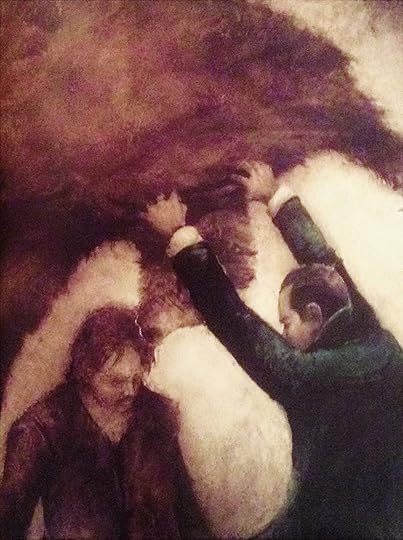
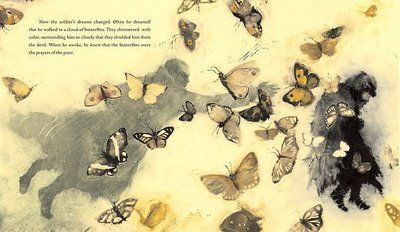
(1) 4-6 Illustrated by Max Grafe. An ex-soldier accepts a hard bargain: he'll be rich forever if, for seven years, he wears the skin of a bear; failure means eternal perdition. Schlitz narrates with clarity and grace. Except for the devil's green coat, Grafe's atmospheric full-page illustrations are almost monochromatic, composed of grays and browns with an occasional wash of blue, gleam of gold, or sunset hue.
Professional Recommendation/Review #2:
Gillian Engberg (Booklist, Nov. 15, 2007 (Vol. 104, No. 6))
The author of The Drowned Maiden's Hair (2006) and Good Masters! Sweet Ladies! (2007) offers and accomplished retelling of the Brothers Grimm tale The Bearskin. An impoverished, desperate soldier makes an unusual bargain with the devil: if the man agrees not to bathe or groom himself for seven years, cloak himself in a bearskin, and stay alive, he will receive unlimited riches. If he fails, the devil will keep his soul. Despite deep misery, the man complies, bests the furious devil, and finds love and wealth. Schlitz gracefully distills the original text, softens its harsh ending, and emphasizes the message about enduring and overcoming great personal challenges. Figures and backgrounds blur together in Grafe's textured, atmospheric illustrations, rendered in heavily shadowed, muted earth tones, and viewers may wish for more distinction in individual characters faces. The scenes ably extend the dark mood and dramatic themes of soul bargaining and personal torment, though, and Schlitz's skillful words present a tale that is rarely retold for youth. Share this with an older audience than the usual picture-book crowd. Grades 3-5.
Response to Two Professional Reviews:
The illustrations in this book are a bit bland, with most pictures only composed of a shaded gray and other muted colors. The scenes are elaborate and set the dark mood of the story. This is certainly a book to be shared with an older audience, and not to younger readers.
Evaluation of Literary Elements:
Overall, the book is well written, and is most definitely for older readers. The amount of text on each page, and the vocabulary of the book would be much too intimidating for beginner/younger readers. The illustrations, bland and colorless as they are, do set the tone of the story, making them appropriate for the book. The themes of the story are well-established and the ending wraps up the tale in a happy, light-hearted manner.
Consideration of Instructional Application: This book could be used for teaching folktales. It is adopted from the Grimm's Brothers tale, The Bearskin. Students can use this book as an example of a folktale, then write their own tale. Additionally, older students could analyze this book as a means of exploring the European culture at the time the tale was written.