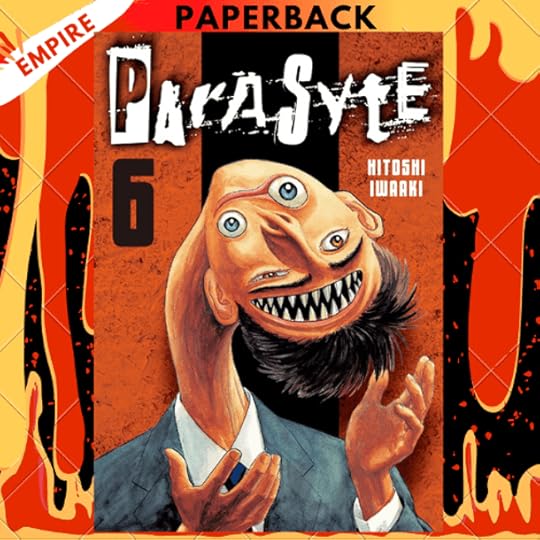
Shinichi has been hiding his true nature from the world: His body has been colonized by an alien being, and now he's half-human, half-alien. The other alien invaders, led by the cruel and beautiful Tamura, have discovered his secret. Shinichi is a threat to their plan to destroy the human race - a threat that these ruthless creatures will no longer ignore....
Hitoshi Iwaaki (Japanese: 岩明均 Hepburn: Iwaaki Hitoshi, born July 28, 1960) is a Japanese manga artist, whose works include the science-fiction/horror series Parasyte. The Mixx editions of Parasyte romanize his name as "Hitosi Iwaaki", while the Del Rey Manga editions use "Hitoshi Iwaaki".
In 1993, he received the Kodansha Manga Award for Parasyte. He was a finalist for the 2005 Tezuka Osamu Cultural Prize Grand Prize for Historie. In 2010 Historie took the grand prize in the manga division of the 2010 Japan Media Arts Festival.
Getting so good! Tamura believes it's time to clean house leaving the detective and our 'hero' Shi as primary targets. As the hunts and lethal measures ae undertaken, our protagonists options get more limited; and if that's not enough, as the events and bodies pile up, the police finally get into the mix. Beautiful plotting as multiple streams come to meet at a park where carnage and pathos ensue in equal amounts! Promise delivered, this volume really moves this series to another level, so intrigued to see where it goes from here. A firm Four Star, 8 out of 12 jam. 2025 read
Iwaaki has really outdone himself this volume. The scene in the park was incredible. I continue to be impressed with the unique directions in which he's taking the story.
Pues... Lento, y gira todo el rato en torno a lo mismo. Parece que van a actuar contra los parásitos, pero no, vuelven a pensárselo... A ver si está vez es la definitiva!! Shinji y todo el asunto en general ya me cansan un poco... es como que avanza pero muy despacio.
En fin 3 estrellas sobre 5 porque sigo queriendo saber como va a terminar la cosa.
Una pasada de tomo! Cada vez me sorprenden más los parásitos y las reflexiones a las que pueden llegar. Y esas páginas sin diálogo tras un asesinato, la representación de la rutina del tema. Maravilloso. Solo quedan 2 tomos para que acabe la obra y NO ESTOY PREPARADA!
Cudowna część. Od pierwszej strony leciałem z historią i nawet na moment się nie zatrzymałem. Poziom zaangażowania ogromny i za to uwielbiam tę serię. Zostały mi już tylko dwa tomiki.
La historia continúa avanzando sin piedad a base de giros sensatos y sólo echo en falta un poco más pericia de Iwaaki a la hora de ilustrar su historia (esos muñecotes, esa narrativa acartonada). Menudo cliffhanger el del final.
Shinichi and Tamura Reiko meet again and Tamura has been changed by living in her human body.
This series is slow-moving: in one volume, there will be one big 'event', and the rest of the story is people thinking about things, or reassuring people that things will be fine, or revisiting the past. Shinichi and the parasite that has taken up residence in his hand are wonderful characters and it's this that keeps me reading the series. Two more volumes to go!
Legit happy that I dont remember how this manga series ends. Im so worried for Izumi !!!!! And Migi.
Reiko Tamura in this volume !!!!! she says "thank you" !???? 😨
"Je pensais que comparées à celles des humains, nos actions et réflexions étaient fondées sur la logique et que nous étions des livres ouverts. Je croyais qu'il nous serait imple de fonder une famille libre de conflits. Quelle erreur ! J'ai commis une grave erreur de calcul. Mais cela montre que malgré tout, nous avons tous autant que nous sommes, nos divergences et notre individualité. Et cela me réconforte. Je me souviendrai avec émotion de ce lynchage." (p.86)
"J'ai beaucoup... réfléchi... A pourquoi je suis venue en ce monde, par exemple... Chaque question résolue... faisait surgir d'avantage d'interrogations. Je cherchais une raison... Je cherchais un but... J'arpentais le chemin de la vie, parsemé de réflexions... Somme toute, si où qu'on aille on trouve la même chose, décider d'arrêter de marcher n'est pas une si mauvaise option... Quelle que soit la révélation finale... Celle-ci ne peut que être décevante." (p.219-220)
Firstly a warning, Parasyte is horror – not the fluffy kind. It’s violent and the artwork backs this up.
I personally prefer creepy over violent horror but Parasyte didn’t bother me, because it’s not just about gore and death – there is plenty of plot. Shin’s parasite didn’t succeed in taking him over, instead he’s trapped in Shin’s hand and the two of them develop and odd (and sometimes rather amusing) relationship. Meanwhile, around them the bodies count is going up.
There were some parts of this story that have some serious emotional punch (you’ll know the ones I mean when you read Parasyte) and I was impressed by how much the first few volumes in this series got to me. Shin’s character slowly begins to change as the story progresses, is it because of what’s happening or because of the parasite?
Parasyte has an overall story arc of why they aliens have come, which brings up another set of questions for you to ponder. As does the conclusion to the series.
This volume is incredible. Chapter 48, in particular, is the highlight of the whole series. "Tamura Reiko" is such an interesting character- a parasite who is slowly becoming more human, developing emotion and questioning her own purpose for existence. Shinichi, who has gradually become less human after bonding with the parasite, is a great contrast to her. The big climax of this volume is fantastic, with the ending leading into the next phase of the story. Seriously, Iwaaki stepped it up for this volume. That was great.
Parasyte vol. 6 has big “episode six of an eight-episode season” energy: the show’s been circling the same beats for a while, so someone important finally has to die to prove we’re still moving. However, reading this as a thirty-something, I’m still more stressed about my pension gap, healthcare contributions, and how much tax disappears every month than about the supposed horror here; my back hurts more from sitting at my desk than my nerves from any parasite attack. But for the first time in a while, the plot actually justifies the page count.
Story-wise, this volume finally widens the frame.
Most of the volume still feels like that middle-season drag: strong, messy opening, then a sag of school life and internal angst. But the last stretch finally bites. It’s less pure horror than tragic social SF, but it does feel like the first genuine shove toward an endgame.
Verdict: 3.5 / 5. Solid mid-season energy: the world finally widens, the stakes slowly go public, and the series proves it’s willing to bleed someone who actually matters, even if it still doesn’t scare as much as my pension forecast. Yes, I dropped heavy spoilers from this volume here, but honestly—this is volume six of a finished manga. If you’re reading detailed reviews of middle volumes at this point, you knew what you were signing up for.
Read these next if you want evolution, ethics, and actual dread: • Devilman: Crybaby — anime series, dir. Masaaki Yuasa; adolescence and apocalypse with zero mercy. • The Girl With All the Gifts — novel by M.R. Carey; children, infection, and brutal survival ethics. • Uzumaki — manga by Junji Ito; small-town life spiralling into pure, cosmic nonsense.
A great series that is at once both an easy read that remains absolutely gripping throughout, while still posing some extremely deep and existential questions about what it means to be both a human and a creature of Earth, as well as analysing the way that we look upon and treat other species, and the way that we ourselves may be looked upon, whether that be the fellow creatures of our planet that we have lived alongside for thousands of years, or potential alien species, such as in this case - the invading parasites. It also takes a look at societal constructs and human behaviours towards our fellow man, whether this be empathy or savagery, and Hitoshi Iwaaki presents a great variety of diverse and developing viewpoints throughout, the writing genuinely makes you stop and ponder these ideas at many moments across the series, while never presenting anything as strictly right or wrong. This sense of ambiguity that is present throughout is especially true of the story's conclusion, which has left me in an extremely philosophical state for days afterwards (of course this is especially aided by the current environment of self isolation in which almost everyone is at home with a lot of time to think), I'm glad that Iwaaki remained consistent in his ability to let the reader think for themselves from start to finish, and this is one of the reasons "Parasyte" is such a successful piece of work.
I would certainly recommend this series to most readers, especially anyone into manga of any kind, the concept is very interesting, and although there is a common "us vs. them" / "good vs. evil" style conflict in this story between the parasites and humans, the ideas presented here go much, much deeper. The relationship between the main protagonist, Shinichi, and the parasite, Migi (who lives in his right hand due to a failure to take control of Shinichi's brain), and their ensuing struggles to understand each other, as well as their respective species', is really where the story shines. Their relationship, obviously a very unique one, is developed extremely thoughtfully and believably throughout the narrative, and due to the nature of the relationship between them this almost forces the reader to confront the grey area that fills 99% of the landscape between "good and evil" (or humans vs. parasites), and to look at things from different perspectives. Personally I find the grey area in pretty much any discussion to be the most interesting, because nothing in life is ever truly black and white, good or evil, right or wrong - so when we force ourselves to delve into this grey area and take a look at other, possibly conflicting viewpoints, as "Parasyte" most certainly does, this helps not only to broaden our horizons, expand our thought processes and develop our opinions, but it can also help us to better understand ourselves as humans and as individuals, and anything that can achieve that is a success in my eyes.
Witness (ch 33) was told from the perspective of an outsider so that was cool. I like the conflict between killing him and letting him live for what he witnessed. I assumed the title was referring to Shinji at first, but it also applied to the detective who came too close to the truth.
Iron and Glass (ch 34) was so frustrating due to Shinji not understanding Migi or the gravity of their situation. Like I'm not saying he should kill, but he could at least see that Migi's not cruel at all the same way animals who hurt others in self-defense aren't.
Fortunately, Murano finally broke up with Shinji.
Don't Care about a Name (ch 35) was kinda weird. Like I can't believe Shinji just revealed everything to the detective to help him realize the gravity of the situation? And that the detective just started investigating Tamiya like that as if he didn't just discover that she might be even more dangerous than Shinji??
It's also interesting to see how Tamiya and Migi are becoming more human somehow. I was honestly touched by Migi's speech defending both the parasites and Shinji.
The Devil's Countenance (ch 36) cemented Tamiya Kozuka as my favorite character in this series. She's so funny, pretty, smart, and always spitting facts. Good for you, queen!!! 💅
Also there's just something about Shinji who lost his mom, and Tamiya who just had a baby. One really cannot help buy wonder how their arcs will further intertwine and end.
The Restaurant (ch 37) was okay. Tamiya Kozuka was right: the detective IS incompetent!!!
The Enemy (ch 38) was kinda all over the place. Shinji's internal monologue feels so tired but I like that it has this sense of naivete to it. I hated the bits with Murano. The part with the naked guy playing the piano didn't make sense. The only part I really liked here was the detective noping out of everything- the smartest thing he ever said or did.
This entire review has been hidden because of spoilers.
Dad, I... I've never fought with you, or disobeyed you... I've been a good kid, right? Mom's dead. It's just the two of us now, so I don't plan on changing that. I'm going to college... Because I know she would have wanted me to.
I'm not calling you as some sort of joke. I can't tell you more now. I know that bothers you, but... That's really not what matters now.
Dad please! Just get out of the house! A monster is coming! The thing that killed mom!
With my last tipsy visit to Worlds Apart in Liverpool only yielding one volume of Moriarty the Patriot, Vol. 4, I thought it would be rude to not make use of the 3 for 2 offer. As such, I picked up the first volume of two other series to try and find another obsession.
Having enjoyed the first volume so much, I knew I had to own the full series and set up an eBay alert for anyone selling a complete set. My luck soon came in and I am now the proud owner of an almost pristine set.
When strange spores arrive on Earth, the parasytes they contain start taking over the body of any animal they come into contact with. One such spore enters the body of a teenage boy but his quick thinking limits the parasyte and it can only gain control of his arm. With the ability to shift his flesh into deadly weapons, the parasyte and host have to work out how to live together.
The presence of the parasytes is starting to get the attention of the public and various stories have been hitting the press. Reacting to this, the parasytes have been working together to get into positions of power in order to hide their feeding.
When one parasyte goes against the group and feeds on someone close to Shin, the fallout causes tensions within the parasyte camp. Turning on each other, the parasytes have to regroup to keep their presence secret from the wider public. However the taskforce is getting close to the truth and Shin once again faces more peril.
A little touch I like are the Q&As with the author which have appeared throughout the series so far. They give little insights into the creation of the story and confirm that the idea is that the parasytes are from Earth, rather than invading alien beings. 5 stars.
Shinichi was was not really the main focus in this volume. The charaters Tamura and the detective Kuramori where instead.
Parasytes murder Kuramori's family so he is out for revenge. He contacts a police lieutenant by the name of Hirama to help in the investigation of the parasytes.
Tamura's fighting skilles are on full display in this volume. Rather then using brute strenth Tamura uses strategy to defeat multiple other parasytes. Which was pretty impressive. When she is seen by humans during this fight a referance to the slit mouth women is made.
In the final chapter of the volume, it is shown Shinichi is close to being discovered as something other then human.
Concluion/Spoiler:
Parasytes murder Kuramori's daughter so he seeks revenge by trying to kill Tamura's son. Tamura prevents this and kills Kuramori. It is then revealed she has alot for sympathy for humans, compared to other parasytes. She has tried to kill less humans, by eating human food. When she is caught by the police, reather then fight she willing lets herself be killed. To make a statement to Shinichi.
The statement it seems Tamura was trying to make to shinichi is that both parasytes and humans are weak and that they need to stop killing each other. Tamura rather then fight for survival tries to break the cycle, by letting the humans kill her. Going against her instincts. It seems she was saying that what the other parasytes need to do.
P.s. I sent alot of the review talking about Tamura since she was one of my favorite characters in this seires. This volume worked as a great send off for her.
I haven't picked up a volume in over a year and a half, oops, but I'm glad I'm continuing because this shit is interesting.
The thrilling scenes and fights scenes keep the intrigue high, and on top of that we also get into some existential concepts about what these parasites actually are and their role with humans.
Spoilery recount of events for when I inevitably forget next volume:
Este tomo habla de cómo los otros parásitos usaron a un humano para investigar a Shiki. Lo primero que hizo el humano fue seguirlo en donde quiera que iba. En una de esas, fue a dar a un sitio baldío donde les llaman restaurants, ahí comen a los humanos y limpian su desastre. En una de esas, persigue a un parásito para matarlo, lo que logra, sin poder salvarle la vida a la víctima. En eso percipe el parásito a un humano que comienza a grabarlo. El humano hace lo imposible para que huyera. Tiempo después se evoca en buscarlo e investigarlo para saber sus intenciones, lo que dan a que es un investigador contratado por la mujer. Shiki le explica que probablemente es un parásito con el cerebro invadido. Tiempo después se ve involucrado en el suceso de enfrentamiento con otra criatura donde Shiki gana, pero el humano ya no quiere saber nada de ellos, ya que tiene una familia a la cual proteger, y un riesgo del que no está preparado.
Aquí pasan cosas interesantes: la mujer está obsesionada con él, puesto que ve una evolución de la cuál no se sabe tanto, haciéndolo muchísimo más fuerte que a los otros. Otra cosa es hacer ver ese instinto de supervivencia humana, en la que prefiere resguardarse del peligro al saberse inferior y huir si se tiene la oportunidad. Contrario a Shiki, que se arma de valor, para acabar con todos los parásitos que atentan con la tierra, ya que es algo de solo él puede hacer. Asimismo, se presentan otros enemigos más poderosos y que tienen toda la intención de matarlo. Atletas, músicos, políticos. La plaga a llegado lejos, pero no lo suficiente para matar a toda la humanidad.
This entire review has been hidden because of spoilers.
Izumi bleibt die Hauptfigur, die wieder in den Mittelpunkt der Geschichte rückt. Es bleibt ebenfalls der Privatdetektiv Kuramori und natürlich die Dreiecksbeziehung im Fokus. Glücklicherweise ist Hitoshi Iwaaki zum Schluss gekommen, dass er etwas ändern muss. Und genau aus diesem Grund werden in diesem sechsten Band der Parasyte-Reihe einige Figuren aus der Geschichte entfernt. Wer das ist, verrate ich an dieser Stelle natürlich nicht, denn ich möchte dem Leser nicht die Spannung nehmen.
Ich bin auch ganz froh, dass in den Ausgaben mehrere Teile enthalten sind, denn so mancher endet mit recht fiesen Cliffhangern, was für die Spannung der Erzählung spricht. Interessanterweise rückt Migi (Izumis Hand) ein wenig in den Hintergrund und die Geschichte dreht sich um das Wesen der Menschheit und um die Frage, was die Parasiten von den Menschen unterscheidet.
Der Humor bleibt auch in diesem Buch nicht auf der Strecke, auch wenn ich mir nicht immer sicher bin, ob dieser sich nicht vielleicht doch ungewollt eingeschlichen hat. Egal, ich finde ihn und er ist gut platziert. Etwas erstaunlich, dass die farbigen bzw. nachkolorierten Seiten arg zusammengeschrumpft sind. In Band sechs dürfte das wohl kein Kaufargument mehr sein, wobei ich diese Seiten sowieso nur als nette Dreingabe gesehen habe. Viel entscheidender ist die Spannung, die der Künstler hat aufbauen können und wie sollte es auch anders sein, als dass Band 6 wieder offen endet und eine scheinbar größere Wendung ankündigt.
Here we see the parasites learning to be human - which is really quite terrifying if you think about it to much.
This volume really makes you think and gets you wondering about what is 'out there' and whether we, as humans, are really our own worst enemies.
------------------------------------------------
Parasyte (Full Series) - 5/5 By Hitoshi Iwaaki
ON EARTH SOMEONE THOUGHT…"IF THERE WERE HALF OF THE NUMBER OF HUMANS, HOW MANY FEWER FORESTS WOULD WE BURN?"
ON EARTH SOMEONE THOUGHT…"IF THERE WAS ONE HUMAN FOR EVERY HUNDRED, THEN THE POISON THEY GIVE OFF, WOULD BE THAT MUCH LESS".
SOMEONE THOUGHT "WE HAVE TO PROTECT THE FUTURE OF ALL LIFE"
If you haven't read Parasyte yet, you really need to! It is one of the best manga series on the market. I first heard of Parasyte after watching the anime and felt that I just had to read it! Like any TV adaptation - quite a few interesting thoughts and ideas were missed out. I found they were explored in depth in the manga.
This series really made me question humans and their humanity.
This is what I expect from this series. I absolutely loved this volume; it's the best one by far. It has the horror paired with the gore fans of the story expect. It has the overall question of "why?" being asked by Tamura and her outwitting her fellow parasites. It has Satomi being in danger multiple times without knowing it, adding to the suspense. It has everything you could want.
The park scene is hands down the MVP of the volume. I was on the edge of my seat and couldn't wait to read how it would all end. It ends on a somber yet hopeful note. Tamura has an amazing outro line and then Shinichi follows it up with actual tears. He can cry again! I can only wonder what this will mean for his relationship with Migi.
This series is worth starting just to get to this volume, it's that good.
Si bien gran parte de la trama parece dar vueltas sobre los mismos temas, creo que una de las razones principales de esta etapa del manga es mostrar el proceso de evaluación y evolución de los parásitos. El ejemplo del bebé es clave: introduce nuevos matices sobre lo que significan realmente los sentimientos humanos.
Al principio pensé que todo esto podría volverse redundante, pero no lo es. Cada detalle está cuidadosamente dispuesto para que el impacto del proceso de Shinichi, al recuperar parte de su humanidad, sea mucho más potente. Este efecto se amplifica especialmente en su reencuentro con Satomi; por un momento llegué a pensar que la iban a matar durante su visita a casa, menos mal no fue así...