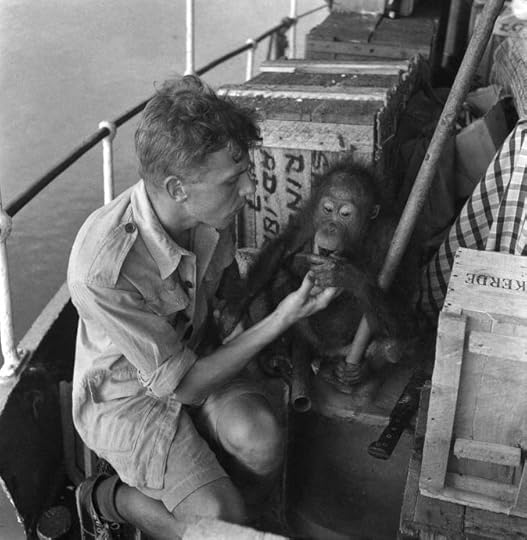
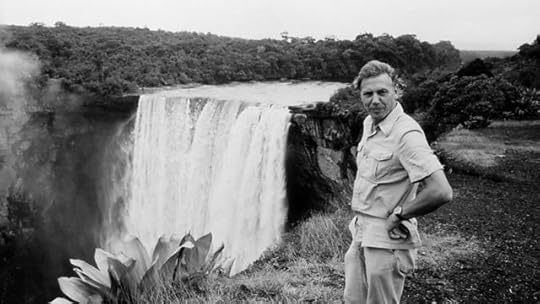
In 1952 David Attenborough got a job as a trainee producer with BBC. He was 26 years old, a novice television producer with two years broadcasting experience and an unused zoology degree, anxious to make animal programs himself.
We’re all familiar with David Attenborough and his wonderful wildlife shows. In saying that, I had eagerly opened the covers of this book in anticipation of reading about some amazingly descriptive wildlife experiences, much like the ones I had viewed with pleasure and awe on television over many years. I guess I knew what a zoo quest is, but these words had not really registered in my mind.
This book is David Attenborough’s account of the first three “zoo quest” expeditions which took place in the late 1950's. David had come up with an idea which was quickly to become a joint venture of the London Zoo and the BBC. A quest to capture birds, reptiles, indeed any creature of interest, to bring them back alive, and also to film them in their natural habitat. Wildlife programs were already attracting a huge viewing audience on television at that time.
The initial quests took place in British Guiana (on South America’s North Atlantic coast, now independent Guyana), Indonesia, and Paraguay (a landlocked country in South America).
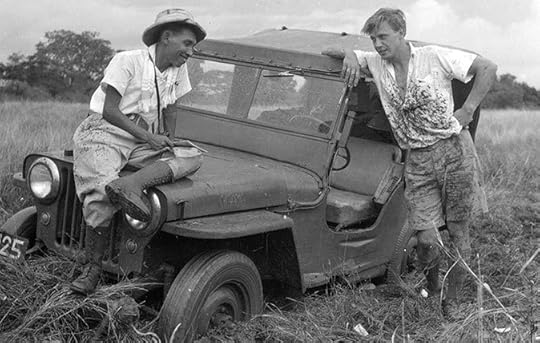
David was 28 years old when he set off for British Guiana, together with an animal capturer and handler (Jack Lester), his cameraman (Charles Lagus), and later an animal carer, whose task was to remain at their base at the coast and look after the animals as they were caught and brought to him.
David was to direct film sequences showing Jack searching for and finally capturing a creature of particular interest. Unfortunately, Jack’s health was failing and David had to step in as the animal collector and subsequently presenter for the BBC series on their return to London. This is how David Attenborough’s wildlife programs began to take shape.
For me, it was good to read over the book’s introduction again, as this was not the David Attenborough I was familiar with, capturing wildlife for a zoo. It was a different world back in the 1950s, and the quest to find species that no other zoo had ever possessed still lingered on from the early 19th century.
All care was taken not to harm any of the creatures caught, and if their food source could not be readily obtained and supported back in London, they were released into their natural habitat shortly after capture. It saddened me to read that chicks and baby animals were taken from their /burrows and nesting holes.
Reading about the armadillos was particularly interesting, and I learned that it is only the three-banded armadillo that can roll itself into a ball, and that all armadillos have ticklish tummies. The nine-banded armadillo has the extraordinary characteristic of giving birth to identical quadruplets. They are the commonest and most widespread of all armadillos. Very sadly, the giant armadillo, with eleven to 13 bands, is considered ‘vulnerable to extinction’.
As David and his companions would stay in remote villages with the natives in the jungle, some of the village practices I read about were quite distressing. In saying that though, David gives a candid description of their customs, telling it how it is. The natives, being adept hunters, were encouraged to trap/capture live wildlife for David and Charles, with blue, white and red beads, sticks of tobacco, and cakes of crude salt being the favoured items for barter.
Their quests in South America and Indonesia were a far cry from any hint of civilisation or luxury, be it their mode of transport, the food they had to eat, the people they met and encountered on their journeys, and the numerous biting insects.
It is easy to imagine that throughout the entire book, it was David Attenborough’s mellow tones narrating to me from every page. Some of the descriptions of characters he met and protocols that had to be followed were often quite comical.
" One of the most important functions a zoo can perform is establish breeding pairs of rare animals so that if the species is faced with extinction in the wild state it can be preserved in captivity and later, perhaps, zoo-bred animals may be released in reservations and re-established in their homelands.” – David Attenborough
“Secure but not home, alive but not free” - Matthew L Miller, Director of Science Communications for the Nature Conservancy USA.
Deforestation, loss of habitat, poaching, hunting, introduced species that are devastating to native wildlife, all contribute to the extinction status. So, I do believe, sad fact as it is, that many species of wildlife, that once flew and roamed free, may only exist in zoos, their survival status, ‘extinct in the wild’.