Sir David Paradine Frost, OBE is a British journalist, comedian, writer and media personality, best known for his serious interviews with various political figures, the most notable being Richard Nixon. Since 2006, he has been hosting the weekly programme Frost Over the World on Al Jazeera English. He was portrayed by actor Michael Sheen opposite Frank Langella's Richard Nixon in the 2006 Peter Morgan stage play Frost/Nixon, and in Ron Howard's subsequent 2008 film adaptation.
Whilst living in Gillingham, Kent, he was taught in the Bible Class of the Sunday School at his father's church by David Gilmore Harvey, and subsequently started training as a Methodist Local Preacher, which he did not complete. At Cambridge, where he graduated with a degree in English, he edited a student newspaper, Varsity, and a literary magazine, Granta. He was also secretary of the famous Footlights Drama Society, which included actors such as Peter Cook and John Bird.
After leaving university, he became a trainee at Associated-Rediffusion and worked for Anglia Television. Frost was chosen by writer and producer Ned Sherrin to host a pioneering satirical programme called That Was The Week That Was, alias TW3. This caught the wave of the satire boom in 1960s Britain and became a popular programme. A 30-minute American version of TW3 featuring Frost ran on NBC from 10 January 1964 to May 1965.
Frost fronted a number of programmes following the success of TW3, including its immediate successor, Not So Much a Programme, More a Way of Life. More notable was The Frost Report (1966-1967), which launched the television careers of John Cleese, Ronnie Barker and Ronnie Corbett. He signed for Rediffusion, the ITV weekday contractor in London, to produce a "heavier" interview-based show called The Frost Programme. Guests included Sir Oswald Mosley and Rhodesian premier Ian Smith. His memorable dressing-down of insurance fraudster Emil Savundra was generally regarded as the first example of "trial by television" in the UK. On 20 and 21 July 1969, during the British television Apollo 11 coverage, he presented David Frost's Moon Party for LWT, a ten-hour discussion and entertainment marathon from LWT's Wembley Studios, on the night Neil Armstrong walked on the moon.
In 1963 a tribute to the recently assassinated President John F. Kennedy on That Was the Week That Was had seen Frost's fame spread to the United States. His 1970 TV special Frost on America featured guests such as Jack Benny and Tennessee Williams. From 1969 to 1972, Frost kept his London shows and fronted The David Frost Show on the Group W (U.S. Westinghouse Corporation) television stations in the United States.In 1977, he met US President Richard Nixon in a series of interviews for American television.
During the 1990s, he presented the panel game Through the Keyhole, which featured a long running partnership with Loyd Grossman. After transferring from ITV, his Sunday morning interview programme Breakfast with Frost ran on the BBC from January 1993 until 29 May 2005. The programme originally began in this format on TV-am in September 1983 as Frost on Sunday until the station lost its franchise at the end of 1992.
As of November 2006, he works for Al Jazeera English, presenting a live weekly hour-long current affairs programme, Frost Over the World, which started when the network launched in November 2006. The programme has regularly made headlines with interviewees such as Tony Blair, President Omar al-Bashir of Sudan, Benazir Bhutto and President Daniel Ortega of Nicaragua.
Frost was instrumental in starting up two important ITV franchises: London Weekend Television in July 1968 and as one of the Famous Five who launched TV-AM in February 1983.
Frost is the only person to have interviewed eight British prime ministers serving between 1964 and 2010 (Harold Wilson, Edward Heath, James Callaghan, Margaret Thatcher, John Major, Tony Blair, Gordon Brown and David Cameron) and
David Frost writes about the context, preparation and actual series of interviews he did with the 'disgraced' President Richard Nixon, on Watergate, the cover ups, the obstructions of justice, Vietnam, Détente, China etc etc. A revealing and engaging look at one of the most famous series of interviews in history. It's also a very accessible and straightforward introduction to he Nixon years. 7 out of 12, Three Stars. 2010 read
Richard Nixon's resignation has always been an oddly fascinating moment for me. I was almost ten years old when he resigned and for some reason, the event left it's mark. Back in the late 90s, when the Bill Clinton impeachment comedy was playing out in Congress, there were a lot of people saying that what Clinton had done, essentially lying about cheating on his wife, was "worse than Nixon." Curious to see if they were correct, I found myself reading everything that I could get my hands on about the Watergate scandal. After watching the recent movie, "Frost/Nixon," David Frost's account of these historic interviews became yet another addition to my ever growing "Nixon Library."
While the movie was a fascinating story based on the real events, the book itself is less than fascinating. I did find parts of it interesting and worth reading but, much of it was tedious. The problem isn't with the story, Nixon was a tremendously flawed and endlessly fascinating individual, but with Frost's writing which is perfunctory at best.
The last third of the book is devoted to long excerpts from the actual interview transcripts. Again, parts of this are fascinating and I'm sure it would be riveting to actually watch or hear the interviews however, much of the dialogue is stilted and just doesn't transfer well to the printed page.
Because I have a strong interest in the Nixon administration, I am unwilling to entirely write this book off but I will say that those with only a casual interest in the Nixon administration should probably skip this one. This is a rare case where I really think the movie is better than the book.
If you weren't around when Nixon was in office, you have to read the interviews, if you were, you have to read them too. So much happened at this time, much of it behind the scenes. Reading the story helps us not to forget what happened and why we need to stop it from happening again.
Read as my non-fiction pick for September 2025 & The Elemental Studies prompt for Orilium Autumn Equinox Readathon September 2025. I've had this on my shelves for a long, long time- I found the idea of a politician and a journalist going head to head intriguing and I'd heard about the series of interviews although never had seen any of them. Watergate was a subject that fascinated me a few years ago and still interests me so it was nice to return to it and hear how the legendary quotes were gotten, the story behind the story was fascinating.
Without a doubt an Intresting look and analysis at not only Frosts interviews and “relationship” with Nixon and Nixon’s White House administration but also a repetitive and at times quite slow book. I would say it was like 70/30, the 30 being the amount of times that David Frost would trail back to something we literally heard Nixon and himself talk about 20 pages ago. I would also highly reccomend doing some research into the administrations policy’s and directives before reading cause at times I found myself lost and resorting to a long Wikipedia session haha.
My hope was to hear the entirety of the Frost/Nixon interviews, and since that was far outside the purview of this 4.5-hour audiobook (the interviews run something like 28 hours), I was disappointed. That's a pattern for me, for my life: disappointment because of insufficient initial info gathering.
But still, there is quite a bit here to hold one's interest. Of especial note is Nixon's parsing, in his own words, in his own voice, and at the business end of Frost's anglovox, Q&A goad, Nixon's parsing of the Watergate cover-up. Nixon is careful to note that his actions did not breach the legal line defining conspiracy to obstruct justice, but "they [= his actions:] went all the way up to that line." He claims that his intent was to simply shield his administration (and himself) from the botched robbery's fallout. (Frost concedes at the end of the audiobook that, in light of all the evidence that's surfaced in the years 1977 to 2007, he's inclined to take Nixon's assertion at face value; i.e., that Nixon didn't know about the initial break-in and that his subsequent actions were meant to simply shunt scandal fallout outward.) Nixon then makes the startling admission that in spite of not technically, criminally covering anything up, "any reasonable person would interpret my actions as constituting a cover up."
There are even a few quite moving moments. All the more remarkable given that my early and initial exposure to Nixon was actually to Jules Feiffer's Nixon caricatures (which I, a 9 year old, could reproduce to the delight of my 5-grade teacher Dawn Fowler, whom I loved) and Dan Ackroyd's SNL Richard Nixon. Thus, the Nixon of my conception is a ludicrous and ridiculous and corrupt cartoon. That's my Nixon-imago, and hearing Nixon and Frost's head-to-head kind of burst that imago and revealed to me something of Nixon the real man.
Did I mention that Frost reveals this little tidbit about Nixon's participation in these interviews? The revelation: Nixon agreed to cede Frost's team 100% editorial control for the interviews. That's one remarkably ballsy move for anyone, let alone for a man obsessed with image-control and power, Nixon. What Nixon basically does in these interviews is, to paraphrase Frost's commentary, to tear down his personality's defenses and leave himself vulnerable (at least vulnerable for Nixon) to a kind of public/personal intimacy. And this isn't to say that he's also not circuitous of speech and cagey and at times combative -- he is -- but he also here and there unbuttons his shirt and tells Frost the marksman to fire at will.
So, hat's off to the be-jowled, vampire hairdo'd, double v-sign wagging national joke, and congratulations to Richard Milhous the man, and congratulations to Frost.
After the success of the Broadway play, David Frost wrote this book to set the record straight on the events of his historic interviews with Richard Nixon. Although he tacitly gave his blessing to the play, he had no influence on the writing and is quick to point out inaccuracies that were incorporated into the play to enhance the dramatic narrative. However, after reading Frost's account of the actual events, there doesn't seem to be any reason in my mind why dramatic license would need to be taken. I always felt sorry for Richard Nixon; a brilliant mind and capable president who was undone by his own insecurities and petty hatreds. The experience of the Frost interviews forced Nixon to come to terms for the first time with the true weight of his actions. As Frost takes you through the interviews (he even provides precise transcripts at the end of the book), you sense that Nixon is going through a therapy session, until he finally admits tearfully that he let himself and the country down. It's compelling stuff, made all the more interesting by Frost's first-hand account of the events. For a Nixon or Watergate buff, this is required reading.
A very insightful look into a critical and turbulent time in American politics. As an American, this book makes several points about the repercussions of the Watergate scandal that are relevant to current US politics under the Obama administration. My critique of the scandal is that Nixon suffered a critical moment of indecision which blew the whole situation up and made it bigger than it should have been. It is also remarkable that Watergate has now become a case study for how a scandal can affect public perception and ultimately shows the power of that perception in policy making and political power.
I realised that perhaps I should have done some more research into the topics being discussed beforehand - it's was very easy to get lost in Nixon's rambling.
It was less about the actually production of the interviews themselves, unlike the film, and more about Frost discussing is take on Nixon during and after the interviews, analysing what he had said, adding in his own motivations and then examining the former president's later life - comparing what he said interviews to what later said in public.
Having thoroughly enjoyed the film when it was released (Can Michael Sheen do no wrong?), coming across this for fifty cents in a secondhand store was pretty exciting. I knew that the film had to take some liberties to make it watchable and no longer than two hours, but I didn't really know what was changed, for the most part.
This set me straight, and had the additional pleasure of being a bit of a character study from Frost's point of view.
This book is at its peak when describing the process of preparing and carrying out the interviews. However, I felt it dragged a tad in other bits and repeated a lot of the same points (The repetition is a criticism that can be particularly levelled at the last section of the book, the transcripts of the interviews).
As someone not alive when the interview took place it was interesting to read the transcripts. But, I kept wondering why a British journalist should be doing a political and historical analysis of Nixon, rather than just presenting his journalistic process and the transcripts.
Listen to the audio for actual clips of the interview. Nothing shocking if you already know about this famous event, but excellent behind-the-scenes details and Frost’s emotional reactions to some of the responses.
Worth listening to the audiobook entirely because it splices in clips from the actual interviews. The book itself is mostly just fine. Nothing in here is mindblowing from what I already know, but it's an interesting encapsulation of an event. Actual rating 3.5.
I would have appreciated this more if it had just been a very detailed telling of the complete run -up and inner workings of the famous series of broadcasts in 1977. Instead Frost spends a lot of time giving historical Nixon presidency background and almost half the book is direct transcripts.
very informative. Easy read and good detail but the flow of the book is a bit off. Order goes: interview setup and overview, nixon later career -- includes a lot of frosts comentary, then transcript of the interviews.
Some incredible details, but ultimately Frost spends most of the book preening and posturing. Disappointing peek at an amazing bit of American history.
As much as I want to say I like the book because I admire Frost's journalism work, I cannot. The book was repetitive and rather uninteresting (at least in the second half).
Frost/Nixon: Behind the Scenes of the Nixon Interviews is divided into two parts.
First there's a look at Frost's decision to interview Nixon when he was basically persona non grata, at a time when Nixon was trying to get back into public life. This was not an easy thing to accomplish for Frost -- a LOT of negotiation went on, including questions over how much money Nixon would get, who was going to have editorial control, the topics that Nixon would speak on, etc. This part of the book also examines the series of interviews that took place, and how Frost was able to ask questions and not get bogged down in Nixon's somewhat elusive answers, especially on Watergate, Vietnam and Chile. It also takes a look at how Nixon tries to, in effect, rewrite some of the history of his tenure as President, even though the Watergate tapes showed he wasn't being quite truthful. Frost also examines what happened after the interviews aired and Nixon went back into public life. After writing about the tapings, Frost takes a look at Nixon's presidency and briefly assesses both negative and positive aspects of Nixon's time in office prior to his resignation. He doesn't just dwell on Watergate but goes on to examine Nixon's foreign policy decisions as well.
The second part contains the transcripts of the interviews by topic.
This was an interesting read, but for me, it was less the behind the scenes stuff and more for Nixon's perspective on his own wrongdoings and those of the men who worked for him. Also, I realized after reading this that the bad-guy Nixon was the same person who did things like open up China. Frost's take on Nixon's tenure in office also gives the reader food for thought.
I have a bone to pick with Frost, though...it's minor but worth noting. Considering the man is a journalist, he should know that Chinese people always state their last names first, so it grated on my nerves when he'd say Mao Zedong and then refer to Zhou Enlai as "En-lai," or Hua Guofeng as Guo-feng, just knowing he was probably using their first names as last names.
I'd definitely recommend this book to anyone who is even mildly interested in the topic. There is a LOT of information on not only Watergate, but other issues of the late 1960s, early 1970s such as Vietnam, civil rights, the cold war and the role of the two major superpowers of the era. I read this book before the movie, and I think anyone who is planning to see the film may find it helpful, even though parts of the movie are fictionalized.
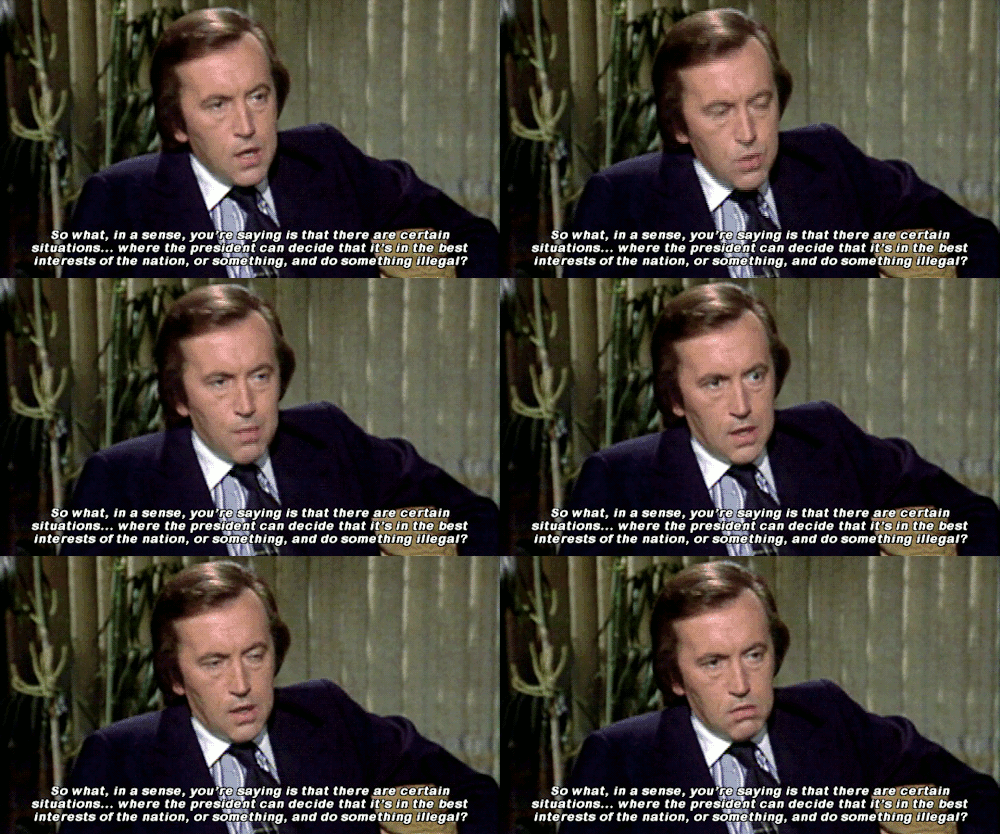
Lest we think "so what -- that was then", on page 89, in the center of the page, there is a bit of transcript which reads something like this:
Frost: "So in a sense what you're saying is that there are certain situations...where the president can decide that it's in the best interest of the nation or something and do something illegal?" Nixon: "Well, when the president does it, that means that it is not illegal." Frost: "By definition?" Nixon: "Exactly, exactly."
This extract is only a part of what Nixon had to say during the Frost/Nixon interviews, but it's important, and it's (imho) still relevant.
The book of the film of the play of the televison show of the interviews of the man.
Definitely felt like a "commissioned" piece - that is, it looks like Frost has been approached to write up his own recollections, following the success of the aforementioned movie, and came up with the disjointed, modular book.
The first half is exactly what we'd expect: Frost's recollections of the process leading up to the interviews; the planning, the initial discussions and meetings with Nixon and a very significant section covering the interviews themselves (which were conductesd on different designated topics, over several days in Spring 1977). He does a decent job of summarising the interviews, with verbatim quotes used where necessary, and accompanied by explanations of where we're up to in the story (especially useful, during the Watergate stuff, for me anyway). He also captures well the interaction he felt between him and Tricky Dicky and the ex-President's moods and responses.
Once that's out of the way, there's a section covering Nixon's life post-'77 and how he worked on his rehabilitation in public life, which was in part down to the exposure (which wasn't all negative) afforded to him by the interviews. I wasn't familiar with his life story in this period, so it was useful to have, albeit it was a very potted and abridged version of his political life up to his death.
Sadly, that's as much genuinely new and engaging content as we get - with still at least a third of the book space left, we're presented with lengthy transcriptions of the Frost/Nixon interviews themselves. Having had the key points (and quotes) already presented to us in the first part, and being without the benefit of the TV footage, I'm ashamaed to say that the start of this section is as far as this reader got in isolation. That's not to say it isn't useful, but i suspect its real value is as a reference work, to accompany viewing of the original TV footage itself; this being a public libarary copy in my (temporary) possession, I don't have that luxury, although I think you'd have to be a devoted scholar to use it more than once.
Overall, a reasonably enjoyable read to a point and, pending digging into a decent and in-depth conventional biography of Nixon, it does a good job of capturing some of the flavour of Nixon's presidency and, more importantly, what Nixon was actually like. For this, it's worthwhile and just about qualifies for a 6-7/10 rating.
Now - does anyone wanna borrow an old cassette I've been given? There's only 18 and a half minutes worth of stuff recorded on it apparently, but I'm told it's one hell of a listen...
One thing I don't like to say in polite company is that I have a long-standing Richard Nixon addiction. This isn't to say I like him, mind you, but the combination of insecurity, criminal inclination, indecision, aggressiveness, political acumen, intelligence and many other seemingly contradictory characteristics are fascinating. Back in 1994 I sucked down Fred Emery's book on Watergate, and watched the excellent documentary that was linked to it.
I hadn't had much time for it in recent years--remission, you might call it--but on a recent trip I rented Frost/Nixon, which I had not seen before, and subsequently I bought the book of the same name that David Frost wrote about his interviews. More than anything, it is illustrative of how Nixon convinced himself that he was always in the right, and could do anything he wanted as a result. That culminated in the famous quote, "When the president does it, that means it is not illegal." Criminality simply melts away in his mind.
There is a chapter dedicated to a transcript of the interview that focused on Chile. It underlines the fact that a) his knowledge of Chilean politics was sketchy; b) he didn't think knowledge of Chilean politics was particularly important; and c) all that mattered was that there was a government friendly to the U.S. Frost accurately pushed back, but Nixon just didn't care, and mostly wanted to emphasize that LBJ had acted against Allende too.
I enjoyed the movie, but it does divert from the book for dramatic purposes. In particular, the Jack Brennan of the movie, played as an authoritarian figure by Kevin Bacon, does not match the Brennan described in Frost's book. Nixon did ask Frost if he had "fornicated" recently, but the movie shows it as a way Nixon tried to throw Frost off, whereas Frost's own recollection was that Nixon clumsily wanted to be one of the boys, and had no idea how to do so. At the very least, if you liked the movie I would suggest taking a look at the book.
Reading more about Nixon these days is also a reminder that, bizarrely, he would likely be considered too liberal in many areas to win Republican primaries.
When you've resigned the presidency in disgrace and then holed up for almost three years without talking to anybody from the media, and then you finally come out of your bunker and talk, what you say might be interesting. Or it might not.
It all depends on the ground rules and the interviewer. Interestingly enough, when Richard Nixon sent the word out that he needed money to pay for his legal fees, the networks weren't very interested ... they didn't expect much to come out of such interviews beyond Nixon's carefully crafted well-prepared message. So when David Frost offered $600,000 for the 11 sessions of interviews (to be boiled down to four 90-minute programs), the world's media at first shrugged their shoulders at what was perceived as four nights of Nixon merely being given the opportunity to rehabilitate his image.
Frost, however, was determined to turn this into an interview for historians ... that is, approach the many unanswered questions as a prosecuting attorney might, attempting to represent the people and their right to know. And it worked. I recall watching it on TV (and at times listening on the radio), and being amazed then by how honest and real Frost got Nixon to be.
The first part of this book is an interesting blow-by-blow of what would become one of the most-watched television shows in U.S. history. Of course, it has recently become a successful stage show, and is now a movie. Jean gave me this book for Christmas in anticipation of going to the movie -- and now I can't wait to see it.
But that's really only about 25 percent about the book, Frost detailing his preparation and reaction with his team. Then there's 25 percent about what Frost thinks of Nixon and his legacy (which is much more clearly expressed and detailed in a fascinating way in Nixonland), and 50 percent is transcripts.
In some ways, this book reminds me a lot of Bobby Fischer goes to War in that much of the action is behind the scenes and between the sessions. But what this book lacks is any insight from the "Nixon's team" side ... I'd love to know how Nixon's team was preparing him, etc.