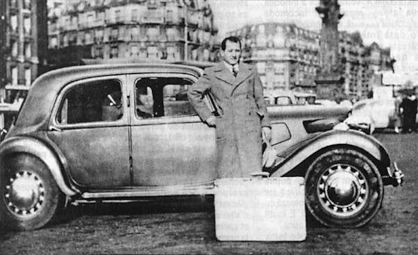
I love the Penguin European writers series. I’ve read all but one that have been published so far, and will happily read any they choose to put out. Even those that I haven’t liked as much as others, I’m always happy to have read them and to have had the opportunity to discover a new European author I may not have otherwise heard of. In this case, I do know someone who’s a fan of Mihail Sebastian specifically, so I did have some hopes for this one in the way that I haven’t always for others from this series. In a way, these hopes weren’t entirely dashed, but ‘Women’ unfortunately didn’t quite live up to them either.
I think the only way to talk about ‘Women’ is to talk about each of the four sections in turn. It’s not a bad way to examine any book of this nature of course, but I think it’s specifically necessary in this case because the quality of each was so wildly different and I felt so differently about each one.
The first story, ‘Renee, Marthe, Odette’, was by far my favourite of the bunch. No contest. It was the perfect story of youth - one of a bored, young, beautiful man, abroad & rootless, and his relationships with the women he meets there. Everything was framed so well through this young man’s curiosity and apathy, and his relationship with each woman was so unique and interesting. The prose in this section was also particularly exquisite (not that it wasn’t wonderful throughout) which enhanced the already wonderful story. If the whole book had been like this, it would have been an easy five stars.
Unfortunately, the next story (‘Emilie’) was the worst of the bunch. I just couldn’t really understand what it was trying to do at all, which made it hard to enjoy on any level. It was just downright peculiar - I’m not sure if would’ve made more sense with more contemporary context, but I just couldn’t connect with it. Also, our charismatic protagonist that I had grown so fond of seemed to more or less disappear, watching only from the sidelines. This maybe would have been okay if what it had been substituted for was just as interesting, but alas, it just wasn’t.
Things improved a little again with ‘Maria’, but it definitely wasn’t without its issues. Quite glaring ones, ones that worsened the more the story went on. A lot of the misogyny in some of the other stories was subtle, something that could either be easily passed over, the type of thing you get used to as a women reading older fiction, or something that made sense within the context of the character. That was not true of this story. It’s a shame too because it was so well written and it started so promisingly, but just devolved too quickly into the ridiculous, almost farcical. Impossible to look beyond.
And quite frankly, the less said about ‘Arabela’, the better. The most boring and illogical of all of the stories, with Arabela herself being one of the least well formed characters of the entire book (something that genuinely wasn’t an issue with almost any of the others). I just couldn’t figure this story out, none of it seemed to hang together. Why they got together in the first place, why Stefan didn’t just take a job at some point to get them money to live. Because it all seemed so strange and silly, it was impossible to enjoy.
Ultimately, ‘Women’ ended up as a real mixed bag, and definitely in a disappointing way. Especially because the very first story in particular was so, so good. This meant the rest felt more and more of a let down. It’s always a shame when a work is compromised by the poor opinions of the time, but sometimes it’s just unavoidable. I think there might have been just a little too much here that was informed by how women were thought of back then, and so through modern eyes it’s inevitable that some of this comes off poorly. In this case, it’s unfortunate that it’s to the point of the ridiculous, almost comical, and isn’t easy to ignore. It’s baked into the very bones of some of these stories. It’s more unfortunate because if the entire book had handled itself the same way as the first section, I feel like this review would have been very different. And that’s definitely the biggest shame of all.