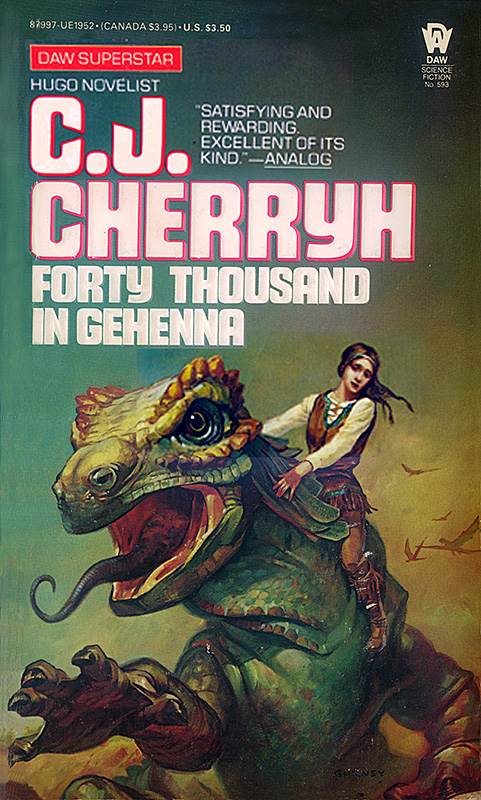
When forty thousand human colonists are abandoned on a planet called Gehenna for political reasons, and re-supply ships fail to arrive, collapse seems imminent. Yet over the next two centuries, the descendants of the original colonists survive despite all odds by entering a partnership with the planet's native intelligence, the lizardlike burrowing calibans.
Currently resident in Spokane, Washington, C.J. Cherryh has won four Hugos and is one of the best-selling and most critically acclaimed authors in the science fiction and fantasy field. She is the author of more than forty novels. Her hobbies include travel, photography, reef culture, Mariners baseball, and, a late passion, figure skating: she intends to compete in the adult USFSA track. She began with the modest ambition to learn to skate backwards and now is working on jumps. She sketches, occasionally, cooks fairly well, and hates house work; she loves the outdoors, animals wild and tame, is a hobbyist geologist, adores dinosaurs, and has academic specialties in Roman constitutional law and bronze age Greek ethnography. She has written science fiction since she was ten, spent ten years of her life teaching Latin and Ancient History on the high school level, before retiring to full time writing, and now does not have enough hours in the day to pursue all her interests. Her studies include planetary geology, weather systems, and natural and man-made catastrophes, civilizations, and cosmology…in fact, there's very little that doesn't interest her. A loom is gathering dust and needs rethreading, a wooden ship model awaits construction, and the cats demand their own time much more urgently. She works constantly, researches mostly on the internet, and has books stacked up and waiting to be written.
Wonderfully perceptive conceptualization of invented societies and cultures, with remarkably Le Guin like precision and authenticity.
An excellently realized narrative, with constant, organically occurring points of suspense; not only in its most urgent events, but with an overarching lingering tension from various underlying moral uncertainties
While my personal tastes had me more captivated by Cherryh's Cyteen for its more intimate approach on inner conflicts and explorations on individual's psyche, this still struck as an undeniably accomplished work for its own specialist theme on wider societal examination.
Also a noteworthy reason for awe is, indeed, that Cherryh is so able to skillfully write narrations with such distinctly different focuses; closely personal or communally resonant. The tone always just as effortlessly concise; both effective as well as affecting.
This was a worthy read. Both, on its own and/or as a supporting work to the wider Alliance-Union universe. Encouraging, too, for what all else kind of flavors there still might be to discover from Cherryh's extensive library.
It’s official: after reading three of her books, C.J. Cherryh has quickly become one of my all-time favorite authors. She writes fearlessly and confidently, infusing her novels with incredibly complex and wonderfully compelling questions and ideas. This novel, of the three I’ve read so far, recalled the work of Ursula K. Le Guin, with a similar depth in her approach to inventing and bringing to life a truly alien species and culture.
I truly never knew where this story was headed along the way, another very strong hallmark of Cherryh’s work, and she has an abiding skill at generating dread and tension, without ever laying it on too thickly, or tipping her hand.
I’m profoundly impressed by her talent, and I’m very grateful that she is a tremendously prolific author, giving me many more books to look forward to reading.
i completely forgot to post a review. So here’s what I posted in the discussion on the Science Fiction and Fantasy Book Club:
I finally finished! It wasn't a struggle really, Downbelow Station was much harder to get through, in my opinion. In fact, I really enjoyed it, but it was a bit bewildering in places. I thought the hereditary names was actually pretty clever in giving us a hand-hold as to where these new characters fit in and were coming from. It was like a built in backstory, which didn't have to be info dumped. Cherryh's style is so, so spare. And it's worse even with the new native human Gehennan's in an attempt at a sort of dialect plus the fact that they communicated with sign language and patterning as well.
I thought the Weirds were an interesting bridge to the calibans. To me, it seemed Cherryh was saying they were an unknown direct side effect of azi reproduction and if the azi's abandoned on the planet had continued to have tape and their children had had it as well, the Weirds probably wouldn't have developed. As it was, their lack of verbal communication is what gave them that connection to the calibans and thus a means for the whole society to stabilize and survive. Otherwise, I think the calibans would've undermined all the settlements and killed everyone. As it was, the Weirds "saved" the rest of the Gehennans and made a Base untenable.
So, do people think that it was the brown calibans that brought about the destruction of the Styxside settlements (as was theorized by Elai)? But why? Is Cherryh saying because the female led society was better for calibans (because they didn't eat the grays) or because they were less war-like and understood the calibans better?
Set in the Union/Alliance universe, Forty Thousand in Gehenna begins with a well worn trope of interplanetary colonization, but quickly moves into new and novel territory. Around the end of the Earth Company/Union wars, and the birth of the Alliance at Pell station, the Union set over 40,000 colonists to the newly discovered planet of Gehenna, deep within Alliance space. The goal? Establish a Union presence there, or at least thwart Earth Company or Alliance from colonizing it first? Not clear, but the Union abandoned the colony in any case, much to the chagrin of the colonists who were expecting support and more ships in three years time.
The initial colonization reminded me of Niven's work-- a planned settlement, with prefab domes and a large agricultural section. Things began to quickly sour, however, as the rainy climate soon killed most machinery and the colony was reduced to an almost neolithic state. Things get even more complicated when Cherryh introduces the aliens of Gehenna.
The colonists encountered the aliens right away, but the initial survey proclaimed them basically animals with no intelligence or civilization. Lizard like, but warm blooded, there were small ones that get everywhere and were tolerated as they were cute and harmless. Larger 'lizards' deemed calibans built mounds everywhere for no clear purpose the colonists could discover at first. The calibans began to encroach upon the colony and things quickly devolved from there.
Cherryh departs from the standard colonization trope by making Forty Thousand in Gehenna not so much a linear novel, but almost short stories in various times as we quickly jump from the founding of the colony to investigate events separated by decades; hence, while there are characters, we encounter new ones in each snapshot of events.
Few authors do aliens as well as Cherryh, making them, well, really alien, not some Star Wars type human with funny features or something. The calibans actually come in two 'flavors'- greys and browns, and the browns at least obviously have some smarts, but how they think remains largely a mystery in the book until the end. When the colony starts failing, many former azi (clone bred workers whose personalities are derived from 'tape') start to flee and many start living with the calibans, almost abdicating their 'humanness' altogether.
Things really pick up when, after decades, the Alliance discovers the colony and tries to establish contact with the new natives. This is hinted at in Cyteen, but Cherryh really does a masterful job here depicting the 'star men' trying to deal with the Gehennans. One of the best installments of the Union/Alliance series by far. 4.5 alien stars!!
This was a hugely ambitious work. I think you can feel the influence of Foundation and Dragonflight in it, and perhaps Clan of the Cave Bear, but with a distinct writing style and focus.
CONTENT WARNINGS: (just a list of topics)
Things to love:
-The concepts. Cherryh put forth an exceptional effort to hit on every moral issue confronting populating a new planet with lifeforms that do not mirror any known species, and what to do when that new population "goes native" in the sense that they become inextricably linked to the new planet with a separate path towards culture. AND ALSO questions of the morality of a world with high tech, clones and so on. Whew, there was so much to chew on in this book.
-The scope. Truly staggering. We follow about 400 years of history, from the time they are selected for colonizing a new planet to 300 years after, when that colony has been cut off and then reintegrated into the planetary federation.
-The aliens. I thought this idea was very cool and handled much better than many first contact scenarios. The work that went into figuring out their culture was impressive.
-The POVs. We have shifting POVs including people in command, people who are effectively slaves, scientists, all told through a mix of media--journals, memos, reports, and classic storytelling with the limited narrator.
-A few great lines. There were a few things that really stuck out to me in the writing. One of my favorite parts was That was really great.
Things that didn't quite grab me:
-Characters. So much effort went into the world, its history, the cultures that were developing etc. that the people in it felt more or less extraneous to me. They were there just to demonstrate what the world was doing and how observers would react. I did not connect emotionally with anyone. Even the ones we got to see a bit more "personally" felt like author stand-ins, and almost all of the emotional moments were overshadowed for me by obscene cruelty shown by anyone observing the person experiencing emotion. Most interactions were incredibly toxic in ways that I'm not sure follow without examination of why this would be their inclination.
-Elly's story. Given what we see later, this did not add up to me. I also hate the woman rival thing (ESPECIALLY WITH HER BROTHERS EW).
-Names. This was really difficult. Everyone was named one of 5 or 6 names across time.
-The whys. We saw so much of what and how but very little why. The set up with Union and Alliance made very little sense to me. The idea of two separate cultures growing seemed plausible, but I didn't understand why. Things kept happening to drastically alter history but I kept asking why? And I just don't think that was the focus. The focus was very much on the thought experiment of how this would play out if human history were condensed and reverted back to the stone age from well into the space age.
-The end. It felt fairly abrupt and a bit less thoughtful than the rest of the book had been.
I'm glad I read it and will certainly try more by this author as I believe her imagination and skill to be unique, but I don't think I can honestly say I loved it. 3.5 for me and I'm very torn on which way to round. I think down because I really did like it, but I don't think I'll pick up this series again next, necessarily, and I'm not sure I'd unreservedly recommend it.
I liked this one better than Cyteen or Downbelow Station. Cherryh writes a rather dry prose which leaves her characters always as characters on a page for me, but never as relatable human beings. With the multi POVs of the above mentioned books this both times let to me not caring. This time her style worked better for me, because she concentrated the narration on only a few characters, brought less info dumping and kept the emphasis on exploration and interspecies communicaton, which always works better for me than space station politicking. The communication approach was the highlight in this story and had me fascinated, even though I had wished for a less simplistic concept of how humans come to understand the calibans.
I will attempt to convey exactly how I feel using this review (but will fail miserably)...
Forty Thousand in Gehenna is an absolutely fantastic work of science fiction. In every sense of the word.
I am completely in awe with what Cherryh has done with this story. I won't go into detail, because I simply won't do it justice. Just read this book. However, I would say, if you've never read Cherryh before, start elsewhere. Cherryh is an amazing writer, but she makes the reader "work." If you're not used to this, a lot of this book's fine details might go unnoticed. Also, be warned, if you like light-hearted "cupcake" books, or other short books that are easy to read and always have happy endings, don't even bother with this one, or most of her work for that matter.
Cherryh is good because her fiction is packed full of Real, flawed characters that are much more human than most characters in the genre. The stories are full of heavy emotion. Many people will say that her stories are dark and ominous--and they are. But I would argue they are like that because she is so good at creating characters you really become attached to that happen to be subjected to unforgiving, real-world situations and they do the best they can
I feel that C.J. Cherryh is one of the most underrated authors of our time. I'm still baffled that I happened to discover her by digging through a stack of old books on a base in Afghanistan, only for her to quickly become my favorite author. But even today, if I mention her name to friends and family, few have heard of her. It always had me scratching my head, because her work is so unlike anything else I have ever read.
Where as Asimov, Clarke, and many others who have gone on to imitate them write to plant ideas in your head (don't get me wrong, I like their work too), Cherryh writes the way a composer writes a symphony, or the way an artist paints a priceless masterpiece. Every note, every brush-stroke, every word, sentence, and paragraph has to be perfect. This is why, among Cherryh fans, they will often say she is so consistent with writing great books.
Forty Thousand in Gehenna is an amazing book, read it.
It's rapidly become an embarrassment that I've had this lying around since 1993 without picking it up (especially given some of the rubbish I've read in between). While I'm used to the author's skill at involving the reader in the cultures involved in her books, the disparate groups and their clashes taking place in this book are a step beyond... just when you're getting to grips with the high tech/feudal culture clash you're suddenly dropped into a distinctly dark ages war... complete with attendant indigenous Lizards (who may or may not be pulling the strings). The story of the development of a (supposedly accidentally) abandoned colony and its development over some three centuries is a masterpiece. Get it if you can, it's a quiet burner.
This is a fascinating, dense SF novel where an abandoned, and then un-abandoned colony evolves very quickly over the course of 200 years into its own culture, with the help of three species of lizards native to the planet: the calibans.
The colony, both due to accident and Union's policy toward colonization at the time, has a genetic composition near-entirely comprised of the descendants of azi, non-freeborn humans who are psychologically trained from birth to be laborers. Very early on, as it becomes apparent that Union will not be returning to support the colony with high technology (i.e. birthing machines), the society transforms into a neolithic one that has no "tapes" to continue the azi brainwashing, and no ability to forge iron. Is it due to their azi heritage that the tower people can more easily communicate with the caliban? Is it why their interpersonal relationships are near universally kind of effed up and prone to sudden, cruel treachery?
Later on as brings space travelers back to the colony, the anthropological truism "not affecting a society you're studying, or for them to not affect you is impossible" comes into play. A couple of anthropologist/xenologist characters lose their sense of distance in the most egregious ways possible, taking on the Styx and Cloud societies' clothes and mannerisms, having sex with them, etc.
Cherryh wastes very little time explaining anything to the reader. This could easily have been a multiple-book series explaining all the changes and being a generational saga on top of that, but I appreciated the spare approach here, that left just enough filled in and left blank to give an impressionistic view of this planet's society's changes over generations. That spare style also creates emotional distance from the reader. It's a mark in its favor that a book like this kept me interested throughout, despite a complete lack of sentiment. The aforementioned cruel events aren't drawn out for pathos, pity, or gross-outs, which one can be grateful for when some of them are .
I enjoyed both this and Downbelow Station and am actively interested in reading more books in this universe. Three and a half stars, rounded up.
This is a novel set in Alliance-Union Universe. I read is as a part of monthly reading for June 2020 at SciFi and Fantasy Book Club group.
While this book is a part of the larger series, it can be read as a standalone, just like the other books in the series, e.g. Cyteen or Downbelow Station. At the same time reading other books allows to see a broader scope, so it is definitely encouraged.
The story starts with quite usual SF trope – colonization of a new Earth like planet. However, x takes a number of unusual turns, which make this book unique.
Firstly, the majority of over 40000 colonists are azi ("Azi" is an acronym for "artificial zygote insemination". The azi are first developed by Union just prior to the "Company War" in the early twenty-fourth century. They are both genetically engineered and psychologically conditioned for specific occupations, such as soldiers or farmers. They are created to supplement the low human reproductive rate and bring a given settlement to self-sufficiency and economic viability.). Azi, due to the method of their “mass production” don’t grew up in families, but get both their education as socialization traits from tapes ("Tape" is a computer-controlled combination of conditioning and biofeedback training. This technology allows large-scale education, especially if pupils are genetically and psychologically similar, like azi.) One of the goals of the newly established colony is try to make ‘born-men’ from naturally born future generations of azi.
Secondly, there are lizard-like local species (from dog-sized to gargantuan), who built strange constructions from mud (this is considered an instinct activity even if the goal is unclear), named calibans. Initially the colony is exceptionally careful with local life, but as calibans start entering ‘colony space’ the situation worsens.
Even starting with these two promises and writing a story about people born on the planet vs ‘old-timers’ would have been enough for a lot of authors. However, Cherryh goes much wider in both time and space, she makes it a multigenerational saga, a first contact with extremely different but potentially understandable species, growth and fall of civilizations and ways of thinking.
The book has a wealth of ideas. I see a lot of comparisons to Ursula K. Le Guin but for me Cherryh writing style is weaker, less poetically flowing; she is dedicated to minimalism, a more sterile view from outside and incomplete suggestions. Her style fits the story, with its multiple POVs and excerpts from formal reports, etc.
The Union settlers that come to Gehenna as part of a political expansion find themselves abandoned there in the company of the native giant lizards who may have more sapience than it first seemed. This novel chronicles the fall and creation of civilizations, and as such has a strange structure. The first two thirds is an overview of broad swaths of time, seen in glimpses from various denizens; the staccato pacing helps balance the distant narrative. Only the final third introduces characters to appeal to reader investment; it also engages some bond animal tropes and brings to fruition issues of civilization, definitions of sapience, and a truly alien species interfacing with humans. Cherryh's novels are often one part politics and one part id--and Forty Thousand in Gehenna is a particularly pronounced example. It's a slow burn with a too-quick end, but pays off for readers that enjoy Cherryh's style or the tropes at play. I imagine it holds up well to rereads.
This novel, set in the Alliance-Union universe, may be science-fiction, but it's really about what happens when language fails. Since it's a written text, there's a certain level of narrative distance from the events, as it moves across several generations of "settlers" and their descendants on a planet where everything is exactly as it is, and nothing is what it seems, unless you know how to, as St. Augustine put it in his "On Christian Doctrine," read rightly. And none of the protagonists know how to do so.
It's a complicated and phenomenally interesting novel, but it's not for someone who needs an explosion on every other page.
2.5*s. Having loved Freedom's Landing and really liked (if was slightly traumatised by) Semiosis, I thought I'd love this one. I didn't hate it, I just didn't connect with it at all. Sad times. Full review to come.
I should have figured out more of the tone from the title. You don't name a vacation palace Gehenna. And this book confirmed me in the idea that "officer" is an insult.
Also, never EVER kill a lizard on an alien planet. Just don't do it.
Cyteen and Downbelow Station are two of my favorite Sci-Fi novels. 40,000 in Gehenna occurs just before Cyteen in the Cherryh Universe timeline (see The Universes Of C.J. Cherryh. I suggest reading Cyteen before 40,000. I think the latter would be a bit confusing otherwise.
This book is pure Cherryh. If you want to know what that means, and it means a lot, start reading her works. She will be an SWFA Grandmaster IMnsHO.
Re-read (9/2019):
My second reading of this Forty Thousand in Gehenna highlighted by love for this novel. I have long been looking for SciFi novels with aliens that have little or no human characteristics, that are so alien that few humans can understand the aliens' feelings, actions, motivations etc. The indigenes of the Planet Gehenna are such creatures. With time these natives and humans come to some sort of understanding which is impossible to put into words. Cherryh does manage to show is this relationship, however. For me it is the main point of the book.
I recommend one reads this novel just before reading Cyteen
I would love to get recommendations of books with similar aliens.
This is a fascinating story of a colony, with a great historical overview – but Cherryh’s at her best when she gives us people-to-people interactions, individual characters we can care about – and with 300 years of history, just as we come to care about a character, we’ve moved on another 50 years – so the book is at its best in the final half, when we finally get to stay with one particular group of individuals. She also takes a little side-trip, in the midst of a story about human/alien communication mishaps, to throw in some musings about male/female communication mishaps and gender roles - lots of fun!
All of my C.J. Cherryh reading has been done within the 27-volume (34 when counting short story anthologies) Alliance-Union universe. So far I have read the Faded Sun trilogy trilogy, the Company Wars heptalogy, three of the four Chanur books, and now, the first of the three Unionside books. Forty Thousand in Gehenna is the best of the bunch, and it can be read as a standalone. Still, I can only offer a cautious recommendation. That is in large part because Cherryh is hard to read. I have found no other major (to be defined as some combination of being prolific, awarded, and widely read) science fiction author to be as consistently unpleasant to experience. Forty Thousand in Gehenna is less cryptic and incoherent than most, but it still features some of the hallmarks of Cherryh’s writing style. She takes what could be bright and paints it clouded, what others would have flowing and turns it disjointed, what should be exhilarating and makes it uncertain. These heavy weights, dragging the story down, are offset by the remarkable take on a staple science fiction subgenre .
The time scale, the geography, the big picture questions are excellently plotted out to make for a fascinating read. Cherryh manages to touch on several big questions without getting bogged down in most of them, instead letting them lay as foundations for her bigger ambitions. This makes it to my recommendations list, even with the disclaimers, because it such good science fiction. The asking of and exploring of interesting questions, the showing of different possibilities, the confrontation with an other, and that so very consuming question of What would you do?. The reader, through the lives of the characters, gets to feel what is like being an outsider as well as being the central focus, all while being reminded of both the smallness of our individual lives and the grandness of civilization. The combination of themes taken on here, the creativity with which they are put together, and the overall vision makes this book one of the best of its sort.
That is not to say that the book is perfect aside from the writing. I was particularly disappointed that Cherryh came up against a wall that has proved impassable to so many other authors. She can raise questions about such slippery concepts as intelligence and show examples of ethnocentrism but without ever coming out on the other side and giving us answers or demonstrating other possibilities. She opens eyes so that we can see more but never orients us to the place for the best viewing. Also, there were a couple of moments in the story where it seemed we were being given some surprising and significant revelation, but a dedication to minimalism and suggestion left them incomplete. There were some across-book disappointments as well. All of the individual subseries of hers that I have read have been largely independent of one another. Supposedly they are set in the same universe, and every so often one comes across a glimmer of connection, but for the most part they have little to no bearing on one another. That is beneficial to newcomers to the series because it gives them entry points into the universe. It is disappointing to veterans of the series. I have only the vaguest idea how this connects to The Company Wars, but it would have been much more satisfying if there were more subtle links and developments for longtime readers.
Forty Thousand in Gehenna, though very much a C.J. Cherryh book, is not very representative of most of what else I’ve read from her. If you want to read only one Cherryh volume, I, at present, recommend this one. Downbelow Station remains perhaps the most accessible, readable, and passively enjoyable of those that I have read, but Forty Thousand in Gehenna just does so much more.
Wow, this lady can write! The problem is what to classify this as? Psychological feudal scifi? All her books have intricate, well-developed and totally strange culture clash. This is no different. A colony is established on a planet, thought to be devoid of intelligent life. A few hundred humans and 40K+ clones start the colony which quickly reverts to agrarian status when promised support doesn't show due to the war. From there the story leaps years at a time out to 300 years from first landing. It is somewhat disjointed but no problem following the theme. She keeps the story moving to a clash between settlements. Not a book if you want battles and action but you will be awed by the completely original and unique society she develops.
This one started out great and depressing: a descent into savagery for a lost colony of azi (read human clones bred for docility) and born-men (well, "real" humans that don't really serve as great examples to the azi) stranded on a hostile planet inhabited by strange "calibans". I loved the brooding atmosphere and the initial characters. However, as the story moved on and jumped generations, I felt the narrative got a bit messy and the conclusion was, for me, unsatisfying. I wanted to read this because I had already read Cyteen where the scandal of Gehenna plays a large part. But, I would only recommend this one for hardcore Cherryh fans.
Forty Thousand in Gehenna starts with a fascinating premise that hooked me. A group of humans is sent to establish a colony on an alien planet, only to find themselves increasingly isolated and forced to adapt to an environment that is very different from what they expected. Cherryh does a particularly good job of making the early portion of the story feel uncertain and compelling. There is a real sense of discovery as the colonists struggle to survive and understand their new home. There are many colonists who are named, but the few important characters to the narrative in the early chapters are simple enough to follow.
Unfortunately, my interest began to wane as the novel progressed. The story moves through multiple generations, and while I understand what Cherryh is trying to accomplish, the constant shifts in time and characters made it increasingly difficult to stay invested. The genealogy trees included with the book eventually become almost essential for keeping track of who is related to whom, but needing to consult them also highlights the problem. There are simply so many characters that it becomes difficult to form much of an attachment to any individual. Just as I began to become familiar with someone, the story would move on to another generation. As the story moves further away from the original colonists, that initial sense of discovery and interest begins to fade.
There is a lot to admire here, particularly the ambitious worldbuilding and the ideas about cultural evolution and adaptation. I have found Cherryh's strengths to lie in creating vast worlds and universes with complex politics, sometimes at the expense of characters and narrative. Here I found the novel more interesting as a concept than as a story. The strong opening ultimately gave way to a book that I admired but left me just a little bit disappointed.
I'll admit that the cover was close enough to Dragonriders of Pern to make me uneasy (not to disparage McCaffrey's work--it has simply been a while since I've wanted to read that sort of story), and the background made it sound like yet another "technologically advanced humans encounter peaceful, tranquil aliens who have not been tainted by human greed and failings story" (along the lines of, say, Le Guin's "The Word For World is Forest," or Cherryh's earlier Downbelow Station). Not that there's anything inherently wrong with such a story; I've just seen it's thematic scope played out enough times for the scenario to have lost its luster. So, yeah, I put off reading this for a while.
Now I did finally pick it up, and am quite glad that I did. It's an excellent depiction of a truly alien and unknowable intelligence, perhaps up there with Niven's The Mote in God's Eye as one of the better realizations of first contact with a wholly non-human-based species, here taken in less of a "biologically unfamiliar" path and more of a "sapience that defies human categorizations of intelligence" route.
The book's plot structure is... odd, seeing as the first third sets up the initial cast and first few years of the colony, then peters pretty slackly into a fast-forward, one-scene-every-few-years, tell-not-show structure that sees the whole cast we've been introduced to die in rapid succession, then the second half of the book pick up (after a few stepping stones) 200 years down the road. Still, it succeeds at intimating the fringes and sharp highlights of a much broader story, most of which is not told but fits within my trained eye as a reader for the shapes of stories in general, and... I like that. I like when the author has the respect enough for the reader not to have to belabor points; has a fresh enough, complex enough, dense enough collection of ideas and thematic thrusts that that meaning can be folded into what is conveyed without having to be explicitly addressed; and when the author has the writing chops to pull off such a "larger/deeper than what's written" story, leaving things that needn't be said to be understood, left unsaid.
The book also definitely delves into some of the more interesting aspects of Cherryh's larger shared world, like the cloned, tank-bred, hypnotic-tape-educated azi workforce that makes up the vast majority of the Union (and has let the Union outbreed Sol and the Alliance).
I have some complaints about the lack of creativity in resolving certain Gordian Knots that the story poses:
But... all in all it's a fairly cerebral book, and just the sort of thing I am always on the lookout for. And I'll be honest: some of my favorite chapters were the scientific reports quibbling and contradicting each other vis a vis the nature of intelligence, the morality human intervention with non-human species (and warning against the dangers of applying anthropocentric value judgments and morality where they are simply not valid)... etc.
A very unusual and wonderful book, exploring a colonisation of an alien world, complete with 40,000 "slaves" (lab-grown humans) stacked in spaceships for months, and landing on a planet with alien animal species. The book takes place over a period of 200 years, with a short epilogue 100 years after that.
Through weather and a misunderstanding of the aliens, the main base collapses and a slow anarchy ensues. No further support spaceships arrive, and a reversion to stone age life takes place in the space of 10-20 years.
This is a superbly written exploration of what might happen, and perhaps at one time on earth did happen - say a slave ship crashing on a remote island, and a society devolving over time.
Fascinating work by Cherryh, with deeper themes than in many of her books. This is not a "Space Opera" but is true Sci-Fi, not fantasy.
This book can be read completely separately - very little of the Union/Alliance universe needs to have been read before you start this one.
Brilliant work.
For Cherryh, the Alliance-Union universe books are (mostly) fantastic - * In order to read:
Downbelow Station (1981) - Superb!! Merchanter's Luck (1982) - Perhaps her best ever! Rimrunners (1989) – Very good! Heavy Time (1991) - good, but long winded Hellburner (1992) - good, but long winded Tripoint (1994) - very good Finity's End (1997) – Superb Forty Thousand in Gehenna (1983) - good but uneven, important for Cyteen and Regenesis Cyteen (1988) – Superb Regenesis (2009) - Superb
The was originally published in 1983, making it one of Cherryh's earlier works, and it is easy to see the development of many themes that Cherryh later mines for gold in the "Foreigner" series: the epic sweep of nations and politics, human/alien cultural divides, and individual endurance (in fact, it is easy to compare 40,000 to Foreigner, as the last half of the book centers around the observations and experiences of a "starman diplomat" to the native Gehennans). This is a book to savor, not just for Cherryh's excellent use of language and descriptions, but because of the hugeness of the story, which covers several hundred years of history and the lives of many characters.
It is an eminently satisfying read, and as usual Cherryh brings to life not only the human characters in all their glory and with all their faults (her humans are always, always genuinely, humanly flawed) but also the alien "dragons" of Gehenna, who are fascinating but truly otherworldly creatures.
Re-read 3/25: this was the first book by Cherryh I ever read. Went in knowing nothing about Cyteen or the azi or anything at all about the Alliance/Union universe. Now, having read 6 (?) books set in this universe, Gehenna is even more fascinating to me. I'm extremely happy with my current Cherryh run!
What a fascinating, wild ride this was. The book was a group read and the author came highly recommended, so I started it without so much as reading the blurb. Which means I was surprised by everything which I absolutely loved. Cherryh manages to create an utterly compelling world. Her depiction of a human settlement developing over centuries into a society that is slowly becoming more and more alien in structure, social norms, way of life, and speech is masterful. Although there are several jumps forward in time and therefore a lot of different characters, I found myself captivated by all of them. And even though some of them are entirely alien, they feel extremely human at the same time. The structure of the novel was amazing as well, the story interspersed with the communications to and from base leaves the reader only just as informed about the outside world as the characters are which makes for an even more immersive read. I can't wait to read more by this author. Five stars with a cherry(h) on top.
Where to start. Well the fact that I flew through this book today even with working a 14 hour day ought to tell you something.
There is in this book a strange sense of naivete and mystery and hope and human pig headed-ness throughout the book.
There are parts that don't work. The early on census reports don't work and I was glad when they were replaced part way through by genealogy charts.
Did I say genealogy? Yup, this book covers some 200 years in medieval health conditions. So the book is written as a zoom-y picture of history, similar to, well history books. Excruciating detail about William Wallace, then the Hundred Years War happened, then excruciating detail about Joan of Arc. Some sections are as much as a hundred years apart, and other sections are 20 seconds apart. But it works. In particular I enjoyed the argument between two scientists over their interpretation of events. It felt real.
As a warning, we are talking about a collapsed colony here, so things do get brutal a time or two (she glosses over a lot more than most authors would).
What Cherryh does well in this book, she does really well. She drops the reader straight into her world and manages to reveal so much about it in so few words. Despite the distance of the perspective I had a real emotional reaction to the characters and their situations, and I loved the way she was able to touch on so many topics without ever seeming heavy-handed. Jin 1's story early in the book, and the arguments between Genley and McGee near the end, were definitely the most impactful for me.
I feel like I could have done with a bit more connective tissue between the generations, or possibly a bit less; as it was, the time jumps were linked just enough for me to feel like I was missing something. I also felt a bit lost during the battle sequence toward the end, though whether it was because the action itself was hard to follow, or I was just more interested in the outcome is hard to say.
Finally, I'm not entirely sure what she was trying to get at with the Weirds. I mostly got the sense that they're supposed to be fairly innocuous; different, but mostly harmless. However, having our introduction to them be a makes that difficult to accept, and honestly makes their role in the story a bit uncomfortable.
In the end though, this was very much a page turner for me, and made me feel a lot of things seemingly effortlessly, which I will always appreciate.
This is probably my least favorite Cherryh I've read so far. But that's not saying it's not good! It is, it's fantastic! I just like her more space based books better with all the politicking going on with Union and Alliance and Earth. This is very much planet based and very much cut off from the rest of her universe, although what's happening in the universe still has a huge effect here. It's fascinating to see society on Gehenna grow/collapse over time and how humanity adapts to their circumstances. Because of the long time covered though, I did feel disconnected from some of the characters and not invested in their future. This was particularly a problem for me in the middle sections as a result of the quick changes in generations and the naming practices of the Gehennans meaning that all the characters there seem to have the same names. The first and last generations though, where so much more time is spent and you get to know the characters more, those were perfection. Overall, this is your typically amazing Cherryh book.
Edit: Did you know Gehenna is an actual place? And also the name of the place has become to mean a sort of Jewish Hades kinda mythical place? I don't have interest in sorting out the details now, but I certainly would have benefited from knowing that back when I read the book! --- Brilliant book if a bit of a slog imo, reminded me of the structure of Semiosis and themes of both that and of The Word for World is Forest (that is, starmen being very slow to pick up on the sapience of the native life, mainly because of reluctance to do so). Read for SFFBC. Not likely to read more by Cherryh, having been (personally) disappointed twice.