

What do you think?

Ida B. Wells, Voice of Truth: Educator, Feminist, and Anti-Lynching Civil Rights Leader
Ida B. Wells, Voice of Truth is an inspiring picture book biography of the groundbreaking journalist and civil rights activist as told by her great-granddaughter Michelle Duster and illustrated by Coretta Scott King Award Honoree artist Laura Freeman.
Ida B. Wells was an educator, journalist, feminist, businesswoman, newspaper owner, public speaker, suffragist, civil rights activist, and women’s club leader.
She was a founder of the NAACP, the National Association of Colored Women’s Clubs, the Alpha Suffrage Club, and the Negro Fellowship League.
She wrote, spoke, and traveled, challenging the racist and sexist norms of her time.
Faced with criticism and threats to her life, she never gave up.
This is her extraordinary true story, as told by her great-granddaughter Michelle Duster and beautifully brought to life by Coretta Scott King Award Honoree artist Laura Freeman.
Ida B. Wells was an educator, journalist, feminist, businesswoman, newspaper owner, public speaker, suffragist, civil rights activist, and women’s club leader.
She was a founder of the NAACP, the National Association of Colored Women’s Clubs, the Alpha Suffrage Club, and the Negro Fellowship League.
She wrote, spoke, and traveled, challenging the racist and sexist norms of her time.
Faced with criticism and threats to her life, she never gave up.
This is her extraordinary true story, as told by her great-granddaughter Michelle Duster and beautifully brought to life by Coretta Scott King Award Honoree artist Laura Freeman.
40 pages, Hardcover
First published January 4, 2022
About the author
Michelle Duster
12 books26 followersMichelle Duster is a writer, speaker, professor, and champion of racial and gender equity. In the last dozen years, she has written, edited, or contributed to eleven books. She cowrote the popular children’s history book, Tate and His Historic Dream; coedited Shifts and Michelle Obama’s Impact on African American Women and Girls; and edited two books that include the writings of her great-grandmother, Ida B. Wells. She has written articles for Essence, Refinery29, HuffPost, Teen Vogue, and The North Star.
Ratings & Reviews
Friends & Following
Create a free account to discover what your friends think of this book!
Community Reviews
Displaying 1 - 30 of 39 reviews

January 26, 2022
In a world where stories that expand our understanding of Blackness throughout Western history are attacked by people who want to erase any sign of our brutalized humanity, any and all forms of storytelling about our most vocal figures are necessary. Lucky for us, one author—Michelle Duster—has written two stories about her great-grandmother within a one-year span. That great-grandmother? Ida B. Wells, of course.
While The Plot Thickens covered the 2021 release (https://blackgirlscreate.org/2021/01/...), we are thrilled to see this new book focuses on key components of this strong activist’s life with fine illustrations provided by Laura Freeman. In picture book format, Ida B. Wells-Barnett’s life leaps off the page and into your brain in a way that could only be comparable to an onscreen adaptation of her life. Readers young and old alike will take inspiration and heart from the trials and triumphs she made during her life under circumstances that unfortunately mirror many of the battles for basic human rights we see today. In making sure that the spirit of advocacy and Black liberation is renewed for different audiences on a regular basis, the team behind Ida B. Wells, Voice of Truth: Educator, Feminist, and Anti-Lynching Civil Rights Leader ensures that readers find this leader’s prolific life on many a bookshelf. As a Tennessean who has found out about stories of historical Black leaders in the state long after gaining an education there, I find Ida B. Wells-Barnett’s courage to challenge dominant white supremacy provided a lens into a history that I always suspected existed but never had any evidence for. Hopefully, readers will find similar value in these texts for years to come. In spite of all that has been erased, the carrying of these stories will continue to live on.
While The Plot Thickens covered the 2021 release (https://blackgirlscreate.org/2021/01/...), we are thrilled to see this new book focuses on key components of this strong activist’s life with fine illustrations provided by Laura Freeman. In picture book format, Ida B. Wells-Barnett’s life leaps off the page and into your brain in a way that could only be comparable to an onscreen adaptation of her life. Readers young and old alike will take inspiration and heart from the trials and triumphs she made during her life under circumstances that unfortunately mirror many of the battles for basic human rights we see today. In making sure that the spirit of advocacy and Black liberation is renewed for different audiences on a regular basis, the team behind Ida B. Wells, Voice of Truth: Educator, Feminist, and Anti-Lynching Civil Rights Leader ensures that readers find this leader’s prolific life on many a bookshelf. As a Tennessean who has found out about stories of historical Black leaders in the state long after gaining an education there, I find Ida B. Wells-Barnett’s courage to challenge dominant white supremacy provided a lens into a history that I always suspected existed but never had any evidence for. Hopefully, readers will find similar value in these texts for years to come. In spite of all that has been erased, the carrying of these stories will continue to live on.

January 29, 2022
This is a really great introduction to Ida B. Wells for kids, and the illustrations are wonderful. It is hard to nail down a good age range though, because I teach four-year-olds and they would not understand many of the words in the book, and to them it might be boring, but for older kids they might think it is too simple. This does however, really make me want to research and read more about her.

April 3, 2024
Oh, Ida B. Wells-Barnett, the woman that you were!
Excellent overview of her life and activism, interesting and engaging pictures, excellent back matter to show her continued impact.
Excellent overview of her life and activism, interesting and engaging pictures, excellent back matter to show her continued impact.
February 4, 2022
Children’s picture book about the life and legacy of Ida
B. Wells written by her granddaughter.
B. Wells written by her granddaughter.

September 29, 2022
This book is narrated by the author, who is the great-granddaughter of Ida B. Wells - the renown investigative journalist, suffragist, and civil rights activist inter alia born into slavery in Mississippi in 1862.
Wells became one of the founders of the National Association for the Advancement of Colored People (NAACP) and in her lifetime was arguably the most famous Black woman in the United States.
Duster explains that when Ida was 16, she lost both of her parents and a younger brother to yellow fever. It was Ida who had to take care of her five remaining siblings. When they were grown, she began a career as a teacher, first in Mississippi and later in Memphis, Tennessee.
In 1884, when Ida was in her early twenties and on a train, she was asked to relocate from the “ladies’ car” to the “colored car.” She refused and was ejected from the train. She sued the Chesapeake, Ohio & Southwestern Railroad, won her case and all the appeals, and was awarded $500. (Unfortunately, in 1896 the Supreme Court, in Plessy v. Ferguson, upheld state-imposed racial segregation, establishing the “separate but equal” doctrine.)
While still teaching, Ida became co-owner of the “Memphis Free Speech” newspaper and built up a following as a writer.
In 1892, her life completely changed, her great granddaughter reports, when three of her friends who owned a grocery store were lynched by whites. Duster writes:
“Ida . . . knew that her friends . . . were only guilty of being economic rivals to a white-owned business. . . . She realized lynching was used to keep the Black community in an economically and socially inferior position.”
Ida employed her newspaper to write about the incident and to urge Memphis Blacks to boycott streetcars and white-owned businesses. But while she was out of town, her printing press was destroyed and her life threatened: “She lost everything she owned and never returned to Memphis.”
Ida moved to New York City, where she worked on the “New York Age” newspaper and wrote pamphlets about lynching, using investigative techniques to expose the extent of the problem. For example, she discovered that in 1892 a lynching in Tunica, Mississippi occurred after the father of a young white woman implored a lynch mob to kill a Black man with whom his daughter was having a sexual relationship, under the pretense of saving the reputation of his daughter.
[You can read Wells' pamphlets online, such as the 1892 “Southern Horrors: Lynch Law in All Its Phases,” here.]. She also began speaking publicly both in the US and abroad about what she learned.
In 1895 she married newspaper owner Ferdinand L. Barnett and, as Duster observes, “did what few married women did at that time: she hyphenated her last name, becoming Ida B. Wells-Barnett.” They had four children, the youngest of whom, Alfreda, is the author’s grandmother.
In addition to her other accomplishments, Ida started the first kindergarten for Black children in Chicago; was involved in the fight for women to get the vote; and she founded and managed the Negro Fellowship League:
“Wherever she saw injustice or inequality, Ida raised her voice and did what she could to effect change.”
Ida B. Wells Barnett died at age 68 on March 25, 1931.
Back matter includes a timeline and list of tributes to Ida B. Wells.
Laura Freeman selected bold colors to display the well-researched historical events the book describes. As always, her collages include many clever but subtle touches to add meaning to the narrative.
Evaluation: There are many reasons for kids to learn about Ida B. Wells-Barnett and her accomplishments. Her dedication to finding out facts and countering rumors and misinformation, such as the common canard that lynchings all were caused by rapes by Black men of white women, and the publication of those facts in pamphlets with wide distribution, was so important to setting the historical record straight.
Specifically, as an online analysis of her work points out:
”The pamphlet refuted the justification for lynching as punishment for black on white rape by revealing that, according to published sources, fewer than 30% of reported lynchings even involved the charge of rape much less a legally proven case of it. This finding became the cornerstone of all subsequent arguments against lynching by a wide range of reformers and critics.”
Rather, this analysis continues, “the rape charge obscured the economic and political competition that fueled white racial hostility toward African Americans in the post-Reconstruction era. Second, it hid the consensual and sometimes illicit sexual contacts between white women and black men that took place in the past and the present. Third, by describing rape as an inherent inclination of black men, white men's institutionalized sexual power over black women (which included long-standing patterns of abuse and victimization that arose under slavery and continued in its aftermath) was eclipsed by sensationalism and an appeal to ‘nature.’"
As Ida wrote, “The way to right wrongs is to turn the light of truth upon them.”
Ida did not let her gender or race deter her from pursuing justice, nor even physical attacks. Her inspiring story is an important part of American history.
Wells became one of the founders of the National Association for the Advancement of Colored People (NAACP) and in her lifetime was arguably the most famous Black woman in the United States.
Duster explains that when Ida was 16, she lost both of her parents and a younger brother to yellow fever. It was Ida who had to take care of her five remaining siblings. When they were grown, she began a career as a teacher, first in Mississippi and later in Memphis, Tennessee.
In 1884, when Ida was in her early twenties and on a train, she was asked to relocate from the “ladies’ car” to the “colored car.” She refused and was ejected from the train. She sued the Chesapeake, Ohio & Southwestern Railroad, won her case and all the appeals, and was awarded $500. (Unfortunately, in 1896 the Supreme Court, in Plessy v. Ferguson, upheld state-imposed racial segregation, establishing the “separate but equal” doctrine.)
While still teaching, Ida became co-owner of the “Memphis Free Speech” newspaper and built up a following as a writer.
In 1892, her life completely changed, her great granddaughter reports, when three of her friends who owned a grocery store were lynched by whites. Duster writes:
“Ida . . . knew that her friends . . . were only guilty of being economic rivals to a white-owned business. . . . She realized lynching was used to keep the Black community in an economically and socially inferior position.”
Ida employed her newspaper to write about the incident and to urge Memphis Blacks to boycott streetcars and white-owned businesses. But while she was out of town, her printing press was destroyed and her life threatened: “She lost everything she owned and never returned to Memphis.”
Ida moved to New York City, where she worked on the “New York Age” newspaper and wrote pamphlets about lynching, using investigative techniques to expose the extent of the problem. For example, she discovered that in 1892 a lynching in Tunica, Mississippi occurred after the father of a young white woman implored a lynch mob to kill a Black man with whom his daughter was having a sexual relationship, under the pretense of saving the reputation of his daughter.
[You can read Wells' pamphlets online, such as the 1892 “Southern Horrors: Lynch Law in All Its Phases,” here.]. She also began speaking publicly both in the US and abroad about what she learned.
In 1895 she married newspaper owner Ferdinand L. Barnett and, as Duster observes, “did what few married women did at that time: she hyphenated her last name, becoming Ida B. Wells-Barnett.” They had four children, the youngest of whom, Alfreda, is the author’s grandmother.
In addition to her other accomplishments, Ida started the first kindergarten for Black children in Chicago; was involved in the fight for women to get the vote; and she founded and managed the Negro Fellowship League:
“Wherever she saw injustice or inequality, Ida raised her voice and did what she could to effect change.”
Ida B. Wells Barnett died at age 68 on March 25, 1931.
Back matter includes a timeline and list of tributes to Ida B. Wells.
Laura Freeman selected bold colors to display the well-researched historical events the book describes. As always, her collages include many clever but subtle touches to add meaning to the narrative.
Evaluation: There are many reasons for kids to learn about Ida B. Wells-Barnett and her accomplishments. Her dedication to finding out facts and countering rumors and misinformation, such as the common canard that lynchings all were caused by rapes by Black men of white women, and the publication of those facts in pamphlets with wide distribution, was so important to setting the historical record straight.
Specifically, as an online analysis of her work points out:
”The pamphlet refuted the justification for lynching as punishment for black on white rape by revealing that, according to published sources, fewer than 30% of reported lynchings even involved the charge of rape much less a legally proven case of it. This finding became the cornerstone of all subsequent arguments against lynching by a wide range of reformers and critics.”
Rather, this analysis continues, “the rape charge obscured the economic and political competition that fueled white racial hostility toward African Americans in the post-Reconstruction era. Second, it hid the consensual and sometimes illicit sexual contacts between white women and black men that took place in the past and the present. Third, by describing rape as an inherent inclination of black men, white men's institutionalized sexual power over black women (which included long-standing patterns of abuse and victimization that arose under slavery and continued in its aftermath) was eclipsed by sensationalism and an appeal to ‘nature.’"
As Ida wrote, “The way to right wrongs is to turn the light of truth upon them.”
Ida did not let her gender or race deter her from pursuing justice, nor even physical attacks. Her inspiring story is an important part of American history.

February 12, 2022
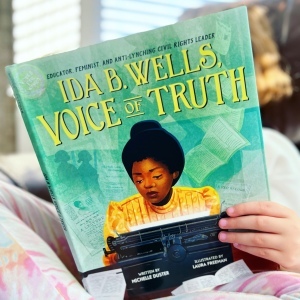
This review was originally written for The Baby Bookworm. Visit us for new picture books reviews daily!
Hello, friends! Our book today is Ida B. Wells, Voice of Truth, written by Michelle Duster and illustrated by Laura Freeman, a powerful profile of an incredible activist and writer.
Born into slavery in 1862, Ida began her professional career at only sixteen, when she became a school teacher to support her five younger siblings. Shortly after, she began writing, often on social and political topics that (by the standards of the time) no woman of color had any business writing about. At 22, she sued a major railroad corporation for discrimination, and won (though the ruling was later overturned in appeals). Ida wrote about her experiences with the railroad, with segregated schools, and with the racism and sexism she experienced daily. When three of her friends were lynched by white rival business owners, Ida encouraged boycotts in her newsletters, something that put her life in danger. Yet Ida never stopped – she continued to fight for minority and women’s rights until her death in 1931, leaving a legacy that continues to inspire activists and community organizers to this day.
Stirring. Wells was certainly ahead of her time as a writer and activist, and this look at her life does a wonderful job of exploring both her immense body of work and the motivations and drive behind it. Duster, who offers a truly unique perspective as Wells’s great-granddaughter, tells her ancestor’s story with a great balance of informative facts and emotional pull; the sequence that covers the lynching murders of Wells’s friends in Memphis and the subsequent fallout is particularly affecting. Freeman’s illustrations are compelling, both visually and emotionally, and truly feel like snapshots of Well’s life and times. The length and subject matter are best for older elementary readers, but JJ was certainly captivated by the story and artwork. Overall, this is an impressive and stirring tale of a figure more than deserving of recognition, and we highly recommend it. Baby Bookworm approved!
(Note: A copy of this book was provided to The Baby Bookworm by the publisher in exchange for an honest review.)
Be sure to check out The Baby Bookworm for more reviews!

March 14, 2022
“The way to right wrongs is to turn the light of truth upon them.”
A quick read on an amazing woman. She started as a teacher in Mississippi and started the Memphis Free Speech newspaper. She wrote about separate and unequal school systems and lost her job. When three of her friends were lynched for competing economically with a white-owned business, she knew she had to speak out about what happened. She urged Black people to boycott white-owned businesses and streetcars and to move to the territory of Oklahoma. She received threats and her printing press in Memphis was destroyed, but she continued speaking out after moving to New York City.
She fought for the right of women to vote, started the first kindergarten for Black children in Chicago and continued to fight school segregation. The list goes on and on of what Ida B. Wells accomplished in her lifetime. She was truly a woman before her time in many respects.
The book is written by Ida B. Well’s great granddaughter. It contains a timeline of events and an author’s note.
A quick read on an amazing woman. She started as a teacher in Mississippi and started the Memphis Free Speech newspaper. She wrote about separate and unequal school systems and lost her job. When three of her friends were lynched for competing economically with a white-owned business, she knew she had to speak out about what happened. She urged Black people to boycott white-owned businesses and streetcars and to move to the territory of Oklahoma. She received threats and her printing press in Memphis was destroyed, but she continued speaking out after moving to New York City.
She fought for the right of women to vote, started the first kindergarten for Black children in Chicago and continued to fight school segregation. The list goes on and on of what Ida B. Wells accomplished in her lifetime. She was truly a woman before her time in many respects.
The book is written by Ida B. Well’s great granddaughter. It contains a timeline of events and an author’s note.

March 29, 2025
I took interest in this book when preparing for a Girl Scout meeting where we presented the girls with the newly issued Juliette Gordon Low quarter. She and Ida B Wells are two of 20 women in American history to be featured on the US quarter.
I checked out as many books on these women from the library as I could and brought them along. The girls didn't take much in the books themselves, but I had their attention long enough to expose them to these women. Now that I have a stack this high of YA biographies, I plan to read them and will encourage my kids to check them out before returning them.
What I liked most about this book is that it was written by Ida B Wells great-granddaughter. The illustrations are captivating and many closely represent original photographs. It's a good introductory book for most ages. This has informed me of her autobiography, edited by her daughter and two books of her writing about her life and legacy that her great-granddaughter edited and published.
I checked out as many books on these women from the library as I could and brought them along. The girls didn't take much in the books themselves, but I had their attention long enough to expose them to these women. Now that I have a stack this high of YA biographies, I plan to read them and will encourage my kids to check them out before returning them.
What I liked most about this book is that it was written by Ida B Wells great-granddaughter. The illustrations are captivating and many closely represent original photographs. It's a good introductory book for most ages. This has informed me of her autobiography, edited by her daughter and two books of her writing about her life and legacy that her great-granddaughter edited and published.
May 31, 2026
As history teachers, we like to read Mavis some history books on occasion. There are fun ones and then there are pretty straight forward biographies like this one.
Moral: Take action to make changes.
Length: This is a Wikipedia page - with more details and facts - accompanied by art. This is certainly not meant for kids Mavis’s age.
Favorite Line: “The people must know before they can act, and there is no educator to compare with the press.”
Overall Impression: Mavis reached for the pirate book while we read this as a family. I won’t be so harsh with my review. This is exactly what it’s advertised to be, and rarely are civil rights biographies entertaining. I learned stuff as we read this book, even if Mavis didn’t. I’ll return to my favorite line often, as I compare America’s own disbelief in the press currently, as lies go told and untold by corporate syndicates crushing their own first amendment rights out of fear of Donald the Great’s lawyers.
Moral: Take action to make changes.
Length: This is a Wikipedia page - with more details and facts - accompanied by art. This is certainly not meant for kids Mavis’s age.
Favorite Line: “The people must know before they can act, and there is no educator to compare with the press.”
Overall Impression: Mavis reached for the pirate book while we read this as a family. I won’t be so harsh with my review. This is exactly what it’s advertised to be, and rarely are civil rights biographies entertaining. I learned stuff as we read this book, even if Mavis didn’t. I’ll return to my favorite line often, as I compare America’s own disbelief in the press currently, as lies go told and untold by corporate syndicates crushing their own first amendment rights out of fear of Donald the Great’s lawyers.

July 22, 2022
An excellent picture book biography of Ida B. Wells-Barnett, written by her great granddaughter. The book does a great job of covering Wells-Barnett's life and activism from her birth into slavery in 1862 all the way up to her death in 1931 without getting bogged down in details—this is a biography that manages to feel driving and urgent. Because so much of Wells-Barnett's work and activism involved the fight against lynching in the U.S., this is a necessarily somber book. However, the overall feeling here is one of empowerment and honoring of a truly powerful legacy.
Themes: Black History, Activism, Social Justice, Racism and Anti-Racism
Age range: Elementary
Themes: Black History, Activism, Social Justice, Racism and Anti-Racism
Age range: Elementary

July 11, 2023
I read this book as an adult reader for the AR Diamond Book Award. This book tells the life story of Ida B. Wells-Barnett. Ida B. was a number of things, but most importantly an important civil rights activist in her time. She spoke up for what she believed in and wasn't quiet about it. People today could take some notes from her! "The way to right wrongs is to turn the light of the truth upon them." -Ida B. Wells
This book could be used in upper elementary 3rd grade and possibly even into middle school.
This book could be used in upper elementary 3rd grade and possibly even into middle school.
June 22, 2023
Nice depiction of Ida B. Wells life and the major events that she went through. This would be a good starting spot for children to start on finding information on a pivotal historic figure. The book gives a very brief account of her life, but doesn't delve too deep into the philosophy of her thinking while not trivializing it. A great book for a 2nd or 3rd grader learning about historical figures.

November 25, 2022
Five-star fabulous! Wells lived an incredible life and left a lasting legacy, righting wrongs by shedding the light of truth with her powerful writing and public speaking. Endnotes include her life chronology and brief biographical sketch. Gorgeous illustrations vivify her larger-than-life presence on each page. Bravo!
“She refused to make herself small. She stood up. Spoke out. And she made a difference for us all.”
“She refused to make herself small. She stood up. Spoke out. And she made a difference for us all.”

January 6, 2023
This picture biography really shines through the page layouts and illustrations of Laura Freeman (including the endpapers), and Michelle Duster's carefully composed text does an excellent job of framing the 'herstory' of Ida's life for contemporary readers through her family connection by starting and ending in the present.

May 26, 2023
How wonderful to read a picture book biography written by a great granddaughter of the subject of the title. Michelle Duster , the great granddaughter of Ida B. Wells wrote a very concise, chronical biography of Ida B Wells. The theme of shedding light on injustice in Mrs. Wells life came through in this title. Illustrations are also well done by Laura Freeman.

September 29, 2023
We really loved this fantastic biography of Ida B. Wells, written by her great-granddaughter! The illustrations were great and I loved Ida's beautiful & bold outfits. Even more importantly, the writing is impactful and really outlines some of the challenges she faced and the good she did to fight both racism and sexism.

May 5, 2022
Possible contender for the Mock Caldecott Awards in January 2023. Extremely informative book about the life of Ida B. Wells and the important part she placed in defending Civil Rights and changing the world.

September 4, 2022
Very informational without being too much text. Mentions lynching but doesn't show it. Gorgeous illustrations. Would have been nice to have the actual photos at the end instead of just the stylized ones.

December 14, 2022
Damn. Ida B. Wells was INCREDIBLE. Adults should read this book, too, since I guarantee the vast majority of them have no idea who she was or what she did. Heck, I do know who she is and a lot of what she did, and I still learned a lot from this.

February 12, 2023
I wish I would have known more about Ida B. Wells-Barnett when I was in high school. I wanted to be a writer, but didn't have the family support. She persisted with much opposition, even though it is mentioned in this book, the weight of her perseverance was inspirational.

July 21, 2023
This was a nice picture-book biography of Ida B. Wells, but I thought it was a bit thin--it seemed a bit advanced for the youngest readers but didn't include a lot of depth that older elementary readers would be capable of understanding.

February 13, 2024
Exceedingly incredible how carefully this picture book handles slavery, lynching and racism so well to be appropriate for younger audiences. The fact that the author is Mrs Well-Barnett’s great granddaughter is truly amazing!

September 15, 2025
I'm impressed by Wells, and I'm glad there are picture-books for big kids about her, but I hope some of the others bring her to life better. I didn't actually feel anything because of this, rather, I felt removed. Too bad.

January 23, 2022
One of the many lesser-known. Civil rights movement founder.

February 23, 2022
I love that this was written by her great-granddaughter!

February 25, 2022
Was really learned alot about her in this book dont remember reading and her in school kids should definitely read this one

March 22, 2022
Informative and inspiring picture book biography of Civil Rights leader Ida B. Wells. My child especially liked that this book is written by Wells' own great-granddaughter.

March 26, 2022
Beautifully illustrated picture book. Great information about Ida B Wells.

April 13, 2022
Wonderful introduction to an amazing woman. I only wish it was a little more in-depth. Although, making me curious to read more can't be a negative. 😉

April 14, 2022
Hard to believe she did so much in just 68 years. Informative and easy to read!
Displaying 1 - 30 of 39 reviews