Discover the Korean War through the eyes of the journalist who covered it in this installment of the New York Times bestselling graphic novel series
In 1950, Marguerite Higgins (1920–1966) was made bureau chief of the Far East Asia desk for the New York Herald Tribune. Tensions were high on the Korean peninsula, where a border drawn after WWII split the country into North and South. When the North Korean army crossed the border with Soviet tanks, it was war. Marguerite was there when the Communists captured Seoul. She fled with the refugees heading south, but when the bridges were blown over the Han River, she was trapped in enemy territory. Her eyewitness account of the invasion was a newspaper smash hit. She risked her life in one dangerous situation after another––all for the sake of good story. Then she was told that women didn’t belong on the frontlines. The United States Army officially ordered her out of Korea. She appealed to General Douglas MacArthur, and he personally lifted the ban on female war correspondents, which allowed her the chance to report on many of the major events of the Korean War.
Nathan Hale’s Hazardous Tales are graphic novels that tell the thrilling, shocking, gruesome, and TRUE stories of American history. Read them all—if you dare!
Nathan Hale is the New York Times best-selling author/illustrator of the Hazardous Tales series, as well as many picture books including Yellowbelly and Plum go to School, the Twelve Bots of Christmas and The Devil You Know.
He is the illustrator of the Eisner-nominated graphic novel Rapunzel's Revenge and its sequel, Calamity Jack. He also illustrated Frankenstein: A Monstrous Parody, The Dinosaurs' Night Before Christmas, Animal House and many others.
(He is not the author of Extinction Earth or the other apocalyptic titles listed. That's a different Nathan Hale. If someone with "librarian" status would disambiguate those titles for me, I'd appreciate it.)
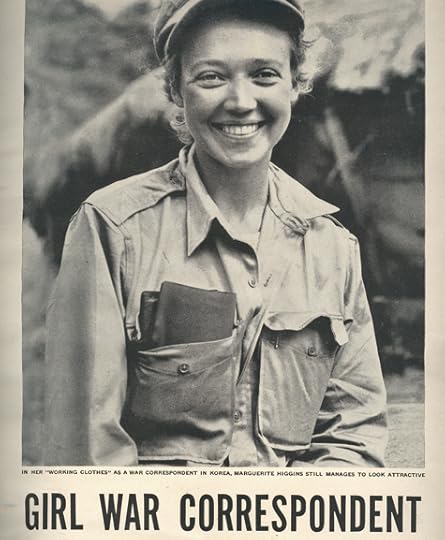
Well done, Nathan Hale. Not only is this book about a period in history that has been overlooked, but it also features a female war correspondent: Marguerite Higgins. She was such a key participant in reporting on the early days of the conflict that she won a Pulitzer -- the first woman to do so for reporting on combat. As with previous books in the series our "loudmouth narrators" are back. Nathan Hale spends the entire book upside down as his foot is caught in the hangman's loop early on. Includes some actual photos of Marguerite and a few of the key generals. A welcome addition to the series and I read it just in time for Women's History Month.
In this informative graphic history/memoir, we see the early days of the Korean War through the eyes of Pulitzer-winning correspondent Marguerite Higgins.
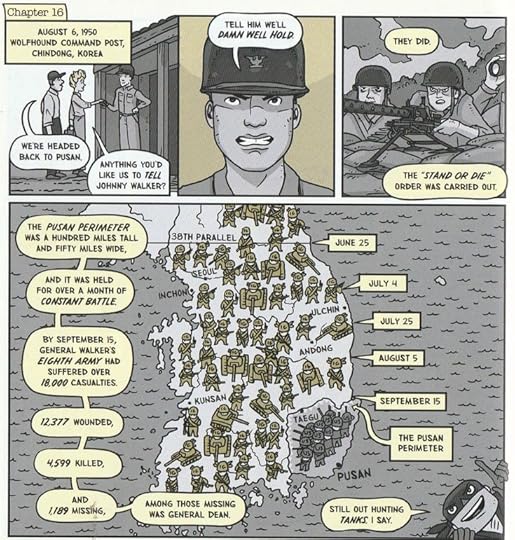
As troops from the north crossed the 38th Parallel, they met with little resistance as the soldiers waiting for them were a peacetime occupying force fresh from the war in Japan. Most of them, formerly bartenders, barbers, and cooks - had never seen combat. Their ammo was useless against an onslaught of tanks, and the only viable strategy was to retreat.
Hale does a good job of putting the reader right in the middle of the action.
Nathan Hale continues to delight me with his educational and humorous looks at history. This time a female journalist covers the opening weeks of the Korean War as unprepared and ill-equipped American forces are routed by North Koreans driving Russian T-34 tanks.
It's fine military history, with the focus almost entirely on American officers and reporters. It does veer a bit too much toward the whole thing being an adventurous lark in a foreign land. I wish more attention could have been paid to the effect all these maneuvers and battles were having on South Korean soldiers and civilians. Still very good, if not the most well-rounded.
A weak entry in the Hazardous Tales series. The Korean War is ripe for exploration - it is widely known as the "forgotten war" after all. But Nathan Hale doesn't give us a straightforward history of the war. Instead, we see it through the eyes of war correspondent Marguerite Higgins.
Is this a cool idea? Emphatically yes! A largely forgotten female war correspondent diving head-first into a war zone should make for a perfect Hazardous Tale. But we never quite get to know Higgins - why is she so driven? Why are any of these war correspondents so eager to cheat death? The storytelling method also makes the deadly, brutal war seem like a lark with Higgins constantly squeaking her way onto Navy ships and army bases.
The focus is on the American effort to defend South Korea as the North Korean army pours across the border. This means we meet dozens and dozens of identical white men, each as forgettable as the next. Why not give the South Korean perspective? Or North Korean perspective for that matter? The war through Higgins eyes is a very limited view. It's still fascinating and perhaps a good launching point for further research, but I would have liked the bigger picture from this Hazardous Tale.
This provides an excellent overview of the beginning of the Korean War for a younger audience that is enjoyable for all ages of readers. The interesting twist is that the story is told from the view of a woman war correspondent rather than from the viewpoint of a military or political figure. The stories of her adventures at the front lines are exciting, and she is a great point-of-view character that readers can relate with.
Well done, Nathan Hale. Not only is this book about a period in history that has been overlooked, but it also features a female war correspondent: Marguerite Higgins. She was such a key participant in reporting on the early days of the conflict that she won a Pulitzer -- the first woman to do so for reporting on combat. As with previous books in the series our "loudmouth narrators" are back. Nathan Hale spends the entire book upside down as his foot is caught in the hangman's loop early on. Includes some actual photos of Marguerite and a few of the key generals. An enlightening read about the Korean War. *Review by Darla from Red Bridge*
Another good one from Nathan Hale, but perhaps targeting a slightly older audience. Still has some silliness which makes it entertaining, but now there may be more words per page and more seriousness overall than the rest of the series.
Hale does a great job of spotlighting history stories which are under-told. Maggie would be a great role model for women/ girls who are restricted from traditional make activities.
This was interesting and I loved learning more about this strong women. I just didn’t find it as funny of engaging as some of the others. Also I don’t love just learning about the war and like being in it if that makes sense. I find the action scenes boring, but I understand how important it is to learn and know more about all aspects.
Major props to whoever greenlighted this remarkable book: a middle grade, lightly humorous graphic novel about a female war correspondent during the first disastrous year of the Korean War, with side digressions on the liberation of Dachau, beginning of the Cold War, and difficulty for woman in overcoming male prejudice during the 1950s…just what today's kids are looking for!*
Don't know how I never heard of Marguerite Higgins, but man, did I learn a lot here. About "Maggie," of course - but also about just how screwed the U.S. Army was during that first horrific year (basically an untrained and ill-equipped group of leftovers with no combat experience, who thought they were just going to be election-monitoring peacekeepers), and how close we came to being pushed all the way off the Korean peninsula entirely…just look at the below; that little circle at the bottom right around Pusan is all that we held on to until MacArthur's risky assault on Incheon turned things around:
An incredible amount of new information for me here, both on the war (since most Korean War books/movies tend to focus on the later "winter war" and things like the Chosun Reservoir) as well as Higgins herself, who was just in her early 20s when covering WWII, barely 30 when this story takes place, and then in her early 40s during Vietnam, where she tragically contracted and died from the horrific disease "leishmaniasis," (another thing I'd never heard of).
Just fascinating, fascinating, fascinating.
* Or at least what they SHOULD be looking for; we really need to find a way to attract young people to "true" heroes like Maggie Higgins, rather than fixating on celebrities, influencers and entertainers. More explorers, scientists, reporters and the like; and fewer sports stars, movies stars, Kardashians and rappers, (do they even still call them "rappers"? God, I'm old...)
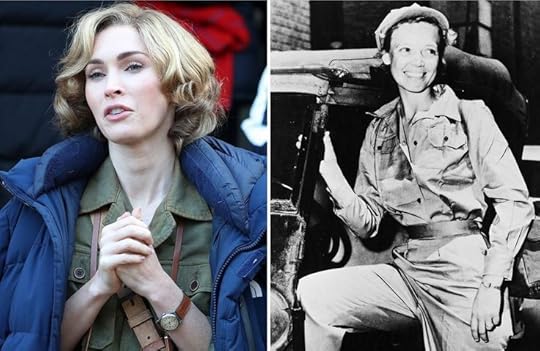
** While Higgins is not nearly as well known as she should be, she does appear as a character in the 2019 Korean film "The Battle of Jangsari," where she is portrayed by a way-too-glamorous Megan Fox who for some reason always has a camera around her neck, (the real Higgins was never a photographer; but apparently a camera looks cooler than carting around a typewriter).
War reporter Marguerite Higgins hijacks Nathan Hale's history lesson for the day and shares the history of the start of the Korean war from her perspective as a war correspondent.
I really appreciate that at the end Hale has Marguerite Higgins clarify that her experience of the Korean War would be very different from South Korean soldiers, local refugees, and others who experienced the same thing. I hope Hale does come back to share some of the rest of this history from a Korean's perspective. Higgins' supposed telling does share how messy this conflict was, how not ready America was to "help", and how they were frequently doing more harm than good at the beginning. It was a mess. Her perspective also shares how hard it was for her to do her job with military leaders who didn't like the truth of the messiness getting out (while at the same time others wanted the news to get out so they could get more help, especially ammo that actually worked), those who felt she shouldn't be there because she was a woman, and just the constant shifting lines of engagement. The time period from 1945-1950 was covered well and really helped explain why the line between North and South Korea is the 38th parallel, how the Cold War really played into all of this, and how that arbitrary line hurt both sides. Also, Nathan Hale gets perks for giving a nod to The Princess Bride having the character Nathan Hale say "Classic blunder" in response to MacArthur wanting to engage in a land war in Asia. I appreciated it. I had never heard about the ammo difficulties on the allied side of this conflict before at the outset of the war. The ongoing battles with the tanks were eye-opening. There really aren't that many informative books on the Korean War for teens, so this is a welcome addition to our library. And of course, Nathan Hale's Hazardous Tales are wildly popular already, so Hale could probably write about the development of the proper English place setting at this point and kids would clamor to get the chance to read it (and certain librarians too). Definitely another winner from Hale.
Notes on content: 2 minor swears. No sexual content. Deaths are mentioned and a few happen on page as well as war wounds. Thanks to the 2 tone color palette and how Hale draws those, they aren't gory. It is given the proper amount of soberness though.
Another great book by Nathan Hale. Full disclosure: I am officially a fan. After wrinkling my nose at Dogman and the other crap my kids bring home from the library, I discovered Nathan Hale's Hazardous Tales and we are all reading them as a family.
This one may not his best, although wars can be complicated to follow in the best of circumstances. I certainly learned more about the Korean War than I ever knew or learned in school.
My 6yo was telling me about the trap Washington set in "Lafayette" (also by Hale) and I asked if he noticed that the Soviets did the same thing to the Americans in "Cold War Correspondent" He did not. But he's six, so I probably shouldn't judge the book by that. Instead, let's point out that Hale managed to get a 6yo to plow through a book about the Korean War.
Started it with the kids when their co-op touched on the Korean War. This one ended up being too long for their attention spans (younger elementary), so I finished it on my own. My own history education never made it much past WWII, so I admittedly don’t know much about the Korean War, though my grandfather was a veteran of it — he never talked about his experience there. So for me, this was a solid overview of how it started, and how it connected to the overarching Cold War. The “loudmouth narrators” added some good humorous elements, and I could see this being a series that my kids enjoy when they’re older. Bonus points for doing this story through the eyes of a female war correspondent.
Another hazardous tale that does an admirable job summing up a pretty complicated story in a digestible format! This one is still a bit muddled in places, but I appreciated reading about the beginning of the Korean War and learning about Marguerite Higgins.
Now I want to learn about “turtle boats”, the first ironclad warships. They were a creation of the Koreans. They look almost cute in Nathan Hale’s illustration! That aside, this volume was a whole lot of war maneuvers, which did not interest me.
I know so little about the Korean War. I feel like it’s often skipped over since it’s between WW II and Vietnam, and this was a fantastic introduction to that history. Marguerite is such an amazing character - I loved seeing history through her eyes.
I appreciate that these books were written and I learned things about the Korean War that I previously didn't know, but the book lacked cohesion and skipped the last 3 years of the war. Weird.
The most modern book in this series also feels like the most biased one. Maybe because I know a lot about WW2 and a bit about the Korean War so I can see when stuff feels off here. In all these books the history is made into gags, but here he decides to bud in with some weird statements. In the slave books he constantly mentions how slavery is bad and evil via the characters. Which is weird as the storytellers are from a time where slavery was not yet banned in their nations so why would they be aghast at American slavery 100 years later that was not even as harsh as what they would have seen? They act like it kinda appeared in USA later on. All slaves are drawn heroic and brave. But at least the statements are made by characters in the book and it's universally accepted in the West that slavery is bad. Maybe Muslim slavery would be shown another way. Here he takes a step further. His second book with a female lead, a war reporter, and this character looks like a blonde thin model and acts like a warrior. It's a shame as he draws the men as Charlie Chaplin type fools - which is funny. Yet women are always depicted as heroic and attractive making it feel unnatural.
Similarly he states that experts said Americans initially sending their army to Korea was the biggest mistake of the war. Why? South Korea would not exist without these sacrifices. South Koreans are endlessly grateful to Americans. The ones who served in the war are seen as heroes in South Korean and are getting amazing treatment there. Even today they know the meaning of their sacrifice. Without American help all would be North Korea and communist. South Korea would not exist. All their brands and movies would not exist. I'm not sure why all of this is not even worth mentioning. The modern North Korean dictatorship is not talked about. The book is doing both-sides and it feels off.
He says USSR was not really the bad guys and definitely not always bad. Again misguided. Lenin created gulags and planned to kill off much of the population to create his utopia. He had the same ideas Stalin had, but he died in 1924 hence is not remembered for implementing death camps. And he was their first dictator. So when were they not evil? During Nikita Khrushchev? Here they invade Korea during WW2, USA invaded from the south stopping their advance. Stalin gave North Korea weapons so that they could conquer all of Korea with modern tanks and planes. Yet the author insist that because Stalin was waring with Hitler and USSR lost 20 million people that they were the good guys at this point. Yet even this is a reach. This is a statement taken directly from Russian propaganda and in USA it's often only reused by tankies or MAGA. Not even mentioning Stalin's rulership or the 3 North Korean dictators is a tad weird and makes this feel like a book that didn't dare to tell us any history that makes USA look good in comparison. In this war and WW2 they were the good guys. I think that's fair to say even if the author tries to stay neutral.
The book stops when the war reporter goes home. Which is early in the war. So we get initial frantic fighting, Americans losing badly and running away, Americans turning it a bit around when weapons that can penetrate tanks arrive and a few tanks and planes too. Then they take Seoul. They lose it later on, but we don't even get to that as she is home in safety winning a Pulitzer price. Fine and dandy for her, but we are left in the dark. I would not have minded another book to complete the war. Unfortunately he has a tendency to only tell part of the story. Same thing happened in the Lafayette book. But at least there his American story was over. Here we don't see her go to Vietnam and die of a sickness she got there. Neither do we see the completion of the war. Only her Korea story is over here. He clearly showed he can tell a full story. His WW1 book is telling us about the full war. Though not all battles.
Is it the worst book in this series? It's definitely the weakest one all in all. Mainly because the iffy history in the other books was too old for me to fully notice. I knew it was there and noted some events I couldn't find in any history book. I figure he made them up or found them in some obscure source. But if you define these books as inspired by a true story it's easier to understand his intention. I definitely wanted her to be a tad more scared and make some mistakes. Just like in the Harriet Tubman book she just cannot do anything wrong as the author is not great at writing women. In a civil war book we see a heroic woman help out bringing water for the cannons and yet again she's drawn like some calm supermodel superhero with no fear while all the men scream and shout. Here all keep praising her unless someone is unfair then she is criticized for sexist reasons alone. Which is not really how real life works. People make mistakes. Even heroic women. Maybe he just used her autobiography and didn't consider much would be a spin? Honestly why not follow someone on the battlefield? Or follow her for 20 pages then jump to someone else. It can still be a female journalist I just wanted the full war to be shown.
I read it last night and noted any content considerations and my impression of the book, feel free to skip my review if you want to draw your own conclusions, CCs are toward the bottom!
REVIEW:
In short, if your kids have already read Hale’s “One Dead Spy”, they should be fine with this book too. It is firmly on the tamer side of the spectrum of Hale’s books in terms of content considerations.
It took me about an hour to read, so pretty quick. Overall I thought it is a decent, albeit incomplete, introduction of the Korean War through the eyes of a reporter, Marguerite ‘Maggie’ Higgins, who describes her experiences of the war’s beginning in 1950. The scope of this tale truly is only in the first year of the war, following Maggie’s travels from place to place to witness and report what she was seeing. While it isn’t the focus of the book, some situations where she received pushback as a woman reporter going into war zones are described. A rivalry with a male coworker shows up intermittently throughout the story. In spite of these things, she maintained her responsibility as a reporter and through a variety of ways accomplished her reporting goals. Examples in the book: speaking to higher ups; following the letter of paperwork and passes, not necessarily the spirit of them; willing to accept whatever accommodations were available; insisting on allowances not due to being a woman, but due to her job. Some WWII context is provided to set the stage in the beginning chapter or so of the book is helpful since for anyone unfamiliar with the specifics of this war, (#🙋🏻♀️), it feels confusing to jump in after thinking WWII was over—soldiers in the book express similar confusion too. This tale is told almost solely from the perspective of one witness, compared to the WWI “Treaties, Trenches, Mud, and Blood” book, which is a general overview told in retrospect that touches on the entire scope of that war through its end. So I would recommend reading several other books from various perspectives to have a fuller understanding of the war—the book itself encourages and supports this approach on its last page or so. Overall it’s not my favorite of Hale’s books (“Treaties” hasn’t budged from the top of that list, it was a bit of a masterpiece IMO), but “Cold War Correspondent” does accomplish the job of a springboard into the pool of wanting-to-know-more waters.
CONTENT CONSIDERATIONS:
Foul language noted in only a small handful of instances, ‘h’ and ‘d’, one particularly is noted to be a direct quote. The phrase ‘sucker’ is used too. An injured man is depicted with a bloody nose but it’s not graphic or even entirely noticeable on an initial read through. When a man is literally blown in two, the soldiers who witness it comment on it with wide-eyed, shocked expressions, but the event itself is not illustrated. A later part notes Marines were literally crushed under a lowering landing ship gate. The ship gate and the water are shown with a big ‘Crunch’ written out, but no bodies are depicted.
The book asserts that the US and the Soviet Union became superpowers playing a game using other countries following WWII, to illustrate this abstract concept they are rendered as rather bizarre, scantly clad bodies with flags instead of heads—only on one or two pages.
There is the briefest mention of Korean women and children being ‘forced to do *terrible* things for the Japanese military,’ (author’s emphasis, not mine.) Nothing further is detailed, the illustrations only depicts a line of women and children with a soldier behind them. I haven’t researched what this is alluding to so I can only imagine what it means, curious readers may question the situation so I include it here as a heads up.
Since it is a war book, battle violence and deaths occur throughout, though in nowhere near the frequency or graphicness of Hale’s “Blades of Freedom”. Since warfare primarily centered around the use of Soviet-backed tanks, the instances of up-close-and-personal engagement are few in this book. Details range from a zoomed out field of skulls depicted, to a man being blown up (shown with an explosion and a man falling backwards, no gore or blood illustrated). At another point a few men volunteer to place explosives in efforts to disarm or damage tanks, it’s a suicide mission, and most do not survive their attempts. Nothing gory is depicted, only an implied illustration of a zoomed out picture of the tank with a “Blam.” There is mention in a flashback story being told of a group of U.S. soldiers executing all Nazi officers on account of the conditions they found at a concentration camp, nothing is illustrated, only described.
This entire review has been hidden because of spoilers.
Book #11 in the Nathan Hale's Hazardous Tales series goes back to the 1950s, along the 38th parallel. It looks at the beginning of the Korean War through the eyes of female war correspondent Marguerite Higgins.
The forgotten war which took place from 1950-1953 is a period in American history, as well as personal history that means a ton to me. My grandfather, William Gordon Dillard, fought in that war. He was a soldier in the 7th Infantry at the Chosin Reservoir. During that battle, he was injured, by a mortar round, proclaimed dead and MIA for about 2 weeks. and suffered severe frostbite. Obviously, his survival meant that I'm here today to tell you that story.
I learned a ton from this book which completely switches gears from the previous 10 volumes and allows Higgins to narrate this hazardous tale. First thing I can say is BOY, did we muck this up! After 5 years of battling Hitler, Mussolini and Hirohito, America was more than ready to stop fighting and I get that. However, the Soviet war machine, despite losing almost 25 million soldiers and civilians in WW2, was more than ready to keep on rolling. And roll, they did! Tank battalions were ordered to clear out the Imperial Japanese occupational force from Korea and they had every intention to keep on rolling all the way from Pyongyang down to Pusan. So we stopped the Russians by putting up a barricade along the 38th parallel cutting off the industrial centers of the North from the fertile farmlands of the South.
From 1946-1950, war between the two halves of Korea looked inevitable. Syngman Rhee, the President of the capitalist backed South Korea, begged the United States for tanks, guns and planes. But because of a fear that by doing so, Rhee would use those weapons to invade the North, we never responded to those requests. So when the Communist backed troops of North Korea crossed the barricades in the Summer of 1950, the South was severely under armed and out-manned.
The key to the North's success were it's tanks: the T-34. It was a Soviet tank known to cut through Nazi lines like a hot knife through butter. When we sent American troops to repel the tanks, our weapons couldn't even put a dent onto the side. That's because America had pretty much paused any legitimate development in our defensive forces. In fact our reinforcements were so poorly trained, we had barbers, cooks and construction workers fighting hand-to-hand combat with literal commandos! And the food, uniforms and munitions were all surplus from World War II!
Our failure to begin the war with properly armed and trained forces as a result, would fuel an arms race that would bankrupt a small nation. In fact, we outspent the Soviet Union, the largest country on the globe at the time, to oblivion, resulting in the it's collapse in 1991. It's another reason we're not on very good terms with China, Cuba and many factions in the Middle East. While I'm more than proud of my grandpa's role in Korea, I'll also be the first to say that we really screwed up during that police action.
Cold War Correspondent marks my completion of having read the entire series. I just didn't do it in order. Thankfully, there's more fun on the horizon. In September of this year, the 13th volume will debut. It's a spooky collection of true tales of terror. I have no idea what to expect. But I can't wait to read it as part of my Halloween reads for 2025.
Great stuff for kids ages 12 and up who love history and graphic novels. Maybe they had a relative who fought in Korea like I did. Though this book stops before the end of 1950, meaning there is still 2 and a half years of war left untold, this can be a valuable tool to help them understand what it was like for their loved ones who fought along the 38th parallel.
First the problems - the bibliography has all books, no websites. One of which is the autobiography of Marguerite Higgins, the woman written about, which the author/artist point out cost him $150 on e-bay. Wikipedia mentions a couple sites that could have been mentioned.
The book takes place during the end of WW2 and the start of the Korean war/police action. Higgins is referred to as Ms. each time she's addressed. While possible, i doubt it was used by Americans in the 1950s as it didn't become popular until the 1970s.
The author seems to have a positive feel for the Korean war, which is kinda icky, it left a sour taste.
The black character, which is apparently a constant in these history for kids books, raises his hand to ask Higgins a question early in the book. Consistent w/how a black man would have to defer to a white woman during much of our history - but again, icky.
The conceit/gimmick of these books are that they are told by U.S. Revolutionary War hero Nathan Hale as he is about to be hung, the hangman ( a man who loves his job), the English officer in charge of the hanging and the black man who made the rope. And the characters clearly work, this is the eleventh in the series.
The positives -learning about a major and important writer from Oakland and Marin that i wasn't familiar with. The art - Higgins is one of the most beautifully drawn women i've seen in comics in a while and the reporters and war scenes are well done. The story is told well, you see Higgins as a not entirely unbiased bystander, but her reporting apparently showed little of her bias. She was well respected by most of her peers and some of the military.
If this were in paperback for eight bucks i'd recommend it because it does show some US history not usually written about and a strong, brilliant woman in a job that wasn't common for women. But as a $15 hardback its excessive.
Thinking back to US history class, the Korean War almost always got ignored. We would be studying World War II and then all of a sudden the end of the school year would be upon us and we might squeeze in some Vietnam, but then it was over.
So I am glad to see this installment of Nathan Hale’s Hazardous Tales tries to fill some of the gap. The chaos of war (and the uniformity of the uniforms) sometimes made the military storyline difficult to follow, but the true star of this story is war correspondent Marguerite Higgins who was right in the thick of everything as the Korean War was just beginning.
The US was ill -prepared for war in Korea in 1950, and by the time they were able to marshall their full strength, there was already a lot of tragedy. These stories were what Higgins relentlessly pursued and captured. She comes across as a fascinating reporter dedicated to getting the latest news for her readers back home, and never hesitated to go anywhere in search of a story. She was shot at, navigated mined fields, waited in foxholes, and had to fight for her place with the press.
I’m sure it’s hard to know where to put the boundaries around the story like this. This book only focuses on the opening months of the Korean War, and not the entire scope. In that same vein, it only focuses on Higgins’ experiences during this specific time, referring briefly to her reporting in World War II, but otherwise giving no context about the rest of her life. The end of the book gives a few more details about Korea and Korean culture, but only offers a plethora of resources that would have more information about Higgins herself. There is a lot of information to pack into this small package, and there’s no question I was left wanting more.
My only other complaint is the Ramona/Mike Mulligan conundrum, which Hale skirts so closely, but then shies away. At one point Higgins is told that she cannot be in a particular location because there are no “facilities“ for her to use, and she responds that there are also no facilities in a foxhole, but she’s managed. I needed more details. Where on earth DID Marguerite go to the bathroom, especially in the jumpsuit that she’s wearing in the photographs in the back of the book? She was in Korea for months so how on earth did she deal with *menstruation* in a foxhole? These are vital questions that should not have been left unanswered. How people go to the bathroom on adventures and in history is one of the most ignored elements of any story, and like Ramona, I’m tired of it.
**Note: Includes priceless Princess Bride joke about never getting involved in a land war in Asia.
While looking for YA reading material about the Korean War, I discovered this collection of nonfiction graphic novels that cover a wide variety of historical events, including the Korean War, which began around the same time as the Cold War. This selection is focused on Marguerite “Maggie” Higgins, the first female war correspondent to win a Pulitzer Prize and one of the journalists present when the Dachau concentration camp was liberated. Though I enjoyed learning about the Korean War and Maggie’s experiences fighting for her right to put her life on the line alongside her male colleagues, I found the narrators–Nathan Hale, E. Pluribus Hangman, Bill Richmond, the Provost–a bit annoying. I know their purpose is to demonstrate what good readers do by questioning the text and making connections, but some of their input just seemed unnecessary. The story begins at the end of WWII when the Russians began spreading communism by simply taking over countries previously held by the axis powers. In this case, Korea had citizens who liked the idea of communism and other who preferred democracy. Communists in the north were provided with top of the line guns and tanks, planes and ships, while those who favored democracy in the south were supplied by the US with hand-me-down munitions left over from WWII. The illustrator includes maps that show the 38th Parallel and then explain who, how, and why that was chosen as the line of demarcation between N. and S. Korea. There are breaks in the timeline to explain or describe whatever is being discussed–leaders, historical events, tanks, communications, etc. And there are photographs of Maggie, Gen. Douglas MacArthur, and others mentioned in the book. We do not learn the whole story of the Korean War, only the parts Maggie experienced before being reassigned to another conflict along with a few other highlights before fast forwarding to the end result. 3.5
This next entry in the popular graphic novel series about historical moments is a 3.5 for me. Featuring the usual cast of onlookers--Nathan Hale, E. Pluribus Hangman, Bill Richmond, and the Provost--the book offers an insider's view on the Korean War. This is complicated territory as there are government betrayals, confusion, mistrust, and downright foolishness, and events occur that will have lasting effects. The battles and shock caused by the Soviet-backed North Koreans' attempts to extend their territory, moving into the south of the country after the Allies divided it into two parts. Marguerite (Maggie) Higgins reports on all the skirmishes for the New York Herald Tribune, filing reports wherever she has access to a phone or can type. More than once she risked her life to tell the story of what was happening even while being trapped in the area as violence threatened or dealing with misogynistic military leaders who wouldn't let her do her job. She stuck to her guns, got help from friendly military sources, and eventually was awarded the Pulitzer Prize for her stories of combat, the first woman to do so. She told the truth about what she saw, which sometimes painted the United States in a negative light. Honestly, despite my love for history, I have always felt a bit confused about the whole Korean separation thing and the Korean War. This book shone a light on elements that had befuddled me and on important individuals during that conflict. I hope Nathan Hale never stops creating these helpful books. Readers will want to be careful when reading the pages, though, since sometimes the panels spread across two pages while most of the time, they just move down one page.
Marguerite Higgins, a reporter for the New York Herald Tribune, covered the outbreak of the Korean War. She was a correspondent in World War II and witnessed the liberation of some of the concentration camps. Stationed in Tokyo, she and other correspondents flew over to Seoul as the North Korean army came pouring south. Many of her personal experiences are told, e.g. dealing with supportive and unsupportive military leadership (some didn't want her anywhere near combat). The battle scenes are exciting and frequent. This book only covers the first year of the war (1950), with the South Korean and American/UN forces pushed all the way back to the southern shore of the Korean Peninsula. General Douglas MacArthur executed a bold plan to retake the capital, launching an amphibious assault at Inchon, eighteen miles west of the capital.
As with all the Nathan Hale's Hazardous Tales books, this is introduced with a little comedy by American patriot (and narrator of the series) Nathan Hale and his executioners. Ms. Higgins takes over narrating duty since she is a reporter and it's a natural fit for her. Her real-life account is riveting. I learned a lot about the Korean War from this book even though it only covers a third of the war. As usual, there's a bibliography and some pictures of the real Higgins. The inside cover gives a map of Korea and explains the language changes by the South Korean Ministry of Culture and Tourism that happened in 2000, when spellings changed, e.g. Inchon to Incheon and Pusan to Busan, among others. This book is a better text than a lot of textbooks!