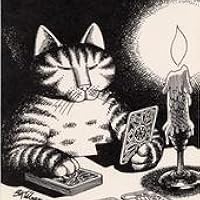
Discovering an ancient tarot deck in her grandmother's attic, Bonnie McBurnie is horrified by the overwhelming powers that are unleashed when she uses the cards and is forced to confront an unsolved family tragedy
Bruce Coville was born in Syracuse, New York, in 1950. His family lived in farm territory, about twenty miles north of Syracuse. Bruce grew up around the corner from his grandparents' dairy farm, where he spent a great deal of time as a child, dodging cows and chores to the best of his ability. As a young reader he loved Mary Poppins and Dr. Dolittle, and still has fond memories of rising ahead of the rest of his family so he could huddle in a chair and read THE VOYAGES OF DR. DOLITTLE. He also read lots of things that people consider junk (Nancy Drew, the Hardy Boys, Tom Swift, and zillions of comic books). His only real regret is the time he spent watching television, when he could have been reading instead. (A mind is a terrible thing to waste!)
His first book, THE FOOLISH GIANT, was published in 1978. It was illustrated by his wife, Katherine, whom he had married in 1969. This was followed in 1979 by SARAH'S UNICORN, also illustrated by Katherine. After a long period of working separately, the Covilles began collaborating again with SPACE BRAT and GOBLINS IN THE CASTLE, both published in 1992.
Before getting published Bruce earned his living as a toymaker, a gravedigger, a cookware salesman, an assembly line worker, and finally as an elementary school teacher (second and fourth grades). He left teaching in 1981 to devote himself to becoming a full time writer - though it took another five years to achieve that goal!)
Bruce has published over 100 books, which have appeared in over a dozen countries around the world and sold more than sixteen million copies. Among his most popular titles are MY TEACHER IS AN ALIEN, INTO THE LAND OF THE UNICORNS, and THE MONSTER'S RING. In 2001 he founded Full Cast Audio, an audiobook company dedicated to creating unabridged, full cast recordings of the best in children's and young adult literature.
I read all of the books in this teen horror series over and over in junior high and high school. I'm sure if I read them now I would find them hideous (in the bad way), but because I loved them so much then, I'm giving them all five stars!
Oh, 1983. When I was 12 I would've loved this book to a dangerous extent. It's a clever little primer on the tarot, and likely a helpful study aide if you're trying to memorize all the cards.That said, reading it now, I'm just struck by how awful Alan is and how annoyed I am that . Passes the Bechdel Test, though.
Considering the target age for this book is probably teens, I'm giving this book a 4 out of 5 because it was entertaining and kept my interest peaked from start to finish. Even if it didn't break any new concepts, I think it would easily climb into my favourites if I read it while younger.
I can pinpoint my interest in Tarot to this book and this book alone. It started it all. As an adult it's a little cheesy, Magistines and gypsies and the lot, but as a kid this story rocked my world.
I had more or less the same reaction to this Chamber of Horrors entry as the previous one. It has all the elements of good teen pulp (in this case: hidden psychic abilities, family secrets, an evil tarot deck, and an ancient magical enemy), but the story never quite coheres. There are some really good scenes in it, like when protagonist Bonnie feels a strange power welling up within her that allows her to give a friend a frighteningly accurate tarot reading. But in the second half of the book, the plot takes over completely, and you lose much of the fun as everything winds like clockwork to an inevitable conclusion.
I think it would have helped immeasurably if Magistimes, the wicked sorcerer with an old score to settle, was more impactful. There is a suggestion that Bonnie finds him alluring, but that's never really developed. He's just a bland, antagonist-shaped blob. Bonnie's annoyingly "funny" boyfriend, Alan, should have been eliminated completely; it would have made more sense for Bonnie to be lonely and unpopular so that Magistimes' seduction could have represented a legitimate temptation. Instead it just felt like there was nothing at stake. I also would have liked to see the ultimate fate of Bonnie's grandfather--revealed as a recovered memory of Bonnie's near the end of the story--carry more meaning. Like many of the things in this book, the revelation of how he came to be lost at sea (while creepy) just kind of happens. A rewrite really could have saved this one.
Honestly, thinking back on Eyes of the Tarot, I wonder how the book could have possibly been 180 pages when it feels so thin and insubstantial. What happened in all those pages, and why do I already remember so little of it?
I'm surprised that I enjoyed this book as much as I did. It isn't good, but one thing three decades of reading has taught me is that a book doesn't need to be good for me to enjoy it. It let me escape for a few hours, and kept me entertained throughout, and that's all I ask for in any book. In my early teens, I probably would have loved it. I looked for anything that dealt with strange happenings or a world within our own. Adult me sees the flaws and had a good time anyway.
I didn't care for this author's style of writing. There were also several grammatical errors, and he should have placed scene breaks in a few places and the places he did put them didn't seem to make sense either. I know this is geared towards younger readers, so maybe I'm not the best person to leave a review on it. I just didn't care for it.
While visiting her grandmother for the summer Bonnie McBurnie discovers a trunk in the attic filled with memories from her youth and of the grandfather who shared it with her. Among these treasures, buried under nesting dolls and kimonos, is a small wrapped package secluded in a hidden compartment.
Here she finds a pack of ancient tarot cards which immediately capture her imagination. Without her grandmothers knowledge she takes these with her when she returns home and the cards begin to cast a spell over the sixteen year old girl, spreading misfortune and awakening something in Bonnie that has long since been forgotten. Memories of an old tragedy mingle with vivid dreams of mystical characters as Bonnie’s world falls apart around her; and she realizes that her actions have triggered the return of an ancient evil that could destroy everything she holds dear.
Bruce Colville’s Eyes of the Tarot, book number nine in the Dark Forces series has to be one of the better books in the range. Though its story is no more complex and presents little more depth than its companion books Colville writes a great deal better than his fellow authors in the series.
Atmosphere and dialogue are Colville’s strengths and the characters and world he builds with deceptive ease in Eyes of the Tarot easily bury any shortcomings in story or plot. The opening scene in the dusty attic where the tarot cards are found to the raging sea on which the book ends are all equally well rendered while never over stepping description and usurping the readers own imagination in the process.
I find that some authors overdo the description of a scene or character, and I can find this even more off putting than a lack of information in this area. Once the world is drawn the reader should be allowed to take it and run with it, the written word acting as a guide rather than a series of rules, so the reader can adjust the world in accordance to their own experience.
As a slight aside here I’ve had people comment about my own writing concerning this, in that I sometimes do the same. People sometimes refer to my “flowery description” and how off putting they find it at times; so I am no less guity here, though I try not to be.
Colville on the other hand manages to walk this line rather well, allowing the reader to fine tune his story and imprint more of themselves into it. At their best this is what separates young adult novels from those we “progress” to as we grow older, though I’m not sure that in many cases “progress” is quite the right word, and perhaps this is one of the reasons why many older readers still have a soft spot for such books.
Young adult novels strengths lie in the author’s ability to mirror that character to the reader in some significant way. This is done in adult novels too, this is true, but in the young adult book this addition carries a great deal of weight, and perhaps is the main draw to such books.
Generally speaking story and plot in such books cover a relatively narrow range, which is further restricted by the available range of acceptable content for a younger reader, so a great deal has to be done with far less as a necessity.
Bruce Colville is surprisingly adept at this.
Eyes of the Tarot was a book I originally read back in the mid 1980’s and I was probably no more than thirteen or so when I read it. I didn’t remember this until I started rereading the book recently and I wonder how I managed to forget a book I should have enjoyed a great deal at the time. Perhaps this is because of the female protagonist (though her boyfriend is called Alan, so I would have thought I’d remember that) but this didn’t make a difference with many others I read at the time so maybe I was just too young to appreciate the effort that went into this particular work.
Checking the history of the book I have noted that the e-book I recently read is a revised edition that includes a further twenty or so pages to the books original hundred and fifty or so and I noted many additions in the book that must have been a apart of this rewrite. At one point a character mentions the X Files for instance, which appeared on TV over ten years after this book was originally released and so I wonder how this edition compares to the original printing of the book.
Obviously this is something I should look into and if the opportunity arises to get a cheap copy of the original printing of Eyes of the Tarot I intend to do just that.
Quite a few Bruce Colville books have been released in the e-book format, among them another book from the Dark Forces range. This book, Waiting Spirits, will probably be the next on the list on my rereading of these fondly remembered books from my youth. In the meantime I intend to take a look at some of the series I didn’t read at the time that are now available in the e-book format, a little research has shown a surprising range of them now easily available for those of us who want to revisit those chilling tales from our youth.
Since no one else has reviewed this, my review written June 24, 1996 at age 12:
"This book has a fantastically original plot and a gripping story, but it resembles his first Chamber of Horrors book (which had the spirit of a demon trapped in an amulet). When Bonnie finds tarot cards and bones hidden in her grandma's attic, she is immediately absorbed with them and takes them home, despite the warnings of her grandmother. When she takes lessons on how to use the ancient tarot cards from a fortune teller, she accidentally unleashes a strange and wonderful power. Each card is a spirit trapped- but some are evil. Through her dreams, will Bonnie choose the right one to listen to?"
(Hmm, makes me wonder if Bruce Coville ever watched Cardcaptor Sakura!)
I found it to be well written with engaging characters, and an interesting premise. The Tarot is handled well, and there are some intriguing fantastical elements in this book. A quick, pleasant read. A nice cover by Ciruelo Cabral as well.