Jump to ratings and reviews
Rate this book

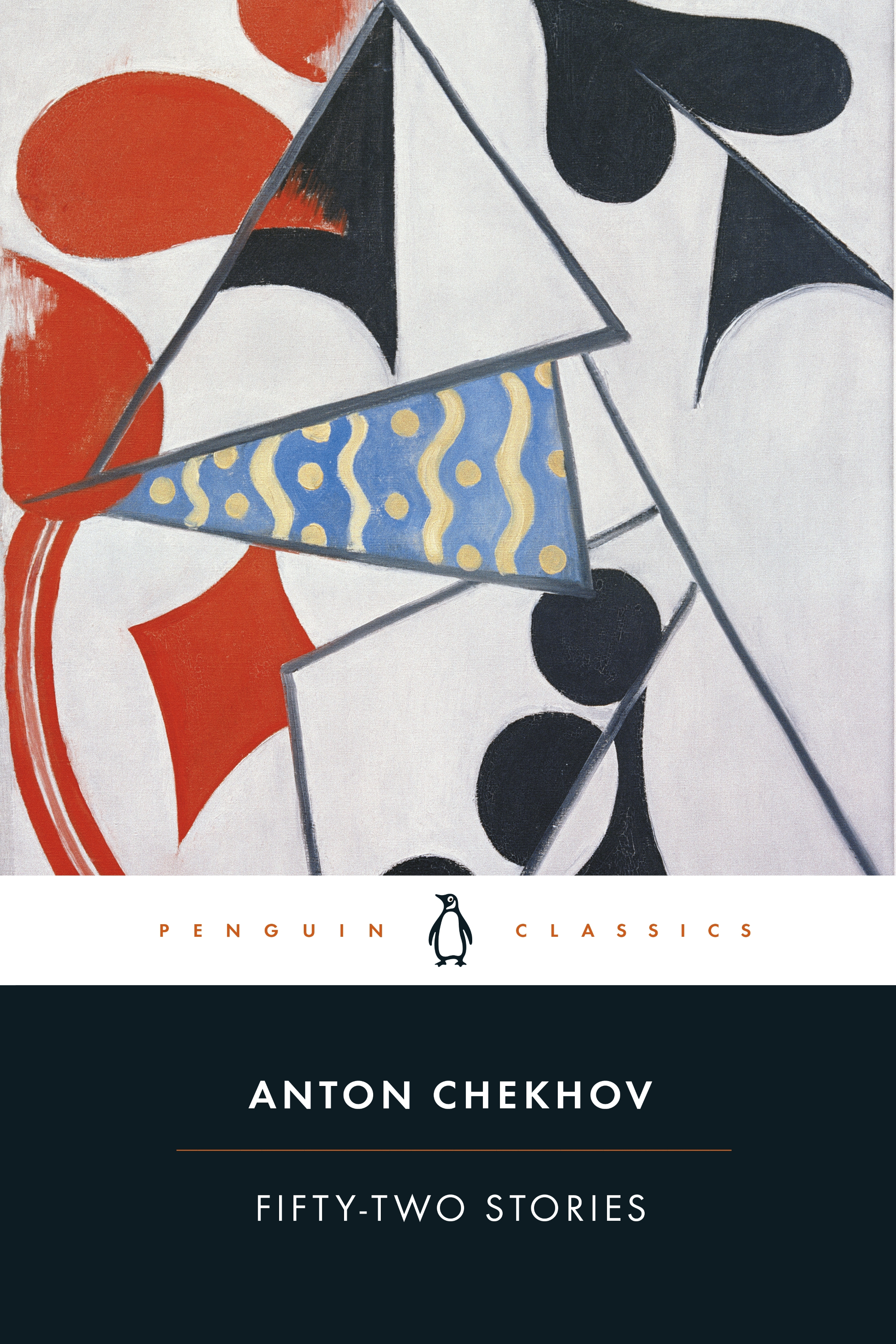
Fifty-Two Stories

Rate this book
'This beautifully produced edition collects, in chronological order, fifty-two of Anton Chekhov's short stories written between 1883 and 1898. It is a 'full deck', intended to reflect the diversity and inventiveness of the author's lesser-known fiction ... compelling and even graceful' The Times Literary Supplement

A masterfully rendered volume of Chekhov's stories from award-winning translators Richard Pevear and Larissa Volokhonsky

Chekhov's genius left an indelible impact on every literary form in which he wrote, but none more so than short fiction. Now, renowned translators Richard Pevear and Larissa Volokhonsky give us their superb renderings of fifty-two Chekhov stories. This volume, which spans the full arc of Chekhov's career and includes a number of tales translated into English for the first time, reveals the extraordinary variety of his work. Ranging from the farcically comic to the darkly complex, the stories are populated by a remarkable range of characters who come from all parts of Russia, all walks of life, and who, taken together, have democratized the short story. This is a collection that promises profound delight.

'The premier Russian-to-English translators of the era' The New Yorker

'The reinventors of the classic Russian novel for our times' PEN/Book of the Month Translation Prize Citation

530 pages, Paperback

First published January 1, 1883

650 people are currently reading
3077 people want to read

About the author

Anton Chekhov

5,890 books9,754 followers
Dramas, such as The Seagull (1896, revised 1898), and including "A Dreary Story" (1889) of Russian writer Anton Pavlovich Chekhov, also Chekov, concern the inability of humans to communicate.

Born ( Антон Павлович Чехов ) in the small southern seaport of Taganrog, the son of a grocer. His grandfather, a serf, bought his own freedom and that of his three sons in 1841. He also taught to read. A cloth merchant fathered Yevgenia Morozova, his mother.

"When I think back on my childhood," Chekhov recalled, "it all seems quite gloomy to me." Tyranny of his father, religious fanaticism, and long nights in the store, open from five in the morning till midnight, shadowed his early years. He attended a school for Greek boys in Taganrog from 1867 to 1868 and then Taganrog grammar school. Bankruptcy of his father compelled the family to move to Moscow. At the age of 16 years in 1876, independent Chekhov for some time alone in his native town supported through private tutoring.

In 1879, Chekhov left grammar school and entered the university medical school at Moscow. In the school, he began to publish hundreds of short comics to support his mother, sisters and brothers. Nicholas Leikin published him at this period and owned Oskolki (splinters), the journal of Saint Petersburg. His subjected silly social situations, marital problems, and farcical encounters among husbands, wives, mistresses, and lust; even after his marriage, Chekhov, the shy author, knew not much of whims of young women.

Nenunzhaya pobeda , first novel of Chekhov, set in 1882 in Hungary, parodied the novels of the popular Mór Jókai. People also mocked ideological optimism of Jókai as a politician.

Chekhov graduated in 1884 and practiced medicine. He worked from 1885 in Peterburskaia gazeta.

In 1886, Chekhov met H.S. Suvorin, who invited him, a regular contributor, to work for Novoe vremya, the daily paper of Saint Petersburg. He gained a wide fame before 1886. He authored The Shooting Party , his second full-length novel, later translated into English. Agatha Christie used its characters and atmosphere in later her mystery novel The Murder of Roger Ackroyd . First book of Chekhov in 1886 succeeded, and he gradually committed full time. The refusal of the author to join the ranks of social critics arose the wrath of liberal and radical intelligentsia, who criticized him for dealing with serious social and moral questions but avoiding giving answers. Such leaders as Leo Tolstoy and Nikolai Leskov, however, defended him. "I'm not a liberal, or a conservative, or a gradualist, or a monk, or an indifferentist. I should like to be a free artist and that's all..." Chekhov said in 1888.

The failure of The Wood Demon , play in 1889, and problems with novel made Chekhov to withdraw from literature for a period. In 1890, he traveled across Siberia to Sakhalin, remote prison island. He conducted a detailed census of ten thousand convicts and settlers, condemned to live on that harsh island. Chekhov expected to use the results of his research for his doctoral dissertation. Hard conditions on the island probably also weakened his own physical condition. From this journey came his famous travel book.

Chekhov practiced medicine until 1892. During these years, Chechov developed his concept of the dispassionate, non-judgmental author. He outlined his program in a letter to his brother Aleksandr: "1. Absence of lengthy verbiage of political-social-economic nature; 2. total objectivity; 3. truthful descriptions of persons and objects; 4. extreme brevity; 5. audacity and originality; flee the stereotype; 6. compassion." Because he objected that the paper conducted against Alfred Dreyfus, his friendship with Suvorin ended

Ratings & Reviews

What do you think?
Rate this book

Friends & Following

Create a free account to discover what your friends think of this book!

Community Reviews

5 stars
345 (47%)
4 stars
273 (37%)
3 stars
94 (12%)
2 stars
13 (1%)
1 star
4 (<1%)
Displaying 1 - 30 of 105 reviews
Profile Image for Darwin8u.
1,835 reviews9,034 followers
May 26, 2020
Nearly perfect. Seriously. Love P&V. And Chekhov is a master. I've nibbled on his stories here and there, but have never devoted so much bandwidth JUST to Chekhov. I think I was saving him for the Rona. He is both a mirror and a diamond. He reflects humanity and dazzles us with his style and simplicity.

I'd write more, but I don't want to give the stories away OR try to give answers to the hows, whys, etc., without a clue. If you've read him, read more. If you haven't start now. If you need a place to start, P&V's translation is pretty damn good.
Profile Image for reading is my hustle.
1,673 reviews348 followers
December 12, 2022
Fifty-Two Stories by Anton Chekhov is a newly translated collection of 52 short stories spanning Chekhov’s entire career. It is said that Chekhov influenced the literary short story more than any other writer & after reading this latest translation I’m okay with such a definitive assertion. Chekhov writes with such compassion about the absurdities of life & human shortcomings. His insightful observations include all segments of Russian society: peasants, laborers, aristocracy. Some of my favorite stories in this collection: Kashtanka, The Witch, Enemies, Grisha, & The Kiss. ⁣

Also, Richard Pevear & Larissa Volokhonsky are rock star famous for their Russian to English translations. I can only imagine the work it takes to translate literature & it's easy to forget Fifty-Two Stories is translated.
Profile Image for Lucy Babidge.
60 reviews4 followers
August 4, 2022
A beautiful sketch of the absurdities and beauty of life, in a very very Russian way (which I love and all should). This book was lovely to pick through, a few stories at a time. Very much recommend. The opening of my favourite story below (because i think it is just lovely).

THE SNOW HAS NOT YET LEFT THE GROUND, but spring is already calling on the soul. If you have ever convalesced from grave illness, you know the blissful state when you swoon from vague presentiments and smile without any reason. Evidently that is the state nature is experiencing now. The ground is cold, mud mixed with snow sloshes under your feet, but everything around is so cheerful, affectionate, friendly! The air is so clear and transparent that it seems if you climbed up on a dovecot or a belfry you could see the whole universe from end to end.
The sun shines brightly, and its rays, playing and smiling, bathe in the puddles along with the sparrows. The river swells and darkens; it is already awake, and will start roaring any day now. The trees are bare, but already living, breathing.
In that season it feels good to drive dirty water along the gutters with a broom or a shovel, to send toy boats down the streams, or crack tie stubborn ice with your heels. It also feels good to drive pigeons high up into the heavens, or to climb trees and tie birdhouses in them. Yes, everything feels good in that happy time of year, especially if you’re young, love nature, and if you're not capricious, hysterical, and your job does not oblige you to sit between four- walls from morning till evening. It’s not good if you’re sick, you're pining away in an office, if you keep company with the muses,
Yes, in spring one should not keep company with the muses.
Profile Image for Ryan.
1,181 reviews61 followers
February 7, 2022
A lot of the earlier, flimsier comic tales and not many of the anthology standards - no ‘The Lady with the Little Dog’, ‘Peasants’ or even ‘The Bishop.’ The new translations also make Chekhov sound starchy and plodding; the Ronald Wilks versions never did.
Profile Image for Alba Hasimja (Abaa).
85 reviews15 followers
September 19, 2023
If you need a break from the superfluous life, get into some Chekhov stories and enjoy the small things that matter in life.
Edit: For heaven’s sake read Chekhov oeuvre.
Profile Image for David.
763 reviews182 followers
June 10, 2021
We hear this about the writing process: If you're going to write, write every day. Why would that be necessary? ~ as opposed to 'Sit down to write when you feel inspired.'? Probably because inspiration has less of a chance of inching through unless you're already seated - daily. 

I'm thinking that Chekhov sat down to write every day - whether inspiration showed up or not. This volume's preface lets us know that he (at least early on, and like Dickens) wrote for money: "In 1879 he graduated and moved to Moscow... entered medical school... [and] his writing... became virtually the sole support of the family--mother, father, four brothers, and a sister." 

(Could he have sensed that he was also writing against time? He was never in good health - he scrupulously hid the fact of his TB - and only lived to the age of 44.)

It's likely (but what do *I* know?) that Chekhov gave little (or much less) time to contemplating the muse, giving faith to the notion that inspiration actively comes and goes capriciously in the act of storytelling; it serves up the main-dish element of surprise - for the benefit of both the work and the writer. Sometimes it moves in in a bold manner, other times it carries a quieter impact. 

That's how it seemed to me, reading this volume. ~ the end result being that (as is typical of short story collections) some stories feel stronger - have more of a punch - than others. Some have more of an obvious point or an obvious feature of standard, action-driven storytelling. Many - especially in the latter half - have a sharper focus on everyday (often humdrum, though certainly not emotionally) life as it is and people as they unresolvedly are (which would also be true of the plays Chekhov wrote in the period which overlaps this collection: the stories were written between 1883-1899; his major plays emerged 1887-1903). 

What's always on display here is Chekhov's energetic skill with language (served lovingly by the seamless translation by Pevear / Volokhonsky), matched by his considerable power of observation. (His physical and behavioral descriptions of characters are particularly vivid.) 

I did prefer the stories here that afforded more of a jolt: things like 'The Witch' (atypical; Nathaniel Hawthorne-esque and one of the finest, most effective examples of the supernatural); 'The Chorus Girl' (revealing the layered duplicity of a weak-minded man); 'Kashtanka' - in which Chekhov accurately explores the POV of a dog in a tale of fealty (one with a chilling, hypersensitive account of the specter of death); 'The Bet': detailing how a charged discussion of which is more humane - capital punishment or life imprisonment - leads to a bizarre chain of events; 'The Princess' (in which allegiance to royalty is upended)... and others. 

Overall, the volume's first half engaged me more directly but, if not every story was to my personal liking, most of them were, and I welcomed the many 'worlds' Chekhov introduced me to. (I didn't even mind all the snow, from the reader's distance - and, this being Russia, there's a lot of snow!)
Profile Image for Steven R. Kraaijeveld.
559 reviews1,926 followers
May 25, 2021
"And it is all as if it never was. All like in a dream or a fairy tale." (496)
I was so excited when I discovered that a new collection of Chekhov stories, translated by Pevear and Volokhonsky, would be published. I immediately put in a pre-order. Chekhov is one of my favorite writers, and getting to read 'new' stories by him in English is indescribably wonderful. I was slightly disappointed that this new collection, which includes fifty-two stories—"a full deck" as Richard Pevear refers to it in the introduction—is not entirely composed of previously untranslated stories (as I was under the impression it would be). I had actually read a number of the stories quite recently in a volume called In the Twilight, published by Alma Classics and translated by Hugh Aplin. Nevertheless, the stories already translated and published in that collection constituted only a relatively small portion (around ten stories or so) of the volume, which left plenty of new material to be discovered. Overall, the collection spans entire Chekhov's career; from his earlier, humorous sketches, to his later, more mature stories. The early stories are slightly overrepresented, probably because his later stories have received much more attention from translators and readers—not least because they tend to be better.

I have to say that, for the first time, I found myself conscious of Pevear and Volokhonsky's translation—to the extent of not liking it at times. Unfortunately, I don't know Russian, so I cannot judge faithfulness to the original language/tone/etc. However, after realizing that for some of the stories I also had the Aplin translations, I couldn't help but compare, and invariably found myself preferring Aplin's choices over those of the lauded duo. I say 'lauded' without irony: they deserve praise. I have read a great many of their translations (I diligently collect their work), and I have so far never felt dissatisfied. I still wouldn't say that I was entirely dissatisfied with their work on these stories; but there are some awkwardnesses in the English, which I am quite sure are absent from Chekhov's Russian. This was especially true in the earlier sketches; in the later stories, I very rarely found anything grating in the translation.

Be that as it may, I'm happy that the previously untranslated stories now exist, and that I was able to read them.
Profile Image for Josh Friedlander.
831 reviews136 followers
November 5, 2020
One of the stories in this collection, "The Bet", is slightly unusual for Chekhov both in its long timeframe and the way it externalises its mechanism - more like something say, Somerset Maugham might have written. A lawyer argues against a banker that long-term incarceration is preferable to death. In return the banker offers him two million roubles if he will spend fifteen years in solitary confinement. The lawyer agrees, and spends the time reading up the Great Books, acquiring a saintly transcendence over material needs. Meanwhile the banker goes bankrupt, and eventually plans to smother the lawyer to avoid paying up. This is avoided when the lawyer independently renounces his millions hours before the deadline to show his scorn for worldliness. The banker has won, but is left pondering his values. Most of the other stories, though less contrived, are similarly about crises of values, in quiet domestic moments.

Tolstoy and Dostoevsky wrote novels where the characters stew over the meaning of life, world history, faith, and morality. In contrast Chekhov's plays and short stories draw their tension from everyday life: his characters are jealous, unhappily married, frustrated professionally, nursing unrequited love, seeing prostitutes...or in a word, alone. Fitzgerald wrote a book called All the Sad Young Men, which could name this collection, except without young, or men. (My first exposure to the stories was seeing Hanoch Levin's classic play "Ashk'va" at the Cameri, which adopts three of Chekhov's stories in a spare Beckettian twilight zone, dropping in shtetl concerns and making the antisemite Ivanov into a Jew.)

Much has been written about Pevear and Volokhonsky's new translations, a veritable industry (this is their second Chekhov collection): here is Janet Malcolm's broadside, and here is another long discussion by David Remnick. I'm not qualified to judge, but as English it seems good enough, smooth and clear if not especially artistic.
Profile Image for liv.
63 reviews44 followers
May 30, 2024
favs: "grief", "anguish", "a little joke", "a nightmare", "the first-class passenger", "the name-day party", "history of a business enterprise", "big volodya and little volodya", "about love"
Profile Image for Gastjäle.
514 reviews59 followers
January 15, 2024
Hailed as a master in the genre of short-story fiction, Chekhov wrote observantly and impressionistically about the people around him. The sound and fury of romanticism bellows far apart from his stories—his is a more Ibsenian style, in that he threaded through the invisibles of the everyday and stuck to the ordinary milieus. Based on the Fifty-Two Stories, his main concern was not to educate, to evince epiphanies or to enhance the everyday experience but rather to offer fictionalised accounts on how his contemporaries might have ended up disillusioned and weary of their lives, regardless of class.

The stories teem with folk who battle with the inexplicability of social life and life proper, or who grow deeply disappointed over inaction or a mismatch of feelings, especially with regard to paying court. Another prominent theme is banality, that treacherous laxity creeping behind every feeling of familiarity. All of these subjects make the protagonists feel weak and foreign to their own minds, and usually their way of coping is, ultimately, to be sucked into the stream of routine-like life and growing deeply dissatisfied, drowning old tender feelings and old vivid dreams as they float along. For example, in the masterful Kiss, the misfit main character is accidentally given a token of love, which ends up kindling his desires, exuberance and future hopes to such a pitch that he exhausts himself in his bulimic day-dreaming, only to end up as a crushed cynic. In the Teacher of Literature, the main character slowly realises, as his life goes on, that he has simply been tolerating the grey dullness around him, finally deciding that he must flee for good. Another example that does not directly offer dissatisfaction, yet showcases the flimsy foundations of a person’s outlook, is in the Princess, where the superficial, aristocratic protagonist is read the riot act by an old acquintance, yet the protagonist cannot internalise the criticism and continues to live in the la-la-land of the cheap charity-working rich.

Like much of Russian classics, Chekhov’s works serve as dilapidated confessional booths that shine in a candid candlelight in whose shine the reader can ponder on their own motives and circumstances, and those of others. At their peak, they weave in beautiful depictions of the Russian nature and take a good look at people from all stations, showing in what kind of a crossfire of mores and ill fate they are forced to foot along. Even the obviously self-centered and petty characters come across as relatable, even if they can commit unforgivable acts. This, if anything, speaks of Chekhov’s patient observing of his people and their conflicts among each other. Take Enemies: A doctor’s child has just died, yet he is called upon to come and visit a possibly dying young woman. Upon arrival, it turns out that the erstwhile patient was merely acting in order to elope with a lover, to which the person who called upon the doctor naturally reacts very strongly. The remaining pages of the story showcase the great tumult within the doctor and the betrayed party, and how they end up locking horns over what has happened. A tremendously good and suffocating observation of sorrow, its power and occasional egotism.

However, despite his sharp eye and big heart, it seems that Chekhov could get a bit bogged down by the banality and cynicism himself. In the fairly weak story, Volodya, the protagonist goes through an embarrassing ordeal with some family acquaintances, and decides to off himself at the end. In Chorus Girl, we have a protracted and painful encounter with a wife and her husband’s mistress that simply bores one to death. In stories like Luck or Shepherd’s Pipe there are simply uninspired yarns, and the latter especially ends with a pathetically gloomy note about the state of the post-Arcadian world. Many of the stories at the end were rather blasé stories about disappointed love and egotism, so towards the it became apparent that either I had been reading too many stories in a row, or Chekhov ran out of things to say. (A sign that the former might have been the case towards the end of the book was that, once I started a new story, I became quickly tired of it, what with yet another bombardment of insipid names and insipid details. Towards the conclusion of each story, I often found something exciting, but I’m not sure whether it was always worthwhile.)

There were also a couple of stinkers in this collection. A Little Joke was a failed attempt at first-person narration: the narrator ending up narrating the life events of the female character simply showcased his own flippancy, removing any depth from the story. Boys was a silly attempt at shedding light on the daring minds of children, yet it just came across as a trifling matter in the end. And after some really great stories with great insights, Kashtanka seemed like an utterly pointless excursion into the blue-eyed animal world.

I will most likely enjoy some of the stories later, when I happen to read them as individual items. I quite like Chekhov’s quiet and unassuming style, and how he makes the reader commiserate with even rather petty characters. In Chekhov’s hands, even a character like Miss Bates—whom Austen’s pen simply made a cardboard bore—could become a living, breathing being.
Profile Image for Micah Johnson.
177 reviews18 followers
July 9, 2025
Chekhov is the master of the short story. His characters are so real. Everyone is either you or someone you've met.

Some of the stories were duds in my opinion, but overall this anthology is very good, including a mixture of comedic, tragic, and contemplative stories.
Profile Image for Gareth.
51 reviews2 followers
December 4, 2022
This was my first foray into Chekhov and I half-suspect I didn’t pick the right book for it. The preface is brief and does not mention the fact that this collection is not one of his greatest hits, but rather an assemblage of bric-a-brac, including the juvenilia. Despite the stilted translation, Chekhov’s legerdemain for portraiture is apparent as he skilfully evokes caricatures across all of Russian society that are simultaneously hilarious as they are resonant. From the impuissant romantic leads of “Fear”, “About Love” to the sympathetic women in “A Nightmare” and “In the Cart”, the acuity of his characterisation is voiced in stentorian tones. Everything roars with life. And you get the sense the language is not the source of its force, but the author’s feel for narrative. Pevear and Volokhonsky deliberately take a more archaic interpretation and avoid idioms but it comes at the expense of distancing us.
Profile Image for Lan Anh.
115 reviews115 followers
November 6, 2024
Mô tả biến chuyển tâm lý đỉnh cao, cấu trúc gọn ghẽ. Ai chê P&V chứ mình vẫn thích các bản dịch của hai vợ chồng này đơn giản vì nó thuận tai chứ có biết tiếng Nga đâu mà đánh giá ai dịch sát dịch gần.

So sánh có tí khập khiễng nhưng cảm giác đọc collection truyện ngắn này giống đọc tuyển tập Nam Cao, tức là truyện nào cũng thích, chỉ có hay hơn thôi chứ không có dở. Nói chung là truyện ngắn không đọc Chekhov thì đọc ai nữa nên thôi không cần khen nhiều =))
73 reviews2 followers
February 27, 2025
Well this took me all month.
Fantastic and easy to see the influence it had on the short story as a medium.
Maybe don't read them all in one go because they can get slightly samey
316 reviews8 followers
July 14, 2020
In a distinguished joint career, Richard Pevear and Larissa Volokhonsky have gifted us with more than 20 books translated from the Russian of Bulgakov, Chekhov, Dostoyevsky, Gogol, Leskov, Pasternak, Pushkin, and Tolstoy. (Pevear on his own has also translated from the French. His translation of Dumas’ THE THREE MUSKETEERS enabled me to grasp all the rich comedy I of course missed in that classic as a boy.)

Now this indispensable couple have given us new translations of FIFTY-TWO STORIES by Anton Chekhov. 52 — “a perfect deck,” as Pevear observes in his preface. For a stellar year, you might read one story each week.

From his 1887 story “The Siren”: “A local justice of the peace, Milkin, a young man with a languid, melancholy face, reputed to be a philosopher, displeased with his milieu and seeking a purpose in life, stood by the window and looked sorrowfully outside.” In stark contrast, the fat main character in the same story rhapsodizes at length on the glories of eating and describes a lavish meal in detail: “ … homemade honey spiced vodka is better than any champagne. After the first glass, your whole soul is engulfed in a sort of fragrant mirage and it seems that you’re not at home in your armchair, but somewhere in Australia on some sort of ultrasoft ostrich.” (I wondered what “ultrasoft” was in the original Russian and was pretty sure careful time was spent arriving at a serviceable equivalent — not recognized, I happily note, by SpellCheck.)

Perhaps the most unusual story in the collection, seeming a children’s story until it begins to deepen, is “Kashtanka,” in which half the characters are animals. I know there are folks who tell us we should never call anything perfect, but Chekhov’s portrayal of a goose tempts me to go ahead and make the claim.

Nowhere is Chekhov’s handling of the effects of social disparities more effective than in the final story in the collection, “The New Dacha.” Here’s a passage from that story that will give you a sense of the heft and sparkle of Chekhov’s language as translated by Pevear and Volokhonsky:

“On a clear, warm morning at the end of May, two horses were brought to Rodion Petrov, the Obruchanovo blacksmith, to be reshod. They were from the New Dacha. The horses were white as snow, sleek, well-fed, and strikingly resembled each other.

“ ‘Perfect swans!’ Rodion exclaimed, looking at them in awe.

“His wife Stepanida, his children and grandchildren came outside to look. A crowd gradually gathered. The Lychkovs came, father and son, both beardless from birth, with swollen faces and hatless. Kozov also came, a tall, skinny old man with a long, narrow beard and a stick with a crook; he kept winking his sly eyes and smiling mockingly as if he knew something.”


Ubiquitous themes in Chekhov are boredom, frustration and exhaustion, but his stories are never boring, frustrating or exhausting because his attention to details of character and place is so sharp. He is one of the most compassionate writers we’ve ever had among us, and even the weakest of his stories is an earnest undertaking to understand.

I can’t improve upon Pevear’s eloquent closing paragraph in his preface: “In his stories, Chekhov does what storytellers have always done: he satirizes human pretensions and absurdities, he plays out the comedy of human contradictions, and ultimately, even in the darkest of them, he celebrates natural and human existence in all its conditional variety.”

Even by todays’s low standards, the physical production of the book is impressive — no surprise with a book coming from the distinguished imprint of Knopf. The striking dust jacket design by John Gall features what I take to be printers’ devices of the period.

On the rear flyleaf of the book, we get that endearing photograph of the translators in their home in France, a photograph that welcomely started appearing in their books about halfway through their career. Looking at it once more, I can just hear Volokhonsky: “Oh, Richard, that paragraph is so good. You deserve a glass of armagnac. Let me get it for you, and I believe I’ll have one myself.” I wish I were there to raise a toast to them.

Profile Image for Anna C.
678 reviews
July 14, 2020
I've always found Chekhov's profound psychological insight to be the most rewarding part of reading him. He's talking about 19th century Russians- and yet I swear he's **seeing into my soul.** It's also incredible how many different voices he can inhabit. He can write from a woman's point of view, or from a peasant's point of view, or from a toddler's point of view, or from **a dog's point of view,** and all with equal insight. Compassion too- Chekhov gets underrated just as a humanist. He presents some of the subtlest, most deftly-sketched views of human weakness, yet comes off as forgiving of what he sees.

Sidenote: I have a lowkey Pevear and Volokhonsky obsession now. This is the fourth or fifth P/V translation I've read. I'll read anything they translate- but now I will *only, exclusively* read their translations. This could possibly restrict my Russian literature explorations.

My favorite stories in the collection: "The Cook Gets Married," "Agafya," "Grisha," "Enemies," "Volodya," "Luck," "Kashtanka," "The Nameday Party," "The Princess," "The New Dacha."
Profile Image for Carolyn Harris.
Author 7 books67 followers
August 17, 2020
A new translation of 52 of Chekhov's short stories including little known tales that have not been translated into English before. Small and often heartbreaking snapshots of the human condition. I found the stories about chance meetings while traveling, which make the characters reconsider their lives, to be especially engaging. There are numerous characters who meet each other at wrong time in life or in social circumstances that prevent them from understanding one another. In almost all of the stories, lasting happiness proves elusive and moments of joy, even imagined ones, are to be savoured. An engrossing and thought provoking read.
867 reviews15 followers
February 25, 2022
Continuing through collections of Chekhov stories I found this to be like its predecessors in that the stories vary greatly. Some are seemingly ideas and small fragments but then others are wonderfully done with deep philosophical questions hiding inside the story. As before I will comment on those that stood out me ( that I’ve not already addressed in previous reviews)

In “ A Commotion “ a young woman in service is shocked that her employers are searching the house including all the servants rooms for some stolen jewelry. When she expresses her embarrassment at even the accusation the gentleman of the house admits their was no theft. Not being willing to admit his losses to his wife he makes up a crime to save face. She is not persuaded to forgive this intrusion and leaves to return home.

In “ A Little Joke “ our narrator recalls a time in his youth when he was courting a young woman. He would whisper “ I Love You “ in her ear only at times when she could not discern if he really said it or if she was imagining it.

In “ Spring “ it seems the author is commenting on the plight of the writer. He writes of how people will
joke and ridicule a struggling writer like they would no other occupation.

In “ A Nightmare “ we get another excellent story from Chekhov about the inequality of man and how, those with a bit more , often, in order to sleep at night, have to find rationalizations for their success or the others failure. Frankly, faced with the system and not knowing how to address it without causing discomfort to themselves it is easier to look away.

“ Grisha “ is a short piece that works well. Told from the viewpoint of a two year old on a walk with his governess it quite well describes the newness of the world that we as adults can never appreciate

“ Romance With a Double Bass “ is a comical story of a man and a woman, both on their way to a party, who both go in for a swim and end up with their clothes stolen. I made the mistake of anticipating the ending and when that did not happen “ as I wrote it in my mind “ feeling disappointed

“ The First Class Passenger “ is a story that is seemingly more relevant today than the time it was written. A successful engineer traveling by train laments that he is not famous or acknowledged. At the same time newspapers cover frivolous and untalented individuals for their activities. In a country with the success of the Kardashian empire we can certainly relate

In “ The Beggar” a man speaks harshly to a beggar he keeps encountering. Offering the man work he feels he has helped him increase his life course and helps him get an office job. Years later he meets the man at the theatre and is shocked to learn that while the man appreciates his efforts the former beggar claims it was the gentleman’s maid who helped him most by her kindness.

“ Luck “ is a seemingly small story, a conversation between two Shepards and a traveler in the overnight hours. Inside it however are some nice passages about the length of time and comparisons of a man’s time in earth and the land itself.

In “ The Shepards Pipe” an elderly Shepard and a man out hunting discuss all the ways the world is failing, diminished game in birds and fish, weaker masters, men, and children, in short nothing like it was in the old days. Perhaps this is always the case.

In “ The Kiss “ a shy young officer is among a group invited by a local retired Army Officer to dinner at his country estate when his troop is in the area on maneuvers. In a darkened room he steps into in confusion after dinner he is embraced and kissed by an unseen woman. He dreams in that experience all summer until he realizes that, not knowing who it is, nothing will ever come if it.

“ Kashtanka” is a surprise. Told in the thoughts of a small lost dog who is adopted by a performer, a clown who has a trained chicken, a goose and a pig.

“ The Name Day Party “ is a longish story about a young woman, wealthy, seven months pregnant and dealing with a husband who is alienating his circle through his pretensions and airs. On his birthday party she spends hours and hours waiting on guests and filled with frustration and exhausted argued into the early morning with her husband. This leads to tragedy.

In “ The Breakdown “ we follow three young men, students, as they have a night out with a plan to visit a street lined with brothels. One of the men is beset by pity and disgust in equal measure and it knaws on his mind even after the night has passed. He considers the guilt of all those that facilitate this activity, wondering how learned men can take part and not consider the women, their lives and such. The arguments Chekhov makes here could be applied to todays pornography industry of course, but also to diamonds, Apple sweatshop workers in China and much else. My wife and I were talking the other day about liberals ( of which I consider myself one ) and their/our hypocrisy. We often can feel great empathy for groups but rarely for individuals . I think, to some extent , conservatives might be feel more for an individual but have little empathy for groups as a whole. I’m not sure that exactly applies to this story but tangent achieved nevertheless

In “ The Bet” a wealthy banker and an idealistic young lawyer are arguing about the merits of capital punishment versus life imprisonment. The banker feels death is more humane than living in a cage for the duration of one’s life. A bet is made

“ History of a Business Enterprise “ is a short piece in which an energetic, ambitious, young man opens a bookstore in his town. No one in the village reads books. Slowly over the course of home he adds new, more practical, merchandise and, after almost failing, the business recovers and prospers. He ends up selling all of the heavy, weighty , books by the pound. He now considers all things literary as unnecessary, he has become that which he originally disdained

In “ The Neighbors” Pyotr has a problem. He always considered himself a liberal, a free thinker, a proponent of modernism. When his sister runs off to live with a neighbor man, he married but long separated, he has to either accept it in view of his old opinions or consider himself a hypocrite. Complicating matters is his whole household is in upheaval, mother, aunt all are bereft at the choice his sister has taken. An interesting paragraph has Vlasich ( the married man ) saying to Pyotr in an attempt at explanation “ If your action upsets someone that does not mean it’s bad. Nothing to be done! Any serious step you take is inevitably going to upset someone…..anyone who places the peace of his family above all else must renounce the life of ideas.” I know a young man who I could picture saying those words.

In “ The Teacher of Literature” we visit a fairly recurrent theme of Chekhov. A young teacher considers himself erudite and questions the mindset of his fellow teachers. Still as he meets and marries he begins to see him sinking into that blankness of complacency. His ideals mold infuse his shell of false happiness and content

“ In a Country House” portrays Rashevich, a wealthy widower as he pontificates on the reality of blue bloods and the hierarchy of class bring a real, necessary, and neglected part if society. The young man visiting and listening is one of the few who still will visit. He is a recent arrival so the reputation of Rashevich does not keep him away. That and the two eligible daughters. On this evening the young man takes offense, admitting he is a commoner. After the young man leaves, his daughters distraught, he retires to his rooms. He realized “ in some sort of fatal way it came about that he would begin softly, gently, with good intentions, calling himself an old student, an idealist, a Don Quixote, but, unbeknownst to himself, would gradually go on to abuse and slander and, most surprising of all, would quite sincerely criticize science, art, morals, though it was already 20 years since he had read a single book or gone further than the provincial capital, and in fact he had no idea of what was happening in the wide world. If he sat down to write anything, be it only a congratulatory letter, abuse would appear in letter as well. And all this was strange, because in fact he was a sentimental, tearful man. Was it some demons sitting in him, who hated and slandered in him against his will? “

I read this quote and think if those we all know or know of who speak in a nostalgic tone about a past that probably never was against a current state that they, frankly, know nothing about.

The final story in the collection , #52 I suppose is “ The New Dascha.” A bridge is being built to cross the River in a small village. The engineers wife, visiting on a weekend from the city, falls in love with the peace and beauty and they build a lovely estate on 50 acres. There are no serfs anymore and They attempt to meld into the community. The wife had grown up poor, and though now wealthy, they did not look down in the townspeople. Over the first years there are several incidents with the engineer or even his wife gently and questioningly asking the townspeople why they rebuked them. Were rude, stole from them, let their livestock roam their fields, gardens and orchards. Eventually the rich engineer and his wife give up, sell the dascha and move back to the city. Now another wealthy official owns it and uses it as a weekend house. He has and does not attempt to have relations with the townsfolk. Strangely there is no friction in this traditional following of the vertical caste.
Profile Image for Kelly.
314 reviews2 followers
January 9, 2022
Looked him up due to the phrase “Chekhov’s gun”. Was not disappointed. Overall I dislike short stories, but his were descriptive, and entertaining. The best part were the names… Ivan Ivanovich!
545 reviews
February 19, 2021
This is a tricky review due to the number of stories in this collection and, like most of my reviews, is mainly to aid my memory when I look back on these stories in the future, so it's chock full of spoilers. Don't read on if you haven't read this collection and intend to.

Firstly, it's interesting that a few of the stories nearer the beginning of the collection, from earlier in Chekhov's career, tended more towards the humorous side of things, in some cases even reading like shaggy dog stories, with long introductions and then a punchline. 'JOY' (a young man doesn't see the difference between fame and notoriety) and 'AT THE POST OFFICE' (a widower spreads a rumour about his wife having an affair with the police chief to ensure other men stay away from her) were particularly enjoyable in this section. I also found 'THE EXCLAMATION POINT' quite inventive (a secretary's fury at being judged for not knowing the theory behind correct grammar, despite knowing correct grammar intuitively, and his determination to correctly use an exclamation point to vent his anger) and brought some interesting questions about education to mind. Lastly, AN EDUCATED BLOCKHEAD (a member of the higher class argues in court that his superior social standing automatically proves him right) seemed to mark a halfway point between humour and social commentary.

It's at this point that the stories start leaning more and more towards the social commentary side of things and, in my view, this is where Chekhov really comes into his own. While some of the stories had themes I didn't find interesting, or they had themes I did find interesting but I found the telling of them slightly dull, I'd say I enjoyed or really enjoyed at least half of the 52 stories in the collection and absolutely loved some of them. Overall, due to the number of stories that I didn't find particularly interesting and read on autopilot, this book doesn't get a 5 star review. However, there are plenty of 4 and 5 star stories in the collection which I have listed below, so I think 4 stars makes a fair rating overall. I've put little stars next to my favourites.

All in all, this collection constitutes most of the Chekhov I've ever read (I'd just read two of his plays before this). After reading this collection, I certainly feel that I've discovered someone special, who has a lot of great work to offer me. While I found the collection as a whole hit and miss, this tends to be the case in any kind of literary collection, and there were more than enough hits here to make me very happy indeed that I devoted some time to this great writer.

GREAT CHEKHOV STORIES IN THIS COLLECTION:

*A Commotion - This was the first story in the collection that I thought was really great and it marked a shift in quality for me. A governess (who is not a peasant but perhaps not as rich as the people she works for) finds her room being searched by the lady of the house. Outraged at being suspected as a thief, she decides to leave the house, at which point the husband explains to her that it is really he who is the thief, and that his wife has taken everything that is rightfully his as her own. I really loved this one.

*The Witch - This one was great too. A story about a sexton who believes that his wife is a witch who can control the wind, and uses storms to lure in travelers from the road so she can seduce them. He takes pains to stop her from seducing a postman and is just about successful. She then cries, regretting that she might have a happy life if she had married a different man.

A Little Joke - A cute story about a young man and woman sledging together. I didn't find it as a enthralling as those either side of it but its levity was a nice change of pace.

*Agafya - Another great story about a lazy, handsome young man that is kind of exiled from the village by the other men. The local women like him and visit him for sex. Agafya is one such woman and is caught by her husband. Walking back to her husband, she finds a newfound sense of abandon upon realising her marriage is ruined. The young man looks on, apparently pitying her.

Grisha - A cool little story from the perspective of a 2 year old. I don't remember reading an account from this perspective before but if I have I'm sure it didn't feel as real as this one. Due to the unique perspective of the story, it's one of the most memorable in the collection.

*Romance With A Double Bass - A really memorable and humorous story about a musician and a princess who have their clothes stolen at the river. The ending was really funny.

*The Chorus Girl - I really felt for the eponymous character in this story, who was accused, cursed and effectively robbed after having done nothing wrong, and I'd challenge anyone not to be affected in the same way.

Difficult People - A story about a boy standing up to his bullying father. I don't know much about Chekhov's life but it felt so real that I suspect that it contains things he would like to have said (or possibly did say) to his own father.

*On The Road - My new favourite in the collection. A story of a man who confesses of his many mistakes and selfish choices to a woman during a storm. Still, due to the passion burning within this man, despite his lack of attractiveness, she finds herself drawn to him and it feels as though she is almost ready to follow him into hell itself. There was something truly amazing about this one and I just loved it.

*The Beggar - A sweet, funny and wise story about a beggar being given some woodchopping work by a man who catches him trying to swindle him. I loved the reveal at the end, in which we find out that it was the cook who chopped the wood all along.

Enemies - A tale of a doctor who has just lost his son, and his dealings with a man who has just been abandoned by his wife, and how the two men come to hate each other. I found Chekhov's assertion that this hatred will remain long after they get over their respective losses to be a very astute and interesting observation.

*Volodya - A sad story about a teenage boy who becomes infatuated with a married woman. After he kisses her, then hears her laughing about the incident with his mother, he feels emasculated. After another encounter with the woman, he kills himself. I liked this one because infatuations with women during adolescence are something most men can understand, and the impulsive and tragic suicide it leads to in this case has likely been the result countless times throughout history. Chekhov made me want to reach out and tell the boy it would all be fine.

Costly Lessons - A romantic story about a man who decides to take language lessons who then falls in love with his teacher, so distracted by her that he fails to learn anything about the language. There was something really charming about this one and I really enjoyed it.

*The Kiss - This one was great too. A story about a shy, sexually inexperienced guy who, in a case of mistaken identity, receives a kiss in the dark at a party. He builds up the kisser in his mind to be more beautiful than any of the women who were actually at the party and obsesses over the incident, suggesting to the reader that the unknown may always more appealing than the known.

*Kashtanka - One of the most memorable stories in the collection and great from start to finish. The eponymous dog is separated from her owners, gets trained in a kind of pet-circus, and finds them again. The most interesting thing about the story, apart from being told from the perspective of the dog, is that it seems as though the original owners didn't treat her all that well and that she may have even had a better life in the circus. However, you can't choose your family and Kashtanka feels as though her place is with his original owners.

The Name Day Party - A tragic story about a couple that prioritise public appearances over the health of their relationship and the safety of their unborn baby. Slightly dull at points but overall a good read with an affecting ending.

*A Breakdown - Detailing a case of depression brought on by a visit to a brothel with friends, the student in this story is troubled by the ugliness in the world, manifesting in the lives and treatment of prostitutes, compounded by the fact that he feels alone in seeing a problem with this (his friends, certainly, don't share his view). In an ending that feels more relevant in today's world than ever before, he ends up taking medicine to help him deal with feelings he is entirely justified in having.

*The Bet - One of the most memorable stories in the bunch. A bizarre bet that escalates from a discussion about capital punishment at a party, in which one man lives alone, cut off from all human contact, for 15 years on the other man's land in exchange for a large sum of money in order to prove that to live imprisoned is better than not to live at all. He uses the time to educate himself, eventually leaving without the money by choice on the day of the deadline.

Neighbors - A young man is concerned with the scandal brought on his family by his sister's choice to live with an older man. His mother is devastated and he goes there with the intention of solving the problem. However, he finds his sister and her partner are happy and unapologetic. I found this conflict between the conservative, traditional viewpoint and the 'live and let live' philosophy to be an interesting one, particularly as I read Anna Karenina not long ago and found some similarities in themes here, albeit with a much happier ending.

Fear (My Friend's Story) - The story of a man who is frightened of everything in life, resulting in his wife feeling in love with the narrator. The frightened man discovers the tryst immediately and the narrator is left wondering why he allowed himself to do such a cruel thing to his friend. While a few of the stories of infidelity in this collection were a bit dull in comparison to some of the more interesting plots, this one stood out for me as a more interesting take.

History Of A Business Enterprise - A very short story that reads a bit like a joke, in which a man who starts a bookshop with the goal of helping the world through education, finds his way to running a large store that caters for whatever the market demands with no regard for his initial goal.

In The Cart - A teacher goes to town to collect her wages and thinks about how quickly her life has passed and how things tend to turn out so differently from how you planned. Teaching for money rather than love, she gets a little drunk and finally catches a reflection of herself in the mirror, realising she looks like her mother. A slightly tragic story of the way in which we let our lives pass us by.

About Love - I wasn't blown away by this one but the final point that love is beyond reasoning, and something to be valued in and for itself, was a nice one. Also, the fact that this story is apparently third in the 'Little Trilogy' made me want to make a note of it for future reference.
Profile Image for Timothy Lissimore.
90 reviews5 followers
July 3, 2025
Anton Chekhov has long been one of my all time favourites. This collection contains a whole load of short stories I'd never read before as well as some I was already familiar with. Some standouts for me are: The Literature Teacher (1894), The Letter (1887), Volodya (1887). Enemies (1887), The Name day Party (1888).
A common theme throughout is the crushing boredom, the desperate ennuie of a conventional, routine-based life, the gradual waning away of youthful passion and curiosity, to be replaced by middle-aged anxiety and hopelessness. There is another common thread running through many of the stories which is the search for meaning which some of the characters experience, as their youthful ebullience loses its intensity. What is life all about? Why this soul-destroying repetition? How can I survive in the midst of all this mediocrity, this small-mindedness? Unlike Tolstoy, Chekhov is not a moralist, so there are no answers to these questions..though, at times, we do glimpse a beauty and a freshness which shine forth from his perspicacious, empathetic witnessing of life warts and all.
104 reviews3 followers
January 5, 2021
There have been two challenges for me with this book: how to enjoy and understand the appeal of the short story; how to understand Chekhov. I don't think I yet achieved the first (maybe just a quick illumination of one dimension of man ?); the second I think I made some progress on. Chekhov, I think, is the writer of the oddly human character. Describing people in everyday circumstances who don't quite do the typical thing. It is not mocking nor unfathomable (as in "nobody would do THAT")....but more like, "gee, that's kind of odd"; or "oh no, don't do THAT" . Because people sometimes outwardly seem odd, but they are acting as best they can, struggling with a situation that they can't quite get themselves through. I want to also say that he is quintessentially Russian, like Dostoyevsky, but maybe that is just my preset notion before I even begin. Dark, with looming feelings of fate and hopelessness. And yet, sometimes quite funny and poignant. I recommend.
Profile Image for Natalie.
101 reviews15 followers
Read
December 16, 2023
I’m astonished that Anton Chekhov was one person. This short story collection is filled with an astonishing breadth of characters portrayed with remarkable depth, all of them so convincing in their humanity that their stories could easily have taken place today. Every single one of the fully fleshed-out stories (as opposed to his earlier work, the sketches, that are found earlier in the collection) opened me in surprising ways.

These stories make clear why Chekhov is considered one of the greats. This is perhaps my favourite short story collection of all time, likely only to be bested by another collection of Chekhov’s stories.
Profile Image for Kasper.
512 reviews12 followers
January 17, 2025
A cross-section of Chekhov's writing career, both in terms of chronology (from when he was just getting started all the way to some of his later classics) and in subject matter (stories across the whole spectrum of late 19th-century Russian society and into the early 20th century). However, because of this, I feel the collection suffers a bit, as some stories are not even close to being as good as others. I wish the translators had prioritized quality above all else. At times, I felt whiplash from reading one story that was a bit of a slog, only to suddenly come across one that made me tear up and re-examine my entire life—only to then return to another dull one (relatively speaking, of course).

Still, at least I got to read some new Chekhov stories, even if I had already read most of my favorites from this collection before I read this one specifically. It’s definitely a worthwhile read, but not one I’d recommend if you’re looking to get into Chekhov.
Profile Image for Jake.
202 reviews9 followers
Read
January 2, 2025
I read one story a week from this collection for the entirety of 2024.

Chekhov is justifiably considered by many to be the master of the short story and with this collection, it's hard not to see why. While each individual story is not perfect, I'd be lying if I said the good ones didn't really sink their teeth into you. The occasional abnormally long story did sometimes feel like homework, but I would still recommend this collection to anyone looking for a few bite-size Russian classics.
Profile Image for Courtney.
276 reviews2 followers
April 8, 2021
So good, but I need a better understanding of 19th century Russian culture to fully enjoy the humor and irony. I enjoyed the audio version, but could have studied it better if I had read at my own pace.
Profile Image for Billie Pritchett.
1,201 reviews120 followers
April 17, 2022
A dandy collection of Chekhov stories including classics like "Grief" and absent only "The Lady with the Dog." Still a wonderful volume and amazing translation of Chekhov's fiction.
Profile Image for Matt Ingwalson.
Author 17 books43 followers
October 20, 2022
Any book with this many stories is going to have some that are brilliant and others that don't work for you. I think the ratio in this volume is better than most.
Profile Image for Hugo Santos.
201 reviews4 followers
Read
June 6, 2024
Ao ler as histórias de Chekhov é aparente que dentro destas está inserida a totalidade da Russia e de forma geral todo o espirito humano. Simplesmente brilhante.
Displaying 1 - 30 of 105 reviews

Join the discussion

Can't find what you're looking for?

Get help and learn more about the design.