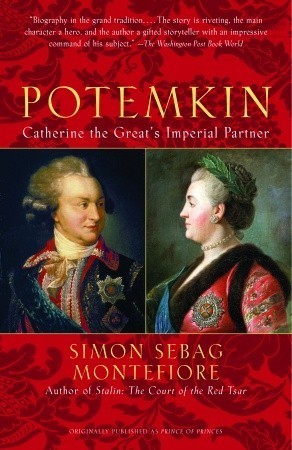
As a young guardsman, Grigory Potemkin caught the eye of Catherine the Great with a theatrical act of gallantry during the coup that placed her on the throne. Over the next thirty years he would become her lover, co-ruler, and husband in a secret marriage that left room for both to satisfy their sexual appetites. Potemkin proved to be one of the most brilliant statesmen of the eighteenth century, helping Catherine expand the Russian empire and deftly manipulating allies and adversaries from Constantinople to London.
This acclaimed biography vividly re-creates Potemkin’s outsized character and accomplishments and restores him to his rightful place as a colossus of the eighteenth century. It chronicles the tempestuous relationship between Potemkin and Catherine, a remarkable love affair between two strong personalities that helped shape the course of history. As he brings these characters to life, Montefiore also tells the story of the creation of the Russian empire. This is biography as it is meant to be: both intimate and panoramic, and bursting with life.
Simon Sebag Montefiore is the author of the global bestsellers 'The Romanovs' and 'Jerusalem: the Biography,' 'Stalin: the Court of the Red Tsar' and Young Stalin and the novels Sashenka and One Night in Winter and "Red Sky at Noon." His books are published in 48 languages and are worldwide bestsellers. He has won prizes in both non-fiction and fiction. He read history at Gonville and Caius College, Cambridge University, where he received his Doctorate of Philosophy (PhD). 'The Romanovs' is his latest history book. He has now completed his Moscow Trilogy of novels featuring Benya Golden and Comrade Satinov, Sashenka, Dashka and Fabiana.... and Stalin himself.
"A thrilling work of fiction. Montefiore weaves a tight, satisfying plot, delivering surprises to the last page. Stalin's chilling charisma is brilliantly realised. The novel's theme is Love: family love, youthful romance, adulterous passion. One Night in Winter is full of redemptive love and inner freedom." Evening Standard
"Gripping and cleverly plotted. Doomed love at the heart of a violent society is the heart of Montefiore's One Night in Winter... depicting the Kafkaesque labyrinth into which the victims stumble." The Sunday Times
"Compulsively involving. Our fear for the children keeps up turning the pages... We follow the passions with sympathy... The knot of events tugs at a wide range of emotions rarely experienced outside an intimate tyranny." The Times
"The novel is hugely romantic. His ease with the setting and historical characters is masterly. The book maintains a tense pace. Uniquely terrifying. Heartrending. Engrossing. " The Scotsman
“Delicately plotted and buried within a layered, elliptical narrative, One Night in Winter is also a fidgety page-turner which adroitly weaves a huge cast of characters into an arcane world.” Time Out
“A novel full of passion, conspiracy, hope, despair, suffering and redemption, it transcends boundaries of genre, being at once thriller and political drama, horror and romance. His ability to paint Stalin in such a way to make the reader quake with fire is matched by talent for creating truly heartbreaking characters: the children who find themselves at the centre of a conspiracy, the parents…. A gripping read and must surely be one of the best novels of 2013. ” NY Journal of Books
"Not just a thumpingly good read, but also essentially a story of human fragility and passions, albeit taking place under the intimidating shadow of a massive Stalinist portico." The National
"Seriously good fun... the Soviet march on Berlin, nightmarish drinking games at Stalin's countryhouse, the magnificence of the Bolshoi, interrogations, snow, sex and exile... lust adultery and romance. Eminently readable and strangely affecting." Sunday Telegraph
" "Hopelessly romantic and hopelessly moving. A mix of lovestory thriller and historical fiction.Engrossing." The Observer
“Gripping. Montefiore’s characters snare our sympathy and we follow them avidly. This intricate at times disturbing, always absorbing novel entertains and disturbs and seethes with moral complexity. Characters real+fictitious ring strikingly true.It is to a large extent Tolstoyan …..” The Australian
“Enthralling. Montefiore writes brilliantly about Love - from teenage romance to the grand passion of adultery. Readers of Sebastian Faulks and Hilary Mantel will lap this up. A historical novel that builds into a nail-biting drama … a world that resembles… Edith Wharton with the death penalty.” Novel of
List of Illustrations Preface to the New Edition Acknowledgements Notes
--Catherine the Great and Potemkin: The Imperial Love Affair
List of Characters Maps Family Trees Select Bibliography Index
(The full and extremely extensive references for this book, which were included in the hardback edition, are available on the author's website at: http://www.simonsebagmontefiore.com. To make the paperback a manageable and readable size, the author and publishers have decided not to include them in the paperback. We hope the readers will agree that, for most, the balance of convenience is best served by this policy.)
At 502 pages before notes and printed in a very small font, this was a challenging read.
Rich in detail and well researched, it gives a true look at a lifelong passion, respect, and devotion between Catherine II of Russia and Grigory Potemkin.
Grigory died from typhoid fever in 1791. He contracted the illness while traveling to Jassy for peace talks. The infection led to bronchopneumonia.
He was 52 years old. Through time, there have been historic love affairs between Titans of power be they man or woman.
Napoleon and Josephine, Cleopatra and Antony, Henry Tudor and Ann Boleyn.
Catherine II of Russia was a Titan of mental steel and power. A survivor surrounded by plotters and traitors.
She began a 2yr physical whirlwind of sexual passion with Grigory Potemkin in 1774. She was 44 yrs old, and he was 34 yrs old at this time.
He was a marvel of a man. Tall and muscular. He was known for his striking good looks and bravery. All the women of the court were drawn to him like a magnet.
The sexual relationship between Catherine and Potemkin ended in 1776.
He formed a devotion and bond to her that forged a partnership that never failed until his death.
In all things Catherine could trust Potemkin. He played a key role in the annexation of the territories of Crimea and the southern Ukraine with his military skill and advocacy on foreign policy.
Catherine had multiple lovers. While accounts vary, it's estimated she had between 12 and 22 lovers during her reign. These relationships were often for pleasure but also for political gain, as she used her lovers to consolidate her power.
Potemkin was different from all others in their shared respect and trust.
The loss of Potemkin in death reached Catherine, and It was devastating news. She was never the same.
It is said with his death, "The golden age of her reign died with him".
Montefiore is fast becoming one of my favourite popular historians. In this, thorough and meticulous research is presented with his particular skill: an enthusiastic, engaging, and amusing style of writing that is both able to convey the intricacies of the historical period and maintain a narrative flow that many novelists would envy.
The author's stated aim was to raise Potemkin from the sidelines of Russian history, to reevaluate the evidence, and reveal the man for the titanic and influential statesman he was. In that, he has certainly succeeded. It would be hard to finish the book without feeling something close to awe for what Potemkin achieved both personally and through the fascinating and powerful partnership with Catherine the Great. My personal preference was for the fist half of the book, which focused on their meeting and the development of this relationship. Montefiore frequently relates the contents of their shared correspondence, often sent back and forth multiple times a day, and the idea that such personal interaction is here for us to read sent a genuine shiver down my spine. Their clear love and lust for each other is interspersed with political and legal debate, social commentary, and health complaints, including the debilitating effects of diarrhoea.
Romanul infatiseaza relatia dintre printul Grigori Potemkin si imparateasa Ecaterina a II-a a Rusiei. Este o poveste de dragoste celebra si pasionala, la baza careia raman ca marturie numeroasele scrisori de amor pe care imparateasa i le-a trimis si care au fost gasite asupra lui Potemkin la moartea acestuia. Biografia pe care o realizeaza autorul este una magnifica si excelent scrisa ce reliefeaza numeroasele fatete ale personalitatii printului. Vorbim asadar despre o carte foarte bine documentata si valoroasa. In prolog il avem pe printul Potemkin in drum spre Nicolaev, foarte bolnav si insotit de nepoata sa, contesa Aleksandra Branitkaia, despre care se zvonea ca-i era si amanta. Simtindu-si moartea aproape printul opreste trasura in plin camp, fiind scos pe brate si asezat pe iarba in bratele contesei. In tot acest timp sosesc scrisori de la imparateasa Ecaterina care isi exprima disperarea si ingrijorarea pentru sanatatea sa. Potemkin moare la 52 de ani in plin camp, in bratele contesei. Romanul se intoarce apoi in timp si biografia porneste de la copilaria lui Potemkin, nascut intr-o familie nobila cu avere modesta, de provincie. Are origini poloneze si stramosi excentrici si incapatanati. Dupa moartea tatalui se muta la Moscova unde-si face studiile, fiind un student remarcabil pasionat de lectura. Ajunge astfel in atentia imparatesei Elisabeta si la Curte. Devine ofiter de Garda si o va ajuta pe marea Ducesa Ecaterina sa infaptuiasca lovitura de stat. Frumusetea si caracterul printului o farmeca pe noua imparateasa si astfel se deschid atat cariera politica cat si cea de amant ale lui Potemkin. Mai tarziu el isi va pierde un ochi si va porni in razboiul impotriva imperiului Otoman ca si capitan, unde va straluci. La intoarcerea din razboi el si Ecaterina isi marturisesc sentimentele si devin amanti. Pe langa nopti de dragoste cei doi pun la cale si conducerea tarii, ea sfatuidu-se cu el atat in privinta razboaielor cat si in privinta intrigilor de la Curte. Vor conduce tara cu abilitate si isi vor scrie scrisori de dragoste erudite si frumoase. Se vor casatori in secret. Cu timpul, atat Ecaterina cat si Potemkin isi vor gasi alti amanti, insa el va ramane mereu mana dreapta a imparatesei. Exista o gramada de legende in ceea ce priveste apetitul sexual si viata intima a imparatesei. De asemenea despre Potemkin se zvoneste ca ar fi avut o relatie scandaloasa cu cele 5 nepoate ale sale. Recomand acest roman pentru pasionatii de istorie, fiind o opera extrem de complexa, ultra-documentata, exacta, cu multe note de subsol foarte bine intocmite. De asemenea este o carte care trebuie avuta in vedere daca va scrieti lucrarea de licenta sau de doctorat. Cu siguranta va va fi de folos. Romanul vine insotit de cateva poze color si alb-negru reusite si clare ce ajuta sa intelegeti mai bine personajele si sa va imaginati epoca respectiva. In incheiere am selectat cateva citate interesante din roman: "Timpul nu-mi apartine ci apartine imperiului." "A inteles ca prea multa stralucire submineaza tocmai puterea pe care trebuia s-o reprezinte." "La acea Curte moderna, nu exista fundatie mai buna pentru o alianta politica decat o intriga amoroasa." "Suferintele dezvolta darzenia, rabdarea si intelepciunea." "Ignoranta rusilor se datoreaza tineretii; cea a turcilor, ramolirii." "Ecaterina, spunea Diderot, are "sufletul lui Cezar si nurii Cleopatrei"." "Domnia Ta lucrezi doar pe hartie..., i-a raspuns ea, in vreme ce eu, biata imparateasa, lucrez pe pielea oamenilor." "Miezul neintelegerii noastre este mereu chestiunea puterii si niciodata cea a dragostei." "Exista doua feluri de afemeiati - desfranatul mecanic, care-si dispretuieste cuceririle, si amantul adevarat, pentru care seductia este o fundatie a iubirii si prieteniei."
The story of Catherine the Great cannot be told without telling the story of Prince Gregory Potemkin. The same way the story of Russia cannot be told without telling the story of Catherine the Great. Therefore, it makes sense to combine a biography of both as Simon Sebag Montefiore does here. It is an intimate political portrait, far from a mere romance, that defined the destiny of the Russian Empire and shaped modern Eastern Europe.
Montefiore is a great writer and the work flows effortlessly, allowing readers of all levels of knowledge to easily understand who everyone is, what happened and why it happened. This could easily be your first book on Russia and you would not struggle. In Catherine the Great and Potemkin to really bring these historical figures to life, he draws heavily on the pair’s surviving correspondence, which brims with passion, wit, jealousy, and strategic calculation. These letters form the emotional backbone of the narrative, allowing readers to witness the evolution of their relationship, from intense infatuation to enduring political partnership. The result is a rare historical account that feels at once grand in scope and deeply personal.
Catherine the Great and Potemkin most famous for its rehabilitation of Potemkin. He has long been caricatured as a vain courtier (and unfairly immortalised in the phrase ‘Potemkin villages’), he emerges here as a visionary statesman, military reformer, and indispensable architect of Russia’s southern expansion. Montefiore persuasively argues that Potemkin was not merely Catherine’s lover, but her co-ruler in all but name. Equally, Catherine herself is portrayed in full complexity: intellectually formidable, emotionally intense, ruthlessly pragmatic. I found that Montefiore resists both hagiography and scandal-mongering, instead presenting her as a ruler navigating war, court intrigue, and Enlightenment ideals while maintaining a fiercely unconventional private life.
Stylistically, the book is vivid and cinematic in typical Montefiore style. He excels at recreating the opulence and danger of the 18th-century Russian court, the glittering balls, brutal military campaigns, and whispered conspiracies. However, Catherine the Great and Potemkin has been criticised for containing too much salacious gossip. Personally, I feel this misses the point as court life was like this. It would be very hard to gain a full picture if this was shaved off the top. This was the enlightenment, before the religious revival of the early 19th century and this is how Catherine and Potemkin lived.
Ultimately, Catherine the Great and Potemkin is more than a dual biography. It is a study of power shared between equals; romantic, political, and strategic. Montefiore shows that their partnership was not a footnote to Russian history but one of its defining engines. I can honestly say I have learnt a lot from the book and I now walk away feeling like I have a solid grasp of who these two magnates of the 18th century were, how they lived their lives in the circumstances that history has placed them in.
This is a weird book. I suppose it is a testament to what a colossal figure Potemkin is, that a regular biography isn't enough, and he needs a whole new genre. The first sections of this book read a bit like a romance novel. Catherine the Great's rise to power is of course fascinating, but it takes back stage to the growing relationship between the empress and her consort. This is the right approach for a man of whom we can definitely say: ¨He slept his way to the top¨.
Once Potemkin has attained his position, the book becomes a more conventional political history, which I find much more satisfying. Montefiore is engaged in a project of rehabilitation, and I think it is largely successful. Potemkin is mostly known as a manufacturer of fake villages, and as an exponent of flim-flammery, and this is unfair. The author shows that he was a truly incredible figure, without which Russia, and the 18th century would both have been different and poorer. He does this by painting an impressively researched portrait of high Enlightenment Russia and Europe. Potemkin lived at the final moment before it all got a bit too serious with the French Revolution, and Europe's ruling classes learned that all these new ideas could kill them. The book's description of Europe's enlightened despots floating down a river in the Crimea, as the Revolution begins to churn in France, is gorgeous.
The reason I did not rate this book higher is Montefiore's uncritical embrace of his subject. The book is meant as a rehabilitation, but it reads like hagioghraphy. Prince Potemkin's servants and courtiers are quoted at great length about his virtues. They are not exactly disinterested. There is some cursory mention of serfdom, and the fact that most prominent characters in the book was the owner of thousands of ¨souls¨. It can sometimes be hard to swallow the gleeful celebration of Potemkin and his ilk, who profited so mightily from the forced misery of others. Definitely worth a read, but also a bit frustrating.
Review: Catherine the Great and Potemkin by Simon Sebag Montefiore
It had been a while since I tackled a substantial non-fiction work, so after resurfacing from a long run of spy novels, I turned to history—and found a gem. I knew Catherine the Great from documentaries in my youth, but Grigory Potemkin had always been a half-heard mystery. Discovering that Simon Sebag Montefiore, author of Stalin: Court of the Red Tsar, had written a joint biography of Catherine and Potemkin was all the encouragement I needed. What I encountered was far richer than expected.
Montefiore tells an extraordinary story. Sweeping, dramatic, and deeply human, this biography reads like a literary Game of Thrones—but with far more compassion and emotional depth. At its heart lies the life of Potemkin, Catherine’s one true love, her intellectual equal, and the de facto co-ruler of the Russian Empire.
The book opens with Potemkin’s death, a cinematic, poignant scene that sets the tone for the emotional weight of what follows. Catherine’s reaction to the news—an utter collapse, followed by shared grief with Potemkin’s protégé—establishes the depth of a partnership that shaped an empire.
Potemkin emerges from Montefiore’s pages as a far cry from the caricature of a vain womanizer or the inventor of the “Potemkin villages” slander. Instead, he is revealed as an audacious, brilliant, and eccentric statesman. Born to obscure gentry, he climbed from the Guards regiments of St Petersburg to become the most powerful man in Russia, married Catherine, negotiated a graceful separation, and then set about building vast swathes of the southern empire—from the Black Sea coast to the territories that would become Ukraine.
His contradictions make him irresistible: a war hero with manic depression; a cultured, humorous eccentric; a general who tried to preserve the lives of his soldiers; a statesman who rejected the antisemitism of his peers and treated Muslim subjects with unusual respect. Montefiore’s depiction of his triumph at the Siege of Ochakov—mud, blood, victory, and a triumphant return to Catherine—stands out as a high point of the narrative.
But the real heart of the book is the relationship between Catherine and Potemkin. Their letters—witty, affectionate, exasperated, and deeply revealing—form the emotional backbone of the biography. Montefiore captures the intensity of their romance, the political battles that strained it, and the calm, lasting partnership they ultimately forged.
Structurally, the book is neatly divided: the first half charts Potemkin’s rise and marriage to Catherine, while the second explores the political arena—how he built southern Russia and shaped the future of the region. Both sections are rich, vivid, and meticulously researched.
Overall, Catherine the Great and Potemkin is a masterful biography that dismantles myths, restores a towering historical figure to his rightful place, and delivers an unforgettable portrait of a partnership that shaped an empire. It is history written with pace, drama, and warmth. If there were ever a historical story deserving of a major biopic, this is it.
My criticisms were two. First, the beginning half of the book seemed more about Catherine than about Potemkin. Second, Montiefiore was so vehemently pro-Potemkin that it made me doubt his argument. Anyone who believed anti-Potemkin stories was biased, jealous, etc. i would have preferred a more moderate tone which would have, I think, served his argument better. But it was otherwise excellent.
Montefiore writes with a novelist’s skill (and really, his novels aren’t bad) about one of the most important relationships in Russian history. He sometimes gets bogged down in details. For this reason I may have actually preferred the Helen Mirren movie version of this romance.
As good account of a stormy relationship between two giants of world history. Potemkin achieved as much in the Black Sea as Peter the Great did in the Baltic. It was all for one woman. Catherine the Great. His lover, confidante, friend. Even when she took different bed partners he tolerated it and pressed on with the affairs of state. She approved all his spending and while his and her legacy embarrassed later years, to this day he doesn't get the credit history shows otherwise. At the back of the book there are maps of Russia which show you what Russia was like in those days.
Molto lungo, molto dettagliato. L'autore simpatizza col protagonista nonostante non nasconda i suoi difetti... e smentisce la leggenda del " villaggi Potemkin" attribuendoli ad invidia dei suoi nemici. una figura a tutto tondo che adesso risulta evidentissima.. mi fa venir voglia di rileggere la biografia di Caterina la grande di Troyat per confrontare le presentazioni. Non ebbe pace nemmeno dopo morto, viste le traslazioni dei resti.. finì perfino in un Museo dell'ateismo e contro le religioni dei tempi staliniani, esposto in una bacheca..
Masterful account of one of the 18th century's world movers. Superbly written, as always with Montefiore, and researched with real boots on the ground.
The first half of the book could easily have been mistaken for a biography of Catherine, but this is unavoidable given Potemkin's fate was directly linked to her (not the other way around). The second half is where Potemkin comes more into his own as he leaves St. Petersburg and Catherine's eclipse.
Novamente o Montefiore entregou uma pesquisa extremamente minuciosa e atenta aos detalhes. Mais que uma biografia, o livro é capaz de te transportar para dentro da sociedade russa da época. A leitura é quase que obrigatória para a compreensão da questão ucraniana (a nota do autor nesse sentido é brilhante e necessária). Não posso deixar de notar, contudo, que ele se rendeu à tendencia dos historiadores modernos de retirar o protagonismo feminino e entrega-lo a um homem. O livro peca ao retratar a Catarina como uma mera bengala do Potemkin e foca consideravelmente mais nele do que nela. Ainda assim, é um trabalho de muita qualidade.
Montefiore does a brilliant job of reconstructing the life of one of Russian history's most unusual and misunderstood figures. He demolishes the negative myths that have surrounded Potemkin ("Potemkin" villages) without ignoring the less savory aspects of the Prince's character. In addition, the work flows smoothly and is highly readable, with excellent illustrations.
I started reading this book after listening to the author's interview with Rory Stewart and Alastair Campbell on Leading. Apparently Vladimir Putin so enjoyed this book that he allowed the author exclusive access to Russia's national archives to conduct further research.
For someone who has very limited knowledge of European history in general and Russian history in particular, I found the book quite difficult to read, simply because of the sheer amount of information that the author (having no doubt done meticulous research) wished to impart. But I think the takeaway from this book is simple: Prince Potemkin was a great, often misunderstood statesman, whose brilliant vision and courage is equally matched by his extravagance. Also, Putin's invocation of history to justify his aggression in Ukraine (and elsewhere) can be understood against the context of history: the vast imperial legacy left by Prince Potemkin who founded the Black Sea Fleet and the city of Kherson no doubt stirred a sense of imperial grandeur in him.
And lastly, I think this quote summarised the relevance of this book to contemporary politics quite well: "The eighteenth-century couple and the new masters of the Kremlin share a belief in the prestige and discipline of the state; the essential facility of autocracy to govern unruly Russia; a vision of the exceptionalist mission of Russian civilisation; the idea that Russia cannot be a great power without Ukraine and Crimea - and a glorious role in the world, relayed in spectacular television images to the Russian people."
So Potemkin as young boy was particularly fast reader he could easily read book a day. To the surprise of his teachers who drank a lot in chaotic education of then, there.
Potomkin lover of Catherine the Great
She has four best lovers in life: -Stanisław August Poniatowski -Grigory Orlov -Grigory Potemkin -Platon Zubov
Younger ones of later period of her life called Potemkin Uncle or Father .
Although Potemkin, like most educated people of that time, grew up in the classics - from Tacitus to Pltarch (hence the Descendant's nickname "Alcybiades"), although he read Greek, she did not (Catherine the great).
Also do remember that Catherinian Era,is about Epistolography, witch is witting letters. Now, 'cause they allowed to send basically, the letter constituted a written communication between two or more individuals who were separated by distance or by social status.
In those days, thanks to the letters system people often romanced with many partners. Be it in France or Russia. This era of letters allowed for distance contact with people of different social classes. It was off then back then that Niece or Aunt was in love and long lasting relationship with this family member.
Russian propaganda of that time depicted Russia as third stage of Roman state from Western Roman civilization, to Eastern.
I really appreciated the author's in-depth and scholarly delving into (even visiting many of the sites frequented by his protagonist) Potemkin's life and extraordinary achievements, but overall I have to say that I found the telling frequently repetitious and occasionally bulked-out with what I consider trivial details.
This is not a book intended for an academic audience and it is very readable and engrossing. I just think that it could have used a little more assiduous editing to make it more concise and less meandering. Also, for those out there who, like me, find reading lengthy passages full of complex chronological and character cross-references time-consuming and tending to bog-down the narrative, the very small typeset didn't help. The occasional notes at the page bottom were so miniscule that they were almost illegible. This, and the cumulative digressions, became rather annoying by the time I finished reading it. All-in-all not a huge complaint, but this was a long read and it could have used some cleaning-up to sharpen the final delivery.
DNF I struggled through a bit more than half this book and it just hasn't been worth it. The history is interesting. Catherine and Potemkin are both interesting people, and the research is extensive, but the presentation leaves something to be desired. Montefiore writes well and with a lot of detail, but there's so much judgment between the lines. It feels like for every historical actor Montefiore tries to present a round and reasonable account of their character but can't resist slipping in judgmental subtle asides through the use of pejorative adjectives for everyone- and you might think 'well at least he does that to everyone'. True, but it's exhausting to read. It feels like I'm reading the text as much as I'm reading between the lines of it, and it's too big a book to keep that up. It's also astounding how dull he's managed to make this history despite including so many scandals and wars.
Brillant, fort bien documenté. Un couple comme il n'a existé aucun autre dans l'histoire mondiale. Un couple étonnant que l'auteur arrive magnifiquement à faire revivre. Un livre historique qui se lit comme un roman. Les grandes heures de la Russie Impériale de la Grande Catherine reprennent vie. L'âme russe habite dans chaque page : une âme qui brûle comme le feu et la glace. Ce Potemkine était un monument de la Russie des Romanov et de la Russie actuelle, l'un des plus grands hommes d'état. L'auteur nous entraîne dans un tourbillon, dans l'effervescence des fastes impériaux. L'histoire n'a jamais été aussi bien racontée. Un plaisir de lecture. C'est le premier livre écrit par Simon Montefiore que je lis. Et je ne le regrette pas. Un must read captivant et magnifique.
Engrossing even though this author tend to repeat himself at times. Potemkn was a collosial genisus and did for 19th century Russia what Peter the Great did in the 18th century. If only these great minds could have been treasured and survived the 1917 Revolution. One wishes that Lenin could have measured up to the stature of Potemkin. If so,"The Sleeping Bear" would today be one of the world's greatest civilizations.
This book was issued, for some strange reason, under the title “Catherine the Great and Potemkin: The Imperial Love Affair”. The three stars therefore reflect the fact that I was broadly dissatisfied with the book as it was almost entirely about Potemkin. Having seen it listed here as a biography of Potemkin, that makes a lot more sense. So, then - a well-researched, well-argued, engaging biography, but not the one I thought I was reading.
A fascinating look at one of history's leading men -- Prince Potemkin, an adventurer, lover and friend of Catherine the Great, and some say that he was her secret husband. Full of details, I found this one engrossing, and quite different than what I had expected.
A lovely book. By chance I listened to several podcasts involving Steven Sebag Montefiore whilst reading it, and I was astonished at the towering, detailed knowledge of Russian history that he displayed. How any individual can carry so much around in his head, immediately available for use, is quite beyond me.
This book starts out as a charming and vivid mixture of history and biography, an account of a remarkable reign as viewed through the eyes and emotions of this remarkable pair – though quite quickly it becomes somehow about Potemkin. There was a moment, several hundred pages in, when I thought “my my, she didn’t seem to do all that much” – when it finally occurred to me that SSM wasn’t trying to write a history one of Russia’s golden periods, he was trying to explore how this magnificent double act functioned. And most of all, the star is Potemkin.
There’s no book of rules that insists that a “historical” account must only cover political events, or who voted for whom; and SSM goes vividly beyond that. He uses “historical” events when it suits (presumably, when the rich archives he gained access to offered juicy insights), and less so when it doesn’t. For example, he goes into blow-by-blow detail of the imperial visit to Ukraine and the battles with the Ottoman empire in 1788 (and fascinating detail it is too), but barely touches on other major events. By that stage in the book the narrative has long since morphed into a biographical-cum-diary account of Potemkin’s extraordinary doings - with Catherine as little more than the supporting act. Nothing wrong with that either – though it did leave me wondering a little why Catherine is so famous from this period and not Potemkin. In that sense perhaps the book’s title is a little misleading.
Potemkin’s court (and Catherine’s in St Petersburg) were the stuff of Arabian nights. Positively dripping with opulence and lovers and self-indulgence. Need some perfume? Well, send a courier halfway across Europe to buy some. Need to feel at home whilst waging war? Why, bring your own English garden, complete with a genuine English gardener, wherever you travel, and have the garden set up while your full orchestra, also brought along, plays selected favourites in the background. Want to impress your guests? Fill the champagne glasses (vintage, naturally) with diamonds. The evidence SSM assembles goes on and on. Oh, and I almost omitted the mistresses. No account of his derring-do could possibly be complete without the mistresses.
The life Potemkin led was astonishing, more ‘rock star’ than Mick Jagger. But at the same time, peeping round the edges of this (ostentatiously vulgar) fairy-tale, is the brutalising poverty of Russia. One element of Potemkin’s and Catherine’s personas was their generosity, handing out gifts of serfs, by the tens of thousands, to their favoured recipients. Slaves! And it struck me more than once how many times SSM used the word “barbaric” or barbarism to describe Russian army methods. True, you won’t find it on every page – but you won’t find it on any page in most accounts of European history. All in all, the book confirms to me that Russia was most certainly a Great Power under this remarkable double act; but it was scarcely a great nation, in the sense of a cultivated people taking its place alongside the other great nations of Europe. It was just very powerful, that’s all.
It certainly was by the time Potemkin finally died, at a relatively young 52 years of age. By the end the book isn’t really about the Potemkin-Catherine double act at all, it’s more about Potemkin, with Catherine as the support act. And little the worse for that, though SSM does get a bit carried away with his obvious mission to rehabilitate Potemkin’s reputation. He’s entitled to in a way, as much of the background sources he uncovers are brand new and worth recording. But it does tend to stray away from historical account and towards hagiography by that point.
In the podcast that I mentioned earlier, SSM remarked that the Kremlin had requested an early copy of the book, for the delectation of the President. It is both a tribute and simultaneously a ghastly thought that this vivid account of Potemkin’s primacy may well have influenced Putin to try to emulate him… Either way, what an important contribution.
A fantastic biography written by Simon Sebag Montefiore. Having read his two books about Stalin I knew that Potemkin's story would be a treat.
The book starts off as a bit of a love story between Potemkin and Catherine, but then turns into a regular biography but also a telling of the events of the late XVIIIth century when Russia became a great power.
The book has stories of all sorts of heroes and villains: Italian courtesans and lovers, swashbuckling American pirates, English explorers and inventors, French philosophers and poets, German diplomats, Greek Amazons, lance throwing Cossack cavalrymen, crazed Tatar hordes and villainous Ottoman sultans. People as diverse as the lover Casanova or famed British philosopher Jeremy Bentham make their appearance in the pages of the book alongside conmen, rebels, generals, kings and emperors.
History has unfortunately remembered Potemkin as a bit of a scam artist due to the so called 'Potemkin Villages'. However, this could not be further from the truth. Just as other powerful men in history, Potemkin had a lot of enemies who concocted a lot of false and libelous stories about him. But in fact Potemkin stands amongst the greatest men of arms and of politics of the XVIIIth century alongside more famous rulers such as Peter the Great, or Frederick the Great.
It was not for nothing that Potemkin was known as the Colossus at the time, this was both for his physical qualities but also for his truly herculean ability to work. The achievements of Potemkin are nothing sort of astonishing, managing to win several wars against the Turks and expand the borders of Russia in the South but also building several completely new cities such as Sevastopol and Kherson all in the span of 10-15 years.
But Potemkin was not only a man of arms and politics, he was also one of the few generals at the time that cared about his soldiers and went out of his was to make sure that they got proper food, clothing and shelter. He was also one of the great lovers of the age with lover letters from hundreds of women being preserved in the archives. Paradoxically he was a deeply religious man that was passionately Orthodox but also took a keen interest in Islam and Judaism. He could be seen wearing nothing but his night gown in his newly conquered palace of the Tatar Khan in Bakhchysarai, surrounded by his harem of women, drinking and gambling, while at the same time having a theological discussion with his Jewish rabbi friend or planning some new monumental construction projects.
Potemkin's mark on history has been underestimated and many of today's cities in Ukraine and Russia were built by him from scratch.
My surprise was also great when i found out that Potemkin died and was initially buried in my native country of Romania and the author actually found a funeral stone for in a church in the city of Iasi. Potemkin even had a plan to revive the ancient Kingdom of Dacia with himself as king.
The only negative that i could find is the author's use of incorrect or very outdated anglicized phonetic version of local names such as Fokshany when in fact the correct local name is Focsani (even in Russian the name is spelled Foksani, certainly no 'y' or 'sh' there) or Galatz instead of Galati.
Om maar met de deur in huis te vallen; ik heb me serieus en serieus geërgerd aan deze Nederlandse vertaling. Eerst over de inhoud; het gaat over het leven en de relatie van Catharina de Grote (tsaar van Rusland) en haar “geliefde” of compagnon Potemkin (in dit boek Potjomkin genaamd). Over Catharina komen we niet zoveel meer te weten; ze blijft wat onderbelicht in dit boek. Duidelijk is wel dat ze niet zoveel gaf om haar eigen kinderen (of toch zeker niet om haar oudste zoon Paul die haar opvolger zou worden). Ze had ook veel aandacht of “liefde” nodig via favorieten. De enige die tegen haar in durfde gaan was Potemkin, zelf een voormalige favoriet. Haar beleid en bestuursdaden komen minder naar voren. Dit boek gaat vooral over Potemkin; zijn leven en werk. Soms is het een beetje een hagiografie of toch zeker een poging tot rehabilitatie van de figuur Potemkin. Hij was zeker een bekwaam iemand en waarschijnlijk minder wreedaardig dan veel andere heersers maar toch waren tal van excessen hem niet vreemd en maakte hij misbruik van zijn positie om andere mensen te manipuleren en te gebruiken. Op mij maakte hij de indruk van iemand met een bipolaire stoornis of toch een vorm ervan. Duidelijk is wel dat Simon Sebag Montefiore heel wat onderzoek naar deze persoon gedaan heeft en daarmee wat uitpakt. Dit is dan ook een puntje van kritiek; dit boek had gerust wat ingekort mogen worden want nu is er wat teveel aan soms “onnodige” of te “overvloedige” informatie wat het lezen soms vermoeiend maakt. Wat me echter het meest geërgerd heeft aan deze Nederlandse vertaling zijn de overvloedige spellingsfouten, zetfouten, taalfouten, woorden die in zinnen wegvallen (vb. … die de voorgevels boerderijen moesten …) of er teveel staan (vb. … ik hoop dat ik dat ik het...), enz. Op bijna alle bladzijden komen deze fouten voor. Ook de data zijn niet altijd correct. Wat me dan ook vragen doet rijzen over de kwaliteit van de vertaling. Heeft er dan werkelijk niemand bij de uitgeverij de drukproeven nagelezen? Want je kunt er gewoon niet naast kijken. Wat is de reden? Kostenbesparing, haastwerk of gewoon slordigheid. Het valt me de laatste jaren meer en meer op dat boeken in het Nederlandse taalgebied vol staan met zo’n fouten. Enkele tijd geleden las ik nog “Dit is Europa” van Hendrik Vos en daar wemelde het ook al van zo’n fouten. Dit boek over Catharina en Potemkin is echter nog een overtreffende trap op dit gebied. Men wilde blijkbaar ook nog besparen op papier want de noten of bijkomende informatie werden niet opgenomen in dit boek maar moet je opzoeken op de website van Montefiore. Ik zou zeggen “good luck” ermee. Mij is het niet gelukt om die noten te zien op die website. Wat me bovendien de volgende bedenking ontlokt: als je een boek in het Nederlands leest waarom zou je dan de noten in het Engels moeten lezen? De prijs van dit slordig boek bedraagt ongeveer 40 euro(!??)… Ik zou zo zeggen; indien je kunt, lees het Engelse origineel.
Pe 5 octombrie 1791, cu puțin înainte de prânz, procesiunea de trăsuri care înainta domol prin inima stepei basarabene, însoțită de lachei în livrea și de un escadron de cazaci în uniforma Armatei de la Marea Neagră, a oprit în mijlocul drumeagului de coastă pustiu și plin de noroaie. Era un ciudat loc de popas pentru alaiul unui personaj de vază: nu se zărea niciun han în depărtare, nici măcar vreo cocioabă țărănească. Cea dintâi a oprit trăsura cea mare, trasă de opt cai. Celelalte, vreo patru cu totul, au încetinit și s-au oprit pe iarbă alături de prima, iar lacheii și escorta au dat fuga să vadă ce se petrece. Pasagerii au deschis portierele trăsurilor. Când au auzit deznădejdea din vocea stăpânului, s-au grăbit către trăsura acestuia. „Destul!“ a spus prințul Potemkin. „Destul! Nu are rost să mergem mai departe.“ În trăsură se găseau trei doctori, îngrijorați, și o contesă, zveltă, cu pomeți înalți și păr roșcat, adunați cu toții în jurul prințului. Acesta asuda și gemea. Doctorii i-au chemat pe cazaci să mute pacientul mătăhălos. „Scoateți-mă din trăsură…“, a poruncit Potemkin. Au sărit toți să îi îndeplinească ordinul căci, de multă vreme, de poruncile lui asculta întreaga Rusie. Cazacii și generalii s-au strâns în fața portierei deschise și, încet, cu grijă, l-au scos pe uriașul bolnav. Contesa l-a însoțit, ținându-l de mână, tamponându-i fruntea fierbinte, cu lacrimile șiroindu-i pe chipul cu nas mic și cârn și gura cărnoasă. Câțiva țărani moldoveni, care îngrijeau de vite pe stepa din apropiere, s-au apropiat agale să vadă ce se petrece. Mai întâi, însoțitorii i-au scos picioarele desculțe, apoi a apărut halatul desfăcut — o imagine deloc neobișnuită. Era notoriu că Potemkin întâmpina împărătese și ambasadori desculț și cu halatul desfăcut. Dar acum era altceva. Încă se mai puteau recunoaște frumusețea slavonă leonină, părul bogat, considerat odinioară cel mai frumos din imperiu, și profilul grecesc, senzual, pentru care își câștigase în tinerețe porecla „Alcibiade“². Însă părul îi era acum cărunt și lipit de fruntea fierbinte. Încă avea o statură gigantică și era lat în umeri. Totul era exagerat la el, colosal și original, dar o viață în care își satisfăcuse fără moderație toate poftele și ambiția necurmată îi buhăise trupul și îi îmbătrânise chipul. Ca un ciclop, nu avea decât un singur ochi; celălalt era orb, conferindu-i o înfățișare de pirat. Avea pieptul lat și păros. Mereu o forță a naturii, acum parcă era o fiară magnifică redusă la un morman de carne ce tremură și zvâcnește.