Jump to ratings and reviews
Rate this book

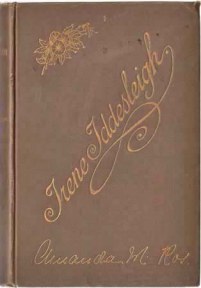
Irene Iddesleigh

Rate this book
This book was converted from its physical edition to the digital format by a community of volunteers. You may find it for free on the web. Purchase of the Kindle edition includes wireless delivery.

189 pages, Hardcover

First published January 1, 1897

52 people are currently reading
441 people want to read

About the author

Amanda McKittrick Ros

11 books8 followers
Anna Margaret Ross (née McKittrick), known by her pen-name Amanda McKittrick Ros, was a Northern Irish writer. She published her first novel Irene Iddesleigh at her own expense in 1897. She wrote poetry and a number of novels. Her works were not read widely, and her eccentric, over-written, "purple" circumlocutory writing style is alleged by some critics to be some of the worst prose and poetry ever written.

(from Wikipedia)

Ratings & Reviews

What do you think?
Rate this book

Friends & Following

Create a free account to discover what your friends think of this book!

Community Reviews

5 stars
31 (12%)
4 stars
10 (3%)
3 stars
26 (10%)
2 stars
39 (15%)
1 star
145 (57%)
Displaying 1 - 30 of 71 reviews
Profile Image for Tabitha.
149 reviews8 followers
August 6, 2013
HALT NOT these unceasing streams of lofty exaltitude, salted by the seeping secretions of sorrow, bestowed upon these words of multitude bound in the current of my Kindle, which have been thrust from the bosom of faulty moralization, the brain of insipid inexactitude, and the presiding pen of purplest prose, which in despite has overfilled my life-pumping organ with devilish and dolesome delight.

This terrible retelling of the history of the tragic tale of the beautiful person of womanly gender, Irene Iddesleigh, who by every turn of each word-filled page is either sympathetic heroine or arch-fiend, depending on the apparently uncertain or picaresque whims of our estimable authoress. It details the dire description of Irene's marriage of most unhappy feelings to the long-suffering bachelor and Lord of Dunfern, Sir John. When Irene's false heart is deus-exly revealed to her despairing husband (she - alas! - still pines in mutuality for her old tutor) her heroic husband secures her fastly in the historically haunted and ill-fated inner dungeon chamber (??!) with respect to his heart's deep desire for forgiveness and forging of familial bonds. What occurs after this momentous and exciting premise? My readers will have to surge their spirits together and read it for themselves.

(I myself was betided with oceans of confusion, seas of ignorance, and rivers of befuddlement to discover that Sir John was meant to be an estimable pillar of love and charity. Yet such is life.)

This stumbling narration of woe, which ends in a manner not requiring the witchtastic assistance of any Bohemian teller of fortune, has all the grace of a stray dog with four broken legs, disjointed in narrative, paltry in scope, repulsive in moralization, not to mention bizarre in its stylistic style of setting down of words. I nevertheless enjoyed it immensely, and will definitely "cast" my "heavily-laden orbs of blinded brilliancy" about to find more of Mrs. Ros' works.
Profile Image for Lacy.
79 reviews
November 9, 2013
How to rate a book like Irene Iddesleigh? So awful, it's awesome! I first heard of it when I learned that the Inklings (CS Lewis, JRR Tolkien, et al) used to have contests to see who could read it aloud the longest without laughing. First I thought, "Aw, that's mean," but then I decided to check it out. It was free on Kindle, so there was no risk. I'm so glad I did. Thanks to Ros' atrocious alliteration and conspicuous circumlocution (which stirred snide sniggering in my own soul) I can say that I have read what may actually be the single worst novel ever written! Who can put a price on an experience like that?
Profile Image for Marc *Dark Reader with a Thousand Young! Iä!*.
1,500 reviews313 followers
November 24, 2021
This is one of those 'special' books that demands either a one-star rating, or an ironic five-stars. There is no justifiable middle ground. Currently included on Wikipedia's "List of books considered the worst" (a list in flux that I happened to discover at the right time to highlight the existence of Empress Theresa, since removed), where this ideal summation is found:

"[Irene Iddesleigh] is often described as the worst novel ever written, with purple prose that is circumlocutory to the point of incomprehensibility."

Mocked throughout history by literatis including Mark Twain, J.R.R. Tolkien, and C.S. Lewis, it is truly something special, akin to The Eye of Argon in that every single sentence accurately reflects its totality. Why write what you mean, when instead you can use florid prose to utterly obliterate intention? What meaning is one meant to derive from passages such as this chapter opener:
A word of warning tends to great advantage when issued reverently from the lips of the estimable. It serves to allay the danger pending on reticence, and substantiates in a measure the confidence which has hitherto existed between the parties concerned. Again, a judicious advice, extended to the stubborn and self-willed, proves futile, and incurs the further malice and fiery indignation of the regardless, the reckless, and the uncharitable.
Why say that someone liked gardens, when instead they are
being passionately an ardent admirer of the fairy-like fruits of the efforts of the horticulturist.
Is something hard to do? Or is it a . . .
task much more difficult of performance.
Are you an orphan, or would you describe yourself as . . .
I, whose parentage is as yet bathed in the ocean of oblivious ostentation, until some future day, when I trust it shall stand out boldly upon the brink of disclosure to dry its saturated form and watery wear with the heat of equality.
Is there illiteration? Ill-intended it is indeed:
Better leave her to the freedom of a will that ere long would sink the ship of opulence in the sea of penury, and wring from her the words:—“Leave me now, deceptive demon of deluded mockery; lurk no more around the vale of vanity, like a vindictive viper; strike the lyre of living deception to the strains of dull deadness, despair and doubt; and bury on the brink of benevolence every false vow, every unkind thought, every trifle of selfishness and scathing dislike, occasioned by treachery in its mildest form!
Which you rather travel by "the express train of friendship," or "the boat of dreamland" along " the path of powerful pursuit," when in either conveyance you might "again be dashed into the dam of denounced riches." I know which I would choose.

It's not only the narrator's voice; the style carries into what scant dialogue exists. Please try to imagine anyone, in any time period, speaking like so:
“Tell me, I implore of you, Sir John and husband, why the once blithe and cheerful spot of peace is now apparently a dismal dungeon on the night of our home-coming, when all should have been a mass of dazzling glow and splendour?

Can it be that she who proffered such ecstacy for months before, on the eve of our return, is now no more? or can it be possible that we have crossed each other on the wide waters of tossing triumph or wanton woe?

Speak at once, for pity’s sake! and do not hide from me the answer of truth and honest knowledge? Oh, merciful heavens!”
So, yeah. It's bad. Aside from the prose, there is no hint of a plot until at least nine chapters in, and what unfolds from there, well, the less said the better. I will simply state that, were you to read this book for yourself, it's not only the prose that would leave you flabbergasted.

My favorite part of the whole affair, is when Amanda McKittrick Ros herself,
demanded there and then that the pen of persuasion be dipped into the ink of revenge and spread thickly along the paragraph of blood-related charity to blank the intolerable words that referred to . . .
a one-page review of this, her first book, by critic and humourist Barry Pain. She felt so offended that she wrote a thirty-page preface to her next book, Delina Delaney, solely to clap back at him. Peering through this text, almost as indecipherable as her fiction, you will find many now-classic responses to criticism. She says, "I've never heard of him." She says his opinion matters not a whit to her (that's thirty pages' worth of not caring, if you're keeping track). She asks, "what have you written that's any better?" She accuses him of being in love with her. She criticizes his single words and phrases at length and out of context. It's quite the diatribe.

** Read along with the '372 Pages We'll Never Get Back' podcast, which I highly recommend. **
Profile Image for Jason Pierce.
845 reviews100 followers
January 12, 2022
Winner of Pierce's 2019 Razzie

I'm so torn here. This truly was amazing, and I want to give it five stars, but it's amazing because it's so bad. To say "I didn't like it" is inaccurate because I enjoyed several parts of it, but only because they were terrible. How the hell is one supposed to rate such a thing? Well, since it's a bad book, it's getting one star.

Is this the worst book ever written? No. There are some authors on goodreads who are worse. But this is the worst successful book ever written, and I'm not the only one who says so. Just google "Irene Iddesleigh" or "Amanda McKittrick Ros," and see all the articles that praise how horrible her writing is. This thing is awful perfection. Someone called it "uniquely dreadful," and that about sums it up. It is the epitome of "so bad it's good," but only if you enjoy reading for the sake of reading. If you're into books simply for the story, then for God's sake, leave this alone. But if you have an appreciation for the the art of writing, and don't mind watching a train wreck from start to finish, then you might enjoy this. Mark Twain considered it "one of the greatest unintentionally humorous novels of all time." The Inklings, a club at Oxford that included C.S. Lewis and J.R.R. Tolkien, would hold contests to see who could read from this out loud for the longest without cracking up. I would've lost my turn by the eighth paragraph when I got to "Within the venerable walls surrounding this erection of amazement and wonder..." But that's because I'm a pervert, and she said "erection."

Still, I also laughed several times at other things. They call it purple prose, but I feel like this goes beyond that. It's like eggplant, or something, and it bleeds into the dialogue too. Take this from Mr. Dunfern: “Speak! Irene! Wife! Woman! Do not sit in silence and allow the blood that now boils in my veins to ooze through cavities of unrestrained passion and trickle down to drench me with its crimson hue! Speak, I implore you, for my sake, and act no more the deceitful Duchess of Nanté, who, when taken to task by the great Napoleon for refusing to dance with him at a State ball, replied, ‘You honoured me too highly’—acting the hypocrite to his very face. Are you doing likewise?” Nobody talks like that, and this isn't even the worst example. But it sure is fun to read everyone attacking everything with such maudlin, soap opera passion.

And good God, the alliteration. I'll give another example, and you can also find this kind of thing happening on any page. "Mocking Angel! The trials of a tortured throng are naught when weighed in the balance of future anticipations. The living sometimes learn the touchy tricks of the traitor, the tardy, and the tempted; the dead have evaded the flighty earthly future, and form to swell the retinue of retired rights, the righteous school of the invisible, and the rebellious roar of raging nothing."

And just what in the hell does that paragraph even mean? As for the story, that's pretty bad too. It's a sappy-romance-gone-wrong kind of thing in the vein of Madame Bovary (blech!), but at least Flaubert presented plausible situations. Ros's shit, while not technically impossible, was 99% improbable. For example, Irene's adopted parents left after... well, after some other improbable stuff happened, but if I start spelling out everything, this review will go on forever. Trust me, there is not enough room in five review spaces on Goodreads to point out everything that's wrong with this story. Let's just say they left England and didn't leave a forwarding address with anybody. 15 or 20 years later as Irene is leaving America to head back to England because her life is in complete shambles, she espies her father whom she adored on the side of the street. In all the wide world, they just happen to cross paths to satisfy a plot point Ros wanted to put paid to... And I'm actually not sure what that plot point was, now that I think about it. Charles Dickens, eat your coincidence-loving heart out.

THEN! After they shoot the bull for a few minutes, father says "well, I gotta go to work," and Irene says "well, I gotta go across the sea," and that's the end of that. It never crossed her mind to say "hey, I'm in dire straits here, have nothing worth living for, may I live with you?" And really, she didn't even need to be doing that. The reason for her going back to England is so stupid it defies belief. But like I said, if I start listing everything, we'll be here forever. I did jot down a couple of notes on chapter 11, so I'll pick on that, but believe me when I tell you that the inanities abound from start to finish throughout the entire book. And I'm not posting a spoiler tag because this book doesn't deserve it.

Irene has been imprisoned in a room by her husband for a year. (Don't even ask about the reasons, or why almost nobody seems to notice or care that the mistress of the house is locked up in a room.) For some reason Irene's old maid goes and sits sadly in the courtyard at the same time everyday and stares at Irene's window, but she doesn't see Irene standing at it. For some other reason Irene just happens to have a small telescope and sees her maid... How big is this fucking house? Is the room on the 20th floor? Or do they both have glaucoma? NO! Because the maid who can't see her mistress sees a handkerchief being waved at her through a window pane Irene cut out with her diamond ring. Then the maid sees a piece of paper being thrown to her. And what is the content contained within this missive? "Have you gotten any letters from my lover?!" She doesn't ask for help getting free (at least not yet). She asks if her lover has asked about her! Later the maid slips a note under the door, and a communication begins between Irene and the lover, and blah, blah, blah, blah, blah. I'd better stop there.

Anyway, like I mentioned earlier, this is worth reading if you enjoy train wrecks. I'm glad I read it, but I'm confident I'll never read it again. Since this is in the public domain, you can read it at Project Gutenberg. In fact, do yourself a favor, click on the link, and just pick a couple of random paragraphs to check out. Bitch made bank with this shit, and it really needs to be experienced to be believed.
Profile Image for Théo d'Or .
651 reviews303 followers
Read
November 20, 2024
" - Do you know the story of that beautiful girl who was so beautiful that everyone who saw her could not help but fall in love with her ? "

No. I don't know that story of that beautiful girl who was so beautiful that everyone who saw her could not help but fall in love with her. But I could practically hear violins playing in the background. The good part is that reading this line I had a divine revelation - health is the most valuable asset . And the sentence above just missed giving me a heart attack, I'd have needed a defibrillator just to get through the next line, but not knowing how to use it, humanity would have counted one less genius. Protect your hearts, folks . Now and then.
Farewell, Amanda. I will love you until the stars fall from the sky, even a little after.
Profile Image for Laura.
18 reviews21 followers
October 14, 2013


but it's hilarious. agonizingly, soul-wrenchingly hilarious.
Profile Image for Stephanie.
300 reviews
August 22, 2019
Call me crazy, but I liked it.

I mean, it's definitely not good in the way the author meant for it to be--she obviously thought she was the next Jane Austen. Well, her reality check bounced.

But it's good in an eccentric, "what the heck am I reading" kind of way. It's short and an easy enough read, if you don't mind how positively bad it is in almost every aspect. It's one of those books that are so bad they're good.
Profile Image for Wreade1872.
813 reviews229 followers
January 3, 2023
That was bad, which is a pity cause the plot is pretty good. If written in a different style this would have approached the work of Emile Zola. Then again who need smore Zola, god he's depressing.

Whereas the terribleness of some of the writing here certainly keeps it entertaining, albeit quite confusing.
This is overdone but its not just Purple Prose, i like purple prose, i like it when a writing is going all out but the writing here is simply bad. It has such mixed metaphors that it becomes genuinely indecipherable at points.
I mean i read a lot of old books and am usually pretty good at parsing such texts but this one, i reread some paragraphs several times and still found it hard to work out what some sentences meant.

These sections are mostly at the start of each chapter its generally easy enough to understand otherwise. However it maintains quite a remote narrator view which keeps it from having any emotional impact.

Anyway.. entertainingly bad and also kind of good plot-wise at times.
Profile Image for Alouise Dittrick.
15 reviews
January 13, 2015
5 stars not because this book is good, but because it is bad. It crosses the line from being so bad to being so good because it's so bad. It's The Plan 9 From Outer Space of books.
Profile Image for Laura.
307 reviews17 followers
Read
November 12, 2021
There is no way to rate this. The writing is terrible, the people are one dimensional, but I implore everyone to read this. It is utterly insane.
Profile Image for Carol Ann.
61 reviews1 follower
August 27, 2018
Fantastically florid, marvelously moral

WaPo called it the worst book ever written. Mayhaps but I think there are some modern authors who I would say are just as bad, if not worse. Overly florid, with more phrases in convoluted language than any contract written by a tribunal of lawyers, it was an entertaining read. The story line was straightforward, despite phrasing that wandered here and there and looping about itself. Given the era when was written, and that it was published as a gift, it could have been much much worse. For those who can't make it past the first paragraph, it's the story of an orphan who was adopted at 11, and despite loving her tutor, married the wealthy bachelor neighbor. When her husband found out she married him but didn't love him, and had kept in contact with her old tutor even while married, a couple of months after the birth of their child he had her locked in a room in the mansion. And, it wasn't just any room, but a room that had been the room where ancestral relatives had not only been confined, but killed themselves. The wife's faithful maid helped her escape into the arms of the tutor. They sailed to the USA, took up residence in a small town in N.Y. (which I am familiar with, but apparently the author wasn't) and became a bigamist by marrying her tutor.
After years had passed, the tutor became a drunkard, committed suicide which caused Irene to sail back to England. In a series of incredible coincidences she meets everyone from her past who was still alive, she learns her fraternal uncle had bought her second husband 's old home, her original husband was deceased, and upon meeting her grown son, is thrown off the property. Her body is found a day or so later in the yard of the home of the family that adopted her.
The tl;dr version - Every person in this woman's circle ended up having a miserable life.
Profile Image for LobsterQuadrille.
1,100 reviews
November 13, 2020
3.5 stars for entertainment value, 1.5 stars for execution.

Somehow Irene Iddesleigh manages to be both boring and ridiculous. Ros must have equated good writing with cramming as many words as possible into even the simplest statement! The unrelenting melodrama even exceeds that of Varney the Vampire. But the wording is so constantly overcomplicated that it can be more tiresome than funny. It reads like the narrator from "Plan 9 From Outer Space" got a bit full of himself and decided to write The Great American Novel. I even found myself imagining the text read aloud in his voice.
McKittrick Ros must have been REALLY fixated on stretching out this plot that could have been told in one brief paragraph. It reaches the point where she rarely even uses the characters' names. Instead we get phrasing like "She whose hope of deliverance rested upon the fragile wings of fortune"**. It really is ludicrous writing, entertaining but best taken in small doses to avoid total loss of sanity.

The characters are so paper-thin and colorless that they make amoebas sound like stimulating company. Irene is so pathetic that she makes Flora from Varney the Vampire look like Jane Eyre. She just kind of lets her jealous husband lock her in a room for almost two years without offering any actual resistance. It apparently took her at least a year to think of breaking a window pane, and when she did that and was able to send out a note to her maid, what did she do? Write to send help right away? Hide behind the door, knock out the evil housekeeper, and run for her life? No, she tells her maid to make sure she gets any letters from her boyfriend.


Sir John is painted as the wronged husband who truly loves Irene, and naturally I can't blame him for being upset about his wife actively corresponding with the guy she is clearly still into. However, locking your wife in a spare room for two years and keeping her from seeing your son because your ego is bruised is probably taking things just a smidge too far. Oh, did I mention they have a kid? I forgot about him because everyone else did too. At the start of her imprisonment, Irene reflects contentedly that her infant will be well cared-for even without her and then proceeds to ignore his existence until FIFTEEN YEARS LATER! And to top this profound moral story off, Though I would be the first to agree that Irene has the brain cells and backbone of a sea slug, it's kind of hypocritical to punish her for preferring to run off with the guy who DIDN'T lock her in a room for two years, and completely excuse the wife-imprisoner's less-than-stellar behavior. Such was Victorian culture I suppose...

Check out Irene Iddesleigh if you sometimes enjoy terrible writing for its own sake, or if you need to de-stress with something that can't possibly be taken seriously. As much as I complained about the incompetent storytelling here, I did get some fun out of how silly and self-important it was.

**I made that quote up myself but this writing is so easy to caricature that I bet you didn't even notice.
Profile Image for Michael.
335 reviews
November 30, 2021
I read this with Donald for the 372 Pages We'll Never Get Back book club podcast. We'd never have read this, otherwise. I'd never heard of it before this, either, despite its apparent infamy.

I rarely read anything other than fairly "fluffy" books for fun, these days, but when I was younger and spent more time reading, I actually enjoyed "classics" and read them recreationally. I don't have trouble understanding old-fashioned writing, for the most part, but the intros ("fortune cookies", to fellow 372 listeners) to some of these chapters were... Phew.

Well, to be relatively brief, Irene Iddesleigh definitely deserves its reputation as a very poorly-written book. However, once you've marvelled over the bizarre, sometimes impenetrable writing style for a few chapters, you start to wonder if it's worth it... Is this all there is to it? Fortunately, there are some entertaining plot developments a bit further on, to save the day, and the book isn't long enough to have much of a chance to drag. There are laugh-out-loud moments, but to avoid spoilers, I'll just say that we enjoyed the unintentional humor. (The podcast makes it fun, too.)

After we finished this novel, we noticed that the author's self-published volumes of poetry were available to us for free (via Prime Unlimited), so we skimmed some of it, and wow, is it bad! If you have the chance to read her poetry for free, it's worth a chuckle or two. (I wouldn't spend a dime on it, though!)

I feel certain that this author wasn't a very pleasant person, in many ways. For instance, she's strangely insistent that her "hero" is a great man, despite all evidence to the contrary.
Annoying! And then there's her poetry, which paints even more vividly the picture of a vicious personality. It's amusing that someone who saw fit to censor herself (dashes instead of the word "hell", for instance) was also wishing that some people's buttocks would be whipped with hooks. If you self-righteously chortle over the idea that So-and-So (some lawyer who angered you) is surely suffering eternal damnation in the fiery pits of Hell, I don't imagine God cares much whether or not you write out the actual word. Somehow, I don't think God is smiling approvingly, so why bother with the falsely conscientious, "Oh, no, I would never curse! Heavens to Betsy! How crass!"
(Still, I can't deny I laughed at her over-the-top, bilious hatred of the lawyers of her acquaintance!)
465 reviews17 followers
November 12, 2021
And then, they died. The end.

Well, Ms. Ros(s) didn't much care for that whole "redemption arc" type story did she?

In some ways this can be viewed as the anti-Ready Player One or the Eduardian long-lost-twin of it. What they have in common: Nothing of interest happens to awful people and in the end nobody changes or learns anything. Where they are opposed is that where Cline's book feels "unwritten" (like a series of forum posts that were "good enough"), Ms. Ros book manages to—well, it also feels "unwritten", but for a more prolix age.

So, instead repeating simple sentences over and over again while skimming over hard-to-write parts (i.e., describing what's actually going on), we get lengthy sentences full of malaprops and at the end you say to yourself, "Wait, did they just get on a boat?" or "Did somebody die?"

But much like RP1, the "heroes" (imagination must be stretched here to use this term) are awful, insofar as they can be made out, and the author is so smugly confident in her world-view that trivial things like descriptions of positive actions need not be provided. You know who the good guys are and the bad guys are, and know better than to allow an observation of their meager actions to alter that opinion.

I can see why this book is so famous.
Profile Image for meghann.
1,061 reviews1 follower
November 1, 2021
I listen to the reading podcast 372 Pages We'll Never Get Back. This is the book they just started, and just... wow. I listened to their first episode covering the first third of the book, and I honestly did not know if this is one I would make it through. It really tried hard at being something it is not. The over the top flowery language and impossibly long run-on sentences truly make it difficult to follow. This was free online, so I decided to give it a go. My brain hurt trying to follow and understand what was going on half the time. Entire paragraphs would be comprised of one standard sentence followed by a second that took up ten lines on the page. And then there was the actual story. I got real tired real fast of Sir John being praised by everyone as so kind and faultless and the victim. Bro locked his wife in room for a year after she almost died giving birth because she had the audacity to love another man before she met him. Literally everyone in this book was awful, and it was all about punishing the woman. I'll watch a Tyler Perry movie if I want that.
Profile Image for Gerd.
555 reviews39 followers
July 10, 2013
Truly a contender for worst book read.

Not so much for the dreadful overwritten prose, which becomes quite amusing once you got the hang of it, but for the terrible morality of the story.
Profile Image for Melissa .
75 reviews11 followers
February 1, 2022
"One of the greatest unintentionally humorous novels of all time." -- Mark Twain.

Irene Iddesleigh is considered by many to be the worst Victorian novel ever written. I wavered between 1 and 5 stars... 1 star, because it is truly, horribly, dreadful. 5 stars, because it greatly amused me, and often caused me to want to scream with laughter. I settled on 5 stars, because it falls into the "so bad it's good" category for me. It seems as if the author didn't even know where she was going with her own sentences, and was simply inventing as she went along. Here is just one small example: "He was tempted to invest in the polluted stocks of magnified extension, and when their banks seemed swollen with rotten gear, gathered too often from the winds of willful wrong, how the misty dust blinded his sense of sight and drove him through the field of fashion and feeble effeminacy, which he once never meant to tread, landing him on the slippery rock of smutty touch, to wander into its hidden cavities of ancient fame, there to remain a blinded son of injustice and unparalleled wrong!" That is all ONE sentence, and I assure you that context would not help you to understand it in the least. The book is simply crammed with such mysterious nonsense, and the plot is also deplorable, by the way. So yes, in my strange mind, it was worthy of 5 incomprehensible stars...
2 reviews
September 3, 2023
With her melodically majestic, soaring and sonorously sounding stanzas of sincere and supreme satisfaction, with those fleeting and fanciful phrases gently streaming like waves across the sea-shore, pounding off like pebbles pressing the pearly precipice of ponds, the ever-drifting ebb and flow of the tides of her eloquence made an impression on the attentive and savant reader, most knowledgeable of matters peculiarly pertaining to the art of the act parlance with pen and paper, only within the extremely exclusive and elusive élite of extravagant eccentricities is this extraordinary feat of epic epistolary acumen able to be equivalently estimated among the rank of its peers and paragons.

The bountiful bacchanale of brute and barbaric banalities with brash brocade of bombasticism binds the brain of the reticient and resisting restless reader to altogether relax his muscles and move them to the position most suitable to amusing themselves by releasing the voice of vivacious convulsions of inhalation, being the only appropriate answer to such an amiable achievement of ardent amateurism.
Profile Image for Harris Bolus.
65 reviews7 followers
November 23, 2021
Amazing. So terribly written and plotted that it can be really funny. Some critics describe Amanda McKittrick Ros’s prose as “purple,” but I think “ultraviolet” may be more accurate - she has an intense love of simile and metaphor, but especially *mixed* metaphor, and uses alliteration at every opportunity.
128 reviews21 followers
Read
January 15, 2013
I read this for pure "novelty" factor. I first heard of this author in the movie, "Bad Writing."

This book delivers as promised in the movie.
Profile Image for Marvin.
266 reviews4 followers
April 18, 2022
A toast to the Queen of purple prose. Once you get the hang of it, it's truly delightful.
1 review
March 19, 2021
One of the worst things ever actually commercially published. The prose is so purple it could clothe a Byzantine emperor.
Profile Image for Shannon.
25 reviews
November 29, 2021
Hilariously over-written. I get why it was deemed terrible at the time, but I was thoroughly entertained.
Profile Image for Damian Penny.
25 reviews
November 30, 2021
The funniest book ever written?

It's definitely in the top ten. The fact that the author was completely, 100% serious about it makes it all the more hilarious.
Profile Image for Ben Causey.
93 reviews
Read
June 17, 2022
Fun if you go in with the proper mindset. I read this entire thing aloud and can confirm it puts a small child to sleep.
Profile Image for Nevena.
56 reviews11 followers
April 12, 2023
Despite being dubbed “the worst book ever written”, I sincerely think McKittrick’s novel isn’t nearly as bad as everyone makes it seem.
Profile Image for Tim.
300 reviews1 follower
July 8, 2023
Some scattered thoughts:

-I swear this book is only like 5 sentences long, except each sentence is about 40 pages long
-Everyone in this novel is the absolute worst
-An abundance of alliterations ain't an adroit act
-There is absolutely no dialogue in this novel, rather characters will monologue for 2-3 pages (not an exaggeration)
-What even was the plot of this book? Like I guess it's a character driven novel, but even those have plots. Émile Zola would love to have a word with you, Amanda
-The prose is so purple, it should seriously seek medical attention
-Mark Twain said of this book that's it's the "most unintentionally hilarious book" he'd ever read
-Mercifully it's short
Profile Image for Hannah’s_Bookshelf.
91 reviews
December 30, 2022
Here’s a challenge for you: Read Irene Iddesleigh, wait three minutes, and then see what you can remember.

I read this book knowing that I was going to hate it. I’ve never been a fan of the romance genre, so it already had that stacked against it. You might be wondering, “H, if you hate romance, why did you decide to read this.” The answer is simple: I knew it was going to be bad, but I didn’t think it would be that bad.

I first heard about this book from the 372 pages we’ll never get back podcast, and when I found out that the Inklings (C.S. Lewis, J. R. R. Tolkien, and the rest of the gang) would rip on this book for kicks. Any possible criticism they came up with applies. The prose is so very purple, The plot is so very nonsensical, and the romance is laughable.

This review is a cautionary tale. Please, for your own sanity do not read this book. Your brain will thank you.
Displaying 1 - 30 of 71 reviews

Join the discussion

Can't find what you're looking for?

Get help and learn more about the design.