

What do you think?

My Wonderful World of Slapstick
Buster Keaton's autobiography is a view into the quirky mind behind the stoic face of the legendary film comedian.
340 pages, Paperback
First published January 1, 1960
Ratings & Reviews
Friends & Following
Create a free account to discover what your friends think of this book!
Community Reviews
Displaying 1 - 30 of 98 reviews

January 19, 2010
Buster Keaton is one of my favorite actors of all time, so it just made sense that I would read his autobiography. I felt like I got to hang out with him and listen to his stories for a little bit every day. He is my celebrity boyfriend. I have a whole slew of films that I want to watch or re-watch now that I know the stories behind them, what was going on with him personally at the time. The beginning of the book was the best part, just like in super hero stories, when they figure out their super powers – that is the best part. So, I particulary enjoyed when he was talking about being a baby on vaudeville stages being the human mop and figuring out which muscles to tighten so that certain falls wouldn’t hurt so badly and realizing that when he smiled during a particular gag, he didn’t get the laughs he got when he didn’t. What a childhood. What a working childhood. Oh, his war stories are pretty good too. And he writes in his voice, you know? So, he bounces from one idea to another just like he’s sitting down and telling you about it. Maybe one of the best stories was about his giant St. Bernard Elmer, who he brought with him every day to the MGM studio and would just sun himself on the porch while he worked. Greta Garbo was working there at the time too and was in the habit of taking a stroll down the length of the lot on her break. Elmer would get up and escort her on these walks completely unprovoked, just because he wanted to. He wouldn’t let her pet him, he just wanted to walk beside her. Yay.
Oh, and then there’s the drinking and the sad stuff. He’s very honest though. He calls it “The chapter I hate to write”. Seems like we’ve come a long way from the treatment for alcoholism they used to have in the 30s… Ugh, it was awful.
It’s interesting to me how obsessed he was with quoting the figures he got paid for such-and-such a job in the book, how he REMEMBERS what he got paid. And he’s constantly bringing up the fact that he was not a millionaire, was never a millionaire. He does this with an odd sense of pride at the fact too.
The autobiography is most beautiful when Keaton talks about the trade. “I never knew a real actor who was happy when he wasn’t working.” I think part of what made him so unique and different from other stars (aside from being around to watch and help the whole industry change from silent films to talkies of course), was the fact that he never forgot the audience as a character. “I think the reason I never lost my humility before audiences is because I have always felt it is the performer’s job to make everything he is doing understandable. After all the audience’s duty ended when they paid to get in.” I think that is so important. As is his recipe for the perfect face splatting custard pie which is also in the book. Gracious, when he talks about the specifics of comedy, it’s fantastic. Like when Red Skelton did the re-make of The Cameraman and the bathroom changing scene didn’t get nearly the same laughs as when Buster did it in the silent film. And Buster’s take on why that was is because they had Red sneezing all over the other guy and that’s just gross. Hee.
Oh, Buster. I wish you were still around so that I could sit down and have a good chat with you. But since you’re gone, I’m glad you left us with this book. This, as translated from Spanish, “little bit of nothing”.
Oh, and then there’s the drinking and the sad stuff. He’s very honest though. He calls it “The chapter I hate to write”. Seems like we’ve come a long way from the treatment for alcoholism they used to have in the 30s… Ugh, it was awful.
It’s interesting to me how obsessed he was with quoting the figures he got paid for such-and-such a job in the book, how he REMEMBERS what he got paid. And he’s constantly bringing up the fact that he was not a millionaire, was never a millionaire. He does this with an odd sense of pride at the fact too.
The autobiography is most beautiful when Keaton talks about the trade. “I never knew a real actor who was happy when he wasn’t working.” I think part of what made him so unique and different from other stars (aside from being around to watch and help the whole industry change from silent films to talkies of course), was the fact that he never forgot the audience as a character. “I think the reason I never lost my humility before audiences is because I have always felt it is the performer’s job to make everything he is doing understandable. After all the audience’s duty ended when they paid to get in.” I think that is so important. As is his recipe for the perfect face splatting custard pie which is also in the book. Gracious, when he talks about the specifics of comedy, it’s fantastic. Like when Red Skelton did the re-make of The Cameraman and the bathroom changing scene didn’t get nearly the same laughs as when Buster did it in the silent film. And Buster’s take on why that was is because they had Red sneezing all over the other guy and that’s just gross. Hee.
Oh, Buster. I wish you were still around so that I could sit down and have a good chat with you. But since you’re gone, I’m glad you left us with this book. This, as translated from Spanish, “little bit of nothing”.

June 5, 2010
Though I love Charlie, Buster is my favourite of the silent clowns. Though I hate to compare them through their autobiographies, I recently finished Chaplin's, so it is difficult not to invite a few comparisons.
Keaton's style is far more informal, more like your Grandad sitting you down for storytime than an old codger regaling tales of his finest hour. Buster begins with his budding career, which began around his 3rd birthday. Named Joseph Keaton (the first son of a first son of a first son to be called Joe Keaton), he earned the nickname Buster after taking a spill down a staircase and being picked up and christened by Harry Houdini.
Detailing vaudevillian life through knockabout sets as a child, burlesquing fellow acts, imitating and learning from the best, and finally declaring independence from his father, Keaton keeps the snappy anecdotes flowing. A little reflection is given, but much of the time we are acutely aware that there was more to it than he lets on.
What is refreshing about Keaton's book is that he is not afraid to share his work ethics, salaries, and details of his tricks. From imitating his father and Houdini to his final days in television, he is honest and opinionated about his colleagues and famous friends. Notable among these stories is Roscoe (Fatty) Arbuckle's murder trial and Keaton's attempts to revive the old friend's career, before dropping him as a director and coercing him onto another project instead. He is candid about his married life and the disappointments it contained, as his first wife wiped him out with nary a squabble.
My Wonderful World of Slapstick is an excellent insight into the life of a great filmmaker, whose humble, take-it-from-me-kid attitude keeps the tone light and the anecdotes pleasing. He compares himself to Chaplin who, unlike Keaton, heard the critics when they called him a genius, and tried to play up to the role. Keaton's modesty may have kept him from becoming a multi-millionaire, but may also have preserved his career. Assessing their memoirs, this is apt.
For silent film fans and autobiography-nerds, My Wonderful World of Slapstick is a wonderful read.
http://unculturedcritic.com
Detailing vaudevillian life through knockabout sets as a child, burlesquing fellow acts, imitating and learning from the best, and finally declaring independence from his father, Keaton keeps the snappy anecdotes flowing. A little reflection is given, but much of the time we are acutely aware that there was more to it than he lets on.
What is refreshing about Keaton's book is that he is not afraid to share his work ethics, salaries, and details of his tricks. From imitating his father and Houdini to his final days in television, he is honest and opinionated about his colleagues and famous friends. Notable among these stories is Roscoe (Fatty) Arbuckle's murder trial and Keaton's attempts to revive the old friend's career, before dropping him as a director and coercing him onto another project instead. He is candid about his married life and the disappointments it contained, as his first wife wiped him out with nary a squabble.
My Wonderful World of Slapstick is an excellent insight into the life of a great filmmaker, whose humble, take-it-from-me-kid attitude keeps the tone light and the anecdotes pleasing. He compares himself to Chaplin who, unlike Keaton, heard the critics when they called him a genius, and tried to play up to the role. Keaton's modesty may have kept him from becoming a multi-millionaire, but may also have preserved his career. Assessing their memoirs, this is apt.
For silent film fans and autobiography-nerds, My Wonderful World of Slapstick is a wonderful read.
http://unculturedcritic.com

October 9, 2007
The great thing about the American genius Buster Keaton is that he never thought hmself as a genius, unlike his pal Charlie Chaplin who thought himself as a genius but...wasn't. Keaton is the greatest artist of the 20th Century. I don't think Duchamp, Einstein, most cinema historians, and even Johnny Depp would disagree with this opinion.
And here we have a memoir where he's....modest. Keaton for me opened up the machine age in an aesthetic sense and truly understood the nature between human, machine and how one places that in history. He should get the highest medal in this country .... as well as other countries and cultures - because the fact is he's essential.
Oh the book gets four stars because of his modesty... there are bios out there that fully gives him credit to his greatness. To Buster Keaton, I truly love you.
And here we have a memoir where he's....modest. Keaton for me opened up the machine age in an aesthetic sense and truly understood the nature between human, machine and how one places that in history. He should get the highest medal in this country .... as well as other countries and cultures - because the fact is he's essential.
Oh the book gets four stars because of his modesty... there are bios out there that fully gives him credit to his greatness. To Buster Keaton, I truly love you.
February 18, 2010
When I saw Buster Keaton's autobiography available as a free file from the Internet Archive, it received the honor of becoming the first work that I would read, in fits and starts, as a mobile e-book. I don;t know what it says that my first e-book is about about a comedian whose greatest success came in the era of silent films, but that's how it is.
Buster comes off a born entertainer who had acting in his veins, so it's no surprise his autobiography -- even if he wasn't usually the one actually setting the pen to the paper -- should be so very entertaining. It's full of page after page of entertaining stories about strange turns of events and practical jokes in the fascinating world of vaudeville and early Hollywood, plus unself-conscious but golden insights into just what Keaton though made a good comedy.
This book might not penetrate as deeply as possible into Keaton's psyche, but I think that is fine left to other biographies. He comes off here as a man who just isn't as interested in self-analysis as he is in telling a story, and when he claims that he's a happy man who's had more joy than sorrow, I believe him. When he does talk about his hard times, it's in a very frank and straightforward way.
This is a fully entertaining book -- and the personality of Keaton comes through; he seems like an honest, genuine fellow who admits his flaws and wants you to have a good time -- and I enjoyed spending the time with him.
Buster comes off a born entertainer who had acting in his veins, so it's no surprise his autobiography -- even if he wasn't usually the one actually setting the pen to the paper -- should be so very entertaining. It's full of page after page of entertaining stories about strange turns of events and practical jokes in the fascinating world of vaudeville and early Hollywood, plus unself-conscious but golden insights into just what Keaton though made a good comedy.
This book might not penetrate as deeply as possible into Keaton's psyche, but I think that is fine left to other biographies. He comes off here as a man who just isn't as interested in self-analysis as he is in telling a story, and when he claims that he's a happy man who's had more joy than sorrow, I believe him. When he does talk about his hard times, it's in a very frank and straightforward way.
This is a fully entertaining book -- and the personality of Keaton comes through; he seems like an honest, genuine fellow who admits his flaws and wants you to have a good time -- and I enjoyed spending the time with him.
Read
July 9, 2025“i think i have had the happiest and luckiest of lives. maybe this is because i never expected as much as i got. what i expected was hard knocks. i always expected to have to work hard. maybe harder than other people because of my lack of education. and when the knocks came i felt it was no surprise. i had always known life was like that, full of uppercuts for the deserving and undeserving alike. but it would be ridiculous of me to complain. i find it impossible to feel sorry for myself. i count the years of defeat and grief and disappointment, and their percentage is so minute that it continually surprises and delights me.”
for me, loving buster keaton is an intrinsic part of my personality. it’s one of those facts you don’t even question– the sky is blue, the first letter of the alphabet is A, trees are crucial to the ecosystem, drinking water is good for you, exercise is important, eden will always love buster keaton. it’s really no secret. i have been completely enchanted by him and his movies. my letterboxd friends know this information first hand and experience it on the daily. none of my reviews, though– most of which get progressively more ridiculous over time– truly articulate just how genuine my appreciation for buster and his work are. it’s so clear to me how much care went into his films– especially the ones he created independently. that level of craftsmanship is hardly replicated today, especially in the comedy world. at the end of the day, what buster keaton cared about most was getting his audiences to laugh. he was a man whose entire goal in life was to bring joy and humor to others. and the fact that he’s still able to do that, even a hundred years later, is so special. i firmly believe he was one of the greatest performers to ever live. buster keaton was a generational talent. he just had that spark, the vivacity, that oomph! getting to be inside buster’s mind (for the most part) and seeing the world through his eyes was such a treat, i needed to take it as slowly as possible (for optimum enjoyment, of course.) i have never had more fun while reading a book, even during its sadder parts. buster lived such a fascinating life, his stories about his childhood on vaudeville to his anecdotes about making films like go west (1925) and the cameraman (1928) had me completely enthralled. if there was one person, dead or alive, that i would like to have a nice, long chat with– it would be buster keaton. being inside his mind and reliving his life as he told it was such a lovely experience. it really was like hearing stories from an older relative. i’m a little sad to be leaving it now, after being in his wonderful world of slapstick for a little over a month. buster keaton is a national treasure in my book. i hope that he knows how loved he still is, even generations after his death. i would give up everything in the world if it meant i could live at the same time he did. seeing his movies in real time and experiencing that part of film history would have changed my life for the better. but for now, while i wait for time machines to become a reality, i’ll settle for reading books like these and experiencing his movies all over again.

Read
January 5, 2017Keaton doesn't go into a lot of specifics about the making of his films and is more interested in telling you about the practical jokes he played on his fellow old Hollywood stars. There is a spirit of exaggeration and tall-tale that runs through it and the reader should be especially cautious about accepting the factual details of his telling. He writes rather humbly and I've never seen anyone speak negatively about his character anywhere. However, his praise of DW Griffiths without any condemnation of the intent behind Birth of a Nation isn't exactly great and the racial prejudice that shows up in his films, while less malicious, are a bit of a bummer. He grew up working in vaudeville where racial caricature and blackface was big business, and he is undeniably a product of his background. His defense of Rosce Arbuckle against his rape and murder accusations (of which he appears to have likely been innocent however the truth is now impossible to know) were perfectly fine, but his subtlish implications that the victim was hussy trying to get ahead don't come off great in 2017. He otherwise seems like a good dude and the occasional dated bit is almost inevitable for a dude who was born in 1895. He remains my favourite artist of the 20th century and does seem like a kind-hearted man, even if he is a tad selective about the details here....the book is gentle and loving to the point of occasionally seeming like a bit of a lie. However, my gripe is more with the academics who always describe him and his films under the most generous of possible interpretations even when problematic details crop up. I admire him and his work, but don't think that means I need to pretend his a perfect person all the time.
It is a fun light read full of entertaining stories. I think Keaton seems like a good but imperfect man. It's worth reading for fans, but I would suggest reading Tempest in a Flat Hat first.
It is a fun light read full of entertaining stories. I think Keaton seems like a good but imperfect man. It's worth reading for fans, but I would suggest reading Tempest in a Flat Hat first.

September 12, 2025
Penso di non aver mai letto una autobiografia così felicemente felice.
Buster è felice sempre, quando viene usato come scopa dal padre per gli spettacoli (grosso modo dai 2 ai 12 anni), quando inventa gag spezzaossa e studia il modo per non farsi male cadendo e rimbalzando come una molla, quando inizia a diventare famoso ma non se ne accorge perchè altri ci tengono più di lui (Chaplin sopra a tutti), quando fa le scelte produttive sbagliate e perde il controllo dei propri film, quando sposa (e continua a sposare) le donne sbagliate, quando si inventa meccanismi registico-scenografici-coreografici talmente geniali che ancora oggi non possiamo fare a meno di sorridere quando li vediamo. La genialità delle sue sceneggiature traspare anche dalla bio, che viene montata con dei crescendi e delle accelerazioni che tengono avvinti alla pagina.
Buster è un ossimoro vivente, uomo-felice-volto-triste. La machera busterkeatoniana che si è impressa nella mente di tutti nasce da uno dei suoi primi film in cui aveva espressioni “normali” e nessuno rideva, e questa cosa di NON suscitare il riso lo fa soffrire moltissimo. Un collaboratore gli suggerisce che deve nascere dal contrasto, tra le cose buffe che fa e il viso triste.
Buster è felice sempre, quando viene usato come scopa dal padre per gli spettacoli (grosso modo dai 2 ai 12 anni), quando inventa gag spezzaossa e studia il modo per non farsi male cadendo e rimbalzando come una molla, quando inizia a diventare famoso ma non se ne accorge perchè altri ci tengono più di lui (Chaplin sopra a tutti), quando fa le scelte produttive sbagliate e perde il controllo dei propri film, quando sposa (e continua a sposare) le donne sbagliate, quando si inventa meccanismi registico-scenografici-coreografici talmente geniali che ancora oggi non possiamo fare a meno di sorridere quando li vediamo. La genialità delle sue sceneggiature traspare anche dalla bio, che viene montata con dei crescendi e delle accelerazioni che tengono avvinti alla pagina.
Buster è un ossimoro vivente, uomo-felice-volto-triste. La machera busterkeatoniana che si è impressa nella mente di tutti nasce da uno dei suoi primi film in cui aveva espressioni “normali” e nessuno rideva, e questa cosa di NON suscitare il riso lo fa soffrire moltissimo. Un collaboratore gli suggerisce che deve nascere dal contrasto, tra le cose buffe che fa e il viso triste.

August 21, 2013
I have really enjoyed re-reading this book authored by the great Buster Keaton. Interestingly enough I was wishing I had a copy of The Navigator and found one at CEX (a second-hand games and blu-rays, dvds shop) last night. It was remastered in 4K and I felt really chuffed to have found it. The young girl behind the counter had never heard of him. She said she will look him up. I hope she does.

December 18, 2007
It's amazing to hear from Buster's own hand the story of his life. This is a book I'll go back to many times over my life, I'm sure.

January 26, 2019
This is not a personal read, I had to read this for work but it was a wonderful surprise. Biographies are not particularly my style. Not to say I don’t read them but I just don’t go look for them. The most recent one I’ve read was Born a Crime by Trevor Noah and if you check, you’ll see I really loved it (and would highly recommand).
I knew only a little bit about Buster Keaton, I had only seen the classics you know like The General and Sherlock Jr. and I know those mainly because I was a film student but I want to be a screenwriter so anything to do with film, I’m in and I really loved this book. While I read, I also ended up watching more of his films and it’s wonderful to do both at the same time so I would highly recommand trying if you have the time.
Buster Keaton really was a genius, anyone who sees his films will know, but it was even better to find out where all this genius comes from.
This man had an incredible childhood and life in general. He has so many stories to tell that this book is never boring. It switches from telling us about his life to telling us of hollywood anecdotes about other actors/producers/directors and their scandals.
If you’re interested in Film, Hollywood in the roaring twenties and Buster Keaton then this is for you !
I knew only a little bit about Buster Keaton, I had only seen the classics you know like The General and Sherlock Jr. and I know those mainly because I was a film student but I want to be a screenwriter so anything to do with film, I’m in and I really loved this book. While I read, I also ended up watching more of his films and it’s wonderful to do both at the same time so I would highly recommand trying if you have the time.
Buster Keaton really was a genius, anyone who sees his films will know, but it was even better to find out where all this genius comes from.
This man had an incredible childhood and life in general. He has so many stories to tell that this book is never boring. It switches from telling us about his life to telling us of hollywood anecdotes about other actors/producers/directors and their scandals.
If you’re interested in Film, Hollywood in the roaring twenties and Buster Keaton then this is for you !

August 11, 2024
"La seconda volta che presi Charlie alla sprovvista fu quel giorno del 1951 in cui lui mi mandò a chiamare per discutere la possibilità di farmi recitare in una scena di un suo film, Limelight, l'ultimo film che girò in questa nazione. Vedendomi sembrò sorpreso. Forse si aspettava di trovare un relitto sia fisico che mentale. Ma io ero in buona forma. Ero reduce da quattro mesi a New York, in cui avevo fatto l'ospite in tv due volte alla settimana. Quindi ero a posto, e si vedeva. - Cosa hai fatto, Buster? - mi chiese. - Sembri in ottima forma -. - Non guardi la televisione, Charlie? - gli dissi. - Buon Dio, no! - esclamò. - La odio. Non la voglio a casa mia. L'idea di attori che si esibiscono in quel misero, ridicolo, puzzolente schermetto! -. - Non ne hai una neanche nella stanza dei ragazzi? -. - Quello è l'ultimo posto dove la vorrei. Oona ha già abbastanza problemi con quelle piccole pesti. Sono carini, ma birichini. Non ci sarebbe modo di controllarli se lasciassimo loro vedere tutte quelle stupidaggini in tv. Dovrebbero metterla fuorilegge. Sta rovinando la nazione -. Poi disse ancora: - Ma dimmi, Buster, come fai a essere così in forma? Cosa ti rende così attivo? -. - La televisione -, risposi. Sussultò, tossì, diventò rosso e disse: - Parliamo di questa scena che faremo insieme -".
Buster, sei sempre stato il mio preferito 💜
Buster, sei sempre stato il mio preferito 💜

November 23, 2020
Fantastic book by a fine human being. Gives me hope in humanity.
I seldom cry from what I read in a book, but the following from Buster Keaton was so beautiful, I couldn't help but tear up.
"There was a day in 1950 when we arrived in Genoa where Eleanor and I were to start a twelve-week musical-comedy tour in Italian theaters. I was standing on the deck looking down at a gang of stevedores working on the dock thirty feet below. One of them recognized me, nudged his neighbor, and pointed. All at once the whole gang stopped working to yell, 'Booster! Booster Keaton!' They waved in wild excitement, and I waved back, marveling, because it was fifteen years or more since they could have seen my last MGM picture.
And if there is sweeter music this side of heaven, I haven't heard it. Dr. Avedon said I could live to be a hundred years old. I intend to do it. For who would not wish to live a hundred years in a world where there are so many people who remember with gratitude and affection a little man with a frozen face who made them laugh a bit long years ago when they and I were both young?"
I never met the man, but I miss him anyway.
I seldom cry from what I read in a book, but the following from Buster Keaton was so beautiful, I couldn't help but tear up.
"There was a day in 1950 when we arrived in Genoa where Eleanor and I were to start a twelve-week musical-comedy tour in Italian theaters. I was standing on the deck looking down at a gang of stevedores working on the dock thirty feet below. One of them recognized me, nudged his neighbor, and pointed. All at once the whole gang stopped working to yell, 'Booster! Booster Keaton!' They waved in wild excitement, and I waved back, marveling, because it was fifteen years or more since they could have seen my last MGM picture.
And if there is sweeter music this side of heaven, I haven't heard it. Dr. Avedon said I could live to be a hundred years old. I intend to do it. For who would not wish to live a hundred years in a world where there are so many people who remember with gratitude and affection a little man with a frozen face who made them laugh a bit long years ago when they and I were both young?"
I never met the man, but I miss him anyway.

September 28, 2008
What can you say about Buster Keaton? If you haven't seen any of his films (the silents especially), do it. You won't be disappointed. Then, read this autiobiography. It's simply written and just a great story about a guy who lived from the birth of film into sound into color into the '60s and still influences so many to this day. At times, Buster seems cranky, but you also get the sense, that for all the hardships he endured, for the blunders, the mishandlings, and all that, Buster lived the way he wanted and ended with no regrets.
September 29, 2021
man, what a life. some i knew, some (a lot) i didn’t, and it’s just so fascinating to see the birth of the film industry through someone who lived it.
(incidentally, today is also national silent movie day, so maybe take in one of those nifty two-reelers, willya? everyone could use more buster in their lives)
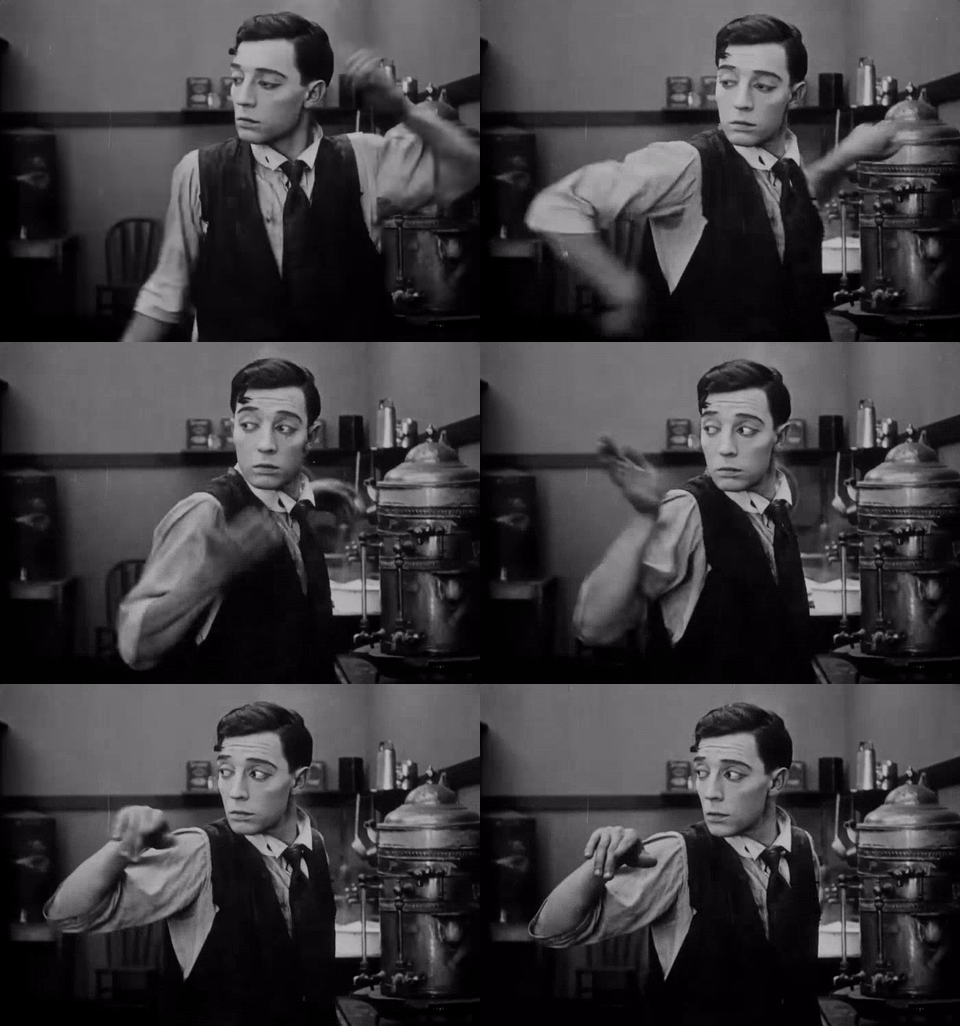
(incidentally, today is also national silent movie day, so maybe take in one of those nifty two-reelers, willya? everyone could use more buster in their lives)
Read
December 18, 2024Now that the semester’s over, I finally have time to read again. I’ve read plenty of memoirs in the past year, but this one stood out among the others. I’m convinced Buster Keaton is one of the funniest people who ever lived. His memoir is just as entertaining as watching one of his films. Through amusing anecdotes and thoughtful introspection, Buster reveals his humble beginnings in vaudeville, his silent film career, and the talkie revolution.
I especially enjoyed reading about Buster’s debut in the movie industry and his creative output of the twenties. I only wonder what other films he could have made if he hadn’t signed with MGM. Still, Keaton’s 67-year career as an actor, director, producer, and gag writer was an incredibly impressive and rewarding one. An enlightening read; I now have so much random Buster Keaton trivia stored in my mind palace. I think I’ll have to rewatch my favorite Keaton features soon too. It’s Buster’s wonderful world of slapstick and we’re just living in it.
I especially enjoyed reading about Buster’s debut in the movie industry and his creative output of the twenties. I only wonder what other films he could have made if he hadn’t signed with MGM. Still, Keaton’s 67-year career as an actor, director, producer, and gag writer was an incredibly impressive and rewarding one. An enlightening read; I now have so much random Buster Keaton trivia stored in my mind palace. I think I’ll have to rewatch my favorite Keaton features soon too. It’s Buster’s wonderful world of slapstick and we’re just living in it.

December 1, 2023
This is quite likely the most enjoyable autobiography I have ever read. Buster Keaton was not only a comic genius, he was also the most pragmatic, humble, and unassuming person ever to grace Hollywood. His humor, which off-screen seems dry and a tad sarcastic, comes through clearly this telling his story.
Even the chapter about his descent into alcoholism, and how he overcame his addiction, includes examples of his many admirable traits.
I highly recommend this book to any fan of Keaton (and who isn't?), of movies and television, or of an individual who remained a wonder throughout his life.
Even the chapter about his descent into alcoholism, and how he overcame his addiction, includes examples of his many admirable traits.
I highly recommend this book to any fan of Keaton (and who isn't?), of movies and television, or of an individual who remained a wonder throughout his life.

July 27, 2015
The three greatest silent comedians were unarguably Charlie Chaplin, Harold Lloyd and Buster Keaton. For me, the best of all of them is Keaton. There is something about his ability to stoically endure - and win out - in the most confusing of situations in his films is endearing and unsentimental. And in many ways, this same ability spilled over into his personal life.
As for his comic craft, Keaton's sense of timing was incredible, and he needed it to do so many of the physical stunts he did. There were no stunt men at this time - you did your own - and they could be very dangerous.
His autobiography, "My Wonderful World of Slapstick", reads as if you are sitting next to Keaton and listening to him as he talks to you. There is absolutely nothing superfluous to this man or his speech. He starts his narration in his typically modest, self-effacing fashion:
"Down through the years my face has been called a sour puss, a dead pan, a frozen face, The Great Stone Face, and, believe it or not, 'a tragic mask.' On the other hand that kindly critic, the late James Agee, described my face as ranking 'almost with Lincoln's as an early American archetype, it was haunting, handsome, almost beautiful.' I can't imagine what the great rail splitter's reaction would have been to this, though I sure was pleased."
Born in 1895, Keaton was performing by the time he was nearly four years old. His family ("The Three Keatons" - father, mother and Buster) were showpeople in the vaudeville circuit. He learned pratfalls early: his father experimented with him by carrying him out onstage and dropping Buster on the floor. Next, when that produced no evidence of minding on the part of his son, he began throwing Buster through the scenery - he even began to be featured in a Three Keatons act as "The Human Mop". It was then that Buster (who was given this name by none other than Harry Houdini) noticed if he smiled or let the audience see how much fun he was having, they didn't laugh as much.
Thus the origin of what would come to be known as "The Great Stone Face".
Keaton's memoirs recall the days when silent film reigned in Hollywood and comedians like Chaplin and Roscoe Arbuckle ruled the screen. He is fascinatingly detailed when discussing his various films, recalling how their gags were constructed (often on the spur of the moment - back then, you came up with your own gags, and Keaton was definitely the master in this art form.) He also tells of the many pranks played on himself and other fellow comedians, all in good fun, but hilarious-sounding even today.
Keaton was also the acknowledged champion custard-pie thrower of any silent film comedians. He taught THEM how to throw pies!
Keaton's candid voice does not gloss over the darker periods in his own life, when sound arrived to transform American film and proved the death knell to so many silent stars because their voices just didn't carry over into the new medium. As he was getting his footing in the new world around him, his first wife drug him through a nasty divorce, grabbing everything including their $300,000 home, two of their three cars and $80,000 in insurance policies on Buster's life. She even took their two sons and changed their last names to hers. All Buster had left was the third car and his clothes. Soon after, he was let go by MGM.
All this brought on a sad period of adversity. Keaton's only saving grace seemed to be his work and he began getting jobs in the new medium of television. But he also began drinking so much that, at one stage, he was taken to a sanitarium wearing a strait jacket to try and dry out. Like so many of his film personas, however, Buster somehow kept going. The work and performing were things he never left, and which never left him. Even at his personal worst, he continued to seek jobs, such as guest appearances on various shows like "Ed Wynn's T and make commercials for products such as Alka-Seltzer. With Keaton, the work came first, and he never lowered his comedic standards.
With his third marriage to Eleanor Norris in 1940, who was 23 years his junior, Buster's life began to pick up. Eleanor is credited with literally saving Buster's life by stopping his heavy drinking and helping him to restore his career. The marriage lasted until his death in 1966 of lung cancer, and the two even performed together at the Cirque Medrono in Paris regularly (she had been a dancer).
Though he's no longer with us, we can still experience Buster Keaton's magic and talent through his onscreen legacy. We can also "hear" his story in this compelling autobiography, a wonderful tale told by the man who lived it, a man who was a true craftsman and a very decent - and hilarious - human being.
As for his comic craft, Keaton's sense of timing was incredible, and he needed it to do so many of the physical stunts he did. There were no stunt men at this time - you did your own - and they could be very dangerous.
His autobiography, "My Wonderful World of Slapstick", reads as if you are sitting next to Keaton and listening to him as he talks to you. There is absolutely nothing superfluous to this man or his speech. He starts his narration in his typically modest, self-effacing fashion:
"Down through the years my face has been called a sour puss, a dead pan, a frozen face, The Great Stone Face, and, believe it or not, 'a tragic mask.' On the other hand that kindly critic, the late James Agee, described my face as ranking 'almost with Lincoln's as an early American archetype, it was haunting, handsome, almost beautiful.' I can't imagine what the great rail splitter's reaction would have been to this, though I sure was pleased."
Born in 1895, Keaton was performing by the time he was nearly four years old. His family ("The Three Keatons" - father, mother and Buster) were showpeople in the vaudeville circuit. He learned pratfalls early: his father experimented with him by carrying him out onstage and dropping Buster on the floor. Next, when that produced no evidence of minding on the part of his son, he began throwing Buster through the scenery - he even began to be featured in a Three Keatons act as "The Human Mop". It was then that Buster (who was given this name by none other than Harry Houdini) noticed if he smiled or let the audience see how much fun he was having, they didn't laugh as much.
Thus the origin of what would come to be known as "The Great Stone Face".
Keaton's memoirs recall the days when silent film reigned in Hollywood and comedians like Chaplin and Roscoe Arbuckle ruled the screen. He is fascinatingly detailed when discussing his various films, recalling how their gags were constructed (often on the spur of the moment - back then, you came up with your own gags, and Keaton was definitely the master in this art form.) He also tells of the many pranks played on himself and other fellow comedians, all in good fun, but hilarious-sounding even today.
Keaton was also the acknowledged champion custard-pie thrower of any silent film comedians. He taught THEM how to throw pies!
Keaton's candid voice does not gloss over the darker periods in his own life, when sound arrived to transform American film and proved the death knell to so many silent stars because their voices just didn't carry over into the new medium. As he was getting his footing in the new world around him, his first wife drug him through a nasty divorce, grabbing everything including their $300,000 home, two of their three cars and $80,000 in insurance policies on Buster's life. She even took their two sons and changed their last names to hers. All Buster had left was the third car and his clothes. Soon after, he was let go by MGM.
All this brought on a sad period of adversity. Keaton's only saving grace seemed to be his work and he began getting jobs in the new medium of television. But he also began drinking so much that, at one stage, he was taken to a sanitarium wearing a strait jacket to try and dry out. Like so many of his film personas, however, Buster somehow kept going. The work and performing were things he never left, and which never left him. Even at his personal worst, he continued to seek jobs, such as guest appearances on various shows like "Ed Wynn's T and make commercials for products such as Alka-Seltzer. With Keaton, the work came first, and he never lowered his comedic standards.
With his third marriage to Eleanor Norris in 1940, who was 23 years his junior, Buster's life began to pick up. Eleanor is credited with literally saving Buster's life by stopping his heavy drinking and helping him to restore his career. The marriage lasted until his death in 1966 of lung cancer, and the two even performed together at the Cirque Medrono in Paris regularly (she had been a dancer).
Though he's no longer with us, we can still experience Buster Keaton's magic and talent through his onscreen legacy. We can also "hear" his story in this compelling autobiography, a wonderful tale told by the man who lived it, a man who was a true craftsman and a very decent - and hilarious - human being.
June 13, 2023
“‘Please clear the wings,’ he called to a stagehand. ‘How can we do our work while the wings are cluttered up with other acts studying our technique and the secrets of our success?’” (pg. 54)
“‘I’ll prove I am your true friend,’ I told him, ‘by not letting you get soused alone. I’ll get drunk too.’” (pg. 72)
“Nobody suspected that the World War just ending would prove to be merely the first one. Had not President Wilson proclaimed it the war to end all wars—if we jumped in and did the dirty job?” (pg. 109-10)
“Like anyone else I enjoy being called a genius. But I cannot take it seriously. Neither does Harold Lloyd, as far as I know. The only one of us who listened and accepted the role of genius intellectual critics thrust upon him was Chaplin. Sometimes I suspect that much of the trouble he’s been in started the first time he read that he was a “sublime satirist” and a first-rate artist. He believed every word of it and tried to live and think accordingly.” (pg. 130)
“From the very start I was against making the switch to M-G-M. It seemed to me I would be lost making pictures in such a big studio. When Joe continued to argue for it, I asked Charlie Chaplin what he thought.
‘Don’t let them do it to you, Buster,’ he said. ‘It’s not that they haven’t smart showmen there. They have some of the country’s best. But there are too many of them, and they’ll all try to tell you how to make your comedies. It will simply be one more case of too many cooks.’” (pg. 202)
“Everything might have been different if I had gone back. Doing a picture I was so eager to do might have enabled me to stop drinking and re-establish myself as a man whose only business was making people laugh.” (pg. 244)
“In between these professional mishaps I kept on drinking like a fish. Once I was taken to a sanitarium in a strait jacket, and twice I was given the Keeley cure, or a facsimile. I will describe this cure briefly here, though with no great pleasure. It starts with three days during which the nurses and doctors do nothing but pour liquor into you, giving you a drink each half-hour on the half-hour.
I trust that any drunkards who happen to read this will not be misguided enough to rush off into the nearest sanitarium to get all of these free drinks. You get your favourite snort, all right, but never twice in a row. Instead they start you off on whiskey and on succeeding rounds give you gin, rum, beer, brandy, wine—before they get around to the whiskey again.
Needless to say, the Bacchus in you is revolted and rebellious long before your three-day round-the-clock drinking marathon is over. When you plead, ‘Oh, no! Take it away please!’ all you get from your bartenders and barmaids in the white coats is a friendly smile.
‘Please take it away,’ you repeat, ‘it hurts my stomach.’
‘Just one more,’ they say, for their purpose is to make the hurt in your stomach grow until it becomes unforgettable. And, being a weakling, you take that one more just as you did in a thousand barrooms.” (pg. 246-7)
“I think I have had the happiest and luckiest of lives. Maybe this is because I never expected as much as I got. What I expected was hard knocks. I always expected to have to work hard. Maybe harder than other people because of my lack of education. And when the knocks came I felt it was no surprise. I had always known life was like that, full of uppercuts for the deserving and underserving alike.
But it would be ridiculous of me to complain. I find it impossible to feel sorry for myself. I count the years of defeat and grief and disappointment, and their percentage is so minute that it continually surprises and delights me.” (pg. 280)
“All of us have our absurd side.” (pg. 281)
“Dr. Avedon said I could live to be a hundred years old. I intend to to do it. For who would not wish to live a hundred years in a world where there are so many people who remember with gratitude and affection a little man with a frozen face who made them laugh a bit long years ago when they and I were both young?” (pg. 282)
“‘I’ll prove I am your true friend,’ I told him, ‘by not letting you get soused alone. I’ll get drunk too.’” (pg. 72)
“Nobody suspected that the World War just ending would prove to be merely the first one. Had not President Wilson proclaimed it the war to end all wars—if we jumped in and did the dirty job?” (pg. 109-10)
“Like anyone else I enjoy being called a genius. But I cannot take it seriously. Neither does Harold Lloyd, as far as I know. The only one of us who listened and accepted the role of genius intellectual critics thrust upon him was Chaplin. Sometimes I suspect that much of the trouble he’s been in started the first time he read that he was a “sublime satirist” and a first-rate artist. He believed every word of it and tried to live and think accordingly.” (pg. 130)
“From the very start I was against making the switch to M-G-M. It seemed to me I would be lost making pictures in such a big studio. When Joe continued to argue for it, I asked Charlie Chaplin what he thought.
‘Don’t let them do it to you, Buster,’ he said. ‘It’s not that they haven’t smart showmen there. They have some of the country’s best. But there are too many of them, and they’ll all try to tell you how to make your comedies. It will simply be one more case of too many cooks.’” (pg. 202)
“Everything might have been different if I had gone back. Doing a picture I was so eager to do might have enabled me to stop drinking and re-establish myself as a man whose only business was making people laugh.” (pg. 244)
“In between these professional mishaps I kept on drinking like a fish. Once I was taken to a sanitarium in a strait jacket, and twice I was given the Keeley cure, or a facsimile. I will describe this cure briefly here, though with no great pleasure. It starts with three days during which the nurses and doctors do nothing but pour liquor into you, giving you a drink each half-hour on the half-hour.
I trust that any drunkards who happen to read this will not be misguided enough to rush off into the nearest sanitarium to get all of these free drinks. You get your favourite snort, all right, but never twice in a row. Instead they start you off on whiskey and on succeeding rounds give you gin, rum, beer, brandy, wine—before they get around to the whiskey again.
Needless to say, the Bacchus in you is revolted and rebellious long before your three-day round-the-clock drinking marathon is over. When you plead, ‘Oh, no! Take it away please!’ all you get from your bartenders and barmaids in the white coats is a friendly smile.
‘Please take it away,’ you repeat, ‘it hurts my stomach.’
‘Just one more,’ they say, for their purpose is to make the hurt in your stomach grow until it becomes unforgettable. And, being a weakling, you take that one more just as you did in a thousand barrooms.” (pg. 246-7)
“I think I have had the happiest and luckiest of lives. Maybe this is because I never expected as much as I got. What I expected was hard knocks. I always expected to have to work hard. Maybe harder than other people because of my lack of education. And when the knocks came I felt it was no surprise. I had always known life was like that, full of uppercuts for the deserving and underserving alike.
But it would be ridiculous of me to complain. I find it impossible to feel sorry for myself. I count the years of defeat and grief and disappointment, and their percentage is so minute that it continually surprises and delights me.” (pg. 280)
“All of us have our absurd side.” (pg. 281)
“Dr. Avedon said I could live to be a hundred years old. I intend to to do it. For who would not wish to live a hundred years in a world where there are so many people who remember with gratitude and affection a little man with a frozen face who made them laugh a bit long years ago when they and I were both young?” (pg. 282)

February 24, 2025
First sentence: Down through the years my face has been called a sour puss, a dead pan, a frozen face, The Great Stone Face, and, believe it or not, "a tragic mask." On the other hand, that kindly critic, the late James Agee, described my face as ranking "almost with Lincoln's as an early American archetype, it was haunting, handsome, almost beautiful." I can't imagine what the great rail-splitter's reaction would have been to this, though I sure was pleased. People may talk it up or talk it down, but my face has been a valuable trade-mark for me during my sixty years in show business.
Premise/plot: My Wonderful World Of Slapstick is Buster Keaton's autobiography written just six years before his death in 1966. (So it does not cover *all* of his career, but it does cover many years of his career.) Does the book cover anything and everything? Yes and no. There are chapters in his life that remain very much PRIVATE and undisclosed. Keaton is not one to name names--for better or worse.
For example, I am almost completely certain that he never mentions his first or second wives by name. His first wife is called "his future wife" or "my wife" or "Mrs. Buster Keaton" and the like, but never her actual name or even nickname. She does appear by name in the book, but only because she appears in his filmography because she was his costar in Our Hospitality. There was a good reason he said zip, zilch about his second marriage. (I believe she was fond of lawsuits for ANYTHING and everything, no matter how tangential to the truth). It was his beloved [third] wife, Eleanor, who gets stories.
There are periods of his life where he shares in great detail about his life--both private stories and show business-y stuff. There are periods of his life where the details are harder to come by. Which is fair, in my opinion. He does talk industry both for STAGE and FILM and television. He has stories about people in front of the camera and behind it. He does not go into great detail about his own films. He does not take himself too seriously. It's like he'd rather shift into telling asides and anecdotes than to deep dive into his own brilliance at what he does/what he did. He comes across as very grounded. He says that Charlie Chaplin's problem was that he believed everything that was being said about him, written about him, and began to take himself too seriously and as [an elite] intellectual.
I would have wished for a little more detail about the making of his own films, but perhaps he wanted his films to speak for themselves. Though at the time this was written, his films would not have been readily available for easy viewing. There were revivals of his films--his films being shown again in theatres, etc.,--especially in Europe. He was MUCH BELOVED in Europe, and I believe the book said Keaton was absolutely HUGE, HUGE, HUGE, MEGA-SUPER-POPULAR in Russia. [Which would make sense of the fact that so many Keaton channels on YOUTUBE are Russian.]
It was his private stories that fascinated me. He writes in one chapter of several different practical jokes that he was in on. If I remember the story correctly, some big studio executive [or similar execs] were coming into town to meet Roscoe Arbuckle, the two came up with a great practical joke: dress Buster Keaton up as his BUTLER and let the comedy follow. He'd be the clumsiest, klutziest butler ever to see if any would recognize him--the theory being that BUTLERS ARE IGNORED--before the big finale. Arbuckle would finally "lose his temper" and let the butler have it to the astonishment of his guests. Meanwhile, Buster would slip out and return as himself--a rising star in his own right--and "meet" the guests. This was just one of many practical jokes he played. Though it was near impossible to pull the same joke twice because word would spread around town.
It was his outlook on life--though he has repeatedly been called NOT introspective or reflective--that impressed me most. He writes,
"I think I have had the happiest and luckiest of lives. Maybe this is because I never expected as much as I got. What I expected was hard knocks. I always expected to have to work hard. Maybe harder than other people because of my lack of education. And when the knocks came I felt it was no surprise. I had always known life was like that, full of uppercuts for the deserving and undeserving alike. But it would be ridiculous of me to complain. I find it impossible to feel sorry for myself. I count the years of defeat and grief and disappointment, and their percentage is so minute that it continually surprises and delights me."
My thoughts: I absolutely LOVED, LOVED, LOVED, LOVED, LOVED this autobiography. There was just something so grounded and matter of fact about his narrative style. He was amusing and fascinating. I imagine this book covers such a small, small, small fraction of stories he could have told.
Quotes:
Premise/plot: My Wonderful World Of Slapstick is Buster Keaton's autobiography written just six years before his death in 1966. (So it does not cover *all* of his career, but it does cover many years of his career.) Does the book cover anything and everything? Yes and no. There are chapters in his life that remain very much PRIVATE and undisclosed. Keaton is not one to name names--for better or worse.
For example, I am almost completely certain that he never mentions his first or second wives by name. His first wife is called "his future wife" or "my wife" or "Mrs. Buster Keaton" and the like, but never her actual name or even nickname. She does appear by name in the book, but only because she appears in his filmography because she was his costar in Our Hospitality. There was a good reason he said zip, zilch about his second marriage. (I believe she was fond of lawsuits for ANYTHING and everything, no matter how tangential to the truth). It was his beloved [third] wife, Eleanor, who gets stories.
There are periods of his life where he shares in great detail about his life--both private stories and show business-y stuff. There are periods of his life where the details are harder to come by. Which is fair, in my opinion. He does talk industry both for STAGE and FILM and television. He has stories about people in front of the camera and behind it. He does not go into great detail about his own films. He does not take himself too seriously. It's like he'd rather shift into telling asides and anecdotes than to deep dive into his own brilliance at what he does/what he did. He comes across as very grounded. He says that Charlie Chaplin's problem was that he believed everything that was being said about him, written about him, and began to take himself too seriously and as [an elite] intellectual.
"I never realized I was doing anything but trying to make people laugh when I threw my custard pies and took pratfalls. Like anyone else I enjoy being called a genius. But I cannot take it seriously. Neither does Harold Lloyd, as far as I know. The only one of us who listened and accepted the role of genius intellectual critics thrust upon him was Chaplin. Sometimes I suspect that much of the trouble he's been in started the first time he read that he was a 'sublime satirist' and a first-rate artist. He believed every word of it and tried to live accordingly."
I would have wished for a little more detail about the making of his own films, but perhaps he wanted his films to speak for themselves. Though at the time this was written, his films would not have been readily available for easy viewing. There were revivals of his films--his films being shown again in theatres, etc.,--especially in Europe. He was MUCH BELOVED in Europe, and I believe the book said Keaton was absolutely HUGE, HUGE, HUGE, MEGA-SUPER-POPULAR in Russia. [Which would make sense of the fact that so many Keaton channels on YOUTUBE are Russian.]
It was his private stories that fascinated me. He writes in one chapter of several different practical jokes that he was in on. If I remember the story correctly, some big studio executive [or similar execs] were coming into town to meet Roscoe Arbuckle, the two came up with a great practical joke: dress Buster Keaton up as his BUTLER and let the comedy follow. He'd be the clumsiest, klutziest butler ever to see if any would recognize him--the theory being that BUTLERS ARE IGNORED--before the big finale. Arbuckle would finally "lose his temper" and let the butler have it to the astonishment of his guests. Meanwhile, Buster would slip out and return as himself--a rising star in his own right--and "meet" the guests. This was just one of many practical jokes he played. Though it was near impossible to pull the same joke twice because word would spread around town.
It was his outlook on life--though he has repeatedly been called NOT introspective or reflective--that impressed me most. He writes,
"I think I have had the happiest and luckiest of lives. Maybe this is because I never expected as much as I got. What I expected was hard knocks. I always expected to have to work hard. Maybe harder than other people because of my lack of education. And when the knocks came I felt it was no surprise. I had always known life was like that, full of uppercuts for the deserving and undeserving alike. But it would be ridiculous of me to complain. I find it impossible to feel sorry for myself. I count the years of defeat and grief and disappointment, and their percentage is so minute that it continually surprises and delights me."
My thoughts: I absolutely LOVED, LOVED, LOVED, LOVED, LOVED this autobiography. There was just something so grounded and matter of fact about his narrative style. He was amusing and fascinating. I imagine this book covers such a small, small, small fraction of stories he could have told.
Quotes:
At any rate it was on purpose that I started looking miserable, humiliated, hounded, and haunted, bedeviled, bewildered, and at my wit's end. Some other comedians can get away with laughing at their own gags. Not me. The public just will not stand for it. And that is all right with me. All of my life I have been the happiest when folks watching me said to each other, "Look at the poor dope, wilya?" Because of the way I looked on the stage and screen the public naturally assumed that I felt hopeless and unloved in my personal life. Nothing could be farther from the fact. As long back as I can remember I have considered myself a fabulously lucky man. From the beginning I was surrounded by interesting people who loved fun and knew how to create it. I've had few dull moments and not too many sad and defeated ones. In saying this I am by no means overlooking the rough and rocky years I've lived through. But I was not brought up thinking life would be easy. I always expected to work hard for my money and to get nothing I did not earn. And the bad years, it seems to me, were so few that only a dyed-in-the-wool grouch who enjoys feeling sorry for himself would complain of them.
The cast for our two-reelers was always small. There were usually but three principals--the villain, myself, and the girl, and she was never important. She was there so the villain and I would have something to fight about. The leading lady had to be fairly good-looking, and it helped some if she had a little acting ability. As far as I was concerned I didn't insist that she have a sense of humor. There was always the danger that such a girl would laugh at a gag in the middle of the scene, which meant ruining it and having to remake it.
Even when making my two-reelers I worked on the theory that the story was always of first importance. But one thing we never did when making our silent comedies was put the story down on paper. On the other hand I never would agree to start shooting until I had in my mind a satisfactory ending for a story. The beginning was easy, the middle took care of itself, and I knew I could depend on my writers and myself to come up with any gags we might need as we went along.

October 7, 2017
A lovely, page-turning, slightly bittersweet read.
I guess personally I would've liked more stories from the making of each of the various silent films he made, but I wonder if at that point he even remembered each as a separate entity, esp the two-reelers. Highly unlikely.
Hell, some of the trips I've made over the years sort of melt into several clumps - and I'm half the age he was when he wrote this!
Some other reviewers mention how modest Buster is in this memoir. True. Hardly surprising, once you've already read something about him, saw a few documentaries or watched him in the behind the scenes docu that is Buster Keaton Rides Again.
Also, I can hardly say his modesty is that unique among the autobiographies I've read (not too many, mind you, I prefer well-researched biographies). He isn't the only very important person capable of an honest assessment of own successes and failings. But in his case I get the feeling absolutely none of the humility projected on the pages was in any way false.
I have to confess though, unlike his honest depictions of his post-1930 years, I took quite a few of the anecdotes from the happy 20's days with whole fists of salt. It frankly doesn't matter much to me, to which degree they were all true, but hey, if it made him happy telling them....
And then there's one thing which sort of bothered me, though not surprised me: it was the way he was talking about women. Mind you, never outright vile, and no hostile talk about his first wife (I'm sure he realised his relationship with her was pretty complex - and even though I couldn't take her side, I'm also not a fan of painting her as a villain - so I think he handled it well here).
But he also barely mentions his female co-stars (I know his 3rd wife mentioned at some point, he regarded them as props, so...as I said no surprise), and his general vibe when talking about actresses (other than Marie Dressler) was reductive, dismissive and a bit condescending.
Product of his time, patriarchal society etc. C'est la vie.
But I don't allow it to spoil the book for me. Can't change the history, have to accept a piece of memoir for what it is. I didn't read this to socio-politically critique it as I read, and I didn't. It's just something I couldn't help but noticing.
P.S.
I wonder how this book is gonna compare with Steps In Time, Fred Astaire's memoir. (to be continued...)
I guess personally I would've liked more stories from the making of each of the various silent films he made, but I wonder if at that point he even remembered each as a separate entity, esp the two-reelers. Highly unlikely.
Hell, some of the trips I've made over the years sort of melt into several clumps - and I'm half the age he was when he wrote this!
Some other reviewers mention how modest Buster is in this memoir. True. Hardly surprising, once you've already read something about him, saw a few documentaries or watched him in the behind the scenes docu that is Buster Keaton Rides Again.
Also, I can hardly say his modesty is that unique among the autobiographies I've read (not too many, mind you, I prefer well-researched biographies). He isn't the only very important person capable of an honest assessment of own successes and failings. But in his case I get the feeling absolutely none of the humility projected on the pages was in any way false.
I have to confess though, unlike his honest depictions of his post-1930 years, I took quite a few of the anecdotes from the happy 20's days with whole fists of salt. It frankly doesn't matter much to me, to which degree they were all true, but hey, if it made him happy telling them....
And then there's one thing which sort of bothered me, though not surprised me: it was the way he was talking about women. Mind you, never outright vile, and no hostile talk about his first wife (I'm sure he realised his relationship with her was pretty complex - and even though I couldn't take her side, I'm also not a fan of painting her as a villain - so I think he handled it well here).
But he also barely mentions his female co-stars (I know his 3rd wife mentioned at some point, he regarded them as props, so...as I said no surprise), and his general vibe when talking about actresses (other than Marie Dressler) was reductive, dismissive and a bit condescending.
Product of his time, patriarchal society etc. C'est la vie.
But I don't allow it to spoil the book for me. Can't change the history, have to accept a piece of memoir for what it is. I didn't read this to socio-politically critique it as I read, and I didn't. It's just something I couldn't help but noticing.
P.S.
I wonder how this book is gonna compare with Steps In Time, Fred Astaire's memoir. (to be continued...)

March 20, 2012
Many people rave about Buster Keaton's work during the silent era, and very few like his talkies. For those people, this is an excellent read, because the bulk of the material is about the gags in his silents, various pranks he played on his co-workers, and his start on the stage. Unfortunately, it does not delve into all of Buster's life, in many cases only giving a short overview of events. Fans of The General will be disappointed; Buster only mentions that it was his favorite film. Some films do get special attention, like The Navigator, Seven Chances, Steamboat Bill Jr., and The Cameraman. The writing is smooth (whether it is Buster's or his ghostwriter Charles Samuels, who can tell?), and the author has obviously thought a lot about his life. It would have been nice to hear about his later career, but Keaton chalks up his choices to a need for money. Thankfully, he remains optimistic so the general mood is uplifting.

September 7, 2020
Mi sarebbero piaciute duecento pagine in piú, con piú approfondimenti su film o su certe epoche concrete oltre ai tanti aneddoti, ma, ciò nonostante, una gran bell'opera di memorie. Colpisce particolarmente che in alcuni momenti sembra di voler giustificare se stesso, per brutti momenti o decisioni, il che fa tanta tenerezza... Ma chi mai non ha sbagliato mille volte in questa vita, caro Buster? E mi sa che proprio tu, molto meglio della stragrande maggioranza, abbia imparato a rialzarti e tornarci ed andare avanti, sempre con un sorriso (in cuore, non in faccia, però... let's not walk out of character!).

February 24, 2012
"Dr. Avedon said I could live to be a hundred years old. I intend to do it. For who would not wish to live a hundred years in a world where there are so many people who remember with gratitude and affection a little man with a frozen face who made them laugh a bit long years ago when they and I were both young?"
January 9, 2022
“With one thing and another I seem to have missed very little in not being a millionaire.
Where I get a great feeling is that now, twenty five years after I’ve made my last important picture, I am still recognised and given special privileges wherever I go. This is particularly true in Europe. When I check in at the Ritz or the George V or the Savoy, the clerk will give me the best room available just because I’m Buster Keaton. I’ve never had to tip a head waiter to get a good table anywhere. I don’t have to be announced in the leading cafes of Europe.
Now, even a beloved businessman, a millionaire many times over, like Joe Schenck gets no recognition. He has to tip the room clerk and the headwaiter lavishly to get the best in the house.
I think I have had the happiest and luckiest of lives. Maybe this is because I never expected as much as I got. What I expected was hard knocks. I always expected to work hard. Maybe harder than other people because of my lack of education. And when the knocks came I felt it was no surprise. I had always known life was like that, full of uppercuts for the deserving and undeserving alike.
And if there is sweeter music this side of heaven, I haven’t heard it. Dr. Avedon said I could live to be a hundred years old. I intend to do it. For who would not wish to live a hundred years in a world where there are so many people who remember with gratitude and affection a little man with a frozen face who made them laugh a bit long years ago when they and I were both young?”
Buster Keaton
1895 - 1966
Where I get a great feeling is that now, twenty five years after I’ve made my last important picture, I am still recognised and given special privileges wherever I go. This is particularly true in Europe. When I check in at the Ritz or the George V or the Savoy, the clerk will give me the best room available just because I’m Buster Keaton. I’ve never had to tip a head waiter to get a good table anywhere. I don’t have to be announced in the leading cafes of Europe.
Now, even a beloved businessman, a millionaire many times over, like Joe Schenck gets no recognition. He has to tip the room clerk and the headwaiter lavishly to get the best in the house.
I think I have had the happiest and luckiest of lives. Maybe this is because I never expected as much as I got. What I expected was hard knocks. I always expected to work hard. Maybe harder than other people because of my lack of education. And when the knocks came I felt it was no surprise. I had always known life was like that, full of uppercuts for the deserving and undeserving alike.
And if there is sweeter music this side of heaven, I haven’t heard it. Dr. Avedon said I could live to be a hundred years old. I intend to do it. For who would not wish to live a hundred years in a world where there are so many people who remember with gratitude and affection a little man with a frozen face who made them laugh a bit long years ago when they and I were both young?”
Buster Keaton
1895 - 1966

December 30, 2023
This man’s life is absolutely insane. I honestly don’t know how much of this I truly believe but I want to believe all of it, from his family surviving four hotel fires and several train wrecks in a span of two years, to him and Arbuckle almost buying 24 acres of untapped oil fields on signal hill, to him setting his starlet gf up with a boxer so he could marry his younger gf without incident.
The details of his younger days and life in vaudeville are amazing to read. All the stories about making movies in the 20s and pranking Hollywood execs are amazing. Being able to hear about his personal life and trajectory of his career in between world wars, as the major motion picture studios are being born and the Great Depression starts is fascinating.
I could have read another 400 pages of this book easily. I feel like he had so much to share with the world. His life philosophies are just as interesting and rich as his stories. I was deeply touched by his views on happiness and the things in his life that are important to him. I highly suggest reading this if you feel personally connected to his films and artistic perspective.
The details of his younger days and life in vaudeville are amazing to read. All the stories about making movies in the 20s and pranking Hollywood execs are amazing. Being able to hear about his personal life and trajectory of his career in between world wars, as the major motion picture studios are being born and the Great Depression starts is fascinating.
I could have read another 400 pages of this book easily. I feel like he had so much to share with the world. His life philosophies are just as interesting and rich as his stories. I was deeply touched by his views on happiness and the things in his life that are important to him. I highly suggest reading this if you feel personally connected to his films and artistic perspective.
July 12, 2023
Terrific autobiography by a master comedian
Buster Keaton’s “My Wonderful World of Slapstick” is full of fascinating stories about his early life growing up in vaudeville where his father would toss him around stage and he learned to do his stunts and how to get a laugh from the audience. He traces his career through the early days of Hollywood, working with Roscoe “Fatty” Arbuckle and how Arbuckle’s career was unfairly derailed by scandal. Keaton too had ups and downs in his career, which he discusses candidly as he admits to alcoholism and run-ins with studio heads like Louis B. Mayer, but always he kept his optimism despite his troubles. Lots of fascinating stories here about Keaton’s fellow movie legends like Chaplin, Lloyd, Mack Sennett, the Keystone Cops, Red Skelton, the Barrymores and others. Also great anecdotes about the making of movie classics like “The General,” “Steamboat Bill Jr.,” “The Cameraman” and more. Buster’s wisdom and outlook on life are things to treasure. And this book is such a joy to read.
Buster Keaton’s “My Wonderful World of Slapstick” is full of fascinating stories about his early life growing up in vaudeville where his father would toss him around stage and he learned to do his stunts and how to get a laugh from the audience. He traces his career through the early days of Hollywood, working with Roscoe “Fatty” Arbuckle and how Arbuckle’s career was unfairly derailed by scandal. Keaton too had ups and downs in his career, which he discusses candidly as he admits to alcoholism and run-ins with studio heads like Louis B. Mayer, but always he kept his optimism despite his troubles. Lots of fascinating stories here about Keaton’s fellow movie legends like Chaplin, Lloyd, Mack Sennett, the Keystone Cops, Red Skelton, the Barrymores and others. Also great anecdotes about the making of movie classics like “The General,” “Steamboat Bill Jr.,” “The Cameraman” and more. Buster’s wisdom and outlook on life are things to treasure. And this book is such a joy to read.

April 5, 2020
This book is aptly titled, because most of it reads like a screenplay to a slapstick two-reeler. Each anecdote is a set up for a pratfall, for about the first two-thirds of the book, anyway. Keaton is a funny writer, but not as funny in print as he was in the movies. Nobody could be.
The other third of the book is more problematical. At about the point where he describes his divorce from Natalie Talmadge (who is never named), he starts trying to deal with “serious” matters, and he really hasn’t the knack, or the self-honesty, for this kind of drama. Although he is frank enough about his drinking problem later on, he blames both his divorce and losing his job at MGM as the causes of his drinking, not the effects. It’s not hard to read between the lines and see it, however.
On the whole, this is an amusing little book, but not enormously useful as an historical source.
The other third of the book is more problematical. At about the point where he describes his divorce from Natalie Talmadge (who is never named), he starts trying to deal with “serious” matters, and he really hasn’t the knack, or the self-honesty, for this kind of drama. Although he is frank enough about his drinking problem later on, he blames both his divorce and losing his job at MGM as the causes of his drinking, not the effects. It’s not hard to read between the lines and see it, however.
On the whole, this is an amusing little book, but not enormously useful as an historical source.
September 22, 2020
I'm so boring for giving every book I read 5 stars, but hey I enjoyed this one a lot. Keaton has an incredibly lively way of telling stories, I enjoyed reading about things that couldn't have been told if the man wasn't there himself, such as the little pranks the silent film stars played on one another and the mishaps that happened during filming one movie or another. I also found reading about his childhood very entertaining. I have to say that as in every autobiography, the author is bound to have a little bit of a bias towards himself, and this one is no exception, but it doesn't read as narcissistic, which is great. Also, if you are looking to read more about the production of his famous silent comedies, this isn't the right book to pick up, as it delves very little into the technicalities of filming. Despite its shortcomings, I still found it very enjoyable and informative.

January 29, 2025
Buster Keaton's autobiography is a wonderful time capsule. Keaton (born in 1895) began his career as a child performer in vaudeville before feature-length films even existed. After achieving success in the silent film era, Keaton moved on to sound films and even ventured to television.
The book is co-written by Charles Samuels, but his involvement is so smooth that the book feels like Keaton's own words all the way through. The text flows naturally, and sometimes Keaton switches topic when something else comes to his mind. While such bouncing around would be edited out in modern biographies, they give the book a sincere and authentic touch. The same can be said about Keaton's unfiltered opinions about his acquintances, including Keaton's contemporary Charlie Chaplin.
My Wonderful World of Slapstick is a great book for those interested in the early history of modern pop culture.
The book is co-written by Charles Samuels, but his involvement is so smooth that the book feels like Keaton's own words all the way through. The text flows naturally, and sometimes Keaton switches topic when something else comes to his mind. While such bouncing around would be edited out in modern biographies, they give the book a sincere and authentic touch. The same can be said about Keaton's unfiltered opinions about his acquintances, including Keaton's contemporary Charlie Chaplin.
My Wonderful World of Slapstick is a great book for those interested in the early history of modern pop culture.

September 1, 2025
Про одного з найкращих і незаслужено обділених увагою творців комедійного жанру, карʼєра якого потрапила під каток студійної системи Голівуду. Але те, що він встиг створити в період з 1920-1928 не перестає вражати та розважати донині. Думаю, якби він не втратив творчу свободу в 1928, то до 1966 року, він міг би порадувати нас ще не одним шедевром
Список моїх улюблених праць Кітона, які можна легко знайти на ютуб
Короткий метр - 20-25 хв:
- One Week 1920
- Convict 13 1920
- The Scarecrow 1920
- The Goat 1921
- The Play House 1921
- Cops 1922
- The Electric House 1922
- Day Dreams 1922
- Love Nest 1923
Повнометражні - 60 хв+:
- Three Ages 1923
- Our Hospitality 1923
- Sherlock Jr. 1924 - must watch
- The Navigator 1924
- Seven Chances 1925
- The General 1926 - must watch
- Steamboat Bill, Jr. 1928
- The Cameraman 1928 - must watch
Список моїх улюблених праць Кітона, які можна легко знайти на ютуб
Короткий метр - 20-25 хв:
- One Week 1920
- Convict 13 1920
- The Scarecrow 1920
- The Goat 1921
- The Play House 1921
- Cops 1922
- The Electric House 1922
- Day Dreams 1922
- Love Nest 1923
Повнометражні - 60 хв+:
- Three Ages 1923
- Our Hospitality 1923
- Sherlock Jr. 1924 - must watch
- The Navigator 1924
- Seven Chances 1925
- The General 1926 - must watch
- Steamboat Bill, Jr. 1928
- The Cameraman 1928 - must watch
Displaying 1 - 30 of 98 reviews