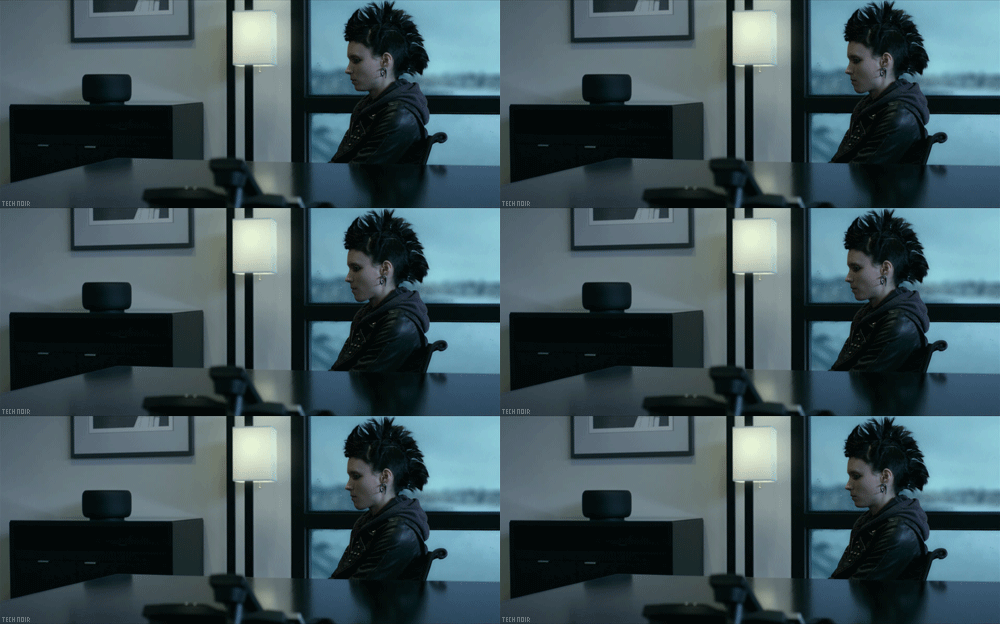
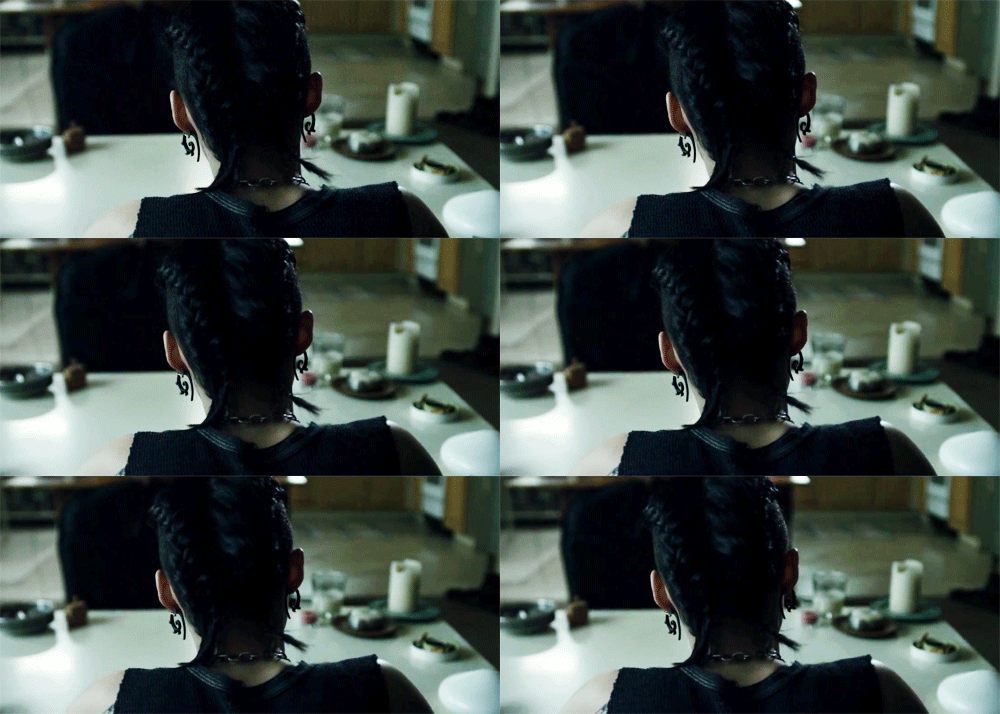
Lisbeth Salander--the fierce, unstoppable girl with the dragon tattoo--has disappeared. She's sold her apartment in Stockholm. She's gone silent electronically. She's told no one where she is. And no one is aware that at long last she's got her primal enemy, her twin sister, Camilla, squarely in her sights.
Mikael Blomkvist is trying to reach Lisbeth. He needs her help unraveling the identity of a man who lived and died on the streets in Stockholm--a man who does not exist in any official records and whose garbled last words hinted at possible damaging knowledge of people in the highest echelons of government and industry. In his pocket was a crumpled piece of paper with Blomkvist's phone number on it.
Once again, Salander and Blomkvist will come to each other's aid, moving in tandem toward the truths they each seek. In the end, it will be Blomkvist--in a moment of unimaginable self-sacrifice--who will make it possible for Lisbeth to face the most important battle of her life, and, finally, to put her past to rest.
David Lagercrantz, born in 1962, is a journalist and author, living in Stockholm. His first book was published in 1997, a biography of the Swedish adventurer and mountaineer Göran Kropp. In 2000 his biography on the inventor Håkan Lans, A Swedish Genious, was published. His breakthrough as a novelist was Fall of Man in Wilmslow, a fictionalised novel about the British mathematician Alan Turing. In David Lagercrantz' writing you can often see a pattern: major talents who refuse to follow convention. He has been interested not only in what it takes to stand out from the crowd, but also in the resistance that such creativity inevitably faces.
In 2011 his best-selling sports biography I am Zlatan Ibrahimović was published, one of the most successful books in Sweden in modern times. The biography was nominated for the prestigious August Prize in 2012, as well as shortlisted for the William Hill Sports Book of the Year award. To date, the book has been published in over 30 languages around the world and been sold in millions of copies.
In the summer of 2013, Lagercrantz was asked by Moggliden (the Larsson Estate) and Norstedts to write the fourth, free-standing sequel to Stieg Larsson's Millennium Trilogy. The Girl in the Spider's Web was published – in August 27, 2015 – simultaneously by 26 publishers (in 24 languages) worldwide, ten years after the Swedish publication of Stieg Larsson's The Girl With the Dragon Tattoo.
Stieg Larsson's three Millennium novels have sold more than 82 Million copies to date, by 52 publishers worldwide. The Girl in the Spider's Web is sold to 47 publishers and more than 6 Million copies have been sold worldwide.
There are many readers who, like me, cannot quite let go of Stieg Larsson's Lisbeth Salander, and have ended up reading David Lagercrantz's resurrected Lisbeth, even when you can feel that there is likely to be a sense of disappointment upon reading his latest addition to this iconic series. There were elements of this that I enjoyed reading in this plot driven narrative, but nothing can disguise the glaring shortfalls when it comes to characterisation and character development, and nowhere is this more apparent than in a Lisbeth who feels like an empty shell, a parody rather than an authentic creation. This along with the creaking weaknesses of some of the plotlines makes for an unsatisfactory whole, although there are some thrills to be gained as the different threads begin to connect near the end.
Lisbeth is in Moscow, and has reinvented herself into the persona of conventional businesswoman, albeit one who carries a gun. Motivated by her need to gain vengeance, she has her evil but beautiful sister, Camilla, in her sights but finds herself crippled by a past that threatens to destroy her in the present. Camilla has some formidable allies, such as Russian GRU military intelligence agent, Ivan Galinov, a charming if entirely ruthless man, and Zvezda Bratva, the criminal enterprise established by Salander's brutal father, the now dead Alexander Zalachenko. In the meantime, in Stockholm, Mikael Blomkvist is unsettled, worried about Lisbeth, and gets drawn into the death of an extraordinary unidentified homeless man that is beginning to look like murder and acquires a surprising girlfriend in Catrin Lindas. In a story that takes in Russian troll factories churning out lies, disinformation and fake news to destabilise democracy globally, a Swedish government minister being torn apart by his past, the Russian criminal underworld, and a tragic 2008 Everest mountaineering party, it all culminates in deadly danger edging towards those close to Lisbeth.
I have no doubt that many readers will enjoy Lagercrantz's latest outing for Salander, and I admit that there were aspects of the novel that absorbed and engaged, but it is undoubtedly an uneven read. There is a part of me that doesn't envy Lagercrantz at all, it must be difficult having to shoulder the huge expectations of the army of fans devoted to Larsson's Salander that anyone would struggle with, if not impossible to fulfil, few could face this burden with equanimity. For those of you planning to read this, I hope you enjoy this, there is much that is entertaining about it. Many thanks to Quercus for an ARC.
”Salander was indeed brilliant at DNA analyses. She had gone to great lengths to try to find out why her family all had such extreme genetic features. It was not just her highly intelligent and odious father, Zalachenko. There was her half brother too, Ronald Niedermann, with his exceptional strength and his lack of sensitivity to pain. There was Lisbeth herself, with her photographic memory. There were a number of people among her blood relations with exceptional characteristics, and although Blomkvist had no idea what she had discovered, he did know that Salander had taught herself the scientific methodology in no time at all.”
A homeless man, a beggar, missing fingers, with dark patches on his face that look like burns, is found dead in Stockholm. The freezing temperatures are a hazard for the homeless, but this man is poisoned. He has Mikael Blomkvist’s business card in his pocket. He had been trying to reach him to tell him about a story that had to be told. Unfortunately, Blomkvist never got the call, but he is still left with the mystery of this “crazy dwarf” and why he was so desperate to get ahold of him. The key is in his DNA. His DNA is going to tell the story of his life, and where he is from is going to be the slender thread that will lead Blomkvist to the story.
Blomkvist is tired of investigating troll factories in Russia. Minister of Defense Johannes Forsell has been the victim of a Russian troll attack, a slurry of fake news that has nearly destroyed his career. The interesting thing is somehow Forsell is tied into the dead beggar. A mystery that is hard to investigate with so few trails to follow to the truth.
Troll attacks have become a cottage industry for Putin and the Russian government. Anyone they disagree with politically is subject to these attacks. The Russians now have their fingers in American and European elections. I think we need to start taking these attacks, based on groundless lies, more seriously and see it as the act of war that it is. I want a tenacious guy like Mikael Blomkvist investigating the Russian troll factories. It is too bad he is a work of fiction, but I have a feeling, if Stieg Larsson were still alive, he would be in the thick of it.
We all have a responsibility to insure the news we are consuming and believing is based on fact.
Lisbeth Salander, our favorite goth and righter of wrongs, is in a cat and mouse game with her sister, Camilla. Her sister is another broken member of the Zalachenko family. She is evil, and yet Lisbeth freezes at the thought of killing her, even though killing her is the only solution to stopping her. When Blomkvist becomes a pawn in the middle of their sibling war, things get very real for Lisbeth in a hurry. The guilt, shame, and sympathy that is crippling her perceptions of her sister suddenly become secondary concerns to keeping Blomkvist out of the clutches of her sister.
So we have Blomkvist’s investigation and Salander’s family obsession that start out being two separate quests, but the reason why their relationship is so strong is because they frequently need each other’s help in their search for truth, or in Salander’s case...revenge. It is an unusual partnership, but a very productive one.
For those who have not enjoyed David Lagercrantz’s depiction of Salander, you will be again disappointed that she doesn’t morph into the Stieg Larsson version. There were a couple of places where I felt that she would have done something different with Larsson guiding her actions. The thing is, fair readers, that ship has sailed. You can complain and tear your hair out all you want, but this version of Salander is Lagercrantz’s version, and it is the only version you will get unless you want to go back and read the first three. The Dragon Tattoo depiction of Salander died when Larsson climbed that set of stairs that induced a massive heart attack. I think Lagercrantz’s version of Blomkvist is spot on. I’m adjusting to his version of Salander. Writer’s brains work differently. Lagercrantz isn’t Larsson anymore than Larsson could be Lagercrantz. Well, he would have to be alive to be anything, but you know what I mean.
Call this Salander the 2.0 model. Sometimes the remake doesn’t live up to the original, but that doesn’t mean it is terrible or an abomination.
3.5 out of 5 stars with a bump up to 4 because I’m a glass half full kind of guy.
Millennium VI: Lisbeth is taking the war to her nemesis, in her own overt direct well calculated way; meanwhile Blomqvist investigates the identity of homeless victim, of what initially appears to be suicide. The victim has signs of polar or mountain trauma with missing fingers and obvious frostbite scars; strangely he was last seen wandering the streets making specific mentions of a current Government Minister. As ever these are just the opening moves, Lagencrantz continues to turn-it-up whilst strongly adhering to Larssen's reality and characters, and most of all holding true to the characterisations of this super cast. Six books in, and a second writer, yet this series continues to delight and surprise; this was my first time reading this volume, and like the previous Lagercrantz books, it is a Four Star (9nout of 12) read on first reading, as there is so much to take on board, that a second read will be needed. Salander's backstory continues to be pealed open, and it is the consistent and believable way its retro-fitted into Larssen original work, that makes this series a joy to read... and next stop writer number three for Millennium VII! 2025 read
But, it was not as good as I was hoping (despite having low expectations going in)
These books, since the death of Larsson, have been fairly mediocre for me. Maybe others like them, but they just don't feel like they are awesome stories extending the previous story line. It feels more like someone figured the could write some so-so mysteries, take a few of the main characters from the original trilogy, and then make sure Lisbeth Salander's name is featured on the cover: queue the sound of money pouring in. As long as people are buying, I am sure it will continue.
I might have been kinder than I was in the paragraph above if Lagercrantz had not tried to tie it in to this series. However, it was a somewhat blah and confusing mystery that didn't really pay off much in the end, so maybe I would not have been kinder.
Feel free to give these post Larsson books a chance, but you are not going to get a recommendation from me. I really wonder sometimes why I keep giving them a try!
The Girl Who Lived Twice was on my must-read summer list. I've been a fan of the Millennium series since the original author, Steig Larsson, began writing them. When he passed away and David Lagercrantz took over, I continued reading the novels and was ready for this launch last month.
The first half of the book is much slower than previous ones. There are minimal fight scenes, suspenseful/scary moments, or major dramatic items. There is a lot to build the story before we can understand where the author is going with the big reveals. The second half more than makes up for it when our famous duo find themselves fighting for their lives. No spoilers here, but beware of fire and a sister scorned.
Lisbeth has gone missing. Mikael misses her. A doctor phones Mikael about a dead body, and it intrigues the reporter enough to reach out to Lisbeth despite it seeming like she wants to stay for away from life again. He quickly learns that Lisbeth's sister, Camilla, is out to kill her over previous sins in the last book. The dead body has no connection to any of them... yet eventually, it all weaves together. From sherpas in Nepal to genealogists all over the world, there are complex layers in this story. Including the super gene, which is based on a reality I hadn't been aware of!
Unfortunately, this book was missing something for me. I liked it, and I believe it’s a very good story, but it wasn't enough to push me above 4 stars. I settled around 3.5, rounding up because it's well written above anything else. To me, I would've liked more connections between all the characters and more detailed chase scenes in the first half. The relationship between Mikael and Lisbeth was weaker than usual, and Mikael's lust for another woman seemed fake. That said, Lisbeth's connections with other people were phenomenal. She was true to her character in much of the book, and when we keep revisiting her childhood, it's always a stronger tale.
If you want the thrills of the early books, you probably will be slightly disappointed. If you love these characters, their adventures will keep you happy. I'm a fan, and I'll keep reading.
Let me begin by stating that I was in favor of the continuation of Millenium series by an author other than the late Stieg Larsson and I've enjoyed the first two books ("The Girl in the Spider's Web", "The Girl Who Took An Eye for An Eye") but this one failed to meet my, admittedly high, expectations. It is an overall mediocre attempt in bringing beloved fictional characters such as Lisbeth Salander or Mikael Blomkvist back to life, in a story that lacks a clear direction and a plot that seems to be flat and without the necessary exciting twists and turns that usually make a crime novel a success.
A fan of the Dragon Tattoo trilogy, I've found the sequels written by this author lackluster. With this story, he's done a good job researching areas like genetics, added new characters and brought back the memories of Zalachenko's physical abuse of his wife and daughters. Bringing Lisbeth's sister, Camilla in as the antagonist is somewhat of a twist, one we hadn't seen in the past. Adding Inspector Bublanski and Modig along with flashbacks from the original series, it seems obvious the goal was similar energy of the originals. When compared to best selling crime/suspense novelists, his pace is slow until the final chapters where it picks up rapidly. He tends to overuse dialog; use of detailed meal descriptions that have little to do with the story seems amateur, though it's possible the translator is at fault. Since Stieg Larsson set a high bar for these characters, Lagercrantz has yet to achieve it, this story included.
I wanted this to be better than it was. Such a disappointment, although I’ve been alright with the Lagercrantz continuation—this one falls way short of anything that’s come before.
A watered down Lisbeth Salander is barely in the book, instead nudged out by an overly bloated conspiracy plot.
There’s so little of Lisbeth Salander in here and, let’s be honest, the only reason I keep reading these is because I simply cannot let go of her character. It’s as if Lagercrantz is afraid to spend more than a page in Lisbeth’s POV. Plus, all the scheming and politicking are barely sketched and not at all that compelling.
Others in this series have been so dark I was a little reluctant to start this, but it's well worth the time. Lisbeth Salander is a character we know and appreciate, and without giving away the plot, this book humanizes her far more, a welcome development in the character arc. Blomkvist is also a more engaging character in this book, less smug, less narcissistic and thus more bearable. Again without giving anything away, the focus of the book--the motive character and the motive event--are unusual and thoughtfully done.
So, I have to say, it is kind of hilarious that for a book set in Stockholm, Sweden, one of the obnoxious minor characters lives "across the bridge" in Copenhagen, Denmark...
Every time I pick up one of these books by a dead author I really admired, continued by Mr. Lagercrantz, I feel a deep fear, an ill-boding, as if I'm really going to regret it.
And yet, when I crack open the book, I'm always pleasantly surprised. Is it because I love the characters from the originals so much that I just don't care? Maybe.
Is it because I actually have fun with the new plots? Maybe.
Is it because I'm still having fun at all, that despite all this trepidation, I still look forward to getting the book and reading it anyway, that I am plainly ENJOYING MYSELF, that I keep coming back?
La reseña de este libro se podría resumir en una palabra: ¡Malísimo! Aún así le doy dos estrellas porque hay una trama dentro de la novela que está entretenida y te engancha para terminar el libro, pero lo que es la historia de los protagonistas principales, los originales de la serie Millenium, Lisbeth Salander y Mikael Blomkvist, difuminan tanto sus personalidades, hasta tal punto, que no sabes si Lisbeth es la mejor hacker de su país (como en la primera novela) o una hermanita de la caridad.
This book never gripped me like the first ones. I was so totally disappointed in the lack of character development. Zippo Zilch. I also felt the story had no cohesion and just meandered about leading to nowhere. Sorry ending for a great series.
I liked book #s 4 & 5 which David Lagercrantz continued from the ‘The Girl with the Dragon Tattoo’ Trilogy. The central characters – Lisbeth Salander and Mikael Blomkvist carried over their personalities very seamlessly. This book is unfortunately a very weak finish to the series, assuming this is the last in the series.
There are two tracks to the story, both of which expectedly involve Mikael Blomkvist & Lisbeth Salander. Track 1 – a beggar is found dead and it is a struggle to identify him. He had Mikael Blomkvist’s name & number. It turns out the dead man has a long story associated with him which involves some current day political leaders. Track 2 – the Russian mafia with whom Lisbeth has fought against is determined to eliminate those that oppose it. The tracks converge towards the end.
The story is ordinary; the progress of the story & pace even more so.
Overall, I enjoyed this story, especially the portions about the Mount Everest expedition. Ever since reading Jon Krakauer's INTO THIN AIR, I find failed expeditions on this mountain to be disturbing but in a fascinating way. Lisbeth Salander continues to be one kick-ass heroine, but I thought her "rescue scene" at the abandoned glassworks factory to be over-the-top unbelievable. Even though Lagercrantz left the ending open to a sequel, I hope he puts the Millennium series to rest.
This third book of the second Millennium trilogy partially redeems the previous two, a bit disappointing for me. In this last episode the setting has finally returned to be a little darker than the previous two and more similar to those of the first trilogy, that of Stiegg Larsson. The plot is quite intricate, as a good thriller plot should be, even if the whole story that takes place on Everest it seems like a bit of a stretch. Mikael and Lisbeth are in this book a little more similar to the real ones (those of the first three books) and they are a little more convincing. What leaves me a little perplexed is that Lisbeth is too little present in this last chapter: of course, she is decisive, but in the unfolding of the plot she is too little present, just when the reader expects to find her in every page, since her search for Camilla, her sister, must be concluded. Instead, Mikael is much more present, reinforcing his strength as an investigative journalist and as a conqueror of women. In particular, the scene where he meets Catrin face to face is very beautiful (and surprising) (I don't spoil how it ends). This concluding chapter is compelling and fascinating, with just the right amount of suspense and violence. There are two main stories that intertwine: the main one tells us about Lisbeth's past and her clash with her twin Camilla, where Lisbeth discovers new information and also discovers that she is more fragile than she thought. The two sisters will chase each other throughout the book, sometimes prey and sometimes predators, until the final battle, where Mikael will also be present (very present). The plot that is intertwined with this is instead centered on a case that begins with the death of a homeless, one whose name is not even known, and which will instead find its importance thanks to a pathologist tired of burying dead without a name , who will call Mikael to intrigue him and make him bring out his streak as a tenacious and curious journalist; Mikael will discover an international intrigue, with spies, the Russian mafia, British secret services and heaps of lies about an atrocious story that took place during a climb of Everest. As we understand how the two stories intersect, reversals and surprises occur, which keep high the attention and the desire to continue reading. All in all, therefore, a well-written book, which worthily concludes the Millennium saga: six books that should be in every library. Four stars well deserved.
Предупреждавах с 4-тата, че това няма да завърши добре. Че концепцията за тези продължения е ... ще го кажа направо - тъпа и само за кинти на гърба на популярни вече герои с история. Това си стана нещо като литературния Disney Star Wars. Също като там, в тази 4-та още си личеше някаква близост с оригиналния замисъл, макар и минимална. 5-тата беше що годе добре написана, но с търсене на еФтини социално-етнически и тем подобни сензации, а освен това и жертваха стария Холгер за едната цел да внесат някаква допълнителна драма.
Освен всички, които написах и казах за предните два франкенщайна, тази 6-тата е с отчайващо безмислен сюжет. За какво ни е това с експедицията до Еверест, която се объркала и евентуално някои от замесените са си разчиствали сметки, а после станали важни политици? О, я стига. Ако ни се чете за експедиция до Еверест - ще четем "В разредения въздух." Ето: (https://www.goodreads.com/book/show/2...) Препоръчвам я.
Действията са нелогични и посъщество безинтересни. Кале през цялото време е уморен, дори, когато намери време да забие някое ново гадже и през цялото време е отнесен в мисли за Лисбет. Тя пък само за сестра си мисли. Накрая втората ще направи един плонж като на Данчо Лечков '94 срещу Германия, само че в стъкларска пещ. Всяко втори действие на всеки от героите всъщност е описано като "изруга". Никаква нова идея, само търкане на стари истории, че даже и мотористите от мото клуба се завърнаха ...
Моля, оставете тези герои, където си бяха и не ги мъчете повече. И Лагеркранц не мъчете повече, няма очевидно какво повече да се изсмуче от пръстите. Към издателите са тези вопли - направете комикс, ако искате, или сериал, че е модерно. Бих го гледал. След 4-тата обаче не бих си купил друга книга. Съветвам Ви същото. Ако Ви е интересно, има ги на БГ за слушене. Мога да препоръчам само оригиналната трилогия. И донякъде 4-тата.
I really wanted to give 4 stars, but couldn't. There just wasn't enough Lisbeth Salander, who is probably my favorite character of the 21st century: brash, bold, brilliant, and probably, psychotic. There are two storylines: Lisbeth on the trail of her lone living relative, sister Camilla. Each seems determined to kill the other to right the wrongs perpetrated in the past. Lisbeth is off the grid, having gone to Moscow, but cannot finish the job after setting up an ambush. Meanwhile, Mikael Blomkvist is called by the city coroner because his cell phone number was found in the possession of a homeless man, who appears dead from an overdose. The dead man had been a Sherpa on a climb on Mount Everest, on which there were several well-known, public figures, which ended badly. Blomkvist asks Lisbeth to help, and as he gets close to unraveling the mystery, he is kidnapped by Camilla's team and the local Swedish motorcycle club, whom Lisbeth has humiliated repeatedly. To save Blomkvist, Lisbeth has to track down and rescue him, literally in the belly of the beast. Violent, and too much Blomkvist for my liking.
David Lagercrantz has done a stellar job writing the last three of the six-book Dragon Tattoo series after the death of original author Stieg Larsson.
I was captured by the latest high octane tale of genius hacker Lisbeth, evil twin Camilla, and journalist Mikael Blomkvist.
The plot is twisty but masterfully spun by Lagercrantz. It features a deadly Mount Everest climb, ties to corrupt Swedish politicos and secret security force, Russian gangsters, and the ferocious fight between the warring sisters.
The author says this is his last in the series. I’m heartsick that we may never have another wild ride in this gripping world. I vote for Anthony Horowitz, authorized to continue the James Bond saga, to take up the baton. Horowitz’s Dragon Tattoo sequels would thrill!
Since David Lagercrantz took over the Millennium series, I have had a tepid sentiment about things. This series was so impactful for me at the start and I have had issues with the transition in a post-Stieg Larsson world. This piece was a decent addition to the series, in which Lagercrantz redeems himself to some degree. With a strong story and utilising the two key protagonists throughout, series fans will have some enjoyment with what is taking place. Building up to a strong climax, the story keeps the reader hooked until the final pages. A decent recovery by Lagercrantz, but nothing spectacular.
While Lisbeth Salander has long been the adoring protagonist of this series and a hero to those who knew her, things have changed. Lisbeth has left the grid and seems to have disappeared. Gone from her Stockholm apartment, with no digital crumbs to point to her direction, Lisbeth seems to have chosen some nomadic life. Little does anyone know, she is outside the country, targeting her evil twin sister, Camilla, on the streets of Russia. The hunt is on and the end result could get messy.
Mikael Blomkvist, the anchor that kept Lisbeth sane and grounded, has been looking for her. Not only has he been worried, but he needs her tech skills to identify a man who died on the streets of Stockholm. His only possession is Blomskvist’s phone number in his pocket. While there is no record of the man, his last known words were rants about bringing down some of Sweden’s most powerful politicians. Was this simply the ravings of a mad man or could there be some substance?
Each with a problem the other can solve, Lisbeth and Blomkvist come together to help. The truth will be substantially more troubling than it appears at first glance, but these two have a way of making things right. When self-sacrifice is required, they are both willing to stand up to the truth, but the end results are sure to be devastating. As the story reaches its climax, the truth will leave the reader gasping and David Lagercrantz in complete control of both the protagonists’ lives.
While the series has come a long way, I have lost my burning interest in things of late, which is why I am so late to the party with this piece. While the narrative style seems solid, I find myself having a harder time connecting with characters and plots that Lagercrantz presents. I do not think it is the translation, but rather the style and narrative presentation. Still, there were some kernels of goodness in there, which helped me make my way through the book.
Character development was tepid at times, though I am always happy to see Lisbeth Salander and Michael Blomkvist back in fine form. These two are so connected and yet independent that I cannot help but want to know more about them. I used to thoroughly enjoy the development of these two in the early novels, complex and yet so highly relatable. While they have both settled in, I had hoped for something more, but will have to deal with what was provided to me. I am eager to see what comes of them as Lagercrantz left them in quite the state at the end of this book.
Plot development is key and I have always relied on its greatness to help me through Scandinavian noir novels. Lagercrantz appears not to have it in surplus to present a superior piece, but still limped along with someone passable. I am eager to o see what will come of the series once it is handed over to another author, as I like twists and turns that keep the series strong. I suppose I will have to reach for the next book to see if I really want to keep going one toss in the towel once and for all. Not sure Stieg Larsson would be as happy with how things have been going, but I cannot speak for him.
Kudos,. Mr. Lagercrantz, for keeping the series moving.
Well well well...he did it again! Another wonderful adventure with Mikael and Lisbeth! The five stars are for the quality of the writing and the book, but as far as adventurous storyline, I’d have to say that sadly this was my least favorite of the Millennium series. I know that my expectations were set pretty high since I have loved all of the previous books, but something just fell a bit short in this one for me. It didn’t delve as deep into the characters as usual, I think because there were so many different characters throughout the book. I still enjoyed it, but it wasn’t my favorite. I hope Lagercrantz is planning on another book in this series, because I would really like a better, and more memorable ending to this series! After all, we have grown along with these characters and have grown to love them! All in all, still glad I read this book, and will definitely read the next one....(that’s a hint to you Mr. Lagercrantz!) please write another book for us to envelop ourselves in!
6º libro de la saga Millennium (Lisbeth Salander y Mikael Blomkvist). 3er libro de Lagercrantz, tras la trilogía inicial. Si has leído los otros, puedes leer este, no te vas a morir y es más o menos ágil.
Si no lo llegas a leer, tampoco te pierdes nada. Y ya.
I can't quite let go of the Millennium series and Stieg Larsson's Lisbeth Salander and Mikael Blomkvist, despite the fact that the late author no writes the books. This novel, however, is timely, covering the topic of Russian trolls and their impact on social media and politics. We get short snippets in each chapter told from the point of view of a variety of characters, so the story moves fairly quickly. Lagercrantz lacks Larsson's meticulous detail and his exploration into the character's psyches, as well as the true intense reporter that shined in Larsson; the trade-off: the books do seem to move at a somewhat quicker pace.
Still, Lisbeth and Blomkvist just don't seem the same as they were in Larsson's world, and I miss my old friends. There's also a lot of focus on Everest in this book--it's plot-related, but it gets to be a bit much. More Lisbeth and Mikael, less mountain, please. It makes the story more complicated than it needed to be, perhaps. Still, there's plenty to keep us entertained, including more from Lisbeth and her sister's dark past.
Overall, a fairly engaging read, but lacking that special flavor and special Lisbeth/Mikael zest that Larsson always brought to the series. 3.5 stars.
La trama comienza con Lisbeth Salander en Moscú trabajando en un proyecto para exponer a corruptos y criminales de alto nivel. Al mismo tiempo, Mikael Blomkvist está investigando una historia sobre tráfico de mujeres en Suecia.
Cuando Lisbeth regresa a Estocolmo, descubre que ha sido acusada de asesinato y se convierte en el principal sospechoso en el caso. Para limpiar su nombre y descubrir quién está detrás de la conspiración en su contra, Lisbeth debe enfrentarse a su pasado traumático y encontrar pistas que la lleven al culpable. Mientras tanto, Mikael Blomkvist se une a ella en la investigación, intentando desenmascarar a los poderosos que están protegiendo al verdadero culpable.
A lo largo de la historia, se revelan los secretos más oscuros de Lisbeth y se exploran los temas de la violencia de género, la corrupción y el abuso de poder. Lisbeth se encuentra con su hermana gemela Camilla, una mujer con una personalidad igualmente compleja y peligrosa. Las dos hermanas tienen un enfrentamiento final que pone a prueba sus habilidades y determinación.
Es una novela llena de intriga, acción y giros sorprendentes. Lagercrantz logra capturar el espíritu y el estilo característico de la serie Millenium, al tiempo que aporta su propia perspectiva al mundo de Lisbeth Salander y Mikael Blomkvist. Los personajes son profundos y complejos, y la trama mantiene al lector en vilo hasta el final.
Es una emocionante continuación de la serie Millenium, en la que Lisbeth Salander y Mikael Blomkvist se enfrentan a nuevos desafíos y luchan por la verdad y la justicia en un mundo lleno de secretos y peligros.
------
The plot begins with Lisbeth Salander in Moscow working on a project to expose high-level corrupt and criminal individuals. Meanwhile, Mikael Blomkvist is investigating a story about human trafficking in Sweden.
When Lisbeth returns to Stockholm, she discovers that she has been accused of murder and becomes the prime suspect in the case. To clear her name and uncover who is behind the conspiracy against her, Lisbeth must confront her traumatic past and find clues that lead to the real culprit. Meanwhile, Mikael Blomkvist joins her in the investigation, attempting to expose the powerful individuals who are protecting the true culprit.
Throughout the story, the darkest secrets of Lisbeth are revealed, and themes of gender-based violence, corruption, and abuse of power are explored. Lisbeth encounters her twin sister Camilla, a woman with an equally complex and dangerous personality. The two sisters have a final confrontation that tests their skills and determination.
Is a novel filled with intrigue, action, and surprising twists. Lagercrantz manages to capture the spirit and distinctive style of the Millennium series while bringing his own perspective to the world of Lisbeth Salander and Mikael Blomkvist. The characters are deep and complex, and the plot keeps the reader on the edge of their seat until the end.
Is an exciting continuation of the Millennium series, in which Lisbeth Salander and Mikael Blomkvist face new challenges and fight for truth and justice in a world full of secrets and dangers.
First of all, I must say right up front that I am a big fan of Stieg Larsson’s Millennium trilogy and consider it some of the best mystery/suspense genre that I have ever read. I loved reading those books and was deeply saddened by his unexpected passing and ensuing estate battles between his father/brother and his longtime girlfriend. I personally think she got robbed and mistreated in ways that I cannot express without getting downright angry. Mostly, I miss Stieg not getting to continue writing his wonderful series and further developing his unique characters.
Putting that aside, I had very mixed feelings when it was announced that the father/brother were hiring another writer to continue the series. In my mind no one could come anywhere near capturing the magic that Stieg produced. In 2015, a new author, David Lagercrantz, wrote “The Girl in the Spider’s Web” and I read it. In 2017, he followed it up with “The Girl Who Takes an Eye for an Eye” and I read it. Now in 2019, his third Millennium novel – “The Girl Who Lived twice” - has been published and I just finished reading it on vacation.
Lagercrantz treated his three books – numbers four through six in the series – as a second trilogy in the millennium series, using the final one to wrap up his storylines of exploring Lisbeth’s family history and her personal feud with her evil twin, Camilla
“The Girl Who Lives Twice” starts off with the disappearance of our fearless hero and protector of the mistreated, Lisbeth Salander. The girl with the Dragon tattoo has sold her Stockholm apartment and gone quiet on all social media and electronic platforms. No one knows where she, how to contact her, or what she is up to. The truth she is has decided to move from the hunted to the hunter in her ongoing cat and mouse fight with her sister, and is planning to strike first.
Salander’s absence is a big problem for Mikael Blomkvist, news writer, and probably the only friend she has ever had. Blomkvist needs to her help to figure out the identity of a homeless man who lived and died on the public streets of Stockholm. Blomkvist has a mystery thrust on him to resolve. The homeless man does not exist in any of the official government records and his last words before dying involved damning knowledge of leaders in the highest levels of government and in the business world. A crumpled piece of note paper with Blomkvist’s personal phone number was found written on it and Mikael has no idea why.
As expected, Lagercrantz weaves the two plots - Blomkvist’s investigation and Lisbeth’s deadly hunt – in a parallel manner, using each to help the other until the two are forced to come together to achieve their separate outcomes. Unfortunately, Camilla, along with her GRU and criminal connections realizes that the way to get Lisbeth to come to her, is through her friends, and Blomkvist is the perfect target for apprehension and torture, forcing Lisbeth to willingly surrender herself and her life for his.
Lagercrantz has now written three Millennium series books. I found the first one to really take a long time to get moving and the new author to find his rhythm and understanding of the characters. I felt that the second book was much better and pleasantly surprised me. The story kicked off right away with easier to follow plotlines and it seemed like Lagercrantz figured out how to mirror the Stieg plotting pace and style better than I expected. I believe he brings that same momentum into the third and final book of his trilogy. For the most part, he successfully bounces back and forth between various scenes and activities, building to moments of key revelation and conflict, and pushing things towards final outcomes and payoffs. He hits a good stride and his words flow well, moving from one scene to another with confidence. His characters and conversations are natural and organic as the story unfolds. There were moments when he laid down some excellent clues and transitioned well between scenes and characters.
I read through several national reviews and noted many major publications considered this book to be less than stellar and rather messy in its delivery. I think my review is more favorable for a different but very important reason. I think that that the cause of the negative views is not due to Lagercrantz as a writer, but rather to limitations he has to work within to write in the Millennium universe and it’s already established characters.
Let’s face it, even ignoring the public fighting between Larsson’s girlfriend and family, Lagercrantz is really limited to what he can do when playing in the Blomkvist and Salander world. He cannot kill them and he cannot change them or their histories. He has to find how to develop the unorthodox and multi-faceted relationship between Mikael and Lisbeth – are they friends or more? It must be extremely hard to expand on what Stieg’s already created and established.
I actually think that the creation of Lisbeth’s sister, Camilla, and expanding their family history and criminal network was a pretty creative approach to take. I am not sure what more a writer could do to deliver something new that adds to what’s already been told. In my mind, after a rough start, Lagercrantz was able to get his footing and find a way to build on Stieg’s foundation, deliver a three-book arc that provided them as much conflict, tension, and development as he could muster, and provide a strong enough ending for everyone involved.
Overall, I was really surprised by Lagercrantz’s marked improvement from his first book through to third. Let’s be honest, taking on Stieg’s Millennium series has a bar so high that it is virtually impossible for anyone to come close to his unique ability to tell an intricate and layered story that draws heavily on our emotions. That is no insult. It is the truth. Still, I believe that Lagercrantz was able to successfully capture a bit of the Stieg magic and make it work.
After reading in multiple interviews that Lagercrantz is done with writing Millennium books, I would even go one step further and make a recommendation. Rather than find another author to take up the mantle of writing of further stories, I suggest that the Larsson family allow Blomkvist and Lisbeth to rest in peace. I cannot really think there’s much left to discover in these characters that hasn’t already been shared. Don’t continue publishing stories that start repeating themselves and lessen or demean the quality of Stieg Larsson’s legacy. Please don’t do that.
I keep coming back to Stieg Larsson's Lisbeth Salander because she is the antihero I love to root for. She didn't sign up to save anyone and she's no angel but she does avenge wrongs and takes names while doing it on her own terms. I don't feel that David Lagercrantz's past attempts at continuing Lisbeth's journey have been disappointments until reading this book. In this story, both Lisbeth and Mikel Blomquist, mainstays of the series, have heretofore been at the forefront of the plot. In The Girl Who Lived Twice, they were relegated to the backstory in favor of the main mystery.
I found myself wanting to see more of these characters. I didn't care about the mystery at hand. I was disappointed to end the series on this note. If there's another book in the series, I won't be reading it, which is really disappointing, considering how much I loved this character and her backstory.
4 Stars for The Girl Who Lived Twice: A Lisbeth Salander Novel, Continuing Stieg Larsson’s Millennium Series (audiobook) by David Lagercrantz translator George Goulding Read by Simon Vance. I’m so happy that this series is continuing. I really enjoy getting a glimpse back into this world.