Jump to ratings and reviews
Rate this book

Half Sick of Shadows

Rate this book
Everyone knows the legend. Of Arthur, destined to be a king. Of the beautiful Guinevere, who will betray him with his most loyal knight, Lancelot. Of the bitter sorceress, Morgana, who will turn against them all. But Elaine alone carries the burden of knowing what is to come--for Elaine of Shalott is cursed to see the future.

On the mystical isle of Avalon, Elaine runs free and learns of the ancient prophecies surrounding her and her friends--countless possibilities, almost all of them tragic.

When their future comes to claim them, Elaine, Guinevere, Lancelot, and Morgana accompany Arthur to take his throne in stifling Camelot, where magic is outlawed, the rules of society chain them, and enemies are everywhere. Yet the most dangerous threats may come from within their own circle.

As visions are fulfilled and an inevitable fate closes in, Elaine must decide how far she will go to change fate--and what she is willing to sacrifice along the way.

The Lady of Shalott reclaims her story in this bold feminist reimagining of the Arthurian myth from the New York Times bestselling author of Ash Princess.

448 pages, Hardcover

First published July 6, 2021

521 people are currently reading
31078 people want to read

About the author

Laura Sebastian

14 books4,206 followers
Laura Sebastian grew up in South Florida and attended Savannah College of Art and Design. She now lives and writes in London, England, with her two dogs, Neville and Circe. Laura is the author of the New York Times bestselling Ash Princess series: Ash Princess, Lady Smoke, and Ember Queen, as well as the Castles in Their Bones series: Castles in Their Bones, Stardust in Their Veins, and Poison In Their Hearts; Half Sick of Shadows, her first novel for adults; and Into the Glades, for middle-grade readers.

Ratings & Reviews

What do you think?
Rate this book

Friends & Following

Create a free account to discover what your friends think of this book!

Community Reviews

5 stars
2,149 (21%)
4 stars
3,993 (40%)
3 stars
2,789 (28%)
2 stars
801 (8%)
1 star
209 (2%)
Displaying 1 - 30 of 1,663 reviews
Profile Image for Laura.
Author 14 books4,206 followers
Read
January 25, 2020
I am so thrilled to be able to talk about this book! It's ironic that it'll be my debut adult book because it was the first fantasy book I ever started writing, back when I was a teenager. We don't have an official description yet, but below is the letter I wrote about it that we sent to editors. I think it sums up the book and my journey writing it pretty well.

"When I first read Tennyson’s THE LADY OF SHALOTT, I didn’t realize how problematic it was. I didn’t really care that it was about a passive woman who checks out a guy and then dies for it. As a depressed teenager, I connected to the image of this woman, locked away alone in a tower, forced to view life second-hand through a mirror without ever actually participating in it. For me, that mirror was always fiction, and so at seventeen I started writing the first draft of HALF SICK OF SHADOWS.
This version, I’m happy to say, is completely unrecognizable from that first effort, in large part because I did, eventually, realize just how problematic Tennyson’s original poem is and, to a larger point, how inherently sexist Arthurian mythology is as a whole. The women in the canon are seductresses and manipulators, prizes to be won and sacrifices to be made. Before Tennyson, Elaine was relegated to just a handful of lines as Lancelot’s wife before she dies of a broken heart when he leaves her for Guinevere.
It isn’t surprising that she became such a cultural figure during the Victorian era—a favorite of poets like Tennyson and Pre-Raphaelite painters. She was seen as the ideal woman, especially when compared to the evil Morgana and the traitorous Guinevere. She was passive and kind, she did as she was told, she was so wholly dependent on her husband that she literally couldn’t live without him. She became a cursed woman in a tower, weaving at her loom day in and day out, a fairy tale princess who could not be saved.
But here we are now, in the twenty-first century, and that is no longer the kind of heroine we want or need. As I grew up and my world view shifted, so did my version of Elaine. She grew a backbone, she took on her own agency, she came into her own kind of power. She stopped living on the outskirts of someone else’s story.
She left her tower.
Writing that journey has been a challenge but an immensely gratifying one. It is, as we writers like to say, the book of my heart. I hope you love it as much as I do."

I'm so excited for y'all to meet Elaine, Morgana, Gwen, Lancelot, and Arthur!
Profile Image for jessica.
2,684 reviews48k followers
July 25, 2021
i love arthurian retellings. i havent read a lot of the original stories, but i love the vibe and atmosphere of camelot, knights, magic, and quests. luckily, all of the retellings ive read were really good at not requiring the reader to have an in-depth knowledge of the subject.

however, this one starts off as if its already in the middle of a story. its a weird feeling being a couple chapters in and feeling like youre missing a big chuck of the plot. and the structure of the story doesnt help. i generally dont mind non-linear timelines but something about having flashbacks to the past, visions of the future, and present-day events all in the same chapter/stream of consciousness just seems a little too chaotic for me. it unfortunately makes the story feel disjointed and slow to progress.

but even though the execution isnt for me, i really do enjoy the content. i appreciate the authors note at the end explaining her reasoning for telling the story the way she did. a lot of key components and characters to arthurian myth are changed, which might annoy some readers, but i thought the changes had a clear purpose and helped transform elaine into the type of character the author wanted, so i cant fault her for that.

overall, a pretty unique take on an old familiar tale.

3.5 stars
Profile Image for Linden.
2,104 reviews1 follower
June 29, 2022
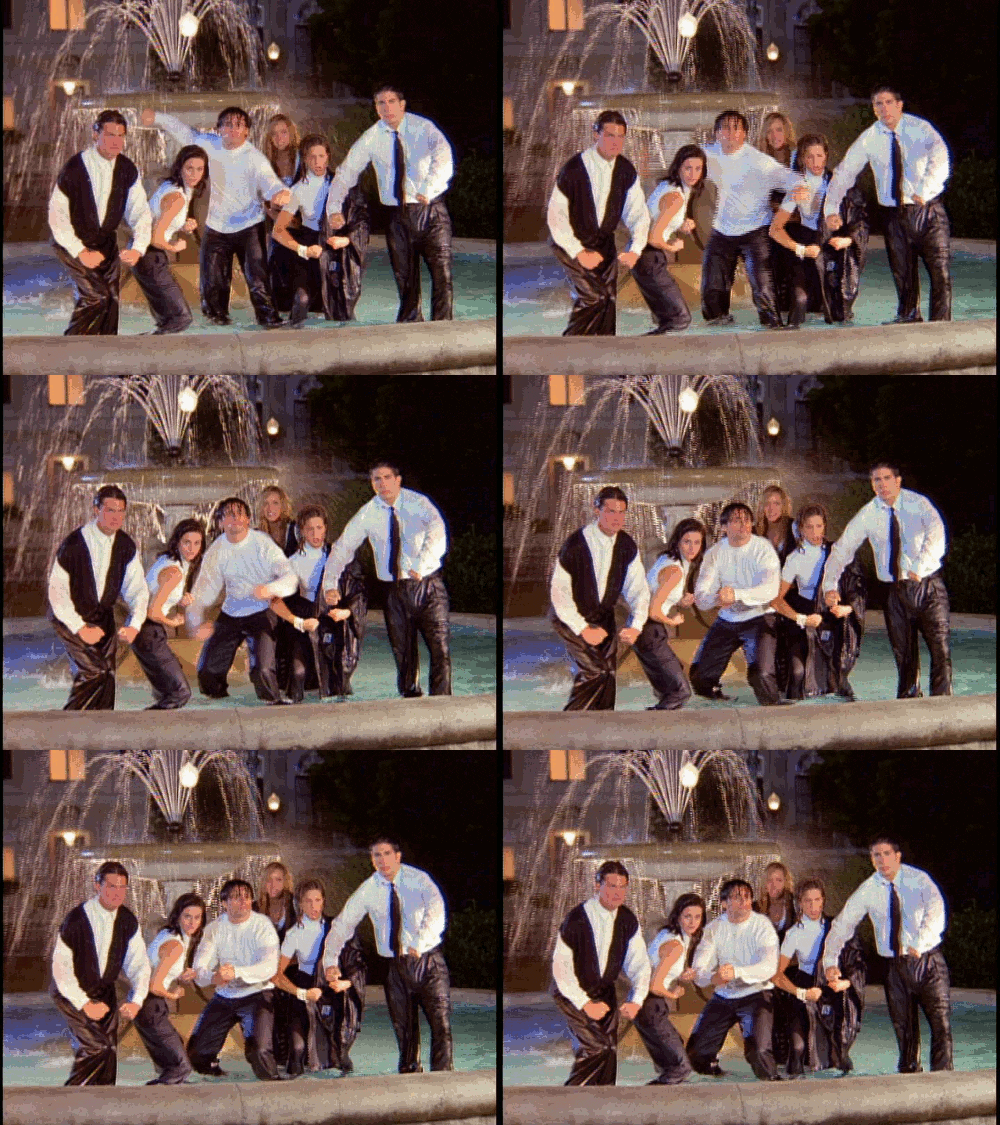
I found the narrative confusing and slow moving, as it jumped from the past, to the future as seen in Elaine’s visions, to the present. There were changes to some of the traditional Arthurian characters, too, making Morgana and Morgause twins, and Morgause the wife of Mordred. I’m familiar with the Arthurian legends and the Tennyson poem, but I never really got the sense of that time period. I found myself questioning the author’s research when she mentioned someone drinking cocoa, which was unknown in Europe before the 16th century, and a child was said to be wearing a taffeta dress, even though that fabric wasn’t around back then. The group, Elaine, Arthur, Lancelot, Morgana, and Gwen, seemed more like they belonged in an episode of “Friends” set in an alternate universe with knights, magic, and patricide. I received an ARC of this novel from Netgalley and the publisher in exchange for an honest review.
Profile Image for Kate (BloggingwithDragons).
325 reviews104 followers
May 17, 2021
I received this book for free from NetGalley in exchange for an honest review. This does not affect my opinion of the book or the content of my review.
Actual rating: 1.5 stars


As a really big fan of Arthurian legend, I’ve been loving that there are so many new retellings of the legend, like The Guinevere Deception and Half Sick of Shadows releasing recently. I had to snap up Half Sick of Shadows, as soon as I read the synopsis. Half Sick of Shadows is a retelling of The Lady of Shalott and claims to be a bold, feminist retelling where the Lady of Shalott, Elaine, reclaims her story. Honestly, I found that the novel was not very feminist at all, despite its claims to the contrary, and that I did not care for a lot of the twists on Arthurian legend, and that I just didn’t like the characters or the writing style of Half Sick of Shadows.

"Nimue's words come back to me. You will always be safe here, but you were not raised to be safe, you were raised to be heroes.


I really do admire that the author, Laura Sebastian committed so fully to writing such a different take on Arthurian legend. I thought it was pretty interesting how a lot of Half Sick of Shadows took place on the island of Avalon. It was interesting seeing the lives that the main group of characters, Arthur, Guinevere, Lancelot, Morgana, and Elaine had there, even if it wasn't extremely well-fleshed out and was told to us from Elaine's memories of the past. However, I never really understood fully why all of these characters were growing up on Avalon, except for some vague and cheesy references to literally being heroes in training. Arthur is supposed to be raised there as part of a peace agreement between the fay and Camelot, since he is prophesied to bring peace to the formerly warring fay and humans with his future reign. Lancelot grows up there with his full fay mother, and Morgana we know, loves it on Avalon, but not why exactly she is there, and not at Camelot, in the first place. I also have no idea why Guinevere was on Avalon at all, but we do find out why Elaine comes to leave her mother's tower and to enter Avalon.

While this take of having such legendary characters growing up together was quite intriguing, I personally struggled with a lot of the aspects of Arthurian legend in Half Sick of Shadows. I was really shocked when Mordred was not, in fact, the son of Arthur. As those familiar with Arthurian legend know, Mordred being Arthur’s son is a very big part of the tragedy of King Arthur. Instead, Mordred is a rival contender for the throne for Arthur, ( the bastard son of Uther, Arthur's father, and also Morgause's husband and stepbrother ), and a pretty basic, run of the mill villainous and conniving character. There wasn’t a whole lot of depth to him. I was similarly surprised by the fact that the major Arthur-Guinevere-Lancelot love triangle, which one could argue is the most famous part of the Arthurian legend, and even takes down the entire kingdom of Camelot, was not really a thing in this novel.

Instead the main romance is between protagonist Elaine and Lancelot, who is part fay. So already, two of the biggest tragedies and components from Arthurian legend are missing, and instead we are stuck with an insecure "will-they-won't-they" first love where Elaine is repeatedly going back and forth on her feelings for Lancelot due to her visions. I also didn’t care for the portrayal of Merlin, who seemed to be Mordred’s champion over Arthur’s, which struck me as Arthurian blasphemy. I also didn’t like how little Merlin seemed to care about events in Camelot and the world at large. He was not at all the typical portrayal of Merlin, who usually appears like a magical genius and calculating mastermind, and instead seemed more like a quirky, lazy uncle, who throws in his unwanted two cents every once in awhile. 

Though I most certainly didn’t care for the portrayal of Merlin in Half Sick of Shadows, I found I didn’t really care for most of the other characters either, unfortunately. Arthur was completely bland, pure-hearted, and guileless, as he is often portrayed. In Half Sick of Shadows, he is more of a figurehead for the throne, where important decisions are made by his group of friends, and is also a puppet for the legend of Arthur, rather than a fully fleshed out character. He has to be there in order for it be the King Arthur legend, but he doesn't feel integral to the story at all. I don’t find it believable that such an innocent and naïve person is able to be a legendary king and to make or in his case, even handle, the difficult decisions required. Lancelot was similarly bland to me, despite attempts to add spice to his character by making him part fay, it really didn’t have much bearing on his relationship with Elaine or any of the other characters. Half Sick of Shadows does give Guinevere, who is often portrayed as a damsel in distress or a similarly weak-minded woman, an interesting background, but the fact that she was actually really undermined her character, in my opinion.

In fact, I don’t think I can overstate how much I did not like that twist in her character and thought it not only completely unnecessary, but also as a blanket excuse for why she was more wild than her legendary character, rather than actual character development. I’d really like to see a feral, warrior Guinevere that just had that personality, period. There is already so much inherent drama in Arthurian legend, why is it necessary to add these kinds of overdone tropes? 

I didn’t care much for main character Elaine, either, sadly.  She is so caught up in the possibilities of the future and who might betray her that she is truly unable to live. Whenever she hits a bump in the road, she runs crying for help from the Lady of the Lake, Nimue, or to Merlin, who doesn't even really support her same cause. When Elaine does finally decide to ignore a couple of visions, it doesn’t feel empowering, but an act of pure desperation, as nothing else has worked or turned out well. The only character I truly had any positive feelings for in Half Sick of Shadows was, in fact, Morgana aka Morgan Le Fay. I truly found her to be a sympathetic character, loving Avalon, her magic, and wishing to remain on the island forever. It was a pretty big problem for me that though Elaine had And it’s never really explained why this was necessary other than to say that the future is only made up of many different possibilities. 

"Especially knowing what Nimue and I do about [Morgana] and Arthur's relationship, how everything we've seen shows it being the first to fracture, how it leads to everything else. I don't know why Nimue is so insistent on sending her back to Camelot. She could keep her here, happy and out of trouble."


These many possibilities are frequently recounted to us by Elaine, which was honestly not my favorite part of Half Sick of Shadows. As an oracle, Elaine constantly sees visions of the future. That means readers, like Elaine, are constantly reliving the same visions, or different versions of them over and over again, which got quite tedious. Also as a result of these visions, and the fact that Elaine has a foot in the door of the future, Half Sick of Shadows is told in a non-linear fashion. Sometimes, the time setting jumps to past, present, and future all in the same chapter. This really didn’t work for me, especially because the jumping didn’t seem all that well planned, with readers not finding out important parts about characters and events either ever or not until way later after an explanation would have been useful. Plus, this novel is really just one big “tell” and not “show.” Unfortunately, Elaine really tells readers everything, and the story itself does not show us. This made for a less enjoyable read for me personally. 

"Don't you know who you're talking to? Lady Elaine of Shalott--Arthur's closest adviser. He trusts her judgement implicitly, and should you try to go over her head...well, I wouldn't recommend it."


A big thing that I would have liked one of these explanations on was how exactly Elaine ended up as being Arthur’s advisor. To me, it seems like a no-brainer not to pick someone who is known as “Elaine the Mad” back in Camelot to be an advisor.  But Arthur is completely unabashed about Elaine’s reputation and how it might reflect on him, even though it seems like something that could have an effect on his bid for the throne. To put it simply, it’s just bad campaign politics. Plus, I did not see Elaine getting any kind of political training at all in Avalon. Yes, she is an oracle, but I fail to see how knowing certain versions of the future makes you suitable to be the sole advisor to the future king. What’s worse, is she was virtually a shut in in her mother’s tower back in Camelot, so I really don’t see how she was at all qualified or experienced enough for this important position. 

"Nimue would be awfully proud, wouldn't she?" she asks, her voice brittle as frozen glass. "Arthur before all."

One of the biggest issues I had was with the claim that Half Sick of Shadows is the feminist and bold marketing claims. The entire novel revolves around Elaine, the protagonist, Morgana, Lancelot and Guinevere doing whatever it takes to put Arthur on the throne. This usually means sacrificing their own personal well-being, whether it’s emotional, mental, physical, or involves their homelands, families, goals, and dreams. It’s rather depressing, as is the ending of the novel. Yes, Elaine manipulates Guinevere into giving up her own happiness and marrying Arthur on the promise of being able to change Camelot with its typical societal pressures on women, but they both quickly realize this is never going to happen in their own lifetimes. That’s pretty disheartening and not at all feminist to me. 

I guess Half Sick of Shadows likes to portray itself as feminist because of the time the main characters spent on the fay island of Avalon, where woman can wear revealing clothing, sleep with men of their choosing and before marriage. But does it truly count to be a feminist when you’re living somewhere where women have more rights? Isn’t a true feminist someone who fights for the rights of women where and when there are none? It really didn’t translate well to me how easily the woman gave up their rights from Avalon and then gave up on changing things in Camelot for the better. Plus, they were all constantly willing to give up anything for Arthur, a man. There’s a pretty big disconnect here in what the novel wanted to do and what it actually did, which was making its heroine seem unqualified, uncertain, and easily giving up. 

Unfortunately, Half Sick of Shadows, with its non-linear timelines, unlikeable characters, strange takes on Arthurian legend, and constant telling and not showing, which was highlighted by Elaine telling us the same visions repeatedly, was not the most enjoyable read for me. I think the premise of retelling the rather dark tale of The Lady of Shalott as a feminist, modern tale was a really interesting and promising, but sadly, the novel just didn’t stick the landing. For me, I was more than half sick of this novel and considered DNF-ing at several points. If you are not bothered by different takes on Arthurian legend that aren’t really true to the core of it, you might still like this novel. I personally enjoyed another retelling of Arthurian legend, The Guinevere Deception, which also has a focus on the female characters and several unconventional twists on the legend, more. 


bloggingwithdragons.com
My Book Review Policy
Connect with Me:
| instagram | tumblr | twitter |pinterest | facebook | email |
Profile Image for Shelby *trains flying monkeys*.
1,748 reviews6,569 followers
August 15, 2021
I love King Arthur stories. I have since the sixth grade when I had a teacher read us a chapter each day from one of the 'tales of King Arthur' line. I could not wait to get to her class each day to see where the story went.

So this one is mostly from the point of view of Lady Elaine. She lives in Camelot and people have said she is mad. The reasoning being is that she 'sees' things before they happen. Arthur's sister Morgana (Morgan La Fey) comes to visit and convinces Elaine to go to live with her on Avalon. Elaine consents and begins being taught that she has a gift by Nimue (Lady of the Lake.)

There she meets her new besties Morgana of course, Gwen who is stronger than most guys, half fey Lancelot and the future king Arthur.
Honestly, this whole set up to me seemed like a bit of Middle agish "Friends."


I kinda did enjoy this book. Maybe the fact was I just loved one of my favorite characters ever. Morgana (Morgan Le Fay.)

The book is supposed to (I think) be sort of a feminist retelling but it totally flopped on that. I felt like everyone was just living to make sure that Arthur was king and to heck with you or your own dreams.
It does tend to drag and repeat itself continuously so there is that to be prepared for. Also, this story introduces some story lines that I wasn't so fond of that would be spoilery to mention. So go in with an open mind that it is not the typical re-telling.

Booksource: Netgalley in exchange for review.
Profile Image for The Smol Moth.
232 reviews35 followers
September 9, 2021
I read a couple of chapters but I may need to DNF, because a medieval gown was described as having 'cap sleeves' and I'm traumatized now

Edit: OH, YOU DON'T THINK SHE'S WEARING A CORSET? yOU DON'T SAY! I WOULDN'T THINK SHE WOULD BE WEARING A CORSET EITHER, CONSIDERING CORSETS WEREN'T REALLY A THING UNTIL THE 19TH CENTURY!

Also, I'm not sure how I feel about Morgana being described as 'beautiful in a cruel way' and then the story immediately goes on to discuss her 'bronze skin' and 'hawklike nose.' Idk, your mileage may vary, it just felt a bit weird to me. And there's only one other POC character so far (not counting Morgause, Morgana's evil sister who's barely showed up so far)--granted, it is only chapter four. Also, Morgause is literally a misogynist stereotype! #FleshOutMorgause2021

Edit 2: I don't think Morgana, a witch from the medieval era, would swear by 'Maiden, Mother, and Crone.' That's a twentieth century thing. Granted, the belief comes from Hecate according to Wikipedia, but as far as I can tell, the phrasing is very modern.
Also, the story is poking fun at the idea of Morgana learning necromancy in a nunnery?? What the fuck, that's literally the best part in Le Morte D'Arthur, I love thinking about the assassin witch nuns who taught Morgana.

Edit 3: I don't know what gave anyone the idea that medieval people were so blushing and reticent that they wouldn't even mention the concept of virginity in front of a teenage girl, but let me assure you: they were not. That's not even a thing in fundamentalist cults, as far as I know. The whole POINT is getting 'virginity virginity virginity' drilled into your head! Do you think they called the Virgin Mary 'Mary, the Person Who Never Kissed Anyone???' There's literally NO reason for people to not tell Elaine that the unicorn represents virginity. Additionally?? Since when have men as a group EVER been good at pretending they weren't interested in what goes on between a woman's legs? Policing your virginity was the socially acceptable form of interest in your sexuality! Yes, it's gross, but there's so much more to say about women, virginity, and misogyny then 'they wouldn't tell Elaine the unicorn represented virginity lol.'

Also, Morgana destroying the tapestry is SUCH a dick move. Embroidery is so hard. If I had worked on that, I would have learned magic to personally kick Morgana's ass into a ditch.

I need to DNF this, God. This is making me so mad.

Did Elaine just describe a villain as having a 'hooked nose?' GOD.

Edit 4: I read a bit more of this book for God knows why (curse my bad impulse control). Magic starts with your menstruation?? So can people who don't get periods not use magic or...

Also.
“She’s touched in the head, Elaine,” Morgana said, her voice surprisingly delicate.

Yeah, fuck this book. As far as I can tell, Morgana is TRYING to say that Elaine's mom is mentally ill. Obviously they don't have the term 'mental illness' in their culture, but I would honestly rather she just called Elaine's mother mad, and that's saying something. Also, how does Morgana even know this?? Has she ever met Elaine's mom? Why is Elaine trusting Morgana when Morgana honestly has the personality and vibes of a villain who's doing it all for the shits and giggles? It'd be really interesting if Morgana was manipulating a lonely, inexperienced girl into doing her bidding, but no.

The full review is up on my blog!
Profile Image for Bethany (Beautifully Bookish Bethany).
2,774 reviews4,686 followers
July 7, 2021
A feminist retelling of The Lady of Shalot, Half Sick of Shadows is a deeply character-driven story that allows Elaine (the titular lady) to take back control of her destiny.

Elaine is an oracle, living with the burden of seeing many possible paths and not being able to share what she sees. Knowing that the man she loves might one day betray her, knowing that her best friends might one day despise her. It's an intense burden and much like how Elaine lives, the book jumps among timelines, slowly weaving a portrait of the past, the present, many possible futures and Elaine's place within it. It's melancholy and often heart-breaking as you slowly come to know and understand these figures from myth with tightly entwined destinies.

I think for some readers this is going to be too slow. It really takes its time and uses repetition to allow the reader into the experience of Elaine's life constantly seeing visions of possible futures. It's messy, but love and found family are at its heart. I think there's something valuable here. I received an advance copy of this book for review via NetGalley. All opinions are my own.

Note that due to the nature of the story being retold, this book deals with suicide and suicidal ideation.
Profile Image for Lucia.
488 reviews37 followers
October 8, 2021
2.5 stars. This is going to be the most pedantic review I'm ever going to write, because my enjoyment of this book hinged on historical authenticity. Not accuracy; authenticity.

Over the years, I learned to silence my inner nitpicker while reading historical fiction. When anachronisms pop up, I trained myself to make a note of it, then let it go, provided they didn't detract from the larger scope of the story.

But this book. This infuriating, maddening book that I had been so damn excited about undid all of that careful training.

I'm going to just preface this review (more like a complaint) that this was actually a decent Arthurian retelling. It was definitely slow, but this was meant to flesh out the Lady of Shalott, Morgan le Fay, Guinevere, and the Arthurian court through the post-modern (but very white) feminist lens as well as explore the dominant theme of destiny vs. choice. I enjoyed the way the author experimented with structure and time, the fresh characterizations of the main five players that still recalled the popular source material, and the overall writing style.

That said, I'm going back to the foundation of this book. This is a retelling of the Arthurian myths - so why the fuck does it feel like I'm reading a Regency soap opera with magic and the fae thrown in?

It's amazing how just the repeated mentions of corsets and tea made me throw this book across this room.

What we know as corsets - both the term and the actual supportive undergarments with boning - did not exist until the 17th century. Its predecessor were called stays, which did not exist until the 15th century (barring the outerwear that resembles a corset on a 1600 BCE Minoan figure) and were not popularized until the 16th century.

And tea, as we know, had only arrived in England in the mid-16th century when the Age of Exploration was underway.

So why the mini history lesson?

Because this book constantly, constantly mentions corsets and tea to the point that deliberately not wearing corsets became half of Morgana's personality and tea and tea time (TEA TIME? TEA TIME??? Are you trying to be Bridger-fucking-ton???) were significant periods of daily life at the Camelot court.

I brushed it off the first time it was mentioned, but by the fifth and certainly not the last time, I had to put the book down and scream out my frustration.

I'm not even asking for historical accuracy in every minute detail, especially since this is a fantasy retelling. But for fuck's sake, having those anachronisms thrown at me in every god damn chapter is so jarring; it takes me completely out of the flow of the story.

If you're going to write something that has been speculated to have taken place between the late 5th and early 6th centuries, I fucking expect you to immerse me at least (AT LEAST!) in the feel of the time period, even if it's a fantasy. Hell, throw in some anachronistic details from the 12th-14th centuries when most of the tales were being written and sung! But fuck, have the god damn decency to keep modern aspects that completely undermine the setting and the historiographical sources out of the story you're trying to sell me.

And it's 20-fucking-21. Can we move on from using corsets to symbolize the oppression of women? It's trite and UNTRUE.

Ugh. What a spectacular, aggravating disappointment. You're better off reading The Guinevere Deception by Kiersten White or Queen of Camelot by Nancy McKenzie if you're really itching for an Arthurian retelling.

(By the way, women prior to the 15th century wore chemises and strips of cloth as underwear. Before the 13th century, women wore loose-fitting clothing so as not to draw attention to their the shape of their bodies - so wearing shapewear like a corset makes no fucking sense in this context.)

Thanks to NetGalley for the ARC.
Profile Image for a foray in fantasy.
327 reviews352 followers
July 12, 2021
I give 5 stars to any book that either makes me cry or want to reread it immediately. This book fits into the first category. I felt so connected with the characters and I ended up really enjoying the time jumps.

This book is kind of depressing, but I enjoyed it.

Also, Morgana and Elaine give off serious queer vibes and I am here for it. I just wish that aspect of their relationship could have been included instead of being vaguely implied.

4.5 stars
Profile Image for abthebooknerd.
317 reviews158 followers
May 19, 2021
The Lady of Shalott is finally given a voice in this unique retelling of the Arthurian legends we all know & love 💖

What a ride! This sucker was dense, but I really enjoyed seeing Elaine’s point of view in this classic tale.

Everyone knows the legend. Of Arthur, destined to be a king. Of the beautiful Guinevere, who will betray him with his most loyal knight, Lancelot. Of the bitter sorceress, Morgana, who will turn against them all. But Elaine alone carries the burden of knowing what is to come - for Elaine of Shalott is cursed to see the future.

On the mystical isle of Avalon, Elaine runs free and learns of the ancient prophecies surrounding her and her friends - countless possibilities, almost all of them tragic.

When their future comes to claim them, Elaine, Guinevere, Lancelot, and Morgana accompany Arthur to take his throne in stifling Camelot, where magic is outlawed, the rules of society chain them, and enemies are everywhere. Yet the most dangerous threats may come from within their own circle.

As visions are fulfilled and an inevitable fate closes in, Elaine must decide how far she will go to change fate - and what she is willing to sacrifice along the way.

My inner Merlin fangirl was very happy while reading this, even though the legendary sorcerer himself had a very little role in the story.


So, expect some Merthur gifs thrown in here.

While I enjoyed most aspects of it, I did find the writing style just a little lacking.

Elaine and her friends were supposed to be in their early to mid-twenties, but the writing style read like YA. It also felt a bit sparse, and barren. When I read fantasy, I want it to feel like I’m walking through a luscious forest. Instead, it was more like: “There’s a tree. Here’s a tree. Oh, and another tree.”

I did love, however, that struggle - that pull - that existed between Elaine and her magic. It was a constant give and take, and the only real villain in the story. In a way, Elaine is very much like the readers: she knows the tale already, she knows the outline of her life and the lives of her loved ones. And the heartache rips her apart, yet she can’t help but read on.


Elaine trying to thwart destiny ^

So sad, but so interesting!

Thank you to Berkley Publishing for sending me an ARC copy of this book!

Book Breakdown

Writing Quality: ★ ★ ★ ☆ ☆
World-Building: ★ ☆ ☆ ☆ ☆
Characterization: ★ ★ ☆ ☆ ☆
Romance: ★ ★ ★ ☆ ☆
Dialogue: ★ ★ ☆ ☆ ☆
Plot: ★ ★ ☆ ☆ ☆
Enjoyment Level: ★ ★ ★ ☆ ☆

「 Overall: ★ ★ ★ ☆ ☆」
Profile Image for Emma Deplores Goodreads Censorship.
1,419 reviews2,011 followers
February 26, 2023
4.5 stars

I had low expectations for this book, but actually loved it! It combines so many elements I particularly love: centering deep and meaningful friendships between women, rather than romance, as the primary drivers of the plot; focusing on the tensions caused by divergent interests in a close-knit group of friends who are all sympathetic characters, rather than heroes-vs.-villains; retelling a familiar story with imaginative twists; featuring multiple great female leads who are very different from one another, one of whom is a prickly dark sorceress type, for which I’m a total sucker. For people who don’t share my tastes this one might not be too special, but it’s a real standout for me.

This is an Arthurian retelling, and I admit to not being a particular fan of Arthuriana. However, Loreena McKennitt’s haunting rendition of Tennyson’s ballad, “The Lady of Shalott,” has stuck with me, so seeing a book about that character piqued my interest. Fortunately, our narrator Elaine has little in common with that version (who lives alone in a tower until she checks out Lancelot, then promptly dies). She seems loosely based on two Lancelot-hungry Elaines from Arthurian mythology, Elaine of Astolat and Elaine of Corbenic, but this being a feminist retelling, has a lot more room to maneuver than either of those ladies.

In this version, Elaine is a seer who has been raised on the island of Avalon from the age of 13, along with her future king, Arthur; his half-sister Morgana; Guinevere, heir to the throne of Lyonesse; and Lancelot, the half-fey son of a water goddess. The story begins when the group sets out for Camelot to help Arthur claim his throne, which will not be as easy as they expect.

The story is told in an unusual way, jumping between past, present and future, which actually works brilliantly. The present story follows the quest for the throne, but there are a lot of flashbacks filling in Elaine’s difficult childhood in Camelot and the strong bonds the five principals have formed with each other while growing up in Avalon. Upon reaching part of the present story focusing on a particular character or element, Elaine will jump back to fill us in on character histories in a way that lends depth and makes their relationships feel long-lasting and meaningful.

The flash-forwards in Elaine’s visions of possible futures are fun too: normally I dislike prophecies in fiction, but here, letting Elaine know what’s coming doesn’t leach tension and possibility from the story, but rather adds to it. Seeing the future puts Elaine in a position similar to the reader (who presumably already knows the roles Guinevere, Lancelot and Morgana play in Arthur’s story), giving her enough foreknowledge to try to change things.

The book focuses closely on these five characters and their relationships, which begin to crack under the expectation that everyone will sacrifice everything for Arthur. Unsurprisingly, I especially loved Morgana, a powerful sorceress with a prickly personality who loves her brother and friends but also carries potential for darkness. Gwen, meanwhile, is the most vibrant, badass and fun version of Guinevere you’re ever likely to see, and the most likely candidate for that cover image.*

Elaine is the conventional one of the group, but holds her own by also being the most politically adept (and adult Elaine’s ability to smack down the mean girl in her own language is enough for me to forgive the book for including a mean girl). As a result of her foreknowledge, she emerges as Arthur’s enforcer among her friends, and ultimately has to decide how far she’s willing to go.

While this is mostly the women’s story, the men are also portrayed sympathetically and with nuance: it’s easy to see why people would sacrifice for the caring, idealistic and scholarly Arthur. Lancelot’s role as ideal knight and Elaine’s love interest makes him perhaps the least interesting of the bunch, but he is still appealing and not without weaknesses.

But while Elaine and Lancelot have a good romance, I loved that this isn’t the book’s central relationship: instead Elaine’s story turns on her friendship with Morgana, which is deep and loving and messy and has betrayal and redemption. So often in fiction friends just exist as sounding boards for the protagonist’s real story, or if both are major characters they have separate arcs with only occasional overlap, or, in fantasy, it’s some idealized thing where they’re willing to die for each other but just because that’s a trope of the genre, not because the friendship feels that significant in their lives. This one does, it feels real and lived-in and imperfect, and you understand exactly why the characters care about each other so much.

Overall the friendships are great here, as the book shows rather than tells us how much all five characters care about each other. I also enjoyed the rare example of male-female friendship between Arthur and Elaine; there’s an acknowledgment of romantic possibility without any expectation that they would or should pursue it. I’m not surprised some readers have felt that the women’s friendships seemed queer—there’s a lot of intimacy between Elaine and Morgana, while Gwen flirts shamelessly with her friends—but I disagree; plenty of real friendships are like this, while fiction overwhelmingly trends toward making all meaningful relationships sexual. This book is a shining, though sadly rare, example of making friendship as compelling as any romantic love story.

I have little criticism—I wish the copyeditor had chosen one consistent spelling on “fay” vs. “fey,” and admittedly the geopolitics are a bit questionable (not uncommonly for fantasy). Fostering of heirs is a known practice, but maintaining no oversight or communication with said heirs seems less likely, and putting Arthur in a position where his only trustworthy advisor is Elaine (who has some political instincts but little social capital and no experience) is a terrible plan.

That said, I disagree with the criticisms related to changes from earlier versions of the tale—the point of retellings is making changes—and the deviations from historical accuracy. This is pretty clearly an alternate world rather than an attempt to depict early medieval England, and Arthurian retellings have never been much for historicity, having arisen in a time before the concept existed.

I do somewhat question the choice to frame this story as about mental health and suicide. While Elaine’s first words to the reader describe her traumatic visions of drowning herself, But that’s an issue of framing rather than the story itself. And I like the extent to which this is a story about personal boundaries and the perils of asking people to sacrifice too much of themselves for others.

Overall, this was an unexpectedly wonderful surprise, and a book that took over my life for several days. It has a compelling plot, with plenty of elements I did not predict, great characters, and an excellent ending. I wasn’t convinced Sebastian could wrap this up in just one book, but she pulls it off. Perhaps not everyone’s cup of tea, but I loved it and would love to read more like it!


* I would like to think Gwen has better weapon safety, but then the “lady in danger of cutting self with own sword” cover is perhaps a trope of feminist Arthuriana; see The Mists of Avalon.
Profile Image for ♣Bookishbellee♣.
405 reviews44 followers
May 26, 2021
“I will die drowning; it has always been known.”

Hook, line, and sinker *LOUD, aggressive clapping*

You know a fantasy book is about to be spectacular with an opening line like that, and spectacular ‘‘twas was.

What makes a fantasy book great? Technically I do not know but whatever formula it is this book did it correctly and then some.

If I were to pick a book that was the very definition of everything that I love about reading, the definition of the plethora of emotions that reading causes me, it would be this book. This is... a tale told unlike any other I’ve read. Mesmerizing, enchanting, an Arthurian legend retelling that contains all the elements of a fantasy that I adore. And yet unlike anything I’ve read. Laura’s idea of retelling the Arthurian legend through the eyes of Elaine of Shalott as an oracle was the best thing to happen to the fantasy book world in ages.

I don’t think I could truly express just how much this books means to me, just how perfect it is for me. I read King Arthur retelling after King Arthur retelling but not a single one has buried itself into my heart like this one.

The story is told in past/present/future intervals that you sort of are thrown into blindly BUT it’s genius because it gives you a daunting sense of a foreshadowing doom that keeps you immersed into this world. It fills you with questions that leave you awake at 4 am anxiously biting your fingernails and wondering if sleep will ever come. It makes you think that the story of King Author and all who surround him could not have existed any other way. It consumes you and sets you aflame with the desire for this book to never end. My gosh, this is, and I say not lightly, my new favorite book of all time.

Also just please, I need Laura to write more retellings in this manner, no other retelling will ever be the same, no other possibility of a retelling will come close to the love I have for Half Sick of Shadows.
Profile Image for Emilie.
605 reviews27 followers
August 20, 2021
I know a lot of people are loving this book, but it was just not for me. I thoroughly enjoy Arthurian legend and retellings of the familiar stories, so I was really looking forward to reading this, but I had a very hard time getting through it. The storytelling style of jumping back and forth through time, from the past to the present, with glimpses of the future thrown in, just made me frustrated and impatient. Others may enjoy the feeling of impending doom that this created, and find that it contributes to the pacing and way the story unfolds, but I just did not. Knowing what was going to happen to the characters in the future just made me want to hurry up and get there, so I could see how the characters were going to deal with the events and circumstances that were to come. But constantly flashing back to the past made me keep thinking, "Ugh. Let's move on!" The characters were compelling, and I am sure not very many will agree with me on my feelings about the book, but to me, knowing that awful things were going to happen and having everything drawn out so much really made me not enjoy the book. If things had moved in a more linear, chronological manner, I think I would have liked the book more.
Profile Image for Taylor.
234 reviews17 followers
June 16, 2022
Half Sick of Shadows isn't perfect, but I still loved this book quite a bit! :)

My rating/score: 4 out of 5 stars on Goodreads' rating system / 8 out of 10 on my own personal scoring system.
Profile Image for Lauren.
53 reviews1 follower
June 11, 2021
I really, REALLY wanted to love this book, but it was so bland. The characters had no real personality beyond the reader being told they were interesting. Merlin was a travesty. I had a hard time following the timeline. It was just a mess to me, and I'm so disappointed because the Lady of Shallot is one of my favorite characters in Arthurian legend.
Profile Image for Muffinsandbooks.
1,721 reviews1,336 followers
January 4, 2025
Ce livre a du être une galeeeeere à écrire mais eh, le résultat m’a beaucoup plu ! C’est étrangement addictif malgré beaucoup de longueurs, c’est attachant et touchant, c’est original comme réécriture des légendes arthuriennes… Le style, les personnages, la ré appropriation de ce qu’on connait des histoires d’Arthur, la tensiooooon, les enjeux… tout était au top et J’AVOUE, mon cœur souffrait de voir Elaine VOIR (prévoir) et de ce que ça impliquait pour sa vie, ses amis, ses relations… vraiment j’ai beaucoup beaucoup aimé 🤌
Profile Image for Kim.
135 reviews13 followers
June 29, 2021
Everyone knows the modern story of King Arthur: The hidden Prince Arthur reappears from obscurity to claim his father’s throne, but to prove his lineage he must draw a magical sword from a block of stone- a feat no one but the rightful heir can accomplish. When Arthur pulls the sword from the stone, the young prince takes the throne of Camelot and rules over a golden age of peace. But he is ultimately betrayed by those closest to him, and so the great kingdom of Camelot falls, and King Arthur dies with it. His body is taken to the mystical island of Avalon, there to sleep until he is needed once more.

The story of the Lady of Shalott is less well-known among the myriad stories of the Arthurian expanded universe, and the version Sebastian draws upon in this case is Alfred, Lord Tennyson’s 1832 poem, ‘The Lady of Shalott’, in which a young woman is locked away in a tower. She is cursed to always weave a magic web upon her loom and to only look at the world using the mirror in her room. She is content to wile the days away like this until she sees a newlywed couple and declares, “I am half sick of shadows”. Soon enough, she sees the handsome Sir Lancelot in her mirror and decides that, curse or no, she will forsake her weaving and go out to see the world. And so the Lady of Shalott leaves her tower, takes a boat down the river, and beholds the kingdom of Camelot before she dies.

In Laura Sebastian’s adult fantasy debut, Half Sick of Shadows, Elaine of Astalot, aka Elaine Shalott is given a chance to tell her story. She is an oracle who’s spent the past several years learning about magic on the mystical island of Avalon, where she, Arthur, his half-sister Morgana, Guinevere, and Lancelot run free among the fey (or fay), use their magic freely, wear whatever they want, and are free to have sex with with whomever they want. Until one day, King Uther Pendragon dies, and Arthur is sent to the court of Camelot to take up his father’s throne. But Arthur is not the only contender for the crown. His half-brother Mordred also has a strong claim, and the sorcerer Merlin backs Mordred and Mordred’s wife Morgause over Arthur. To prove his worthiness, Arthur must accomplish a set of impossible-seeming tasks. And so he, Elaine, Morgana, and Lancelot set out together to aide Arthur. But for the women of the group, achieving it may be as much punishment as victory, for the stifling court of Camelot is not friendly to women, and has made magic illegal. Elaine must choose whether or not she will stay with Arthur, or if she will help Morgana keep her powers, for Elaine has seen visions of a future where Morgana betrays her half-brother– to his death, and the end of Camelot.

It is clear that Laura Sebastian is familiar with modern Arthurian stories. And it’s clear that she knows that you, the reader, also know the modern Arthurian stories. And she knows that you know that she knows all about them. With that in mind, she lays out a story where the reader is inescapably aware that things are going to end very poorly for the charismatic Prince Arthur. Sebastian also finds it necessary to explain precisely how all the characters met on Avalon, and so constantly interrupts the narrative to provide a series of flashbacks that do little but prove that, with a slight costume change, the main characters would fit right in to a modern teen television drama.

But just in case having myriad flashbacks wasn’t enough to distract from Elaine’s present-day story, the narrative never lets the reader forget that she is an oracle with many, many visions of the future. And so the book is replete with flash-forwards (written in future tense), wherein Elaine describes how things could and will go wrong, either during Arthur’s quest or far in the future if/when he becomes king. In all those visions, she sees Morgana betraying Arthur to his ultimate death. And then Elaine does next to nothing to prevent all of this. And so, instead of a story presenting a young woman slightly unmoored from time, the reader gets a story so intent on its past and the future that it neglects the story it is actually telling. The characters banter, argue, and banter again before bemoaning the fact that most of them are voluntarily doing what they’re doing. A climactic battle scene provides a confused perspective on feminism and a slippery grasp of politics, but does show that Sebastian has at least a passing familiarity with Margot Adler’s 1979 study of paganism and witchcraft in America, Drawing Down the Moon.

Feminism is also meant to be at the center of Half Sick of Shadows, though Morgana, the Strong Female Character, is more upset about being expected to wear her hair up, wear a corset, and have tea with the other women of the court than she is about real gender equity. Because, apparently, having to style one’s hair, wear underwear, and be polite to one’s guests is the sign of living under a tyrannical patriarchy. Morgana is also upset about magic being illegal, but magic is illegal for everyone, not just women. So where Sebastian could have made a statements about female empowerment, women lifting each other up, or about powerful men listening to women’s advice, Sebastian chose instead to focus on the old chestnut that Victorian corsets (otherwise known to women of the late 1800s as “everyday underwear”) are symbols of oppression.

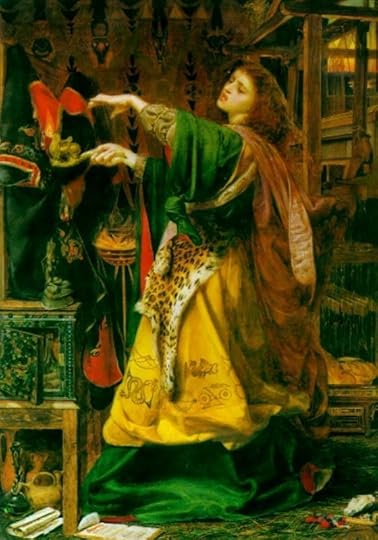
Arthurian retellings have been an evergreen subject over the past 1200 years, and especially so in the past decade. In Half Sick of Shadows, Laura Sebastian attempts to let Elaine of Astalot, the Lady of Shalott reclaim her story and provide a fantastical Pre-Raphaelite-esque tale of love, destiny, and betrayal. Instead, we get an anachronistic mishmash of elements from Disney’s The Sword in the Stone, Alfred, Lord Tennyson’s poem ‘The Lady of Shalott’, and BBC’s Merlin that is half sick of its own story– so much so that it would rather dwell on its past and future than keep its mind on where it is. The result is a bland tale of a group of young people who would rather not grow up, because that involves making difficult decisions and facing the consequences of their actions.

Thank you to NetGalley and Ace for providing me with a free ebook in exchange for an honest review. This did not affect my opinion.
Profile Image for Sahitya.
1,177 reviews248 followers
July 9, 2021
CW: suicide, bullying, descriptions of drowning

Though I’ve only read the author’s debut Ash Princess before and never managed to continue the trilogy, she is fun to follow on Twitter and I’ve been very excited for this book since it’s announcement. But now I’m pretty unsure of my feelings after finishing it.

I know Arthurian legends are very famous and probably familiar to most western readers from a young age. But I didn’t grow up knowing them, and my only knowledge is pretty limited to the show Merlin and the books The Mists of Avalon, which I encountered less than a decade ago, both of which I don’t remember much of. So I’m not exactly attached to the original mythos and I don’t have the usual complaints like other reviewers, that it diverges too much from the original.

My problem is mostly with the plot itself. I frankly didn’t find the non linear timeline structure of the story too difficult, and it was actually interesting to read the “future” chapters and imagine all the various possibilities. It was just that all of the past chapters felt very detached, so when our group of ensemble characters in the present timeline pledge undying loyalty to each other and tell that they would do anything to make Arthur king, I couldn’t find it emotionally engaging because I couldn’t understand why they were actually so close and loyal to each other.

The characters themselves are interesting, I especially loved Elaine because she is kind of a tragic figure, unable live her life properly as she is always thinking about future possibilities and betrayals and how to change them. I really wanted her to have a life where she got what she wanted. Morgana is another character I loved because she is fierce and impulsive, but always remains true to herself. I think I would enjoyed the book more if more of these two women’s dynamic was explored. Gwen is a warrior who gets to make difficult decisions for the sake of her love and her people, but I didn’t feel much of anything towards her. Even the romance between Lancelot and Elaine, or Gwen and Arthur were just peripheral subplots that didn’t have much impact. Arthur himself wasn’t much of a major figure in this book, but I knew that going in because the author herself mentioned it many times, so it didn’t bother me much.

To be honest, I don’t even know where I’m going with this review. It was an okay story, but I could never understand what the goal or ending we were going towards, and I’m not sure if I’m satisfied with the ending, though it was an interesting surprise. I probably could have loved this more if I could’ve felt connected to the characters, but alas that didn’t happen. I don’t know to whom I can recommend this book, but definitely not to those who are very attached to the Arthurian legends and would be unhappy with such a drastically different retelling.
Profile Image for Christine.
185 reviews21 followers
July 9, 2021
I so wanted to love this book. I am a huge fan of Arthurian legend and retellings, and the Lady of Shallot is such an interesting character, so when I saw this on the BOTM list, I snapped it up. I actually did love this book, for about the first 1/3. Then the story went wonky, with characters making illogical decisions, and the plot went off the rails.

The story starts out with adult Elaine of Shallot, who has the gift of prophecy, spinning visions in her loom. She has been living on the magic island of Avalon for ten years. Then, in a flashback we see 13 year old Elaine living in Camelot with her mother. In Camelot, all magic has been outlawed. Mom is giving Elaine medicines to suppress her gift, and as a result, raising a neurotic child. Enter Morgana, visiting from Avalon. Morgana convinces Elaine to move to Avalon with her, where her gift will be nurtured by the goddess Nimue. On Avalon Elaine befriends Guinevere, Lancelot and Arthur. Ten years pass. Then Uther Pendragon (Arthur's father) dies, and the five friends are sent back to Camelot where, presumably, Arthur will become king.

This was great as a premise, but as the story unfolds, it is told in a series of flashbacks and future projections, which got confusing and a bit dull. I felt like I never got to know much of the characters in the actual present time. Elaine's gift of prophecy enables her to see so many different possible future scenarios, she may as well not have had the gift at all. (A normal human without "Sight" could imagine ten different scenarios, that "may or may not" come to pass.) The flashbacks and future projections made for a lot of telling, rather than showing.

My biggest problem was the characters' decisions which seemed to make no sense. And also, even though this book is heavily touted as a "feminist" version of the Arthur tale, the female characters are constantly doing things to undermine their own power. For example SPOILER END SPOILER

While it is not a book I'd recommend, a lot of people are five starring this. My opinion is not among the most popular, and fantasy fans might want to give it a try.

Profile Image for Alex (The Scribe Owl).
429 reviews118 followers
July 25, 2021
See this review and more at my blog, The Scribe Owl!

Thank you to Ace and NetGalley for an ARC in exchange for an honest review!

4/5 stars

This was a pleasant surprise! I honestly wasn't expecting much out of Half Sick of Shadows, but I enjoyed my read. It was a bit of an emotional roller coaster, but it ended up working out.

When I first heard that this was a retelling of the legend of Arthur, I thought that Elaine would end up being a side character in her own story. That was corroborated by how shy and uninvolved she was in the beginning and the flashbacks. I'm so glad that she wasn't! Elaine is the main character and a strong one at that.

I loved that this was a character-/relationship-centric book! All of the secondary characters were fleshed out and important to the plot. They were also unique and honestly very different than I expected.

While I enjoyed most things about this book, I wish I was more familiar with the legend of Arthur. Half Sick of Shadows seems to occur before and during the beginning of the story, but the ending is presumably everything that happens in the legend it's based on. The ending is a little abrupt because it assumes the reader has read the legend and knows what's coming.

All in all, Half Sick of Shadows was a solid four-star read.
Profile Image for Kathy.
3,265 reviews56 followers
February 20, 2023
There were parts of this that I loved; especially how strong the female characters are for most of the book. It took a bit to figure out the timeline of Elaine's visions and that took away from the story. The middle dragged a bit for me but the later part of the book grabbed my interest again. While I know it had to happen, I wasn't happy about it.
December 16, 2025
It was an interesting twist from the original story to have Gwen and Lancelot also have some magic abilities, other than just Merlin and Morgana. Arthur didn’t need magic to get the throne. He was smart and good at communicating with people. Even with Mordred’s continuous interference to try and prove that Arthur wasn’t worthy of the crown, he showed that he was truly capable and the rightful heir.

I love how the author went about showing us the different visions Elaine was seeing. It was kind of fun to puzzle through and figure out which ones were actually going to come true, and what certain visions would mean going forward.

3.5 stars
Profile Image for Leah M.
1,667 reviews62 followers
September 14, 2021
Thank you to NetGalley for providing me with an ARC of this book. I am offering my honest opinion voluntarily.

CONTENT WARNING: suicide, bullying, brief mention of rape, brief mention of animal abuse

I’ve always been a huge fan of Arthurian retellings, and I absolutely can’t resist one that centers female characters and feminism. But this one felt like it fell a bit short for me. And it sucked, because I really wanted to love this book so badly.

The first issue that I noticed is that the story is choppy. The story is told in the present, but there are also flashbacks to the past and visions of the future, all of which would happen in a row. This got to be really confusing, and made it difficult to keep track of exactly when and where I was in the story.

Rather than jumping into the story once Arthur is already king, this one mainly tells the story of the road to getting Arthur crowned. Sort of. Because it also talks about all the possible future paths, since Elaine is an oracle — she can see the potential paths that the future can take, although these are immensely changeable. So there’s a lot of speculation about what might happen.

While the story has an immense amount of potential, there are also some major flaws. First, there’s so much telling, rather than showing. Arthur is mostly a shadow of a character. We’re told that he’s charismatic, but aren’t really given the chance to see it. Instead, he comes across as a boy, and one who relies heavily on his friends to lead the way, rather than demonstrating any sort of confidence or capability to actually lead a country. Lancelot? He’s just kind of there, serving as a foil for the on-and-off romance while Elaine decides which future vision she’s going to believe will most likely occur. Gwen — I like that she’s portrayed less as a damsel in distress, and more as a fierce, feral woman connected to nature, but she fades so much after leaving Avalon. And I’ve always had a soft spot for Morgana, even though she always gets a bad rap in the story. I think this one does her more justice than most, to be fair. Elaine was a little bland, constantly worrying about the future and often replaying the same vision, slowing down the reading by forcing us to reread the same or very similar versions of the future.

I was a little disappointed by the claims of bold feminism, too. While the norms are very different in Avalon, where gender roles and customs aren’t as restrictive and women have more rights, as soon as they ventured away from Avalon, they slipped right into traditional gender roles, conforming to the expected roles:

“…in a court where women are happy to fold themselves up tight to be more easily manageable, to swallow arsenic to be thought of as just a little bit sweeter.”

It’s easy to be feminist where women have equal rights, but it’s most important to fight for feminism when it’s hard. When women don’t have the same rights. When they’re expected to be manageable and sweet, and do what they’re told. But the only one who really ever stayed true and was a feminist even when it was hard was Morgana. All of the others just gave in and did what was easier, with the women often sacrificing far too much of themselves for Arthur, who appeared to not even notice what the women around him were giving up on his behalf.

Finally, some of the key parts of the story were changed. Mordred is changed from Arthur’s son to his stepbrother/brother-in-law, Morgause and Morgana are twins, Gwen has a huge secret that completely steals away any chance of feminism that she’s got, and Merlin was portrayed in a completely different manner than I’ve ever seen. I’m usually open to changes, but these were a little much for me. I’ll be sticking with the Camelot Rising series by Kiersten White.
Profile Image for Nathaniel.
Author 33 books282 followers
November 2, 2023
I’m flailing in speechlessness. This is…perfection? I didn’t approach this as a retelling because I don’t know the story of King Arthur very well. I just enjoyed it for what it is, and that happened to be one of the most compelling stories I’ve read in recent memory.
Profile Image for Athena of Velaris.
729 reviews195 followers
September 18, 2021
This book was full of beautiful phrases and passages, a truly masterful twisting of an ancient tale. I loved the characters, even if the plot was a little weaker and the non-linear timeline took some getting used to. Half Sick of Shadows was an impactful story of sisterhood and the strength that comes with it, as well as the line people cross in the name of heroism. Instead of writing a proper review, I've decided to include some of my favorite quotes below:

“Heartbreak isn't as lethal as the name implies, you know. Maybe it feels that way at the time, but I swear it isn't. You've seen Gwen and me both rebound from it eventually. I don't regret anything leading up to it, and I doubt Gwen does either. It's life, Elaine. Getting hurt, picking yourself up, trying again. You're so focused on the ending sometimes that I don't think you know how to appreciate the during.”

“The wise ones know that there is much to fear in the world; it’s the foolish who claim that nothing frightens them because they don’t have the foresight to know what to be afraid of until it’s too late.”

“You are different and it terrifies them, so they try to push you down and keep you small and manageable. They know that if they keep you huddling in your corner, you will never stand to your full height. They know that if you ever do, you'll be great enough to ruin them.”

“I didn’t want to live in fear that I would make a misstep and bring my entire life to ruin. I didn’t want to live where people whispered about me behind my back and made jokes at my expense. I wanted a home, not a lonely tower where I felt more ghost than human.”

“In the years that I’ve known her, I’ve never seen her try to disappear. That’s always been me, trying to fade into the background or fall away into the pages of a book.”

“You were not raised to be safe. You were raised to be heroes.”

“Some things can't be fixed, they can't be glued back together as they were. Sometimes, all you can do is find the beauty in the broken. All you can do is figure out how to put the pieces together as best you can, to make something new out of them.”

“I wonder what will be left of you,” she muses, “when all the people you love have chipped away their pieces.”

"I would give anything to save him." I tell her. "But some things are not mine to give."

“Everything I am, I've made myself. Maybe you have all shaped me, molded me like a vase, but when all is said and done, when everyone has chipped away their pieces, I will not break.”
Profile Image for Laura.
1,248 reviews147 followers
August 17, 2021
"Maiden, Mother and Crone"

This is a feminist retelling of the Arthurian legend. The young Arthur, Morgana, Guinevere, Elaine and Lancelot as they grew up in Avalon with the Fae and formed their relationships.

Then returned home to Camelot where magic was outlawed other than Merlin each of them having some power to hide other than Arthur. Arthur has to prove himself and LET the quests begin! 

All the while Elaine the seer is seeing multiple endings for all of her friends, her found family. She's trying to make the right decisions to set them on different paths not knowing if she's solidifying the right or wrong path. What a very significant and heavy gift to wield. 

To be able to see how many different ways your heart will break but still choose love is bittersweet.

I love reading the authors note at the end it usually gives you a look inside why they shared this story with you. And this book was started when the author was 14, which we also learned from the foreword, but from reading Tennyson's Lady of Shalott and connecting it to the images of her in the tower.

This retelling giving Elaine all of the power and the one who made all of the decisions to lead the fiercesome five into legend.

Thank you berkley pub and net galley for the e-ARC for my honest and voluntary review. 

This was also my Book of the Month choice for last month. 
Profile Image for Noha Badawi.
632 reviews608 followers
November 17, 2021
What a ride this has been! A little bit dense, took me a while to get through but totally worthwhile and enjoyable. I’ll read any King Arthur retelling you throw at me, if I can speak the truth. One of the legends that has so much depth to it, with many twists and turns; and Laura did an excellent job retelling it beautifully
Profile Image for BookNightOwl.
1,083 reviews181 followers
January 10, 2022
Not a lot of going on. I would think with a fantasy book it would be more plot driven but it was more character driven. I waited for the excitement and adventure to start but it lacked a lot of that. Just wasn’t for me. Unfortunately
Displaying 1 - 30 of 1,663 reviews

Can't find what you're looking for?

Get help and learn more about the design.