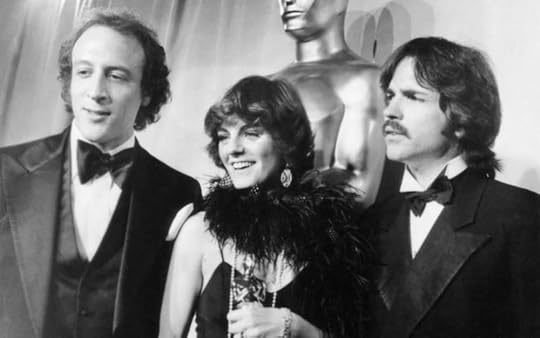
Julia Phillips became a Hollywood player in the freewheeling 1970s, the first woman to win the Best Picture Oscar as co-producer of The Sting. She went on to work with two of the hottest young directorial talents of the era: Martin Scorsese (Taxi Driver) and Steven Spielberg (Close Encounters of the Third Kind). Phillips blazed a trail as one of the very few females to break into the upper echelons of a notoriously chauvinistic industry.
But for all her success, Phillips remained an outsider in the all-male Hollywood club. She had a talent for deal-making, hard-balling and wise-cracking, and a considerable appetite for drink, drugs, and sex. But while these predilections were tolerated and even encouraged among 'the boys', Phillips found herself gradually ostracized. By the late 1980s, she was ready to burn bridges and name names, and the result was this coruscating memoir of her career.
Julia Phillips died on January 1, 2002, at the age of 57, but her book will stand as one of the classic exposes of La-La-Land in all its excesses and iniquities.
Julia Phillips was an American film producer and author. She co-produced with her husband, Michael (and others), three prominent films of the 1970s — The Sting, Taxi Driver, and Close Encounters of the Third Kind — and was the first female producer to win an Academy Award for Best Picture, for The Sting.
The tell-all memoir that outraged Hollywood, by the first woman to receive an Oscar as a producer. She co-produced, The Sting, Taxi-Driver and Close Encounters of the Third kind. A frenetic book, naming names and shaming people for their behaviour, including her own, as it also documents her manic almost life long drug addiction, especially freebase Cocaine, and her eventual recovery. Very poorly edited in my opinion, so despite the content this was a One Star, 2 out of 12 read for me! 2010 read
Sigh. I'd always heard I needed to read this book - it was a 'must read' for anyone in The Industry in Hollywood.
What I found was a memoir from an egotistical, self-indulgent woman who lacks humility and the capacity for self-analysis. One of those books where someone talks about all the drugs they've done, all the sh*t they've been through, but never seems to really examine the correlation between the two. And if they do accept responsibility for where they are, they only do it in tandem with insisting that the world is against them.
Sure, there were a lot of insights to the way things worked in Hollywood in the 70's and 80's...sure, there were a lot of drug stories about famous people (big whoop). But what did I get out of this (besides the moral that Julia is a 'my way or the highway'-kinda gal, and that if others don't agree with her, they're against her)? Not much.
Actions have consequences. So do behaviors. Grow up, Julia. Own your decisions, and recognize that your choices got you where you are.
A long trawl through shallow waters - well, shallow people.
At 600 pages, this rant remains in dire need of an editor, but would benefit even more from a plot. Basically, our not-so-humble narrator gets lucky with The Sting in 1973, then it all turns to drugs, then it all turns to shit. Her primary concern – beyond any pretence of allegiance to drug-dealers, family, colleagues and friends – appears to be keeping her table at a dining-hole in Hollywood where she can see and be seen, hence the title.
The fact that Hollywood power-brokers are non-creative, cliquey, scandalously overpaid, vain, ambitious, addictive, obsessive, compulsive and above all treacherous parasites should come as no surprise to anyone who's bothered to pick up this book. What is surprising is that an operator with all of those traits and more could vomit up a story from it and not pause long enough to find any redemption whatsoever in herself or her surroundings.
Perhaps the saddest testament to this tragedy comes in reading it today, 15-years after publication. Names that once clattered when she dropped them now ring hollow as even the internet can't dredge up any trace of them. And as for those who remain 'names,' take a look at the bonus features disc of The Sting DVD – Redford, Newman et al looking back on their film in 2005 (a film that Phillips spends half the book telling us was her creative genius) and the name 'Phillips' does not come up once in hours of recorded material. Who she?
Julia Phillips burned her bridges beyond recognition with this memoir of life in the fast lane of 1970s Hollywood. There are very few people who were big from the late 1960s to the early 1990s who aren't mentioned here, mostly unfavorably. The lady had good reason to be angry; the machinations of getting a film made are ludicrous enough to drive anyone over the edge. She freely admits that she didn't help her own cause by spending most of her time looking for her next high.
It would be easier to be on her side - she was, after all, the first female producer to win a Best Picture Oscar, and was behind some seminal films (The Sting, Taxi Driver, Close Encounters of the Third Kind) if she didn't go out of her way to be so unlikeable. She has the redeeming feature of the great love she has for her daughter, Kate, who sounds like phenomenal person. Other than that, however, she sounds like the classic egotist (and, ridiculously backward in her language). She is smarter (in her own mind) than almost everyone she meets, she calls black people the N-word and gay people all manner of slurs. Her bigotry about people who are overweight is downright repulsive.
You'll Never Eat Lunch In This Town Again is full of aliases in order to avoid lawsuits, I suspect, but I also suspect that Hollywood insiders knew exactly which people Phillips was referring to when she changed a name. Even so, she is fine with naming and shaming Spielberg, Geffen, Erica Jong and numerous others. David Geffen was so furious with the release of this book that he dumped her from the negotiations they were in the middle of for Interview with the Vampire. And, as it turned out, she didn't have lunch in some of the most important places in that town again. She got banned from Morton's where, for many years, she had her own table.
I would have liked the book better (I do love dish, so it would normally be tailor-made for me) if (1) it had been proofed for grammar (for someone who is supposedly so intelligent, she should know how to use the words "I" and "me" in a sentence); and (2) if it had been shorter (a good editor could have shown her how to tighten it up and dump the extraneous, existential meandering). I'm very glad I read it; I just wish I'd liked it, and her, a bit more.
The more scandalous aspects of this book (drugs! sex! Goldie Hawn never showers!) have probably overshadowed how funny and true it is. Julia Phillips is an incredibly accomplished woman and this is the story of her rise (she was the first woman to win an Academy Award for best picture) and subsequent fall. She is unafraid to call out powerful friends, former friends, and herself for rediculous behavior, and her sharp writing and brutual honesty keep this from becoming another tired Hollywood memoir.
A behind-the-scenes tell-all of my favorite UFO movie, written by a drug addicted movie producer who happens to be the first female movie producer to win an Oscar for best picture? Sounded irresistible so I picked up a copy of Julia Phillips’ best-selling Hollywood chronicle. OK, there was far less about "Close Encounters of The Third Kind" than I had hoped for. "You'll Never East Lunch in This Town Again" is really the autobiography of Julia Phillips. Truthfully, I had never heard of Julia Phillips who died in 2002 - ten years before I discovered her somehow, via my wayward web surfing.
Phillips begins by chronicling her childhood in Brooklyn during the 1940's. From there she makes her way through college, and then onto her marriage to fellow producer Michael Phillips. After about a 100 pages, she begins detailing her ascension through the movie industry. Strangely, aside from the chapters on Close Encounters, Phillips discusses many more pre-production situations about money, hiring, etc. - than she does the actual work on the sets of her films. Sometimes, especially during the first half of the book, Phillips phases out of present tense, and holds flashback sessions in which she refers to herself in the third person. While reading, this technique seemed a tad confusing and unnecessary. Aside from that, Phillips’ obvious talent as a writer demonstrates why she enjoyed such a successful movie producer - for a while, at least.
After reading "You'll Never Eat ...." here in 2012, I found that it does not live up to advanced billing as a “shocking tell-all.” Perhaps I feel this way because I’ve become desensitized from two decades of celebrity tell-all books published since the initial release of Phillips' book in 1991. Still, I should acknowledge that Phillips raised the bar for books of this nature when “You’ll Never Eat …” first came out.
A lot the hubbub surrounding this book must have centered on her the endless derisive comments and personality critiques Phillips makes about influential Hollywood characters of the late 70's and 1980's. But aside from a couple notorious observations about Goldie Hawn, the dirt is usually limited to character assassinations of her business and movie industry contemporaries. And sometimes, she's even a bit evasive about the identity of her targets by skipping the name and merely alluding to whom the person might be. This usually happens when she's discusses the drug use of other Hollywood figures. Not very over-the-top. And if you're too young (like yours truly) to be familiar with the movie moguls and big names of the 1970's you may not have an idea of who she's describing/disparaging anyway.
Toward the very end of the book, Phillips recounts a close encounter (pun intended) with a fairly modern celebrity: "Paula Abdul, who has choreographed several of Mary's videos, comes over to say hello, and we invite her to sit down. Within a minute, she is pouring her heart out to Mary about the lousy treatment she's received from Janet Jackson, who has not acknowledged Paula's contribution to her videos or her stardom. She must have been truly hurt to be so open in front of a complete stranger. The old Hollywood boogie...... A year later Abdul's album would have four hit singles and soar to number one. Had she become a star because another star rejected her? A case of ‘fuck me? no fuck you’ .......No doubt."
Phillips' auto-bio is replete with great observations like this one (above). In a way, Phillips was holding a mirror up to the ugly, selfish and greedy side of the entertainment industry - the side that most never see. Phillips' witty, and often mischievous writing style, combined with her very judgmental and sometimes spitfire attitude carried me though all 615 pages. In other words, "You'll Never East Lunch in This Town Again" remains an engaging read - considering that it is a somewhat dated account of the movie industry in the late 70's and 80's.
Ugh. What a rambling, self-centered piece of crap. Reading this made me feel like I was in a therapy session with the author, except without any sort of self-exploration or willingness to look at the role that SHE might have played in her circumstances. "My parents (especially my mom) fucked me up! The producers/directors/actors/what have you fucked me over! Poor me!" I kept waiting for some sort of realization and ownership of her actions, but it never came. This book has really driven home for me the idea of "Life is too short to read books you hate."
I felt like I had to fight through a thicket of coke-addled dithering to get to the dirt, and even then I wasn't sure what was going on -- was that a sex scene between Julia Phillips and Julie Christie? Who edited this? Anyway, this hasn't earned its reputation as a trash-talkin' masterwork.
By all means this should be a fascinating, juicy Hollywood tell-all. I was thrilled to spot it in a secondhand store and grabbed it, primarily because of the excellent cover design on the vintage version I'd found.
But this is one book written by a celebrity that is most definitely not ghost-written.... and maybe it should have been. It's hideously self-indulgent and seems like it was never edited or revised. I am a fast reader and it took me several hours to get through 100 pages of this book. I could not finish it.
This COULD have been great. And for a book that trash-talks so many of Julia Phillips' peers at the time, it should at least be well-written to be worth burning all those bridges. But it's not.
It reads exactly like how someone on coke talks, which is to say, rambly, incoherent, and irritating.
A looooooong, sometimes dishy, sometimes torturous, sometimes fascinating, sometimes intensely annoying lived-to-tell-the-tale autobio of a too smart, too honest, too too Oscar-winning producer who had it all then lost it, became a junkie, then pulled herself together and did her best with this tome to give readers the real unvarnished truth about the Hollywood grind—and what a grrrrriiiiind it is.
This was such an entertaining book to read——very witty, very dishy, and so very Hollywood. Julia Phillips won an Oscar for producing one of the finest films in history, Close Encounters of the Third Kind, and she was involved in the production of other fine films such as Taxi Driver and the Sting.
Until I read this book, I had no idea what a producer might actually contribute to a film. As described by Phillips, a producer pretty much does everything that no one else has done——and chronicles this in the context of a downward personal spiral fueled by drugs du jour, mostly cocaine, the “breakfast of champions.” Reminiscent of the equally witty musings of Carrie Fisher but Phillips names names.
An almost poisonous memoir from Julia Philips, this is good in parts but overall it's too long and windy to be properly entertaining. A long time after her Hollywood success (Taxi Driver and Close Encounters), she seems to take great delight in heaving dung at her previous friends and colleagues and nobody comes out of it well, least of all her (at one point, her daughter is saved by technology which was - inadvertently - developed from machinery created by ILM, yet George Lucas is still a 'cold man'). Sour and painful (not to mention pitiful), when it's not focussed on her 'current' woes and discussing the great films she was involved in, it's not bad at all. Your interest in this will depend on how you feel about addicts biting the hand that feeds, I think.
The first woman to win an Oscar for producing--- The Sting. If you want the inside dirt on the way Hollywood really works, this is the book. A lot of name dropping and you can read between the lines to figure out who she slept with-- a lot. Also, a ton of drug use. She got fired from Close Encounters because of that. A bright mind damaged by drugs and cut short by cancer.
The phrase “dumpster fire” has been popular, usually signifying that something has gone wrong. If I call this book a “lumberyard fire,” it has a different connotation — it means that it’s such a conflagration that it’s a spectacle worth watching for hours. And this book is even more spectacular than a lumberyard fire: it ranks right up there with the waterfront fire I saw in San Francisco years ago — jumping over streets from warehouse to warehouse, even consuming at least one fire truck in the process. Julia Phillips’s memoir is at least that hot and out of control. In other words, a great spectator sport.
I’m calling it 4.5 stars, marked up to five by Goodreads, only because I reserve nonfiction full 5-star ratings for books on "more important" subjects, like war and peace. I did give five stars to Garson Kanin's book Hollywood . . . don't think it was as entertaining as this book, but it perhaps was more serious . . . or at least not over-the-top, if that's a fitting description of Ms. Phillips's tale.
Ms. Phillips gives plenty of evidence to show that most people involved with "Hollywood" in the last 25 years of the 20th Century were NOT honorable folks, or at least less honorable than the typical American. One should believe her . . . she willingly admits her flaws and bad judgment. She suffers and deserves much of what she gets . . . but she is far from the worst person on the scene.
One doesn't learn much about the technical or artistic side of the movie business, but there's plenty to see here about the BUSINESS side of the business . . . how deals are or aren't done, how one manages or doesn't manage the process, how relationships are built or not built or ruined . . . in short, about human nature at its worst, mostly.
This book is quite a trip. I almost felt guilty reading it, so much bad behavior is going on. And these people are (were) huge influences on our civilization? And could it be worse today than in the 1970s/‘80s? Yuk!"
This is a Hollywood book that makes me glad my fantasies of becoming a feature filmmaker never came true. Julia Phillips was a successful female (one of the first) film producer in the latter part of the 20th Century with credits such as "The Sting," "Close Encounters...," "Taxi Driver," and others that have left their mark upon us all. As a result, she looks at the film business from the top down, the POV of the money people and decision makers that manipulate everyone else.
Julia is a sharp witted, sharp tongued niggler who manages to find fault with everyone she ever met, friends, business associates, lovers, her ex-husband, and herself. Regarding Goldie Hawn: "She is an okay broad. The best thing about her is The Laugh. The worst is that she is borderline dirty, with stringy hair - all the time."
This about a party at Jane Fonda's house loaded with top film talent: "...these social gatherings that Hollywood people invent for themselves, usually to raise money for the cause of the week, bring out my shyness. Maybe snobbery, too, because it's pretty funny, all this posturing, from a bunch of people who are predominately street hustlers, most of whom haven't gone to college, let alone graduated from high school. They read moving their lips and they have horrible table manners."
Something else that Julia reveals is the prodigious amount of drugs consumed by the Hollywood elite. "To be perfectly fair though, I have been partaking from a panoply of mood enhancers, stimulants and depressants all day. Every once in awhile, I would strike upon the perfect chemical combination: for Oscar night it's been a diet pill, a small amount of coke, two joints, six halves of Valium, which makes three, and a glass and a half of wine. So far, I have a warm and comfortable feeling of well-being."
Hilarious, revealing, behind the scenes look at Hollywood studio moguls on their worst behavior. the late Julia Phillips details her malfeasance in this no holds barred tell all. Studio politics, ruthless backstabbing, lying , manipulation, egotistical stars and lots and lots of coke .. at first powder and then a raging freebase habit. She goes into excruciating detail describing the precise quantities of booze and alcohol she consumed before receiving her Academy Award for The Sting. If she really drank, snorted, smoked all that .... how could she possibly remember much less make her way to the stage? She details trysts with studio execs like the late Don Simpson, drug fueled marathons with other Hollywood stars, an attempt to commandeer a young Stephen Spielberg's career (he wisely cut his ties early on) and her involvement with the disgraced studio executive David Begelman. Another post rehab bit where she tries to partner with another drug washout, Jeff Wald (Helen Reddy's ex husband) was amusion. While Phillip's account was compelling, a few thoughts nagged at me. Where was her husband all this time? She describes him like a piece of furntiture leading a seperate life. How could she hold a job? Is Hollyowood really that forgiving? Can you put all those drugs on your expense account? And what kind of parent was she to her young daughter? Phillips spends a lot of time tearing down other Hollywodo types (and may have been crossed off a few A lists), but the book really paints a very disturbing portrait of its author.
This is a trashy Hollywood tell-all about how it worked in the 70's, 80's and 90's when this business called show was new to seeing women in the driver's seat. You won't like the protagonist. She's a bitch and she's often contradicting herself. But it's full of adrenaline and a good "window in" to a world few witnessed...Book lost steam about three quarters of the way through and then her bitchiness starts to really take over. I would only recommend to the real movies buffs.
I can't believe I've never read this, being an (abashed) Hollywoodphile. Turns out, I couldn't get through most of it. It was a box-office bummer, truly as miserable as it was juicy.
But, oh, that first chapter. Phillips tells ALL about the night she won an Oscar, as a producer, for The Sting, and it's exhilarating to peek into the excess and ennui of the night. That first chapter I'll never forget.
Phillips took a lot of drugs. How did she function? It's not surprising that she pissed off everyone in Hollywood. Sounds like a cocaine addicted bitch. Yet she redeems herself because her writing is clever. Loved every page, and even laughed out loud at times. RIP Julia Phillips.
A good enough book that certainly has plenty of interesting sections, but is weighed down by passages of unnecessary chit-chat. This thing desperately needs an editor, and is incredibly self-indulgent, but I didn’t hate it. Still, I doubt I’ll ever read it again.
This is frenetic and weird and funny and inappropriate.
To follow her wheelings and dealings is really fun. She always has a quick quip or snappy putdown, but she also works really hard and has plenty of good reasons for her creative choices. Her personal ones: less so. She likes handsome men, DRUGS, and spending money on furs, jewels, and travel. I'd love to hear what her daughter has to say about all of this: many of the incidents described in her home are HORRIBLE for children, from seeing her mom cook up freebase to having mom's boyfriend shoot up the house. She presents this as absurd and funny, which it is, but also: a child without control of her own life and surroundings had to go through this.
She provides a lot of details in some places and not so many in others. She can tell you what she wore and where she sat on a particular night, but the whole explosion that sent her out of Hollywood gets remarkably few pages. I reread that section a few times to see what I missed--was it throwing the drugs on the table of an important meeting? Was it the open secret of drugs in general? Was it the cowardice or weaseling of the people around her looking to push her out? There's a bit of foreshadowing about betrayal, but it's not clear to me how/why that exactly all went down. She has the tone of someone being completely honest with you--about her love/hate relationship with drugs, about her triumphs and frustrations with the movie biz, about her body and aging, about people she worked with, but underneath that there's a lot that goes unsaid. The denouement of Close Encounters being a case in point.
Her comeback is fascinating as well. The fact that she's a woman is all over this, running with the men, trying to get them to take her seriously, trying to play their game with their aggression and big egos, and succeeding for the most part, often to be reminded that she's a woman and therefore will never really count as much. The transition to the "suits" of the 1980s and the money grubbing and greed and ridiculous pictures after the "artistic" period of the 1970s is dramatic. She, as an individual, as a person, as a unique snowflake, obviously made her own choices. But there's the larger story of her fighting the world and using drugs as a creative enhancer as well as to handle the stress of Hollywood but also Hollywood as a woman. I think she does a good job of pointing out how she acted but also the context in which she acted. And she never blames anyone else for the drugs--she liked them, she did them. But it's easy to see the environment in which she did them.
I enjoyed the writing. Sometimes, her puns were a little much for me (BALL JOKES ARE HILARIOUS, EVEN BALL JOKES WE'VE HEARD BEFORE). But in general, I found her style fresh and vibrant, and this was written 20-odd years ago. I didn't always get the transition from first to third person or her movie script pieces. I think the third person is supposed to give her more a chance to reflect on what she felt (as a middle-aged woman) coming through all of this, as her standard first-person autobiography narrates the events of life. These different sections become nearly indistinguishable both in content and format as her autobiography catches up with her present. And the movie scenes aren't a coherent movie (maybe that's the point?) because they aren't used consistently enough or to tell a complete movie plot. But, as she says, what movie doesn't have its gimmicks? What life?
A fun read. Eventually I just let the names slide over me and enjoyed the crazy ride.
If I had read this book in my twenties or thirties, I probably would have enjoyed it a lot more. But I'm now a grown-ass middle-aged man. If anything, reading this book revealed how much empathy I've developed over the years. Because Julia Phillips comes off as a shit-talking, tyrannical, cokehead, drug-snorting asshole. Was there any reason to reveal Jamie Lee Curtis calling her to seek help to get off drugs? No, there wasn't. But Julia did. Was there any reason to constantly take potshots at Martin Scorsese while he was fighting the suits making TAXI DRIVER? No, there wasn't. The film is a masterpiece. What kills me is that Julia Phillips did this and SHE PRODUCED IT! Do we need to know that Goldie Hawn doesn't bathe or wash her hair? Not really. Honestly it kind of makes sense given the hippie aura she has. And the book is so fucking LOOOOOOOOOOOOOOOOOOOONG. Proving yet again what a tyrant Julia Phillips was. Obviously she had some kind of magnetism to draw these people in. But every run-in with a major name usually involves her shit-talking them. And while I give Julia Phillips props for "evolving" the tell-all memoir form to make nothing off limits, I had to ask myself, "What kind of a life do you really have when you see everybody around you so negatively?" I think that's ultimately the reason why nobody reads or mentions this book anymore. It will eventually sink from our culture without a trace. Why? Because Julia Phillips was an insufferable and incredibly negative narcissist. And nowhere nearly as good of a writer as she thought she was.
An interesting look behind the Hollywood glamour by a woman (the first to win an Oscar for producing) booted from the ranks, after producing three major movies of the 1970s, for two sins: being addicted to freebase cocaine and being female (sometimes it’s hard to tell which is the greater sin). Nobody comes off looking good in his memoir, including the author who, despite getting clean, etc, is extremely fat-phobic and has some trouble avoiding problematic slurs in talking about gay men or non-whites. The other problem with this book is that it veers between third-person past-tense POV for sections set (presumably) in 1989 and first-person present tense POV for all parts set in the past. Which makes it very hard to follow at times - where was the editor?
I have a lot of time for unlikable women, and Julia Phillips is up there as one of the most unlikeable. In fact, I love her for her unlikability. It’s reductive to brand this book as self centered, of course it’s self centred — it’s an autobiography by an addict. Addicts, by their very nature, are self centred. I also think it’s unfair to say that she thinks she’s in the right and everyone else is wrong. She knows she’s wronged, and she knows she’s been wronged. She’s telling her side of a rare story; a successful female producer in Hollywood in the mid—late 20th century. It’s salacious. It’s catty. It’s sharp. It’s not very PC, but I don’t believe she claims to be PC. It’s a lense through which to view a period of recent time, and it is a very entertaining lense.
If I could take the best bits from this book, it would be four stars, absolutely.
But!
It's like reading a Spy magazine that goes on for 633 pages. Suddenly, you're getting thrown from limo to lunch to meeting, and you can't remember who Harlan is, and is this Michael the ex or is it the producer guy, and golly they do a LOT of drugs. There are bits in here that are so sharp, and there are jokes that are so funny, and there's stuff that tries to be sharp and funny and just comes across as dickish. And also, you spend a LOT of time with Julia (Ju-lee-a, Jools, etc.) who is someone who can't keep a long-term relationship going. By the end of the book, you get it.
An abridged and annotated version of this would crush it.
A little dated, circa 1992, but still relevant if you want to figure out the Hollywood movie subculture. LUNCH is autobiographical and as much a cautionary tale of drug addiction as insider info. I had a brief run-in with Hollywood when my novel BLUES DELUXE was published in the mid ’90s; had my very own Hollywood Agent for a while, but nothing ever came of it, and B.D. is now out of print. Looking back on it now, my experience was a bit of a Catch 22: she snapped me up, on the chance that my book might hit the best seller lists, when she would then be positioned to make a deal; I was trying to do it backwards, by finagling a movie deal to hype book sales.
Anyway, LUNCH is a lot of fun to read; the gal is a hell of a writer. Julia makes herself look so bad that it’s hard not to believe every word of her story. For sheer fun, this book is hard to beat, and you may learn a thing or two about Hollywood while you are smiling and laughing. And then groaning at how a once powerful woman could get herself into such a mess.
WHAT DO YOU SAY WHEN WARREN BEATTY SUGGESTS A THREESOME WITH YOU AND YOUR TEENAGED DAUGHTER? Julia: “We’re both too old for you.”
Another awesome book on the Hollywood power structure, also from 1992, is THE CLUB RULES by Paul Rosenfield. Very literary, and perceptive; Rosenfield made me stop reading often to think about the implications of what he was writing.
I haven’t kept up on the latest Hollywood Exposé books. But the central Hollywood truth won’t change no matter how the tiny details adjust.
Nobody In Hollywood Wants To Hear About Anyone They Haven’t Already Heard About.
You won’t “break in,” they will hear about you and then they will come for you (with every intention of robbing you blind); so get 3 independent experts to sextuple-check any deal you are thinking of signing.
I have a shelf of books on how to break into Hollywood and how to write screenplays, stuff like that. Reading most of them was a waste of time. (Except that I’m a “carrot” not a “stick” kind of guy, so maybe I needed to read lots of crap to “keep the dream alive” so I would keep moving forward.)
David Chasman’s thin book of aphorisms, EVERYTHING I NEEDED TO KNOW ABOUT SUCCEEDING IN HOLLYWOOD I LEARNED FROM MY PIT-BULL, circa 1995 still kicks ass in 2013.
In the mid Ninties I wanted to write a screenplay of my novel BLUES DELUXE. My vague idea was that this would somehow help me to “Break Into Hollywood.” The actual screenplay format is a simple structure; even so, I knew I didn’t dare jump right in and write the BLUES DELUXE screenplay. I needed a learning experience. So, I wrote an original action adventure screenplay first. It’s actually not too bad. (Needs work.) But I learned a lot, by actually writing a screenplay: so that is my advice to other writers who want to learn how to write a screenplay. Write one! Then write the one you really want to write.
I am somewhat disappointed that I actually prefer the BLUES DELUXE screenplay I wrote to my original novel. The screenplay is actually better, in my opinion. [insert sad-face icon] Now go read YOU’LL NEVER EAT LUNCH IN THIS TOWN AGAIN. @hg47
Well it is actually a good thing that Ms. Phillips is dead, because she cannot remake her life, as she made enough of a train wreck out of it as she could while alive. Unfortunately this book turns out to be a great exercize of work just to get through it, what with all the stars (first names!) the lines, the joints of Maui Wowie, and E. Coast Jewish girl kvetching. It would never have occurred to me to read this but if not for having read the Jill Jonnes book (q.v; review) and learned that Ms. Jonnes used Ms. Phillips' book as source material for her own. I suppose she could not have chosen a more negative role model par exemplar for her screechy late 90's anti-drug manifesto. Because Ms. Phillips, while being a "woman pioneer in a male dominated industry" also shows that actualy she gets somellace in it because she is an asshole like the rest of them, the men she hates for the particulars she always remembers. She hates herself, too, incredibly so, for the kinds of men she gets down with turn out to be the very sort "proto-feminists" like her have complained about for years. But hey this is Hollywood! Nobody will love you for who you are, and they will hate you for what they think you are. She becomes a first-class crack addict pretty quick as soon as the first freebase torch shows up. All these Hollywood-sorts can ignore the drug laws- they far are above being mere mortals anyway. They get their dope messengered-in by courier. They can blow off court appearances, post bail, get fined a slap on the wrist and be back in action next week. They can fly around the world with a stash in their sock, sneak coke into rehab, and do all manner of things that you and I, mere little people, have to realize are beyond our own boundaries to attempt. Now that I know this was all a great portrait of 80's-90's excess, in many ways it is a very good picture of a dysfunctional careerist in a business I don't think I would want much to do with (and so why did I study film in college anyway, if what might have happened was, I'd have ended up as a 3rd string grip working for assholes like Ms. Phillips! Perish the thought.) So she gets two stars, mainly for being a train wreck, and why the hell I ought to care about a crack freak just because she made a big name for herself being as much an asshole as the men she felt the need to destroy (along with the usual cattiness against sister movie-people) by writing this. "I did it my way." Oh, but didn't you.