Sombra Moon acaba de salir de la cárcel y se entera de que su mujer ha muerto. Derrotado, en la ruina y sin saber adónde ir, conoce al misterioso señor Wednesday, que le da trabajo como guardaespaldas y le hace entrar en el mundo letal de lo sobrenatural, donde los fantasmas del pasado vuelven de entre los muertos y la guerra entre los viejos y los nuevos dioses está a punto de estallar.
*La novela ganadora de los premios Hugo, Bram Stoker, Locus, World Fantasy y Nebula, convertida en exitosa serie de televisión de Starz, ve su primera adaptación al formato de la novela gráfica.
*Recopila los nueve primeros números de la serie de cómic American Gods además de bocetos, diseños de personajes y cubiertas de, entre otros, David Mack, Glenn Fabry, Becky Cloonan, Skottie Young, Fábio Moon y Dave McKean.
So after disliking virtually everything I've read from Gaiman, it's now two books of his I like in a row, and this one's my new Gaiman fave; and this from someone that did not enjoy the American Gods conventional book! Re-imagined, I presume to sit alongside the TV show - Shadow Moon's journey from prison to Wednesday's man via the House on the Hill and the House of Death and many miles of American tarmac. It works really really well in a graphic novel format allowing the narrators to be easily distinguished from the players, reality from non-reality and dreams, past from the present; the format brings a much needed clarity and clearer direction for me. The art could have been more defined, but after reading nine issues it's now the feel of the series. The story is great, especially the intervals about how specific Gods reached the New World. 9 out of 12, fab Four Star read. 2019 read
I'll admit it: I can't get enough of Gaiman's take on all kinds of gods and mythological beings so as soon as I was made aware of a graphic novel version, I had to check it out.
The story is more or less the same as in the novel/TV show: Shadow has spend a few years in prison and shortly before he is about to be released, his wife dies in a car accident. With no home to go back to and no job (his best friend, who had held a spot for him, died in the same car crash), he accepts the offer of the mysterious Mr. Wednesday to become "his man". But what started out as a sinmple gig as the bodyguard to a hustler soon beconmes very confusing and dangerous as there are several parties involved, not all benevolent. And Shadow soon doesn't know whom to trust or what to think of the people that claim to be gods.
This first volumes tells the story up to the point when Shadow is leaving Jakal and Ibis after helping them out with their funeral home for a while.
For anyone wanting to know my opinion of the story itself, please read my review for the novel here (print) and here (audio).
What is left to say about this adaptation? Well, it is rather remarkable that this story can be told in so many different ways and holds up in all of them. This comic version is no different. The story sucks you right in and the art makes everything come to life. Some characters were not drawn the way I had imagined them (or how they are shown in the TV show) and the art in general wasn't always 100% to my liking (too "ugly") but it was always done on purpose and worked very well for the different episodes (flashbacks to ancient times as well as the different POVs in present day). Moreover, this volume includes some seriously gorgeous cover art!
I read the book over 15 years ago, but this is one of the most faithful adaptations I can remember. I found myself instantly transported back to my first time reading the book. Long time Gaiman collaborator, P. Craig Wilson, gets the pacing right, letting the story dictate the pace of the comic letting it take as many issues as it takes to tell the story properly. Adaptations can often just be paragraphs of text with some pretty picture. Thankfully, that's not the case. Gaiman's wonderful prose is still here but is edited down to what is needed to tell the story in a visual medium. Scott Hampton abandons his painted style except for one surreal sequence, opting for concise pencils instead. Colleen Doran, Glen Fabry, Walt Simonson and more are brought in to tell the stories of the gods peppered throughout the book.
Right up there with 300, Watchmen, V for Vendetta and Maus - the cycle of deicide we have set in motion for our own purposes is looked at in a profoundly unique way.
Listen, I love American Gods. I don't necessarily have a 'top 5 novels' list, but if I wanted to sit down and make myself be decisive, American Gods would probably be in it. Why the lower rating then? Because at least 95% of this is just word for word exactly what happens in the book. I know that some people are going to love that, but I just reread the book last year so I'm kind of sitting here like 'what is the point then'. I guess the artwork could be the point, but I'm not exactly wild about it either. I much prefer adaptations when the person obviously understands the source material enough to change things up or even add things while still staying true to the tone of the original. I know a lot of people are diehard 'adapt the book line for line into a comic/TV show/movie' fans, and those people will love this, but to me that's just boring because why do the exact same thing twice?
Nobody’s American. Not originally. That’s my point.
This is the only country in the world that worries about what it is…No one ever needs to go searching for the heart of Norway or look for the soul of Mozambique.
American Gods is Neil Gaiman’s masterpiece. I didn’t think so the first time I read it. Sure it was a fascinating concept, but I was underwhelmed by it. But he kept reproducing it in new mediums, and I was drawn back to the story. When I heard it was to be produced as a TV show, I reread it, this time as an audiobook. I really got what he was going for that second time through. Not a quest and final battle story at all — that’s just the con for the marks. Its true meaning was hiding in plain sight the whole time — it’s an American road story — On the Road with trickster gods instead of hepped up Beats.
Like I said, American Gods now exist in several mediums, and I’ve experienced them all. The TV series was interesting, but cancelled before the final payoff. The audiobook is a great way to experience it — it’s the kind of tale that works particularly well when read to you. And this form — the graphic novel adaptation — is excellent as well. The text of the story is brilliantly edited, preserving everything that’s necessary to bring out every nuance. The artwork is straightforward and workmanlike. There’s no experimental or outlandish style, just images that carry the story along without distracting from or distorting it.
This graphic novel is volume one of three. It takes three volumes to fully tell this complex tale. If you’ve already read the book you will still enjoy experiencing it again in this form. If you haven’t, this graphic adaptation is faithful and complete enough to serve as an excellent introduction to Gaiman’s novel. And that’s the thing — this story grows on you — expands. Get captured by it like I have and, like me, you may end up consuming every iteration of it available.
First off, I haven’t read the original American Gods novel or seen the television show, so I have no idea how closely this graphic novel follows the story. I can only rate it on its own merits as a graphic novel. And I have to say, this was an excellent reading and visual experience for me. I’ll come right out and admit that I’m not a big fan of Gaiman, but for some reason, I keep giving him more chances to impress me or at the very least, not disappoint me, as I read book after book by him. This is one of the reasons I chose to read this story as a graphic novel since it seemed a safer bet than reading the book with at least some great artwork to carry me through it. But now, I’m intrigued, and I’m thinking about going back to read the book at some point once I’ve finished all three volumes in the graphic novel series.
In volume one, Shadow Moon has been doing his time in prison for the past three years and is about to be released. He’s done some reflecting during that time and is determined not to mess his life up again. He has a loving wife waiting for him and a best friend offering him a job upon his release, so he can’t wait to start over again. But only days before his release, he finds out his wife has died in a car accident and he soon learns his best friend died along with her. So now, he’s heading home to nothing when he encounters a strange man on the plane who calls himself Mr. Wednesday. He persuades Shadow to take a job with him, as a right hand man of sorts. But just who is this mysterious Mr. Wednesday and what is Shadow’s part in the man’s shadowy business affairs? Plagued by nightmares and awakening horrors, Shadow gradually finds out the answers to these questions and more as the old gods get ready to do battle with the new gods in America.
I think this story is more relevant than ever today than when it was first published in 2001, considering the current political climate in the US and what those governing now seem to value. So I’m curious to see where this story will go in the next two volumes and where the US will stand by the time I’m done reading them.
If I have to complain about anything, it would be that the character development is fairly slim in the graphic novel with Shadow Moon passively doing what he must as deemed by Mr. Wednesday, no matter where it takes him or how distasteful it is. He’s like a wind up man, tottering here and there at his boss’ request with little thought about what he desires for himself. And Wednesday, he’s a cipher, definitely in command, but seemingly without force does he force others to do his bidding. But maybe this surface treatment of the characters also works to the story’s advantage, in keeping with the strange dreamlike quality Shadow’s life has taken on.
As I mentioned, the artwork, done by multiple graphic artists, is excellent in varying styles, from beautiful watercolor scenes in pastel colors to near photo realistic, full color scenes done in deep, harsh tones. These pictures were probably worth a thousand words each, literally, in conveying the story since at times the text was limited. But at other times, the text took over as old folklore tales came to life and enriched the novel.
So this graphic novel is both a good introduction to this story or a great supplement to it for those who’ve read the original book already and want more. I’m looking forward to reading the next two volumes as soon as they’re published. And in the meantime, I’ll continue reading about the old gods and myths which I couldn’t help researching online while reading this novel.
Estou a fazer tudo ao contrario com American Gods. Primeiro vi a série, que adorei e depois vim parar a esta BD fantástica (ainda me falta ler o livro mesmo). A arte é espetacular. Não conhecia nada de P. Craig Russell nem de Scott Hampton. A escrita é simples e lê-se rápido. De salientar que as páginas finais são uma espécie de bónus com esboços dos artistas. Trabalho genial!
American Gods Vol 1 covers all the material in the novel up to Shadow going to Lakeside.
This comic is obviously an adaptation of the novel. The gist? Shadow is let out of prison early due to the death of his wife. He meets Mr. Wednesday and is hired. Mr. Wednesday is actually Odin and is recruiting Shadow to help the Old Gods in a fight against the New Gods (tv, highways, internet, etc).
As a side note-Wednesday has a few different origins, depending on what language you are using. In Old English (English spoken by the Anglo-Saxon settlers from roughly 450-1066) it was Wōdnesdæg, in Middle English (English as it was spoken 1066- Late 15th Century) it was Wednesdei. Both mean "Woden's Day" or "Odin's Day" (Odin and Woden, as well as Wotan, are all the same guy but Odin is Norse and Woden is Germanic). Though the current spelling of Wednesday, likely derives from the Old Frisian (Old Frisian is a West Germanic language spoken between the 8th and 16th centuries in the area between the Rhine and Weser on the European North Sea coast) version which was wednesdei. If you speak French or Italian then it is mercredi or mercoledì, respectively. That means "day of Mercury" (from the Latin dies Mercurii). If you are wondering how Odin got mixed up with Mercury, in approximately 170 AD Vettius Valens (an astrologer and contemporary of Ptolemy) spoke of the Germanic God named "Wodanaz" or "Germanic Mercury". So now you know.
Umm back to the comic- so Shadow and Odin wander around America trying to recruit the Old Gods to come fight. It is a trippy story as only Gaiman could tell. The comic form works well due to the visual medium being an excellent vehicle in helping the reader to visualize the story. I rather enjoyed the art work and it helped to give me an idea of what Shadow/Mr. Wednesday or even Mad Sweeny looked like.
There is obviously a Vol 2, as this volume ends with Shadow going to Lakeside, WI. If you enjoyed the novel then you will appreciate this excellent adaptation. If you haven't-then you will still enjoy this excellent tale, but certainly do pick up the next volume.
An absolutely stunning adaptation of the first half (I think. It's been way too long since I read it, so the details are hazy) of Neil Gaiman’s classic novel!
Shadow has just been released from prison. His world has been upended because the wife he thought was waiting for him has just died in a car accident, the incident in fact prompting his release a couple of days early. In a semi-daze, he begins the journey home. On a plane, he finds himself sitting beside a man who seems to know exactly who he is. This is seemingly impossible because, through a chain of events including a missed flight and a complementary upgrade to first class, there is no way anyone could have predicted where he would be sitting. And yet the man--Mr. Wednesday, he asks Shadow to call him--greets him by name, and even knows of his wife's death. He offers Shadow a job as his assistant/chauffeur/bodyguard. He says there's a storm coming, and it soon becomes apparent that Wednesday is more than he seems …
There's a struggle for power going on, between the old gods and the new. Everyone seems to want Shadow on their side, and there's also the issue of his dead wife, who is definitely dead, but insists on showing up at odd times anyway. It's also a glorious road trip through the American midwest.
This is one of the best prose-to-comics adaptations I’ve ever seen. Too often these projects either condense things to an absurd degree, or are much too reverent towards the source material, cramming whole pages of the Author’s Sacred Prose into speech balloons and captions, slowing the reader’s pace to a crawl. The pacing is just right on this book, though, and it appears that Dark Horse has granted the creative team all the space they need to do a proper job of it.
The art is lovely! Scott Hampton, P. Craig Russell, and Glenn Fabry (and Walt Simonson and Colleen Doran) have never looked better. I’m eagerly looking forward to the next volume. Highly recommended!
I've been waiting for a moment when the backstory becomes clear, but that hasn't happened yet. I feel that I doesn't get some vital part of information because I'm not American. Though I like the idea that now new gods are being born: gods of the TV, money, credit card, etc.
I'm not sure I've read the American Gods novel in full since 2002 or 3, so a lot of this post is about differences between the comic and the TV series, and it may not be of much interest to those who haven't seen the series.
Maybe comics are a very small world - or maybe the comics that interest me are a very small world. Last month I read collected volumes 1-5 of Hellblazer, issues 1-46, originally published 1988- 91. Neil Gaiman wrote a guest issue, and Glenn Fabry was a noted cover artist for the series. The Neil Gaiman connection here goes without saying, but American Gods: Shadows (2017) has spectacular covers by Fabry - which I didn't know when I decided to read it. A number of them, I'd say, are more interesting art than the Hellblazer covers. (Okay, that's partly because I find it weird when he makes Constantine look like Rik Mayall - but these AG covers are wonderfully detailed works of art.) Not only that, but when I hit the 'Coming to America' mini story about Salim and the Ifrit, I thought, 'this is the best panel art in the whole damn book, whose is it?' It was Fabry, the only set of panels he'd drawn in it. (Another weird little parallel with Hellblazer was the way the vertical scar over Wednesday's eye is the same as that on Simon Bisley's illustrations of Constantine for the late-series covers of the late 00s and early 2010s. Maybe it's just an easy way to draw a character with a scarred eye?)
The main art, by Scott Hampton, did the job and was basically unobjectionable. Though I do like something a bit more detailed or characterful. The very best thing he drew IMO was winter trees in the background…
Although some illustrations invoke the TV series, for the most part it's obvious this comic is adapted from a novel. There are a lot of panels where the descriptions aren't the sort where every word counts and - even if they've been trimmed a bit - evoke prose writing that expects to go on for paragraphs.
I'd love to know more about the timing and relationship between the comic and the TV series. Some characters in the comic look so much like the actors that they have to have been based on the TV versions, especially the Ifrit. Many others look like totally different people, but occasionally take on facial expressions just like their actors, as Wednesday and Salim each did once or twice. Where character appearances differed between comic and TV, usually the comic version made more sense - even whilst the actors are excellent in their roles. Scraggy comics Mad Sweeney looks like my old idea of the character from the novel - much like the Rainbow Riches leprechaun - and fittingly dressed like William H. Macy in Shameless USA; less telegenic than the Conor McGregor lookalike he is on TV. Ian McShane inhabits the role of Wednesday perfectly (plus he seems to evoke Gaiman as RL presiding spirit), and as a result the comics incarnation, who looks different, doesn't seem to have anything like as much charisma. But at the same time, if you'd heard without further info that McShane was playing a modern version of an ancient god, you'd probably assume from his looks that it would be Greek or Roman; this taller, red-headed Wednesday is more like the standard fictional and artistic idea of a Norse god. (Albeit it's Thor who was nicknamed Redbeard in sagas.) The comics gods are mostly older in appearance than their TV counterparts, which makes sense in their stories. I think it gives the show more vibrancy to have them a variety of ages - I'm not sure if this is ageism on my part but. In particular Mr. Nancy in the TV series, with his BLM-relevant speeches, it seemed fitting to make younger. Perhaps the biggest difference is in minor characters: for example, Bilquis' first conquest(?) is much better looking in the comic than on TV.
The biggest difference between the comic & novel, and the TV show, is in Laura's story (and her team-up with the longer-lived TV Mad Sweeney and the younger TV Salim, the latter whom I find very likeable). In the novel, I found Laura & Shadow boring. I did too the first time I watched the TV series (only 4 episodes). But then when I watched it again, and the whole series and the next, I thought she was a great character, anything but boring. Laura in the comic was a travel agent and wears a sensible skirt suit, and basically seems (so far) responsible except for her affair. On TV she was, when alive, a small-time bad girl who never managed to get her life to match her ambitions. As a zombie, she's been forced to exchange sex appeal for brute strength; she grapples implicitly with this, loving the strength that means she can now back up her confrontational nature, but feeling lost that she can't flirt effectively or be physically desirable any longer. There's something epic about the force of her personality, even more so because it's made tragic by her limited lifespan as a zombie. And, even more so after the episode in the second series where 18th century hustler Essie McGowan (Essie Tregowan in the comic and novel) is played by the same actress as Laura, Laura seems like a frustrated trickster goddess in waiting - a type of woman who's existed for all of history, making her fortune via seduction, sneakiness and petty crime because that was usually the only possibility if not born rich, and it required a lot of guts and ability to ignore social norms - and for whom there should have been a sacred avatar. Except that she's of a type that's rarely been respected unless they made it all the way up to Empress or similar. So yeah, it's a bit flat to come back to this more normal sensible version of Laura.
Racial ambiguity is a significant part of Shadow's life story and appearance in the novel, and it's easier to drawn that in a comic than it is to cast in someone who is *also* a good actor for the role in other respects. As the comic follows the 2001 novel, it has less to say about race, whilst the TV series has made itself more contemporary by making present in the directing, and subtly in the script, questions like "How is it for Shadow being around all these old white gods?" There seems to be an almost constant racial tension in the show, and sometimes an overt sense of menace mingled with old white people's clumsiness, as between Czernobog and Shadow. Yet, for some reason I have never been able to fathom, Shadow in the TV series, although it's emphasised he's an intelligent, well-read guy, is weirdly slow to suspect/understand who the gods are. (IMO even if he's sceptical, he would twig their identities soon enough, he might just think it was a dream or hallucination.) Shadow in the comic is quicker on the uptake about this - which is good.
Sam Tallbear is another character who's been altered somewhat for the TV series to make her a stronger and more contemporary representation - and her story about the Norse gods Coming to America is used at the start of the TV series, replacing the one about Vikings killing a Skraeling (Indian). The TV series (despite the very stupid decision to fire Orlando Jones) projects a sense of contemporary centre-left social responsibility when set alongside the comic & novel, written at a time when pop culture was less overtly political - a sense of responsibility also evident in the decision not to include fringe historical theories about e.g. the Ainu, or Egyptians, the Welsh or Irish, or West Africans, or the Chinese reaching America before Columbus. (Although they've still left in the lines about America being a bad land for gods, which have never made a great deal of sense - and were among the first flaws I became aware of in the novel, and which demoted it from my all-time favourites.) The comic is uneven about updating smaller details for the present: Shadow has an e-ticket for the plane, and a vision is described as 'streaming images' but a bankrupt-stock warehouse still contains Ninja Turtle toys and Bill Clinton watches, as it would have in 2001. (Did the writer think it would be too depressing for the audience to change the latter to Obama memorabilia?)
And sometimes I'm just confused: the current version of the novel ('author's preferred edition') totally misses out the scene shown in the TV series where Audrey tries to have sex with Shadow after the funerals. I *think* that in the original novel they actually did - that scene made an impression on me when I was younger - but that's not easy to check now.
Some reviews from readers who read the comic soon after the novel suggest it may get repetitive to read both in a short space of time. However, for someone like me, who wouldn't mind a refresher on the novel, but doesn't really want to do 600 pages worth of re-reading, it makes sense. For all that I've mentioned a few criticisms here, I enjoyed this adaptation and found it interesting to see how this story worked in another medium.
You can find my review on my blog by clicking here.
When thinking about literary Gods, Neil Gaiman comes to mind. His accomplishments so far have successfully garnered an incredible fan base that will hands-down praise his work forever. If you have ever read any of his work, you will notice that his fascination for dreams and mythologies is unprecedented, as his portrayal of his ideas reaches deep into the realm of creativity. American Gods is one of those work of fiction that successfully conveys his love for mythology and explores a whole cultural dilemma lived by many who often travel to lands where they discover a colossal clash of cultures. While it was a long ride when I first read it, it was still a very thought-provoking read that only offered its readers any form of gratification upon reaching the ending. With a comic book adaptation of his work, it was only a matter of time before his imagination was put to even better use.
What is American Gods: Shadows about? Upon his release from prison, Shadow Moon is lost in a world that he has yet to acclimate to as he discovers tragic news regarding his wife. While he dreaded this opportunity at a second chance, never would he have imagined it to kick off as it did. In denial, he continues with his plans until he crosses paths with the mysterious Mr. Wednesday who wishes to employ him. His demeanour and knowledge of the world, as well as Shadow’s personal life, astonishes him and leads him to ponder Mr. Wednesday’s proposition. What could possibly go wrong if he were to serve him as his bodyguard? Unfortunately for him, a storm is brewing and it is far bigger than he could have ever imaged it. Based entirely on Neil Gaiman’s novel American Gods, this first volume collects issues #1-9 and covers part of the original story and more.
When I first read the novel, I felt like I was being dragged around to different pit stops that would commence a whole new adventure with mysterious people who hide their real intentions until it’s too late to realize. Sooner or later you realize where the story is headed, you start to connect the dots, and you understand that this isn’t a story focused solely on Shadow. This is a story that looks beyond his environment and into the world of Gods. While his decisions are the driving force of this novel, it is a game of ideologies that is ultimately explored in the background. To understand it all, you, unfortunately, need to stick around till the last pit stop, and you need to take a moment to reflect on the entire trip. While Neil Gaiman’s writing style is what saves his novel from being dropped by many halfway through the adventure, the comic book format does an even better job in not only being loyal to the novel’s content but to give it the perfect pacing that allows the reader to quickly consume all the information and grasp the scope envisioned by Neil Gaiman for this story.
The artwork in American Gods: Shadows is appreciable. It is nothing that would maintain your jaw glued to the ground, but it grows on you as the story progresses. At first glance, it leaves a poor impression with a style that remains rough and blurry with very little attention to details, whether it’s the character designs or the environment. Most of the appeal comes from symbolism and imagery, amplified by Scott Hampton’s style. Some side-stories featuring Gods are also drawn by other artists who each embrace their styles and allow the story to proliferate and elevate Neil Gaiman’s ideas to new heights. With artwork by Walter Simonson, Colleen Doran, and Glenn Fabry, the creative team behind this volume is solid and each of their roles within the narrative is justified without ever giving the reader the impression that they are reading the work of multiple artists. As you reach the ending, you also come to realize that the art style perfectly fits with Neil Gaiman’s imagination and conveys his exotic and eccentric ideas focused on dreams and mythos.
American Gods: Shadows is an outstanding comic book adaptation of Neil Gaiman’s award-winning novel and triumphantly translates visually the war between Gods in our time.
Not as rich as the book, but a whole lot better than the Starz series, this first part of Neil Gaiman's graphic novel adaptation of his American Gods takes Shadow Moon from the penitentiary through his experience in Cairo, IL, with Ibis and Jacquel.
Don't get me wrong; there are moments in the Starz series when everything feels like it's running on all cylinders and its extra material and camera work add a mind-blowing visual dimension to Gaiman's original, with both its imaginative depictions of the Old Gods as well as its vision of a decrepit America, an America replete with shitty roadside attractions, decaying towns, and crappy diners. But inevitably, nearly every episode of the show seems to break down by the end leaving me dissatisfied, and ultimately despite so many excellent visuals at work, the tone rarely matches that of Gaiman's original, and the New Gods never feel quite right, especially Mr. World.
But here, unlike in the show, Gaiman is doing the adaptation himself and he manages to do a much better job of capturing the tone of his novel, although there are a few things that don't come together very well thus far. For example, the conflict with the New Gods has not been vocalized very clearly so far, and although the scene with Media's incarnation through Lucille Ball works well, the depiction of Tech Boy really falls flat. As long as Gaiman is around to tinker with the material and communicate with the artists, I imagine the product will be pleasing. The problem with the show, as with the recent seasons of Game of Thrones, is that when lesser talents presume to pick up the narrative threads left to them by far greater writers, they can't help but fuck it all up.
Anyway, despite the graphic novel's ridiculous depiction of Mr. Wednesday, who looks here like some smarmy Eurotrash real estate agent (Ian McShane may look nothing like how I pictured Wednesday in the book, but he has managed to make the All-Father all his own), and its tendency to move too quickly through the material (we need more of the back stories, especially the coming-to-America stories), Volume 1 of American Gods will not fail to please fans of Gaiman's book.
There's a lot going on here, but I'm bored. I've now tried reading the original novel and this graphic format, and I think the story just doesn't do anything for me. 🤷♀️
I’m not sure what I was expecting from this, but it wasn’t a word-for-word presentation of the novel itself. The only difference was the inclusion of the, well, graphics. I think this three-part series of graphic novels would be perfect for someone who hasn’t yet read the book, or a superfan looking for a slightly different experience that doesn’t change a thing about the story they love. However, as someone who likes the book a good deal without quite loving it, and who has read the novel more than once, this felt incredibly repetitive to me in spite of the art. Also, there is some really weird sexual content in this story that is much easier to skim over when presented in pure prose. Some of the images that accompanied these scenes in the graphic novel iteration were difficult to stomach. But as always, Gaiman tells an incredibly interesting story. As this is such a faithful, virtually unabridged version of the novel, I will be skipping the other two volumes of this series for now. But, like I said, I can see this being a huge hit for both superfans and newcomers alike.
Having never read the book or seen any of the show I only had vague notions of what I was getting myself into here and, it must be said, this shit was wild.
[image error]
Definitely rated "M for Mature" material here but, if you're up for that in a graphic novel, it is an eye popping journey that begins in an American prison and ends why dreams, myths and deities collide.
I am some what surprised that I was luke warm on this. I was expecting a lot from this graphic novel and it started well for me, but i found the last half of the book really heavy going. I think there was just too much going on, with the storyline and with the art, I just found it mentally tiring to read. So overall was left a little disappointed. I am wondering if a 'less is more' approach would not have been better with this story.
Prvi tom sadrži prvih devet epizoda stripa Američki bogovi, dodatke o procesu nastanka, skice likova, kao i dodatne naslovnice.
U ovih 230 strana Senka izlazi iz zatvora, upoznaje tajanstvenog gospodina Sredu, postaje njegov ''potrčko'', i uvodi ga u svijet u kojem je rat između bogova na vidiku.
Sjajni crteži prate tekst Gejmenovog romana, a prevod na srpski jezik u izdanju Dibidusa usaglašen je sa Laguninim izdanjem Američkih bogova.
Moja preporuka je da ipak prvo pročitate roman, a zatim i strip, jer će izgledati mnogo smislenije i preglednije.
I read the original novel ten years ago and enjoyed it a lot. So I was a bit disappointed when I watched the TV adaptation last year and found it a bit frustrating; I liked the visuals and the acting, but the scripts were pretty weak and didn't seem to line up completely with my memories of the book. This adaptation seems more faithful, though like the rest of Dark Horse's Neil Gaiman Library of graphic adaptations it is also a bit stiff and lifeless. At least I can better remember what I liked from the original novel, even if the magic isn't quite all there.
Na moments odusevljen crtezom,opet,par "kockica" dalje,totalno razocaran.Moje trece citanje dela(knjiga,serija pa sad graficka novela),ovde me je ta nekoherentnost u crtezom sprecila da ,kao svaki zagrizeni fan Gejmana ,dam 5 zvezdica.Nadam se da se u nastavcima ovo ispravlja
"Gods die. And when they truly die they are unmourned and unremembered. Ideas are more difficult to kill than people, but they can be killed, in the end."
Shadow is looking forward to a better life with his wife once he gets out of prison. A few days before his release, he receives the devastating news that his wife has died in a car accident and he is released early to go to her funeral. Unemployed and all alone, he lends his services to Wednesday as a personal bodyguard. Soon he is visited by dead spirits, tricking strange entities and engage with the ancient and modern gods.
I picked up the novel years ago and got stuck. I am not sure why anymore but I think I was struggling to visualize the story and didn't quite understand what was happening. In my defence, I was not really familiar with Gaiman's style at that point either. I saw this graphic novel series at my local library and decided this would be the perfect way back in and the first part did not disappoint.
I was horrified and fascinated at the same time by the extreme visuals and the vulgarity at first but it all started to make sense as I moved on. The overarching narrative is so powerful and has so many layers, it would take another entire book to cover. Gaiman is not shy of touching upon every embarrasing, touchy, disgusting or painful thing that makes us fundamentally human. He uncovers our backwards ideas of morality, the baselessness of self-justification using rationality and the fact that institutional religion may be on its way out but we are now more than ever under the influence of the gods, our modern gods. Fascinating stuff! I may decide to write on Gaiman for a university course, should I get the chance.
The images are also just so beautiful! I look forward to volume 2, which I managed to already get my hands on as well.
Neil Gaiman is a wonder, and reminds me every time I read his work that his aesthetic is on an entirely different plane. The first volume of this three volume trilogy pays beautiful homage to the original novel, but it also is a wonderful reminder to the reader of how Neil Gaiman cut his teeth in the comics medium. Rather than just put out a simple comic book version of his book, Gaiman is able to create a beautiful and stirring graphic novel that doesn't just pay lip-service. This book is a real work of art and captures the love and attention to the myth of the American consciousness.
There are problems with this book, as I'm sure it exists largely to plug the television series, but regardless the story lends itself fantastically to the medium of comics. There are moments in this text that were fine in prose, but now because they are blended with images they assume new meanings and sensations that are almost sublime.
There is a beautiful idea in American Gods which is that gods are not just apathetic omnipotent beings, above humanity. They are humanity made manifest in often fallible forms. Whether it's jinns, leprechauns, Egyptian deities, the internet, television, cell phones, of the old father-trickster Odin, gods are as much a part of the human experience as the mortals that fashion them. American Gods is a chance to observe the eccentricities of humanity, and how they have developed into mythos and pantheons throughout the age.
Our gods are ourselves, and they are just as fucked up as the rest of us. Long live Neil Gaiman!
Picked this up again, and enjoyed it more this time around. I was able to see it more as it was, and not compare it to the series which was fresher in my mind the first time around.
The plot here is barely introduced, but still manages to be dazzling. The concept is impressive and the twists and turns gripping. 4.5 stars this time around.
[original review] My introduction to this work was watching 2 seasons of the TV series, which felt like a fantasy show for adults. This graphic adaptation is based on the series and the original novel. I haven’t read the novel, but now I fear I must!
Not sure how much this version adds to fans of the novel or the series. Coming from the series, I kept noticing all the differences; yet it also brought the joy of revisiting favourite scenes and filled in some background. It is all quite polished but is nowhere near a complete work, and perhaps not even necessary.
If only I had read the novel, I might appreciate this version more.
Just what I need — another book/god to read/worship.
Having read the book and loving it, knowing that a graphic adaptation was out there, I was left wondering if it was any different.
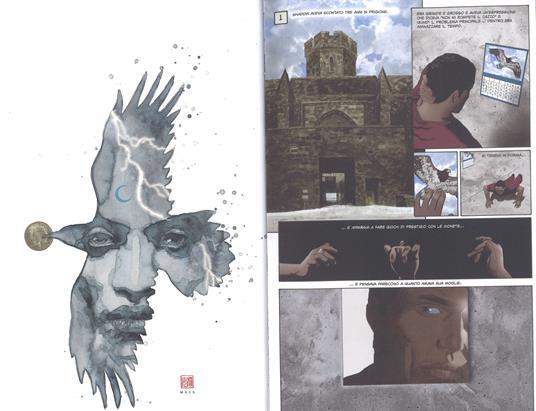
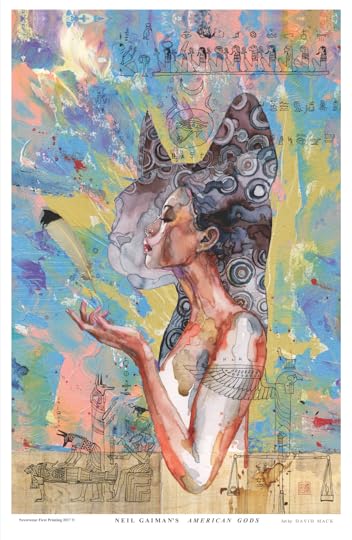
This is a fairly word per word version of the first arc of the novel which was great to read again but the artwork itself was not as engrossing and in some scenes didn't do enough justice to the scenes as written but I did love some of the David Mack pieces that are in between the issues but then again it was hard to not love them with their color and touch of magic.
I think this is one of those books that my imagination is best imaging the scenes rather than having an artist interpretation of them so I might just reread the book yet again.