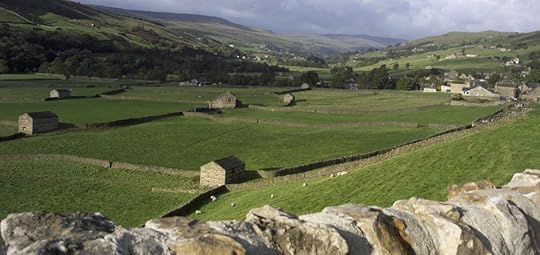
A Guided Tour Through the Beloved Land of All Creatures Great and Small.
Takes readers on a delightful walking tour of the land he brought to life in his memoirs. Glorious color photography is supplemented by Herriot's own irresistable descriptions.
James Herriot is the pen name of James Alfred Wight, OBE, FRCVS also known as Alf Wight, an English veterinary surgeon and writer. Wight is best known for his semi-autobiographical stories, often referred to collectively as All Creatures Great and Small, a title used in some editions and in film and television adaptations.
In 1939, at the age of 23, he qualified as a veterinary surgeon with Glasgow Veterinary College. In January 1940, he took a brief job at a veterinary practice in Sunderland, but moved in July to work in a rural practice based in the town of Thirsk, Yorkshire, close to the Yorkshire Dales and North York Moors, where he was to remain for the rest of his life. The original practice is now a museum, "The World of James Herriot".
Wight intended for years to write a book, but with most of his time consumed by veterinary practice and family, his writing ambition went nowhere. Challenged by his wife, in 1966 (at the age of 50), he began writing. In 1969 Wight wrote If Only They Could Talk, the first of the now-famous series based on his life working as a vet and his training in the Royal Air Force during the Second World War. Owing in part to professional etiquette which at that time frowned on veterinary surgeons and other professionals from advertising their services, he took a pen name, choosing "James Herriot". If Only They Could Talk was published in the United Kingdom in 1970 by Michael Joseph Ltd, but sales were slow until Thomas McCormack, of St. Martin's Press in New York City, received a copy and arranged to have the first two books published as a single volume in the United States. The resulting book, titled All Creatures Great and Small, was an overnight success, spawning numerous sequels, movies, and a successful television adaptation.
In his books, Wight calls the town where he lives and works Darrowby, which he based largely on the towns of Thirsk and Sowerby. He also renamed Donald Sinclair and his brother Brian Sinclair as Siegfried and Tristan Farnon, respectively. Wight's books are only partially autobiographical. Many of the stories are only loosely based on real events or people, and thus can be considered primarily fiction.
The Herriot books are often described as "animal stories" (Wight himself was known to refer to them as his "little cat-and-dog stories"), and given that they are about the life of a country veterinarian, animals certainly play a significant role in most of the stories. Yet animals play a lesser, sometimes even a negligible role in many of Wight's tales: the overall theme of his stories is Yorkshire country life, with its people and their animals primary elements that provide its distinct character. Further, it is Wight's shrewd observations of persons, animals, and their close inter-relationship, which give his writing much of its savour. Wight was just as interested in their owners as he was in his patients, and his writing is, at root, an amiable but keen comment on the human condition. The Yorkshire animals provide the element of pain and drama; the role of their owners is to feel and express joy, sadness, sometimes triumph. The animal characters also prevent Wight's stories from becoming twee or melodramatic — animals, unlike some humans, do not pretend to be ailing, nor have they imaginary complaints and needless fears. Their ill-health is real, not the result of flaws in their character which they avoid mending. In an age of social uncertainties, when there seem to be no remedies for anything, Wight's stories of resolute grappling with mysterious bacterial foes or severe injuries have an almost heroic quality, giving the reader a sense of assurance, even hope. Best of all, James Herriot has an abundant humour about himself and his difficulties. He never feels superior to any living thing, and is ever eager to learn — about animal doctoring, and about his fellow human creature.
If all of All Creatures Great and Small and Every Living Thing is not enough for you, in essence, if you are a James Herriot junky, I've got just the book for you!
James Herriot's Yorkshire: A Guided Tour Through the Beloved Land of All Creatures Great and Small is what you want! Herein the author of all those wondrously delightful tales about the life of a country vet in (approximately) 1940s Yorkshire, England takes his fans on a walkabout tour of the Dales where he once practiced.
This is an oldish book now and so the pictures have a dated look about them, yet still it's a joy to see and hear described these locations, some of which appeared in the books and television show. My wife and I spent our honeymoon in England and for a few days we drove about Yorkshire. She was more interested in the Harry Potter film locations I found for her, while I was keen on locating places like The Wensleydale Heifer, a massive tavern (now a "boutique hotel") where Herriot and his wife would go for drinks or a bite to eat.
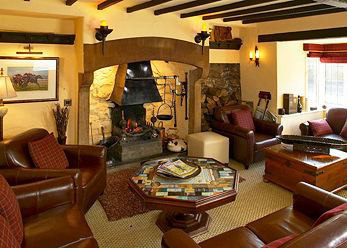
This pic of the Wensleydale Heifer looks nothing like the rustic, homesteady type place I visited, and is a far cry from what Herriot knew. Looks like they've really gone over it with heaps of cash.
No, it's not for everyone, but this book will be of great interest to a certain kind of person.
I fell into this book, drawn from a pile years-old, bought 2nd hand for $1. I was dazzled by the T.V. marathon of All Things Bright and Beautiful. Having tried to read that book decades ago, I couldn’t, didn’t find the prose compelling, whereas the film version sure was. Here, the grand photos by a Brabbs augment my experience, because I have been to Yorkshire many times—especially the Minster, next to where Roman Emperor Constantine was crowned. In my simple reading Herriot’s Yorkshire, I note that Herriot really did drive a car without brakes.
Again, I do not find the prose compelling, but credit Herriot for his ironic contrasts: Skeldale House, the vet Farnon soon to return and interview him for a job, Herriot outside, “The peace of high summer contrasting with the turmoil in my mind” (p.139). We find the dramatic hills of Richmond (easy for me since I lived in Richmond, Mass for ten years) and the church in Thirsk, where he and Helen were married, with its medieval doorway. Next, Sunnyside Nursing Home, where his daughter was born, attended (and parents well fed) by Nurse Bell. Herriot had entered in a panic, on leave from his R.A.F. billet, first greeted by Norse Bell’s husband, unflappable Cliff. “At that moment the most anxious man in the town was confronting the calmest”(136). Another good contrast.
We Americans grow used to depictions of cowboys roping cattle from the saddle, but in Gayle, on the Allen farm over the high moors to Oughtershaw, “a piece of the bleakest Yorkshire,” our author saw the cattle in stone barns, “but the ones outside were run down and caught on the open fells by the two Allen sons. This is something I have never seen done anywhere else, I look back with awe on the toughness and endurance of those two young dalesmen”(135).
Near Coverdale, the town Horsehouse was named for the pack horses fed and barned there (80). For other names, rivers are called “becks,” and many Yorkshire town names derive from Norse, like Sunnorfeld from “Sjunor,” lookout; Lovely Seat locally called Lunasit, “perhaps derived from ‘Luin’ which means an alarm. Probably it was used in the old days to send warnings to the settlers in Twaite in case of imminent danger”(65).
For ancient monuments, there’s remnants Whitby Abbey, where the date of Easter was set in 664; it also housed the great Northumbrian poet Caedmon. It was destroyed under Henry VIII, along with many other abbeys and clerical centers; but its remnants are still used by sailors as a landmark. Contrast Newburgh Priory, still inhabited, where Oliver Cromwell’s bones may be buried. Cromwell’s third daughter lived there; she had married the grandson of Lord Fauconberg (154).
Then in Coxwold lies Shandy Hall, where Laurence Sterne lived as vicar, in an octagonal-towered church. He was never happier than living there for seven years during which he wrote parts of “Tristram Shandy” and “Sentimental Journey.” Now it’s a Laurence Sterne museum, open Wednesdays; but it remains a farm, inhabited.
Well and truly, James Herriot's Yorkshire is pretty much a perfect companion book for the All Creatures Great and Small novels, giving us as readers delightful descriptions of nature, of buildings and also of Yorkshire history/culture, exponentially increasing the local Yorkshire knowledge that James Herriot already provides in and with his memoirs, and with Derry Brabbs' accompanying full colour photographs providing a wonderful visual mirror not only for James Herriot's printed words in James Herriot's Yorkshire but indeed also for All Creatures Great and Small and the sequels (but part of me kind of wishes that when James Herriot writes about himself, his family, his friends etc. in James Herriot's Yorkshire he were using his and their actual names and not the pseudonyms from the novels, but well, that is only a very minor and unimportant issue and I do have to admit that reading about James, Helen and Siegfried in James Herriot's Yorkshire certainly does feel rather more familiar than encountering the names of Alfred, Joan and Donald would).
However and be that as it may and although my rating for James Herriot's Yorkshire is solidly five stars, I guess I also should leave the following caveat regarding James Herriot's Yorkshire. For yes, albeit I absolutely and utterly adore James Herriot's writing and how this book, how James Herriot's Yorkshire is obviously the author's love song to Yorkshire, and in particular to those parts of Yorkshire Herriot knows intimately and is most familiar with (due to James Herriot's/Alfred Wight's veterinary practice being located in Thirsk, Yorkshire, and which in the All Creatures Great and Small books is of course known as Darrowby), I would probably consider most of the information James Herriot provides in James Herriot's Yorkshire about youth hostels, bed and breakfasts etc. as likely, as probably being out of date in 2023 (which is not an issue in and of itself except that if one were actually considering using James Herriot's Yorkshire as a travel guide, the details about places to stay, the information about youth hostels and the like need to be taken and approached with a large dose of the proverbial grain of salt).
But yes, as a celebration of in particular the Yorkshire landscape (and especially areas like the Dales, the Pennines and the Yorkshire Moors), James Herriot's Yorkshire is a descriptive marvel and delight, and with James Herriot demonstrating not only his penmanship but also his total and all encompassing love for Yorkshire (and of course, Herriot also does precisely this with his memoirs as well, but James Herriot's Yorkshire gives a bit of a landscape polish up and expansion to the All Creatures Great and Small stories, and so do in fact Derry Brabbs' photographs, as for example, his pictures of massive snowdrifts really bring home the fact that James Herriot's accounts of having to drive to veterinarian appointments on remote Yorkshire during raging blizzards in the late 1940s are actually authentic and massively totally accurate).
I love All Creatures Great and Small and it's just delightful to read anything at all from this author. James Herriot's Yorkshire was just a nice read. It's good to read a little more of the real life towns that inspired his stories.
A bit less “Herriot” than I’d hoped. I suppose if I’d read it 25 years ago, when first going through his books, it’d be more interesting, but now, it’s just a slightly dated tour of places I’ve never heard of and will never see. The dark photographs don’t perk it up, either. However, he’s a history buff and it is great to read about the ancient abbeys and castles that seem to be every ten miles. And when he describes the special places that he’s taken his kids (and dogs!) on walks, I would like to be with him on those walks.
This is the fifth book in the series about a veterinarian in Yorkshire, England. This book describes the countryside in which the author had his practice. It contains photographs along with the descriptions of the various places in the Yorkshires. I recommend this book to anyone who has an interest in what life was like in rural England.
I read James Herriot over and over as a kid, and this book wasn't one available from the library at that time. I was pleased to find this at a booksale. It was nice to revisit the stories and locales of his other work, with some added personal description and striking photos. It's one of those kinds of books I like to have around on sleepless nights, with words and illustration that are soothing. One you can flip through without worrying too much about it.
Warning: you will sigh and start daydreaming if you read this book.
Herriot’s writing is always so wonderful—these descriptions of his favorite places in Yorkshire do not disappoint. I used this book for travel research instead of just googling stuff, and that made the contents even sweeter.
As always, James Herriot comes up with just the right words to bring you into his world. There are a lot of beautiful pictures in this book and just the right amount of narration. I did see a little of Yorkshire when I vacationed in the UK twenty years ago, but it takes a native to bring to life what it means to actually live there. I hadn't realized before that Mr. Herriot (vets and surgeons are called Mister in the UK) and his wife Helen were still alive when the original TV series was being filmed. That must have been very special for them as well as for the actors involved. I might need to go back to reread some of the books.
Probably the best little library find we've ever had. I didn't even know this book existed, but it was like taking a charming excursion with Alf Wight himself across his beloved Yorkshire. I will get there someday.
A short tour through the actual countryside the beloved vet traveled with some explanations on how he changed things for his stories. Pictures are included & not bad. It is beautiful countryside.
I was a bit disappointed in the very dated photographs that didn't do justice to this beautiful part of Britain, but we visited in the Spring when the fields were full of adorable lambs and bright yellow rape, while the hills were emerald green. No doubt we were seeing it at its best. Nevertheless, I enjoyed seeing Yorkshire again through Herriot's eyes and expert writing.
This beautifully-photographed book prompted me to spent a week discovering Yorkshire about twenty years ago. The book came with me. Yorkshire was even more beautiful than the book had promised: rolling dales, becks, sheep everywhere, wild moors, cobbled market towns, wonderful food and drink. Our brakes failed on a steep hill and we were forced to take refuge in a pub in a tiny village for hours while the mechanic fixed our car; that was how we found the best beer in Yorkshire and the best sandwiches in the world. It was hard for me to pull myself away from Yorkshire and head back to London and eventually back to Canada. I'd go back in a heartbeat. The book isn't just for people who loved Herriot's books or the TV show, though it helps. The scenery and historic buildings in it are worth looking at on their own, and the book is a great guide to Yorkshire although it doesn't have maps.
I wanted to like this book, especially since I found about my Yorkshire roots and all. The book was okay, but just barely. Maybe it was just my edition or my copy, but the black and white photographs were mostly black and I couldn't make much of anything out. And there really wasn't a whole lot of substance in the text, either. Plus, all the odd-numbered pages were printed with huge left margins.
On the plus side: the book was a crazy fast read, thanks to the many unviewable photos and huge page margins. Also, Herriot struck me as someone I would like, and I think his dogs were the luckiest dogs in the world, getting to walk with him and run and play in the Dales every day.
A friend lent me this book when I slept over and I very much hope I've given it back to her (if not, super sorry Zion, I warned you!).
Anyway, this is pretty. It's so pastoral and natural, almost magical in the most British way. It makes me want to travel there and see it for myself.
Admittedly, I read this during guard duty and it provided some much needed escape. If I had other books near me (that weren't very difficult philosophy books) I'm not sure I would have been able to finish it.
I love James Herriot's books and his beautifully depicted Yorkshire so much that I did a pilgrimage in 1995, just missing meeting him by a few months. (He had just died.) But Yorkshire didn't disappoint!
If you loved this series the way that I do ( I even have the entire DVD set of the BBC series) this book is awesome. As it shows some of the areas that Mr. Herriot talks about in the series. What a terrific man who led a terrifically wonderful life!
This has been on my shelf for over 11 years and I've finally gotten round to reading it. I LOVED it! The scenery of Yorkshire looks so much like where I grew up in Eastern Oregon. I thought that when I visited York and Haworth in 2016 and was reminded as I looked through the beautiful photos in this book. It was eye-opening to imagine traveling across some of those very sparsely populated areas at night. When I've read things like Jane Eyre or Wuthering Heights, I guess I imagined they traveled by streetlight---ha! But no, to imagine a coach traveling through the dark and the cold and the weather---it does seem very bleak!
I especially enjoyed the photos of York and remembered the builders who were working on York Minster when I visited there. Someone told me that they were learning the original ways of repairing and maintaining the building---knowledge handed down over hundreds of years. How wonderful!
I also learned something new: the name prefix "fitz" being similar to "ben" in Hebrew or the suffix of "son" in English---all meaning "son of".
I read JAMES HERRIOT’S YORKSHIRE because I wanted to see all the beauty Herriot spoke of in his ALL CREATURES GREAT AND SMALL series. His descriptions of his veterinary work in Yorkshire, England made me want to visit there. But he was talking about the 1930s in his series, and I’m sure much has changed since then. Everything looks gorgeous in the pictures in JAMES HERRIOT’S YORKSHIRE, but even this was written in the 1970s. I wonder how much has changed since then.
Herriot accompanies the photographs (by Derry Brabbs) with his memories, some of his veterinary work in those locations, some of his visits there with his family, and others simply noting history. I admit to getting a little bored when he describes the scenery at length.
After finishing this lovely book, I still want to visit Yorkshire. But here I am in the United States and I don’t know how likely that is. I have to keep reminding myself that we have beauty over here, too, and I haven’t seen all of it yet.
James Herriot, author of All Creatures Great and Small, presents a descriptive and pictorial work on some of his favorite places in Yorkshire. He presents places, towns and landscapes through rambling walks, day trips, vacation and getaway spots, periods in his life and locations associated with specific people and friends. There is no doubt that Herriot loved Yorkshire and between his work and his explorations visited most of it. The book has some great photography taken in the late seventies, but unfortunately the mass market version is in black and white. I did look up a lot of the places online after reading the book to get a look at the places today. Beautiful, open and often stark country.
First of all, please understand the difference between James Herriot, the author, and the caricature of the man in the 1970's - 1980's TV series & the rebooted 2021 P.B.S series. Those TV versions are entertaining, but you can only really appreciate the man through the books that he himself authored. In this book, which is loaded with wonderful photographs of Yorkshire, you get to go very many splendid places. Herriot concludes this book with these words: In literally thousands of letters...the same phrase has recurred: "I wish I could see the places you write about. " If this book can reach those readers, it will give them at least a glimpse of the countryside where I have found so many of the good things in life." I for my part, certainly believe that he succeeds in that.
A bittersweet trip down memory lane. The Yorkshire coast and moors are the places I love most in the world. There are thousands of gorgeous walking trails, thousands of lovely village pubs and on a sunny day it is just warm enough to walk vigorously without getting too sweaty (unlike Darwin), if it gets too cold the pub is never very far. This book belonged to my Dad as he was also a walking fan, I didn't spend enough time walking with him when he was alive. While I love Yorkshire, I never felt I was good enough to be accepted there so I moved on again. The problem wasn't Yorkshire, it is me, I've never been good enough wherever I went or whatever I did. Perhaps I should have stayed but I didn't, I still love to visit and roam this beautiful countryside.