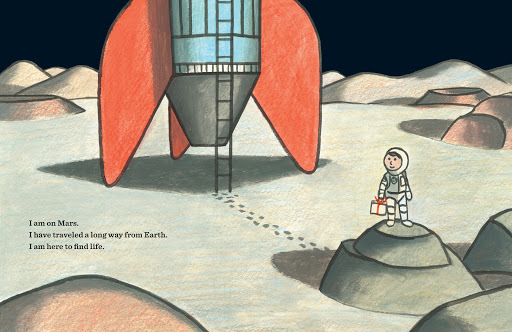
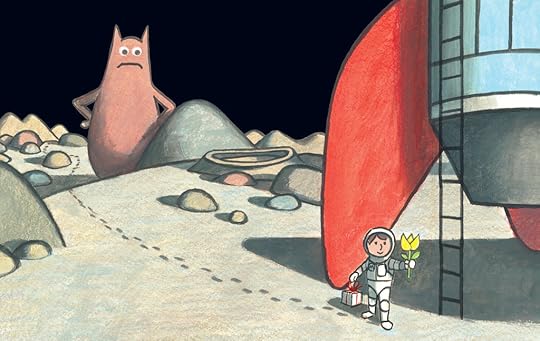
Petit homme s'envole dans sa fusée rouge et foule le sol de Mars, à la recherche d'une trace de vie. Il va et vient de dune en cratère, un cadeau à la main, qu'il offrira au premier Martien venu. Mais il n'y a personne sur cette maudite planète, et à force de chercher, Petit homme a perdu sa fusée...
I grew up in Nyack, New York, just up the street from the Hudson River. In our house, there was always an art project going on.
My early drawings were very animated: a lot of stuff zipping around, airplanes, racing cars, football players. No surprise my first published drawing was a pack of rats running along a highway (The Rat Race). I did that for the New York Times Op Ed page when I was still in high school.
I went to college at The Cooper Union School of Art in New York City. I studied painting, sculpture and filmmaking, but what I loved doing most—in my spare time—was drawing cartoons and comic strips.
When I graduated, I hauled my pile of doodles into the offices of a bunch of editors, with the wild notion that somebody might publish them. When that failed, I wrote a story for kids to go with my pictures (If Snow Falls). It was two sentences long (which counts, by the way). Frances Foster, a wonderful editor at Random House, saw something in that book and signed me up.
The next book, Ellsworth, was about a dog who teaches economics at a university. When he gets home, he throws off his clothes and acts like a dog, which is fine, until some fellow teachers discover this and he loses his job. Somebody told me that Ellsworth was a story about "being yourself." I never realized it had a moral.
I moved to another publisher with Ludlow Laughs, the story of a grumpy guy who laughs in his sleep. This book was doing very poorly until the comedienne Phyliss Diller read it on PBS's Reading Rainbow. It stayed in print for over twenty years.
My fourth book, The Incredible Painting of Felix Clousseau, was a hit. One of the first people to see it and give it the thumb's up—literally, hot off the press—was Maurice Sendak. We bumped into each other at the printers. It was a lucky first meeting, and happily not our last.
That was all a long time ago. Since then I've written many other picture books, illustrated a few by other authors, and created a series of offbeat wordplay books, beginning with the book of palindromes, Go Hang a Salami! I'm a Lasagna Hog!
I visit schools across the country and sometimes around the globe. I live with my wife, Audrey, in San Francisco.
A fun and quick read about a boy going to Mars in the hope to find life. Not seeing the Martian he goes home disappointed having only found a flower. Although this was a nice enough story I was hoping for a bit more. It would be good to point out to children reading this that they shouldn't pick a wild flower, particularly if they don't know what it is, lets hope Mars has some more of these flowers somewhere.
A boy ends up on Mars because he believes there is life on Mars. He wanders the planet not seeing the giant monster who lives there. The illustrations are really nice and the monster is really cute.
However, when the kid finds life on Mars -- a flower -- he plucks it! Hooray, there's life on Mars. Now it's dead.
Ok maybe I'm being overly sensitive/reading too much into this, but it really bugged me that when the boy finds proof of life on Mars- the only life he's seen at all, and what, as far as he knows, may be the only life on Mars- he kills it in order to bring back as proof.
2.5? I don't know. Ugh I really liked the pictures... I found the story problematic though :( My friend pinpointed what was bothering me - that the boy plucks the flower, thus killing it, to bring back as evidence of like on mars. Also it made me really sad that the boy was so oblivious to the alien. I don't know why the review said fans of Oliver Jeffers would like this. The illustrations are pretty adorable, but Oliver Jeffers books to me are very sweet and friendship-affirming. I am probably thinking about this too much. It just kind of made me sad though.
Jon Agee’s silly story of an adventurous astronaut on the hunt for life on Mars is a we-know-something-the-hero-doesn’t tale. Readers see the Martian, but will our astronaut? This is sure to make young readers giggle, point, and shout…”Look behind you!” It’s sweet fun!
The art’s simple shapes and thick, black lines come together to create depth and definition. Some of the images have a 3D look to them. I had to reach out and touch the rocket blasting off into space! The style looks as if someone colored pictures, cut them out, and pasted them to these pages. Pages full of surprises! The ending is a gift. Haha…It’s sure to get readers talking and smiling.
I’m a bit obsessed with Mr. Agee’s quirky storytelling and art right now. I’m off to find more and more of his distinctive, off-kilter worlds.
This is definitely meant for young children, and I think young children will find it really funny. A young boy believes there is life on Mars, so he travels there to search for it. He can't find any (despite the enormous creature following behind him). I'm sure young children will think this is really funny.
I agree with other reviewers that it is problematic that when he does finally find life on Mars (a flower), he picks the flower to prove that there is life on Mars. However, this certainly could lead to some great discussions...are we ever oblivious to things happening around us? Do we ever unwittingly or intentionally cause harm to living things around us? What could the boy have done to bring back "proof" that wouldn't have caused any harm? Why might there be/not be life on Mars? What conditions are needed for there to be life on a planet? Granted, these discussion points go far beyond the scope of this book...and I probably wouldn't bring up most of them with really young children. But for early elementary age students, these discussion questions could turn this into a good teaching resource.
Here we meet a young man who has traveled all the way to Mars to prove the existence of life on that planet. I don't want to give away any more of the plot, though you can gather from the cover image that there's plenty of life hanging out there. Let's just say the boy learns a good lesson in the importance of paying attention to the world around you.
Jon Agee's books always make me laugh, and this one was no exception.
This book was precious and philosophically profound. Human beings are an ego-driven species that often can't see beyond their own selves, and this book with it's sweet astronaut and the martian who follows him around the planet reminds children to open their eyes and really observe their surroundings. Our dreams and ambitions are powerful forces in this life, but if we become blinded by them we'll miss the incredible events, forces, and species that make up this incredible universe.
Lühike, aga tabav. Võiks kohati öelda, et lugu on seiklustühi, sest justkui midagi ei juhtu, aga ometi juhtub nii palju. Eriti meeldis loo omapärane lustakus, mille tipp oli kõige viimasel lehel olev nägu.
I stumbled across this on Libby and decided I'd give it a try, not realizing it was a children's picture book. I'm definitely not the target audience but it was still fairly enjoyable to look through.
He elegido este libro para iniciar el tema del sistema solar el próximo curso (siempre me gusta hacer storytelling antes de empezar un nuevo tema para introducir un poco el vocabulario y hacer un poco más dinámica la clase, preparo o busco algunas actividades a partir del libro y ya los pongo en situación)
Este libro cuenta la historia de un astronauta que viaja a Marte en busca de vida. Lo divertido del libro es que el va narrando su periplo mientras las imágenes que acompañan al texto desmontan todo lo que va contando.
Lo recomiendo mucho, se ha convertido en el favorito de mi niña antes de ir a la cama.
When a young explorer heads for Mars he is sure he going to find life on the red planet. He hunts high and low and is on the verge of giving up when he spots something! As he explores he fails to notice that he is being followed which gives the young audience a secret to share. On his way home he discovers that he was not alone!
This is a lovely read-a-loud with lots to talk about.
P.S. Megan is amazing. she is my favorite librarian ever. Or at least this week.
A child lands on Mars seeking life. He takes along cupcakes to share. He sees nothing but dirt all around him. He finally spots one sign of life. This book is all about the illustrations. We see not only the narrator's story but the reality of the situation as well. Great book for beginning readers or as a read aloud for younger children.
A young space traveler lands on Mars in this latest humorous picture-book from Jon Agee, determined to find the local life-forms and present them with his gift of chocolate cupcakes. But his wanderings - in which he continuously misses seeing a massive creature that appears to be very curious about him - only serve to convince him that he is wrong, and that there is no life on Mars. Although delighted to eventually find a flower - proof of the life he had believed in all along - our young hero continues to overlook the creature that has been following him all along...
Like some Jon Agee's previous picture-books, from It's Only Stanley, in which a family dog builds a rocket ship to take him to the moon, to The Other Side of Town, which features a taxi ride to an alternate dimension, Life on Mars presents an amusing science-fiction story, one in which the young child reader/listener will find entertainment in being "in the know," when the main character is not. Although quite enjoyable, I did find that my funny-bone wasn't quite as tickled by this latest of Agee's efforts, and felt that it didn't quite live up to some of his previous stories. Still, fans of this author/artist will find much here to keep them engaged, with young would-be space explorers finding the story (and artwork!) particularly appealing.
A child astronaut heads to Mars because he just knows that there is life there. He travels all alone, exploring the barren landscape of rocks and mountains. He even brings a wrapped gift of cupcakes with him for the creature he encounters. He does find a yellow flower blooming, proof that he was right all along. But along the way, he completely misses the huge martian following him around. That is until he gets ready to return to Earth and discovers the cupcakes have been eaten.
Agee is a master of riotous yet understated humor. Readers are in on the joke throughout the entire book, easily seeing the huge orange creature on the page. They will wonder if the astronaut will ever spot him. The use of the flower as proof of life on Mars is cleverly done, offering proof of life without the astronaut ever seeing the larger find right near him. As always, the illustrations by Agee are simple and friendly. His use of thick lines works well with the alien landscape of Mars, creating a dramatic feel.
A winner of a book that combines the joy of a mystery, a secret, aliens, space and cupcakes. Appropriate for ages 3-5.
Agee is brilliant, but you wouldn't know it from this book. The reader seeing things that the hero doesn't is a trope that was overdone centuries ago. And there's really nothing else to the story, unless you want to talk about the now-extinct fauna of Mars. (Note the sad expression on the Martian as the astronaut walks off with the flower, given that the Martian discreetly helped him find his way to his spaceship.)