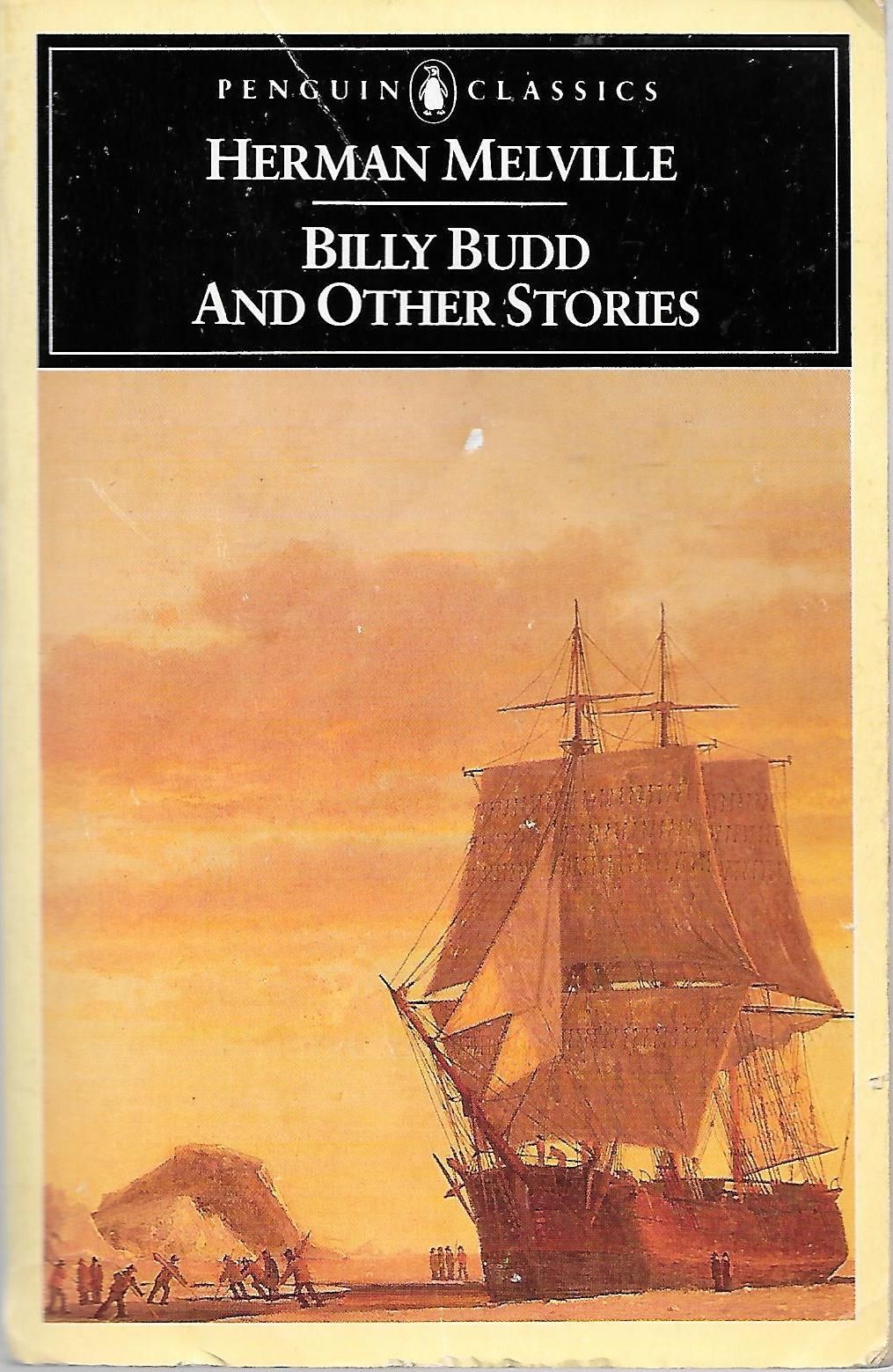
Alternate Cover Edition ISBN 0140390537 (ISBN13: 9780140390537)
Tales of compelling and mysterious power by one of America's greatest and most complex writers.
The works collected here were all written after Moby-Dick and Pierre. Stung by the critical reception and lack of commercial success of those two books, Melville became obsessed with the difficulties in communicating his vision to readers. This sense of isolation, of a need to find a way to express oneself, lies at the heart of these later works. "Billy Budd, Sailor," a classic confrontation between good and evil, is the story of an innocent young man unable to defend himself against a wrongful accusation. Billy's silence, his literal inability to express the truth, will lead to his death. The other selections here - "Bartleby," "The Encantadas," "Benito Cereno," and "The Piazza" - also deal, in varying guises, with the ways in which fictions are created and shared with a wider society.
Frederick Busch discusses in his introduction Melville's preoccupation with his "correspondence with the world," his quarrel with silence, and why fiction was, for Melville, "a matter of life and death." (back cover)
Herman Melville was an American novelist, short story writer, and poet of the American Renaissance period. Among his best-known works are Moby-Dick (1851); Typee (1846), a romanticized account of his experiences in Polynesia; and Billy Budd, Sailor, a posthumously published novella. At the time of his death, Melville was no longer well known to the public, but the 1919 centennial of his birth was the starting point of a Melville revival. Moby-Dick eventually would be considered one of the great American novels. Melville was born in New York City, the third child of a prosperous merchant whose death in 1832 left the family in dire financial straits. He took to sea in 1839 as a common sailor on a merchant ship and then on the whaler Acushnet, but he jumped ship in the Marquesas Islands. Typee, his first book, and its sequel, Omoo (1847), were travel-adventures based on his encounters with the peoples of the islands. Their success gave him the financial security to marry Elizabeth Shaw, the daughter of the Boston jurist Lemuel Shaw. Mardi (1849), a romance-adventure and his first book not based on his own experience, was not well received. Redburn (1849) and White-Jacket (1850), both tales based on his experience as a well-born young man at sea, were given respectable reviews, but did not sell well enough to support his expanding family. Melville's growing literary ambition showed in Moby-Dick (1851), which took nearly a year and a half to write, but it did not find an audience, and critics scorned his psychological novel Pierre: or, The Ambiguities (1852). From 1853 to 1856, Melville published short fiction in magazines, including "Benito Cereno" and "Bartleby, the Scrivener". In 1857, he traveled to England, toured the Near East, and published his last work of prose, The Confidence-Man (1857). He moved to New York in 1863, eventually taking a position as a United States customs inspector. From that point, Melville focused his creative powers on poetry. Battle-Pieces and Aspects of the War (1866) was his poetic reflection on the moral questions of the American Civil War. In 1867, his eldest child Malcolm died at home from a self-inflicted gunshot. Melville's metaphysical epic Clarel: A Poem and Pilgrimage in the Holy Land was published in 1876. In 1886, his other son Stanwix died of apparent tuberculosis, and Melville retired. During his last years, he privately published two volumes of poetry, and left one volume unpublished. The novella Billy Budd was left unfinished at his death, but was published posthumously in 1924. Melville died from cardiovascular disease in 1891.
For me, Moby Dick is compelling for its flaws as much as its genius. It is somehow both brilliant and overly-ambitious. One can feel, on every page, Melville straining to write something Miltonic, Shakespearean, even Biblical in its reach and power. But like some over-educated Icarus, his soaring flights of gorgeous prose are always followed by plunges into tedious pedantry. And yet, the book holds together, in part because Melville’s doomed stabs at greatness reveal him to be another Ahab, chasing the impossible. No other book better dramatizes the paradoxical fight to overcome one’s own nature.
I add this little sketch of Moby Dick because I wanted to explain why that particular book is so special to me—and, by common consent, so much better than anything else Melville wrote. It is like an enormous spark, cast off by Melville’s throwing every bit of his intellectual weight against the rock of immortality. But when he set his sights a little lower, and his ambition is cooled, his defects as a writer come more fully into view. At least, that was my consistent impression as I made my way through these stories.
The title piece of this collection has proven to be a challenge to editors. Written during the final years of his life, and published only decades after his death, the manuscript of Billy Budd was, apparently, disorganized and difficult to read. Given that it was left unfinished—and that Melville did not try to publish it—I think it would be uncharitable to judge it too harshly. Even so, I think even the most generous critic would call it uneven, awkward at times, and often infelicitously written. Yet as the story crescendos near the end, it achieves a striking and memorable beauty.
Even so, I would rank “Bartleby” as the highlight of this collection. Written in the first person (which helps to dampen Melville’s tendency toward the fustian), the story almost seems to presage Kafka in its absurd premise. “Benito Cereno” is also a strong piece of writing, even though its racist treatment of the black slaves will likely unsettle the modern reader. And “The Encantadas, or Enchanted Isles” almost reads ike Moby Dick in miniature, focusing on the Galapagos Islands rather than a white whale. I cannot say I cared much for the other stories in this collection.
It is interesting to encounter Melville from the perspective of the present. Despite all the radicalism and experimentation in the century and a half since most of these tales were published, it is clear from reading Melville that the novel has become more, not less, rigid as a form. He puts so many things into his fiction—authorial comments, learned allusions, technical details, philosophic asides, naked moralizing—that just do not seem to belong there now. It often seems as though, for Melville, the story is merely a vehicle to convey his ideas. He was not trying to create the kind of immersive experience—like a movie playing in our heads—that we have come to expect from fiction.
For my part, even if I found many pages of this collection to be tedious, dull, or clumsy, I still came away with a great deal to think about. And perhaps that is what Melville wanted most of all.
This, ladies and gents, is what we call round these parts a darn good sentence:
"By the side of pebbly waters--waters the cheerier for their solitude; beneath swaying fir-boughs, petted by no season, but still green in all, on I journeyed--my horse and I; on, by an old saw-mill, bound down and hushed with vines, that his grating voice no more was heard; on, by a deep flume clove through snowy marble, vernal-tinted, where freshet eddies had, on each side, spun out empty chapels in the living rock; on, where Jacks-in-the-pulpit, like their Baptist namesake, preached but to the wilderness; on, where a huge, cross-grain block, fern-bedded, showed where, in forgotten times, man after man had tried to split it, but lost his wedges for his pains--which wedges yet rusted in their holes; on,where, ages past, in step-like ledges of a cascade, skull-hollow pots had been churned out by ceaseless whirling of a flint stone--ever wearing, but itself unworn; on, by wild rapids pouring into a secret pool, but soothed by circling there awhile, issued forth serenely; on,to less broken ground, and by a little ring, where, truly, fairies must have danced, or else some wheel-tire been heated--for all was bare; still on, and up, and out into a hanging orchard, where maidenly looked down upon me a crescent moon, from morning."
According to many reviewer on here and other sites such a sentence is "unreadable" or "meandering" or "too long and confusing".
It is interesting (well, mildly interesting) to note how stating a text is "unreadable" (as though this was some sort of universal category into which it can be placed) allows one to deflect the potential damage to one's self-esteem in admitting the truer statement that one was unable to read it. The blaming of the text rather than admitting one's own limitations is usually also accompanied by a dismissal of any other reader who had a more positive view as being "pretentious", or somehow something performative designed to shape the way the reader is perceived.
The idea that someone could read the above quote and receive nothing but sincere joy, genuine pleasure, from the reading, is rejected.
I am not quite sure why I am writing this, other than that I am bored at work. I am growing increasingly convinced that no one reads these reviews anyway. I would be lying if I did not admit that part of the reason for writing them is my own thinking out loud, as well as the fact that I like typing word after word after word and seeing where they take me. The lure of the echo chamber remains.
After all, this is Melville for god's sake. What on earth can I possibly add to the discussion?
Anyway. All the stories here are well worth your time, particularly those (if you are anything like me) you may have read before and forgotten or never even heard of.
Billy and Bartleby and Benito (he does like his "B" names!) are pretty damn essential reading.
Distinctly we see the difference of the colors, but where exactly does the one first blendingly enter into the other? So with sanity and insanity.
Billy and Bartleby are old friends, portraits of bejeweled philosophy. Strange as it may appear, the selection which punched me in the jaw was Cock-A-Doodle-Do: a tale told by a fellow traveler (he drinks porter and reads Rabelais) about a magical fowl which is a fount of bliss, an actual agent of earthly happiness.
Herman Melville – of course, it’s understood – was a genius, but I find his work difficult and, more importantly, not always enlightening. His prose, to say the least, is mannered and contorted; reading it can oftentimes seem like negotiating a thornbush. But at its root (and this is what makes the going slow, since I can’t simply push through without its grasping me) it’s strong, wedded to meaning as to earth, deep-reaching. As a prose-writer, then, Melville is dazzling, always sure of what he wants to say even as the twists and turns of his sentences make the likelihood of his having planned them slim, able to think on his feet, deft, agile, and most importantly, always alive-seeming, his effects all movement and indrawn-outdrawn breath, not the static wood-carvings of other mannered nineteenth century writers. That said, its the meaning – the roots of it all – where I take exception, or at the very least question what could possibly motivate the man, whose more obscure concerns seem rarefied at best and semi-autistic at worst, and when the message is clear (or seems so; am I missing something?), as in “Benito Cerino”, it’s so clear as to be confounding, because surely he couldn’t have required 100 pages just to tell us that, could he? (Where’s the mystery? Within ten pages everyone, surely, knows the score, except for his witless narrator. A nice trick, for ten pages.) Of course “Bartleby” is the exception, a masterpiece, but it makes me all the sadder when I can’t find that heft (or what seems to me heft; let’s just say a plane on which our concerns/perceptions can meet) in the other stories. Which is to say, so much of meeting, of seeing, of finding a book comes down to temperament, the author’s and the reader’s. It’s not just what Melville writes, or how he writes it, but why he does so, why he thinks it’s important. I may not grasp that why, may not be able to elucidate it, but I have to share a sense of it, an inkling. In Melville’s case, for the most part, I have an inkling, but not much more. Except for in “Bartleby”, never does he blow me over. The power of “Bartleby” comes from its being both a howl and a chuckle, and granted that’s a common theme here. But why’s he howling? I may come to grasp it; I’m not ruling it out. For now let’s just say he’s a genius, but not quite my kind of guy.
*BILLY BUDD, a classic tale by America's Herman Melville, was written 40 years after his burst of creative energy. Melville still possessed the feeling for a good story, but he wrote it in a language so ornate and (to our modern eyes) stilted, that one can hardly absorb it. Nevertheless, BILLY BUDD deals with a timeless human issue---the nature of justice. Billy, a handsome young sailor, has been impressed into the British Navy where he incurs the jealousy or instinctive dislike of an officer. Billy has done nothing to warrant his wrath and is highly popular among everyone. This officer, rather more intellectual than most, proves tenaciously vindictive. He endeavors to trap Billy in a mutinous plot, but Billy rejects the idea. At last the officer goes to the captain and accuses Billy of mutiny directly. The captain too likes Billy and cannot believe the accuser. He calls Billy, who in tense circumstances is apt to stutter or be tongue-tied. When presented with the officer's accusations, Billy cannot speak. He strikes the officer. The conclusion is swift and sad. I should not reveal the ending, but the question of "what is justice ?" lies at the center of it.
*Other Tales---these are neither very enjoyable nor easy to read except for BARTLEBY THE SCRIVENER, an amusing story that might remind readers of one episode from "Sinbad the Sailor". Bartleby, a copyist or scrivener arrives at a lawyer's office and is hired. He seems to have no past, no present. We discover that he even lives at the office, never goes out. He gradually refuses to do all work, but will not leave the premises. How to get rid of him ? I could tell you the end, but in the immortal words of Bartleby himself, "I would prefer not to." This is a minor classic.
Herman Melville est un de très grands romanciers de la littérature américaine. On trouve les plus examples de son genie dans ce livre. Billy Budd et Benito Cereno sont des chefs d'oeuvres incontestables mais il y a bien de bijoux dans cette belle collection qui represente beaucoup mieux le genie de Melville que Moby Dick qui est à mon avis sur évalué.
Je recommende fortement aussi l'opéra de Benjamin Britten.
One of Melville's finest. I like to think it took his whole life to write this short piece because it condenses his finest diction, symbolism, and commentary on human nature. By story’s end, Melville’s descriptions have created a singular character of innocence, one he calls a “childman” of simple-mindedness. Every character who meets Billy knows that he has this unique and noble quality, though they each react differently to it. Many sailors love him, the Dansker mentors him, Vere fathers him, and Claggart destroys what he can’t become himself. Through all of these experiences, Billy remains distinctly human, for an innocent nature is not perfect.
Magnificent story collection. Incredibly oppressive atmosphere, very akin to Poe and in some ways anticipating Kafka. Benito Cereno in particular is breathtaking.
Some words regarding the stories collected in this volume:
BARTLEBY THE SCRIVENER
I’m sure that nobody could have predicted that a stage in the afterlife of poor Bartleby would be to become a semi-niche meme amongst literary millennials. You can buy t-shirts and coffee mugs with ‘I would prefer not to’ on; it seems unlikely that most other characters from Melville’s other fiction could become currency in the same way. I don’t have any particular problem with this but it does mean the story now comes with baggage which is at least worth unpacking before we dispose of it altogether.
Something of its popularity has to do with its form: it’s a short existential comedy about a strange man who will never leave his office; it is not a million miles from the bits of Kafka that everyone knows about, and it’s not far removed from Seinfeld either. It is funny, and it’s accessible. It’s about work. It’s about the opposite of the ambition we are all supposed to nurture. It’s about a certain kind of resignation which is not felt in terms of surrender but in terms of safety. If you ever find yourself in a job you don’t especially like, but which you find it impossible to leave, you will find something to enjoy here.
In this regard the story has broad appeal, just as it was intended to have: Melville originally wrote it for a magazine to make money after the critical and commercial failure of Moby-Dick, and in terms of his prose it at least has the vibe of a straightforward story, simply told. But ‘simply told’ does not necessarily equate to ‘simple’. The narrator is an intelligent man, an elderly lawyer; worldly as far as his profession is concerned, but entirely lacking in imaginative faculties. His flustered incomprehension at Bartleby’s permanent state of reluctance is entertaining on the level of a bewildered boss in a sitcom. But more troubling is the total absence of any other perspective.
A different narrator — Ishmael, perhaps — would know the questions to ask of a Bartleby. And he would know the limit of any such questions. He would take an axe to his skull if necessary. But in this instance, there is no such room for deliberation. The narrator’s concern for his welfare is contemptible and founded in self-interest: ‘…to humor him in his strange willfulness, will cost me little or nothing, while I lay up in my soul what will eventually prove a sweet morsel for my conscience.’
As it turns out he will not even have the patience to humour him for very long. Self-abnegation is not a viable strategy in the modern world, not even for those as monastic in their habits as Bartleby. It enrages others when it comes to their attention.
We are supposed to find a certain relentless horror in the repetition of this image: a man alone, facing a window day after day behind which there is nothing to see; a man going slowly blind. It is the horror of the condition of the worker who willingly gives up space in his brain to accommodate the capital of his employer. But it’s also the horror of his employer who can only see before him a machine gone wrong.
There is something perpetually inscrutable about almost everything Melville ever wrote. This extends even to the popular conception of him: the title alone of Moby-Dick has become shorthand in public life for the great unreadable novel. But Bartleby the Scrivener is a story about the human cost of becoming unreadable. Presenteeism will not do; it is not enough to show up, and technical mastery will not suffice, in any vocation; if one cannot (or ‘would prefer not to’) perform the requisite emotional labour required to engender human empathy, one's presence can only ever be a net loss on society. The only rational action remaining is to erase oneself entirely from the world, or to allow oneself to be erased.
COCK A DOODLE DOO!
Talk about relentless: this is a tale with all the pace and vigour of the steam trains the author so deplores in the first few pages. Part picaresque, part parody of Wordsworth, it’s a bizarre story about a man who becomes preoccupied with the crowing of a local cockerel. With all the clear-eyed obsession of a character from Poe, he sets out to find it, and its owner.
(Wikipedia gives an uncited description of this as: ‘one of Melville's experiments in utilizing sexually explicit metaphors, in an effort to challenge what Melville saw as a culture of sexual repression and the subjugation of women in contemporary America’. If this is the case then I missed it entirely.)
It starts out like a stand up comedy routine. The words come in long, rampaging paragraphs, along the lines of Sterne (who the narrator sits down and reads at one point). Our man is much too busy pronouncing on the state of the world to much care about the debt collector lingering at his door. From time to time appears something that looks like an allegory — the old farmer struggling to repair his swaying fence that rests on rotten pins — but until he finds his cockerel, the story cannot settle.
He has to follow the voice of the cockerel to its source. And what he finds there is terrible: a man who has forsaken his wife and children in favour of worshipping his cock. He lives in a poor shack, and while dedicated to his pursuits, he seems utterly deluded about the state of his existence:
‘Poor man like me? Why call me poor? Don’t the cock I own glorify this otherwise inglorious, lean, lantern-jawed land? Didn’t my cock encourage you? And I give all this glorification away gratis. I am a great philanthropist. I am a rich man — a very rich man, and a very happy one.’
Much the same might we find amongst the bios of certain wags on Twitter. This one has pursued his artistic vision to the extent that it has required him to forego every other part of his life. Is the world grateful? They are not. Only he and this other man, our narrator, recognise the greatness in his crowing. He is probably some kind of monster. But it does not follow that he is wrong, either.
THE ENCANTADAS
When Melville served on a whaling vessel, he visited the Galapagos islands on board the Acushnet. Many years later, his experiences there formed the basis for this series of ten sketches. He does not paint an especially alluring picture; but then he did jump ship, and spend many days and nights living off the land before he mustered up the courage to approach the locals.
Still, one might think it a little strong to describe these islands as if they were an image of evil ‘glued into the very body of cadaverous death’. It is far removed from the sort of travel writing he wrote when he was younger: the author now seems bent on conveying the absolute seriousness of his tone through his insistence on the dearth of mammalian life on the island.
There are only reptiles in sight — and the tortoises, with which he develops an obsession:
'Nay, such is the vividness of my memory, or the magic of my fancy, that I know not whether I am not the occasional victim of optical delusion concerning the Gallipagos. For, often in scenes of social merriment, and especially at revels held by candlelight in old-fashioned mansions, so that shadows are thrown into the further recesses of an angular and spacious room, making them put on a look of haunted undergrowth of lonely woods, I have drawn the attention of my comrades by my fixed gaze and sudden change of air, as I have seemed to see, slowly emerging from those imagined solitudes, and heavily crawling along the floor, the ghost of a gigantic tortoise, with " Memento * * * * * " burning in live letters upon his back.'
Nobody would set a story in such a place if they did not wish to make a point about something. But as ever, Melville’s intentions remain elusive. The sketches vary wildly: one describes the ascent of a local rock, describing the birds that live on it in accumulating layers; another the ascent of that same rock and how it and the islands came to be discovered and named; all conventional stuff, prettily written. But the stories get progressively more strange.
Sailors escape in the Encantadas and make it their home. One sets up a sort of buccaneer rule there, keeping a rough sort of order by the pack of vicious dogs he breeds there. It’s a rough sort of allegory for a nascent America, I suppose; needless to say they do not last long in Melville’s imagination. More durable is Hunilla, a woman left alone on one of the islands for years, after the sudden death of her husband and his friend. The book approaches the tragedy of her condition, and attempts a depiction, but it keeps a distance.
The implication is that she has suffered a profound kind of awfulness, and even the narrator doubts his ability to convey it, to the extent of interrupting himself mid-sentence:
‘Against my own purposes a pause descends upon me here. One knows not whether nature doth not impose some secrecy upon him who has been privy to certain things. At least, it is to be doubted whether it be good to blazon such. If some books are deemed most baneful and their sale forbid, how, then, with deadlier facts, not dreams of doting men? Those whom books will hurt will not be proof against events. Events, not books, should be forbid. But in all things man sows upon the wind, which bloweth just there whither it listeth; for ill or good, man cannot know. Often ill comes from the good, as good from ill. ‘When Hunilla— ‘Dire sight it is to see some silken beast long dally with a golden lizard ere she devour. More terrible, to see how feline Fate will sometimes dally with a human soul, and by a nameless magic make it repulse a sane despair with a hope which is but mad. Unwittingly I imp this cat-like thing, sporting with the heart of him who reads; for if he feel not he reads in vain.’
The doubt here is notable. As with many of his little stories, Melville borrowed Hunilla’s tale from the real story of a lone woman who was rescued from San Nicholas Island. And here he is, taking her story, adapting it and selling it for money. ‘Events, not books, should be forbid,’ is a disclaimer of sorts — a way of saying ‘don’t blame me for taking this story; in its common awfulness it belongs to humanity’. The extent to which this convinces may depend on the nature of the reader.
THE BELL TOWER
On a superficial level this is a gothic parable about the folly of ambition. But it is also a rather odd, half-developed allegory for race relations. This much is actually announced by the anonymous epigraph (from one of the author’s own manuscripts) that precedes it: ‘Like negroes, these powers own man sullenly; mindful of their higher master; while serving, plot revenge.’
It is set in Italy, sometime in the early Renaissance, a master architect named Bannadonna designs and builds a great tower — one of the tallest ever conceived. (In my mind it looks something like the Torre del Mangia in Sienna, though there are countless other campaniles that would serve just as well.) To cap it, he conceives of a system of clock and bells that functions in a unique fashion; he reveals to nobody how it will work, but those who have been near the top claim to hear a set of footsteps where no person should be at the top of the tower.
The end comes soon, and almost by accident; Bannadonna is putting the finishing touches to the artwork of the clock when he is killed. He had created an automaton from black iron to ring the bell — it so happened that the creator’s skull, distracted with creative thought, intervened between the hammer and bell.
It’s not dissimilar to the man preoccupied with the sound of his own cock in Cock-a-doodle-doo! but there’s something else going on here too. A certain inevitability: the feeling that Bannadonna must die, and that his tower must fall, is surely evident to the reader as soon as the comparison to Babel is mentioned on the very first page. But that death should come via a figure so fundamentally imbued with blackness suggests themes that Meville would explore in more depth and complexity in a later story…
BENITO CERENO
We are back at sea. It is a story told in retrospect by Delano, the captain of a whaling ship. They encounter an old Spanish man o’ war, apparently drifting in some distress. He visits and boards the ship and finds that it has been lately converted to carry slaves. But something seems odd, and Delano cannot quite put his finger on it. The slaves are not in chains but walk openly amongst the Spanish on deck; a group of them sit on the quarter-deck, forever sharpening hatchets; a black man is seen striking a white sailor in anger, and no punishment is issued. Cereno, the captain, seems inexplicably nervous, even in the presence of his favourite slave Babo. And why is he asking about the armaments carried on Delano’s own ship? Could these be pirates plotting some kind of assault on the whalers?
This tension is drawn out over what feels like a long reminiscence. To a reader it’s likely to be fairly evident what has happened, but Delano is fairly stupid, and has no idea until he tries to leave. While his crew are rowing him away, Cereno leaps from his own ship and into Delano’s boat. It is not until Babo pursues and tries to kill Cereno that Delano comes to realise what has happened: the Spanish ship has been taken over by the slaves, who are holding the Spanish crew captive so as to pass undetected.
It is this which creates the uncanny atmosphere aboard the old ship. That atmosphere is perhaps the strongest aspect of the story, though as ever Melville’s style lays the sense of strangeness on thick at every opportunity. It is actually a tale taken from true life — the actual memoirs of the real Captain Delano — but Melville adds a great deal of embellishment.
Most curious of all is an extended section following Delano’s first-person narrative that is written as if the text of a legal document: it explains in detail the circumstances leading up to the uprising of the slaves, but it also effectively exonerates the sailors of much of the responsibility. Needless to say it says next to nothing about the lives of the black people aboard the ship. Delano’s casual unreliability as a narrator is thus contrasted; here is a supposedly authentic, accurate record of experience that nevertheless clearly and deliberately omits a vast further range of experience that goes unspoken, unwritten for this story.
It’s a feeling elegantly underlined by the coda here. Melville puts Delano and Cereno together again in a scene now overlooked by an omniscient narrator. Delano is optimistic but Cereno is deeply melancholic:
‘You generalise, Don Benito; and mournfully enough. But the past is passed; why moralise upon it? Forget it. See, yon bright sun has forgotten it all, and the blue sea, and the blue sky; these have turned over new leaves.’ ‘Because they have no memory,’ he dejectedly replied; ‘because they are not human.’
Cereno’s sadness comes from his sense of dereliction of duty. But what Cereno does not understand is that the problem was the duty itself, not his failure to inhabit it:
‘…The dress, so precise and costly, worn by him on the day whose events have been narrated, had not willingly been put on. And that silver-mounted sword, apparent symbol of despotic command, was not, indeed, a sword, but the ghost of one. The scabbard, artificially stiffened, was empty…’
‘Artificially stiffened’ would be an adequate way to describe the pages and pages of legalese that follow Delano’s narrative. Sincere to the end, on the other hand, is the character of Babo - if that is even his name. ‘On the testimony of the sailors alone rested the legal identity of Babo’. He is silent when questioned; when placed before the judge, he faints. He is a person turned into a fiction enabled by slavery. The human being behind that character has been erased by the process of history.
BILLY BUDD
It is odd that this novella should find its way into this volume at all. All the stories written above were originally written for magazines and published in a collection called Piazza Tales in 1856. After that, there would be another novel (The Confidence Man) and various poems, but very little in the way of critical or financial success. Eventually Melville gave up writing full time altogether. In 1866 he became a customs inspector, a job which he held for some 19 years; apparently he was quite good at it. What he wrote in his free time he published privately in small quantities, or kept to himself — Billy Budd wasn’t discovered until after his death, and even then went unreleased until 1924.
It is, in its way, a simple story. Billy is a sailor who is pressed into the service of the British navy during the time of the Napoleonic wars. He is a beautiful creature, a likeable innocent — a sort of noble savage — who for no particular reason attracts the attention of Claggart, the master-at-arms. Claggart comes to hate Billy. In front of the captain, a man named Vere, Claggart accuses Billy of treasonous thoughts and deeds; in response, Billy hits Claggart, who dies. As a result, Vere sentences Billy to death, and Billy is executed by hanging.
In terms of action, there isn’t much too it. It is supposedly unfinished; yet Billy’s story has a beginning, a middle, and a very definitive end. All of this is divided over 30 very short chapters, some of which are as digressive and discursive as anything in Moby-Dick. The writing has all the old mystery but it feels like a work of late style — the characters don’t seem to animate as one would expect from a work of historical fiction (and it was historic even when it was written) but rather they feel like moral abstractions brought to life.
The author is trying to explain to the reader what life was like on a such a ship at the time; but he is also trying to say something about the way in which humanity orders its affairs; and these two things aren’t so carefully balanced here as they were in Moby-Dick. Yet as ever there is the same sense we always have in Meville of exhaustion, even impatience, with the limitations of the novelistic form.
The point is that Billy’s situation is inherently absurd. He has been put in an impossible situation by the lies of a senior officer, and that officer is now dead. Vere is intelligent enough to see and understand all this quite well, but he also knows that in the interests of maintaining order on his ship (and throughout the fleet) Billy must be put to death. On the level of the individual, his execution is in nobody’s interest, but society demands it regardless.
The intent, I suppose, is that this is not only a story about the Navy but about the world at large. Belief in Billy’s fate is besides the point; we are only expected to recognise that this is the way the world works. From time to time it is necessary that a perfectly innocent person must suffer in order for the rest of the world to persist in the delusion that justice can be blind. Similarly, it was necessary to throw Bartleby in jail out of fear that we might all become Bartlebys. But at any distance of consideration it starts to look more like what it is: the sacrifice of one small man’s life to placate the shadow of a larger abstraction; an action born out of the fear that if overlooked, the abstraction might consume them all.
Otherwise known as "Billy Budd, Sailor", this, along with the other book, about the white whale, never brought fame to Herman Melville during his lifetime. In fact, "Billy Budd", a novella, started in 1886, was left unfinished at Melville's death in 1801, and was not published until 1924. Like "Moby-Dick", it contains elements from Melville's personal experiences aboard sailing ships in the Nineteenth Century, and plumbs the dark depths of human emotion.
Billy is a strong, capable, cheerful and charismatic fellow who is happily employed as a seaman aboard the English merchant "Rights-of-Man" when the ship is boarded by a press gang on the high seas, from the Royal Navy ship "Bellipotent." This occurs during the early years of the Napoleonic Wars, in 1797. The Royal Navy was chronically short of manpower throughout this period, due not only to the need to fill crews for a hugely increased number of ships built for the war, but also to compensate for the constant desertions caused by the poor food, exhausting work conditions and draconian punishment served on the sailors as freely as their daily rum rations and dollops of figgy dowdy pudding on Sundays.
Billy, true to his nature, performs his duties as foretopman cheerfully as a member of the "Bellipotent" crew after his impressment into the navy. He becomes an admired role model to all of the crew except one, the dastardly ship's master-at-arms Claggart, who apparently never met a saint he didn't hate. While remaining outwardly friendly to the gullible Billy, Claggart retains a growing hatred which culminates in a visit to the ship's commander, Captain Vere. Since Claggart's position on the ship is a sort of First Sergeant to the ordinary sailors, he is allowed to approach the Captain. He falsely tells Vere that Billy is involved in mutinous conversations with other crew members and urges Vere to take action against him.
This is a very serious accusation to make against any sailor, but it was especially alarming at this time in history. It is no coincidnce that Melville picked 1797 as the date of the story. That was the year that the Royal Navy was beset by mutinies on ships and at its naval bases; the latter included the mutiny at Spithead and what became known as the "Great Mutiny at Nore." These disturbances were put down by force in some instances, and by promises by the navy to improve living conditions for sailors. Now the surviving mutineers could rest assured that their efforts were rewarded, with living conditions for sailors in the navy improving from intolerable to barely tolerable. Nevertheless, the officers on every ship in the Royal Navy at this time were extremely sensitive about hearing rumors of anything that sounded like mutiny.
Captain Vere addressed this accusation by having Billy brought to his cabin to be confronted by Claggart's accusations. Billy was allowed to voice his defense after hearing the case against him. Unfortunately, Billy spoke in a stammer which caused him to be increasingly incomprehensible the more excitable he became, and he was virtually speechless. In his extreme frustration, he lashed out and struck a blow to Claggart's head. Claggart died on the deck of the ship almost instantly. Vere, aware that justice had been served on Claggart, spontaneously declared "Struck dead by an angel of God! Yet the angel must hang!" Pontious Pilate couldn't have said it any better.
Vere almost immediately convenes a drumhead court martial on the ship to try Billy. This is a form of military summary court convened under field or sailing conditions. The court was presided over by three of Vere's officers. The deck was stacked against Billy, since the court's officers were commanded by the Captain and no defense counsel was provided. A case could be made that a trial could have been delayed until the ship returned to port, or to the remainder of the fleet, where other naval officers could be used. Nevertheless, the officers, especially the Royal Marine commander, were fair in their personal assessments of the justifiability of Billy's actions. Couldn't a finding of guilt with extenuating circumstances be rendered? Vere, in a meeting with the three officers, reminded them that it was their duty to observe the law, in particular the Articles of War (which prescribed a mandatory sentence of death for such crimes as mutiny; deliberate burning of a ship; murder; and buggery or sodomy of man or beast), and that swift and decisive action to acquit or condemn was required. In the case of the former, they were told to consider the possible encouragement a finding of not guilty would have on other mutiny plotters.
The court of course felt it had no choice but to find Billy guilty, and he was ordered to hanged from a yardarm at dawn the next morning. As the time approached for Billy to be taken up on deck for his execution, the ship's chaplain kissed him on the cheek. Billy's last words were "God bless Captain Vere" as the sun's rays shot through the clouds to create "a soft glory as of the fleece of the Lamb of God" when he was hanged.
Waves of danger and anger break over this well told story. Its meaning can be considered from different perspectives. Frederick Busch, in his introduction to the Penguin Classics edition, describes the story as allegory for, first, the Christian Passion, and second, for the anguish Melville felt in his own life after the (apparent suicide) death of his son in the Melville home. Captain Vere can be seen as a father figure. Later in the novel, Vere is mortally wounded in a sea battle, and he dies with the name of Billy Budd on his lips. It can also be seen as a an example of the realities that the condition of war means that individual lives are expendable in pursuit of greater ends; and that the preservation of individual human rights are sometimes sacrificed by institutions when they feel themselves in peril.
Melville's motivation may also be driven from the need to air examples of man's inhumanity to man that occurred in his own life. Ian W. Toll, in his excellent "Six Frigates" (W.W. Norton & Company, 2006, p. 474) notes that Melville enlisted as an ordinary seaman on the United States Navy frigate "United States" in Honolulu in 1843. There were 163 reported floggings on the ship during the fourteen months he spent there, an example of extreme naval discipline still in use 46 years after the events in "Billy Budd." Toll connects these experiences with the stories told in Melville's novel "White-Jacket" and "Billy Budd."
Like the tell-tale stripe in the King's rope, Melville's yarns are spun with a distinctive thread of cantankerousness, misanthropy, and all-around fuck-offishness. His prose, piling clause upon clause, preserves the torturous process of writing and the private gnashing of obscurity. He wrote what he knew and made absolutely clear that a writer's job is to make the reader know it just as thoroughly. To give it all away, the ship (or whatever) is a mere pretext for examining The World. Each story contains its fair share of rambling, usually at the beginning as the situation is being laid out in pedantic details not to be appreciated until later, an awkward and laborious mobilization of a mass of material. The reader has to shoulder this burden and push on if they are to earn the rights of insight. And Melville's eye has not dimmed: anyone can portray a character, but Melville can tell what makes characters people--trapped, complex, contradictory people. Building and springing these traps, tracing the complexities, and lavishly embroidering the contradictions are Melville's metier. It's good for us that he knew it better than his era.
The first tale, Bartleby, is pure uncut short story greatness about a man that simply will not move from where he is. Other sailing yarns about castaways and gothic captains follow, two tales; Benito Cereno about a mysterious, hellish slave ship and Billy Budd, a sad and melancholic story are superb. What words this man conjures!
Reading Melville makes me doubt my powers in judgement of literature a little bit. I admire the musicality of his writing, though sometimes it comes with the price of dated complications of diction. I do appreciate his sea-life stories and I do think that I grasp at least some of the allegorical or philosophical content of them. But - probably unlike the majority of Melville readers - I esteem his stories that stand on the ground of terra firma more than those on the heaving planks of ships. "Bartleby the Scrivener", what a masterpiece, on a par with Kafka. "I and My Chimney", "The Piazza", "The Lightning-Rod Man" all dark in content, yet presented with a light irony, that is much less blunt than the wordy treatises that usually interrupt Melville's sea-stories. Don't get it wrong: All of Melville's works are worth reading, what I relate above is a personal preference. I'd be glad to hear from people who appreciate his seafaring works the most what drives their appreciation. That might help me to further develop my literary judgement skills. For the time being, and particularly after reading this collection (with the sea-pieces here being "Benito Cereno" and "Billy Budd"), I feel that in "Moby-Dick", "Cereno", and "Budd" the core of the story is a juxtaposition of black and white, good and evil, sane and insane, whereas the stories that I appreciate even more we don't know for sure: There is more incertainty, just as in real life, where we perceive, but not always know the driving forces behind what we perceive. A story, where the narrator clearly tells me who is evil or insance therefore attracts me less than a story that confronts me with riddles that I also face in life.
Ever since I read Moby-Dick for the first time last year, I’ve held Herman Melville in high esteem, and have been eager to read more of his work. I expected to like this a lot, but my experience reading his selected short stories was average at best. In spite of this, it was still an insightful one.
It brings me no pleasure to deride a writer that I once loved, but I must do it. To appreciate Melville properly, one has to look at him in the context of his time. Part of the reason that Moby-Dick is hailed as such a seminal text is because, taken in its context, it was doing something that no book had ever done before, nor has ever done since. It is a searing epic of the soul that has the capacity to challenge and enrich its reader. Its inspired prose held me in thrall throughout, and I even endured its tangents with relish. Most of these stories, on the other hand, did not connect with me in the slightest. I will chalk this up to fatigue; having recently read and reviled The Scarlet Letter, I think I am tired of the trite writing of white-men living in the mid-1800s. It's not you, Melville, it's me.
I will be sure to re-read some of these stories at some point, and hope that when I do, they will resonate with me in the way that Moby-Dick once did, and still does.
Like many, I struggled through Moby Dick in college, never intending to read any more Melville, not until I ran across the short story “Mr. Clubb and Mr. Cuff” in Peter Straub’s collection Magic Terror last year. Discovering that Straub’s story is loosely based on “Bartleby” (1853), I was determined to revisit Melville. I found a used copy of Billy Budd and Other Stories (including “Bartleby”) and could not stop reading. Unlike “Bartleby,” most of the collection’s other tales contain some nautical elements, which I was surprised I enjoyed. I was also surprised I latched onto Melville’s style and use of language. Don’t be surprised if you see more Melville from me in the future.
"Billy Budd", as far as I'm concerned, was an airball. A good attempt but it just came up short. The language fairly throttles the story, which is insightful and compelling.
"Bartleby" is a masterpiece. So applicable to today's culture- passivity, negative capability, the ravaging effects of routine, capitalism, The Law, resignation, nothingness. "I would prefer not to".....Brilliant!
"Benito Cereno" is an excellent moral parable about racism, which again I felt was slightly ruined by the voluminous detail (there's such a thing as too much, you know) and over-elaborated plot and storytelling. One could cut about twenty pages from it and I think the narrative would come shining through. Very interesting especially when applied to Hegel's master/slave dialectic....where the slave is REALLY the one in charge, since without him the master's nothing....!
"The Encantadas" I picked up by chance in a bookstore one day and was quickly drawn in. Hypnotic, mediative, surreal, cinematic. Luminous. A slow dream, with travelogue and mystical ruminations for the mind's eye to follow.
Melville's syntax can be a pain, but he is nonetheless a great writer who is very aware of the larger issues in society.
Benito Cereno and Bartleby are absolute masterpieces, though Billy Budd is a phenomenal critique on law and human rights as well. Regarding Benito Cereno, I think it offers society a realist's gaze to slavery and slave revolts, which 19th-century America failed to understand. The response to violent and brutal slave revolts, like the Haitian Revolution, are not Uncle Tom's Cabin, which show slaves as colonized, Christianized people. Instead, slaves are rightfully angry and vengeful; they are also intelligent enough to play the white man and his ignorance for fools. While some might say that Benito Cereno fails to condemn racism, I would say Melville's satire, irony, and mockery went directly over their heads.
These stories are dense, yes, but reward upon further readings. Particularly, the title story will give you quite a bit to think about if you allow it. When you read these, think of the nature of evil, the nature of ambiguity, the nature of interpretation. And plan a rereading.
DNF. Melville can't get to the point to save his life. At least Billy Budd was mildly entertaining, but the rest I couldn't concentrate on for more than a page or two at a time because it meandered so much.
I'm glad that Moby Dick isn't the only good thing Melville ever wrote - after having finally actually read it, it was great to be reminded how satisfying it is when something that's been endlessly lauded manages to live up to that reputation. Melville's short stories don't have the iconic status that Moby Dick does, but no one capable of turning out that masterpiece could fail to show some signs of that talent for exploring human nature in his lesser works, and there's plenty for anyone who likes his distinctively discursive but acute style to enjoy here. "Bartleby, the Scrivener", "The Encantadas", and "Benito Cereno" are excellent, with other stories like "Billy Budd, Sailor" still being highly enjoyable.
- "Bartleby, the Scrivener". This is possibly the greatest story ever written about the importance of an HR department, as well as a good look at how people cope with the inexplicable in their daily lives. It reads like a 19th century ancestor of the movie Office Space, with the title character's battle cry of "I would prefer not to" encapsulating the oppressed office drone's secret wish of being able to assert at least some volition in a world of meaningless drudgery. That Bartleby was driven into his catatonia of productivity by working in a dead-letter office before his scrivener position in the law firm prefigures a surprising amount about the modern workplace, and the mysterious inability of the unnamed narrator to just fire Bartleby and replace him with someone more like his other copyist assistants is also pretty interesting: when an immovable object like Bartleby drops into your life, what do you do, and what does that say about your management style? A management consultant might have a lot to say about the impact of one bad apple on teamwork and productivity; most other people will identify either with the narrator's inexplicably determined kindness, or Bartleby's justified horror of scrivening and steadfast determination to do his own thing. - "The Piazza". I read this as a straightforward study in perception vs reality wrapped in parody of pastoralism. Behind the dense, Shakespearean verbiage, the difficulty the narrator and Marianna have communicating about what they each see as desirable is a good, if somewhat anodyne elaboration on "the grass is always greener". - "The Encantadas". One of Melville's great gifts is how good he is at turning something insanely boring into a riveting, almost hypnotic journey. This starts off as a series of "sketches" of Galapagos-ish islands, with Melville seemingly determined to describe every rock and tortoise in ten thousand leagues, but slowly he builds it up until you find yourself actually enjoying things like his slurs on that noble avian the pelican:
"But look, what are yon wobegone regiments drawn up on the next shelf above? what rank and file of large strange fowl? what sea Friars of Orders Gray? Pelicans. Their elongated bills, and heavy leathern pouches suspended thereto, give them the most lugubrious expression. A pensive race, they stand for hours together without motion. Their dull, ashy plumage imparts an aspect as if they had been powdered over with cinders. A penitential bird, indeed, fitly haunting the shores of the clinkered Encantadas, whereon tormented Job himself might have well sat down and scraped himself with potsherds."
The nature descriptions alone would be fine, the envy of travel writers everywhere, but eventually he gets to the adventures of the visitors and inhabitants of the islands and it gets really good. Melville is always very interested in how human nature deals with nature nature, and I see this as a response to the "state of nature" philosophy like Hobbes's work that was so popular in the 18th century. He spends so much time describing how miserable and hellish the islands are so that you're hardly surprised that human beings use them for murder, piracy, slavery, and all that other fun stuff in the sixth through ninth sketches. In particular, the eighth sketch about the marooned newlywed who's lost her husband, brother, and most of her dogs would make the whole story worth the read by itself. - "The Bell-Tower". A criticism I had with this one is that Melville tips his hand too early that Banadonna, the chief horologist who's seeking to create the finest clock tower in Italy, is up to something sinister and hubristic. It's fine to drop Tower of Babel allusions on the first page (his creation of the servant automaton Haman also obviously parallels Frankenstein), but the continuous reminder that something about the project is off got a bit repetitive, and made the comeuppance ending anti-climactic. - "Benito Cereno". In contrast, this was a fantastic case of well-built tension, where the hints of something amiss actually worked well. A big challenge for an author is to let the reader know things the characters don't from the first person without just coming out and saying so. American captain Amasa Delano's rescue of Spanish captain Benito Cereno's seemingly weather-damaged slave-ship proceeds through a lot of curious incidents, but while the Big Clues in "The Bell-Tower" were clumsily telegraphed, in this story Delano's attempts to rationalize away Cereno's odd behavior in the presence of his sinister "assistant" Babo are actually pretty psychologically revealing. Just like in "Bartleby", when confronted with unusual situations, people with power and authority are just as susceptible to strange lapses as anyone. The contrast between Delano's assessment of the character of the ethnicities and their actual capabilities is another example of skillful ironic juxtaposition, and the climactic reveal of the other meaning of the "follow your leader" slogan is also well-done. - "The Paradise of Bachelors and the Tartarus of Maids". An extended analogy about sexism which boils down to: sucks to be a woman. He contrasts the lavish lifestyle of London lawyers with the grim existence of mill-workers, about which you could probably write some good essays for a gender studies course, or about how different social classes spent the Industrial Revolution. - "Billy Budd, Sailor". Cobbled together from draft notes dating from 40 years after Moby Dick, and very reminiscent of its more famous older brother, this is an entertaining but somewhat odd story of a sailor who ends up on trial for a murder at sea. Set in the immediately pre-Napoleonic era following famous British naval mutinies, this is apparently often cited in Law and Literature-type classes for passages like the following, which somewhat reminds me of the parts in Heinlein novels where he'd go off for a few pages about how great military discipline is:
"We proceed under the law of the Mutiny Act. In feature no child can resemble his father more than that Act resembles in spirit the thing from which it derives - War. In His Majesty's service - in this ship, indeed - there are Englishmen forced to fight for the King against their will. Against their conscience, for aught we know. Though as their fellow creatures some of us may appreciate their position, yet as navy officers what reck we of it? Still less recks the enemy. Our impressed men he would fain cut down in the same swath with our volunteers. As regards the enemy's naval conscripts, some of whom may even share our own abhorrence of the regicidal French Directory, it is the same on our side. War looks but to the frontage, the appearance. And the Mutiny Act, War's child, takes after the father. Budd's intent or non-intent is nothing to the purpose."
Even though I liked the story for the most part, there's a weird tone to the whole thing, in particular the constant reminders of how good-looking and Christ-like the title character is to the rest of the crew, that keeps this from being truly great, especially in comparison with Moby Dick. Budd is no Ishmael, Captain Vere is no Ahab, the central impulsive crime that Budd is tried for lacks the resonance of Ahab's obsession, there's a closing "what really happened here?" section that doesn't add much thematically, and just in general this can't help but suffer in comparison. In part this is due to its unfinished nature, however it's still well-written in typical Melville style, and he never forgets to leave you with thoughtful metaphors for his themes:
"Who in the rainbow can draw the line where the violet tint ends and the orange tint begins? Distinctly we see the difference of the colors, but where exactly does the one first blendingly enter into the other? So with sanity and insanity. In pronounced cases there is no question about them. But in some supposed cases, in various degrees supposedly less pronounced, to draw the exact line of demarcation few will undertake, though for a fee becoming considerate some professional experts will. There is nothing nameable but that some men will, or undertake to, do it for pay."
Hmm. I only read Billy Budd, and… it was something I read but honestly I would put it in the same category as Frankenstein - books that work best in the classroom setting. I would love to read a bunch of analysis about Billy Budd/Claggart/Vere/Board-Her-In-the-Smoke/the afterguardsman, and what they might symbolize etc. It feels like there’s a lot there, or like people would have/have had a lot of fun trying to make something *be* there. (Also maybe good source material for an adaption/retelling!) But I didn’t enjoy this book as something to just sit down and read.
I don’t disagree with the main theme as I read it - harshly and blindly applying the law is bad, and assuming the law is right and everyone who breaks it is a villain is also bad - authoritarian approaches are bad generally, I guess - but I don’t know that it was worth reading all this to get that out of it. Maybe the navy setting would have made this more poignant or more relevant at the time Melville was writing it. The news article at the end was nasty and horrible in quite a good way, so there’s that?
The alleged gay themes in this one are overstated. I’m willing to be convinced I guess, but I think some critics/readers have really conflated aesthetics with sex. (Not to be the guy in the reddit comment I came across while googling reviews/critiques of this book who wrote multiple paragraphs about how not everyone in the Navy is gay, stop assuming everyone in the Navy is gay, he’s not gay and he never did anything gay while he was in the Navy so stop asking! 🫠) But tbh pretty much all of the references I had heard to Billy Budd prior to reading it (and I’m including as a “reference” the time my 10th grade American Lit teacher had us watch the black and white movie of Billy Budd because “Melville is too boring and complicated to read, you guys wouldn’t like it”) really focused on the Claggart as this villain who sublimates his gay attraction to Billy Budd into mistreatment of him. And idk I think that interpretation totally misses the main point? The main point, I guess, being that hot guys with good personalities just get treated *different*, but they also gotta get savvy fast or they’ll be taken advantage of? I mean yeah, sure, maybe that’s it lol.
Idk I really would like to read/think more about this book because I think as a text it’s a great foundation for that - but I wouldn’t recommend it as something worth reading outside of an academic context.
Background For Readers Information (FRI) - 1 -"Billy Budd" was edited and published posthumously.
2 - The writing is thick and difficult as Melvelle read Shakespeare for the first time in his 40's. Beforehand he was a hack reporter for "Harper's Magazine" - the "GQ" or "People" magazine of the day.
3 - After reading Shakespeare Melville wrote "Moby Dick" which was panned as "Unreadable" by book reviewers. Melville almost went bankrupt because of these bad reviews and he died miserably in NYC working as a bureaucrat, and not a writer.
"Billy Budd" was a very popular opera (1951), movie (1962), and play in New York and London.
The ultimate story about men and the "Law."
The boat "Billy Budd" got conscripted from was called "The Rights Of Man." An obvious reference to Thomas Paine's revolutionary book titled "The Rights of Man."
Men on a boat floating around aimlessly trying to figure out life.... "Billy Budd" along with "Youth" by J. Conrad and "Querelle of Brest" by J. Genet all have the same sleazy navy and sailor backstory which works well in mysterious ways.
No women characters.
Like with all military stories there is a harsh review of male friendship or camaraderie that some academics have labeled as homoerotic. But the demographics / the aesthetics/ the look, of a possible male friend play a major role with friendship - even among the straightest of military men.
Not often written about, but perhaps even more pronounced among women, is the fact we all want to be friends with the "Hot guy" or the "Hot girl."But what happens when "Mr. Hot" breaks the law during war time on a boat? That is the questioning thesis of Billy Budd. Can the "Law" be compassionate?
Melville is undoubtedly a genius but he is a genius of the minutiae. Each sentence of Billy Budd lasts a full half of a page. It is not that they are not artfully crafted; no, it is that they are simply boring. Fleshing out characters, for Melville, seems to be very difficult work and it shows.
Melville said that Budd is the embodiment of mankind’s innocence while other critics sense a homoerotic element at work in the character (I can see it in the way Claggart envies and hates Budd; one doesn’t both envy and hate unless one knows they cannot possess the object of their attention). Melville lauds the “peacemaker who fights” but I found Budd to be rash, boyish, and utterly stupid in the face of shame and embarrassment over his speech impediment! What “innocent” lashes out in a dialogue even he is facing a hard accusation—Mutiny!—without even trying to stammer his way to a defense? I say Budd may be innocent but he sure is ridiculously stupid.
Despite the length of “Billy Budd, Sailor,” the actual events leading to a quick hanging take only a few pages. If you are a native speaker, this is worth reading just to feel like English is your second language and you have really worked those neurons out. Pat yourself on the back and grab a reward for yourself before you toss this book in the donation bin.