An orphaned Chincoteague colt restores happiness to his new owners in this beloved horse story from Newbery Award–winning author Marguerite Henry.
Movie men have come to Chincoteague to film the annual Pony Penning, and Paul and Maureen are thrilled—until they learn that the producers want to buy their beloved Misty. Reluctantly, they agree to sell in order to send their uncle to college. But how will they ever fill the lonely place that Misty leaves behind?
Finding an orphaned colt helps Paul and Maureen deal with their loss, and they soon discover that little Sea Star needs them just as much as they need him.
Marguerite Henry (April 13, 1902–November 26, 1997) was an American writer. The author of fifty-nine books based on true stories of horses and other animals, her work has captivated entire generations of children and young adults and won several Newbery Awards and Honors. Among the more famous of her works was Misty of Chincoteague, which was the basis for the 1961 movie Misty, and several sequel books.
"It is exciting to me that no matter how much machinery replaces the horse, the work it can do is still measured in horsepower ... even in the new age. And although a riding horse often weighs half a ton and a big drafter a full ton, either can be led about by a piece of string if he has been wisely trained. This to me is a constant source of wonder and challenge." This quote was from an article about Henry published in the Washington Post on November 28, 1997, in response to a query about her drive to write about horses.
Marguerite Henry inspired children all over the world with her love of animals, especially horses. Author of over fifty children's stories, including the Misty of Chincoteague series, Henry's love of animals started during her childhood. Unfortunately, Henry was stricken with a rheumatic fever at the age of six, which kept her bedridden until the age of twelve. Born to Louis and Anna Breithaupt, the youngest of the five children, Henry was a native of Milwaukee, Wisconsin. Because of her illness, Henry wasn't allowed to go to school with other children because of her weak state and the fear of spreading the illness to others. While she was confined indoors, she discovered the joy of reading. Soon afterward, she also discovered a love for writing when her father, a publisher, presented her with a writing desk for Christmas. On the top of stacks of colored paper her father wrote, "Dear Last of the Mohicans: Not a penny for your thoughts, but a tablet. Merry Christmas! Pappa Louis XXXX."
Henry's first published work came at the age of eleven, a short story about a collie and a group of children, which she sold to a magazine for $12. Henry always wrote about animals, such as dogs, cats, birds, foxes, and even mules, but chiefly her stories focused on horses.
In 1923, she married Sidney Crocker Henry. During their sixty-four years of marriage they didn't have children, but instead had many pets that inspired some of Marguerite's stories. They lived in Wayne, Illinois.
In 1947, she published Misty of Chincoteague and it was an instant success. Later, this book—as well as Justin Morgan had a Horse and Brighty of the Grand Canyon—were made into movies.
She finished her last book, Brown Sunshine of Sawdust Valley, just before her death on November 26, 1997 at the age of 95.
Yes and if truth be told, I sometimes kind of tend to wish that especially with regard to Marguerite Henry's Sea Star: Orphan of Chincoteaque (the second of Henry's Misty of Chincoteague novels), I had not decided a few years ago to check online resources about the real-life happenings that precipitated Sea Star: Orphan of Chincoteaque. For the optimistic and intensely hopeful ending of Sea Star: Orphan of Chincoteaque is in fact more than a bit of a total fantasy and fairy tales, since the sad truth of the matter regarding the actual Sea Star is that he did not survive, that he in fact died, something that does make me rather majorly sad whenever I now do reread Sea Star: Orphan of Chincoteaque (although realistically speaking and as someone familiar with horses, horse breeding and their care, I actually do well know from first hand family experience just how difficult and at times even impossible successfully raising and caring for an orphaned foal can be).
But all the above having been said, and if I in fact just choose to read Sea Star: Orphan of Chincoteaque as a story in and of itself and with nothing attached (with no consideration of what actually happened regarding Sea Star in real life), yes, as a horse themed novel for children, I absolutely and in every way consider Sea Star: Orphan of Chincoteaque not only a more than worthy sequel to Misty of Chincoteague, but that there are actually a number of parts and points regarding Marguerite Henry's presented plot, of the basic storyline of Sea Star: Orphan of Chincoteaque that I in fact appreciate even somewhat more than Misty of Chincoteague (and especially as an adult reader).
For example, while in Sea Star: Orphan of Chincoteaque, Maureen Beebe is still being shown by Henry as having rather more house-based (read inside) chores to do than her brother Paul (and considering both the time and place of Sea Star: Orphan of Chincoteaque, this is not all that unusual, and is in fact personally appreciated realism), I much like, I do very much enjoy that for the most part, Maureen is actually never all that much overburdened with housework, is thus not expected to constantly be helping Grandma Beebe in the kitchen (and that in Sea Star: Orphan of Chincoteaque, Maureen is really only at the very beginning of the novel responsible for the entire housework getting done, and this is only because Grandma Beebe is away for the day on important errands, and of course, the house needs to be cleaned, the beds need to be made and supper prepared). And therefore, while in and throughout Sea Star: Orphan of Chincoteaque Maureen does indeed have somewhat more inside chores and errands to perform than her brother, than Paul, there is at least in my opinion, never in any way a sense of Maureen being narratively criticised by the author, by Marguerite Henry for preferring to muck out horse stalls, for preferring to care for Grandpa Beebe's ponies than helping her grandmother clean house or cook meals (and also once again, and like in Misty of Chincoteague, the vast majority of misogyny, the vast majority of comments against or critical of "girls" present in Sea Star: Orphan of Cincoteague come not from Grandpa and Grandma Beebe, come not from the Fire Chief, the movie executives etc., but from Paul Beebe, and with him, I again and still consider these jabs and verbal put-downs more a case of sibling squabbles, of sibling rivalry, of an older brother trying to feel and act superior towards a younger sister, and with thankfully and appreciatively, Henry also depicting, describing Maureen as increasingly verbally fighting back against this).
Now with regard to Misty in Sea Star: Orphan of Chincoteague being sold to those two movie producers (executives), I feel a bit like Paul and Maureen are described by Marguerite Henry as feeling, that instead of despising Mr. Van Meter and Mr. Jacobs, I rather do like them both on a personal level. But this general affection and regard notwithstanding, I still strongly also believe that the two men should absolutely have waited for Grandpa Beebe to show up before even considering discussing Misty and their plans to purchase her for a movie project, for as Grandpa Beebe so clearly points out, adults should not be "horse trading" with children (and although I do very much feel intensely proud of the fact that Paul and Maureen decide to sell Misty to Mr. Van Meter and Mr. Jacobs in order for their uncle to be able to attend college, I find it frustratingly saddening that this has even been necessary, that the children have to sell Misty in order to obtain the necessary tuition funds for Clarence Lee, that there are seemingly no scholarships, student loans or bursaries available for potential students with limited financial means).
And finally, while I certainly do understand and appreciate that both Paul and Maureen originally very much chafe at Grandpa Beebe's insistence that little Sea Star NOT be bottle fed, not be hand reared so to speak, I am very much glad that they heed their grandfather's dictum and also, concurrently, that the author also clearly and realistically textually shows and demonstrates in Sea Star: Orphan of Chincoteaque to her readers exactly why, that Henry does not simply have Grandpa Beebe declare a categorical NO with regard to bottle feeding Sea Star without an adequate explanation (because it really and truly is majorly problematic and difficult to successfully raise, to successfully hand feed a foal with a bottle, and the scenario described by the grandfather of a hand reared, bottle fed foal becoming increasingly spoiled, unmanageable and even potentially dangerous as it ages, as it gets larger and more powerful is a realistic, is a bona fide concern, which is why, for orphaned foals, or for foals where the mare does not produce sufficient milk, it is ALWAYS generally better if not necessary to find a suitable replacement, a nurse mare).
Four stars, brightly, shiningly glowing for Marguerite Henry's Sea Star: Orphan of Chincoteaque, and even though the actual and true reality of the little orphaned foal which story the author used in her novel did not have an equally positive outcome, I do love love love especially the sweet and oh so gently evocative ending of Sea Star: Orphan of Chincoteaque (with Paul and Maureen Beebe receiving both Sea Star and his "new" mother from Wilbur Wimbrow, two very special Chincoteague ponies, to take their minds off constantly missing Misty, until her movie shooting days end and she is able to return to the family).
what was I, 8? 10? 12? .......I read this dozens of times..... an older edition with a different picture on the front but same story. Wonderful. I went back to Chincoteague in March and saw the wild horses out on Assateague Island, and walked on the beach and felt the wind in my hair and book postcards of the horses in the surf and bought Misty Of Chincoteague for my niece. It was wonderful to be back there again (last time was in 1963 and I was 6).... I really enjoyed myself.
I think I liked this even better than I liked Misty, though in some ways it's similar. I think one of the things I like about it is that Maureen was more active. I mean, sure, she still had to do housekeeping type stuff, but she also got to ride bareback etc. And she even almost let the beans burn!
Knowing this isn't remotely what happened in actuality, being prepared for it, and some personal experience with loss (even if Paul and Maureen's loss was chosen as opposed to forced on them) and the ways the universe can mysteriously bring you something to look forward to afterward changed my perspective enough to just enjoy the writing here and bump my rating.
First review I would have given this one four stars, but I hate, hate, hate the first half. Not because it's poorly written, but because selling Misty, even for all the children of the world to see, is upsetting. Still, Sea Star is pretty cute, although once again, most of the book isn't about him, but rather about Misty and selling her; Henry's writing, fortunately, makes up for most everything.
This entire review has been hidden because of spoilers.
A sweet story of the Bebee children and their grandparents on Chincoteague island continues in the book Sea Star. It's another Pony Penning Day and the outside world is coming to see the ponies swim. Misty is famous. A movie is.being made of Misty and the movie production team wants to tour with the pony. Off Misty goes to movieland,and the children are kept busy harvesting oysters for the Pony Penning Day supper. They discover a dead mare lying on the beach and an orphaned colt.They set about capturing the wild baby and recueing him home with them.The brown colt is named Sea Star for the splat of white on his forhead.Sea Star needs a mother and milk to live.So the Bebees try what they can to save the little colt.
This was such a cute little book! I love how Paul and Maureen named the orphaned foal Sea Star!!😍😍 unfortunately we did Not know the mares name, but we know she was so sweet. 🥰 what will Misty think of a new Mare and foal on the ranch!!??
When I was younger a friend of mine had the first book in this series, and I had always wanted to read them. So when I saw book 2 and 3 at a yard sale I grabbed them up with a skip in my step. I didn't for one moment wonder if I wouldn't enjoy them as much now.
I loved every page of this story. I loved Misty's personality and how the children loved her. I loved the grandparents. Reading about the roundup made me want to research it or read a non fiction book about it. I was so proud of Paul and Maureen for their selfless act. I'm not sure I could have done it myself.
And the actual story of Sea Star was so sweet. It is exactly the kind of story about orphan ponies that brings a tear to my eye. I really considered starting the story all over as soon as I finished, but I really hear book 3 calling my name.
Read this one aloud to my daughter, who is a big fan of horse stories. I had read this book as a child, but honestly had forgotten most of the tale over the decades. All in all it is a nice story, and continues the Misty of Chincoteague story of the Beebe's, as Misty is sent away to become a star, and Paul and Maureen rescue an orphan foal that ends up filling some of the hole left in their hearts with Misty's departure.
It’s been a long time since I read this story and I forgot that it comes before “Stormy.” Oh well. It was sweet and sad and lovely and happy all at once. Paul and Maureen are just delightful. I read it all in one day and enjoyed it all the way through.
Sea Star has become one of those books that I absolutely adored when I was a kid and now can barely tolerate now that I'm 47. Then again, when I was 4 I liked peanut butter and mustard sandwiches, but this difference isn't so extreme.
Let me explain.
As a story, it's really sweet without being disgustingly so. An orphan foal is discovered by the Beebe kids and they work like heck to save.
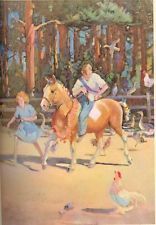
And the art is FAB. If you are going to buy this book, make sure you get one with all of the full-color and black and white illustrations as they add so much to the story. Case in point:
At the beginning of the story, Misty and the Beebes meet two men who convince the kids that Misty can be in the movies if she leaves Chincoteague right this second. Now, in the book, no harm comes of this but with my battle-scarred mind I can't be stunned at just how STUPID the kids were to just GIVE away their beloved (and famous) pony just on the word of two complete strangers. How about if the guys asked the kids to come along? What would they have done to Paul and/or Maureen?
You're welcome for that mental picture.
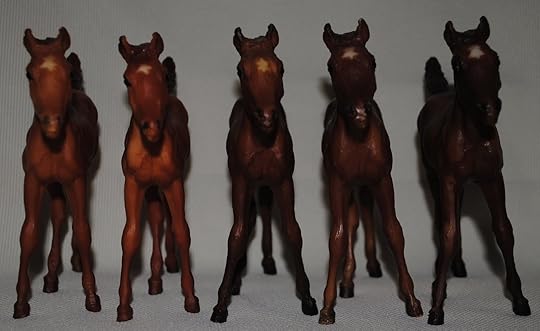
And also Sea Star is never mentioned in the third book in the series, Stormy, Misty's Foal. It didn't bother me when I was a kid, but it sure does now. What the hell happened to Sea Star? I can't help but be bothered that I don't know. It's as if Sea Star never grew up, always remained a foal, such as was immortalized by Breyer in their infamous crooked-legged model:
It just goes to show -- growing up spoils EVERYTHING.
What ages would I recommend it too? – All ages. Children will enjoy the single storyline; while adults enjoy an easy afternoon read (especially while waiting on a bus, show, doctor, or other appointments).
Length? – Reasonable for an afternoon.
Characters? – Memorable, several characters, though a bit confusing in the beginning.
Setting? – Real world, Recent times (1940′s).
Written approximately? – 1949.
Does the story leave questions in the readers mind? – Yes! At the end, Sea Star had just been dropped off too weak to walk only hours before, it seems that at least 24 hours should have not passed, not less than five hours.
Any issues the author (or a more recent publisher) should cover? This one again has a money issue. It would help if there was a tiny prologue showing some of the money amounts listed in the book in more up to date terms. We can understand why the Fire Department let them buy the baby for $10.00, though that is extremely low. However, the idea of college tuition being $250.00 needs some reconciliation with current figures. Also, some readers would like to know what happened to the real Paul and Maureen, even a good Internet search did not easily find anything.
A completely charming book for young people that holds it's own for adults also! I loved it as a child and read it again to get me in the mood for a trip to Chincoteague.
I read this with my 8 yo daughter. Both of us enjoyed this story of Sea Star. There are certainly moments of heartbreak and concern but it's primarily a joyous and loving tale.
After reading Misty of Chincoteague, anyone could become enamoured with the ponies of Assateague island. That being said, this book is kind of a let down after that. While it was still well written for children and does envelop the horse culture that is Chincoteague, the story almost seems incomplete and not very fleshed out.
Its the next Pony Penning day at Chinconteague and before all the wild ponies of Assateague can be driven over to the island, Paul and Maureen are approached by some movie makers wanting to buy Misty, their pony they had gotten the year before. Misty is beloved to them and they have a hard time letting her go, but need the money to send their uncle to college and also think other children should be able to experience the wonderfulness that is Misty. With the emptiness that fills their hearts after letting her go, they need to find something to ease the pain. Luckily, they find an orphaned foal whom they call Sea Star and claim him for their very own. He doesn't want to eat however, and is not thriving very well. Maureen and Paul have to find a way to save him.
The characters in this book are not as fleshed out. Although they are the same as from the previous books, they just don't have as much warmth to them and even Grandpa Beebe seems a little less cheerful. Grandma Beebe gets a few more lines in this book which was nice to see, but still remains a minor character. The book mostly focuses on Paul and Maureen but they are often doing things rather than experiencing them and showing emotion (the exception being when they make the decision to sell Misty).
This book is still very well written for kids. Most of it is easy to read and understand and has a simplicity that even the younger ages can handle. There isn't anything offensive in this book and it is appropriate for all ages. I do find some flaws in the writing though, although a lot happens in this book there is scant description and the ending seemed incomplete. Another fifty pages or so would definitely help the book and bring the story along more.
It was an ok book, just not as good as some of Henry's others. I do look forward to reading some of her other books and always love a good horse story that appeals to adults and children alike.
Sea Star Copyright 1949 174 pages including pictures
I may have read this years ago but had no memory of the story. If I hadn't known that the children get Misty back I don't know if I could have listened to the whole thing, reading about her being sold to the movie men about broke my heart. Thankfully this ended very happily and sweetly for the horses and the child. Can I just add that I adore Grandma and Grandpa? Grandma sewing on the Sabbath and missing Sunday School made me smile.
This entire review has been hidden because of spoilers.
A lovely story! The pictures are wonderful and the story was sweet. I wish I'd read these when I was younger, they would have gone alongside My Friend Flicka and The Jackie books! I still wouldn't have given up my pony just because someone wanted to put her in a film, especially if she was going to be petted by lots of 'orrible kids!!!!!
Not as good as the first book. The horse side of things is weakened by being split between the Misty and Sea Star aspects, but the family side is still wonderful. The ending was a bit abrupt - it works, but I wanted to hear more of how things progressed.
Narration by John McDonough was excellent. All the regional flavor and peculiarities of the Beebes' speech came through effortlessly.
These books are so wrapped up in my childhood that I see the title and remember the school library and sitting on the floor with my best friend, reading the books.
I think Marguerite Henry is the source of my obsession with reading everything in a series.
Let me preface this by saying that I grew up horse-obsessed, and read lots and lots of horse books, including most of Marguerite Henry's works. I remember reading Misty of Chincoteague as a kid, though I don't remember loving it. I wanted to re-read the book after recently traveling to Chincoteague for the first time, but I couldn't find our copy of it, so I settled for the second in the series, which was available via my library's Libby app.
I had read this one before, too, and remembered a couple of aspects of it. One of the things I remembered were the old-timey ways of Grandpa, which seemed so familiar to me as a kid growing up in rural Appalachia. I was surrounded by people like Grandpa Beebe, even though we were in the landlocked hills rather than the outer-banks island of Chincoteague. But old rural folk in the Eastern U.S. look a lot alike, from my experience, and it wasn't so much that I didn't like old rural folk...but I remembered being kind of uncomfortable with him as a character--even when I read Misty to my daughter for the first time years ago--though I couldn't quite place why.
I think this book is the why.
I'm going to hide this under spoilers because it gives things away in the story, but in short: Grandpa behaves in ways that absolutely boiled my blood when it came to the orphaned colt Sea Star.
I was also reminded of why I didn't really love these books when I was a child, even though everyone assumed I would. First, the aforesaid behavior under the spoiler cut. This is clearly why I felt the echo of discomfort with the Grandpa character (take that both ways). But the book also is expressly NOT about Sea Star--the kid's not even in it until somewhere around the 2/3 mark. This book, as well as the other Misty books, are about the people, not the horses, and I just wasn't into that as a kid.
And of course, there's the old bugaboo of books written in this time period--all the implicit sexism. You'd think that Marguerite Henry, being a woman, could have seen her way clear to make Maureen as smart and interesting as Paul, but no--Paul is the POV character through most of the book and his thoughts and ideas are much more deep and centered in the narrative than anything Maureen has to offer. She is a couple years younger, but this doesn't appear to be the reason that Paul is clearly beloved by the author and Maureen is given almost a sidekick role. It's annoying.
So...I doubt I'll bother to reread Misty (even though I have the Breyer model horse of her). I gave the book two stars because Henry is an excellent writer and does a great job of crafting descriptions and building a unique writerly voice. I just wish she had plied her talents creating characters I could love, or at least focused more on the horses.
“Sea Star: Orphan of Chincoteague” is a 1949 award winning children’s novel by Marguerite Henry. It is illustrated with drawings by Wesley Dennis. The first edition book was released by Scholastic Inc under arrangements with Rand McNally Company.
Book Commentary Mr. Van Meter and Mr. Jacob were on a plane that landed on Pony Ranch. They left the plane and walked to where teenagers Maureen and Paul Beebe were trimming their pony named Misty. When the plane passengers Van Meter and Jacobs see the pony, they ask the teenagers “Is your pony named Misty?” Paul and Maureen say yes. The teenage children live on their grandparent’s Pony ranch on Assateague Island off the coast of Virginia. The two plane visitors are making a movie about the pony legacy of the Island. They also want to buy and use Misty in their movie. Pony Penning Day is an annual roundup of wild horses on Assateague Island. During the Pony Pen round up Paul mounted the Red Demon Wild horse and the officials in the Pen turned on their riding clock. Paul rode 21 seconds on the wild horse.
Paul and Maureen have an uncle Clarence Lee who wants to enroll in a college but he needs $300 to pay his tuition. Grandma Beebe went to see her grandson Clarence Lee to discuss his educational interests in religious ministering and his school funding needs. Later in the evening, her meeting with Clarence Lee was a discussion topic at the dinner table with Maureen, Paul, and Grandpa Beebe.
The Beebes discover that Misty is featured in a book about Assateague Island ponies. The visitors told Grandpa, Maureen, and Paul that Misty will be very popular among the many people who love the book about her, and they would also be enamored by the movie. At dinner Paul and Maureen both agreed to accept the payment for Misty and give the money to Uncle Clarence Lee to help him pay for his tuition. When Misty made it back to the Beebe horse pen, Maureen fed her corn kernels to lure the pony into a recently constructed cage. Mr. Van Meter and Mr. Jacobs put the caged horse on their airplane, paid the Beebes cash for Misty, and departed from the island. After the movie team leave the island Paul and Maureen go oyster hunting using the family boat in water on the Island coastline. While in the boat they see a very young colt in the shallows. They use their boat to drive the colt into an area where they were able to capture him. They then put the colt in their boat. Because the colt was captured in the sea they named him “Sea Star.” When they returned to the Beebe Pony Ranch they put Sea Star in Misty’s pen and introduce their captured pony to their grandparents. Grandpa Clarence Senior and Grandma Ida are elated to have a new pony in their horse barn.. Shortly after Sea Star arrives, the baby pony refuses to eat the food provided him. Grandpa Beebe tells his neighbor Wilbur Winnow about the new pony’s eating disorder and asks Wilbur if he would let his milk producing mare become a foster mamma for Sea Star. The foster mare would need to be tricked into believing Sea Star is her offspring. Grandpa Beebe gave gunny sacks to Paul and Maureen and they went into the forest and filled the sacks with fragrant myrtle leaves which they ground up in grinder and poured a bag of the mare’s milk over the leaves. They then mashed the fragrant milk soaked leaves. Next, they rubbed Winnows’s mare and Beebe’s Sear Star with the fragrant mashed myrtle leaves. Both animals believed they are related mother and new born because they both smelled alike and they both embraced each other. A few days later Wilbur Winnow brings Sea Star and his foster mother to the Beebe Pony Ranch. He gifts them both animals. In a state of great joy the book concludes with a wonderful dinner prayerful song to commemorate the bonding of Sea Star and his foster mother. The spiritual song was sung by Grandma Ida: “The angel of the Lord stood by the Myrtle trees. And the morning stars sang together and all the daughters and sons of God shouted for joy.” (P)
I no longer remember the name of the reader advisor who sent me books as a young child from the Utah State Library. That person is doubtless long retired or perhaps even joyously reunited with loved ones long missed. I remain in that remarkable nameless person’s debt for sending on records a book called Misty of Chincoteague. The book captured my heart and mind as few had up to that time. I admired Grandpa and Grandma Beebe, and I envied Paul and Maureen because they got to participate in the famous Pony Penning Day on Chincoteague Island. Henry captured and vivified that experience for me so much that, when I lived in suburban D.C. three decades ago now, I vowed I would take my daughters to Virginia where they could see the ponies swimming between the islands. That event still apparently occurs on the final Thursday in July. Alas, we never made it.
I’ve wondered through the years since whether my one-time brush with Marguerite Henry and her vividly memorable characters was a fluke. In June of 2011, I noted that this sequel had made its way to the National Library Service, and I downloaded it. It rolled around on that hard drive all these years because I’ve been a bit scared to read the book, worried that I might not find the same electrifying charm I knew back when I read the original Misty book. I needn’t have worried.
Misty is fully grown as the book opens, and Paul and his sister, Maureen, continue to have a great relationship with her. But times are tight in the Beebe household, and Grandma wants to earn $250 to send a close relative to preacher school. Coincidentally enough, some Hollywood types fly into town and offer Paul $250 for his beloved horse, Misty. They want to use her in an upcoming movie about her experiences in the first book. The kids refuse to sell initially, but they recognize that Grandma could sure use the money. Through tears, they sign on the line, and Misty boards a plane for New York. The men insist they’ll bring her back one day after she’s done a national tour and visited elementary school children throughout the country.
On another Pony Penning Day, Paul and Maureen find an orphan colt they name Sea Star. A neighbor nearby has taken possession of a lame mare whose colt was dead. You can read this to figure out how it all ends if you wish.
I confess I wasn’t quite as edge-of-the-seat electrified by this book. Perhaps the years have taken their toll in some way. But I loved reading this, nonetheless. I loved transporting myself back to 1949 with Paul and Maureen and again experiencing the love among the Beebe family. There’s great stuff you’ll learn about how to convince a mare to adopt a colt. It’s simply good, old fun, and you’ll wonder how that time could slip by so quickly.
I'm almost certain I read this a time or two in my younger years (what I wouldn't give for a lifetime Goodreads record!). I re-read the first book in the series April 2021, and it was a series I recommended for my boys. Just a cute/clean story of kids and horses. I have a hard copy in my home library and just grabbed one at the thrift store to put in my little free library - so I figured I'd give it a read. I went with the audio edition, and was able to grab a kindle copy from the library. There was a note from the author that she hadn't planned on writing a sequel, but had gone back to the island and saw the premise of this book (a baby colt with a star on it's forehead, whose mother didn't survive the crossing). I think the part about Misty, a movie about her being made, and the producers wanting her for publicity, was partly true too (a movie was made, and the author DID take Misty back home with her).
This was written 20 years before I was even born ... it feels only the slightest bit dated. I still enjoyed the read and the story today, as I'm sure I did when I was young. I think the circumstances of the children parting with Misty were realistic (I had read the blurb and thought that they wouldn't just sell her) and it made me want to revisit book 1, as I don't remember it all (and perhaps check out the movie that was made).
I don't even know how I pronounced Chincoteague in my head ... it's more of a Shhink-a-Teague. Noted the word riffling (better than rifling here). Song was sung by the narrator at one part. Loved the word "recomember" (used five times, Grandpa and Paul) ... a mix of "remember" and "recall" ... I think it's super cute! I enjoyed the illustrations in the Kindle/Print copy.
I started reading this to S way back in the summer, but once we reached the midpoint of the book he lost interest for a while and stopped requesting it, moving on to other things. Eventually I got curious and wanted to hear how the story would end, so I suggested that before we start a new book together we finish reading this one. As it turned out, we were both glad to pick it up again. Sea Star finally shows up about halfway through the book (the first half is about Misty being sent away with movie producers, which is just kind of sad and not super exciting). My general impression of this book was that it was very simple. There isn't major drama, and I could see why my 7-year-old's interest wandered for a while, but I thought the two main events (Misty's departure and Sea Star's arrival) were depicted in great detail and given a lot of emotional weight. I once again also really loved how distinctly Marguerite Henry depicts the people and nature of the eastern shore in the 1940s. Reading this book made me feel like I was on Assateague Island enjoying the salt air. I'm so glad to have had the opportunity to visit Assateague and Chincoteague a few times now, and that experience made reading this book more enjoyable for me. Incidentally, L (5) listened to most of this book, although she needed a lot of vocabulary explanations so I'm not sure how much she will actually understood and will remember of it. But she always stayed and listened, so she must have enjoyed it at least somewhat.
I don’t think the plot of Sea Star is as captivating as the plot of Misty. Sea Star, the little orphan foal, doesn’t even appear until half way through the book. Instead, the entire first part is about Misty leaving. That being said, Henry ties the two parts of the book (Misty’s leaving and Sea Star’s arriving) together beautifully at the end. The characters of these books are so lovable and Henry really refines them as the book goes on. You can’t help but want to spend a day with the Beebe family! There were a couple of times I couldn’t quite make sense of the characters’ sweet eastern shore accents, but it was no loss to the story, rather just a word here and there. I have a newer publishing copy of Misty and the third book in the series, but for this one I have an older rendition that use to be either my mom’s or my aunt’s. Which is to say that the book is essentially falling apart, but I think that merely added to the charm. The pages are also significantly bigger in the older copies of the books which makes the illustrations larger and even more spectacular.
All in all, a delightful sequel to one of my favorite childhood horse books that I finished just in time for my horse-girl pilgrimage to Chincoteague tomorrow!!!