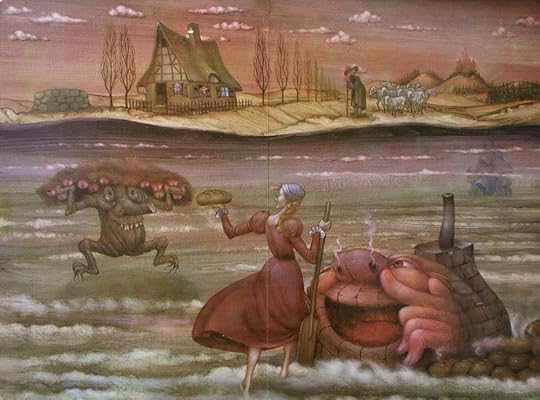
Rare edition with unique illustrations. When Jacob and Wilhelm Grimm published their Children's and Household Tales in 1812, followed by a second volume in 1815, they had no idea that such stories as "Rapunzel," "Hansel and Gretel," and "Cinderella" would become the most celebrated in the world. From "The Frog King" to "The Golden Key," wondrous worlds unfold--heroes and heroines are rewarded, weaker animals triumph over the strong, and simple bumpkins prove themselves not so simple after all. A delight to read, The Original Folk and Fairy Tales of the Brothers Grimm presents these peerless stories to a whole new generation of readers. Mother Holle is a German fairy tale collected by the Brothers Grimm and first published in 1812 as part of Children's and Household Tales. It was originally known as Frau Holle and is tale number 24 Mother Holle is one of Germany's most durable female legendary figures and one who without doubt[citation needed] represents a pre-Christian deity who survived in popular belief and in the memory of common people well into the nineteenth century. Mother Holle is featured in Grimm's Fairy Tale Classics.
German philologist and folklorist Jakob Ludwig Karl Grimm in 1822 formulated Grimm's Law, the basis for much of modern comparative linguistics. With his brother Wilhelm Karl Grimm (1786-1859), he collected Germanic folk tales and published them as Grimm's Fairy Tales (1812-1815).
Indo-European stop consonants, represented in Germanic, underwent the regular changes that Grimm's Law describes; this law essentially states that Indo-European p shifted to Germanic f, t shifted to th, and k shifted to h. Indo-European b shifted to Germanic p, d shifted to t, and g shifted to k. Indo-European bh shifted to Germanic b, dh shifted to d, and gh shifted to g.
قصههای برادران گریم قصه بیست و چهارم قصه مامان هُل
مامان هُل گویا یکی از شخصیتهای فولکلوریک پیشامسیحی آلمان است که ریشههای آن در گذر تاریخ گم شده است. اما احتمالاً از همان آبشخوری سیراب میشود که ننه سرمای ما. داستان، داستان یک دختر سیندرلاطوری است که مانند آلیس در داخل چاه میافتد و به اعماق زمین و سرزمینی جادویی سفر میکند و آنجا با مامان هل روبرو میشود. بقیه ماجرا، یه جورهایی شبیه به سه مرد کوچک در جنگل پیش میرود. همان درس همیشگی که اگر بدون چشمداشت به دیگران کمک کنید، و مزدش را هم میگیرید.
“… even though everything is wonderful down here, I’ve got to return to my people.”
Nothing takes me back to childhood reading like Grimm’s fairytales.
The character of Mother Holle comes from pre-Christian, German folklore. Apparently there is a Frau Holle festival in mid-winter celebrating this dark goddess. In parts of Europe, they still say, when it snows, that Frau Holle is making her bed (shaking her bedding until the feathers come out like snow).
This is a Cinderella-type story, short and instructive, in Grimm’s special way.
I guess this was kinda like a Cinderella story in a way. For instance the step-daughter is "THE CINDERELLA" because the make her work and the ugly daughter is doted on by the step-mother.
But that's the only part that is similar. Well, that and the pitch. There is pitch at the end.
Cinderella (we'll call her that) is working over by the well and looses this thing that I'm not even sure what ... cuz I don't use a spinning wheel... and goes to retrieve it.
So, wait... she jumps in the well cuz her step-mom tells her to. Right now I think she would be the kind of person who would jump off a bridge if her friends all did it.
Now the story becomes more like Alice in Wonderland cuz loaves of bread talk and so do apples.
Cinderella meets this creepy woman with big teeth but she's cool and tells Cinderella if she does her chores for her then she'll be rewarded. Once Cinderella gets homesick Mother Holle takes her away from the mole people (which I'm guessing she's a mole cuz she lives below the well and has big teeth) and back up to the surface where she rains gold on her. This makes it sound like she turns to gold but I don't know why anyone would want to be made of gold.
Step-mom and daughter are super thrilled to get her back cuz she's blinged out and Mom wants the same for her daughter. This daughter of course is ugly and lazy and doesn't want to do what Mother Holle says and gets splattered with pitch when she wants to come back to the surface.
My aunt brought me this book (which is printed on the same year I was born) from Germany when I was really too small to remember. The illustrations are just amazing.
MOTHER HOLLE: A widowed mother with two daughters, favors the ugly daughter, while the pretty one she causes to work. The pretty one ends up in service to an old woman. MORAL: Character is important. Hark workers get rewarded. Lazy workers earn a bad reputation. [RATING: 3 STARS]
A much lesser known story of the Brothers Grimm, but one with a wonderful moral just as usual.
I think Mother Holle may stick with me for a long time. I would definitely recommend this one for your children with the moral behind it - "work hard, you shall be rewarded, do not, you shall be punished". If my parents had shown me this when I was younger, I would have definitely been a lot better about doing my chores.
Another beautiful story from the Brothers Grimm. Wonderful to read.
MOTHER HOLLE: A widowed mother with two daughters, favors the ugly daughter, while the pretty one she causes to work. The pretty one ends up in service to an old woman. MORAL: Character is important. Hark workers get rewarded. Lazy workers earn a bad reputation. [RATING: 3 STARS]
MOTHER HOLLE: A widowed mother with two daughters, favors the ugly daughter, while the pretty one she causes to work. The pretty one ends up in service to an old woman. MORAL: Character is important. Hark workers get rewarded. Lazy workers earn a bad reputation. [RATING: 3 STARS]
MOTHER HOLLE: A widowed mother with two daughters, favors the ugly daughter, while the pretty one she causes to work. The pretty one ends up in service to an old woman. MORAL: Character is important. Hark workers get rewarded. Lazy workers earn a bad reputation. [RATING: 3 STAR]
MOTHER HOLLE: A widowed mother with two daughters, favors the ugly daughter, while the pretty one she causes to work. The pretty one ends up in service to an old woman. MORAL: Character is important. Hark workers get rewarded. Lazy workers earn a bad reputation. [RATING: 3 STAR]
MOTHER HOLLE: A widowed mother with two daughters, favors the ugly daughter, while the pretty one she causes to work. The pretty one ends up in service to an old woman. MORAL: Character is important. Hark workers get rewarded. Lazy workers earn a bad reputation. [RATING: 3 STARS]
Excelente historia para estás épocas, muy digna de los hermanos Grimm con sus reflexiones toscas y nada sensibles pero que sin duda dejan una bella marca en la psique infantil.
People who study European countries' ancient traditions and cultural history tell us that Mother Holle has been around for many centuries. According to the well-documented Wikipedia article about her ("Frau Holle"), she was the kind and generous receiver of the souls of children who died in infancy, also the patroness of weaving, and the custodian of winter. She was called out as a witch by early Catholics yet perceived as a pre-Christian deity well into the 19th century.
But she is not the star of this fairy tale. She is the supporting character, the vehicle through which the protagonist's true self is revealed. I find it a little strange that the Grimm brothers should have titled the story after her, notwithstanding her impressive résumé.
As the story opens, we hear about two sisters – one beautiful and industrious, one ugly and lazy. The first lost her mother at a young age; the other is the second wife's daughter. Sound familiar? The Grimm brothers even refer to the virtuous sister as the "Cinderella" of the family.
But among the many stories about virtuous young women, this heroine is continuously compliant. Unlike Cinderella, she doesn't want to go to the ball and see the world for herself. Unlike the little mermaid, she's not curious about a world she'll never fit into. And – speaking of compliance – unlike the saintly sister in Hans Christian Andersen's "Wild Swans", she doesn't have to undertake an unbelievably difficult penance (and vow of silence) to prove her virtue.
The big adventure of the story begins while she is spinning, and she accidentally drops her spindle down a well and jumps in to retrieve it. She finds a whole new world at the bottom of the well, inhabited by Mother Holle. As a visitor to that world, she is obliged to spend some time as Mother Holle's housekeeper – a position that includes making the bed every day and shaking the pillows hard enough to make the feathers fly, which brings snow to the world above. (It may be noted that two of Mother Holle's ancient attributes are brought to the fore here, as patron of spinners and custodian of winter.)
The girl stays for an undefined period of time but eventually misses her family. When Mother Holle opens a magical gate that sends the girl back home (without having to endure the well again), she is showered with gold, which sticks to her and is enough to make her fortune for life.
The wildly jealous stepmother decides that the "industrious" sister must not outdo her own child and sends her lazy daughter to jump down the well and repeat every action. However, from the very beginning, the nemesis cannot live up to her sister's virtuous actions, and after a few days of her not shaking the pillows (thus upsetting nature itself), Mother Holle sends her home through the same gate. Only this time, as the evil sister anticipates a shower of gold, she instead has hot tar poured over her.
The story itself is predictable to those of us who have lived in the world for more than a few years. But, accompanied by a few phrases that are uttered to both sisters – e.g., the apples that cannot pick themselves, the bread that cannot take itself out of the oven – it is a tale that etches itself into a child's memory. The most memorable quote goes to the family rooster as they each get home:
When the "good" sister returns:
“Cock-a-doodle-doo Your golden girl's come home to you!"
And, upon the "lazy" sister's return:
“Cock-a-doodle-doo Your dirty girl's come home to you!"
Kuuluukohan tämä kirjablogiin ollenkaan? Joulun, Winter Solsticen, Talvipäivänseisauksen ja Keskitalven juhlan aikaan on julkaistu kirjoituksia muista alkuperäisistä juhlista, jotka alkavat noin 25.12. Pakanoiden ja feministien sivuilla. Grimmin satu Frau Holle on suomennettu Kirjasammossa ihanalla nimellä: Rouva Pyry!
Rouva Holle, Frau Holle, puistaa tyynyjään niin lujasti, että höyhenet irtoavat ja tippuvat maahan, näin syntyy lumipyry, lumisade.... Joskus on ilkee laittaa wikipedia linkiksi, mutta en ole varma onko tästä mainintaa seksistisessä Combi-tietosanakirjassa, jota muuten luin tiuhaan 70-luvun alussa, ja joka löytyy siis kylmästä mökistä, jonne pitää kahlata kainaloihin asti ulottuvan hangen läpi. Lisäksi sinne pitää matkustaa.
Grimmin satu on tietenkin sadistinen ja ei ollenkaan kehopositiivinen. Nuoren naisen, piian ja tyttären, maailma ja unelmat ovat niin rajattuna.
The set up and structure to the story is very common. We have a widow who has a stepdaughter and a biological daughter. As expected, the widow is good to her ugly daughter, but is mean to the pretty stepdaughter.
The story will follow the stepdaughter being a good person and then the ugly daughter will be bad and reap the consequences.
I do like the part of falling into the well and then coming out to a meadow. It's a nice visual and a kind of ancestor to Alice falling into the rabbit hole.
Mother Hulda is a nice character. She's like a witch but isn't directly said to be a witch. Many characters with powers are said to be an old woman or a little man, but they can grant gifts.
It's a story that might feel like deja vu, but it's still good on its own.
Jacob Grimm, alongside his brother Wilhelm, is renowned for compiling "Grimm's Fairy Tales," a collection of German folktales. This book is a captivating journey into the heart of folklore, presenting a mixture of enchanting and sometimes dark stories that have fascinated readers for generations. Grimm's work is not just a mere collection of tales; it's a profound exploration of the human condition, morals, and the cultural heritage of Germany. The stories range from the well-loved "Cinderella" and "Snow White" to the less known but equally intriguing tales. Each story is a masterpiece of fantasy, imbued with timeless themes and moral lessons, making this book a valuable treasure for both young and adult readers. Jacob Grimm's contribution through this compilation has left an indelible mark on literature and continues to inspire the imagination of readers worldwide.
These stories are all the same. The ugly daughter is lazy and typically the evil step-mother's precious beloved daughter, while the pretty princess-to-be daughter is outrageously nice, sympathetic, hard working, and hated by the ugly daughter and evil step mother. The Grimm brothers apparently 'wrote' or collected 200 stories, but it appears they really had 5 different types, the others are all the same.
⭐⭐⭐⭐ Mother Holle is a great little story about selfishness but most importantly that hard work always pays off. If you are lazy and do no such work, your reward is nothing. When you work hard, your reward is gold.
Like most Brothers Grimm, there is always a message. Sometimes they hide it in gore and horror. This one no. They simply tell it how it is. A must read
Very simple story of "being lazy is bad and you get punished, but doing good work will be rewarded". Good example of how fairy tales were told to teach something, by kinda scaring people. And personally I think it is terrifying to be covered by gold. Anyway, it succeeded at doing what it wanted to and that is great.
Suitable for 7-9 years. This book is based on an old legend. It is not as gruesome and scary as some other Grimm’s tales. The story has a strong moral. That is, hard work and diligence are rewarded, whereas laziness is punished. The book is very short.
Apart from ugly = bad and beautiful = good, an the typical wicked stepmother, this story was enjoyable. It shows the value of hard work and while hard work does not always pay off in the way you wanted it to, I find that there is always something of value in it.
This entire review has been hidden because of spoilers.
Hard work is its own reward but often we see success follow from those who've prospered from hard work. Those who just want to get by Will get by by the hair of their teeth. Often, if they're politic they can be as successful But everyone seems to know who got there Why/How.