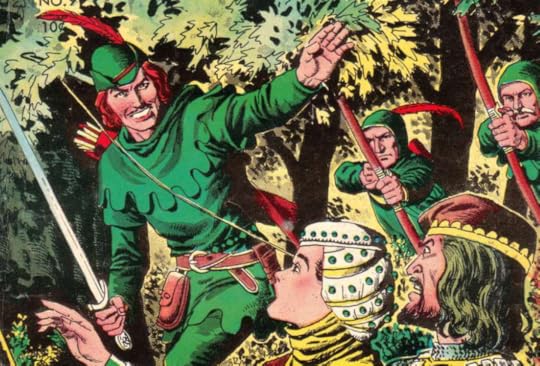
In this edition, Henry Gilbert tells of the adventures of the Merry Men of Sherwood Forest - Robin himself, Little John, Friar Tuck, Will Scarlet, and Alan-a-Dale, as well as Maid Marian, good King Richard, and Robin's deadly enemies Guy of Gisborne and the evil Sheriff of Nottingham.
This retrospective review is a real blast from my past, since I read this novel as a seven-year-old kid (I turned seven in 1959). Along with Stevenson's Treasure Island (which I read around the same time), it formed my lifelong liking for historical fiction, as well as a lifelong comfort with older, more formal diction patterns. (This was written in 1912 --and Gilbert actually employs an archaic, medieval-flavored style in the dialogue, and to a degree in the narration, which would have sounded very old-fashioned even back then.) It was also my first literary introduction to the whole Robin Hood mythos; I've read other novels about the forest-dwelling archer since then, but this one sort of became the mental template against which they're compared.
Henry Gilbert (1868-1936) was a popular British author of adventure-oriented historical fiction who, as his preface here indicates, envisioned his audience as "healthy boys and girls," probably in their teens. (The view of him as primarily a boy's author comes from the sexist assumptions of the publishers who marketed his work.) I included the book on my "children's" shelf in deference to that background, and reprint editions continue to be marketed for kids and classified in those sections in many libraries. (The cover of the edition with the most linked reviews on Goodreads --and therefore the one that usually shows in a simple title search-- is actually a cartoonish one that makes the book seem intended for pre-schoolers; I think Gilbert would have found that one as disgusting as I do, and if he wasn't dead I suspect the publishers would have been sued.)
However, in the Bluefield College library (where I was responsible for having the book ordered), I saw to it that it was classified in the regular, not the Juvenile, collection. IMO, it's a book that some teens and tweens today could read and enjoy; but it's not a "kiddie" book in the sense that most of us think of those. The diction takes some degree of reading skill, though it wouldn't daunt an adult or a serious kid; the characters are adults, and think and act like adults, and there's nothing about the plotting or action that's dumbed-down to small-child level. (Gilbert doesn't use foul language or interject sexual content; but adult authors in his day didn't either, and those elements aren't needed to make a work "adult.") I'd say the primary audience today would be readers of all ages, from about 11-12 on, who are serious fans of adventure-oriented medieval fiction. Though I read it at seven, I wouldn't recommend it for most kids quite that young; some terms were over my head --I didn't know what "October brewing" was, for instance, being totally ignorant of ale-making-- and the use of lethal force against the bad guys was morally challenging to me at the time, with a child's innate sensibilities (although it's something I was able to work through).
Historical accuracy was a hallmark of Gilbert's writing, and he was thoroughly familiar with the whole corpus of about forty medieval ballads that constitute our primary sources for Robin's life. (The author was among those who believe the legends have a basis in fact, and that Robin was a real person, though the balladeers may have idealized him somewhat --but, as Gilbert observes, "that is what poets and writers are always expected to do.") Following the example of Sir Walter Scott in Ivanhoe, he locates Robin's prime in the late 1100s, making him a contemporary of Richard the Lion-Hearted and King John. He draws primarily on the oldest ballads for instances to re-tell, but he adds other events and characters of his own creation; all of these are handled very realistically, to give an authentic flavor of the time. There's a lively social and ethical awareness here; the injustices of feudalism are depicted quite clearly, and though Robin is an outlaw in an unjust legal system, he's an outlaw with a strong and genuine moral code. Maid Marian, who eventually becomes Robin's wife, is an important character, and the romance is one plot strand; but it doesn't overwhelm the other plot strands, and the treatment of it isn't bodice-ripping or sappy.
Besides this book, I can also heartily recommend Gilbert's The Book of Pirates, a collection of well-researched fictionalized re-tellings of the careers of notable pirates from Roman times down to the early modern era (which I read when I was a few years older).
5 stars. I’m a big Robin Hood lover, and I’ve read many books about that Merrie Olde England archer. ;) But this is my favourite—much better than Howard Pyle’s, in my opinion. It shows the situation of the times very well. It’s somewhat violent but also captures the imagination. This book contains the famous Robin Hood stories and some other invented ones. It has a beautiful writing style, and the language is old-fashioned but completely understandable. Definitely one of my favourite medieval fiction books!
Content: There is a lot of praying to Mary (obviously!); some mild language (by the Trinity, by heaven, etc); a little drinking; and mentions ghosts & spirits & fairy powers & such—universally believed in. The men of the Underworld are simply people of the old British descent, who do not have supernatural powers.
داستان زیبای رابین هود داستان مروت ومردانگی است کوشش دیرینۀ بشر برای رسیدن به رهایی ونیکی.ما باید آثار افسانه ای را بخوانیم آثار کلاسیک را بخوانیم تا بر آرمانهای گذشتگان وقوف یابیم هرچند نویسنده به قرن بیست تعلق دارد اما کتابش را براساس متون قدیمی نوشته است ترجمه جناب کسایی پور بسیار زیبا وتوانمندانه است وتوسط نشر هرمس به صورتی پاکیزه منتشر شده است .
'Once upon a time the great mass of English people were unfree,' begins the preface to the edition of this book that I read and reread as a girl, going on to speak of the appeal of figures such as Robin Hood to people toiling under oppressive feudal regimes. It is a testament to how deeply I loved it, and what an impact it had upon me - it sparked a life-long love of all things Robin Hood, and reinforced an interest in issues of social inequality that was already being inculcated in me by my parents' politics - that I have only to think of this book, and that first line floats into my mind.
However that may be, this version of Robin Hood will always be the definitive one for me, as it is the first one I can recall reading. It uses some rather self-consciously archaic language at times, particularly in the dialogue between the characters, but it's nothing a good child reader can't handle, and it's certainly no worse than the medievalism displayed in Howard Pyle's work. As some reviewers have noted, the conflicts are depicted in a whole-heartedly bloody way, but again, I found this no deterrent as a child, as it felt in keeping with the times in which the story was set. I don't know that this version is for everyone - I see a number of online reviewers disliked it - but I do recommend it. Those attempting to decide whether it's for them, might take a look at it online first, and decide whether they wish to proceed.
This was pretty bad. Very frustrating read, because there were passages and bits of chapters that were really fun, and you can tell that the author tried to tie in many aspects of the Robin Hood legend into this, but because of that, there are many repetitive plots, endless identical side characters and villains, and even the personality of Robin Hood himself seems contradictory. It's a real shame, I was ready to really love this book.
Despite this being not a long book it's taken me a while to read it. I've been dipping in and out of it rather than reading it through. I found it very slow to begin with but once it got going I enjoyed it very much. Each chapter is a different story. Maid Marian was hardly in it at all which I was disappointed about. The last chapter was very sad and I felt it. The writing was wonderful, even though there were a lot of 'evil eyes' and 'grim faced men'. Glad I read it.
Oh how differently I had anticipated this read to be. What began as quaint, inviting, and even a tad exciting, lost traction rather quickly, ending quite pitifully in a smoldering pile of ruin. Can I petition to have the time stolen by this knave of a book back in my life? Yes, it was that bad.
Why would a master procrastinator such as myself with 50 other books on my current reads even bother finishing such a one, you may ask? I have but one reason, the child in me who so loves the Robin Hood legend hoped beyond hope that it would muster up the decency to conclude with at least a semi-enjoyable finish. Alas, each progressive chapter is worse than the preceding. How challenging is it to satisfy the unassuming expectations of one who is already sold on the characters, language, setting, era, and overall lore of the tale with no encroaching comparisons to be made other than the beloved 1973 animation. Way to go Disney, responsible for yet another unmatched expectation.
Returning to the matter at hand, the storytelling is so unabashedly lazy, much of the tale resembles that of a basic plot synopsis. Am I reading a history book? No sorry, that's an insult to history books. I think I'd find more imagery, originality, and vivacity in a dictionary. After the initial fifty pages or so, my mind was desperately craving any sort of description and dialogue that wouldn't resemble the printed ingredients on a shampoo bottle. Am I being too savage? Well, when a book embodies that of a chore to be reluctantly completed and leaves you feeling utterly spent... it's a one-star read. Not even sorry.
رابین هود شخصیتی ست که واقعیت وجود و حیاتش بی اهمیت است،او تمثال آرزو و تمنای مردمی ستمدیده و ناامید است زمانی که در پایان روزی سخت از بیگاری و بردگی برای اربابان،فرد به افق می نگرد و سبزی و سکون درختان در پهنه آرام آسمان ذهنش را به پرواز در می آورد،که زندگی تنها همه این نیست،چند قدم به سمت جنگل سبز و آزادی،فاصله زیادی نیست،می توان یاغی شد و حق ستمدیدگان را از ستمکاران گرفت افسوس که نیاز خانواده و عزیزان او را وامیدارد که به این زندگی محنت بار ادامه دهد،ای کاش اما می شد قیام کرد و آن خشم فروخورده را بر ظالمانی که حق حیاتش را پایمال کرده اند آزاد کرد.خورشید اما غروب می کند و باید به بستر رفت و برای روز سخت دیگری آماده شد.
Henry Gilbert’s Robin Hood sulks in the uneasy twilight of world literature. The likes of Sir Gawain, Piers Plowman and Beowulf have had the good fortune to have their tales told in a clear, definitive voice and then retold by scrupulous and concise editors. Robin Hood’s story was told and retold by so many balladeers and then moulded into whatever shape his editors thought would fit the sensibilities of the times. Therefore it is difficult to find Robin Hood in his original alliterative verse and doubly difficult to respect the historical truth of his story.
Unfortunately Henry Gilbert’s retelling does the legend of Robin Hood no service. His tales stand in a kind of literary limbo. They were first published in 1912, but language and style he used inaccurately aped the supposed concept of medieval without having any scholarly basis. The “thees,” “thous,” and liberal helping of archaic terms served no purpose but to turn the leisure reader off from the book. This is reminiscent of the mistake that Charles and Mary Lamb made in their Tales from Shakespeare. Rather than preserve the beauty of the original language only the difficulty remains.
The one area in which Gilbert redeems himself is in honesty. Even this praise may only come through hindsight. The mores of the society at the turn of the last century were not as squeamish about bloodshed as this one. Today, material for children must be scrubbed, sanitized and made harmless. Today, Robin Hood sings and dances or is portrayed by a cartoon fox. He bests his enemies by befuddling them, rather than beheading them. Gilbert’s Robin Hood injures and kills his enemies when necessary. Life in Sherwood Forest is still unbelievably pastoral, but at least the shadow of the hand of death hovers over these men of violence.
To one interested in the tales of Robin Hood, I would first recommend some cinematic escapism through Men in Tights and Disney’s conceptualization. Stay far away from the Costner version! Then, if one’s interest is truly peaked, hunt down the original ballad verses and work through the language. Henry Gilbert’s 1912 retelling simply isn’t worth the effort.
Well, this was fun. A lot happened. The names were many, the places numerous, and it was all kind of confusing.
But it was still a good time. I'm glad to have finally read this. The classic 'rob from the rich, give to the poor' wasn't as big of a portion of the story, what it did more of was meting out justice to those oppressors and rulers who were unmerciful, cruel and greedy. You get most of the classical Robin Hood stories, meeting Little John, Friar Tuck, the archery contest, fooling the sheriff, etc.
It was just really fun and if you're into Robin Hood it's definitely worth a read.
Even though it says the book is for ages 9-12 (and the cover makes it look like a book for 4-year-olds), I think it’s a bit too dark and violent for children… It was fun throughout, despite the violence and heartbreakingly sad at the end 💔
This entire review has been hidden because of spoilers.
Romanul "Robin Hood", scris de Henry Gilbert, aduce la viață una dintre cele mai cunoscute legende medievale: povestea vestitului haiduc care fură de la bogați și îi ajută pe cei săraci. Această versiune literară a legendei este plină de acțiune, dramatism și personaje pitorești, toate așezate pe fundalul unei Anglii medievale, cea a Regelui Richard Inimă de Leu, în care dreptatea este rară, iar codrul e singurul refugiu al celor nedreptățiți.
Robin Hood este prezentat ca un erou curajos, cu o privire pătrunzătoare și o figură nobilă, dar în același timp un om religios și devotat cauzei sale. Deși a ajuns în afara legii din cauza temperamentului său impulsiv și a vorbelor prea libere, el reușește să-și transforme exilul într-o misiune de justiție socială. Împreună cu o ceată de proscriși – printre care se remarcă Micul John, Scarlet, Ket Piticul și fratele lui Hob din Deal – Robin stăpânește Padurea Verde, un loc plin de mister, unde spiritele pădurii și vietățile par a fi de partea lor.
Atmosfera cărții este una tensionată, în care pericolele pândesc la tot pasul: de la cavaleri lacomi și preoți trufași, la urmăriri și confruntări armate.
Cartea reflectă și aspecte istorice importante: viața dură a țăranilor, supuși castelanilor, frica lor de superstiții și cruzimea unei societăți în care doar sabia mai poate aduce dreptate. Răscoalele, jafurile și incendierile devin reacții firești într-o lume lipsită de lege.
If I'm being honest, I dreaded reading this at the beginning. But, the last 150 pages were golden, and I relished every moment. There is some great commentary about power in church and state which all people like to exploit for their benefit. I am consistently reminded about the ever needed "outlaw tale" that has been a staple for hundreds of years. From pirates to gunslingers to the merry men, we love to read stories of people to stand up to corrupt governments (although the first two options can be ... less good) and live in freedom. I think as governments continue to be corrupted through the workings of wickedness, we need these tales more than ever. This was by far my favorite version of Robin Hood that I've read. Did I cry at the end? Yes. I was deeply moved by this story in spite of my initial dread. I'm so glad I pushed through because I thoroughly enjoyed it.
I have loved Robin Hood since I was a child, so I’m always hoping to find more books about his adventures. Admittedly, I found this slightly hard to get into as I hadn’t read something written in older English for a long time, but once I got into it I loved it.
The stories were beautifully written, my only qualm is that I would have liked to have seen more characterisation of Allan-A-Dale and Friar Tuck and the rest of the gang, as we had of Little John. I also can’t help wishing that we saw more of Maid Marian, as her appearances were few, but nevertheless I’m thankful that Gilbert portrayed her as a strong character, rather than as a damsel in distress.
Overall, this is a lovely story about the life and legends of my favourite outlaw.
Am citit Robin Hood de Henry Gilbert în cadrul proiectului meu, 100 de cărți pe care trebuie să le ai în bibliotecă, acesta fiind singurul motiv de ce nu am abandonat lectura. Problema nu a fost povestea, ci structura și scriitura - cu siguranță, dacă textul ar fi apărut în forma asta în zilele noastre, ar fi considerat nefinisat. Multe personaje introduse din pod, evenimente care se întâmplă fragmentat, o conturare foarte slabă a protagonistului. Spre final parcă-parcă lucrurile au început să se aranjeze, dar a fost prea târziu pentru a mă implica emoțional în acțiune.
Romanian review: Robin Hood este probabil cea mai primitivă formă de supererou din istoria literaturii. Adică, avem un lord care este cel mai bun arcaș din toată Anglia și care, sătul de toată nedreptatea și cruzimea celorlalți lorzi, se hotărăște să treacă în afara legii și începe să fure de la bogați, oferind săracilor. Legenda este deja extrem de cunoscută, avem și în această versiune a lui Henry Gilbert personajele emblematice poveștii lui Robin Hood: Micul John, părintele Tuck, Marian, șeriful din Nottingham sau Regele Richard Inimă de Leu. Versiunea lui Gilbert este un roman distractiv de aventuri, cu multe scene de vitejie și momente umoristice. Robin Hood este un personaj inteligent, viclean și îndemânatic, pe care este foarte ușor să îl susții. Problema principală a cărții este lipsa unei complexități morale a personajelor. Tipii buni și tipii răi sunt niște clișee, niște personaje unidimensionale a căror personalitate este reprezentată în totalitate de susținerea sau nu a lui Robin Hood. Prin urmare, ,,Robin Hood" este un roman interesant de aventuri care a reușit să mă distreze, dar nu are o complexitate psihologică sau o intrigă foarte bine dezvoltată.
English review: Robin Hood is probably the most primitive form of superhero in literary history. We have a nobleman who is the best archer in all of England and, fed up with the injustice and cruelty of other lords, decides to become an outlaw, stealing from the rich and giving to the poor. The legend is already incredibly well-known, and Henry Gilbert’s version features all the iconic characters of the Robin Hood story: Little John, Friar Tuck, Marian, the Sheriff of Nottingham, and King Richard the Lionheart. Gilbert’s rendition is a fun adventure novel, filled with acts of heroism and humorous moments. Robin Hood is a clever, cunning, and skilled character who is very easy to root for. The main issue with the book is the lack of moral complexity in the characters. The good guys and bad guys are clichés, one-dimensional figures whose entire personalities are defined by whether they support Robin Hood or not. In conclusion, "Robin Hood" is an enjoyable adventure novel that managed to entertain me, but it lacks psychological depth or a well-developed plot.
Robin Hood is the best-loved outlaw of all literature, and one of the best-loved characters altogether. Henry Gilbert's version of the story proves it. The book is interesting to read, since it provides an explicit view over the hard past times in old England, over the people and the lands. Its action brings the suspense which will keep you entertained reading it till the very end, and its characters almost deliver their very feelings to you, as a reader. Robin Hood is finely designed, so that he really stands out as a stalwart protector of justice and of his noble beliefs, which make subject to the all-time legends regarding him and the Merry Men of Sherwood. Together, the valorous outlaws fight bravely against the dark deeds of Guy of Gisborne, Sheriff of Nottingham and others, aiming to restore freedom and sanity to a war-torn England.
My 9-year old picked this out as our read-aloud chapter book, and I got about a paragraph into it before thinking there was no way we would be finishing it. I figured he would change his mind after the first night and ask for a new book -- or maybe I was just hoping he would change his mind. Its medieval style filled with thees, thous and cansts wasn't exactly drawing me in either. However, my son never even suggested we give it, and we made it through the whole thing.
Certainly, it was a challenge to read. I am quite sure I was saying half the names and many of the words wrong (how does one pronounce villeins?) but once you got used to the style, it was a very engaging book.
This definitely isn't the Disney-sanitized version of Robin Hood. People are killed, castles are burned and prisoners are tortured. I did appreciate that in between "slewing" evil knights, Robin and his men made time to go Mass and were quick to praise the Virgin Mary for any of their good fortune. The ending was even an unexpected tearjerker.
While a struggle at times, this book was worth it in the end.
I at last decided upon three stars because I did enjoy enough of it to say I enjoyed it overall (I think), but...it's one of those books written in 1912 that you can tell from a mile off was written in 1912 even if you didn't look at the pub date and...it is disturbing to have slowly realized just how much the heyday of progressivism and its attendant eugenic mindsets (treated as Scientific Fact) infiltrated English-language children's literature at the time. and I can't read books (like this one) in which that is obvious without thinking about it
I want some imago Dei propaganda in my children's lit for a change, y'all!! it would be shocking, it would be subversive, it would be great
کتاب خوبی بود ولی اول اینکه خیلی طولانی بود و نسبت به حجم زیادش، داستان اونقدر زیادی نداشت.صفحات زیادی صرف توصیف جنگ های پی در پی رابین شده بود.جایی در اواخر کتاب حس میکردم هیچ داستانی در جریان نیست و صرفا شاهد جنگ های بی پایان رابین هود هستم. فکر کنم بار اوله که فیلم یک کتاب رو از خودش بیشتر دوست داشتم. البته همچنان رابین هود رابین هوده و میتونه شما رو به جنگل های انگلستان ببره و با جنگل نشینان یاغی همسفره کنه.
I found that this book had a slow start and was a bit difficult to get into.
It’s a good book for fantasy lovers who want to get into reading classics.
I would place this book as targeting a younger demographic (11-13) but because of the language used (older English) it can be hard to understand without an advanced reading level.
Overall I enjoyed the book albeit a slow moving story line.
An exciting story about the whole life of Robin Hood from his time before being an outlaw to his end… a completely different story than we know from the children's books. Can definitely be recommended to everyone
Great, fun book and I really enjoyed reading it; it was a refreshing antidote to the more saccharin Robin Hood tales peddled by Disney and Hollywood. I especially enjoyed the frequent, strongly worded denunciations against clerics, abbots and other church leaders, but I was a bit disappointed in Robin's deep devotion to the monarchy. The movies also leave out his most exciting and heroic adventure, in which he helps a kindly knight pay off his mortgage!
It was kind of fun, though dry at first... however by the last third of the book I was literally skimming just so I could "finish" it. The vignettes were choppy, the characterization was non-existent, the 'action' was descriptive but dull. With all the re-tellings I've heard I thought for sure there would be more of the Sheriff and Prince John but instead there were these random eViL nights, who are... bad... but it's not really clear why.
I suppose this was written in 1912 as a retelling from oral history... but lord, the writing/storytelling is just... bad. I think I'm going to rewatch the Kevin Costner "Robin Hood" to cleanse my palate.... and that's saying something! Ha!
One nice thing was that Marian wasn't damselled that often and kind of badass... when he bothered to write about her. So that's something!
I can't be particularly rational or analytic about this book. It's a childhood favorite, that appeared in our house when I was maybe 10 or so in odd edition dated 1935 that lacked an author credit.
Re-reading it as adult, I'm struck by either how much it was perfect for my tastes or, maybe, how much it helped shape my tastes. Mainly, I think, for how much awesome, extraneous stuff it has in it. I'm typing this with my back to a map of Westeros on my wall and I think the sort of intriguing but often unexplained side details crammed into this book are definitely a thing I like. My lovely wife is pretty much anti that stuff and prefers a more streamlined narrative, I think it's fair to say, but I delight in things like Robin being treated by blood-letting and his men all being afraid of the Spectre Mare, which are plot points, but not really explained, as well as other details in the book that aren't even that much, like the widespread belief in witches and superstition people constantly express and the writer's salting the text with old English terms sometimes explained in parenthesis and sometimes not.
It's told in episodes and even with them, it's not a straight-line narrative, with a lot of little detours and derails that are there, seemingly, just for fun. And other places, it's refreshingly direct, such as where Robin decides the sheriff of Nottingham has crossed the line and shoots him dead. This is a more violent, wilder Robin Hood whose men try to burn Guy of Gisborne in his house and who doesn't hesitate to hang enemies get gets ahold of. The climatic scene where Robin leads an attack on his enemies castle (subtly nicknamed The Evil Hold) ends with him capturing and hanging the lords of the place, rather than killing them in a sword fight, for instance. It also deflates the standard scene where Richard I meets Robin and pardons him by noting that most of his former outlaws go often to campaign with the Lionhearted in France and end up dead. Easy to see how liking this stuff at 10 leads A Song of Ice Fire mega fandom at 36. And there are brownies who help Robin. Also, non-standard for these things is Robin helping Jews fleeing pogroms.
The book's also fascinating now for its politics. By the amount of anti-rich sentiment and calls for literal class warfare (which often gets soft-pedaled in late 20th century Robin Hoods) I wouldn't be shocked if Mr. Gilbert voted for Eugene V. Debs. It's also super, super Catholic, with Robin namedropping Our Lady pretty much every page. I guess it's also of its still kinda Victorian era in the complete lack of any hint of sex. And it also doesn't remark on the fact that Robin and Marian are married like 20 years and don't have any kids.
Cautions as to reading it? The dialogue goes between implausible and ridiculous, with Mr. Gilbert trying out a lot of Fake Medievalism that can only be enjoyed as camp, but he also often breaks away from such things for lovely little descriptive passages about the woods or a village or something, so I'd not rate the writing as bad overall. And these are stock characters. We get some shading, such as Robin having a temper he needs to control, or the sheriff not seeming like a particularly bad guy, just a greedy one who wants things quiet so he can get rich. Maid Marian doesn't have a huge presence in the book, though she does run off to the forest to find Robin, hiding out and spying on him, so she displays a little big of agency herself.