Jump to ratings and reviews
Rate this book

Miranda in Milan

Rate this book
With Miranda in Milan, debut author Katharine Duckett reimagines the consequences of Shakespeare’s The Tempest, casting Miranda into a Milanese pit of vipers and building a queer love story that lifts off the page in whirlwinds of feeling.

After the tempest, after the reunion, after her father drowned his books, Miranda was meant to enter a brave new world. Naples awaited her, and Ferdinand, and a throne. Instead she finds herself in Milan, in her father’s castle, surrounded by hostile servants who treat her like a ghost. Whispers cling to her like spiderwebs, whispers that carry her dead mother’s name. And though he promised to give away his power, Milan is once again contorting around Prospero’s dark arts.

With only Dorothea, her sole companion and confidant to aid her, Miranda must cut through the mystery and find the truth about her father, her mother, and herself.

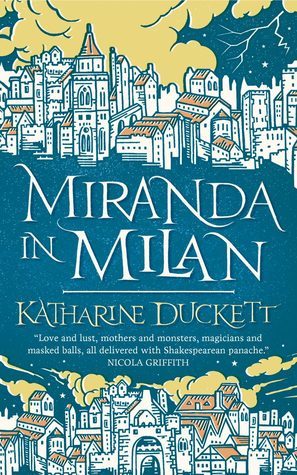
“Love and lust, mothers and monsters, magicians and masked balls, all delivered with Shakespearean panache.” —Nicola Griffith, author of Hild

Miranda in Milan is somehow both utterly charming and perfectly sinister, and altogether delightful. A pleasure for any lover of romance, myth, and magic — whether or not they're fans of the Bard.” —Cherie Priest, author of Boneshaker and I Am Princess X

At the Publisher's request, this title is being sold without Digital Rights Management Software (DRM) applied.

204 pages, Kindle Edition

First published March 26, 2019

53 people are currently reading
3017 people want to read

About the author

Katharine Duckett

20 books52 followers
Katharine Duckett is the author of Miranda in Milan, a Shakespearean fantasy novella debut that NPR calls "intriguing, adept, inventive, and sexy." Her short fiction has appeared in Uncanny, Apex, PseudoPod, and Interzone, as well as various anthologies including Disabled People Destroy Science Fiction and Wilde Stories 2015: The Year's Best Gay Speculative Fiction. She is the guest fiction editor for Uncanny's Disabled People Destroy Fantasy issue.

Ratings & Reviews

What do you think?
Rate this book

Friends & Following

Create a free account to discover what your friends think of this book!

Community Reviews

5 stars
173 (13%)
4 stars
478 (37%)
3 stars
451 (35%)
2 stars
132 (10%)
1 star
31 (2%)
Displaying 1 - 30 of 298 reviews
Profile Image for Tadiana ✩Night Owl☽.
1,880 reviews23.3k followers
June 4, 2020
In this recent novella sequel to Shakespeare's The Tempest, Prospero's daughter Miranda travels back to Milan with him and finds life a lot more unpleasant than she expected. Everyone treats her like some kind of monster, she's confined to her rooms and only allowed out with a heavy veil, her fiance Ferdinand has disappeared, and her father is distant and uninterested in her welfare. The only bright spot in Miranda's life is one of the maids, Dorothea. Maybe she can help Miranda figure out what's gone wrong?

It's a warmhearted and well-intentioned novella that puts a very different twist on Shakespeare's story, with distinctly modern social views and occasionally veering into preachiness. It got a little too clunky for me and the plot didn't always flow smoothly or make total sense, but it had its moments. If a queer, feminist fantasy take on Renaissance Italy sounds like your cuppa tea, I'd recommend it.

Available for free right now as part of a set of four Tor LGBTQ+ novellas, with Tor's ebook of the month club.
Profile Image for Tim.
491 reviews837 followers
June 7, 2020
Miranda in Milan is an attempt to write a sequel to a Shakespeare play. Many have attempted such a task and few ever seem to really capture what made the plays special in the first place. The plot here follows Miranda after the events of The Tempest. After arriving in Milan, she begins to suspect much is amiss. The people act as if she is a ghost, and clearly her father did not renounce his magic as he said he would in Shakespeare's play. With the help of a maid/witch Dorothea, she will unlock secrets, she will seek the truth, she will live the cliche.

Yes, that's one of the main reasons I didn't like it. While I was initially drawn in by the idea of a sequel to The Tempest, I found myself disappointed by how unfulfilling it all was. Gone is the beautiful dialogue of Shakespeare (except when we get quotations of past dialogue, which make it jarring that characters spoke... well, in Shakespearean dialogue, and now speak in modernized English). In fact, it had moments that felt less like Shakespeare and more like an episode of Scooby Doo, complete with mask figure leading characters through underground tunnels.

While I believe the book was intended for an adult audience, it felt very YA in tone, down to our lead being super pretty, awesome in every way (and any mistakes or misunderstandings she has will be corrected before the end, let me assure you!) yet everyone doesn't like her or at least doesn't understand her (except Dorothea) and woe unto her.

Well, I didn't like her much either; I didn't really care about how awesome she was and I sure as hell didn't care what happened to her.

Some will praise the romance between Miranda and Dorothea (that's not a spoiler, it's practically advertised with the book). For the most part I found that the best done aspect of the book, other than the fact that they jumped into it way too quickly. Given the situation, it felt odd to me that these characters progressed so fast. Again, I'm sure many will disagree, and due to the short length of the book, the author admittedly did not have a lot of time to develop them and give them time to actually get to know each other.

This was just not for me. I can't exactly blame the book for this, and while it is compliantly written and I'm sure many will love it, overall, I cannot say I cared for the book. There are aspects that are noteworthy, which save it from the dreaded 1 star review, but I cannot suggest it to anyone in particular and found myself too annoyed by all the above mentioned to really enjoy it. 2/5 stars
Profile Image for Lex Kent.
1,683 reviews9,853 followers
January 30, 2020
3.50 Stars. I have been enjoying listening to audio CD’s while driving. When I stumbled upon Miranda in Milan for only 1.50 USD for a MP3 CD, which is half the price the ebook costs, I could not pass that deal up. This is a novella but it is still 4 hours and 30 mins of audio so it’s a great deal. I’m not sure what the price is in other countries but Amazon US page is still showing that low price for the audio CD as of 1/30/2020. The ebook price is 3.99.

This is supposed to be a version of what happened after The Tempest, with a lovely Sapphic twist. I don’t know the Tempest well. I know I saw one of the movies a long time ago but I just don’t remember it enough to say for sure if this makes sense as a sequel, but it seems to. This has a dark fantasy, NA feel to it.

Overall I enjoyed this and I thought it was worth listening too, but I didn’t love it. It had pace issues for me. I felt like it kept slowing down, speeding up, rinse and repeat. There were parts when I was glued to every second of audio, but other times I found my mind wandering and I knew I wasn’t listening as well as I should.

When it came to the romance it is very sweet. It was a little fast moving but this is a novella so I was okay with it. The relationship wasn’t just thrown in there to put the LGBTQ label on this. The relationship felt integral to the story and affected most of the decisions Miranda made.

The book did improve as it went on. There was a little twist I didn’t see coming and I liked learning the backstories about certain characters. I also thought the ending was quite satisfying so the last 1/3 of the book was much better than the first 2/3’s.

I thought the narrator was decent. I liked her main narrating voice and most of the characters including the main character of Dorothea but I wasn’t crazy about Miranda and even Prospero’s voice. I have not heard of Saskia Maarleveld before now, but I did think she did the other male voices well so I don’t know why Prospero bothered me so. Miranda was even more bothersome since she was the main character but I did get more used to her voice as the story went on. As someone who mostly reads, I don’t do many audiobooks, it’s interesting how you picture what you think a character should sound like and it throws you off a bit when they don’t actually sound like it. But there were more good voices than bad so I would give her a B- grade overall.

I didn’t love this but it was a good story. For $1.50 I would 100% recommend people getting this audio CD. This is a steal at that price. Heck it’s still a steal at double that price so I would say grab it if you can. It will give you 4+ hours of entertainment with a satisfying ending so why not.
Profile Image for Hiu Gregg.
133 reviews163 followers
April 2, 2019
A slightly strange, slightly unsettling, but very sweet story. I was a huge fan of the romance, and the writing flows together so well. Read it all in two sittings, and it would have been one if life didn't get in the way.
Profile Image for Hamad.
1,316 reviews1,625 followers
August 4, 2019
This review and other non-spoilery reviews can be found @The Book Prescription

“Dorothea was sand and sea, Miranda thought dizzily. She was wind and water and heat all at once, a tempest of her own making.”

💉 This book did exactly deliver what it promised, a sapphic retelling of Shakespeare’s The Tempest! I am not fan of classics and I did not read the tempest but I looked up a couple of summaries online to see what it was online and this stayed close to the original story with the addition of queer elements.

💉 I did not love this one and neither hated it, I just thought it was okay, since I am trying to write a short story, I have been appreciating writing styles more and more and the author does have a good prose!

💉 So in short, if you like classics and you like The Tempest, then there are good chances you will like this one specially if you want something queer!
Profile Image for Jeanette.
4,088 reviews837 followers
May 4, 2019
This took me away to another time and place. One of my very favorites too- Milano, Italia. But in a classical and other era/ human cognition that reminded me strongly of Madeline Miller's works within the Greek gods' classics retells. Nobility parental dictates and some of the "kindness" habits being so similar.

Couldn't put it down. It was the perfect length and pace for my grasping the Miranda reality and "eyes" for her own situation and the inheritances from her parents.

The writing was excellent. I'd read another by her at the drop of a hat. And will.

I'm still thinking about the "knowledge" that Prospero always seeks above all else.
Profile Image for Katie.dorny.
1,159 reviews645 followers
October 5, 2019
This glided along the surface of this classic story, but it just seemed lacklustre and as though the author was just colouring inside the lines without enveloping the reader in anything worth connecting to.
Profile Image for Mogsy.
2,265 reviews2,777 followers
April 15, 2019
3 of 5 stars at The BiblioSanctum https://bibliosanctum.com/2019/04/14/...

Miranda in Milan isn’t so much a retelling than a sequel, reimagining of the events after The Tempest by William Shakespeare, picking up the tale at the play’s end where everyone including the magician Prospero and his daughter Miranda are getting ready to head back to Naples. But instead, they end up in Milan. Miranda and Ferdinand are to be married in celebration of their triumphant return, and Prospero himself is to reclaim his dukedom. Rather than the joy she expected, however, Miranda is met with fear and distrust at her destination, shunned and shut away in her chambers at the castle. Whispers of Miranda’s resemblance to her dead mother Beatrice follow her everywhere, and she is forced to wear a veil to hide her face whenever she ventures outside.

Isolated and friendless, abandoned by her father who has gone on to do bigger things and with no word when her wedding will happen, Miranda begins to lose hope. That is until she meets her new maid Dorothea. As a Moor, Dorothea is just as ostracized as Miranda, and she doesn’t seem bothered by the rumors about the duke’s daughter. The two of them start to grow close, with the friendship swiftly blossoming to become something even more. Meanwhile, it appears Prospero has not been entirely truthful in his proclamations to abandon his magic. As everything begins to fall under the threat of his dark schemes, Miranda and Dorothea must work together to uncover the truth and save Milan.

In the original play The Tempest, Prospero is the main character, portrayed as an unfortunate exile. Miranda is but a mere side note, her actions and behavior completely dictated by her father. In Miranda in Milan, however, it is she who gets to feature as the story’s protagonist, while Prospero is cast as its villain. Admittedly, I might have been more taken with author Katharine Duckett’s direction of these roles had I not read 2017’s Miranda and Caliban by Jacqueline Carey. While there are many differences between the two books, at their heart, both shine the spotlight on Prospero’s kind and compassionate daughter, both reimagine her in a coming-of-age romance, and both depict her father as a domineering and menacing figure in her life. There are just enough parallels to invoke comparisons between how the characters, relationships and themes are handled, and in almost every way—e.g. character development, romance, world-building, storytelling, etc.—I felt Miranda in Milan fell short.

Part of the issue could be due to its length. At just a sliver over 200 pages, this novella had a lot to convey and yet not enough time to do it. I hate to say it, but this is why I’m typically wary of short fiction because more often than not, I come away from short works wishing they had been more, and this was one of those cases. To wit, there’s a lot going on in this book: first, the Shakespearean elements, and contextual details of the original play that had to included; second, there were the relationships—and that means not only of the romance between Miranda and Dorothea, but also the complexities and nuances in the dynamics between Miranda and Prospero, Miranda and Ferdinand, etc.; and third was the overall plot itself, which sought to incorporate a bit of mystery related to Miranda’s mother along with the intrigue and conspiracy of Prospero’s dastardly plans.

With all this in play, there was barely enough time to properly explore the world’s secrets or its magic, or go any deeper into characters’ backgrounds, personalities, and motivations. As a result of this, I have mixed feelings. On the one hand, I want to praise this book for its ambitions and its integration of so many interesting and rich concepts, but on the other, I can’t say it managed to develop any of them very well. This ineffectual build-up ultimately led to very little pay payoff and satisfaction, sad to say. For example, Miranda and Dorothea’s romance—which I considered to be the most notable aspect of this tale and thus expected quite a lot from—ended up being nice and sweet but also rather superficial and uninspired. As well, the ending which I thought contained several unique twists and revelations was nonetheless anticlimactic simply because the story’s foundations were not developed enough to make me feel much of anything for the characters or their conflicts. Miranda in Milan being Duckett’s debut, I also wasn’t surprised to run into pacing problems. Understandably, some things cannot be rushed, but I did feel the early sections of this book moved too slowly and were bogged down by unnecessary diversions.

All in all, I can’t say I loved this book, but that being said, I didn’t dislike it either. In the end, I think I just wanted more—more depth, more clarity, more detail. More feeling. It’s possible that tighter pacing and more pages could have provided all that, but as it is, Miranda in Milan gets an average rating from me, though I will keep watching to see what Katharine Duckett writes next.
Profile Image for Corrie.
1,688 reviews4 followers
July 15, 2020
"To be in this world, you must always be a little less than yourself. With every day that passes, you must give up a little more. And ... it hurts. If you dwell on it, it sometimes hurts too much to bear."

Miranda in Milan, Katharine Duckett’s Shakespearean fantasy novella debut was a great discovery. Don’t worry if you haven’t read The Tempest. Duckett explains some of it in flashbacks through Miranda’s point of view, so you won’t feel completely lost.

Poor Miranda. I really felt for her. Plucked from her magic island and taken to unknown Milan where a promised marriage and a throne await her in Naples. Her manipulative father, however, has different plans and so she’s confined to her room in the castle instead, with servants who scarcely dare to interact. Even her sinister aunt Agatha - who supervises her – treats her with barely concealed disgust. Veiled and treated like she’s some monster, Miranda feels utterly alone until she meets an allie in the Moroccan witch Dorothea, who works as a servant in the castle and soon makes her forget all about her waiting fiancé.

This could have easily been a full length novel, there is such a wealth of material here. So yeah, longer scenes and more time to deepen the characters would have been lovely. I really enjoyed it when the story kicked into Gothic mode. Lots of unsettling things lurk in those secret tunnels.

Cherie Priest sums it up nicely "Miranda in Milan is somehow both utterly charming and perfectly sinister, and altogether delightful. A pleasure for any lover of romance, myth, and magic -- whether or not they're fans of the Bard."

f/f

Themes: women at the margins of society, Prospero’s dark arts, a usurping uncle, a dead mother, spirits, necromancy, secret tunnels, many dark doings, Bice, a veiled portrait, family secrets.

4 Stars
Profile Image for Georgie-who-is-Sarah-Drew.
1,366 reviews152 followers
October 15, 2021
3.5 stars rounded down.
There's a picture of an optical illusion that goes around from time to time; it's either a young woman or an old one, depending on how you squint. I think Miranda in Milan is like that - all the ingredients that made up The Tempest are there, just twisted sideways a little to give a totally different outlook. (The book definitely offered very much more because I'd already read The Tempest.)

I didn't not enjoy this: Duckett writes fluently enough, although her style is on the functional side. I liked the occasional references to Renaissance Milan, and the otherness of Dorothea's peripatetic upbringing. There's also a strong post-colonial nod in Miranda's reassessment of Caliban & Sycorax.
“But—” Miranda floundered. “Caliban has no language. We—I mean, my father—taught him everything he knows. The name of the sun and moon, and the stars. He knew nothing of these, before we came.”
“Do you believe his mother knew no poetry? That she never whispered or sang him to sleep? Ask him, Miranda. His mother wrote, or spoke her truths to him. Language isn’t bound in books. It’s in hands and tongues and looks just as surely as in holy scripts. Caliban has a language. It’s you who ignore its import, his greater meaning.”

But this is a book that derives most of its energy from the original, and brings little that is new to the story. In that sense, it's a bit like . It's not helped by several plot holes . It's also let down by the strange decision to devote a quarter of the novella to Agata's story. Sure, it's information that needs to be shared, but structurally it interrupts Miranda's tale and it also steals space that desperately needs to be used to characterise Miranda.

In The Tempest, she is little more than a blank, in thrall to Prospero, who moulds her as he will; if she has a journey to make in this book, it's how she becomes in thrall to Dorothea - from one sort of magic to another. But who Miranda herself is, I'm not clear. She says herself:
"What is it, to be happy? I hardly know my own mind, after so many years alone, with only my father as a guide, and he so often plunged me into darkness. Who knows what I do out of fear, and what out of love? Half my life is lost, my history submerged.”
If I'm in Miranda's PoV for most of the book, I want a far stronger sense of her personality.

So while I can acknowledge the cleverness of this anti-Tempest, it doesn't go quite far enough. Duckett shows the other side of the illusion, but doesn't, IMHO, replace the whole thing with a positive of her own.

BTW, totally gorgeous cover, by David Wardle.

I got this as part of Tor.com's book of the month giveway, so (a) thank you to Tor, and (b) that made no difference to my review.
Profile Image for Justine from Novels and Panda.
536 reviews236 followers
April 19, 2019
Miranda in Milan started out peculiarly in my point of view, but once I get the gripping of the pacing and its standing itself in the novel; it was amazing! It is an #OwnVoices for sapphic romance read. I love to seeing development such as this; stories that are represented not only in heteronormative point of view but as a retelling that reaches the diverse community, both gender, race, and religion. It features a queer, black, Muslim, Dorothea.

I adore the romance happening. It was flowing out innocently and naturally. I had been anticipating their interactions in the novella quite closely! And I must say that it worked out well for me. And the mystery airing the novel makes it more compelling as to why Miranda was being held in the dark.

For the setting build up, I have nothing but praises. It was eerie gothic, places well. The banter amongst them as well. Their tone for the retelling is fitting. I love witnessing the tale of self-discovery in here. Definitely worth a read and rereads to come.

Though, for something short it was rather slow for me. I think it was the reason I had a slightly difficult time settling in.

Trigger Warning/Content: parental neglect and abuse, parental death.

More Miranda in MilanInstagramTwitter

Copy provided by the publisher in exchange for an honest review. All views and opinions are my own and don’t necessarily reflect the author, the author’s work, the publisher, nor any other group of people, nor I received any monetary compensation for doing this review.
Profile Image for Ellie.
579 reviews2,412 followers
February 29, 2020
I enjoyed this, even if I did feel everything had a flavour of underdevelopment due to the restraints of the novella length. A very original idea, though! Thoroughly enjoyed the Shakespeare basis, especially as I love The Tempest. And the f/f relationship, of course.

> 3.8 stars

read for #fffebruaryreads 2020
Profile Image for E.M. Williams.
Author 2 books100 followers
April 4, 2025
Miranda in Milan by Katharine Duckett is a retelling of The Tempest that imagines Miranda's life after her return with her father from the island. It also introduces Sapphic elements into the classic story.

But the world they left is not the world she has been told to believe in, and Prospero has not given up his magic. With the help of a crafty maid who is also more than she seems, Miranda works to discover the secrets of her family and her place in her new court.

The story hinges on the relationships between women -- between Miranda and her dead mother, between Miranda and Dorothea, her maid -- and I enjoyed that aspect of the reimagining.

Duckett understands the claustrophobic worlds and choices of women, and this novella would make an interesting comparison read with The Marriage Portrait, which is also an adaptation set in a similar time period.

I wish it was more interested in characters like Ariel and Caliban, who are alluded to but don't have much of a textual presence.

All in all, an interesting retelling.
Profile Image for Nicky.
4,138 reviews1,112 followers
April 17, 2020
I liked Miranda in Milan more than I expected from the reviews I saw around before I read it -- I was curious, but not wildly interested, and mostly just picked it up now because I'm reading a lot of short fiction because that's what's working for my brain. And it turns out... I really liked it. I started reading it and figured I'd have to stop halfway through for work; halfway through, I damned work and carried on until I was finished.

It's a semi-retelling, semi-sequel to The Tempest; a retelling because it plays with some of the facts and embellishes them, a sequel because it's set after the play. It follows Miranda after she and Prospero return to Milan. The servants whisper about her, and she's forced to wear a black veil to hide her face, but luckily a young Moroccan servant is happy to talk to her and explain things to her. They quickly become close, and this develops (fairly quickly) into a romantic relationship. I'm a little nonplussed by reviews feeling it came out of nowhere; I didn't actually remember this was f/f, and was hoping for the romance to happen from the first hints of it.

It's probably a good thing I read Jacqueline Carey's Miranda and Caliban quite a while now, because the prose would suffer in comparison! As it is, I found it worked well for me: I wouldn't say it's going to stick in my head for beauty, but it succeeded in conjuring an atmosphere for me.

It all resolves a little simply and in the way I kind of expected, and I do appreciate the criticism that Prospero has no complexity and is basically a big evil bogeyman -- though I also appreciated the way Miranda had to go over her memories and figure out where the lies and gaps were. It's a little realistic hint of an abusive relationship that rang very true. Agata could have been just completely horrible, too, so I enjoyed that we got to see another side of her and understand a little of her bitterness and fear.

All in all, it worked really well for me; I thoroughly enjoyed it.
Profile Image for Terence.
1,311 reviews469 followers
November 28, 2019
Not very substantial. It could have been an interesting idea - what happens to Miranda when she and her father return to Milan - but it's only superficially developed. Prospero is reduced to a one-dimensional, power mad villain; and Miranda doesn't get much agency. She's carried along by a sympathetic friend & witch, Dorothea, and a dea ex machina.

Decent enough brain candy but not really recommended.

Profile Image for Jennifer.
481 reviews22 followers
March 29, 2021
Miranda in Milan is an imaginative and gorgeously written queer retelling ot Shakespeare's The Tempest. The obvious standout of this novella is definitely the prose: it's dreamy, picturesque, and enchanting. I really liked the way Duckett described the magical island and Italy!! I also think the author did a pretty solid job at crafting Miranda's personality and her relationship through carefully fleshing out the necessarily backstories. While the rest of the novella lacks the tension (so this wasn't as engaging as I've expected), I appreciated the emotional appeal with regards to the f/f romance.

Overall, this is still a pretty intriguing read which will satisfy Shakespeare fans and fantasy readers all the same.

N.B. This novella contains following triggering content: illness, death, and corpse
Profile Image for Freya Marske.
Author 20 books3,258 followers
April 7, 2019
Creepy, magical and romantic. This novella shows a deep understanding and affection for my favourite Shakespeare play as well as a willingness to dig in and criticise it. It also has the unmistakable air of a Gothic, which I wasn't expecting, but should have - Miranda's story here fulfils all the requirements of innocent-girl-comes-to-grand-house, exploring secret tunnels, and dark family secrets. And a lovely f/f romance on top of that!
Profile Image for Kaa.
614 reviews66 followers
April 16, 2019
I wanted to love this but I just didn't completely connect with the writing style. Certain parts felt too rushed, while others felt more drawn out than they needed to be. I did really like the ending, though.
Profile Image for lauraღ.
2,339 reviews170 followers
May 13, 2021
“What must you never do, when dealing with the Devil, girl? Turn your back to him, and give him time. Time, and books, and the sanguineous sea.”

2.5 stars. This was... fine? I'm a little disappointed overall. I reread the Tempest a while ago in preparation for this, and found it pretty dull and racist. This, happily, was not racist. And it was gay. And that's pretty much all I can say about it.

Well, no, that's not fair. The story is an imagining of the events that might have transpired after the end of the Tempest, as well the events in the history/lives of the characters that would have led to everything. We're following Miranda as she tries to get used to her new life in Milan after returning with Prospero. But she trusts her father less and less with every day, she hasn't heard from Ferdinand in weeks, and there's a sinister mystery surrounding the castle. Miranda slowly gets to the heart of it, alongside a new friend and confidante.

Duckett has a lovely writing style, and some parts were pretty striking. I think the beginning of this showed promise, and the story as was told was definitely interesting, but for some reason it just didn't capture my attention. The middle part dragged a lot, and I really think the author could have found a better way to tell the same story. Thankfully, the ending did pick up a lot. The romance was really cute, and I loved all of the Shakespearean courtship language. But it moved way too fast to have any impact on me, even for a novella. Dorothea was a great character, but I never felt like we got to know her enough. 

I definitely liked the idea behind this, and I can safely say I enjoyed it more than the original? But that was a pretty low bar to clear.
Profile Image for Jenia.
554 reviews113 followers
April 3, 2019
Miranda in Milan is a charming book that offers a queer take on Shakespeare's The Tempest. It continues the story a few weeks after the play's ending (so SPOILERS for a 400 year old play, I guess). Miranda and her father have triumphantly returned to Milan from their remote island. But the island is the only home Miranda remembers, and despite her position as the lord's daughter, she finds herself shunned and isolated. Moreover, her father has not given up his magical powers as he had promised; Miranda realises he has not told her the whole truth of her family's dark past and exile to the island. The only one who doesn't avoid Miranda is her maid Dorothea, and the two lonely women begin to grow closer.

So, I'd never read or watched The Tempest before I'd heard of Miranda in Milan. I'm always on the lookout for f/f stories though (plus the cover is really pretty), so I awaited the book eagerly. It didn't disappoint! However, after the first couple pages I went back and read the original play, and I recommend everyone to at least read the wiki article before starting Miranda in Milan. The book does a good job explaining the backstory, but in my opinion it works better if you're familiar with the characters and themes of the original, which it toys with.

The main focus of Miranda in Milan is Miranda herself: a lonely, abused and naive woman who has internalised a lot of her father's views. Her life on the island was much freer than in the castle of Milan, where she is derided as a wild girl and is sequestered in her room. But it's also her first time encountering opinions about the wider world that differ than he father's. Watching her re-examine her own beliefs about her father and the world, and grow beyond them, was fantastic.

It's also Miranda's first time encountering other women. In the play, she falls in love with the prince of Naples, who was shipwrecked on the island. Miranda in Milan continues that thread very logically. It's not that Miranda never loved the prince... but also he was literally the first person she'd ever met as an adult. Her increasing understanding of her own feelings and attraction to Dorothea is very sweet. Their relationship starts off very unequal, with Dorothea much more worldly but Miranda of a much higher social status, but the inequality is handled with care.

I also really liked Dorothea, a Moroccan with witchy powers, in her own right. While she doesn't get as deep a character arc like Miranda does, neither did I feel that she was shoved into the story just to serve as Miranda's guide-slash-lover. It's just that in contrast to Miranda she knows who she is and what she wants a lot better already. I'd happily read a prequel or sequel with Dorothea as the protagonist instead.

Thematically, the book fits into the body of work that examines The Tempest from a post-colonial perspective. (I told you the wiki page is useful.) A large part of Miranda's growth is re-interpreting what her father had done to the island's original inhabitants, as presented in the play. With Dorothea, the perspective of an immigrant from a colonised country is also given directly. I really liked the little details here. For example, Dorothea prefers others not to use her real name both because it marks her as a foreigner but also because it's just exhausting to hear your name constantly mispronounced.

One last thing I'd like to quickly mention is the prose. Miranda in Milan flows very smoothly and in my opinion it balances the Shakespearean adaptation aspect well. That is, the dialogue and prose are nowhere near as old-fashioned as the original play's, but neither does it feel odd to read Shakespeare's characters talking as they do in the book.

Altogether, I found Miranda in Milan a delightful book. I'm sure I didn't get as much out of it as proper Shakespearean scholars would, but I really enjoyed it nonetheless. And I... may actually go read some more of Shakespeare's plays now. In hopes that there'll be more cute, queer, post-colonial fantasy book reinterpretations.

Especially recommended for:

- People looking for f/f romance
- Fans of retellings/reinterpretations (though this isn't a direct retelling)
- ...So fans of fanfic, I guess?
- Shakespeare fans
- People who enjoyed The Goblin Emperor
- People who enjoyed the themes of The Traitor Baru Cormorant but wouldn't mind something a lot fluffier. Like, a lot fluffier.
- Oh also there's dark magic, so fans of creepy stuff
Profile Image for Lynne.
Author 105 books223 followers
May 1, 2019
If you are the kind of person who read The Tempest and thought “Prospero is kind of a dick,” this is a book for you. It is Miranda’s story after she gets off the island, and it is DELIGHTFUL.

This is the story of how Miranda comes into her own, finds (queer) love, and becomes free.

Miranda in Milan is a story of surviving abuse and refusing to pass it along to others. It's a story of ghosts in your own life, and learning to live with them--and love them. It's about understanding that family has many meanings, and how we treat one another is definitely part of defining those meanings. It's about making choices, and living with them, and making amends where you can. It's about exposing family secrets so that healing can begin, and accepting the things that you cannot leave behind, so that you can move forward into the person you are now.

It's about secret passages, magic, masquerade balls, and smooching, too.

Beautifully written, emotionally honest, and delightful.

And it's not all about Prospero, because he's kind of a dick.
Profile Image for Moonglum.
331 reviews7 followers
May 10, 2019
I really liked the prose, and the gothic creepiness. If this were not an interpretation of and sequel to the Tempest, I would have liked it more. As it was, I thought that it was too unfair to Prospero. The novel negates Prospero's transformation in the play by telling us that he did not in fact give up his magic. That is a major theme in the play, and without it having occurred, one does not feel that the book is about Prospero at all. I did not believe that Miranda would have sided with Antonio, who tried to have her murdered as a child, against her father, who did in fact care for her on the island. And in the play, Prospero is certainly not a killer. The Prospero we meet at the end of the novel does not seem like the character from the play.

Now, if I think of this as being the sequel to a different version of The Tempest, perhaps one from a universe near to but not the same as the one in which the Prospero and Miranda from our univeres's play dwell, it is really a beautiful story, and I like the life Miranda chooses for herself.
Profile Image for Teleseparatist.
1,274 reviews160 followers
July 1, 2020
The Tempest meets Rebecca and a little bit of Frankenstein, and gets decolonised and queered, but without anything that compelling to recommend it. All these ingredients sound like my thing, but the end result was just not terribly gripping. Parts felt more like plot summary than action, and my favourite section was when we engaged with Agata and her point of view - it was also the only moment when some nuance was found in the morality of the characters and the story.

Profile Image for l.
1,707 reviews
June 3, 2019
I think this could have worked as a mediocre young adult novel. It’s just a kind of shallow take. But you know... lesbians.
Profile Image for Netanella.
4,724 reviews38 followers
December 14, 2025
"Miranda in Milan" is a sapphic sequel to Shakespeare's The Tempest, giving Prospero's daughter Miranda the lead in this story, as Miranda and her father arrive in Milan to reclaim the city. There's a mystery to be solved, as Miranda is swiftly locked away in her rooms and not allowed to venture out without being forced to wear a veil or a mask over her face. Eventually, Miranda joins forces with her witchy servant girl Dorothea, and together they solve the mystery in the underground tunnels where her father has begun his sorcerous experiments again.

I remember reading The Tempest as a colonization piece, as Shakespeare had connections with several members of the Viriginia Company, who founded Jamestown in the seventeenth century. Caliban and Sycorax are demonized as dark skinned, savage and wicked and for Sycorax, she's a sorceress to boot. Damn misogyny rears its ugly head everywhere.

I did like that in Duckett's version of events,

Oh! And I did really like the touch about the

I will say that I was entertained. And I enjoyed having to re-remember my bits of Shakespeare from college. However, I simply did not like that the ending was all neatly tied up with a bow on top, and "everyone lived happily ever after, the end."
Profile Image for Anurag Sahay.
440 reviews36 followers
January 11, 2023
I read this novella in a flight from US to India -- it was a free book I received at some point from the tor.com book club and I wasn't able to google the story before reading it.

If I had, I probably wouldn't have read it -- given that this is a sequel to Shakespeare's The Tempest which I have not read/seen! Having said that, the book was quite readable despite, and I enjoyed it a great deal. It made me want to read The Tempest (though, of course, this book is rather a post-colonial/feminist take on the original). Highly recommended!
Displaying 1 - 30 of 298 reviews

Join the discussion

Can't find what you're looking for?

Get help and learn more about the design.