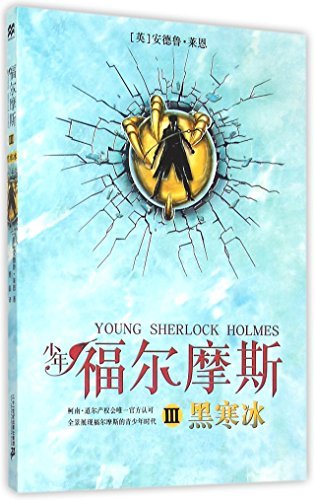
When teen Sherlock and American tutor Amyus Crowe visit Sherlock’s brother Mycroft in London, they expect polite lunch. Instead, Mycroft holds a knife over a dead body in a locked room. Threatened with the gallows, Mycroft needs Sherlock. The search for the truth goes from a London railway station for dead bodies to frozen Moscow.
During 2009, Macmillan Books announced that Lane would be writing a series of books focusing on the early life of Sherlock Holmes. The series was developed in conjunction with the estate of Sir Arthur Conan Doyle. Lane had already shown an extensive knowledge of the Holmes character and continuity in his Virgin Books novel All-Consuming Fire in which he created The Library of St. John the Beheaded as a meeting place for the worlds of Sherlock Holmes and Doctor Who.
The first book in the 'Young Sherlock Holmes' series – Death Cloud – was published in the United Kingdom in June 2010 (February 2011 in the United States), with the second – Red Leech – published in the United Kingdom in November of that year (with a United States publication date under the title Rebel Fire of February 2012). The third book – Black Ice – was published in June 2011 in the UK while the fourth book – Fire Storm – was published originally in hardback in October 2011 with a paperback publication in March 2012. The fifth book, Snake Bite was published in hardback in October 2012 and the sixth book, Knife Edge was published in September 2013. Death Cloud was short-listed for both the 2010 North East Book Award. (coming second by three votes) and the 2011 Southampton's Favourite Book Award. Black Ice won the 2012 Centurion Book Award.
Early in 2012, Macmillan Children's Books announced that they would be publishing a new series by Lane, beginning in 2013. The Lost World books will follow disabled 15-year-old Calum Challenger, who is co-ordinating a search from his London bedroom to find creatures considered so rare that many do not believe they exist. Calum's intention is to use the creatures' DNA to help protect the species, but also to search for a cure for his own paralysis. His team comprises a computer hacker, a free runner, an ex-marine and a pathological liar.
Останах изключително доволен и очарован и от третата книга на Андрю Лейн от поредицата за "Младият Шерлок Холмс". Отново приключения, задъхано действие, изобщо преди да стане улегналият детектив с лулата като младеж яката е търчал насам-натам, забъркан в чудни каши, така де, мисии от общонационално значение за родната му Англия.
"Годината е 1868-a. Четиринайсетгодишният Шерлок Холмс се сблъсква с най-загадъчния си случай до момента. Майкрофт, по-големият му брат, е намерен с нож в ръка, надвесен над труп. Само Шерлок вярва, че брат му е невинен. Но може ли да го докаже? В една изумителна надпревара, която ще го отведе чак до Москва, младият Холмс трябва да разбере кой е натопил Майкрофт и защо, иначе има опасност брат му да увисне на въжето."
Шерлок расте и израства все повече с всяка следваща книга, задава въпроси и на менторите, и на себе си, усеща се как вече разсъждава като възрастен, при това доста интелигентен човек. Пътешествията са много силна част на поредицата - тук се появяваме с нашите приятели в Москва и се виждат на практика разликите между Англия и Русия, Запада и Изтока, не само в сградите, а и в хората, манталитета и какво ли не още.
Тайни полиции, заговори и комплоти, политически игри на високо ниво, призраци на стари врагове и реални чудовища на сегашни противници, мистични общества, почти всичко и всички са срещу младия Шерлок, брат му и ментора им. Обучението на Шерлок е много силно, вижда се как реално става все по-добър.
Естествено, да не пропусна и чудесният превод на Коста Сивов, на ниво както винаги. Като цяло книжката е малко по-добра от втората, изобщо поредицата ми харесва много и горя от нетърпение да видя на български и четвъртата книга - "Огнена буря".
Die Bücher werden immer besser finde ich. Oder ich gewöhne mich langsam an den Stil XD Sherlock lernt aber langsam wirklich dazu und ich finde es gut, wie der Autor versucht Sherlock durch seine Geschichten zu dem zu machen, was er später ist und wie man ihn kennt. Diesmal ist Sherlock hauptsächlich mit seinem Bruder Mycroft unterwegs, eine Abwechslung zu den bisherigen Abenteuern. Er gerät auch wieder in brenzlige Situationen aber nicht mehr ganz so viele und er kann sie langsam auch besser handeln.
Ако сте чели ревюто ми на „Петата купа” от Дан Симънс вероятно си спомняте, че съм голям почитател на Шерлок Холмс. Именно там бях споменал и поредицата „Младият Шерлок Холмс” от Андрю Лейн. Чудесната юношеска поредица представяше ранните тийнейджърски години на знаменития детектив, като заедно с първите му приключения читателят ставаше свидетел и на редица сцени, оказали влияние върху личността му и формирали бъдещия характер на героя. „Облакът на смъртта” и „Червената пиявица” бяха издадени у нас от „Ибис”, съответно през 2014 и 2015 година, и тъкмо бях изгубил надежда, че ще видим преводи на още книги от поредицата, когато най-неочаквано се появи третата част - „Черен лед”. Лейн продължава добрата традиция, установена в предишните части и включва в новата книга всички елементи, които ме накараха да обикна „Младият Шерлок Холмс”. Нещо повече – „Черен лед” е най-напрегнатата и вълнуваща книга от серията до момента, защото този път случаят е повече от личен. Шерлок ще трябва да докаже невинността на собствения си брат. Провали ли се Майкрофт ще увисне на въжето...! Прочетете ревюто на "Книжни Криле": https://knijnikrile.wordpress.com/201...
Anfangs war die Handlung an zwei Stellen für mich sehr vorhersehbar. Jedoch ändert sich dies in der zweiten Hälfte und gerade der Schluss war total überraschend. Sherlock reist nach Moskau und lernt wieder einiges für seinen späteren Beruf dazu. Beim Ende war ich sehr verwundert, welche Intrigen dahinter stecken. Ein überraschendes und spannendes neues Abenteuer des jungen Sherlock Holmes.
Cover Blurb: Yes or No? I do continue to like these covers (so much better than that horrible copy of Death Cloud,!), with the color schemes and the "symbols" that allude to something in the story itself. Though, in all honesty, the silhouette is beginning to irritate me. Don't really know why; it just is.
Characters: Young Sherlock is not improving. He continues to be too emotional, too dependent on others people's good opinion and approval, and his detective skills are laughable. Seriously - can he figure nothing out for himself? Does he constantly have to ask Amyus Crowe or Mycroft "But how did they do this? Why?" He essentially fills in Watson's role in this series: as a sounding board for Crowe to bounce his brilliant plans off of. When young Sherlock finally begins to do a bit of deducing himself, it's never on important things, and the Author seems to suggest that every method the Sherlock uses was picked up from Crowe or Mycroft. How does this make Sherlock abnormally brilliant? It seems to indicate to me that Sherlock is merely incapable of having any brilliant plans on his own. But I will give the Author partial credit when it comes to Mycroft: he does a pretty good job of portraying his character, though he and Sherlock are still far too close, in my opinion. I have no doubt that the Holmes brothers respected and trusted one another in their own ways, but I don't believe that they ever got along. Two brilliant minds like theirs, coupled with conceitedness, wouldn't get on as well as this Author portrays. I missed Matty in Black Ice, but I was not sorry for Virginia Crowe's absence. Something about that girl just keeps rubbing me the wrong way. My opinion of Rufus Stone, Sherlock's violin teacher, is lukewarm; I don't dislike him, but I don't have any special attachment to him, either. The villains in this book were not nearly as laughable as the previous two - none of them were ridiculously grotesque, - but they were rather obvious and had a tendency to monologue too much.
The Romance: Since Virginia is absent, there are not "strange, growing feelings" for young Sherlock to experience, thank goodness.
Plot: When Amyus Crowe takes young Sherlock up to London to visit his brother Mycroft, it is only to discover Mycroft in the same room with a body, and the murder weapon in Mycroft's hands. Mycroft is arrested, and it's up to Sherlock and Crowe to prove his innocence. Through their investigations, they discover that Mycroft has been (predictably) framed, and it has something to do with the disappearance of Mycroft's agent and close friend in Moscow - and the ever-elusive Paradol Chamber. Together, Mycroft and young Sherlock journey to Moscow, disguised as actors, to find out what's happened to Mr. Wormersley. But the Paradol Chamber is on to them, and they will stop at nothing to apprehend Mycroft and Sherlock Holmes. I have always said that these books are more plot-driven than character-driven, which is the only thing that saves them. Black Ice has, in my opinion, the more interesting plot out of the first three books. Amyus Crowe doesn't come to Moscow with the Holmes boys, which I imagine disappointed some Readers, but I personally was okay with it just being Mycroft and young Sherlock. However, while the discovery of Mycroft with a dead body was a very intriguing beginning, and the explanation behind the murder rather clever, Black Ice spent far more time on action sequences than actual mystery-solving. Nonstop action is all well and good for spy novels, but not mysteries. And this is, in all honesty, a series that feels like it's trying to be the new Alex Rider. Sherlock has one harrowing escape after another, only to encounter still more sticky situations that almost see him dead - or at least brutally injured. It got really wearing after a time, to a point that the chase scenes ceased to be even a little bit exciting. And the rate at which Mycroft solved things - , or that he was knocked out so he could be framed for the murder - was ridiculous. Mycroft is supposed to be more brilliant than Sherlock, and it took him that long to realize that something was wrong? I spotted it right off! Needless to say, it caused quite a bit of frustration on my part.
Believability: I took issue with the "death by falcon." Theoretically, one could kill someone this way. Falcons can do a lot of damage, and I'm certain people have been killed by birds of prey before. I'm not disputing that at all. What bothered me was it didn't seem like the best and most fool-proof way to assassinate someone. It's a neat idea on paper, but quite a hassle to actually execute, and there has to be a better, swifter, and more succinct way of doing away with someone.
Writing Style: The style of these stories has never done anything for me. It't movie-ish and modern - doesn't at all fit the era - and would belong better in a spy novel than a Victorian mystery. And I am, quite honestly, getting really tired of Crowe's Texan accent.
Content: None.
Conclusion: It was actually a lot less ridiculous and action-packed than previous installments. And that is not a complaint. And I really, really do like the concept of Paradol Chamber; I look forward to seeing them in later books. However, because the Paradol Chamber's members have a bad and cliche tendency to monologue, they aren't nearly as scary as they could be. That little chat in the cafe they have with Sherlock? It was an extremely convenient place for the Author to easily explain all of the little nigglies to his Readers, and that isn't good. One should never have a Q&A session between protagonist and antagonist for the sole purpose of answering all of the little nigglies, because it is so obvious. There were a couple of twists that I wasn't wholly expecting - - but there were others that were obvious from the beginning - . As a whole, Black Ice was a small improvement when it came to villains and plot from the other books, but it nearly killed my Sherlockianism to read this book; it really did. As a normal Reader I enjoyed the plot, but as a Sherlockian I was gnashing my teeth.
Recommended Audience: Girl-and-guy read, fourteen and up, fans of mysteries, Alex Rider, and Sherlockian fiction that is anything but accurate.
Jeśli kiedykolwiek zobaczę mema z dopiskiem "Sherlock Holmes po roku w Rosji" nie obrażę się, a raczej przypomnę sobie tę książkę, gdzie właśnie nasz młody bohater się udaje xd.
Ta część akurat najmniej mi przypadła do gustu, może przez tak zatrważającą z punktu widzenia mojego i Mycrofta ilość błędów, jaką popełnił. Nie wyobrażam sobie, by ten od Conan Doyle'a skłonny był dopuścić się popełnienia ich aż tylu, aczkolwiek mogę to wybaczyć autorowi, gdyż tutaj Mycroft jest jeszcze młodym człowiekiem. Podobnym do tego, jakiego go poznajemy późnej, ale wciąż jeszcze z pewnego punktu widzenia niedojrzały. I przejęty opieką nad młodszym bratem, co łagodzi trochę moje niezadowolenie.
Aczkolwiek ta część i tak jest fantastyczną lekturą i nie odstaje ani trochę od swoich poprzedniczek. Podoba mi się, że Sherlock zaczyna dostrzegać coraz więcej, wysnuwać ze swoich obserwacji coraz trafniejsze wnioski i samemu filtrować informacje, które mogą się przydać, a które nie.
Żałuję tylko, że pozostałych części nie przetłumaczono na polski, bo zapowiedź starcia "panicza Holmesa" z "demoniczną" ochmistrzynią Panią Eglantine niezwykle mnie intryguje. Może poddam się swojej ciekawości i zakupię następną część w języku angielskim albo niemieckim? Jeszcze zobaczę, ale ciężko mi się oprzeć z taką wyśmienitą zapowiedział rozwoju spraw.
I liked it. Not as much as the other two, but it was fine. As usual, something goes wrong, and suddenly Sherlock is dodging assassination attempts left and right. In fact, this book went a lot more into Sherlock’s resourcefulness in dodging assassination attempts. What I didn't care for so much was:
1. The bagillions of references to his last adventure in Red Leech (Rebel Fire to me). It's been a LONG time since I've read that, and I forgot a lot of what happened in it. Thus the gratuitous mentions of "It reminded Sherlock of the time..." was sort of off-putting. Also, when authors do this in their sequels, I sort of get the feeling of "yeah, I read that book. But this is its sequel. Do you REALLY have to mention the same material over so many times? Where's the new material?"
2. Sort of going along with that, with so many mentions of the last book's adventures, with Mattie and Virginia and all that, those to characters are barely in this one. Mattie is still a street urchin, and Sherlock interacts with him ONCE, early on in the book, to tell him that he's going to London. Mattie is sort of bitter, trying to scrounge up a meal, and pushing Sherlock's friendly offer of food aside on the grounds that it's gasp! charity. Seriously? Sherlock going out of his way to save his life wasn't charity? I thought they were friends! Virginia too, has very minimal presence in this book. In Sherlock’s only interaction with her, he mentions something about disliking emotions (set up for the great seemingly emotionless Sherlock Holmes he will become) and she reacts with some sort of disappointment or something that suggests that maybe she likes him and believes in love or something? "Well I believe in emotion" or something. She is not in the book again.
3. This book focuses much more on Sherlock's mentor, Anamangus, and all his tedious little lessons about observation and predator stalking prey. This is later tied in with Mycroft's teachings, as about 3/4 in, suddenly Anamangus is out of the picture. I'm not a huge fan.
4. Sherlock's random little mind ramblings. Sometime early on in the book he goes on thinking about what separates animals from humans, and how we have decided to eat cows but keep pet dogs and what keeps us from eating horses, and etcetera. This comes out of nowhere and is never mentioned again. Seriously. Did the author just read one of the many books published about this recently or something? And then there is the nod to Indian culture when he makes the thought of "perhaps in other cultures the cow is worshiped?" right in the middle of all this. Is this supposed to make Sherlock seem more intelligent by putting in these strange musings?
5. While Sherlock is trying to get away from assassins, he is forced in the sewers. There the author seems to be trying to stuff in a social commentary about poor children and street life. Sherlock is disgusted and feels bad about the "feral children" he runs into, thinking about how Mattie is only a step away from becoming this. However, later on in the book, they are not mentioned again. Again, Mattie was never seen again after the one interaction early on in the book, and Sherlock didn't become sympathetic to their cause or making their lives better in any way. I suppose he didn't have to, but considering the big deal he was making about how he's lucky in comparison and etcetera, I thought that experience would have more of an impact on him.
6. While the huge, overall conspiracy was fun, it seemed rushed, and I didn't get as invested in it as the other two adventures. The focus, again, was more on Anamangus's teachings and Mycroft's problems and Sherlock's dodging assassination attempts. There wasn't as much on the line, again, without Mattie or Virginia, and there didn't seem to be as many events about hunting for clues or anything.
This book was not my favorite out of the three I’ve read so far. It was a little slower, but what intrigues me is the mystery is even more difficult to piece together than the last one. This one even has Sherlock completely stumped for a majority of the book and I love that. It helps show that even Sherlock has times where nothing makes sense. Again we have more character growth and we see Sherlock feeling more creative and struggling with that fact as he is only shown logic as an acceptable thought process. I’m excited to see the writer explore this more.
I would recommend this book to any Sherlock Holmes fan: especially in your teens. This series would’ve been one of my favorites if I had read it when I was 14.
A really good read, full of suspense – a few twists, people who appear not to be what they’re supposed to be. I missed Matty and Virginia in this adventure of the young Holmes. The Holmes siblings are « en route » to Moscou, in disguise, but they forget that villains are smart. I enjoyed it a lot.
3.5* The ending was fabulous!!!!!! Sometimes it was pretty boring but it was a good book + it taught me a lot of things and the plan at the end was so smart and complicated (Loved that)
yes, as a matter of fact i read this book on german. i have only found out now that the german blurb is VERY different than the english one. my expectations would have been lower if i had only read the english one. (okay, can we talk about how cute the word blurb is? blurb)
"Mycroft wurde mit der Leiche in einem verschlossenen Raum gefunden, ein blutiges Messer in der Hand. Nur Sherlock glaubt an die Unschuld seines Bruders. Doch kann er sie auch beweisen ... und Mycroft vor dem Galgen bewahren?" das ist der deutsche klappentext. ich habe mir davon einen spannenden agatha christie-artigen roman erwartet, in dem sherlock alleine gegen die zeit arbeitet um mycroft zu retten. aber nein, das "wie" wurde innerhalb von seiten geklärt und noch nicht einmal von sherlock.
die verfolgungsjagden wurden alle sehr gut und spannend geschrieben, aber bis auf eine waren alle ziemlich unnötig. außerdem macht sich sherlock zwar während den jagden zwar immer viele gedanken und sorgen, aber sobald diese vorbei sind, würde man meinen sein gedächtnis wurde gelöscht und er macht die gleichen fehler nochmal.
"Der junge Sherlock Holmes ermittelt in Moskau", ja ich glaub auch. sie waren genau 94 seiten in moskau. ich dachte, die ganzen moskau gespräche im buch bauen darauf auf, dass es im nächsten teil nach russland geht, aber nein. mycroft kauft sich einfach aus dem ganzen mit-einer-leiche-im-gleichen-raum-gefunden-skandal raus und im letzten drittel machen sie sich auf den weg nach russland. wofür?
in conlusion: auf keinen fall ein schlechtes buch. sehr spannend und interessant erzählt, aber leider nicht das was ich mir erhofft habe.
In dem Buch Eiskalter Tod (Young Sherlock Holmes 3) von Andrew Lane, geht es um Sherlock Holmes, welcher gerade mit Anymus Crowe im Esszimmer des Hauses von seiner Tante und Onkel sitzen. Als der Tee für die beiden gebracht wird, bekommt Sherlock einen Brief von seinem älteren Bruder Mycroft, indem er ihn bittet nach London zu ihm zu kommen. Sofort will sich Sherlock am Bahnhof eine Karte kaufen und begegnet auf dem Weg seinem Freund Matty und dem Violinlehrer Mr. Stone. Nach kurzer Zeit schon kommen Anymus Crowe und Sherlock in dem Club von Mycroft an, indem er sich mit ihnen treffen möchte. Im Diogenes Club herrscht die Regel, nur im Besucherraum darf geredet werden, sonst nicht. Der Diener führt sie zu einer Tür und klopft, aber erst nach dem zweiten klopfen öffnet sich die Tür und Mycroft steht im Türrahmen mit einem Messer in der Hand. Als er sich zur Seite dreht, sieht Sherlock einen toten Mann im Sessel sitzen, welcher eine Wunde im Körper hat. Kann es sein, das Mycroft diesen Mann umgebracht hat oder doch nicht ?
Meine Meinung: Ich fand die Geschichte spannend und flüssig zu hören. Der Sprecher hat die Geschichte deutlich und verständlich erzählt und so konnte ich mir die einzelnen Ereignisse gut vorstellen. Auf den Täter wäre ich zwar selber gekommen, aber warum er das gemacht hat nicht. Den mit dem Mord an dem Mann beginnt die Geschichte erst so richtig.
Fazit: Spannender 3 Band mit viel mehr Hintergrund, als am Anfang ersichtlich. Ich freue mich schon auf Band 4.
Erneut ein sehr gut gelungenes Buch in dieser Reihe! Ich verfolge die ��Young Sherlock Holmes-Reihe“ nun schon sehr lange und muss sagen: Bis jetzt hat mir jedes Buch gefallen und das kann man schließlich nicht von jeder Buchreihe behaupten.
In „Young Sherlock Holmes-Eiskalter Tod“ verschlägt es den jungen Sherlock Holmes ins kalte Russland, um genauer zu sein, Moskau, denn Sherlock ist in Sorge: Sein Bruder Mycroft wird wegen Mordes angeklagt und zum Tode verurteilt. Ein Rennen mit der Zeit beginnt, wodurch der Leser von diesem Buch regelrecht gefesselt wird.
Den Leser erwartet ein wirklich sehr spannend geschriebenes Buch. Anfangs ist es etwas gewöhnungsbedürftig, da die Schreibweise anders ist, als in manch anderem Jugendbuch. Erneut haben wir es mit einem wirklich sehr raffiniertem Plan einer Organisation, die bereits in vorherigen Büchern dieser Reihe eine Rolle gespielt hat, zu tun.
Im Endeffekt kann ich dieses Buch an alle Fans dieser Reihe (Und natürlich die, die sich für aufregende Fälle des jungen Sherlock Holmes interessieren!) nur weiterempfehlen und vergebe dafür 5 Sterne!
I enjoyed another adventure and loved getting to know the characters more!
I was dissapointed that Crowe, Virginia and Matty arent in this one as often and i am excited to read the next one hoping for them to come back more!
The only thing that slightly annoyed me throughout was the change of 'ah' when Crowe was talking. 'ah went there the other day' instead of 'I'. It wasnt in the other books and threw me off every time i would read what he was saying.
I found this book somewhat more gripping than the others. I the middle of the first 2, I would lose a little interest and put the book down for longer periods of time, but for some reason, I was with this book from beginning to end. Though the first 2 books were good, this book gave me hope that the rest will be even better than the other 2.
Actual rating: 3.5 stars I really liked 'Black Ice', the third book in the 'Young Sherlock Holmes' series, it was interesting, full with twists, intense moments and many misteries, of course. I liked the fact that we got to see more from Sherlock's bigger brother and we even learned a lot about Russia in the past and some very interesting deals. I only wish for the resolution of the story to have come earlier, because at a point i thought we wouldn't even get it.
Another intriguing adventure of the young Sherlock Holmes. I like how the author continues to build the emotional relationship between the two brothers, Mycroft and Sherlock. In "Black Ice", Mycroft is the target of a nefarious plot and Sherlock will stop at nothing to help his only brother.
This book was a little... short. I'm not saying it was rushed, but it was short, in terms of the "book-time". Sherlock Holmes was kind of a novice, compared to Craig, since it was set in his youthhood. I always thought of Sherlock Holmes as a talented person, who clearly showed his extraordinary capabilities. This book changed my perspective on him; he was a talented person, but he surely didn't show it very clearly. My favourite character was the main character, Sherlock Holmes, because of how he solves problems, under pressure. Also, it is exciting that he finally cracks the assassination of the next victim. I started reading this book, after a classmate introduced the series, Young Sherlock Holmes, to me, when he was desperately looking for the 4th book in the school library. After my book was taken away (I had the book), I looked for a book in the same series, and that's how I found Young Sherlock Holmes: Black Ice. I would recommend this book to my friends, because the middle and last chapters were filled with action. The first few chapters acted like an introduction and explanation on why they had to travel to Moscow.
This may be my favorite in the series so far. It starts off as a regular Sherlock Holmes mystery and turns into almost an action adventure spy thriller. I loved that he brought up stuff from the first two books and expanded on them (giving the books a broader arc rather than cases-of-the-week). I love the ongoing mystery of Mrs. Eglantine, a question that is going to be solved in the next book according to the author. Loved the expansion of Mycroft's character. After what he went through in Russia you can see why he spends the rest of his life in a five-mile radius in London (and the walking! Poor Mycroft having to walk up stairs!). There is a great introduction to Sherlocks love of theatre and theatricality (and putty noses). Overall, loved it. Can't wait to read the next one! The mystery of the enigmatic and dastardly Mrs. Eglantine (personally I have my theories on her, but we will see).
This third installment was not as satisfying as the first two. Possibly it was because the story was closely involved with Sherlock's brother Mycroft. I prefer some of the other regulars and this book hints that the next one stays closer to HOLMES MANOR and that would probably include more action from Matty and Virginia. That said, there were a couple of hair-raising sections but the whole "Paradol Chamber" gang was a little far fetched and unfortunately the heart of the story. I liked the first murder scenario and the theater troupe plot twist but the author could have done more with it in my opinion including expanding upon Sherlock's use of disguise - not just seeing others use techniques. Also when his brother states that they will go in disguise to Moscow - and the "disguise" amounts to a name change?!? Totally missed the opportunity there! A 2.5 star rating.
Black Ice by Andrew Lane is a Young Sherlock Holmes book and it's about a boy named Sherlock Holmes. One day when he visits his brother Mycroft, he find a dead man who had been stabbed and his brother holding a knife. All the evidence points to Mycroft as the killer but Sherlock know that his brother was framed. Now can he find the real killer before Mycroft is to be killed? I picked this book up because I read the first two books and they were really good so I wanted to see what would happend to Sherlock Holmes now. I finished this book because I wanted to find out who the real murderer was. I would recommend this book to Aloka becase this book is sort of like the Skulduggery Pleasant series by Derek Landy and I know that she likes that series.
Russia, France, the London underworld -can it get any better? In his latest installment to the Young Sherlock Holmes series, Andrew Lane does not disappoint! Each of his characters are authentic, real, and relatable, and the mysteries just as intricate as ever. It is my hope Young Adult editors and publishers will take a lesson from Mr. Lane's wondrous example and provide a surge of similar stories on library and bookstore shelves everywhere -the Young Sherlock Holmes is truly a gem I am grateful to have discovered and wish more teens knew about. It combines all the best aspects of suspense, mystery, and action of adult fiction in the swashbuckling and adventuresome style and complex characters that Young Adult readers crave. Bravo, Mr. Lane! I can't wait for the next book.
Meh. Pleasurable but forgettable. I liked the storyline about Mycroft getting framed but I felt the story just kind of drifted away from that in all kinds of directions as the book went on and there was just too much going on for me. I read this over a couple of months so that may have been part of the reason I was finding it difficult to follow, but I do think there's an issue with this series of Sherlock constantly walking into danger when he's supposedly just a normal kid right now. Lack of realism aside though, this book wasn't bad at all and I am looking forward to seeing what goes on in the next book.
A teenage Sherlock Holmes takes a trip to London to visit his brother only to find his brother as the only suspect in a locked room murder. It's an interesting and fun book, but it was rather slow to get going.