

What do you think?
Frank
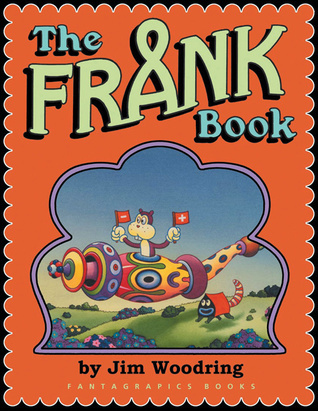
The Frank Book
by Jim Woodring
Since 1991, these lusciously rendered, hypnotic fables have dazzled comics readers the world over. All the Frank stories in one massive and deluxe tome. Between its handsome cloth covers are 344 pages of Frank comics, drawings and oddities. A fancy dust jacket, swoon-inducing end papers and ribbon bookmark make this book a decorative object as well as a repository of storytelling genius. Frank is a unique, visionary comic, exquisitely drawn and so fully realized that readers find themselves drawn deeply into Woodring's hallucinatory mindscape. The stories, almost entirely wordless, are told with brilliant, candy colors that people of all ages find alluring. This beautiful collection contains new material and lots of rare and previously-unpublished material (including the very first Frank story, not seen in over 10 years). Plus, this book includes an introduction from prominent Jim Woodring fan and acclaimed film director Francis Ford Coppola! This definitive collection is the very best way to give, receive, and experience one of the great cartoon achievements of the 20th century.
Since 1991, these lusciously rendered, hypnotic fables have dazzled comics readers the world over. All the Frank stories in one massive and deluxe tome. Between its handsome cloth covers are 344 pages of Frank comics, drawings and oddities. A fancy dust jacket, swoon-inducing end papers and ribbon bookmark make this book a decorative object as well as a repository of storytelling genius. Frank is a unique, visionary comic, exquisitely drawn and so fully realized that readers find themselves drawn deeply into Woodring's hallucinatory mindscape. The stories, almost entirely wordless, are told with brilliant, candy colors that people of all ages find alluring. This beautiful collection contains new material and lots of rare and previously-unpublished material (including the very first Frank story, not seen in over 10 years). Plus, this book includes an introduction from prominent Jim Woodring fan and acclaimed film director Francis Ford Coppola! This definitive collection is the very best way to give, receive, and experience one of the great cartoon achievements of the 20th century.
344 pages, Hardcover
First published June 1, 2003
About the author
Jim Woodring
132 books248 followersJim Woodring was born in Los Angeles in 1952 and enjoyed a childhood made lively by an assortment of mental an psychological quirks including paroniria, paranoia, paracusia, apparitions, hallucinations and other species of psychological and neurological malfunction among the snakes and tarantulas of the San Gabriel mountains.
He eventually grew up to bean inquisitive bearlike man who has enjoyed three exciting careers: garbage collector, merry-go-round-operator and cartoonist. A self-taught artist, his first published works documented the disorienting hell of his salad days in an “illustrated autojournal” called Jim. This work was published by Fantagraphics Books and collected in The Book of Jim in 1992.
He is best known for his wordless comics series depicting the follies of his character Frank, a generic cartoon anthropomorph whose adventures careen wildly from sweet to appalling. A decade’s worth of these stories was collected in The Frank Book in 2004. The 2010 Frank story Weathercraft won The Stranger’s Genius Award and was a finalist for the Los Angeles Times Book Prize for that year. The most recent Frank book, Congress of the Animals, was released in 2011.
Woodring is also known for his anecdotal charcoal drawings (a selection which was gathered in Seeing Things in 2005), and the sculptures, vinyl figures, fabrics and gallery installations that have been made from his designs. His multimedia collaborations with the musician Bill Frisell won them a United States Artists Fellowship in 2006. He lives in Seattle with his family and residual phenomena.
-Walter Foxglove
He eventually grew up to bean inquisitive bearlike man who has enjoyed three exciting careers: garbage collector, merry-go-round-operator and cartoonist. A self-taught artist, his first published works documented the disorienting hell of his salad days in an “illustrated autojournal” called Jim. This work was published by Fantagraphics Books and collected in The Book of Jim in 1992.
He is best known for his wordless comics series depicting the follies of his character Frank, a generic cartoon anthropomorph whose adventures careen wildly from sweet to appalling. A decade’s worth of these stories was collected in The Frank Book in 2004. The 2010 Frank story Weathercraft won The Stranger’s Genius Award and was a finalist for the Los Angeles Times Book Prize for that year. The most recent Frank book, Congress of the Animals, was released in 2011.
Woodring is also known for his anecdotal charcoal drawings (a selection which was gathered in Seeing Things in 2005), and the sculptures, vinyl figures, fabrics and gallery installations that have been made from his designs. His multimedia collaborations with the musician Bill Frisell won them a United States Artists Fellowship in 2006. He lives in Seattle with his family and residual phenomena.
-Walter Foxglove
Ratings & Reviews
Friends & Following
Create a free account to discover what your friends think of this book!
Community Reviews
Displaying 1 - 30 of 161 reviews

August 14, 2015
With Frank, Jim Woodring conjures up an alternate universe that brings to mind the idiosyncratic style of early cartoons (Felix the Cat) and newspaper strips (Little Nemo; Krazy Kat), the freewheeling trippiness of underground comix (Vaughn Bode; Robert Crumb), as well as the darker, more doubtful and angsty postmodern narratives developed by the likes of David Lynch or Charles Burns. It’s an enigmatic and downright crazy place, this alternate universe – disturbing, gorgeous and funny all at once. As it turns out, though, there is a dreamlike, strangely hypnotic logic to its phantasmagoric landscapes, bizarre creatures, mystical iconography, and hallucinatory revelations. Mesmerizing stuff!

September 30, 2012
Surreal, hallucinogenic, bizarre, disturbing, humorous. . . there are aspects of the art that owe something to early days of comics, so at a glance you might be inclined to think of this as a tribute to early comics, but at closer examination, there is this twisted nightmare and playful silliness and deeper rendering of human fears and curiosity and longing at the heart of Woodring's project.
I really do find this guy and his work amazing, but since there are these deliberately off-putting aspects (Hogman and other monsters) that consistently work against your expectations, of narrative closure, of rationality, of typical narrative engagement with character development, it's hard to say most people will love it. It's counterintuitive to an old school embrace of story. Even acknowledging that approach might be interesting, it's hard to say I loved it. But the surreal is one of his traditions, and fantasy, and dreams, and he owes something to Kafka's Metamorphosis. . . Pretty impressive stuff, no doubt. Crazy, intriguing, but crazy for sure. Maybe horror is another way to think of it.
I really do find this guy and his work amazing, but since there are these deliberately off-putting aspects (Hogman and other monsters) that consistently work against your expectations, of narrative closure, of rationality, of typical narrative engagement with character development, it's hard to say most people will love it. It's counterintuitive to an old school embrace of story. Even acknowledging that approach might be interesting, it's hard to say I loved it. But the surreal is one of his traditions, and fantasy, and dreams, and he owes something to Kafka's Metamorphosis. . . Pretty impressive stuff, no doubt. Crazy, intriguing, but crazy for sure. Maybe horror is another way to think of it.

November 1, 2015
Jim Woodring’s Frank is a generic cat-like anthropomorph who lives in a fantastical land called the Unifactor. His adventures are silent and generally black and white though there are several comics in this edition that are full colour.
The stories in The Frank Book are easy to follow in a technical sense because Woodring is an excellent cartoonist who knows how to tell a story sequentially. His art too is superb and enormously creative.
But content-wise? Woodring could take LSD on a trip - he could teach imagination a thing or two! Some stories are straightforward: Frank gets a job, earns money, buys a house albeit in an abstract way. And then some are… well, I’ll describe one story.
Frank dreams of swimming in a well so he buys a rug but Pupshaw (his “dog” for want of a better word) senses the rug is evil and tries to throw it out. Frank takes it back, sleeps on it, and it gives him nightmares of dreaming a book underwater. He wakes up and Pupshaw burns the rug. Frank is angered and goes walking in the mountains where he discovers the well from his dreams in a room on the side of the mountain. A man with an enormous chin fills up a black jug from the well which his prisoner, Manhog, takes outside and then runs off. Frank then picks up the black jug out of which comes a black morphing figure that becomes the skinny moon-faced Whim who imprisons Frank in the mountain along with the recaptured Manhog. Frank discovers a hole in the floor that leads deep, deep down in the dark where he meets twin “dogs” and picks one to lead him to the well of his dreams. He dives into the well, nearly drowns, Pupshaw saves him, but Frank’s head is deformed and he now has eight eyes. Pupshaw forces Whim to save Frank’s life and they leave the cave happily ever after.
…
Say whaaaat?
The Frank Book is full of those kinds of stories. I like that they’re surreal and wonderfully bizarre but after reading story after story of these inscrutable vignettes they tend to wash over you without leaving much of an impression. “Eh, another zany story about Frank doing something weird and then something weirder happening.”
I got this as part of the recent Humble Bundle Banned Books Week and apparently The Frank Book was “challenged” though I can’t find details of what was objected to. It’s surreal and oftentimes grotesque but there are plenty of books like that that aren’t challenged. Maybe someone read this on hallucinogens, exploded their mind and their family campaigned to put a warning sign on the cover: “Do not read on ‘shrooms!”? Whim does genuinely creep me out though – why won’t he stop smiling!?!
The Frank Book, and anything by Jim Woodring for that matter, is an interesting read. He doesn’t have any comparisons – his work is unique. And if you enjoy indie comics with a surreal/abstract twist to them, you’ll definitely get something out of this one. For me though it was a bit too much whackiness in one go with too many unfathomable stories in the mix to enjoy more.
The stories in The Frank Book are easy to follow in a technical sense because Woodring is an excellent cartoonist who knows how to tell a story sequentially. His art too is superb and enormously creative.
But content-wise? Woodring could take LSD on a trip - he could teach imagination a thing or two! Some stories are straightforward: Frank gets a job, earns money, buys a house albeit in an abstract way. And then some are… well, I’ll describe one story.
Frank dreams of swimming in a well so he buys a rug but Pupshaw (his “dog” for want of a better word) senses the rug is evil and tries to throw it out. Frank takes it back, sleeps on it, and it gives him nightmares of dreaming a book underwater. He wakes up and Pupshaw burns the rug. Frank is angered and goes walking in the mountains where he discovers the well from his dreams in a room on the side of the mountain. A man with an enormous chin fills up a black jug from the well which his prisoner, Manhog, takes outside and then runs off. Frank then picks up the black jug out of which comes a black morphing figure that becomes the skinny moon-faced Whim who imprisons Frank in the mountain along with the recaptured Manhog. Frank discovers a hole in the floor that leads deep, deep down in the dark where he meets twin “dogs” and picks one to lead him to the well of his dreams. He dives into the well, nearly drowns, Pupshaw saves him, but Frank’s head is deformed and he now has eight eyes. Pupshaw forces Whim to save Frank’s life and they leave the cave happily ever after.
…
Say whaaaat?
The Frank Book is full of those kinds of stories. I like that they’re surreal and wonderfully bizarre but after reading story after story of these inscrutable vignettes they tend to wash over you without leaving much of an impression. “Eh, another zany story about Frank doing something weird and then something weirder happening.”
I got this as part of the recent Humble Bundle Banned Books Week and apparently The Frank Book was “challenged” though I can’t find details of what was objected to. It’s surreal and oftentimes grotesque but there are plenty of books like that that aren’t challenged. Maybe someone read this on hallucinogens, exploded their mind and their family campaigned to put a warning sign on the cover: “Do not read on ‘shrooms!”? Whim does genuinely creep me out though – why won’t he stop smiling!?!
The Frank Book, and anything by Jim Woodring for that matter, is an interesting read. He doesn’t have any comparisons – his work is unique. And if you enjoy indie comics with a surreal/abstract twist to them, you’ll definitely get something out of this one. For me though it was a bit too much whackiness in one go with too many unfathomable stories in the mix to enjoy more.

October 16, 2007
My desert island book. Possibly even my dessert island book. It's that, good.
My copy is signed, too, which is like having The Bible signed by Peter, Paul and Mary. So, that's something.
Seriously, tho... this is my Favorite Book of All Time. Go to jimwoodring.com and buy a signed copy ... if it doesn't become your Favorite Book of All Time just give it to me and I'll pay you what you spent on it.*
*offer not valid outside** the 48 contiguous United States
**or, in
My copy is signed, too, which is like having The Bible signed by Peter, Paul and Mary. So, that's something.
Seriously, tho... this is my Favorite Book of All Time. Go to jimwoodring.com and buy a signed copy ... if it doesn't become your Favorite Book of All Time just give it to me and I'll pay you what you spent on it.*
*offer not valid outside** the 48 contiguous United States
**or, in

May 2, 2008
Throwback looking comics (60's trippiness & innocence pureed w/ menace) yet timeless for the open mind on edge dipping into platters of happiness with one eye on the vicious squigglies and massive sky stomps. Most of Woodring's comics are set in the shapeshifting inner void of dark dream shudderings (candy littered) reachable only by the innocence of cat hybrids. Frank is a furry Virgil with little or no brain but big smart eyes tethered to a sunshine heart.

October 10, 2019
I want to live inside this book.
October 31, 2010
I've been following the work of Jim Woodring, in particular the Frank stories, since the late nineties. He is one of the few artists able to translate the rules and revelations of dreaming into something cohesive and beautiful. Many try it, but most fail. Everyone finds their own dreams fascinating, but listening to someone else recount the 'crazy nightmare' they had last night is always a mind-numbingly dull experience. Even the best writers struggle and fail when it comes to incorporating dreams into their stories. Paintings, however, in particular the canvases of Dali, Ernst, Delvaux, Beksinski and Neo Rauch, seem far better suited to reproducing elements from dream. Film, too, has proven to be a medium able to play with the stuff of dreams, as the films of David Lynch demonstrate. Sequential Art is perhaps better equipped than any other, including Film and Painting, at representing both the visual idiosyncrasies and internal logic of the human subconcious. The earliest masterpiece in Comics history, dating back to 1905, is 'Little Nemo in Slumberland', by Winsor McCay. Every Sunday, readers were dazzled by McCays' virtuosic depictions of a young boys adventures in the world of dreams, giving his imagination free rein as he illustrated monsters and mythical beings, invented worlds and strange transformations. The visual aspect is no doubt the most important reason behind the failure of prose and poetry to harness the power inherent in dreams. Jim Woodring understands that words have diminished potency in 'The Unifactor', a small corner of psychic real estate set aside in his subconscious mind. This is the world in which the 'Generalized Anthropomorph' Frank lives and plays, encountering the stupid and selfish brute known as 'Manhog', a powerful sorcerer called 'Whim', and a protective godling-pet, 'Pupshaw' (as well as her male companion, 'Pushpaw', who appears later in the stories). These tales are wordless, and require no explanations. Whatever bizarre, wonderful or horrifying events take place, they unfold according to the skewed logic of dreams, effect sometimes preceding cause. Woodrings' talent as an artist cannot be overstated. His massive, incredibly detailed charcoal drawings are in great demand, as are the 'Designer Toys' he has produced for Presspop Gallery in Japan (i.e. Lorbo) and Strangeco (i.e. Mr. Bumper). His artwork in 'The Frank Book' is pitch-perfect for the subject matter, utilizing both a highly stylized black-and-white and a brightly-colored, fully-painted technique. Both are beautiful in their own right. This volume, bearing purple-cloth covers with embossed black titles, and specially illustrated end-papers that depict a star-chart with constellations seen from the Unifactor (a Frank constellation, a Whim constellation, etc.), compliments the full-length Frank books also released by Fantagraphics. At 360 pages, this oversized collection contains over a decade worth of stories. Like The Simpsons: Seasons 3 - 10, or Seinfeld: Seasons 3 - 9, this is one more relic of the 1990's that never gets old. Along with Charles Burns, Daniel Clowes and Chris Ware, Jim Woodring is one of the greatest cartoonists working today.

August 26, 2008
Much as I liked Seeing Things, reading something with a narrative, like The Frank Book, puts Woodring's abilities in a whole new light. It's part Carl Barks and part Fritz the Cat, only without that icky feeling the latter gives me. Frank is a creature of pure id, moving in a world that is held together by visual themes. Clues are all around, but how much they mean is hard to tell. Danger? A sign of something that needs to be done? It's easy to understand why Frank himself frequently becomes frustrated enough to resort to violence against other creatures. He wants things, and he doesn't know how to get them. It's also, despite a feeling of unease that permeates the whole thing, a sense that disaster could strike at any moment and destroy the whole world, kind of awfully cute. The characters are cartoony without crossing over into completely eyelashed critters, and Frank's little polygon dog thing that looks out for him seems quite pettable. Jim Woodring seems like he's done a lot of drugs, also, but his work is still appreciable by the extremely sober.

July 6, 2018
Cryptic fables of menace and wonder unfolding across an unknowable world shot through with ill-defined but glittering valencies.
We have or have encountered nearly all of these before in other collections, but taken all together, Woodring's masterpiece is completely astounding.
We have or have encountered nearly all of these before in other collections, but taken all together, Woodring's masterpiece is completely astounding.

July 28, 2007
Is this philosophy or madness? I was collecting them separately when the hardcover came out. I bought it and immediately read it from cover to cover. It’s savage and beautiful.
It’s what I love most about comics.
It’s what I love most about comics.

January 12, 2012
i want to like this collection so much. i really do. the character designs are out of this world. the surrealism is fun. and it's just gross enough to make me laugh. i just can't do it. there's an afterword in this volume that probably would have better served as a foreword. i understand why it's not at the beginning though - the artist would obviously rather have readers approach Frank knowing as little as possible. and i can understand that. the problem i have with it in this case is the tone of the comic feels so much like it's full of puns and inside jokes that if you're not at once in tune with the way jim woodring's mind thinks, there's a sense that the narrative is actually trying to prevent you from understanding what's going on. the individual stories are built more around what it FEELS like is going on, and while i can respect that in a certain sense, it doesn't work for me here. there's a level of such angry social commentary and pessimism that i'm turned off by the characters and their successes and failures. it's hard to care about characters that don't seem to care much about anything themselves. i still recommend. it's hard to find ANY book that just isn't worth your time, and this one definitely merits a read. especially given it's received such a high average rating from the goodreads universe. and maybe it's my fault for seeing a cute character and wanting something closer to Berkeley Breathed's Opus. still, the innocent, mindless darkness got to me after a while, and left me with a bad taste in my mouth. and while i'm sure those are all signs of the work succeeding and being good, it doesn't mean i have to like it.

December 19, 2012
When nerds like myself insist that Comic Books are "capital A" Art, there is no better example they could give you than Jim Woodring's "The Frank Book." Through the simplest of designs, Woodring creates disarmingly insightful stories of emotion and humanity, despite the complete absence of "human" characters or dialogue. The characters and stories in "The Frank Book" are timeless and ambiguous metaphors for the human condition, or for God, or for something. something important. I think... And while Woodring asserts in his afterword that all of his stories have straightforward meanings, his profound decision to keep them obscured, allows for interpretation, discussion, and relevance usually only ascribed to things hung in galleries. And y'know, if my review doesn't convince you, Francis Ford Coppola writes the introduction (for those of you who value opinions of legendary film auteurs over stay-at-home dads).

July 6, 2007
What did The Frank Book teach me?
That weird shit can happen at any moment...especially if you are a half-cat half-weasel-type creature with geometric chickens for friends and an anthropomorphic pig named Man-Hog for an enemy.
That weird shit can happen at any moment...especially if you are a half-cat half-weasel-type creature with geometric chickens for friends and an anthropomorphic pig named Man-Hog for an enemy.

October 9, 2017
Felt like being taken on a bizarre trip that I didn't enjoy.
Just plain weird and most of it doesn't make any sense.
Never thought a silent comic could give me such a headache :(
Just plain weird and most of it doesn't make any sense.
Never thought a silent comic could give me such a headache :(

September 29, 2021
Since 1991, Jim Woodring has filled hundreds of pages with comics set in a twisted, mysterious world called the Unifactor. This isn't just a fantasy land; it's a plane of existence that operates on a fundamentally different logic to our own. Its inhabitants see the world in a way we can't hope to comprehend, their motivations and morals often unfathomable. At times, even the very laws of cause and effect seem to be ruptured. It's a place that's at once familiar and unknowable, terrifying and enchanting. These are comics that burst with unbridled imagination – not mere inventiveness, but the raw stuff from which dreams are made.
The Frank Book contains all of Woodring's Unifactor comics from 1991 through 2003. They range in length from 1 to 50 pages, with most falling somewhere around 5–10 pages. They could all fairly be summed up as twisted, psychedelic distortions of classic cartooning (think Mickey Mouse on acid, or Bugs Bunny's nightmares). That said, there's considerable variety here. Some work as simple morality tales, while others are just zany, cartoonish antics, not a million miles away from Tom & Jerry (or Itchy & Scratchy). Many of them are structured like gag strips, ending on a punchline – though the punchlines are just as often horrifying as humorous. Some of them seem to be saying something real and important – expressing a certain emotion or idea – but others are so surreal that any attempt to make sense of them would be fruitlessly frustrating.
For me, the most interesting thing about these comics is that they seem to be crafted from pure archetype, bypassing the reader’s rational mind and speaking straight to the subconscious. The most obvious example of this is the character of Frank himself: Woodring refers to him as a "generic anthropomorph", and this is achieved perfectly; he embodies the essence of an anthropomorphic mammalian cartoon character in such a way that one barely notices that he doesn't belong to any recognizable species. Even more evocative, however, is Manhog, a pitiable, viscerally repulsive creature that one only has to observe for a moment to recognize as a personification of such undesirable human traits as selfishness, greed, cowardice, laziness and sycophantism. What's more, in as far as these comics can be said to have narratives at all, their plots are constructed almost entirely from symbols, motifs and feelings: wonder, fear, surprise, exploration, curiosity… peeking through holes, walking through doorways, physical mutilation, bodily transformation…
None of this would work, of course, if it weren't for Woodring's absolutely stellar cartooning. With scarcely any words, he always manages to depict events with the utmost clarity – even if it's often unclear why things are happening, no reader could fail to follow the panel-to-panel action. Perhaps the greatest testament to Woodring's cartooning skill is Pupshaw – Frank's friend/pet/housemate – who boasts probably my favourite character design in all of comics. She's a box-like, quasi-canine creature with a simply drawn but superbly expressive face, who often follows Frank around during his adventures, and tends to sense dangers to which Frank is blissfully oblivious. As such, she serves as a kind of Greek chorus, her facial expressions providing a hilarious silent commentary on events as they unfold. I know I'm doing a terrible job of explaining why, but every panel featuring Pupshaw puts a smile on my face. And it's not just Pupshaw, of course – every single character, object, building and landscape is awesome in both design and execution. And Woodring seems to be equally adept at working in black and white and in colour: the black-and-white material (the majority here) boasts meticulous, bold linework that evokes mediaeval woodcuts and gives Charles Burns a run for his money, while the colour strips experiment with different styles and techniques and really bring the Unifactor to life, in all its technicolour glory.
I should emphasize that these comics were published individually over the course of a decade, and I think reading a lot of them in one go would be exhausting, especially for a newcomer to the Unifactor. I read them over several months, dipping in and out, and often re-reading the same strips multiple times, and this is definitely the approach I'd recommend. As surreal and largely textless comics, it would be easy to burn through them quite quickly, but I advise taking the time to soak each one up and reflect on it a bit.
It did take me a while to get into these comics – to learn to appreciate Woodring's unique vision – but once they'd clicked for me, I was completely enthralled. I guess a lot of people wouldn't get anything out of this work whatsoever, but it's a must for anyone with a taste for surrealism and psychedelia. Moreover, this is essential reading for anyone with an appreciation for the craft of cartooning, as Jim Woodring is undoubtedly one of its great masters.
The Frank Book contains all of Woodring's Unifactor comics from 1991 through 2003. They range in length from 1 to 50 pages, with most falling somewhere around 5–10 pages. They could all fairly be summed up as twisted, psychedelic distortions of classic cartooning (think Mickey Mouse on acid, or Bugs Bunny's nightmares). That said, there's considerable variety here. Some work as simple morality tales, while others are just zany, cartoonish antics, not a million miles away from Tom & Jerry (or Itchy & Scratchy). Many of them are structured like gag strips, ending on a punchline – though the punchlines are just as often horrifying as humorous. Some of them seem to be saying something real and important – expressing a certain emotion or idea – but others are so surreal that any attempt to make sense of them would be fruitlessly frustrating.
For me, the most interesting thing about these comics is that they seem to be crafted from pure archetype, bypassing the reader’s rational mind and speaking straight to the subconscious. The most obvious example of this is the character of Frank himself: Woodring refers to him as a "generic anthropomorph", and this is achieved perfectly; he embodies the essence of an anthropomorphic mammalian cartoon character in such a way that one barely notices that he doesn't belong to any recognizable species. Even more evocative, however, is Manhog, a pitiable, viscerally repulsive creature that one only has to observe for a moment to recognize as a personification of such undesirable human traits as selfishness, greed, cowardice, laziness and sycophantism. What's more, in as far as these comics can be said to have narratives at all, their plots are constructed almost entirely from symbols, motifs and feelings: wonder, fear, surprise, exploration, curiosity… peeking through holes, walking through doorways, physical mutilation, bodily transformation…
None of this would work, of course, if it weren't for Woodring's absolutely stellar cartooning. With scarcely any words, he always manages to depict events with the utmost clarity – even if it's often unclear why things are happening, no reader could fail to follow the panel-to-panel action. Perhaps the greatest testament to Woodring's cartooning skill is Pupshaw – Frank's friend/pet/housemate – who boasts probably my favourite character design in all of comics. She's a box-like, quasi-canine creature with a simply drawn but superbly expressive face, who often follows Frank around during his adventures, and tends to sense dangers to which Frank is blissfully oblivious. As such, she serves as a kind of Greek chorus, her facial expressions providing a hilarious silent commentary on events as they unfold. I know I'm doing a terrible job of explaining why, but every panel featuring Pupshaw puts a smile on my face. And it's not just Pupshaw, of course – every single character, object, building and landscape is awesome in both design and execution. And Woodring seems to be equally adept at working in black and white and in colour: the black-and-white material (the majority here) boasts meticulous, bold linework that evokes mediaeval woodcuts and gives Charles Burns a run for his money, while the colour strips experiment with different styles and techniques and really bring the Unifactor to life, in all its technicolour glory.
I should emphasize that these comics were published individually over the course of a decade, and I think reading a lot of them in one go would be exhausting, especially for a newcomer to the Unifactor. I read them over several months, dipping in and out, and often re-reading the same strips multiple times, and this is definitely the approach I'd recommend. As surreal and largely textless comics, it would be easy to burn through them quite quickly, but I advise taking the time to soak each one up and reflect on it a bit.
It did take me a while to get into these comics – to learn to appreciate Woodring's unique vision – but once they'd clicked for me, I was completely enthralled. I guess a lot of people wouldn't get anything out of this work whatsoever, but it's a must for anyone with a taste for surrealism and psychedelia. Moreover, this is essential reading for anyone with an appreciation for the craft of cartooning, as Jim Woodring is undoubtedly one of its great masters.

October 27, 2007
i once had a copy of woodring's "frank" comic in the back seat of my car. a friend of mine picked it up and started reading it. after a few minutes he put it down and said, "man, this shit freaks me out." i guess i could tell you how great i think he is but...seriously, woodring's drawings are beautiful, and there is no one like him.

July 24, 2015
I think I first read a Frank comic when I was about twelve, and it probably took me about twenty years to get over being grossed out by it enough to assign it to my students. Since then, I decided I would like to read some more Frank comics. My friend has a lot of Frank comics. I borrowed them. I read them.
I WAS SO STUPID WHEN I WAS TWELVE.
I WAS SO STUPID WHEN I WAS TWELVE.

June 19, 2008
This book tucks me in at night. I have developed a way to read the stories aloud to my wife although there is no text.

December 10, 2008
I love this. It makes me feel queasy and laugh. It makes me want a Pupshaw tattoo.

January 15, 2018
There is a state of pure potential and it is the world and mind of Jim Woodring. His character Frank, and sometimes Manhog, exist in a universe in which literally anything is possible. Someone might go for a walk and discover a well that offers eternal reward or else draws one inside to a world where worms and leeches made of designs that would put Ottoman tailors to shame crawl up into our bodies and twist them into new forms. Jim Woodring in this book crafts stories in which no words are spoken, yet by the end of every one there is no doubt the reader has been told a story which has never existed before.
The Frank Book is a boon to comics artists, writers, and critics, because it offers something that simply doesn't exist anywhere else. It offers fans of comics a new opportunity to observe how comics as a medium can operate. It introduces a character who in his own way is timeless and can serve as a substitute for the reader who may be unwilling or unable to truly comprehend the universe in which Jim Woodring creates. And most importantly of all The Frank Book is an adventure, because no matter where or how far Frank travels from his home, the reader is assured that by the end of the story, Frank might have been turned inside out by some sort of polka-dotted worm-leach, and he might have been deceived by Manhog to give up his skull, and he might even have been invited by the dead to a party in which no one attends, but nevertheless by the final panel Frank will have come home.
The Frank Book is a boon to comics artists, writers, and critics, because it offers something that simply doesn't exist anywhere else. It offers fans of comics a new opportunity to observe how comics as a medium can operate. It introduces a character who in his own way is timeless and can serve as a substitute for the reader who may be unwilling or unable to truly comprehend the universe in which Jim Woodring creates. And most importantly of all The Frank Book is an adventure, because no matter where or how far Frank travels from his home, the reader is assured that by the end of the story, Frank might have been turned inside out by some sort of polka-dotted worm-leach, and he might have been deceived by Manhog to give up his skull, and he might even have been invited by the dead to a party in which no one attends, but nevertheless by the final panel Frank will have come home.
September 29, 2014
Wow. Part of me thinks I should reserve my rating of this book until I've read it again. I loved it but I cannot honestly say I fully understood it.
Almost completely wordless, this is a collection of comics Jim Woodring made about an anthropomorphic animal of ambiguous species. The art is absolutely beautiful but it really shines in the assortment of full-colour comics included in this collection.
I've seen these comics described as parables and I wouldn't necessarily disagree - though "fable" may be more apt. And Woodring has said that he will not speak to the meaning of his works, allowing them to operate in the mind of the reader as usually happens with literature and fine art.
But the level of ambiguity on display in these comics is both maddening and exhilarating. In a story where things bear very little resemblance to anything real, the level of abstraction increases beyond that inherent in the comics medium.
These are dreamy, surreal comics, illustrated in a seemingly storybook style, about very dark subjects. It would be easy to suggest some kind of Freudian reading of these works - vaginas, penises and anuses can definitely be seen in some design elements of the creatures and environments - but that seems much too simple for what's going on here.
I really did love this. But I'm going to reserve a five-star rating until I've read it again so that I can better unpack some of its symbolism.
4 Gentlemanhogs out of 5
Almost completely wordless, this is a collection of comics Jim Woodring made about an anthropomorphic animal of ambiguous species. The art is absolutely beautiful but it really shines in the assortment of full-colour comics included in this collection.
I've seen these comics described as parables and I wouldn't necessarily disagree - though "fable" may be more apt. And Woodring has said that he will not speak to the meaning of his works, allowing them to operate in the mind of the reader as usually happens with literature and fine art.
But the level of ambiguity on display in these comics is both maddening and exhilarating. In a story where things bear very little resemblance to anything real, the level of abstraction increases beyond that inherent in the comics medium.
These are dreamy, surreal comics, illustrated in a seemingly storybook style, about very dark subjects. It would be easy to suggest some kind of Freudian reading of these works - vaginas, penises and anuses can definitely be seen in some design elements of the creatures and environments - but that seems much too simple for what's going on here.
I really did love this. But I'm going to reserve a five-star rating until I've read it again so that I can better unpack some of its symbolism.
4 Gentlemanhogs out of 5

March 1, 2013
Astonishingly original and imaginative. This book is a collection of Frank comics published to mark the 20th anniversary of his creation. The comics feature a bizarre cast of characters who seem to have somehow emerged from the world of dreams to engage in a series of hallucinatory, Beckettian adventures. Woodring is equally adept at drawing them in colour or monochrome, but one of the most unusual and original aspects of these comics are that they are all 'silent'. There is no dialogue at all. The sense I got from these comics is less like a silent film (as Jason's comics can be)and more like it somehow taps into a primeval sense of storytelling and myth. There isn't a standard tone to these comics. Some are cute and childlike, some defy logic and are utterly dreamlike and others are really sinister and brutal. I had never heard of Jim Woodring or his comics when I spotted this in the library and decided to give it a try but I'm glad I did. This book is introduced by Francis Ford Coppola of all people, and Daniel Clowes is quoted on the back saying 'Frank, and I say this without a shred of hyperbole, is a work of true genius by one of the all-time greats'. When Daniel Clowes sees fit to write something like that you know it's got to be worth checking out.

January 14, 2019
This book is nuts. It’s bizarre in a way that’s both unnerving and delicious. I know, if I had read that sentence before I read the book, I wouldn’t know what I was talking about either. The colors, shapes, and otherworldly objects and creatures on every page really punch you in the face. It's brain candy.
So many things make this comic unique, but if I had to pick one it would be that it perfectly embodies the title “sequential art” and deserves the distinction. This really is an art book first. Guess what? This book contains only art. No speech bubbles, pretty much no words at all. It’s been called a “hallucinatory mindscape” and I couldn’t have said it better. It feels a bit like an acid trip, sometimes a magical one, and sometimes one that gives you a glimpse of Acid Nightmare Land. This book is a work of art, inside and out. I open it up occasionally just to look at a random page and I always get my art fix, but it’s a fix of its own just holding the beautiful 351-page hardback in your hands. It’s worth paying more than you would for most sequential art books or comics just to have a copy of this on your bookshelf. My second time reading this beautiful book was just as rewarding as the first time.
So many things make this comic unique, but if I had to pick one it would be that it perfectly embodies the title “sequential art” and deserves the distinction. This really is an art book first. Guess what? This book contains only art. No speech bubbles, pretty much no words at all. It’s been called a “hallucinatory mindscape” and I couldn’t have said it better. It feels a bit like an acid trip, sometimes a magical one, and sometimes one that gives you a glimpse of Acid Nightmare Land. This book is a work of art, inside and out. I open it up occasionally just to look at a random page and I always get my art fix, but it’s a fix of its own just holding the beautiful 351-page hardback in your hands. It’s worth paying more than you would for most sequential art books or comics just to have a copy of this on your bookshelf. My second time reading this beautiful book was just as rewarding as the first time.

January 9, 2013
This book is hard to describe but I love it. How do you read a book without words? All you have to do is visualize. The Frank Book by Jim Woodring reads like some dream of flowers and sunshine that often becomes a nightmare of strange and frightening proportions. If I was going to compare this book to a film,'Eraserhead' and 'Un Chien Andalou' come to mind. There is an indescribably subtle sort of evil to this book. It's like finding a snake in a lollipop. In this book, you can certainly expect the unexpected. If there is something that you wish to be explained, don't bother, because whether it makes sense or not you will still have the same awkward reaction. Jim Woodring is a true creative genius and it really shows in The Frank Book. Just open your mind and Frank will come to you.

September 21, 2008
Here is a book about the wondrous things that happen after your mind ends, and ingenious parasites infest the ruins of your cerebellum. Your sense of self will become a purple catman with poor judgment, and you will be assisted by end table/raccoons in your struggles against other people, who are swine, and also against Satan and your father. The passementeries and tassels of unseen spiritual curtains will also help and hinder your progress. A story of the mind.

September 10, 2017
2020 review: I may not always know what's happening in this book but I can always feel it having some impact on me, deep down.
2022 review: This book fucking rules. Every time I read it there's a handful of stories I've completely forgotten about. I don't know whats going on in a lot of these, but that mystery is so fucking tasty. I love Frank! We should all love Frank! And Manhog, that sunovabitch.
2022 review: This book fucking rules. Every time I read it there's a handful of stories I've completely forgotten about. I don't know whats going on in a lot of these, but that mystery is so fucking tasty. I love Frank! We should all love Frank! And Manhog, that sunovabitch.

January 11, 2019
Amazing Boschian fairytales straight from Jim's psychedelic mind !
I showcase Jim Woodring's legacy here :
https://youtu.be/9nRuh4AChzw

September 11, 2010
if you like this review i now have website: www.michaelkamakana.com
140910: this is the definition of why surrealism is best in visual media, rather than music, prose, dance. dreamlike, weird, weird, more weird- this is what pixar could do for adults, this would make a great movie... just do not know what music would go with it…
140910: this is the definition of why surrealism is best in visual media, rather than music, prose, dance. dreamlike, weird, weird, more weird- this is what pixar could do for adults, this would make a great movie... just do not know what music would go with it…

December 4, 2007
This is so cool. Phil you haven't stolen my copy have you? You gave that to me for Christmas and I want it!
But yeah highly recommended - amazing art and disturbing story lines (in a good way).
But yeah highly recommended - amazing art and disturbing story lines (in a good way).

May 27, 2010
indie,alt,fantasy,weird
Displaying 1 - 30 of 161 reviews