What do you think?
Rate this book


'Oliver Sacks-meets-When Breath Becomes Air ... Barbara Lipska's remarkable story illuminates the many mysteries of our fragile yet resilient brains.' LISA GENOVA, bestselling author of Still Alice and Every Note Played
All we think, feel and dream, how we move, if we move, everything that makes us who we are, comes from the brain. We are the brain. So what happens when the brain fails? What happens when we lose our mind?
In January 2015 renowned neuroscientist Barbara Lipska's melanoma spread to her brain. It was, in effect, a death sentence. She had surgery, radiation treatments and entered an immunotherapy clinical trial. And then her brain started to play tricks on her. The expert on mental illness - who had spent a career trying to work out how the brain operates and what happens when it fails - experienced what it is like to go mad.
She began to exhibit paranoia and schizophrenia-like symptoms. She became disinhibited, completely unaware of her inappropriate behaviour. She got lost driving home from work, a journey she did every day. She couldn't remember things that had just happened to her. Small details like what she was having for breakfast became an obsession, but she ignored the fact that she was about to die. And she remembers every moment with absolute clarity.
Weaving the science of the mind and the biology of the brain into her deeply personal story, this is the dramatic account of Dr Lipska's own brilliant brain gone awry.
202 pages, Kindle Edition
First published April 3, 2018


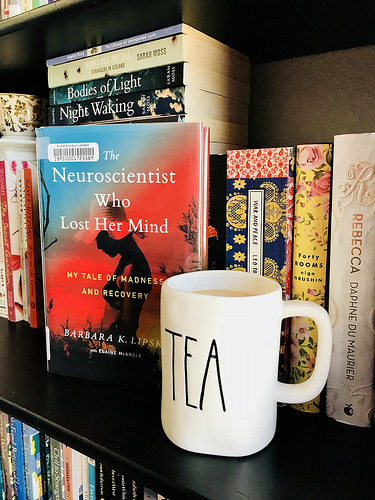
This book is an account of what mental illness looks like from the inside. But it is also a map of my evolution as a scientist and as a person. It is the story of an incredible journey, one from which I could not have imagined I would ever return. It is a story that I never thought I would be able to tell, of how I went from being a scientist studying mental disorders to being a mental patient myself – and how, remarkably, I came back.
My emotional overreactions – anger, suspicion, impatience – suggest that my frontal lobe is undergoing catastrophic changes. But these warning signs are lost on me. As an expert on mental illness, I, more than most people, should be able to see that I'm acting strangely. But I can't. Although I don't know it yet, my six tumors and the swelling around them are shutting down the frontal cortex, the part of the brain that allows for self-reflection. Paradoxically, I need my frontal cortex in order to understand that mine has gone missing.
Kasia doesn't tell me until much later, but it deeply pained her to see me so disoriented, so altered, from the sharp-minded and accomplished person I used to be: her sharp-witted mother, the one who taught her math and logic as well as the importance of honesty and how to enjoy her life. She doesn't want our roles to change. She doesn't want to be a physician examining my symptoms and observing my strange new behaviors in an attempt to understand what's wrong. She wants her loving, fun, competent mama. Not this confused, angry, self-absorbed impostor.
As if from some previous life, as if from the deepest fog of perception, images of my recent past begin to emerge. I'm regaining my hold on everyday life and on reality. It's like I'm clawing my way up from a black hole and slowly beginning to recognize my surroundings and see the sun. And I'm starting to realize how deep that hole was.