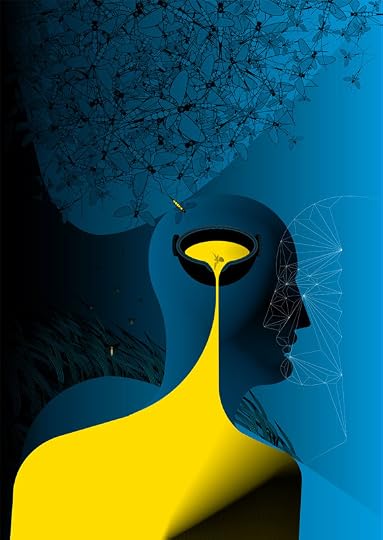
Metallurgists are both admired and feared. They splinter their own minds in order to manipulate metal at the microscopic level, creating shadow selves to craft the nano-architecture of metal alloys into perfection. Near the vast steelworks of Karshad, a journalist has fallen in love with the residual personality of a metallurgist, but what will happen when realliance—and forgetting—comes?At the Publisher's request, this title is being sold without Digital Rights Management Software (DRM) applied.
Huh? So didn’t like the non-ending ending. Would have been nice to have an actual resolution to the dilemma presented in the story. 2, gimme an ending, stars.
I was let down by the ending. The premise was incredibly intelligent and masterfully woven with love. However, I wanted to read the experience of the hero's gambit and the process of realliance. Most of all, I wanted at least a hint of whether or not it paid off. Now, perhaps the ending is an obscure way of offering this, but, if so, I missed it and liked it less for it. Still good, though.
Adjective. spinodal (comparative more spinodal, superlative most spinodal) (chemistry) Describing the transformation of a system of two or more components in a metastable phase into two stable phases.
A young man, a journalist, falls in love with a metallurgist who's not all there. She's splintered her mind into a residual personality in order to work on a assignment, and once the job is completed, the metallurgist's realignment with her body will erase the memories of her residual personality.
This was an intellectually stimulating story, but I felt something was off. Very odd story.
Setting presentation, design and originality (how cool is the setting?): 5 Setting verisimillitude and detail (how much sense does the setting make?): 4 Plot design, presentation and originality (How well-crafted was the plot, in the dramaturgic sense?): 3 Plot and character verisimillitude (How much sense did the plot and motivations make? Did events follow from motivations?): 3 Characterization and character development: 3 Character sympatheticness: 3 Prose: 4 Page turner factor: 3 Mind blown factor: 5
I understand the premise of leaving the outcome to the reader's imagination, but lately it is just making me feel like authors are just not bothering. This story would have been better to have had the outcome, imo.
An interesting little twisty story, but I didn't totally feel like there was enough here, it would have been more interesting and full feeling if it had been drawn out into something longer.
I can appreciate it is well-written, but my brain hurts. I am just not smart enough for this much metallurgical lingo. I agree with Brian's review - it really had potential, but I wanted the payoff.
In a near feature metallurgists souls can be separated from the body and sent inside metals to manipulate them Metallurgists to craft the nano-architecture of metal alloys into perfection. Doing so leaves the body without a soul, inhabited by an echo of their soul until their are reunited few month later... if the soul decides it want to do so, erasing all the memories of its echo. Near the vast steelworks of Karshad, a journalist has fallen in love with the residual personality of a metallurgist...
A story which finds poetry in metallurgy - both the real thing, and its imagined future form, where metallurgists leave residual versions of themselves in their bodies while the greater part of their consciousness enters the metal to shape it from within. Over a pretty short space, the tale finds all sorts of things to say about mind, matter, aesthetics, love, betrayal...you know, most of the big stuff. The writer, Hanuš Seiner, is entirely new to me, and doesn't seem to have published much fiction, but as a PhD working in material science I assume he's not finessed too much of the detail here (well, except maybe the whole consciousness download bit). Why do Czechs have such a gift for smashing down the 'two cultures' nonsense like this (see also: poet-immunologist Miroslav Holub, who integrated the two vocations much better than you might expect)? Whatever the answer, I hope we get more from Seiner in English soon.
The translation is by Julie Novakova, incidentally. Which is not something I'm normally great about noting, but some of Seiner's other stuff is in anthologies which have translation work by someone with whom I deal for less exalted translation jobs at work, and that rather brought it home to me.
There’s some really interesting ideas in this one, but I don’t fully understand it. I think I wanted a bigger burst of understanding at the end, something to really make the lead up click into place. But the things I could understand were cool so that’s worth something to me. I’m really enjoying my journey through these Tor short stories (novellas?).