

What do you think?

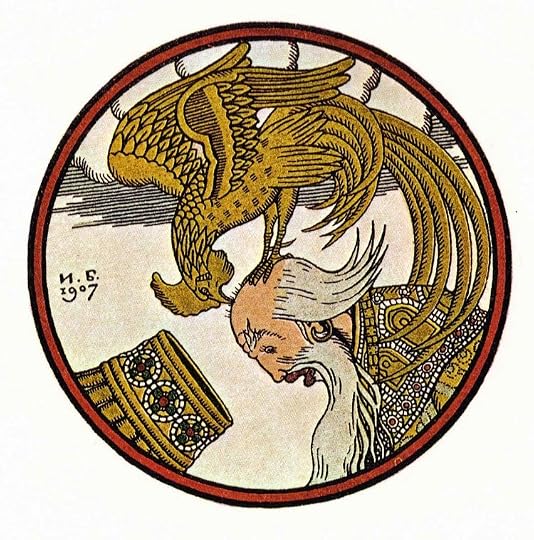
The Golden Cockerel and Other Fairy Tales
"The four tales in this book illuminate different aspects of Russian art, of the Russian soul, writes Rudolf Nureyev in his Introduction. Derived from folktales told by peasants from time immemorial, they are the oldest voice of Mother Russia. . . ."
111 pages, Hardcover
First published October 1, 1990
About the author
Alexander Pushkin
2,925 books3,640 followersWorks of Russian writer Aleksandr Sergeyevich Pushkin include the verse novel
Eugene Onegin
(1831), the play
Boris Godunov
(1831), and many narrative and lyrical poems and short stories.
See also:
Russian: Александр Сергеевич Пушкин
French: Alexandre Pouchkine
Norwegian: Aleksander Pusjkin
Spanish:Aleksandr Pushkin
People consider this author the greatest poet and the founder of modern literature. Pushkin pioneered the use of vernacular speech in his poems, creating a style of storytelling—mixing drama, romance, and satire—associated ever with greatly influential later literature.
Pushkin published his first poem at the age of 15 years in 1814, and the literary establishment widely recognized him before the time of his graduation from the imperial lyceum in Tsarskoe Selo. Social reform gradually committed Pushkin, who emerged as a spokesman for literary radicals and in the early 1820s clashed with the government, which sent him into exile in southern Russia. Under the strict surveillance of government censors and unable to travel or publish at will, he wrote his most famous drama but ably published it not until years later. People published his verse serially from 1825 to 1832.
Pushkin and his wife Natalya Goncharova, whom he married in 1831, later became regulars of court society. In 1837, while falling into ever greater debt amidst rumors that his wife started conducting a scandalous affair, Pushkin challenged her alleged lover, Georges d'Anthès, to a duel. Pushkin was mortally wounded and died two days later.
Because of his liberal political views and influence on generations of Russian rebels, Pushkin was portrayed by Bolsheviks as an opponent to bourgeois literature and culture and a predecessor of Soviet literature and poetry. Tsarskoe Selo was renamed after him.
See also:
Russian: Александр Сергеевич Пушкин
French: Alexandre Pouchkine
Norwegian: Aleksander Pusjkin
Spanish:Aleksandr Pushkin
People consider this author the greatest poet and the founder of modern literature. Pushkin pioneered the use of vernacular speech in his poems, creating a style of storytelling—mixing drama, romance, and satire—associated ever with greatly influential later literature.
Pushkin published his first poem at the age of 15 years in 1814, and the literary establishment widely recognized him before the time of his graduation from the imperial lyceum in Tsarskoe Selo. Social reform gradually committed Pushkin, who emerged as a spokesman for literary radicals and in the early 1820s clashed with the government, which sent him into exile in southern Russia. Under the strict surveillance of government censors and unable to travel or publish at will, he wrote his most famous drama but ably published it not until years later. People published his verse serially from 1825 to 1832.
Pushkin and his wife Natalya Goncharova, whom he married in 1831, later became regulars of court society. In 1837, while falling into ever greater debt amidst rumors that his wife started conducting a scandalous affair, Pushkin challenged her alleged lover, Georges d'Anthès, to a duel. Pushkin was mortally wounded and died two days later.
Because of his liberal political views and influence on generations of Russian rebels, Pushkin was portrayed by Bolsheviks as an opponent to bourgeois literature and culture and a predecessor of Soviet literature and poetry. Tsarskoe Selo was renamed after him.
Ratings & Reviews
Friends & Following
Create a free account to discover what your friends think of this book!
Community Reviews
Displaying 1 - 4 of 4 reviews


December 27, 2024
I love how every culture has its versions of the same fairytales: Snow White, the Fisherman's Wife... it's cool how deep those roots go. The stories were simple but classic, and the illustrations were stunning.

December 21, 2008
Beautiful illustrations. Also, the stories are not the way we Anglo-Saxon types have often heard them (if we've even heard them), they're definitely more Russian and it's a lot of fun.

January 28, 2013
"Astă-noapte, am fost foarte atent la cîntecul cocoşului. Era atît de sincer, de plin de elan, încît nu pot concepe că nu se adresează nimănui, că o face doar pentru sine. In mod vădit, are ceva de comunicat, deşi registrul lui rămîne acelaşi şi nu pare să-şi schimbe formula. Şi ce dacă! Atîta convingere trebuie să corespundă unei realităţi şi să exprime un mesaj. Nu poţi să crezi că-i vorba de un simplu exerciţiu." - Emil Cioran
Displaying 1 - 4 of 4 reviews