The funny and moving story of the apocalypse - as seen from one small village in England
Retired teacher Edgar Hopkins lives for the thrill of winning poultry prizes. But his narrow world is shattered when he learns that the moon is about to come crashing into the earth, with apocalyptic consequences. The manuscript he leaves behind will be a testament - to his growing humanity and to how one English village tried to survive the end of the world...
Written in 1939 as the world was teetering on the brink of global war, R. C. Sherriff's tragicomic novel is a masterly work of science fiction, and a powerful warning from the past.
Robert Cedric Sherriff was an English writer best known for his play Journey's End which was based on his experiences as a Captain in World War I. He wrote several plays, novels, and screenplays, and was nominated for an Academy Award for Best Writing (Adapted Screenplay) and two British Academy of Film and Television Arts.
A science fiction story about the moon crashing into the earth....or is it?
You might read this story as the politics of the first half of the 20th century, the great cataclysm of the moon crashing into the earth is World War 1, the Era of Recovery, is the post war years, the war between the Europeans is World War 2 and the eastern threat of Selim the Liberator is the looming shadow of Communism.
However, I read this story as one about socially conditioned loneliness. Edgar Hopkins is hardly a sympathetic character. He is a small minded, middle class snob and it's his class based snobbery that casts him into a life of crushing loneliness. He looks down his nose at 'the lower orders', rages with petty minded jealously at more successful peers and idolises an aristocracy that is unaware and uninterested in his existence. As a result this lonely, middle aged bachelor's best friends are chickens.
When the great cataclysm destroys society, and with it class boundaries and social convention, Hopkins slowly begins to accept other people into his life. The cataclysm rescues him from his own petty and dismissive attitude and he begins to learn to love finding a truly fulfilling purpose in helping others. Indeed Hopkins freely admits that the happiest days of his life were after the great moon disaster, working within the small self sufficient egalitarian based society of the local survivors.
However as the national infrastructure recovers and a governmental hierarchy retains control of the country and appeals to the populous to fulfil 'duty to the state' Edgar Hopkins has every thing he had learned to care about taken away from him. Only the most stoney hearted will fail to feel desperately sorry for him.
So for me the story is about how without the oppressive, conditioning structures of state, class and social convention true community can thrive...with the alternative being nothing more than the role of isolated and self motivated competitors.
In a foreword we learn that the last inhabitants of Great Britain starved to death 1000 years ago. Following a Cataclysm in which the moon came out of its orbit and crashed into the Earth, the nations of the East spread into devastated mainland Europe, but not as far as England, because it was thought too damp. But two years previously an expedition into the island's interior discovered the Hopkins Manuscript, and this is what we read as we go on.
Edgar Hopkins writes his manuscript in what is left of Notting Hill in London, knowing that he is one of the last survivors, and about to die himself. He relates the story of the lead up to the Cataclysm and what happened afterwards. When his story starts he is an unmarried poultry breeder living in Hampshire. He's often bumptious and snobbish, and for the first third of the novel rather unlikeable. But after news comes that the moon is going to crash into the Earth he works with his fellow villagers and as he discovers that he likes many of them, so we come to like him.
The book was published in 1939, without knowledge of the second world war, and is so prescient of how the country coped and tried to pull together in the face of disaster. But although terrible things happen after the Cataclysm, it isn't that event which destroys the west, but something even more prescient considering the times we're in now.
My only word of warning is that the book is of its time: England has an empire that is seen as a great thing, and there are barely any women in the novel (and those that there are, are either saints or stupid washer-women types who can only manage because there are men to help them). 4.5 stars rounded up to 5.
R.C. Sherriff also wrote the superb, The Fortnight in September. If you haven't read it I urge you to go and find a copy now.
This starts off with a note from an Abyssinian professor talking about a manuscript that was discovered when a team from the university made an exploration into England and discovered a manuscript hidden in a flask. A thousand years ago, Western Europe was wiped out when the moon crashed into the Atlantic. Very little is now known about the society back then, because the oppressed rose up and destroyed everything of the oppressors. What follows is the tale, as told by Edgar Hopkins, of the build up and seven years after, the Moon crashed to Earth. Hopkins is a pompous snob, who, being a member of the British Lunar Society. As such, he learns of the disaster to come before most of his fellow men. He gloats privately of his knowledge while obsessing about his status at the poultry show, and worrying about events to come. I don't think we are meant to particularly like Hopkins, but he is a brilliant voice to carry the narrative and the authors message. I won't add more, because I don't want to spoil the story. A very compelling read. I loved it.
Its not everyday, we come across a novel written by a British author/playwright/screen writer, no less one born in 1896. More interesting is how he approaches the creation of Edgar Hopkins, a compassionate farmer who raises prize winning chickens in Beadle, a small town on the outskirts of London. Told in classic British narrative it adds a dash of tongue-in-cheek humor throughout it.
Edgar has a regimented life with both housekeeper and gardener; dines regularly with neighbors, attends church and enters his 'pullets' in annual shows. With an interest in the Universe, he joins the Lunar Society whose plan to construct a telescope is of interest. During one such meeting an expert brings to light a startling fact; the moon has been moving closer to the earth daily. Its decided that this must be kept confidential from the community while scientists around the globe investigate.
Over the course of months, a theory that it will simply graze the earth and move on surfaces, giving the members of Lunar Society a breath of fresh air. Meanwhile, the threat of a world war signals an effort to develop dugouts/bomb shelters and the construction is underway. As the doomsday of the moon approaches, its learned the grazing theory was faulty and citizens hurry to the dugouts for protection.
Suddenly the skies turn dark, tornadoes flourish and Beadle is flooded by tidal waves. Edgar manages to survive as do a small group of residents who learn the flood was due to a section of the moon breaking off and plunging into the Atlantic. With shipping channels blocked, England is isolated as are other parts of Europe. Once civilization begins to rebuild, scientists learn the moon's composition has value due to minerals, oil and precious metals.
Rather than spoil the story, suffice it to say that political, economic and spiritual elements combine with an unexpected outcome. I picked this book since reviewers seemed to think the Netflix film, "Don't Look Up" was loosely based upon it. Having been published in '39, I seriously doubt it however. That said, I loved the learning that R.C. Sheriff is known for writing the script for The Invisible Man!
Regardless, its unique, engaging and in some ways, heart warming due to Edgar Hopkins's persona. If you'd like to take a break from traditional science fiction, mystery or otherwise, you might add this book to your list!
Edgar, a quiet and polite forty-something Englishman (who will sound off, when provoked) has two interests in his lonely life: the Moon...and his precious prize-winning chickens (Broodie always wins). Unfortunately, it turns out that one of Edgar's interests will cancel out the other: the Moon is predicted to hit Earth. It's coming down hard. Then again, maybe the experts are wrong and Earth will just get "grazed", or the Moon will miss us and the poultry entirely (does Broodie always win?). Edgar is in on the tragic news well ahead of the general public, and has time to prepare for what looks like it could be the ultimate end for everyone - making new friends, politely ticking off the tactless when they make a rude comment, and entering his pullets in what he knows are likely to be the last poultry shows on Earth. Meanwhile, the British Govt. prepares the terrible announcement it will need to make, the day after the night people will look up in the sky and no longer believe the statement "Nothing to worry about, the Moon just LOOKS weird...".
Like the Moon, this book has phases, and things do go from lighter to darker, on a large scale. I mean, it is a post-Apocalypse novel, even if it seems to launch from Blandings Castle. The turning point in the novel arrives - and yes, by that time I was quite done with the build-up and ready for the Moon to do whatever it was actually going to do - and some of the most riveting chapters involve the day before and day after the "moon landing". And then, it's Edgar adjusting to a new existence; we learn what he learns about the fate of Earth.
As the last phase of the book hits, I learned why blurbs for this wonderful novel say stuff like "a prescient vision of the future, eerily published in 1939, just before the start of WW2". I thought "that's fine and all, but this is the Moon crashing down to Earth, not a world war. Are we going for some kind of weird comparison??".
Ja nie wiem kurwa. Jako satyra na angielską klasę średnią-wyższą i prowincje to nawet ciekawe, choć nużące i te kilkadziesiąt lat później mało zabawne. Jako post-apo, gdy apokalipsa zaczyna się realnie w 3/5 książki, to trochę nuży i mało się na niej skupia. W ogóle NUŻĄCA to dobre słowo dla tej powieści. A do tego relacja głównego bohatera z sąsiadeczką kriperska myślę nawet jak na standardy lat 70.
Edgar Hopkins decides to retire from teaching and go and live in the small Hampshire village of Beadle Valley rearing poultry. Although he loves the country life and his chickens, he decides to become a member of The British Lunar Society and enjoy his other hobby of astronomy. After a few months Edgar receives a letter from the society informing him of an urgent meeting all members must attend. He soon finds out that within a few months the moon will be colliding with the earth and that this cataclysm could wipe out the entire world. I'm not usually a fan of science fiction but after reading and loving R.C. Sherriff's 'The Fornight in September' and 'Greengates', I thought i'd give this one a go. I found Edgar Hopkins to be quite a snob and a self-centred person at first but towards the end his character really starts to improve. I loved this strange, funny and moving story and would recommend reading it, although I don't think I will look up at the moon in the same way ever again !
This entire review has been hidden because of spoilers.
Quaint but powerful and prescient piece of science fiction. Published in 1939, it not only foreshadows the destruction Europe faced at that time but remains relevant to modern day global issues. Because ultimately this is a novel about human beings, their strengths and failings, and the disaster scenario serves to magnify and highlight the actions of humanity.
Edgar Hopkins, author of the manuscript, is a rather pompous and lonely bachelor, whose life revolves around two pastimes - breeding and showing poultry, and his monthly attendance at meetings of the British Lunar Society, dedicated to observing and discussing the moon. At one of these meetings, he learns that the moon has been jolted out of its path and is heading towards the earth. The book examines how his small rural village prepares for the cataclysm, and what happens in the aftermath.
The narrative moves skilfully from comedy to tragedy, from heartwarming nostalgia to a painful sense of loss. There are some truly chilling descriptions of the approaching moon and its effect on the landscape, all the more striking because of their contrast with the tranquil rural setting. Edgar himself develops through the novel, finding a connection with humanity that he had previously avoided, but also a growing realisation of how fragile and easily disrupted the world is.
This book has similarities with works by HG Wells and John Wyndham, with its portrayal of a dystopian Britain affected by external forces, and human response to disaster. I found it haunting and thought provoking, and a gem that stands well alongside works by these more familiar authors.
Check out my full, spoiler free, video review HERE. This is a fantastic work of early post-apocalyptic science fiction involving a lunar collision with earth. This is a very easy to read book that does a great job of analyzing the human condition. Good to see this one back in print.
I’m not sure if ‘The Hopkins Manuscript’ is a really, really great book or if it just happens to be a book I really, really like.
I would sum this book up by describing it as ‘Mr Pooter verses the apocalypse’, it’s a glorious tightrope walk which hovers over narrow-minded absurdity but manages not to fall into it by surprisingly astute psychological understanding.
Mr Hopkins is a small, fussy man, full of his own self-importance. His big interests are poultry breeding and discussing lunar science in a smart club. Having accidentally promised to pay for an observatory for the Lunar club, he is justifiably worried when called to an emergency meeting of the club. So worried is he about this financial observation, that he is relieved when told that the moon is going to crash into the earth. When this sinks in, his main observation is that not as many cream eclairs have been eaten as usual, because that’s the kind of cake you can only eat with a calm and steady hand.
The members of the club have been pledged to secrecy about the approaching collision, so that governments can make preparations to deal with panic. Although he does occasionally think about the awfulness of apocalypse, he mainly wanders around feeling smug that he has a really great secret, and feels huge urge to tell everyone. The introduction describes Hopkins as irritating but I find something endearing in his clinging to the rules of the poultry society (and buying the vicar a book on poultry ‘to make him more interesting’) just as the world is ending. As he says, the end of the world is too big to apply ‘normal common sense’.
Eventually, the rest of the world find out about the impending disaster and Hopkins’ main feeling is disappointment that people aren’t as impressed with him as he hoped. This disappointment comes out in bitchy arguments about the quality of snowdrops in the garden.
The government sets towns and villages the challenge of creating ‘moon-proof’ bunkers, mainly as something to keep people busy but also on the outside chance that they might work. Hopkins begins to join in and enjoys the camaraderie. That said, he daren’t let anyone call him by his first name, just in case the moon didn’t crash and they wouldn’t call him sir afterwards.
When the moon eventually crashes, most of the village go in the moon-bunker but Hopkins stays in his house. It’s evocatively described, strange and psychedelic. The rush of the moon that brings a dusty whirlwind and even the Atlantic Ocean spreading out into the Hampshire valleys. He emerges and is (mostly) a new man. The need to rebuild the world gives Hopkins more to live for, he even fulfils his dreams and becomes an important man.
These are my favourite chapters, I love the feeling of rebuilding a new world from the ashes of the new. Hopkins is so into this new egalitarian mood that he can talk to a plumber ‘as if he was an equal’. Of course, all things end and this period of new growth is crushed by politics. I wasn’t surprised, the author was a WWI veteran writing in 1939 - what else could it be.
This book is historically interesting in seeing how a man in 1939 imagines how Britain will bear under a cataclysm. He imagines London not to have strong enough communal ties but that the countryside will be able to keep going - he was to be proved wrong by London’s ‘blitz spirit’, which despite a massive rise in crime stands in the city’s memory as being the time of greatest community.
Other than that, the book is funny, full of excitement, mystery and the intricacies of poultry-fancying.
The Hopkins Manuscript was found one thousand years after it was written. The author was Edgar Hopkins, a retired math teacher in his mid-fifties. He professed to us he wanted to be a writer and thus penned this manuscript. In the beginning of our story, Edgar has an air of self importance about him. It makes him sound rather pompous, but I quickly came to enjoy his company.
Edgar lives in Beadle, a rural English town where he is a member of the Lunar Society. Because of his membership, he becomes one of the first to learn that the moon is on a direct collision course with the earth and scientist know the impact date. Towns are ordered to construct bunkers and given specific specifications. The villagers are told it’s to prepare for war, but as the moon looms ever closer, the government is forced to confess.
The story is split into two parts. Before the moon collision and after the moon hits. While I am not at all sure of the accuracy of a moon collision, thru Edgar, Sherriff’s portrayal of humanity’s reaction is poignant and realistic.
I loved the characters and the rebuilding. We witness Edgar form a sort of family with survivors as they work to feed themselves and make life easier. We see other towns open trading and witness the country getting back on their feet. Indeed, a little utopia forms, that is until the world powers jockey for the moon.
The Hopkins Manuscript had a wonderful flow and has me looking to read more of Sherriff’s works. It felt relevant and present. It offered a fascinating look into human nature.
Nicholas Boulton and Lameece Issaq, did a wonderful job of bringing this story and its characters to life. Indeed, I could listen to Boulton every day and never grow tired of his smooth, addictive tone. The story is well written and lends itself perfectly to the audio format. This review was originally posted at Caffeinated Reviewer
Imagine if Moonfall was narrated by a semi-aristocratic English chicken farmer in the 1930's and had less nano-bot snake aliens. That's this book.
The novel takes the form of a recounting of the lead-up to the cataclysm in which the moon's orbit suddenly decreases and sets it on a crash-course for Earth. More than that though it's a book about the educated middle-class Englishman as he anticipates and experiences incredible upheaval, and how his fellow countrymen fare. There are many things to like here. Not only is the premise very unusual for a book of this structure but it's easy to read. The diary entries are short and engaging, interspersed with daily life as they are with rumination on the state of the country and the general feeling of its people as events unfold. There is some pleasant descriptive writing about the English countryside and the cataclysmic events. Overall, I had no issues reading the book.
Our protagonist is an odd man, filled with a sense of his own self-importance he is nevertheless incredibly lonely. His journey over the course of the book: from someone demanding reverence to someone eager to be part of a group in whatever role they'd have him was very telling. The preface, fictional, casts him as unlikeable and petty but over the course of his trials his strengths become apparent and in acting as he believes he should, even if it doesn't come naturally, he surpasses his inherent nature. Would that we all discover such wholesome depths within us during a tragedy. It's smartly done too: he never has an overnight transformation. The events begin when he is already 47 years old and although he shows his mettle, his petty and proud nature often shines through. Especially if it's to do with chickens. In some ways the book reminds me of The Wall with its introspection on survival and the daily practicalities of surviving. This definitely has more of a farcical tone to it though.
The progression of events, and how they affect the country and countryside is absolutely fascinating. The differences between city and countryside attitudes, the way the government controls the dissemination of information is reminiscent of how the pandemic has progressed the past few years. Or indeed Brexit. It's clear that many of the themes in this book were Sherriff's reflections on the Great War and the upcoming WWII.
My big negative is that the first half, before the event, is just too long. I really enjoyed it, but some sections felt unnecessary compared to the rest of the book. I guess most of them were to set the scene for our protagonist's character development whereas the remainder of the book was about the world at large.
In the Persephone Books edition that I read there is an afterword suprisingly by George Gamow that adds a lot of scientific and historical context to the piece. So look into that edition if you can (and it's beautifully published of course).
This is an extraordinary book that I would highly recommend to anybody interested in the time period between the world wars and a fan of classical literature in general. It is long, it can be a chore at times (chickens!!!!) but the cataclysm and what follows more than make up for it. Recommended!
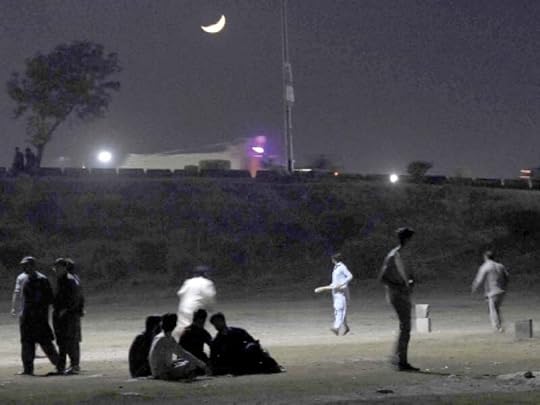
Alongside many well-crafted description of a frosty morning are haunting images like this one.
RC Sherriff's lasting legacy is, of course, his remarkable play Journey's End, but Sherriff wrote several novels (as well as screenplays for such films as The Invisible Man and Goodbye Mr Chips). This one is something of an oddity, a work of science fiction which nicely bridges the gap between HG Wells and John Wyndham. As the title implies, the book takes the form of a journal kept by Edgar Hopkins. As there is a preface detailing the discovery of this manuscript, it is known from the outset that things don't turn out well for the human race in the ensuing story. Hopkins is a fussy little man, early retired, and passionate about his chickens and his stamp collecting. A sudden interest in all things astronomical leads him to joining the British Lunar Society and so becoming one of the few people in the country to learn of an impending ecological disaster. The moon has veered from its usual orbit of the earth and is now headed on a crash course for the planet. Sworn to secrecy to avoid a global panic, Hopkins tries to maintain a normal routine in the face of his awful knowledge. Within months however, the secret is out, as the growing size of the moon in the night sky becomes increasingly apparent, and Hopkins observes the plans which are put into action in an attempt to save humanity. Although the plot sets this book very firmly in the genre of science fiction, Sherriff is most interested in examining the effects an enormous peril has on human nature, rather than considering the technical accuracy of the effects of the moon crashing into the earth. It takes a lot of suspension of disbelief to accept the outcome of events. However, he nicely contrasts the ordered calm of village life with the anarchy and looting which Hopkins witnesses in London. There is a deeply ironic twist in the latter third of the novel which takes the narrative in an entirely unexpected direction, and reinforces many of the themes Sherriff raises in Journey's End. While the book is somewhat ponderous in places, it's still a great read, and it is a testament to the wonderful work of independent publishers Persephone, that this quirky little read is now back in print.
The Hopkins Manuscript is a brilliant imagining of the moon’s collision with the earth, and the eventual end of western civilisation. Sci-fi novels vary in type, and I have read only a few over the years, but the only kind of Sci-fi I have any interest in, is the type which is set in a recognisable world, where unexpected, unworldly or fantastic events impact seriously upon that world and the people in it.
The novel opens with a foreword in which an Abyssinian scientist explains how the Hopkins Manuscript was discovered inside a flask by explorers examining the ruins of Notting Hill; working to understand the last days of that dead western civilisation. The document was written in the days before the death of that civilisation, and hidden away for men of the future to discover.
The Manuscript begins seven years after the cataclysm; the world of Western Europe is dying.
4.5🌟 After loving both The Fortnight in September and Greengates, I knew I had to read this third Persephone by R.C. Sherriff! I’m not a huge fan of science fiction, but I decided to give it a try and I’m SO glad that I did!
At first, I was a little worried that the story line would be too technical or that I’d have a hard time getting into it. But, luckily, after a chapter or two, I was hooked!
This is a unique situation in which I did not at all like the main character of Edgar Hopkins, but I really loved the story. I found his pompous, conceited and self-important personality to be very irritating though, at the same time, very fitting to the overall plot.
I was truly drawn into the story and dying to know what would happen next. Although the theme of the book is about the possible end of the world and the situation is certainly tense, the writing is strangely cozy. The domestic details and descriptions of every day life are all there and that made this book so good.
There are perhaps several interesting ways one could approach “The Hopkins Manuscript”. The first being as a chillingly prescient allegory for the Second World War which was on the author’s and Britain’s doorstep at the time of its publication in 1939. Sherriff, having survived the First World War and seeing where this new war was heading, wrapped it all up in the shape of the moon being slightly bumped off its axis and heading straight for the earth. Everyone knows its coming (not at first of course as the powerful try to hold back information for as long as possible for fear that the common people will rape, loot and murder with nothing left to lose) but there is a sense of helplessness and inevitability about it as people standby and invariably hope for the best. War in many respects is the same. The second reading, and one I’m partial to, is how a sense of crisis, be it war or a giant rock about to crash into the earth, tends to bring the best out of human beings with disparate goals and personalities. Our narrator Edgar Hopkins is a wonderful example of this in that he is at various times of the book relatively insufferable. He has few friends outside of his poultry, which he breeds and enters in competitions, and generally lives an isolated and unhappy life full of condescending judgement of other people. As much as you want to dislike him for being a self-obsessed poultry fanatic however, he is at heart a very sad and lonely man living a pathetic existence. When he is told at his meeting of the lunar society that the moon is about to crash into he earth he is not as troubled by the news as his colleagues. Rather, he seems to relish the fact that he is told to keep this a secret from the unsuspecting public until further notice. He spends his days in a kind of smugness that he knows something other people don’t and imagines that when the day comes that he can share the secret, he will be the main source of information for his village and therefore a figure of authority and respect. Like we all would when faced with the news that the world is ending in 6 months. Right? It takes the cataclysm itself however for Hopkins to really find his humanity when he becomes close to two young siblings, Pat and Robin, who for perhaps the first time in his life give him something to care for and be cared for. He loses most, of his condescension toward other people, there are no other people, and embraces being a father figure to the young adults. This being earth however and humans being humans, we always find a way to mess things up. Nations eventually rebuild just enough to start fighting over trivial things again, nationalism resurrects itself, and soon people forget that they were within a hairs breadth of annihilation. On the plus side, America is now a part of Europe, much I would imagine to Europe’s chagrin. Overall it’s a really fascinating take on human nature, war, and how people can come together in their darkest hours, and yet just as easily be at each others throats at a moments notice.
Archaeologists running a dig on the long-deserted terrain of what was once Great Britain, are searching for clues to help them decipher its past history. Elsewhere the West’s no longer a global force, and hasn’t been for hundreds of years, its people, culture, heritage wiped out by a cataclysmic event, so distant that any memories of what happened have been totally erased. But this dig unexpectedly bears fruit, a manuscript seeming to date as far back as 1945, written by an obscure figure: Edgar, a retired schoolteacher, now a poultry farmer and chicken afficionado, settled in rural England. Edgar’s manuscript tells the story of his country’s final years. In his spare time Edgar’s a keen astronomer, by happenstance his membership of the British Lunar Society gives him unique access to information of an impending disaster, the moon’s on a collision course with the Earth. Edgar’s a surprisingly sympathetic character, at first glance he’s the kind you might find in a comic novel by Jerome K. Jerome, slightly Pooterish, socially inept, and his initial story has a wonderfully droll, amusing quality. But as time passes things start to look bleaker.
Very much an old-school SF narrative, the closest comparison I can make is to John Wyndham’s novels, but Sheriff’s much less focused on plot or the broad sweep. He’s incredibly adept at conveying the minor details that make a story vivid and immediate: news headlines, incompetent politicians, Edgar’s state of mind as he realises what’s facing him and his local community, local pub culture and gossip, eccentric villagers, and even Edgar’s inability to focus on what’s going on around him, taking refuge from reality in beloved childhood books. Sheriff’s skill transforms what might have been a stale, overly-familiar scenario into an entertaining, engrossing piece.
The sun never set on the British Empire but the moon surely did.
This made an interesting companion read to Larsen’s The Splendid And The Vile. Published in 1939, before the Blitz, before WWII, before Churchill as PM, this book foreshadows the English carry-on mentality in the face of cataclysm, and incorporates love of empire, snobbish superiority, class system, honor code, willingness to pitch in, and desire for fair play.
And, of course, the susceptibility of far too many humans to reactionary demagogues causing wars. I’d like to think we’ve moved on these many decades later but nope.
This also brought the catharsis aspect of Everett’s The Trees to mind but with regards to colonialism. I especially liked the somewhat oblique reference to the knowledge of astronomy that bettered and predated that of the Europeans, who were still running around in animal skins.
I really enjoyed this book. It trundled along quite nicely. The comedy of mundanities and pettiness (and chickens) which obsess the narrator made for true laugh-out-loud moments, particularly in the first half. And the tragedies, both the minor petty ones perceived by the narrator, and the truly catastrophic and poignant ones, were touching and sad. Reading this in the lead-up to Brexit was also tragicomic and awful in its own special way. I didn’t love it all the way through, so I hesitate on giving it 5 stars, but it’s a tragicomic gem absolutely worthy of a read, with a loosely sci-fi framing premise and a very British consideration of war, human nature, and prize-winning poultry.
What an astonishing story by an amazing writer! This is the tale of "what if" -- the moon somehow goes out of its orbit around earth and is heading towards the earth! Will it hit the earth? Will it graze and pass by? How do you prepare for something like that? And what happens after that? Is there an "after?!"
This is set during the 1940's (first published in 1939) and written from the viewpoint of a bachelor farmer in an English village; and his account of the happenings "before" and "after" the event, along with his wonderful descriptions make this one a stunning read! I loved it!
While I wouldn't look to this book for scientific plausibility, it's aged remarkably well! While the story dragged a bit after a bold opening, things picked back up and kept me engaged for the rest of the book. Late in the book, the plot zigged in a most unexpected direction. And the chicken -loving, self-aggrandizing protagonist is a hoot! I'm *almost* positive the humor is intentional, LOL.
Final verdict: This would be a great read for fans of HG Wells!
this book was easy to read and well written, and the story held my interest the entire time. it was fun for me to take an little dip into sci-fi and to have a book that made me think about what I learned in school alongside the societal impacts of catastrophe. this may have started a Persephone books phase for me, please stay tuned.
"All that they desired was peace, and the dignity of quietness."
This is possibly one of the strangest end of the world accounts I've read. Published not long before the start of the Second World War, and told from the point of view of a petty, small-minded, class-obsessed Englishman, it recounts the months prior to, and years after, the Moon's collision with the Earth (a note on the science: for the most part it's rubbish - the Moon is pulled to the Earth by 'Magnetic Attraction', and contains, amongst other things, an untold wealth of oil and coal; after the collision, the atmosphere clears within a day, and the Moon itself collapses almost neatly into the Atlantic. But -and obviously thankfully- science is not why we're here).
Initially it's less about suffering and more about societal decay with regards to country bumpkins forgetting their places, toast not being done quite right, trains not running on time, that sort of thing. This is done with such attention to detail, remains so true to character (that being the eponymous Hopkins, a middle-class man of leisure living in a small Hampshire village breeding prize-winning chickens and attending a bi-monthly astronomy club), that I honestly began to think that these were the author's own attitudes and outlook, and despaired of anything really meaningful.
But matters build. An eeriness creeps in, but most of all a sadness. Hopkins, though always professing otherwise, never really understands why the western world is exploding in slow motion all around him, and certainly cannot deal with it (nobody can, it ultimately turns out), and things become highly reminiscent of the doomed old couple in Where the Wind Blows, albeit as it may have been presented by the Village Green Preservation Society. The ending is poignant, sad on many levels, and on the surface very English, with folk in ever smaller groups pottering around their own little strips of London looking for food... it made this reader think of the heat death of the universe, which is bigger, even, than England.
This is not big budget catastrophe, it's a TV film... but, given a chance, one of the better ones.
This marvellous, disturbing novel is very different from what one might call the 'typical Persephone' title. Indeed, had it not been published (re-published, rather) by Persephone, I might not have read it, as science fiction isn't one of my favourite genres.
First published in 1939, the story is narrated by 53-year-old Edgar Hopkins, a rather pompous ex-schoolmaster. Content to spend the rest of his life in the small village of Beadle, breeding poultry, he is stunned to say the least when he learns that the moon is drawing gradually nearer to the earth, and in fact it is estimated to strike the earth in seven months' time.
Because of the way the book is structured, we know that the world is not destroyed in 'the cataclysm' - we know that it survives for at least another seven years. The people of Beadle react in a way that anticipates what would later be called 'the spirit of the blitz'. In London, on the other hand, there existed 'no such bond of community life' - looting, suicides, and violent mobs marred an otherwise calm populace, but the heart seemed to have gone out of the place and the people.
Although 'the cataclysm' devastates the earth, it is the man-made disaster some years later that really seals the planet's fate. The original, 'natural', disaster did not destroy the world. What no one anticipated was that the real danger lay in the fact that 'human nature' - the desire for wealth, for land, nationalism - remained unchanged.
Tom lent this to me, then I lost it, then I bought it and read it and gave it back to him for his birthday. I am such a great girlfriend. I had a lot of ups and downs with this. It is absolutely compelling and chilling, particularly read in the face of the current climate crisis. I felt like I was having an anxiety attack for half of the book, which was not pleasant but is a credit to the writing I think. The suspense-building is really good and some of the descriptions are amazing. However,there were some big problems for me too. The narrator of the story is designed to epitomise all the problems in middle-class society in England: undying respect for tradition, disdain for the working-class, clueless selfishness, a strong belief in his (and the British Empire's) self-sufficiency... I could go on. Tom and I debated this a little as I was so frustrated that he is essentially unchanged at the end of the book. I love characters and character development so I found this irksome but I can see how it is important that he is unchanged. I also thought that the book was uneven. The first 2/3 are building suspense but it was a little overdone and then an awful lot of plot is crammed into the final third, which could have done with more time and space to develop. Nonetheless I would really recommend reading it. It is really prescient on many points and reads as though it could have been written in the 21st century.
Persephone books are an auto-buy for me, but some don't please me as much as others. I loved R.C. Sherriff's The Fortnight in September so I had high hopes for this story where the moon crashes to earth, in the solid English tradition of The War of the Worlds and The Day of the Triffids. However, the scifi part of the story is completely ludicrous, and Edgar Hopkins, the survivor writing the account, is so pompous, I cringed over and over again. All the same, there is something horribly compelling about him, so I did enjoy it enough to give three stars.
It could be prescient in that the ending could happen without the moon hitting earth first. Otherwise Sherriff was way off the mark, but possibly he didn’t care, since that is not the point. I think it is not intended to be believable scifi, but a novel of how an “ordinary” man, not at all hero material, responds to crisis.