Jump to ratings and reviews
Rate this book

And He Built a Crooked House

Rate this book
A clever architect designs a house in the shape of the shadow of a tesseract, but it collapses (through the 4th dimension) when an earthquake shakes it into a more stable form (which takes up very little room in our 3-dimensional space.)

78 pages, ebook

First published September 1, 1940

7 people are currently reading
1007 people want to read

About the author

Robert A. Heinlein

1,060 books10.6k followers
Robert Anson Heinlein was an American science fiction author, aeronautical engineer, and naval officer. Sometimes called the "dean of science fiction writers", he was among the first to emphasize scientific accuracy in his fiction, and was thus a pioneer of the subgenre of hard science fiction. His published works, both fiction and non-fiction, express admiration for competence and emphasize the value of critical thinking. His plots often posed provocative situations which challenged conventional social mores. His work continues to have an influence on the science-fiction genre, and on modern culture more generally.
Heinlein became one of the first American science-fiction writers to break into mainstream magazines such as The Saturday Evening Post in the late 1940s. He was one of the best-selling science-fiction novelists for many decades, and he, Isaac Asimov, and Arthur C. Clarke are often considered the "Big Three" of English-language science fiction authors. Notable Heinlein works include Stranger in a Strange Land, Starship Troopers (which helped mold the space marine and mecha archetypes) and The Moon Is a Harsh Mistress. His work sometimes had controversial aspects, such as plural marriage in The Moon Is a Harsh Mistress, militarism in Starship Troopers and technologically competent women characters who were formidable, yet often stereotypically feminine—such as Friday.
Heinlein used his science fiction as a way to explore provocative social and political ideas and to speculate how progress in science and engineering might shape the future of politics, race, religion, and sex. Within the framework of his science-fiction stories, Heinlein repeatedly addressed certain social themes: the importance of individual liberty and self-reliance, the nature of sexual relationships, the obligation individuals owe to their societies, the influence of organized religion on culture and government, and the tendency of society to repress nonconformist thought. He also speculated on the influence of space travel on human cultural practices.
Heinlein was named the first Science Fiction Writers Grand Master in 1974. Four of his novels won Hugo Awards. In addition, fifty years after publication, seven of his works were awarded "Retro Hugos"—awards given retrospectively for works that were published before the Hugo Awards came into existence. In his fiction, Heinlein coined terms that have become part of the English language, including grok, waldo and speculative fiction, as well as popularizing existing terms like "TANSTAAFL", "pay it forward", and "space marine". He also anticipated mechanical computer-aided design with "Drafting Dan" and described a modern version of a waterbed in his novel Beyond This Horizon.
Also wrote under Pen names: Anson McDonald, Lyle Monroe, Caleb Saunders, John Riverside and Simon York.

Ratings & Reviews

What do you think?
Rate this book

Friends & Following

Create a free account to discover what your friends think of this book!

Community Reviews

5 stars
367 (29%)
4 stars
469 (37%)
3 stars
344 (27%)
2 stars
52 (4%)
1 star
9 (<1%)
Displaying 1 - 30 of 70 reviews
Profile Image for Lyn.
2,017 reviews17.7k followers
October 12, 2017
A very early Heinlein short story, this tells the tale of a mathematics-minded architect who has an idea to build a house based upon a tesseract.

No doubt many science fiction readers said something like “ah! a tesseract, RAH is having fun with a fourth dimension.”

Down at the shallow end of the gene pool, amidst the knuckle draggers, the Cheetos eaters and the liberal arts majors, I nodded noncommittally and went to my friends at Wikipedia and found this helpful guide:

"In geometry, the tesseract is the four-dimensional analog of the cube; the tesseract is to the cube as the cube is to the square. Just as the surface of the cube consists of 6 square faces, the hypersurface of the tesseract consists of 8 cubical cells. The tesseract is one of the six convex regular 4-polytopes.

The tesseract is also called an 8-cell, C8, (regular) octachoron, octahedroid,[1] cubic prism, and tetracube (although this last term can also mean a polycube made of four cubes). It is the four-dimensional hypercube, or 4-cube as a part of the dimensional family of hypercubes or "measure polytopes"."

Ah! That explains everything, RAH is having fun with a fourth dimension.

First published in 1941 and told with Heinlein’s homespun Missourian charm but set in Southern California this is a fun short work from an SF Grandmaster. Reminds me of an M. C. Escher artwork.

description
Profile Image for Apatt.
507 reviews945 followers
September 21, 2015
One of my all-time favorite short stories. And He Built a Crooked House is about a house built in the shape of a tesseract:

When the architect of the house, the owner of the house and his wife go to have a look around they find that an earthquake from the previous day has caused parts of the house to be folded into the fourth dimension; leaving only one room visible and accessible. Unwisely they enter the house and major dimensional weirdness ensues.

The warping of space and dimensions remind me of M. C. Escher’s drawings, “Relativity” in particular:
The story is humorous in tone and quite mind blowing. I cannot tell you any more without spoiling the story; I can, however, make a link to an awesome demo of this crooked house.
If you would like to read this story online just google the title, I am not sure what the copyright status of this (1941) story is so I won’t put in a link.
Profile Image for Jason Koivu.
Author 7 books1,413 followers
May 12, 2018
An LA architect wants to build something in a new style and ends up constructing a tesseract. The new home owners are not pleased. This humorous tale sets up a playground in which Heinlein considers the possibilities of the fourth dimension. A fun and intriguing bit of speculation.
Profile Image for Manny.
Author 52 books16.3k followers
September 21, 2015
Like most geeky kids of my generation, I learned the word "tesseract" from this story. Interstellar is not an acceptable substitute. If STEM skills are decreasing, I wouldn't be surprised to find a direct causal relationship.
Profile Image for Nandakishore Mridula.
1,362 reviews2,733 followers
February 8, 2016
This is a mathematical concept presented as a story - a bit like Flatland: A Romance of Many Dimensions. Here the theme is the king, and there is very little story and characterisation - however, it is an enjoyable short read for geeks and SF aficionados.

The story involves a Tesseract or a Hypercube - which is a cube in the fourth dimension. Like a cube in 3D, which has six square faces in different two-dimensional planes, a tesseract has eight cubical "faces" in eight different three-dimensional spaces. It is impossible to build a tesseract for us 3D beings; however, we can build a development of the same.

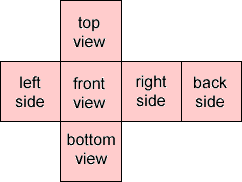
To understand this, let us look at the development of a cube in a two-dimensional plane.


Folded along the edges, it will form a cube:


Now imagine a two-dimensional being. It can see all the faces of the developed cube; however, once folded, it can see only one face. It also follows that for a two-dimensional being located on one of the faces, exit into two planes in different dimensions is possible through a "door" placed on any one edge (on to the original plane of entry or the one vertical to it). The beauty is, if it moves on to another face and another dimension, coming back may be a bit difficult!

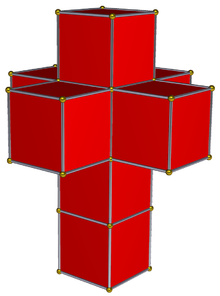
Now consider the development of a hypercube in 3D space:


If folded up in 4D space, we will see only a cube in our dimension. If we enter that cube somehow, the exciting (and frightening) possibility of inter-dimensional travel opens up.

This story is about a house shaped like the development of a tesseract, which gets folded up in an earthquake.
Profile Image for Shannon Looper.
12 reviews7 followers
September 30, 2010
Awesome tale of the forth dimension. Read this and Flatland in the same day and then start looking around for higher order interactions. :-)
Profile Image for Stephen.
1,516 reviews12.5k followers
November 22, 2010
3.5 stars. Classic Heinlein short story about an architect named Quintus Teal who designs and builds a "four dimensional" house shaped like a tesseract (i.e., the four-dimensional analogue of a cube). Keeping a visual of the house while reading is a bit confusing but the story itself is a lot of fun.

Profile Image for Jerry Jose.
379 reviews62 followers
January 2, 2017
Explanation of 4 dimensional Tesseract like Carl Segan, apt usage of alloys and constructional elements like a materials engineer, and Heinlein expostulating with himself through an architect and his client.

I won't be surprised If Mark sites this mathematical fiction as inspiration material for the infamous House of Leaves. Or even for Tardis.
Profile Image for Old Man Aries.
576 reviews34 followers
February 13, 2015

A clever architect designs a house in the shape of the shadow of a tesseract, but it collapses (through the 4th dimension) when an earthquake shakes it into a more stable form (which takes up very little room in our 3-dimensional space.)

Profile Image for Bob Wake.
Author 4 books19 followers
July 15, 2023
“This house sets a new style. It's later than television, newer than next week. It must be seen to be appreciated.”

A Laurel Canyon house built as an unfolded tesseract (a 3D rendering of a 4D object) collapses in upon itself during an earthquake to become a literal portal into the 4th dimension. Space-time slapstick ensues when prospective homebuyers tour the house. Rooms repeat ad infinitum. Soon everyone is bumping into multiple versions of themselves.

Robert A. Heinlein’s classic 1941 science fiction short story, “—And He Built a Crooked House—,” is still shared and taught for its entertaining visualization of a 4th-dimensional reality. The story is easily accessible online through the University of Illinois at Chicago’s Department of Mathematics, Statistics, and Computer Science. And the Internet Archive has a scan of the story’s original appearance (with vintage illustrations by Charles Schneeman) in Astounding Science Fiction.
Profile Image for ΑΝΝΑ.
294 reviews
Read
January 23, 2023
Ο συγγραφέας παίρνει την έννοια της τετρακτινας (ευτυχώς που είχε το σκίτσο να καταλάβω και εγώ η αδαής τι στο καλό είναι) και περιγράφει με χιουμοριστικό τρόπο, τι θα συνέβαινε, αν ένας ευφάνταστος αρχιτέκτονας το έκανε πράξη, χτίζοντας κατ' αυτόν τον τρόπο ένα σπίτι.
Profile Image for kaelyn.
55 reviews
January 28, 2026
i fear i’ll never be able to comprehend higher order dimensions but this was so cool
258 reviews2 followers
December 13, 2014
Well overall good, this story seemed to fail me with it's imagery and thought process. The idea there's a tesseract house is interesting, but it doesn't seem like it was the intended design for the main character. And in addition the house itself is confusing in a way that could be made far clearer. Heinlein is a master at times describing complex objects or theories. His other short stories are great. But this one seems to have fell flat on me.

Yes it was a hard idea to deliver on, but at the same time I understood it not because of the writing but because of other books, and worse, seems to break it's rules on a whim.
Profile Image for Nore.
855 reviews49 followers
June 16, 2021
This was so short, I feel bad adding it to my actual-books shelf.

Well, what can I say? It was short, funny, and incredibly sexist, which I feel is a bit of a given for a book written in 1940. The premise is interesting - I can wrap my head around the idea of a tesseract, but less so actually picture it in my head or understand how the many diagrams I've seen fold out into the cross the architect built. While that made it a bit hard for me to understand the interior layout of the house (bah), I still enjoyed this quick little read.
Profile Image for Jordan.
1,274 reviews67 followers
February 1, 2012
I actually had to read this for a Calculus class my freshman year of college. It was probably the only good part of the class. At the time I hadn't ever read anything before by Heinlein, but this was definitely a nice intro to him. I don't remember too much of the story other than the concept of a tesseract house, but that alone was really amazing and worth it.
Profile Image for zudlow.
22 reviews7 followers
December 11, 2013
This is a short book but WORTH the read for anyone interested in higher dimensional theory.

It is written in a playful narrative and explores the idea of a house built on a tesseract.

It is really helpful for anyone trying to imagine in the fourth dimension and helps explain what it would physically be like to travel along a hypercube's curve.
247 reviews5 followers
May 23, 2017
Of all science fiction, I appreciate most those stories which incorporate otherwise abstract concepts in mathematics as key story elements. This short tale explores the higher dimensional geometry of hypercubes through the ambitious project of a young architect looking to make his mark on the aesthetics of his field.
Profile Image for Harkonen.
27 reviews2 followers
March 26, 2011
My favorite short story be Heinlein! I reread this short almost every year. If you haven't go out and get this right now!
Profile Image for K.M..
Author 1 book6 followers
February 24, 2013
This is the short story that got me hooked on Heinlein, truely one of the masters of science fiction.
3 reviews
April 25, 2013
One of Heinlein's best short stories.
Profile Image for Mike Snodgrass.
102 reviews1 follower
April 26, 2018
Loved this fun little classic hard science fiction short story! So dated, which just adds to its appeal, if you ask me.
Profile Image for Preetam Chatterjee.
7,558 reviews389 followers
November 23, 2025
This gem of a story remains one of the most entertaining, mathematically playful, and structurally inventive works in early science fiction. The story shows Heinlein’s eagerness to blend hard science ideas—in this case, higher-dimensional geometry—with brisk narrative humour.

The premise revolves around an eccentric architect, Quintus Teal, who embraces the fourth dimension with the enthusiasm of a showman rather than a conventional designer. His dream: to build a tesseract-shaped house (a four-dimensional analogue of a cube) in modern-day Los Angeles. The result is both fantastical and catastrophically funny.

Heinlein uses the structure of the house itself as the story’s central character. When an earthquake hits, the tesseract collapses inward, leaving the protagonists trapped inside a spatial paradox. Heinlein writes this with a deft, light touch—never falling into dry mathematical exposition, yet never softening the conceptual weirdness that makes the story intellectually delightful.

The characters stumble from room to room only to find themselves looping in impossible directions, windows opening into strange skies, and doors exiting into non-existent corners of California. The exploration of the house becomes a puzzle-box adventure: physics becomes comedy, and geometry becomes both danger and spectacle.

What makes the story feel enduring is Heinlein’s ability to dramatise abstraction. The fourth dimension, normally relegated to equations or theoretical speculation, becomes something the characters must physically confront.

Heinlein’s humour is warm but pointed; he lightly mocks both highbrow scientific enthusiasm and the vapid consumerism of Los Angeles real estate culture. The satire is subtle but sharp, giving the story a dual identity—part intellectual romp, part social commentary.

The pacing is brisk. Heinlein keeps the story visually cinematic, moving the reader through hallways, impossible stairwells, and looping dimensional traps. By the time the characters finally escape, the story lands its final punch: the house simply vanishes, collapsing entirely into another dimension. Heinlein ends with a grin rather than a lecture, reminding readers that speculative fiction can be deeply conceptual without sacrificing joy, levity, or craft.

And He Built a Crooked House stands as a demonstration of Heinlein’s versatility—his ability to be rigorous yet mischievous, imaginative yet grounded in real mathematical curiosity. It remains one of his most frequently anthologised stories, and for good reason: it is the rare work of science fiction that can make readers think deeply about spatial mathematics while also laughing at the absurdity of it all.

Decades later, it still holds its charm, serving as a testament to the delight of conceptual speculation handled with wit and narrative elegance.
Profile Image for Amir Sepahram.
Author 5 books10 followers
October 23, 2023

"و او خانه‌ای کج ساخت"
رابرت هاینلاین ، امیر سپهرام

رابرت آنسون هاینلاین یکی از برترین و اثرگذارترین چهره‌های ادبیات علمی‌تخیلی آمریکا و جهان است. در سال ۱۹۰۷ متولد و با تحسین علم و فناوری رشد کرد. آثار علمی‌تخیلی او به اکتشاف امکانات و وجوه سیاست و معضلات اجتماعی و اخلاق می‌پردازد. نوشته‌های او عمدتاً با شخصیت‌پردازی قوی، درون‌مایه‌های پیچیده و ایده‌های نوآورانه همراه است.
بسیاری «غریبه‌ای در غریبستان»، «ماه خاتونی خشن است» و «جنگاوران اخترناو» (برندهٔ جایزهٔ هوگو به سال ۱۹۶۰) را بهترین رمان‌های او می‌دانند.

«فضای استعاره» یکی از داستان کوتاه او را منتشر کرد.
در «و او خانه‌ای کج ساخت» حکایت معمار برجسته و نوگرایی است که در یکی از ماجراجویی‌هایی حرفه‌ایش تصمیم می‌گیرد خانهٔ منحصر به فردی بر اساس مدل مکعب چهاربعدی (تسرکت) بسازد.
خانه با موفقت ساخته می‌شود ولی وقتی می‌خواهد آن را به دوست صمیمی و همسرش او نشان دهد، زمین‌لرزهٔ کوچکی اتفاق می‌افتد و تبعاتی غریبی به بار می‌آورد.

لینک داستان

| فضای استعاره | MetaphorSpace |
Profile Image for Stephanie.
171 reviews2 followers
May 8, 2018
Somehow I ended up reading this thanks to TV tropes, and I don't even know why. It's a short story about an architect that creates a house in the shape of a tessaract, or a 4th dimensional shape, and then takes his friend and friend's wife to see it.
Things go kind of pear shaped when they realize it's not so easy to just leave the house, and that a house with the shape of a tessaract is not so easy to navigate. Eventually, they get out, but then there's a new problem.
It's a fun short story. Feels dated, but it was written in 1940, so that would be why. I had trouble wrapping my head around the tessaract shape, so I looked it up, and then things made more sense. Still, fun short read.
68 reviews1 follower
January 29, 2020
A short story, kinda of old (think husband wife relationship 50s old), with the score inflated for being a "classic", more like 2,5 stars for being original.

To me the worst thing is that Heinlein didn´t took the time to explore the dimensionality concept, instead the story goes from sci fi to fantasy and there are rooms that give view to the NOTHING and then they are teleported... none of those things is related to a tesseract at all.

A very old sci fi with very old characters a touch of comedy, but the heart of the story, the idea of a hoouse becoming a tesseract, was badly explored.
Profile Image for Scott S..
1,440 reviews29 followers
March 2, 2026
A recommendation from my future mother in law. I'd somehow missed this Heinlein short. Aspects of it reminded me of something in Endymion.

I enjoyed it.

Watched it on youtube, where it was well narrated.
Displaying 1 - 30 of 70 reviews

Can't find what you're looking for?

Get help and learn more about the design.