''When Mokhtar made a mistake, Hamood was angry only if Mokhtar made an excuse. 'Own the error and correct it', he said. Hamood had a thousand proverbs and maxims. His favorite was 'Keep your money in your hand, never in your heart'. He used to say that a lot.
'What does it mean?' Mokhtar asked
'It means that money is ephemeral, moving from person to person', Hamood said. 'It's a tool. Don't let it get into your heart or your soul' ''. (page 28).
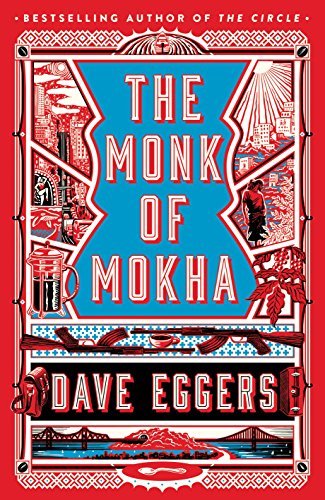
The Monk of Mokha tells the amazing adventure of Mokhtar Alkhanshali's efforts to revive the art of making quality coffee in Yemen. While Mokhtar's adventure is amazing, unfortunately the book itself disappoints, in two ways: They way it is written, and the actual information that is provided.
This is a non-fiction book that is part biography, part adventure story and part business book. The standard for the combination biography-business book is set by Walter Isaacson's superb biography about Steve Jobs. Isaacson combines a layered multifaceted description of Jobs' character with key business insights. On both of these dimensions, the Monk of Mokha falls short.
The main problem: In this book, Mokhtar is a one-dimensional superhero, with one superpower: He can talk himself out of any situation.
Detailed descriptions that would give depth to his character are mostly absent. For instance, his relationship with Miriam, who seems such a vital influence in Mokhtar's life in his early twenties, is only mentioned in passing. The information we get is that ''they dated for a year or so, but the odds were long'' (page 3) because they belonged to different ethnic backgrounds. How he really feels about her, and their apparent breakup, is not mentioned. Even less attention get her feelings for him.
There are also some contradictions, or paradoxes, that, if explored more, could have given a more detailed idea of Mokhtar's personality. Two examples:
- Mokhtar grows up in a dodgy neighborhood in San Francisco called the Tenderloin. ''The Tenderloin taught you to think quick, talk fast'' (page 31). Mokhtar learns these lessons: ''By middle school, Mokhtar had become a fast learner, a fast talker and a corner cutter'' (pag 16). However, at his first coffee conference, when he wants to introduce himself to someone, all these lessons have strangely disappeared, and Mokhtar is all of a sudden described as shy (page 100). This is not necessarily inexplicable, but it would have given his character more depth if this contrast had been explored more.
- Both in school and at an after-school program at a mosque, Mokhtar is a corner cutter who finds trouble difficult to avoid. However, not much later he is described as an autodidact, who reads plenty of books. Again, an exploration of this contrast, that could give more understanding of his personality, is missing from the book.
Another aspect that I didn't like about the way the book is written is the abuse of explicit suspense. Several times it is mentioned explicitly that Mokhtar thought he was going to die. If the threat of death is mentioned often, it becomes less believable. I appreciate it more when a writer describes an event or a situation in such a way that the reader himself can only draw one conclusion: This is scary or dangerous. Here, in order to create the suspense, the writer has the main character saying many times that he thinks he is in a dangerous situation, which I came to feel as less powerful than a possible better description of the very real threats. Examples: ''He figured the odds of survival were about 60 – 40'' (page 171), ''Mokhtar knew he might die here'' (page 223), ''Now Mokhtar believed he might die'' (page 256), ''Grim possibilities ran through Mokhtar's mind. Secret prisons. Illegal detentions'' (page 289), ''Thinking that there was a remote chance he'd be detained, send to Guantanamo'' (page 295).
I also had several questions about the information that is provided.
1. Mokhtar of course is on a noble mission, reviving the Yemeni coffee culture and providing the Yemeni coffee farmers with a better life. On his second visit to Yemen, Mokhtar promises Malik, a coffee farmer in Haymah, that he will buy all his coffee ''at a price 5 times what he'd been paid before'' (page 186). Wonderful. Then, once the business is starting to take off, it is mentioned that ''his farmers would be making 30 % more than what they'd been making before'' (page 300). 30 % more is not quite the same as 5 times more, but still, wonderful. Then, in the epilogue, it turns out that Mokhtar's specialty coffee from Yemen is sold at US $ 16 a cup. Now I start to wonder: Before Mokhtar arrived on the scene, Yemeni coffee was a commodity product. For a cup of commodity coffee, US $ 3 seems reasonable. He sells his coffee for more than 5 times more than the commodity coffee, and his suppliers just see a 30% increase, while they had been promised 5 times more? Of course, it is well possible that my reasoning is too simple, but without further explications on these numbers, the books leaves unpleasant questions unanswered.
2. On pages 93 to 95, Mokhtar's explains the benefits of direct trade, without interference of loan sharks and brokers, between himself and Yemeni coffee farmers. Direct trade will remove the middle men. All this sounds like a good idea. Then, two things happen:
First, the first time he meets an actual middle man, in his grandfather Hamood's city Ibb, Mokhtar describes this middle man as ''Highly ethical and fair'' (page 129). Strange, because apparently ''he had millions of dollars under his control'' while coffee in Yemen ''was sold so cheap – mostly to brokers and loan sharks – that it was nearly unworkable for any Yemeni farmer'' (page 95). Loan sharks are bad but the first one Mokhtar happens to run into is OK?
Second, after his first visit, it turns out that he has access to 3 farmers who can provide superior coffee. Now I expected him to focus on those and trade directly. But no, he ends up buying from that same middle man from Ibb (page 198). What happened to direct trade?
3. On his first visit to Yemen as a coffee enthusiast, Mokhtar first visits his grandfather Hamood in Ibb. There he sees the coffee plant again: ''They came to the row of coffee trees hugging the wall of Hamood's compound. 'Do you remember these?' Hamood asked. Mokhtar touched the glossy leaves. He remembered'' (page 127). Some time later, during that very same first visit, Mokhtar mistakes an olive tree for a coffee plant. '' 'That's not coffee', Yusuf said. Mokhtar had been carefully examining an olive tree'' (page 150). I don't understand.
4. Sometimes characters seemed to appear out of nowhere. Best example is Abdo Alghazali on page 195. He advises Mokhtar not to get in touch with Andrew Nicholson, an American coffee mill owner in Yemen. Without questioning, Mokhtar follows this advise. 5 pages later, Andrew and Mokhtar do meet and almost instantly get along well. ''Almost immediately Mokhtar realized that Abdo Alghazali had wanted to keep Andrew and Mokhtar apart'' (page 200). Who is this Abdo? Why did Mokhtar follow his advise without questioning? And why did Abdo want to keep Andrew and Mokhtar apart? We are left in the dark.
My conclusion: Mokhtar's adventure is amazing and his efforts to help and improve the lives of Yemeni coffee farmers are admirable. I am just sorry the book doesn't match Mokhtar's exciting story and his good intentions.