So begins this eerie science fiction and cautionary tale that takes place in the year 2951. Written in 1889 by the founder and editor of Life magazine, John Ames Mitchell, The Last American is a quick though somewhat unsettling read. Beginning in Persia, the reader is taken along with a group of travelers who voyage across the ocean to find the remains of a once great nation, Merhika. Landing first in Nh-Yok and later then in Washington, the reader follows these travelers as they make their way about the ruins, all the while commenting and comparing Persian society with the lost American society that they have found a society, a race of people that they saw as purely imitative; simply an enlarged copy of other nationalities extant at the time. A society that was obsessed with pleasure and money, with their chief passion being to buy and sell. And also a society that suddenly disappeared as a result of frightful climatic changes which swept the country like a mower s scythe. If this book had been written today, with global warming and climate change at the forefront of issues facing America, and as well in light of our current relations with Iran, the reader might not be surprised by the possibility of such a tale. However, and as noted above, this story was was written over one hundred years ago, and that makes this tale and its ending all the more troubling.
One of the first post-apocalyptic novels, and the first I know of to depict a future America in ruins. Written in 1889, it takes place in 2951 as a group of Persian mariners explore the devastated land they have only read about. Clearly meant as something of a spoof, the book's Persian characters have names like The Prince of Dimph-Yoo-Chur (Dim Future), Fattan-laiz-eh (Fat and Lazy), and Ja-Khaz (get it?).
Parts of the book satirize the mania around archaeological finds in the 19th century and their exploitation. The description and reverence given a "wooden god" found by the explorers is comical given that the text makes it clear that the object is a cigar-shop Indian.
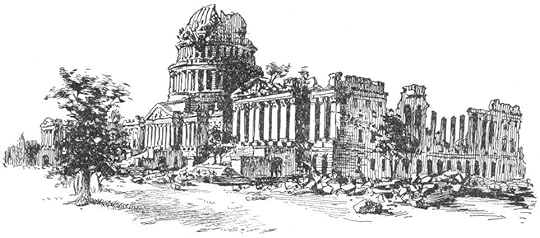
Even though it is meant to be satirical, The Last American is not without some poignancy, as some of it is eerily prophetic. The factors that most contributed to the downfall of "the Mehrikans" are climate change and greed. The illustration of the US Capitol in ruins (labeled "The ruins of the Great Temple") is moving, as are the fragments of the Brooklyn Bridge.
An interesting look at what a 19th-century writer thought about the country's future.
This was an interesting book. It was written in the late 1800s about a Persian expedition that sails to the eastern shores of the North American continent in 2951 [or so]. The chapters were fairly short; it moved at a brisk pace. The names of the Persians were farcical and hilarious, as were the names of various leaders sprinkled throughout the novel [especially in the later chapters when naming various American and European military leaders].
I had read about this book in another book that was like an encyclopedia of science-fiction authors. This book probably falls more into the 'alternate-history' category, but it does discuss some valid scientific reasons as to why a nation may 'disappear' from history. But what I read about the book perked my interest enough that I kept an eye out for it and finally found a copy that could be downloaded for free online.
The first chapter of the book [prologue, I guess] discusses how the Persians have discovered California; from there, they learn about the great cities on the East Coast. The book is very interesting and I am sure is some kind of spoof of archeological reasoning from the time [in terms of the conjectures and conclusions the Persians arrived at based upon the least amount of information possible, the scraps/refuse of society]. The Persians first explore 'Nhu-Yok' before moving on to Washington, DC. They expostulate what they believe society to have been like, based on surviving ancient histories as well as their own preconceived conceptions/beliefs. We learn that America, in its heyday, had a population of over 100 million by the late 1900s but then terrible climate change, disease, and other unknown variables essentially wiped out the American population in a short period of time. Much of America's material wealth was left to either rot in the dust or be found by future explorers; amazingly many buildings were/are still standing after nearly 1000 years have passed since America's downfall and disintegration.
Considering the book was written over 140 years ago, it was eerily prophetic in some respects [or maybe not as much as I think].
I did find a lot of humor in throughout the book.
The ending was probably the saddest part of the book [and not just because it was over so soon]. It was rather melancholy.
I also thought the descriptions of the two cities was rather effective. I could feel the sadness as the Persians described the magnificence of the ruins and pondered how a nation that was so powerful could fall so far so fast as to completely disappear from the face of the Earth. It was crazy how powerful those scenes were to me - not sure why they affected me like they did.
Although The Last American is not the first post-apocalyptic story, from what I can tell it is the first future history set in a post-apocalyptic world, thereby predating H.G. Wells' Time Machine by seven years.
Largely satirical and acting as a critique of American society of the 1880s (and very much today too), the story sees a Persian research party rediscover America in the year 2951 after America's fall in the mid twentieth century. A short tale that encompasses thoughts that future generations might have if they were to unearth material from our contemporary society. Most interesting is that Mitchell predicts that it is both America's greed coupled with devastating climate change that devastated the Northern continent. Eerie considering this was published in 1889...
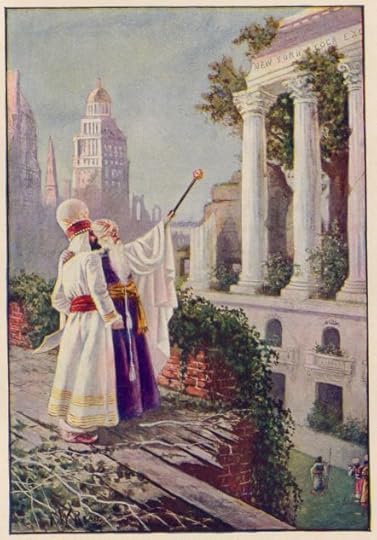
I strongly suggest that if you are going to read The Last American, that you find an edition with the images. There are diagrams & sketches by Mitchell, and colour oil paintings by F.W. Read, that really complete this work of fiction. Without the images, the story will seem a little stale. It's meant to be read with the plethora of images. In many ways, it's like an early graphic novel.
This would probably get 4.5 stars if that was an option. Fascinating little book though, it feels very ahead of its time in so many ways yet very of its time in others. It’s really interesting to see what a gilded age vision of post-apocalyptic America would look like and the found-footage-esk format of the story strikes me as something that would have still seemed cutting edge if it were written a century after it was originally published, it’s in a very similar vain to the 1978 book Motel of the Mysteries. Almost the entire cast is middle eastern which is cool, it’s very clearly written by a white guy and there are some exchanges that I think were entended you be humerus that have not aged well, but I thought the handling of the characters was about on par with The Persian from Phantom of the Opera. The second half which features the titular Last American is definitely less strong than the rest of the story and could easily be skipped without loosing much, but overall still a quite interesting, almost anthropological exploration of American society both than and now.
Yet another post-apocalyptic novel exploring the ruins of the United States centuries after a societal collapse and climatic catastrophe looking for answers. Is this the first image of a ruined Statue of Liberty in literature?
Primarily a piece of satire. While some of the names and descriptions of the Arab explorers don't meet current sensibilities, some of the commentary on American society feels surprisingly fresh. And the use of climate change as the eventual apocalypse surprised me considering this story was written in 1889.
What a weird little book. An expedition of comically named Persian explorers visit the ruins of the land of “the Merikans.”
First they go to New York and see the ruined Statue of Liberty (take that Planet of the Apes) and one of the explorers has a run in with an “odious kitten” (🦨).
Later they go to Washington DC and encounter the “Last Americans” on the steps of the US Capitol.
It’s slightly amusing, slightly insightful, and accompanied by some lovely pen and ink drawings.
Best of all, it ends before you get tired of its charms.
Short, kinda fun read - 1885 post-apocalyptic fiction about a ship from Persia that visits the ancient abandoned land of Mehrika. Characters with names like Jā-khāz, Nōfūhl, and Lev-el-Hedyd make wry archaeological observations about Mehrikan civilization that are great satirical barbs about our culture.
This was pretty good. It is mostly a satire of the USA in the late 19th century. Much of it still does apply to us today. It would have been nice if it were longer and dug deeper, especially with regard to the climate catastrophe. Still, it is a surprising story for 1889! I feel it is still readable today. There isn't any racism or sexism that I saw. Just a good satire on the United States from a post-apocalyptic perspective.
Se promociona como "novela", pero en realidad estamos ante un cuento corto con ilustraciones. La propuesta es interesante, pero la extensión es tan breve que no da mucho pie para disfrutar la narración.
This book has not aged well. It was the first fictional work (188) to feature a ruined Statue of Liberty but that doesn't make it worth reading. I would recommend reading Motel of the Mysteries instead.
Iom stranga, sed unika pra-sciencfikciajho el la 19-a jarcento. Samkiel aliaj malnovaj prognozoj pri la tiama estonteco, plej interesaj estas tiuj, kiuj koncernas jardekojn jam pasintajn.
Increíble como un libro escrito hace mas de 100 años pronostica algunas de las evoluciones sociales de los occidentales y como puede ser tan vigente hoy en día, además como dice el dicho lo bueno si es breve doblemente bueno
Suppose America suffers sudden and catastrophic population loss and collapse--how will the world remember us? As image-obsessed, unoriginal hacks, excelling only in fighting, according to Mitchell's vision of the future from 1889. A quick read, more social commentary than plot.